Hotel Phone System: 6 Picks for Small Properties
A guest rings at 8:40 on a Saturday evening to ask whether you've got a room for the following weekend. You're carrying plates in the restaurant downstairs, both hands full, and the phone is behind the desk in the other building. By the time you call back on Sunday morning they've booked somewhere else.
That's the shape of the problem at a small property, and it's not the problem most hotel phone system reviews are written about. Search the term and you'll find comparisons built around 24/7 front desks, property management system integrations and per-room extensions. If you run eight rooms, a homestay or a guesthouse where the owner is also the host, the cook and the night porter, almost none of that applies.
So this one is written for small properties: what actually matters, what to skip, and the arithmetic that tells you how much to spend.
TL;DR:
- A hotel phone system for a small property has one job: make sure a booking enquiry reaches a human or gets captured, even when nobody's free.
- Skip per-room extensions and PMS integration under about 15 rooms. They solve problems you don't have yet.
- One missed booking usually costs more than a year of the phone bill, which is why the cheapest option is rarely the cheapest outcome.
- Properties with a restaurant have a second call type to plan for: table bookings, which arrive in a different window than room enquiries.
- dialnote answers after-hours booking calls on a flat plan from $49/mo with no per-user cost, so the owner, manager and weekend host share one number at one price. No PMS integration, and table booking is on the roadmap rather than live.
What should a small hotel phone system actually do?
For a property under about 15 rooms, a phone system needs to do three things: ring in more than one place, hold a second caller instead of dropping them, and capture the enquiry when nobody can pick up. Everything else on a vendor feature list is optional at this size.
That's a shorter list than the category usually sells, and the gap is worth understanding. Most hotel phone system content is written for properties with a staffed front desk and a property management system, where the valuable feature is syncing a room number to a call. At eight rooms there is no front desk at 9pm, and the owner knows which room the Hendersons are in without looking.
What breaks at this size is simpler. Two calls arrive at once. The owner is in the restaurant. Somebody rings during the school run. Each of those is a booking that may or may not survive the inconvenience.
What does a missed booking actually cost?
More than the phone system, usually by an order of magnitude, and that ratio is the whole buying argument.
Take a property at $160 a room night with a typical two-night booking. That's $320 of revenue in a single call. Miss one a month and you're down roughly $3,840 a year. Against a phone plan at $15 to $50 a month, the system pays for itself on the first recovered booking and then keeps going.
Here's the part owners underestimate: the calls you miss aren't randomly distributed. They cluster in exactly the hours you're least able to answer, which at a small property means dinner service, check-in time, and weekends. Those are also the hours when somebody is most likely to be booking a weekend away.
One honest caveat on that math. The $160 and the two-night average are stand-ins, and the right version uses your own numbers. Pull your average daily rate and your typical length of stay, multiply, and you'll have the figure that actually decides this. It's usually bigger than the guess.
What about the restaurant?
If your property has a restaurant, you've got two different businesses sharing one phone line, and they peak at different times.
Room enquiries arrive in daytime and early evening, from people planning ahead. Table bookings arrive closer in, often the same day, and spike right when the kitchen is busiest. The failure modes differ too: a missed room enquiry is a lost booking, while a missed table booking is usually a lost cover plus a guest who now thinks you don't answer the phone.
The practical answer is routing by what the caller wants, not by who's free. A caller asking about a room and a caller asking about a table need different information and different urgency, and handling both from one voicemail box serves neither.
Be realistic about integration here. Most phone systems, including dialnote, don't write a table booking into a restaurant's reservation book today. What a good one does is answer, ask the questions you'd ask, and hand you a complete record so whoever runs the book enters it once. That's a meaningful improvement on a voicemail saying "hi, it's about Saturday" with no name and no number.
In practice the split looks like this. A caller asking about rooms gets asked for dates, number of guests and a contact number, because that's enough for you to quote and confirm. A caller asking about a table gets asked for the date, the time, the size of the party and anything dietary, because that's what the book needs. Same phone number, two scripts, and neither one wastes the caller's time on questions that belong to the other business.
The owners who get this wrong usually do it by setting up one generic greeting and hoping. What comes back is a pile of half-messages that someone then has to chase, which is most of the work of answering the call in the first place, just done later and worse.
Is the owner's mobile good enough?
For the first year of a small property, honestly, often yes. Then it stops being enough, and it's worth knowing which failure arrives first.
A mobile has no queue, so the second caller gets a busy tone or voicemail. It has no hours, so you're answering booking enquiries at 11pm or feeling guilty about not answering. And it has no handover, so when you take a night off the number goes with you, and bookings quietly stop for the evening.
Forbes Advisor's roundup of hotel phone systems is a reasonable map of the category, though like most of this content it's written with larger properties in mind. The useful filter when you read any of these lists is to ask which features assume a staffed desk, and quietly cross those off.
The usual trigger for moving off a mobile isn't a feature. It's the first time an owner realises they've been on call for eleven months without a proper evening off.
The 6 best hotel phone systems for small properties
Ranked for properties under roughly 15 rooms, not for chains.
1. Ooma Office, best for plug-and-play hardware. Often recommended for boutique B&Bs and small inns that want desk phones working out of the box without a contract. If you've already got handsets and want them to keep working, start here. The catch at small scale is that you're paying for a hardware-centric product when the owner's phone is the device that actually matters most evenings.
2. Zoom Phone, best for low call volume. The metered plan suits a property that takes a handful of calls a day, where a per-user unlimited plan would be paying for silence. Good fit if the owner already lives in Zoom. Metered billing cuts both ways though: a sudden run of enquiries after a good review is exactly when the bill moves, and exactly when you least want to think about it.
3. GoTo Connect, best for multi-building sites. Unlimited extensions matter if reception, the restaurant and the owner's cottage all need to be reachable on the same system. More feature depth than most small properties will open, and an admin surface to match. Worth it if buildings are genuinely your problem, overkill if they are not.
4. Nextiva, best if you're keeping existing handsets. Flexible about hardware and strong on queueing, so the second caller during check-in hears a queue rather than a busy tone. Priced per user, so the weekend host and the part-time manager each add a line for the same single number.
5. Hello Hotel, best if you run Mews. Purpose-built for independent and boutique properties, combining voice and SMS in one inbox. Worth a look only if your PMS is on its integration list, which is narrow. If you run Cloudbeds, Little Hotelier or a spreadsheet, this one isn't there yet.
6. dialnote, best for flat pricing and after-hours answering. dialnote is the AI business phone system priced for your whole team: shared numbers, call routing, branded AI voice agents that answer, qualify, and book, and automatic CRM sync, all included, with no per-user cost. Flat from $49/mo on Team with a 10-day free trial, so the owner, the manager and the weekend host all answer one number at one price. The honest limits: no PMS integration, and no table booking today.
Hotel phone systems compared
| Best for | Pricing model | PMS integration | |
|---|---|---|---|
| Ooma Office | Plug-and-play desk phones | Per user, monthly | Yes, broad list |
| Zoom Phone | Low call volume | Metered or per user | No |
| GoTo Connect | Multi-building properties | Per user, monthly | No |
| Nextiva | Keeping existing handsets | Per user, monthly | No |
| Hello Hotel | Properties running Mews | Per property | Mews only |
| dialnote | Flat cost, AI answering after hours | Flat monthly, unlimited users | No |
Per-user pricing deserves a hard look at this size. A small property isn't a team of desk workers, but the list of people who need to answer grows anyway: the owner, a partner, a part-time manager, the weekend host. On a per-user plan each of those is another monthly line for the same single phone number.
What per-user pricing costs a small property
Worth running the numbers, because the list of people who answer grows faster than owners expect.
A small property doesn't have a sales team, but it does accumulate answerers: the owner, a partner, a part-time manager who covers two days, the weekend host, maybe the restaurant manager. Every one of those is a monthly line on a per-user plan, for a single phone number.
The per-user figure below is $20/user/mo, a normal mid-tier small-business rate, and it's an assumption rather than any one vendor's list price.
| People who answer | Per user at $20/mo | dialnote Team, flat | Annual difference |
|---|---|---|---|
| 1 (owner only) | $20/mo | $49/mo | per-user wins by $348 |
| 3 (+ partner, weekend host) | $60/mo | $49/mo | $132 saved |
| 5 (+ manager, restaurant lead) | $100/mo | $49/mo | $612 saved |
Read the first row carefully, because it's the one vendors skip. If it genuinely is just you answering, per-user pricing is cheaper and you should take it. Flat pricing is a volume argument, and a one-person property has no volume to argue about. The crossover sits between two and three answerers, which for most properties with a restaurant arrives sooner than they think.
Where dialnote fits, and where it doesn't
Worth being direct, because the gaps matter more than the features at this size.
dialnote has no property management system integration. If a Mews or Cloudbeds sync is the thing you're buying, this isn't the product and one of the others on that list is.
Table booking isn't a live integration either. It's on the roadmap. Until it ships, the AI agent answers the call, asks for the details you specify and logs them for whoever keeps the book. If you need the integration sooner than the roadmap, message dialnote's chat support: a customer who needs it to sign is exactly the signal that gets something prioritised, and that offer is real rather than a brush-off.
What it does do well at this size is the after-hours gap. The agent answers on the first ring at 9pm on a Saturday, captures the enquiry, and books into Calendly or Cal.com where you use them. The flat price is the other half: no per-user cost means putting the weekend host on the account doesn't change the bill.
What to check before you sign
Four questions, in the order that'll matter.
- What happens to the second caller? Ring the demo line twice at once, from two phones. A queue keeps the booking, a busy tone loses it, and voicemail sits somewhere in between. This one test tells you more than any feature list, and almost nobody runs it before signing.
- Count the people who need to answer, including part-time and seasonal, then multiply by the per-user price before comparing anything.
- Ask what the PMS integration actually does if a vendor is charging for it. Under 15 rooms the honest answer is often "not much you aren't already doing".
- Plan the restaurant line separately if you have one. The question isn't whether both calls get answered, it's whether the right information gets captured for each, so the person holding the book isn't ringing people back to ask what time they wanted.
For the broader version of the missed-call arithmetic, we worked it through in the cost of missed calls, and the human-versus-AI side is in AI receptionist vs live answering service.
Where a phone system won't help
Two things it won't fix, said plainly.
It won't fix availability. If callers are ringing off because you're full on the weekend they want, answering faster just means disappointing them sooner. The phone system recovers the bookings you could have taken, not the ones you couldn't. Seasonality makes that worse in both directions: in peak weeks you are turning people away anyway, and in quiet weeks the phone barely rings, so the month you most want the data is the month you get least of it.
It also won't fix a booking process that lives in the owner's head. An AI agent that captures a perfect enquiry nobody follows up on has moved the problem, not solved it. The properties that get the most out of this are the ones where somebody checks the captured calls every morning, which sounds obvious and is the step most often skipped.
And one thing nobody has good data on yet. We don't know how guests at small, personal properties feel about an AI answering rather than the owner, over time rather than once. The early signal is that it beats voicemail comfortably, which is a low bar, and "better than voicemail" isn't the same as "as good as you". If the personal welcome is the product, test it on the after-hours calls first and keep the daytime ones yourself.
You can see what flat pricing looks like on pricing, or how the answering side works on AI receptionist.
Frequently asked questions
It's the setup that handles a property's inbound calls: booking enquiries, guests already staying, and restaurant or table requests. For small properties it usually runs over the internet, so the owner's mobile, the desk and an AI agent can all answer the same number.
Usually less than vendors suggest. Under about 15 rooms, most owners run the calendar by hand or in their booking platform, so the phone system's job is capturing the enquiry accurately, not syncing it. Check what you'd actually do with the sync before paying for it.
Not as an integration today. It answers the call and captures the booking details for whoever runs the book. Table booking is on the roadmap, and chat support can prioritise building it for a customer who needs it sooner.
Most small properties land between $15 and $50 a month. The number that matters is what one missed booking costs: at a $160 room night, a single recovered two-night stay covers several months of almost any plan on this list.
It works until it doesn't. A mobile has no queue, no hours, and no way to hand over. The usual breaking point is the first time two people call at once, or the owner takes a night off and bookings quietly stop.

Written by
Pratiksha Singh Tomar
Customer Success Specialist, SmartReach.io
Pratiksha Singh Tomar is a Customer Success Specialist at SmartReach.io with over 9 years of experience in business development, client relationship management, and communication technology. Before SmartReach, she spent nearly a decade at Shreeram Te...
Pratiksha Singh Tomar is a Customer Success Specialist at SmartReach.io with over 9 years of experience in business development, client relationship management, and communication technology. Before SmartReach, she spent nearly a decade at Shreeram Te...
Related Articles
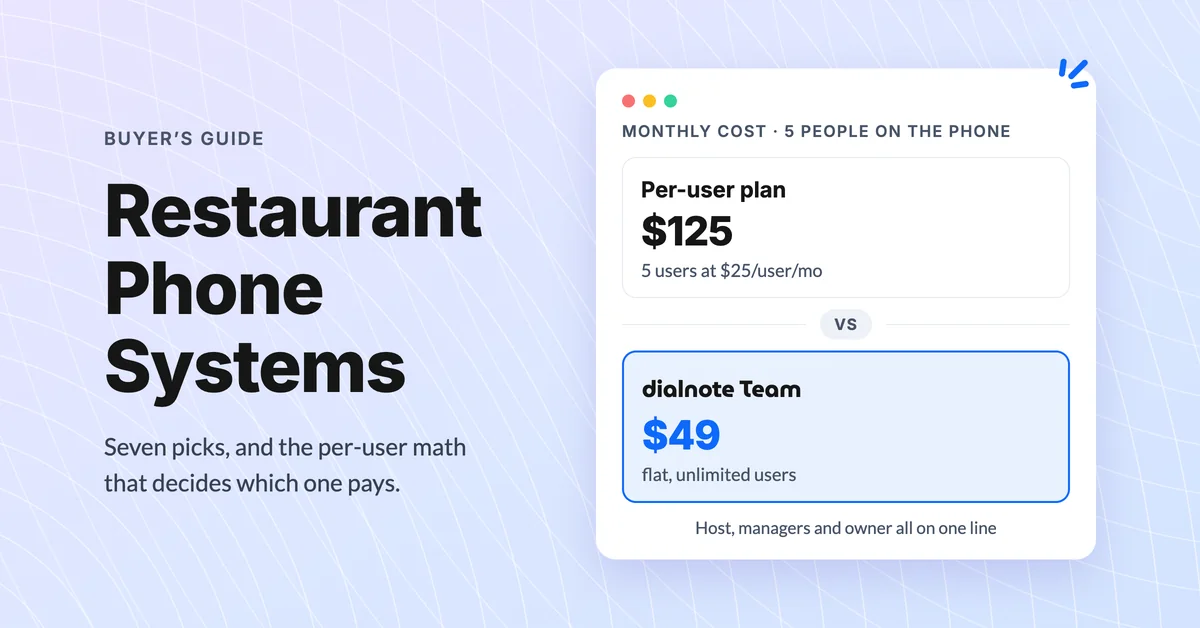
Restaurant Phone System: 7 Picks and What They Cost
Compare 7 restaurant phone systems on takeout orders, reservations and rush coverage, with the missed-call math that decides which one pays for itself.

Does Your Business Need an After Hours Answering Service?
Learn how an after hours answering service captures missed calls, compare pricing for live vs AI options, and set up 24/7 coverage for your business.
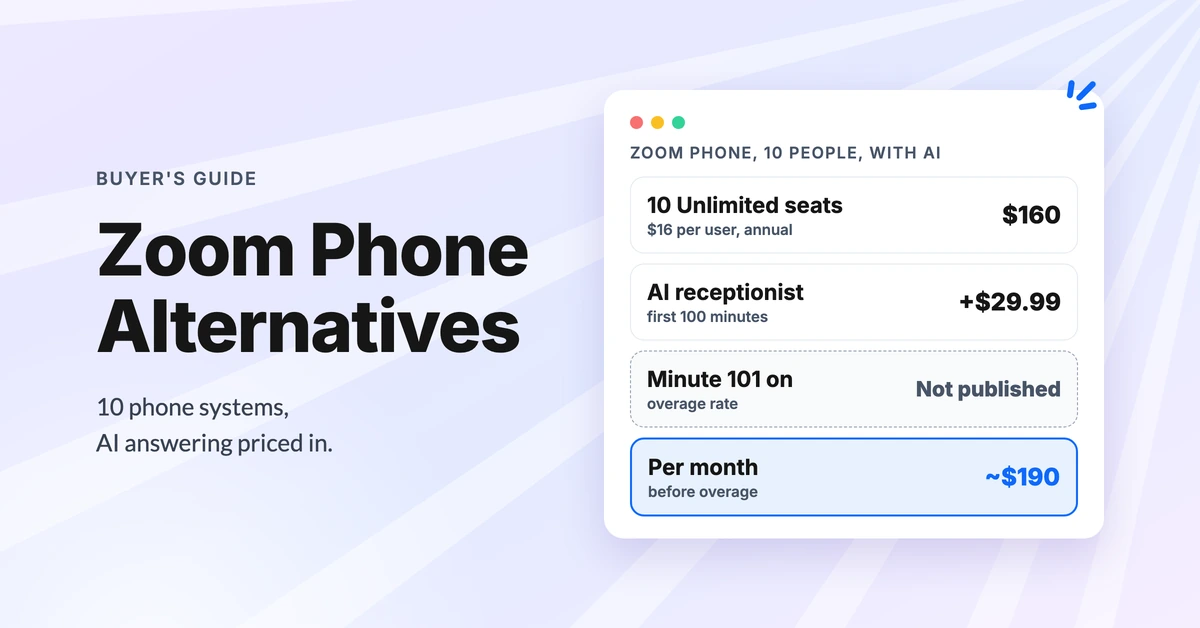
Best Zoom Phone Alternatives, Priced for a Real Team
Compare 10 Zoom Phone alternatives on what 3, 10, and 15 people pay once AI answering is added, using Zoom's live October 2026 prices. See the math.