OpenPhone or Aircall, which is better for your business?
The OpenPhone vs Aircall debate comes up constantly for teams shopping for a business phone system. Both platforms are popular, well-reviewed, and built around modern VoIP. But once you get past the feature lists and demo videos, the pricing models, AI capabilities, and real-world costs are quite different.
Maya runs operations at a 15-person consulting firm. She spent two weeks testing both platforms, liked what she saw in each, and then started adding up what she'd actually pay once AI features, additional numbers, and integrations were factored in. The number was a lot higher than the advertised starting price. Sound familiar?
This guide covers both platforms honestly, with real pricing data, user feedback, and a full feature breakdown side by side. We also bring in dialnote, a third platform from the SmartReach.io group, which solves several gaps that come up in both OpenPhone and Aircall, particularly around AI pricing and team scalability.
TL;DR:
- In the OpenPhone vs Aircall matchup, OpenPhone starts at $15/user/month with no user minimum, while Aircall starts at $30/user/month with a 3-user minimum (a $90/month floor before add-ons).
- Both platforms gate AI behind higher tiers or per-minute fees: OpenPhone's Sona receptionist covers 10 free calls/month, and Aircall's AI Voice Agent costs $0.99/minute after 50 free minutes.
- For a 10-person team with AI features included, OpenPhone runs about $255/month and Aircall $390-500/month.
- dialnote offers a flat-rate alternative from $49/month for unlimited users, with AI transcription, summaries, and SMS agents built in and AI voice agent usage billed at $0.89/min from a prepaid wallet.
- Pick OpenPhone for small, simple teams, Aircall for CRM-heavy sales and support teams, and dialnote for flat-rate pricing with AI included as you scale.
OpenPhone and Aircall at a glance
OpenPhone is a US-focused business phone system built for startups and small teams. Plans start at $15/user/month with no minimum user count, making it one of the more accessible options for teams of one or two. In late 2025, OpenPhone rebranded as Quo after raising $105M in growth financing.
The core product stayed largely the same. Most review sites still refer to it as OpenPhone, and we'll do the same here since that's what most people search for.
OpenPhone is known for its clean interface, shared inboxes, and team collaboration features like internal message threads. In 2025, it launched Sona, an AI receptionist available on all plans with 10 free calls per month.
Aircall is positioned for sales and support teams with call center needs. Plans start at $30/user/month, with a mandatory minimum of three users. That means your starting cost is at least $90/month even before add-ons. It offers advanced IVR routing, a power dialer, and deep integrations with HubSpot, Salesforce, Zendesk, and 100+ other tools.
Both platforms are capable. But the real story is in what you pay at each tier, and what happens to that cost when your team needs AI to do more than basic transcription. That's where the comparison gets more interesting than the marketing pages suggest.
How do OpenPhone and Aircall compare on features?
For basic calling and messaging, OpenPhone and Aircall are fairly comparable. Aircall pulls ahead on call center depth, multi-language IVR (16+ languages), and enterprise CRM integrations. OpenPhone is stronger for simplicity and small-team affordability.
Here's the full breakdown, including dialnote:
| Feature | OpenPhone | Aircall | dialnote |
|---|---|---|---|
| Starting price | $15/user/month | $30/user/month (min 3 users) | $49/month (unlimited users) |
| Pricing model | Per seat | Per seat | Flat-rate (unlimited users) |
| Unlimited users option | No | No | Yes, from $49/month |
| AI transcription | Business plan+ ($23/user/month) | Add-on ($9/user/month) or Professional | Included |
| AI summaries | Business plan+ ($23/user/month) | Add-on ($9/user/month) or Professional | Included |
| AI receptionist | Sona: 10 free calls/month, then $25/month for 40 calls | AI Voice Agent: 50 free mins/month, $0.99/min after | No platform fee; $0.89/min from your wallet (prepaid, min $30 top-up) |
| AI SMS agent | Limited | No | Yes |
| AI call evaluation | No | AI Assist Pro ($49/user/month add-on) | Yes |
| Auto CRM updates | Via integrations | Yes (Professional+) | Yes |
| Bulk SMS | Limited (A2P 10DLC) | No | Coming soon |
| Call queueing | Limited | Yes | Yes |
| IVR | Up to 2 nested menus | Advanced (16+ languages) | Yes |
| Integrations | 100+ | 100+ | Native CRM + Zapier (5,000+ apps) |
| Video conferencing | No native | No native | No (calls only) |
| International numbers | US + Canada only | 100+ countries | US, CA, UK, India, France |
| Calling limits | Unlimited US/CA (fair use) | Unlimited local + North America (fair use) | Included in-region pool + wallet |
The pricing difference becomes clearer at team scale. For a 10-person team with AI features included, OpenPhone costs roughly $255/month and Aircall runs $390-500/month. dialnote's flat-rate plan starts at $49-99/month for unlimited users, with AI voice agent usage billed separately from your wallet at $0.89/min. For teams that don't need AI handling calls around the clock, that gap is still substantial.
Which platform has better AI capabilities?
Both platforms offer AI features, but the free tiers are limited and the upgrade costs are steeper than most buyers expect. The difference lies in how each platform gates those capabilities, and what that means for your monthly bill.
OpenPhone's Sona AI is available on all plans, which sounds good on paper. The catch: the free tier covers 10 AI receptionist calls per month. After that, you buy credit packs. The entry pack is $25/month for 40 calls. A business handling 200+ inbound calls monthly would need multiple packs, spending $75-150/month on AI credits before the base plan cost is even counted.
AI summaries and call transcripts are locked behind the Business plan at $23/user/month. If you're on the $15 Starter plan and assumed AI would work across the board, you'd need to upgrade first.
Aircall's AI Assist is even more fragmented. On the Essentials plan ($30/user/month), AI summaries and transcripts are a paid add-on at $9/user/month per person. For a 10-person team, that's $90/month extra just to get call summaries, which most people now consider a standard feature rather than a premium one.
The AI Voice Agent for automated call handling costs $0.99/minute after a 50-minute free monthly allowance. According to Gartner research, AI deployments in contact centers are expected to reduce agent labor costs by $80 billion by 2026. That's a real value opportunity. But it only plays out if your AI costs don't erode the savings. A team using 500 AI-handled minutes monthly would pay roughly $450-500/month on the AI Voice Agent alone.
AI call evaluation, which helps managers score performance and spot coaching opportunities, is only available through Aircall's AI Assist Pro at $49/user/month on top of the base plan. For a team of five, that's $245/month extra.
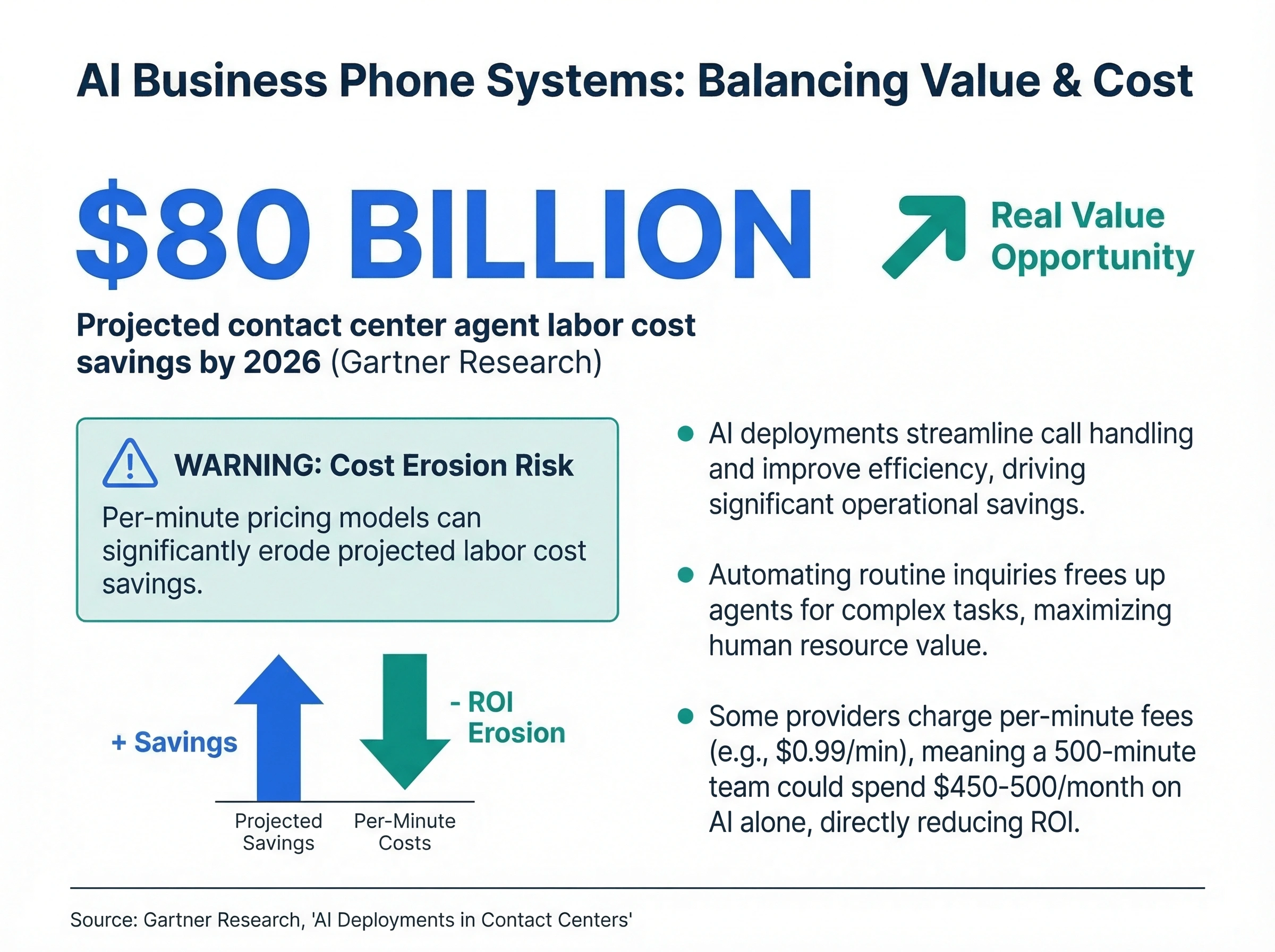
Honestly, the per-minute AI pricing model is hard to budget around. Teams end up rationing AI usage or getting hit with large invoices at the end of the month. That's the opposite of what AI automation is supposed to accomplish.
dialnote takes a different approach to AI pricing. Transcription, call summaries, call evaluation, and SMS agents are built into every plan. The AI voice agent for inbound call handling is usage-based at $0.89/min, billed against your prepaid wallet (minimum $30 top-up). The key difference: dialnote doesn't charge a platform fee for its AI agents. You only pay for the minutes those agents actually handle, which is the same model as OpenPhone and Aircall, but without the base add-on fees stacked on top.
For a team where the AI agent handles 200 inbound minutes a month, that's roughly $178 in agent usage. Aircall's equivalent, once you account for the $9/user/month AI Assist add-on and the per-minute overages, runs meaningfully higher for any team above three people.
OpenPhone vs Aircall pricing: what you'll actually pay
The sticker price is rarely the full story. Here's what you're working with once feature needs are factored in.
OpenPhone pricing (annual billing):
- Starter: $15/user/month
- Business: $23/user/month (adds AI summaries, transcription, Salesforce integration)
- Scale: $35/user/month
Extra costs to plan for: additional numbers at $5/number/month, Sona AI credit packs starting at $25/month, and international calling at per-destination rates.
Aircall pricing (annual billing):
- Essentials: $30/user/month (minimum 3 users)
- Professional: $50/user/month
- Custom: Quote-based
Extra costs to plan for: AI Assist add-on at $9/user/month on Essentials, AI Assist Pro at $49/user/month, advanced analytics at $15/user/month, additional numbers at roughly $6/month each.
dialnote pricing (monthly billing):
- Team: $49/month (unlimited users)
- Business: $99/month (unlimited users)
- Pro: $199/month (unlimited users)
Extra costs to plan for: wallet credit for international calls (anything outside your number's region) and AI voice agent usage at $0.89/min. Minimum wallet top-up is $30. In-region calls (within your number's own region) are covered by your plan's included minutes pool.
A note that applies to every VoIP platform: most advertise "unlimited calling," but fair use policies apply across the board. Real businesses that handle high call volumes do hit these limits. It's worth asking both providers specifically what the overage policy looks like before you sign a contract. This isn't a knock on either platform specifically. It's just a reality of the VoIP market that pricing pages don't always make obvious.
For a concrete comparison, a 10-person team needing mid-tier plans with AI summaries:
- OpenPhone Business + Sona AI pack: ~$255/month
- Aircall Essentials + AI Assist: $390/month
- Aircall Professional (AI included): $500/month
- dialnote Professional (AI features included, agent usage via wallet): $99/month + actual usage
That's a meaningful difference, especially for SMBs where every budget line gets scrutinized.
There's also the contract question. Both platforms offer month-to-month billing at higher rates or annual contracts with discounts. Before signing an annual deal, it's worth understanding the cancellation policy in writing, not just from a sales rep over a call. Several Aircall reviewers specifically mentioned that verbal promises about contract flexibility weren't backed up by the written terms. That's a lesson that applies to any SaaS contract.
What real users say about OpenPhone and Aircall
Review platforms paint a fairly consistent picture for both tools.
OpenPhone users frequently praise the interface and the low entry price, particularly for teams of one to five people. It's easy to set up and the shared inbox features are genuinely useful. The most consistent complaints are around call quality and support responsiveness.
Dropped calls, audio lag, and connection issues show up regularly across reviews. And because OpenPhone handles all support through tickets with average response times of two or more days, outages or quality issues can stay unresolved longer than you'd want for a business-critical phone line.
Aircall users tend to like the CRM integrations and the setup speed, particularly for teams already using HubSpot or Salesforce. The complaints that appear most consistently across G2, Capterra, and Trustpilot are around billing. Users report charges on accounts they believed were cancelled, unexpected auto-renewals, and invoices that don't match what was quoted. According to Capterra, only 48% of Aircall reviewers rate it as good value for money.
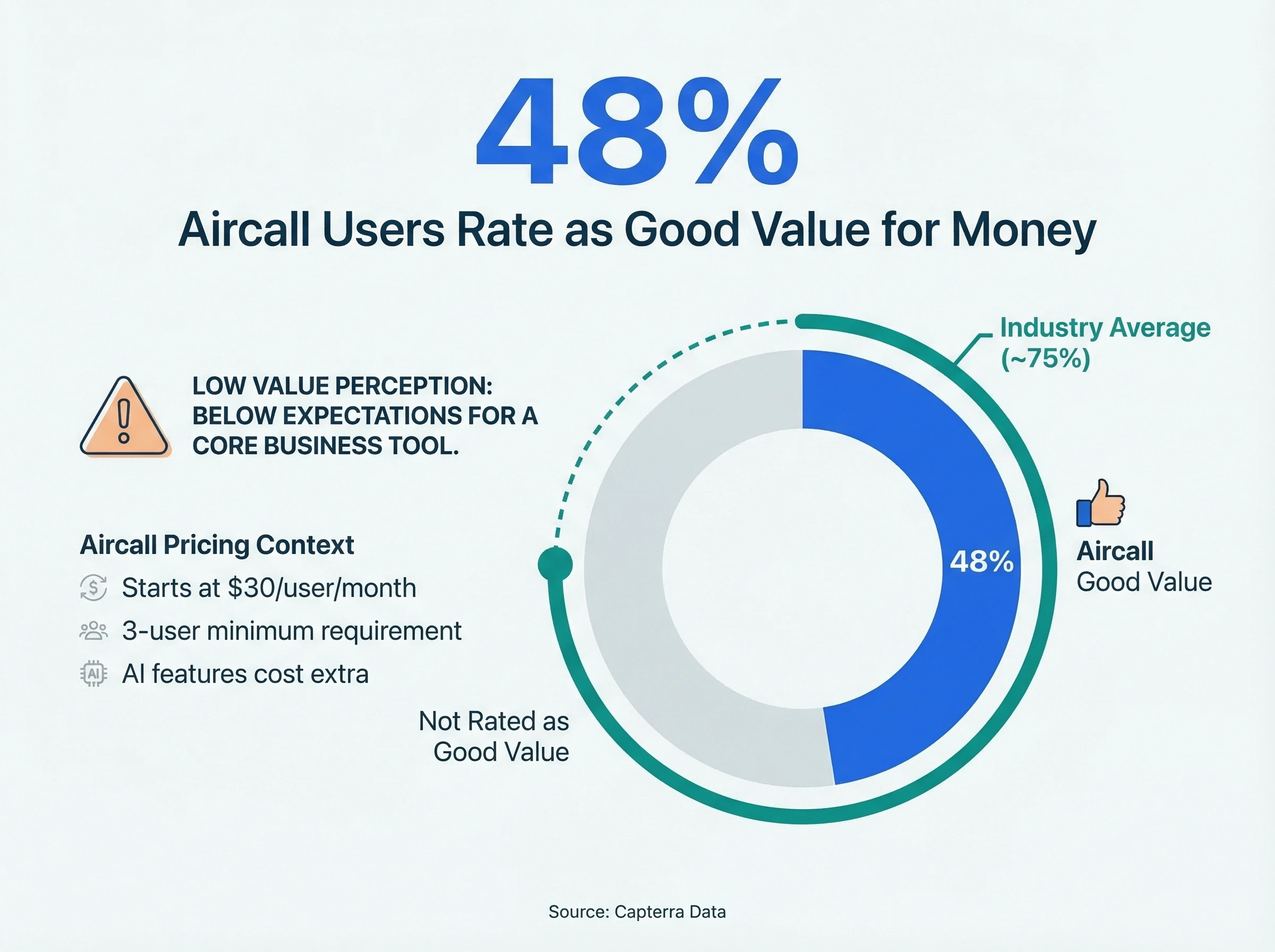
For a phone system, that's a low value rating. And billing issues aren't just annoying. If your operations team is spending hours resolving unexpected charges or navigating a cancellation that doesn't actually go through, that's real labor cost that doesn't appear in any pricing table.
What's interesting about both sets of reviews is what's missing: neither platform gets consistently strong marks for AI features actually saving time. Is that surprising for tools where AI is largely gated behind higher tiers or per-minute billing? Not really.
OpenPhone users mention Sona but note the free tier runs out fast. Aircall users on the Essentials plan note that AI Assist costs extra. The AI story for both platforms is largely aspirational at the entry-level price point.
Where both platforms fall short
OpenPhone works well for very small teams with straightforward needs. Once you need call queueing, bulk SMS, advanced AI automation, or global phone numbers without add-on fees, you start hitting limitations. It's also primarily a US and Canada product. Teams with international operations will find the coverage narrow.
Aircall is a capable platform for larger sales and support teams, but it's overbuilt and overpriced for most SMBs. The three-user minimum locks out smaller teams entirely, the AI add-on structure pushes real costs well above the listed price, and the billing complaints suggest an operational experience that doesn't match the sales pitch.
A pattern emerges when you look at both platforms together: they were built in an era when AI was a premium feature, not a core one. Both pricing structures reflect that history. OpenPhone limits AI by capping free calls. Aircall limits AI by charging per minute or per user for each capability. Neither model works particularly well for a team that wants AI to handle routine call work without calculating what each interaction costs.
Neither platform currently offers:
- Flat-rate pricing that doesn't climb with every new hire
- AI transcription, summaries, receptionist, and SMS agent included at the base price
- Numbers in the US, Canada, UK, India, and France, plus calling to 90+ countries
These aren't edge-case requirements anymore. For teams scaling past 10-15 people, they're increasingly standard, and paying per-minute for AI features that compete with human labor costs starts to look like a poor trade-off.
Why dialnote is worth adding to your shortlist
dialnote, built by the SmartReach.io group, starts from a different pricing assumption. Instead of per-seat billing, it offers Unlimited Users plans starting at $49/month. A 5-person team and a 50-person team pay the same base rate.
That pricing model removes the most predictable budget problem in business phone adoption: cost escalation as you hire. With per-seat tools, every new sales rep adds to your monthly bill. With dialnote, hiring is decoupled from phone system cost.
Most AI features are built into every plan, not sold as add-ons:
- AI transcription and call summaries
- AI SMS agents
- AI call evaluations
- Automatic CRM updates
- Call queueing
The AI voice agent (receptionist) works differently. There's no platform fee to access it. dialnote doesn't charge for the agent itself. You pay only for the minutes it handles, at $0.89/min from your prepaid wallet (minimum $30 top-up). You can test the AI receptionist live on the dialnote website before signing up for anything.
On number coverage, Aircall's footprint (100+ countries) is the widest here. dialnote counters with numbers in the US, Canada, UK, India, and France (more countries opened on request), calling to 90+ countries, and a flat bill that doesn't scale per seat. Weigh which of those your regions actually need.
On calling limits, every dialnote plan includes a pool of domestic calling minutes for your number's region, shared across the team under fair use. If you take a number in a given region and call within that same region, those minutes come from the included pool. International calls (anything outside your region) draw from your prepaid wallet at published per-country rates: the same wallet that funds AI agent minutes.
We're not certain how AI pricing will shift across all three platforms as infrastructure costs drop. That's genuinely hard to predict. But right now, the gap between "AI included in every plan" and "AI at $0.99/minute" is large enough to affect real monthly budgets for most small and mid-size teams.
SmartReach.io has built B2B tools for years, competing with platforms like Outreach, Salesloft, and Lemlist. That product depth and engineering track record matter when you're choosing infrastructure that handles every inbound lead call and customer escalation. Reliability and support quality aren't just soft factors.
If you're also weighing options beyond these three, the post on how to choose the right business phone system covers the full evaluation framework. And if AI call features are a priority, the breakdown of AI call summaries and what they actually do is worth reading before you commit to a plan.
Which phone system is right for your team?
After looking at pricing, AI capabilities, user feedback, and real-world costs, here's how to frame the decision:
Choose OpenPhone if:
- Your team has fewer than 5 people with basic calling and messaging needs
- Budget is the top priority and US/Canada calling coverage is sufficient
- You want a simple, clean interface without complex setup or call center features
Choose Aircall if:
- You're running a 10+ person sales or support team with heavy CRM usage
- You need advanced call routing, power dialer functionality, and multi-language IVR
- Enterprise integrations with Salesforce, HubSpot, and Zendesk are mission-critical
Choose dialnote if:
- You want AI automation included in the base plan, not layered on as extras
- Your team is growing and you don't want per-seat billing to eat into your hiring budget
- You need phone numbers across multiple countries at a predictable cost
- You want flat-rate pricing from the start and a live AI receptionist demo before you commit
All three platforms offer free trials. Test the AI receptionist feature specifically during your trial, since that's where the actual cost differences surface most clearly. The headline price is rarely the number that matters six months in. If Dialpad is also on your list, our Dialpad vs Aircall comparison breaks down that matchup in detail. If you want to see what AI-powered call handling actually looks like before committing to anything, dialnote's live AI receptionist demo on their website is a good place to start.
Start your free 10-day trial and test the AI receptionist yourself. No credit card required.
Frequently asked questions
It depends on team size. Aircall suits larger teams with complex call center needs, while OpenPhone works better for small teams wanting simplicity. Both have significant AI cost limitations compared to platforms like dialnote.
dialnote stands out for built-in AI features including transcription, summaries, AI receptionist, and SMS agents with no per-minute fees. OpenPhone limits free AI calls to 10/month, and Aircall charges $0.99/minute for its AI Voice Agent.
Yes. OpenPhone's Sona AI receptionist is available on all plans with 10 free calls/month. AI summaries and call transcripts require the Business plan at $23/user/month or higher.
dialnote is a strong alternative. It offers AI transcription, summaries, AI receptionist and AI SMS agents on flat-rate Unlimited Users plans starting at $49/month, with calling to 90+ countries.
dialnote's Unlimited Users plan starts at $49/month for your whole team. OpenPhone charges $15-35/user/month and Aircall charges $30-50/user/month with a 3-user minimum. For teams of 5+, dialnote is usually cheaper.
Top Aircall competitors include dialnote, OpenPhone, RingCentral, Dialpad, and Vonage. dialnote stands out with flat-rate unlimited-user plans from $49/month, built-in AI features, and no per-user fees as your team grows.
OpenPhone's main competitors are dialnote, Aircall, Dialpad, and Vonage. dialnote offers unlimited-user plans starting at $49/month and includes AI transcription and summaries in the base plan — features OpenPhone charges extra for on its Business tier.

Written by
Lancelot Dsouza
Chief Marketing Officer, SmartReach.io
Lancelot Dsouza is the Chief Marketing Officer at SmartReach.io, where he built the Marketing, Sales, and Customer Success verticals from the ground up. With over 25 years of experience spanning digital marketing, business development, and strategic...
Lancelot Dsouza is the Chief Marketing Officer at SmartReach.io, where he built the Marketing, Sales, and Customer Success verticals from the ground up. With over 25 years of experience spanning digital marketing, business development, and strategic...
Related Articles
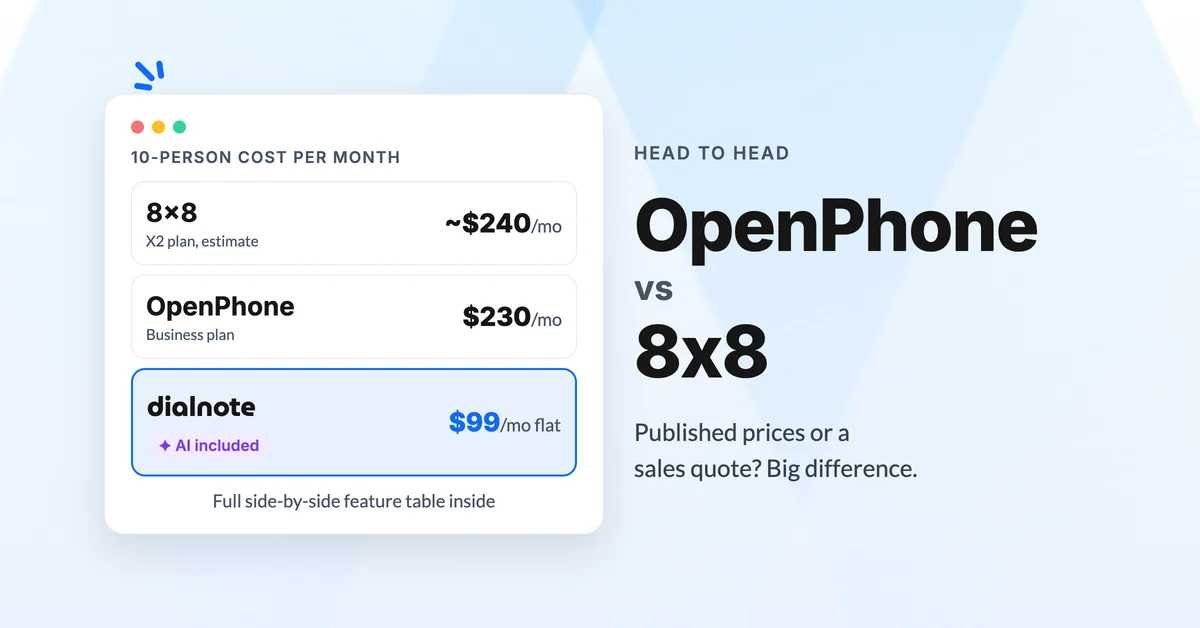
OpenPhone vs 8x8: Which Should You Choose?
Compare OpenPhone vs 8x8 on pricing, quote-only sales, and AI answering, then see why dialnote may fit small teams better than both.
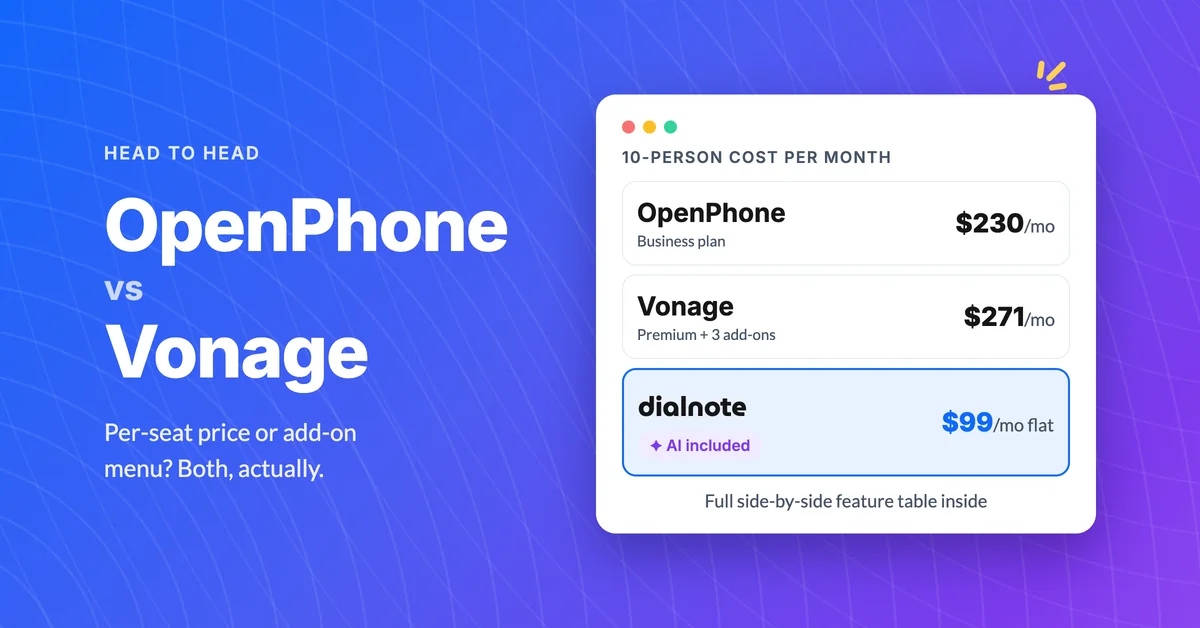
OpenPhone vs Vonage: Which Is Better Value?
Compare OpenPhone vs Vonage on pricing, add-on fees, and AI answering, then see why dialnote may be the better value for small teams.
OpenPhone vs JustCall: Which Is Better for Teams?
Compare OpenPhone vs JustCall on pricing, AI tiers, and hidden minimums, then see why dialnote may be the smarter pick for small teams.