Why Do Property Managers Need An AI Receptionist?
Your leasing office phone won't stop ringing. Between maintenance requests, leasing inquiries, and owner check-ins, most property management teams miss about 30% of incoming calls. An AI receptionist for property management changes that by picking up every call, day or night, without adding staff.
Marcus manages 180 units across three apartment communities. His two-person office team handles everything from lease renewals to work orders to showing vacant units. On a busy week, they get 200+ calls. They miss around 40 of them.
One of those missed calls last month was a family ready to sign a lease on a three-bedroom. They couldn't reach Marcus's office, called another complex down the road, and moved in the same week. That vacant unit sat empty for three more weeks. At $1,400 per month, a single missed call cost Marcus $1,400 in lost rent.
Property management runs on responsiveness. Tenants expect fast answers, prospective renters won't wait around, and owners want to know their investment is being looked after. When calls go unanswered, trust breaks down at every level.
And it's not just leasing you lose. Existing tenants who can't reach the office start leaving negative reviews online. Owners who don't hear back start shopping for another management company.
The ripple effects of missed calls go way beyond that one lost lease. They touch your reputation, your retention rate, and your bottom line all at once.
TL;DR:
- An AI receptionist for property management answers every tenant, leasing, and owner call 24/7, so you stop losing leases to missed calls and voicemail.
- It triages maintenance requests by urgency, routes real emergencies to your on-call team, and logs routine work orders automatically.
- It fills vacancies faster by answering leasing calls instantly, qualifying prospects, and booking tours on the spot.
- Expect roughly $50-$300 per month versus $35,000-$45,000 a year for a full-time front desk, with setup usually done in a day.
- Look for property-specific training, maintenance triage, calendar and PMS integration, and flat monthly pricing before you pick a tool.
Why do property managers miss so many calls?
Property managers aren't sitting at a desk all day. They're walking units with prospective tenants, meeting with contractors, handling move-in inspections, and dealing with emergencies. The phone rings at the worst moments.
The call volume alone is tough to keep up with. A single 200-unit community can generate 50-100 calls per week between tenant requests, leasing inquiries, vendor coordination, and owner updates. Multiply that across two or three properties, and you're looking at hundreds of calls that need a real person's attention.
Traditional voicemail doesn't fix the problem. Most prospective renters hang up the second they hear a recording. They're apartment hunting on their lunch break, scrolling through listings on their phone. If you don't pick up, they tap the next option on Zillow or Apartments.com.
According to AppFolio's 2025 property management benchmark report, AI adoption in property management jumped from 21% to 34% in just one year. There's a reason for that surge.
Hiring a full-time receptionist sounds logical, but the math gets tricky for smaller teams. A dedicated front desk person costs $35,000-$45,000 per year plus benefits. For management companies handling 100-300 units, that's a big chunk of your operating budget. And even a great receptionist only handles one call at a time, goes home at 5 PM, and takes vacations.
After-hours calls are where the real pain lives. A pipe bursts at 11 PM. A tenant gets locked out at midnight. A prospective renter browsing apartments after dinner wants to schedule a tour for tomorrow.
These calls don't wait until morning. Neither do the consequences of missing them.
Then there's the seasonal crunch. Summer turnover season can double or triple your normal call volume almost overnight. Your leasing team is already stretched thin handling move-outs, make-ready inspections, and new move-ins.
Adding a flood of leasing calls on top of that? Something has to give. Usually, it's the phone.
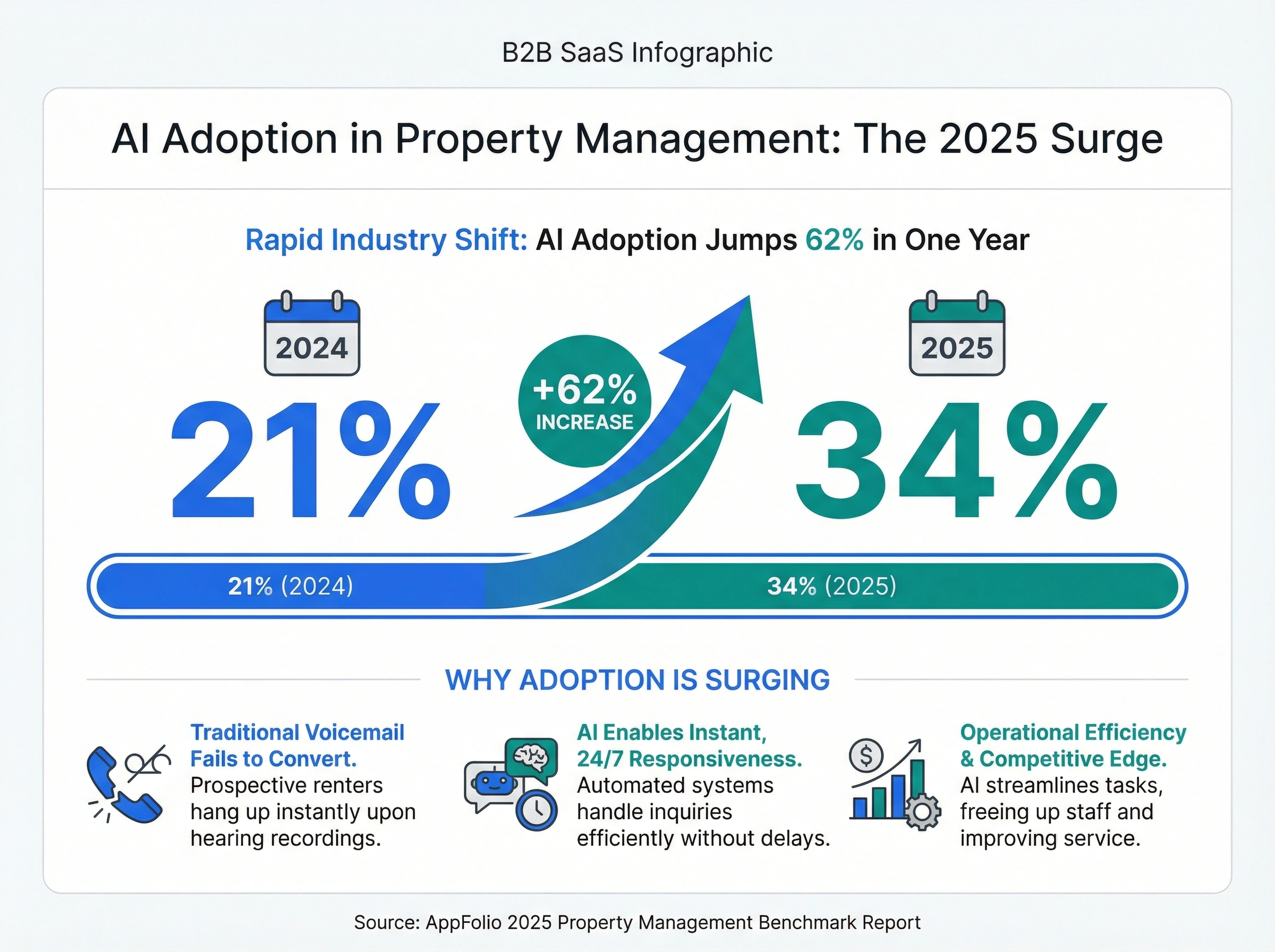
The financial impact of all these missed calls is bigger than most managers realize. Beyond the obvious lost rent from vacant units, there's the cost of higher tenant turnover when residents feel ignored, the cost of negative online reviews that scare off future applicants, and the cost of losing management contracts when owners feel out of the loop. A single negative Google review can discourage dozens of prospective tenants from ever calling you in the first place.
What can an AI receptionist handle for property management?
An AI receptionist answers your property management calls in real time, around the clock. It's not a basic voicemail system or a "press 1 for maintenance" phone tree. Modern AI receptionists carry on natural conversations, ask the right questions, and take action based on what callers need.
Here's what a well-trained AI receptionist handles for property managers:
- Leasing inquiries about availability, pricing, square footage, pet policies, and move-in costs
- Maintenance requests with automatic triage (urgent vs. routine) and work order creation
- Tour scheduling directly on your calendar without any back-and-forth
- Rent payment questions about due dates, late fees, and accepted payment methods
- After-hours emergency routing that sends urgent issues to your on-call maintenance team right away
- Owner updates with basic performance info and answers to common questions
- Vendor coordination by taking messages from contractors and logging appointment details
- Instant call summaries sent via text or email after every interaction
But can AI really handle something as sensitive as a maintenance emergency? Actually, yes. Modern AI voice systems are surprisingly good at understanding urgency.
A caller saying "water is pouring through my ceiling" gets flagged as critical and routed to your emergency line immediately. Someone asking "when does the pool close for winter?" gets a direct answer and a friendly goodbye.
The key is training. The best AI receptionists learn your specific properties, lease terms, amenities, and policies. A caller asks "does Building C have in-unit laundry?" and gets the right answer for that specific building, not a generic response. This is a big step up from traditional answering services where operators read from a script and can't tell callers anything useful about your properties.
You can also set up custom call flows for different scenarios. A leasing call triggers one set of qualifying questions. A maintenance call triggers another.
An owner calling about their property gets routed differently than a tenant calling about a repair. You control the logic, and the AI follows it consistently every single time.
If you're curious about how AI phone systems work more broadly, we've written a detailed guide on AI voice assistants for small business.
How an AI receptionist fills vacancies faster
Every vacant unit costs money. At an average rent of $1,400 per month, a unit sitting empty for even two extra weeks costs $700. Across a portfolio of 200+ units, those losses add up fast.
The biggest reason units stay vacant longer than they should? Slow response to leasing calls. A prospect finds your listing on Apartments.com, calls during their commute, and gets voicemail. They call two more places. The first community that answers, qualifies them, and books a tour typically wins the lease.
An AI receptionist makes fast response the default. It picks up every leasing call instantly, answers questions about the unit, asks about move-in timeline and budget, and schedules a tour on the spot.
Here's what a typical leasing call sounds like with AI handling it:
Caller: "Hi, I saw the listing for the two-bedroom in Maple Creek. Is it still available?"
AI receptionist: "Yes, that unit is still available. It's a two-bedroom, one-bath at $1,350 per month with a move-in special this month. Would you like to schedule a tour?"
Caller: "Sure, what's available this week?"
AI receptionist: "I have openings tomorrow at 2 PM and Thursday at 10 AM. Which works better for you?"
The prospect gets everything they need in one call. You get a pre-qualified lead with a confirmed showing on your calendar. No phone tag. No delay. No lost prospect.
Hard to say exactly how much faster AI fills vacancies across every market, but the early numbers look strong. Morgan Stanley research found that AI can automate 37% of real estate tasks, representing $34 billion in operating efficiencies. For property managers, a big share of that value comes from converting more leasing calls into signed leases.
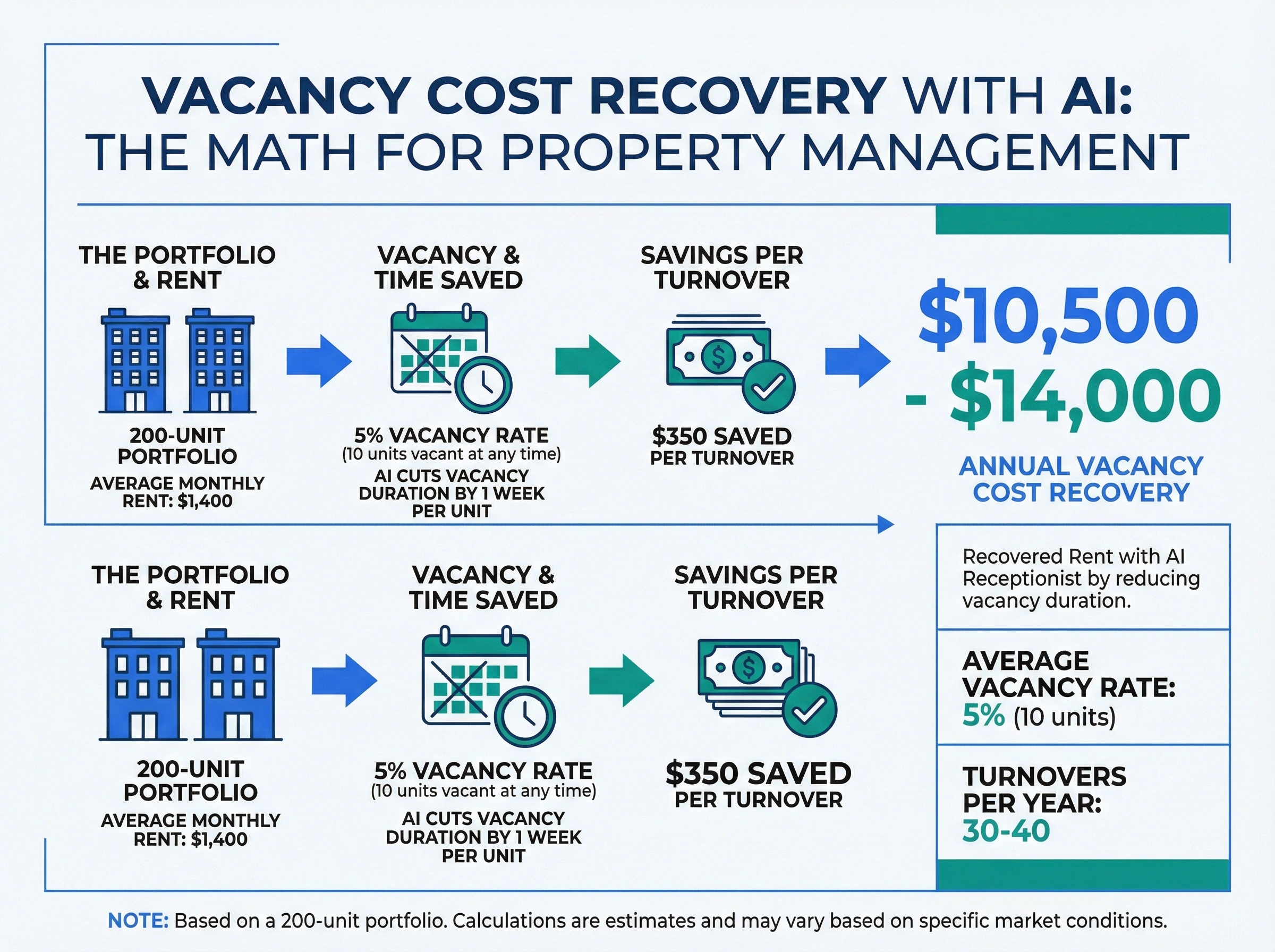
Here's what the math looks like for a 200-unit portfolio:
- Average monthly rent: $1,400
- Average vacancy rate: 5% (10 units vacant at any time)
- If AI cuts vacancy duration by just one week per unit: $350 saved per turnover
- Across 30-40 turnovers per year: $10,500-$14,000 in recovered rent annually
That's a conservative estimate. It doesn't account for the extra leases you'll sign from prospects who would've called a competitor instead.
It also doesn't factor in the time your team saves by not having to return leasing calls manually, which means they can focus on closing the leads that do come through.
The AI also pre-qualifies prospects before they ever set foot on your property. By asking about budget, desired move-in date, number of occupants, and pet situation, the AI filters out callers who don't match your available units. Your leasing team only spends time with people who are genuinely a good fit.
How different property types use AI receptionists
AI phone answering works across the entire property management spectrum. The way you use it just depends on what type of properties you manage and who's calling.
Multifamily apartments benefit the most from AI leasing support. Call volume is high, units turn over regularly, and competition for tenants is fierce. An AI receptionist that answers leasing calls instantly, provides unit details, and books tours gives you a clear advantage over communities that send callers to voicemail. During summer turnover season, this can be the difference between filling units in two weeks versus two months.
Single-family rental portfolios face a different challenge. Properties are scattered across neighborhoods, and tenants often call about property-specific issues. An AI trained on each individual property can answer questions about that specific address, like whether the house has a fenced yard or if the garage is attached. This level of detail is almost impossible for a traditional call center to provide.
Student housing has intense seasonal peaks. Most of your leasing happens in a 3-4 month window before the academic year starts. During that sprint, your phone rings non-stop with students and parents asking about availability, lease start dates, and roommate policies. An AI receptionist handles the volume without you hiring temporary staff every spring.
Commercial property management deals with fewer but higher-stakes calls. A business owner calling about leasing 2,000 square feet of retail space expects a professional, knowledgeable first impression. An AI trained on your commercial listings can discuss square footage, CAM charges, lease terms, and available buildout options. It also captures the lead details so your commercial leasing team can follow up with a proposal quickly.
HOA and condo management companies get a constant stream of calls from homeowners about rules, assessments, architectural approvals, and community events. Most of these questions have straightforward answers that don't need a human. An AI receptionist handles them instantly, freeing your community managers to work on bigger issues like vendor contracts and board meeting prep.
Vacation and short-term rental management companies deal with high guest turnover and constant inquiries about check-in instructions, amenity details, and local recommendations. An AI receptionist handles these repetitive questions around the clock, which is critical when your guests are in different time zones and calling at all hours.
No matter the property type, the core value stays the same: every call gets answered, every caller gets helped, and your team focuses on work that truly needs their attention.
5 ways AI phone answering saves property managers time
Beyond filling vacancies, an AI receptionist gives property managers back hours every single week. Here are five specific ways it changes daily operations.
1. Maintenance triage runs on autopilot
Maintenance calls eat up more staff time than almost anything else. Most property management offices spend 2-3 hours per day fielding repair requests, asking follow-up questions, and deciding which ones need immediate attention.
An AI receptionist handles the intake automatically. It asks the right questions ("Is there active water damage?" "Can you still use the unit safely?"), categorizes the request by urgency, creates a work order, and sends you a summary. You review and dispatch instead of spending your morning on the phone.
This matters even more when you manage multiple properties. A tenant at one complex reports a slow drain. Another at a different building reports a gas smell.
The AI flags the gas issue as an emergency and routes it to your on-call team immediately, while the slow drain gets logged as a routine request for the next business day. That kind of automatic prioritization can prevent real damage and real liability.
2. Common questions stop eating your day
"What's the late fee?" "When does my lease expire?" "Is the office open Saturday?" "Can I have a cat?"
These questions come in dozens of times per week, and they all have the same answer every time. An AI receptionist handles every one of them instantly. Your team focuses on work that actually needs a human touch, like resolving disputes, negotiating lease renewals, or walking a tricky unit with a prospective tenant.
Think about it this way: if your staff spends just 3 minutes per repetitive question call and gets 15 of those per day, that's 45 minutes of their day gone on questions that a trained AI answers in seconds. Over a week, that's nearly 4 hours. Over a month, it's a full two days of productive time returned to your team.
3. After-hours calls get handled without waking anyone up
Property emergencies don't follow business hours. But neither do leasing calls. An AI receptionist sorts the two automatically.
A burst pipe at 2 AM gets routed to your emergency maintenance line. A renter asking about availability at 9 PM gets answers and a scheduled tour. You wake up to a clear summary of everything that happened overnight.
This is a major win for work-life balance too. Property managers are notorious for being "always on." When you know the AI is catching everything that comes in after 5 PM, you can actually step away from work without worrying about what you're missing.
The truly urgent stuff still reaches you. Everything else waits until morning with a full summary ready to go.
4. Tour scheduling stops being a back-and-forth process
Without AI, scheduling a property tour usually involves 3-5 text messages or emails. The prospect suggests a time, you're busy, you suggest another, they can't make it. By the time you agree on a slot, they've already toured two competitors.
An AI receptionist checks your calendar in real time and books the tour during the first call. Done. No delays. The prospect gets a confirmation text, and you get a calendar notification with all their details attached.
Some AI systems also send automated reminder texts 24 hours before the tour, which cuts no-show rates significantly. Fewer no-shows mean fewer wasted trips to vacant units, which saves your leasing team even more time.
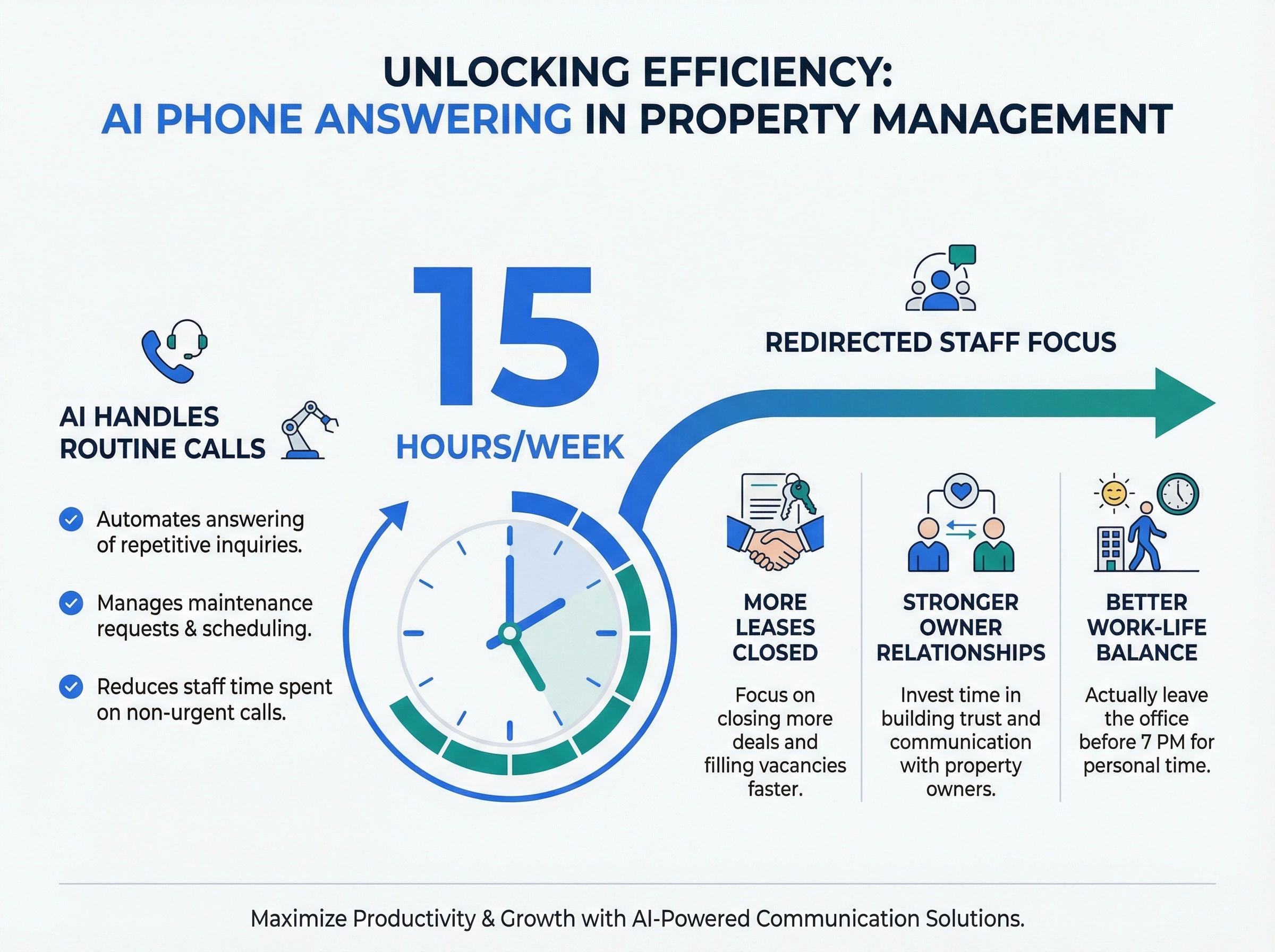
What would you do with 15 extra hours a week? That's roughly how much time a small property management team spends on calls that AI can handle entirely. You could use those hours to close more leases, build owner relationships, or actually leave the office before 7 PM.
5. You get data on every single call
Most property managers have no idea how many calls they actually receive, how many they miss, or what callers are asking about. An AI receptionist logs everything. You can spot patterns: "We get 30 HVAC calls every August" or "80% of our leasing calls come in between 5 PM and 8 PM."
This data helps you staff smarter, market better, and fix recurring property issues before they turn expensive. For example, if you see a spike in heating complaints every November at one property, you can schedule preventive HVAC maintenance in October and cut those calls in half next year.
The call data also helps with owner reporting. Instead of guessing how many leasing inquiries you got last month, you can show exact numbers: 47 leasing calls, 12 tours booked, 6 applications submitted. That kind of transparency builds trust with property owners and makes your management company look sharp.
For more on how call data improves operations, check out our guide on understanding call routing and how it fits into a modern phone setup.
What to look for in an AI receptionist for property management
Not all AI phone tools are built for property management. The wrong one will frustrate tenants and cost you leases. Here's what actually matters when you're choosing a system.
Property-specific training. The AI needs to know your units, amenities, lease terms, and policies. Generic AI that can't answer "does Building B have a washer/dryer hookup?" won't cut it. Look for tools that let you upload your property data so the AI gives specific, accurate answers about each building and unit type.
Maintenance triage ability. Can the AI tell the difference between "my dishwasher is making a weird noise" and "there's water flooding my apartment"? This is non-negotiable. Bad triage means either waking up your emergency crew for a squeaky appliance or ignoring a real flood. Both outcomes damage your credibility.
Calendar and PMS integration. Your AI receptionist should connect to your property management software and scheduling tools. Leads and maintenance requests should flow in automatically. Manual data entry defeats the purpose and creates gaps where things get lost.
Natural conversation ability. Call the system yourself and test it. Ask something tricky about pet deposits or parking assignments. If it sounds robotic or gives vague answers, your tenants and prospects will notice. The best AI receptionists handle curveball questions gracefully, even if they don't have the exact answer. They take a detailed message and flag it for your team.
Smart call transfer rules. Sometimes callers need a human right now. The AI should route calls based on rules you set. Active water leak? Transfer to your emergency line immediately. Question about lease renewal terms? AI handles it. You control the triggers.
Multilingual support. If your properties are in diverse markets, you need an AI that handles calls in Spanish and other languages. A Spanish-speaking prospect who gets an English-only system probably won't wait for a callback. In metros like Miami, Houston, or Los Angeles, multilingual support isn't optional.
Pricing transparency. Watch out for per-minute billing that spikes during busy months like summer when turnover peaks. The best providers charge a flat monthly rate so your costs stay predictable even when call volume doubles during leasing season.
Setup speed. You shouldn't need weeks of onboarding. Look for tools that let you go live in a day or two. Upload your property info, set your routing rules, and you're running. If setup takes longer than a week, that's a red flag.
The best platforms also make it easy to update your AI when units change status, new amenities are added, or policies get revised. Your AI should be as easy to update as it is to set up.
Reporting and analytics. A good AI receptionist doesn't just answer calls. It gives you insights. Look for dashboards that show call volume by time of day, most common questions, leasing conversion rates, and maintenance request categories. This data helps you run your operation more efficiently and gives you solid numbers to share with property owners during reviews.
Skip traditional answering services entirely. They charge per minute, they can't answer property-specific questions, and they're reading from a generic script that doesn't know the difference between your buildings. An AI receptionist trained on your portfolio outperforms a call center operator every time, at a fraction of the cost.
We've done a full cost comparison of AI answering services if you want the detailed numbers. And if you're also thinking about upgrading your entire phone setup, our guide on choosing the right business phone system walks through what to consider.
How dialnote helps property managers handle every call
Even if you're not ready for a full AI receptionist today, a modern business phone system can change how your property management office runs day to day. The phone is still the primary way tenants, prospects, and owners reach you. Getting it right matters.
Here's what a platform like dialnote gives property management teams out of the box:
A real business number on your personal phone. You don't need a landline at an office you're rarely sitting in. dialnote's mobile app puts your business number on the phone you already carry. Tenants see your professional caller ID, not your personal cell. And when the day is done, turn on Do Not Disturb and calls go straight to voicemail without ringing your phone.
Shared numbers for your whole team. Got a main office line? With shared numbers, any team member can pick up incoming calls from that number. If your leasing coordinator is on a tour, the call rolls to your maintenance manager or assistant. No more single points of failure where one person being unavailable means a missed tenant or lost prospect.
Smart call routing that fits your schedule. Set up simple rules: during property tours, send calls to voicemail or the AI receptionist. After hours, route emergencies to your on-call team and everything else to the AI. Route tenant calls to one team member and leasing inquiries to another. You control who gets what and when.
Call analytics you'll actually use. See exactly how many calls you get each day, what times are busiest, and how many you're missing. This data helps you figure out if your apartment listing ads are generating calls, whether you need more leasing staff, or if most prospects call between 5 PM and 8 PM. The analytics dashboard makes patterns visible at a glance.
CRM and PMS integration. When a call comes in, dialnote can log it directly in your property management software. No more scribbling tenant names on sticky notes and forgetting to enter them later. Every call, every maintenance request, every leasing inquiry gets tracked automatically.
Call recording and transcription. Can't remember what a tenant said about their lease renewal? Go back and listen. Need to recall the details of a maintenance conversation? You've got the call recording. AI-powered call summaries give you the key points without replaying the whole conversation.
Voicemail transcription. Even when calls go to voicemail (it happens), dialnote transcribes them into text automatically. You can scan 10 voicemails in 30 seconds instead of listening to each one. The transcription flags caller intent, so you know which messages need an immediate callback and which can wait until morning.
The AI receptionist is powerful on its own, but it's just one piece of a system that can sharpen your entire property management phone operation. You can start with a business number and call routing, then add the AI receptionist when you're ready to go further.
Stop missing calls and start filling units with AI
Every unanswered call at your property management office is either a lease that went to a competitor, a tenant losing patience, or an owner questioning your responsiveness. Over a year, the cost of missed calls can easily reach tens of thousands of dollars in lost rent and turnover expenses.
An AI receptionist for property management fixes this without hiring more staff. It answers every call, handles the routine stuff, routes emergencies, and sends you detailed summaries of everything that happened.
The property managers pulling ahead right now aren't necessarily the ones with the biggest portfolios. They're the ones who answer every call and respond fast. That's exactly the kind of edge an AI receptionist gives you.
If you're also interested in how AI receptionists work in related industries, we've covered AI receptionists for real estate agents and how they handle buyer calls and showing schedules, plus AI receptionists for automotive businesses including dealerships, repair shops, and body shops.
Whether you manage 50 units or 500, the math works. The cost of AI phone answering is a fraction of what you'd pay a receptionist (compare dialnote's pricing plans), and the coverage is better because it never clocks out.
Your next signed lease might be sitting in your missed calls right now. Don't let it go to voicemail.
Frequently asked questions
Most AI receptionist tools run $50-$300 per month, compared to $35,000-$45,000 per year for a full-time receptionist. You'll save significantly while getting 24/7 coverage.
Yes. Modern AI receptionists understand urgency and automatically route emergencies like flooding or gas leaks to your on-call maintenance team while handling routine requests normally.
Most callers don't notice. Today's AI receptionists sound natural and conversational, especially when trained on your specific properties, policies, and common tenant questions.
No. AI receptionists work with your existing business phone number through call forwarding. Setup typically takes less than a day with no new hardware needed.
It answers every leasing call instantly, provides unit details, qualifies prospects, and books tours on the spot. Faster response means fewer prospects calling competitors instead.

Written by
Upasana Sahu
Senior Digital Marketing Specialist, SmartReach.io
Upasana Sahu is a Senior Digital Marketing Specialist at SmartReach.io with over 10 years of experience in content marketing, SEO, and digital strategy. She manages end-to-end blog operations, from content creation and on-page/off-page SEO to traffic...
Upasana Sahu is a Senior Digital Marketing Specialist at SmartReach.io with over 10 years of experience in content marketing, SEO, and digital strategy. She manages end-to-end blog operations, from content creation and on-page/off-page SEO to traffic...
Related Articles
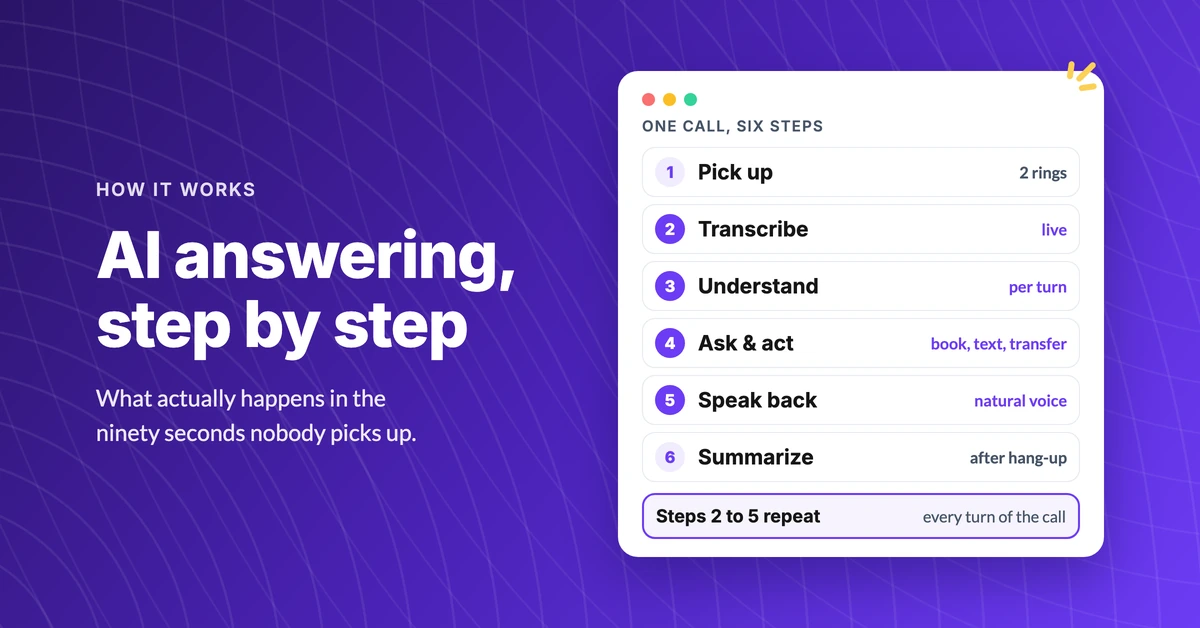
How Does an AI Answering Service Actually Work?
See how an AI answering service works, step by step: what happens in the first four seconds, what it can do on the call, and where it hands off to a human.
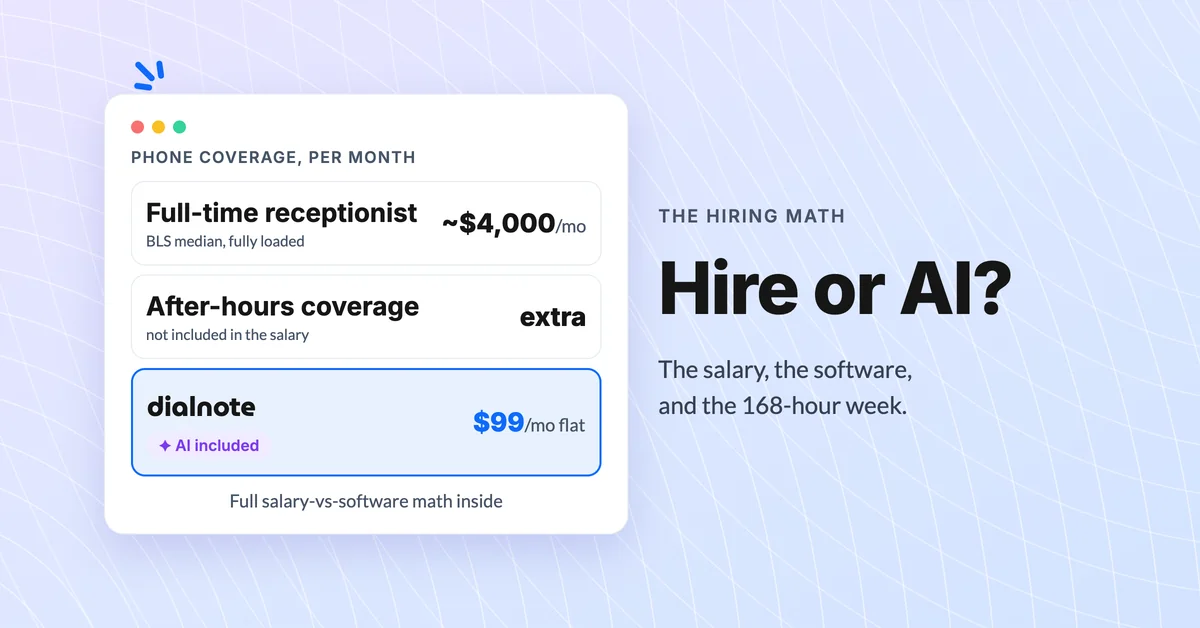
AI Receptionist vs Hiring: What Each Really Costs
Compare an AI receptionist vs hiring a receptionist: salary and benefits math, coverage hours, and what each option really costs over a year.
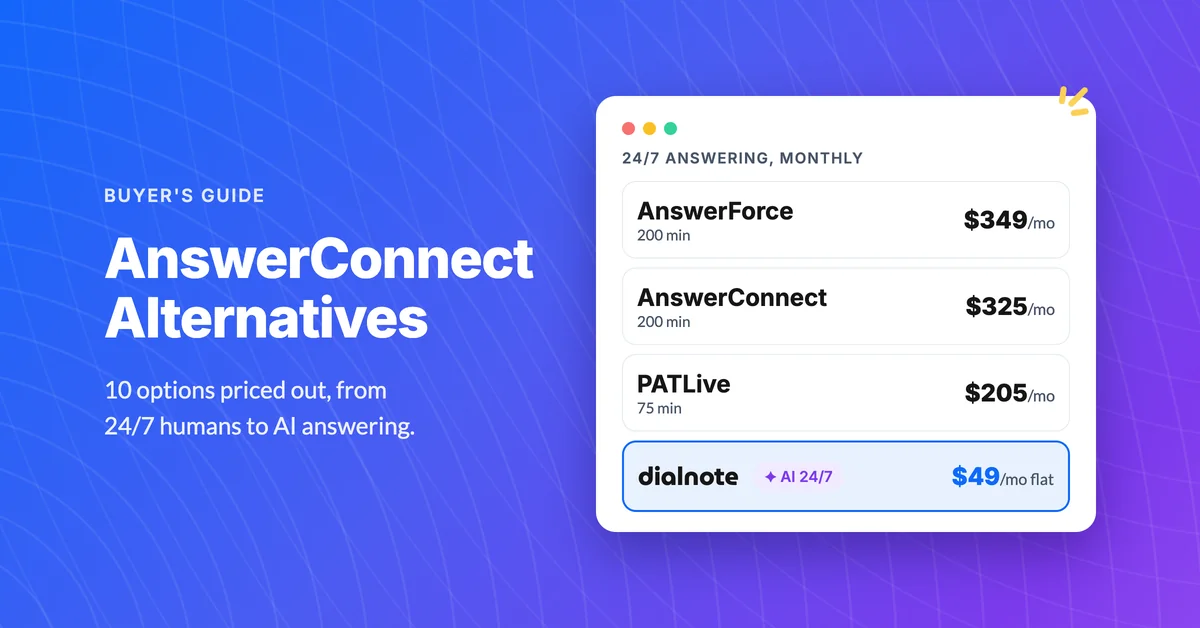
AnswerConnect Alternatives: 10 Better Options [2026]
AnswerConnect runs $325/mo for 200 minutes, and after-call work bills too. Compare 10 AnswerConnect alternatives on real cost per answered call.