RingCentral vs Zoom Phone for Small Business
Comparing RingCentral vs Zoom Phone? Most evaluations end in sticker shock. Not at signup, but two months later when the first invoice arrives. RingCentral shows $20/user/month on the pricing page. Add the features your team actually uses and you're often at $85+ per user. Zoom Phone starts at $10/user, then layers in bundle requirements, Power Packs, and AI that isn't where you expected it.
Jordan ran into this. She runs operations for a 25-person logistics company. Her team fields dozens of calls daily, coordinates across two time zones, and logs notes into HubSpot after every customer call. When their old phone system failed, she spent two weeks deep in the RingCentral vs Zoom Phone comparison. Both had solid names. Both promised AI-powered features. And both had pricing pages that got more complicated the deeper she read.
If you're in that same evaluation right now, the most useful thing to see first isn't another feature list. It's what a team of 10 actually pays once you add the AI features most growing teams need.
TL;DR:
- In the RingCentral vs Zoom Phone matchup, RingCentral fits enterprises that need 400+ integrations and unified voice/video/messaging, while Zoom Phone suits teams already living in Zoom for meetings.
- RingCentral charges $60/user/month extra for phone-call AI (transcription, summaries, coaching), so a 10-person team pays $600-1,000/month in AI add-ons on top of the base plan.
- Zoom Phone starts at $10/user but only includes AI on its Pro Plus bundle ($18.33/user annual), not on standalone phone plans, which trips up buyers who research the cheaper pages.
- Both hide costs: RingCentral adds a $3-5/line compliance fee and rigid auto-renewing contracts; Zoom Phone climbs toward RingCentral pricing once you stack the Power Pack, Auto Dialer, and AI bundle.
- dialnote is a flat-rate alternative that bundles AI transcription, summaries, CRM auto-updates, and an AI receptionist from $49/month for unlimited users, roughly $79/month vs $889+/month for a 10-person AI-equipped setup.
| What you get | RingCentral | Zoom Phone | dialnote |
|---|---|---|---|
| Base plan (10 users, Advanced/Pro Plus) | $250/mo | $183/mo | $79/mo (Business, annual) |
| + AI call summaries | +$600/mo ($60/user) | Included | Included |
| + AI receptionist | +$39/mo (100 min) | Add-on (varies) | Included (5 agents) |
| Estimated monthly total | $889/mo+ | $183-400/mo | $79/mo |
That gap is real. The rest of this post explains how it happens, and what it means for your decision. We'll also look at why dialnote comes out so far ahead on that table, and whether it's the right call for your team.
A quick look at RingCentral and Zoom Phone
Both platforms are VoIP-based business phone systems. Both promise to replace traditional phone infrastructure with something more flexible and intelligent. But they started from very different places, and that shapes everything from their pricing model to what they actually do well.
RingCentral has been in business communications since 1999. It's one of the most established names in UCaaS (unified communications as a service), with over 400 third-party integrations, a full video conferencing suite, team messaging, and advanced analytics. Enterprise IT teams love it because it checks every box on a requirements list. The flip side: it's priced and built like an enterprise product, even when you're buying it for a 15-person team.
Zoom Phone launched in 2019, built on top of the video conferencing platform that tens of millions of businesses already use daily. The pitch was simple. If your team is already in Zoom for meetings, why use a separate app for calls? Zoom Phone gives you VoIP calling, voicemail, SMS, and call management without leaving the Zoom ecosystem.
Both platforms have genuine strengths. But both also have trade-offs that aren't obvious until you're already a customer. And both have a pricing structure that looks clean until you start adding the features most growing teams actually need.
RingCentral vs Zoom Phone: how do the features compare?
On paper, both platforms cover similar ground. Calling, SMS, voicemail, IVR, call routing, and basic integrations are standard on each. But the depth and cost of those features diverge quickly.
RingCentral's feature list is genuinely impressive. You get multi-level auto attendant, call queues, power dialer (on Advanced and Ultra plans), auto call recording (Advanced+), and 400+ integrations including deep CRM connections to Salesforce and HubSpot. Video meetings for up to 200 participants are included. If you need a comprehensive communications platform that handles voice, video, messaging, and analytics in one place, RingCentral delivers the full package.
The catch is that many of those features live behind the Advanced or Ultra tiers. Auto call recording requires the $25/user Advanced plan. The power dialer does too. The Core plan at $20/user is functional but limited, and a lot of teams find themselves upgrading within the first few months.
Zoom Phone takes a different approach. It assumes you already use Zoom for video, so it focuses on adding phone calling to a platform your team already knows. You get voicemail with transcription, call forwarding, ring groups, call monitoring, and IVR across most plans. The interface is clean and familiar to anyone who's spent time in Zoom meetings.
Where Zoom Phone falls behind is in outbound sales tools and integration breadth. RingCentral's power dialer and custom call lists are genuinely useful for teams making high volumes of outbound calls. Zoom's equivalent (Auto Dialer) was added mid-2025 and still requires a paid add-on. Zoom Phone also has roughly 100 integrations compared to RingCentral's 400+. If your CRM workflow is complex, that gap matters.
Here's how all three platforms compare side by side:
| Feature | RingCentral | Zoom Phone | dialnote |
|---|---|---|---|
| Starting price | $20/user/mo | $10/user/mo | $49/mo (unlimited users) |
| Pricing model | Per seat | Per seat | Unlimited users or per seat |
| Unlimited US/Canada calling | All plans (fair use) | Unlimited plan ($15+/user) | In-region pool + wallet |
| SMS | 25-200/user/mo | Unlimited (US/CA/AU) | Unlimited |
| International numbers | Add-on | Global Select ($20/user) | US, CA, UK, India, France |
| IVR / auto attendant | All plans | All plans | All plans |
| Auto call recording | Advanced+ ($25/user) | All plans | All plans |
| AI call transcription | Add-on ($60/user/mo) | Bundles only (Pro Plus+) | All plans |
| AI call summaries | Add-on ($60/user/mo) | Bundles only (Pro Plus+) | All plans |
| AI receptionist | Add-on ($39/mo+) | Add-on | Business plan+ |
| AI SMS agent | Not available | Not available | Business plan+ |
| AI call evaluation | Add-on ($60/user/mo) | Not available | Pro plan |
| Auto CRM updates | Not included | Not included | All plans |
| Bulk SMS | Add-on ($25/user/mo) | Power Pack ($25/user) | All plans |
| Call queueing | Add-on ($35/user/mo) | All plans | Pro plan |
| Video conferencing | Up to 200 participants | Built-in with bundles | No (calls only) |
| Unlimited users option | No | No | Yes |
But does "unlimited calling" actually mean unlimited? Not quite, and it's worth knowing before you commit. Every VoIP provider has a fair use policy. RingCentral caps toll-free minutes at 100/month on the Core plan with overages at $0.039/minute. Zoom Phone's $10/user metered plan charges $0.024/minute for outbound calls. Budget an extra 10-20% on top of plan prices if your team makes significant outbound call volume. This applies to dialnote too, so factor it into any realistic cost comparison.
What are the AI capabilities on each platform?
RingCentral and Zoom Phone both advertise AI, but the cost to actually use AI on phone calls is very different. RingCentral charges $60/user/month extra for phone call intelligence. Zoom includes it only on bundle plans, not the cheaper standalone options.
RingCentral's AI story has two layers. For meetings and video, AI summaries, transcriptions, and highlight reels are included on all paid plans at no extra cost. That's useful if your team uses RingCentral for video calls.
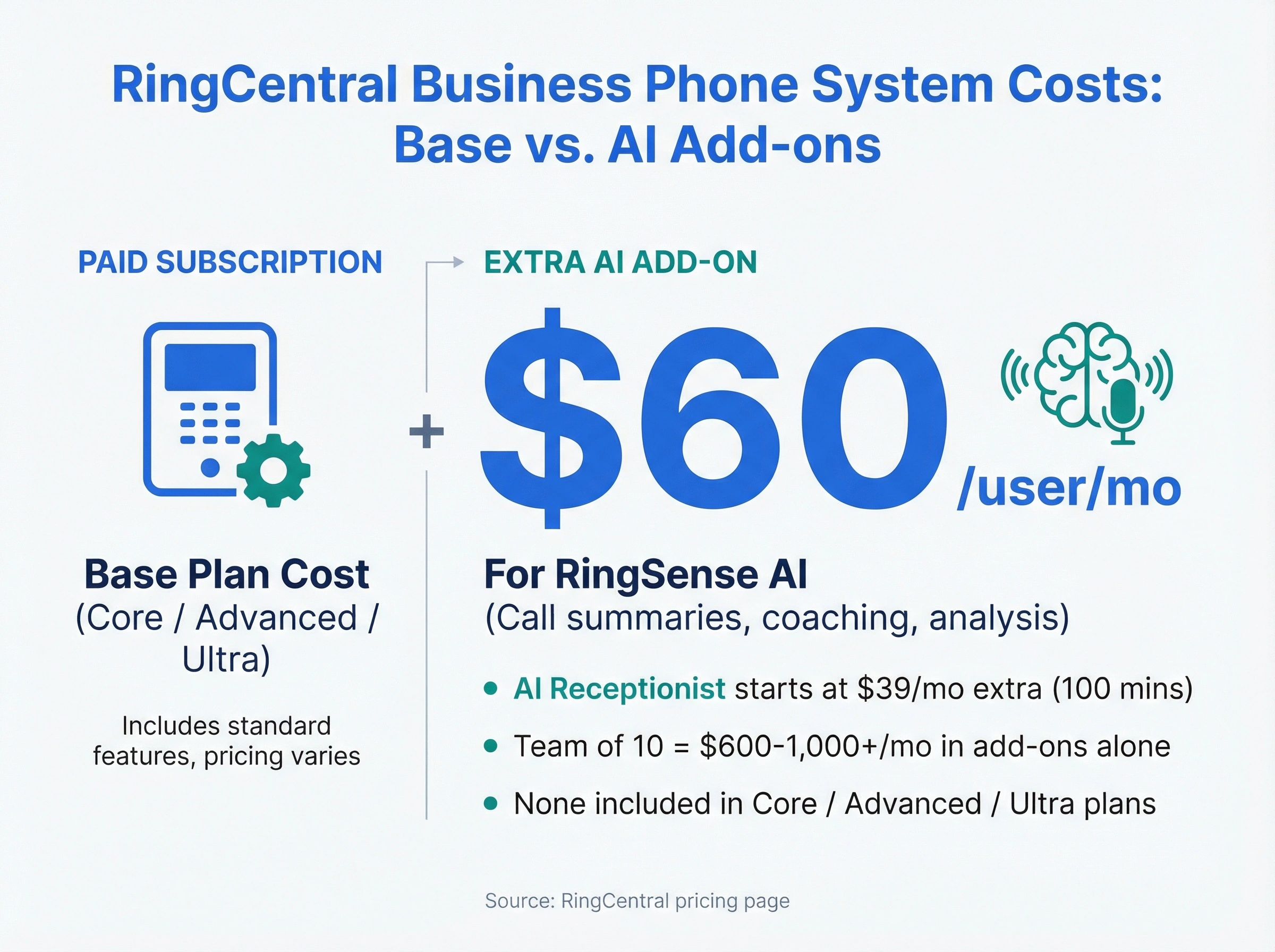
For phone calls, the story is different. RingSense AI, which covers call summaries, automated coaching, performance analysis, and real-time sentiment analysis, costs $60/user/month as a separate add-on. The AI Receptionist starts at $39/month for 100 assisted calling minutes, with each additional minute costing $0.50.
Getting meaningful AI on phone calls through RingCentral means adding $60-100+ per user per month on top of your base plan. For a 10-person team, that's $600-1,000/month in AI add-ons alone.
From a marketing and growth perspective, I've seen this dynamic play out across dozens of B2B SaaS tools: the feature that's supposed to save your team time ends up costing more than the time it saves. When AI phone features run $60/user/month on top of a $25/user base plan, most small businesses skip it entirely and keep logging calls by hand.
Zoom Phone's AI picture is more nuanced. The AI Companion (meeting summaries, task extraction, voicemail automation, sentiment analysis) is included at no extra cost on the Pro Plus bundle at $18.33/user/month (annual). That's a real advantage for teams already paying for Zoom Workplace. But if you're on a standalone Zoom Phone plan ($10-$20/user), AI Companion isn't included. You'd need to upgrade to the bundle to get it.
Neither RingCentral nor Zoom Phone currently auto-updates your CRM after a call. Both platforms provide transcription and summaries, but moving that data into HubSpot or Salesforce is still manual (or requires separate integration tools at extra cost).
dialnote's approach is different. Transcription, summaries, and CRM updates happen automatically on every plan. The AI receptionist answers calls, handles FAQs from your knowledge base, captures leads, and schedules appointments in 14 languages. You can test it before signing up: call +1 650 772 6683 and see how it handles a live conversation.
How does pricing really break down?
RingCentral starts at $20/user/month and Zoom Phone at $10/user/month, but neither price reflects what most teams actually end up paying. Both have significant gaps at entry level that push you toward higher tiers or paid add-ons quickly.
RingCentral looks approachable at $20/user/month for the Core plan. But the Core plan has real gaps for any team that needs full functionality. You get 25 SMS messages per user per month (roughly one text per business day), 100 toll-free minutes total across your account, and no auto call recording. Moving to Advanced costs $25/user and adding AI for phone calls costs another $60/user.
And on top of all that, RingCentral adds a "compliance and administrative cost recovery fee" of $3-5 per line per month that doesn't appear on the pricing page but does show up on your invoice. Multiple users on Trustpilot and Reddit report bills running 20-30% higher than expected.
Zoom Phone starts at $10/user/month for the metered plan (pay per minute for outbound calls). The $15/user Unlimited plan gives you unlimited domestic calling, voicemail, and SMS within the US and Canada. But if you want AI features, you need the Pro Plus bundle at $18.33/user/month (annual). Need advanced analytics or shared team SMS? Add the Power Pack at $25/user/month. If your team grows beyond 99 users, you're forced to upgrade to Business Plus at $22.49/user. The entry-level price gets further away from your actual bill as you add what you need.
dialnote prices differently. Instead of per-seat pricing that scales with headcount, it offers Unlimited Users plans at a flat monthly rate:
- Team: $49/month ($39 annual): unlimited users, 2 phone numbers, AI transcription, auto CRM updates
- Business: $99/month ($79 annual): unlimited users, 3 numbers, 5 AI agents, AI receptionist
- Pro: $199/month ($159 annual): unlimited users, 5 numbers, 10 AI agents, call queueing, AI call evaluation
Per-seat plans start at $15/user/month for very small teams. But for most teams of 4 or more, the Unlimited Users plans are the better deal because adding headcount doesn't add to your phone bill.
According to Tech.co, businesses switching from traditional setups to VoIP save an average of 50-75% on communication costs. The more relevant question is which VoIP platform gives you the best return once you've made that switch.
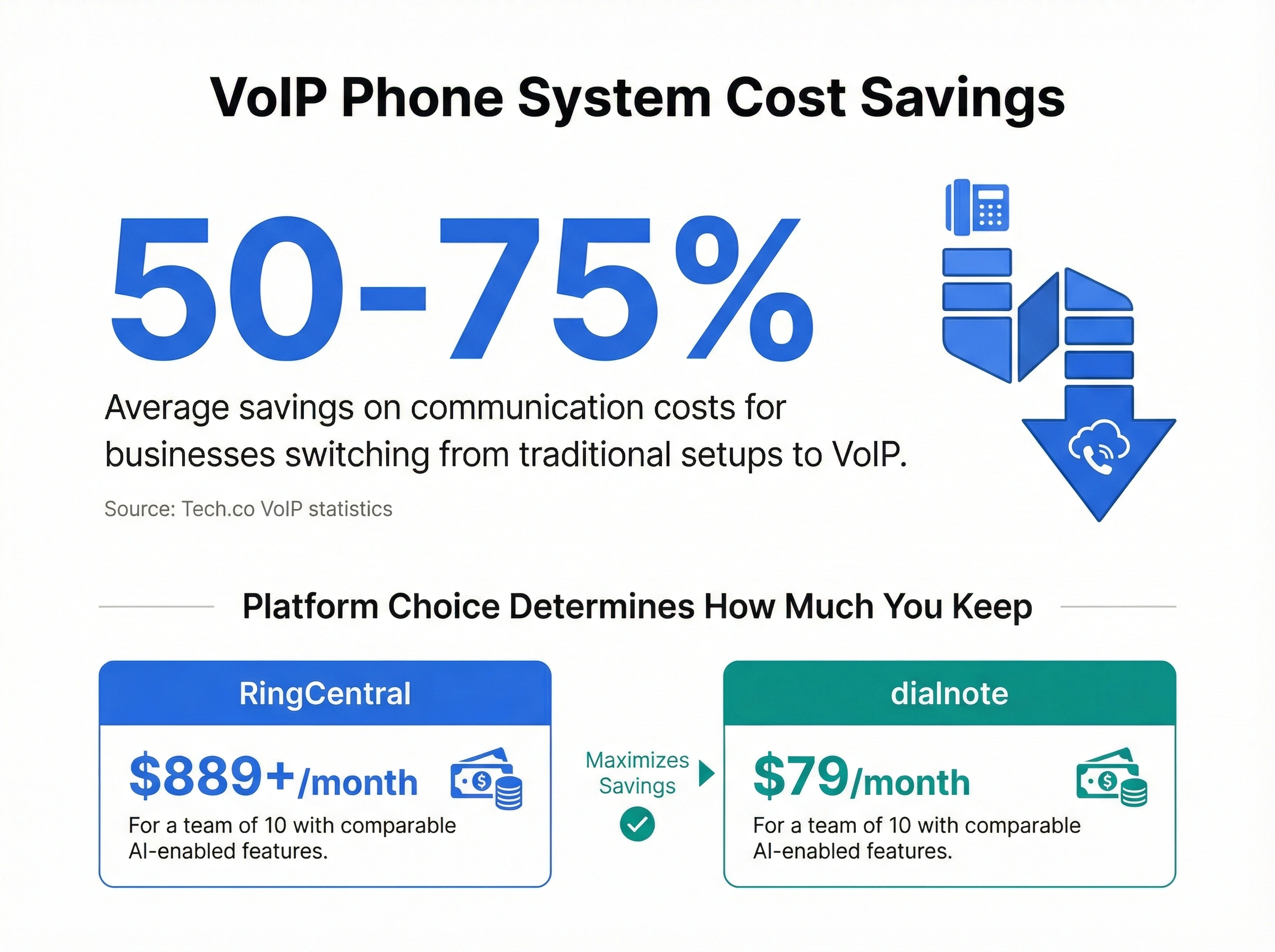
That's not a rounding error. For a 10-person team that wants AI call summaries and an AI receptionist, dialnote at $79/month on annual billing compares to $889+/month on RingCentral, exactly what the comparison at the top of this post shows. Your phone budget and what you get from it look very different depending on which direction you go.
For more context on what drives the biggest cost differences in business phone systems, our guide on business phone systems with unlimited seats breaks down the per-user vs. flat-rate model in detail.
What real users say about both platforms
Review scores tell different stories depending on where you look.
RingCentral holds a 4.0/5 on G2, which is solid for enterprise software. But its Trustpilot score is 2.2/5 and PissedConsumer averages 1.4/5 across hundreds of reviews. That gap between enterprise and consumer ratings usually signals a problem with billing, support, or contract terms, not the product itself.
The most common complaints across Trustpilot, Reddit, and BBB filings:
Billing after cancellation. Multiple users describe being charged for months after requesting to close their accounts. Annual contracts auto-renew and are difficult to exit. Several BBB complaints describe fighting $1,500/month charges for six months after cancellation. The support process involves being transferred between departments without resolution.
The compliance fee surprise. The $3-5 per line administrative fee doesn't appear during signup. It shows up on the first invoice. For teams that didn't budget for it, that's an unwelcome surprise compounded across every line.
Feature gating. Teams that signed up for Core quickly discovered that the features they actually needed (auto recording, CRM sync, analytics) required upgrading to Advanced or buying add-ons.
Zoom Phone's picture is more favorable overall. Gartner rates it 4.5/5 across nearly 8,000 reviews, significantly higher than RingCentral's ratings on the same platform. But community forums and PissedConsumer (1.9/5) show consistent patterns:
Call quality inconsistencies. Dropped calls, choppy audio, and voicemail notifications arriving hours late come up regularly, even with strong internet connections. A Zoom community forum thread with hundreds of replies describes callers sounding "robotic" with no clear resolution from support.
AI not where users expected it. Users on $15/user standalone plans often assumed AI Companion was included. It isn't. You need the Zoom Workplace bundle. The distinction between standalone phone plans and bundled plans isn't always clear during the sales process.
Add-on cost creep. The $10-$15/user entry point looks attractive. Then comes the Power Pack for analytics ($25/user), then the Auto Dialer for outbound calls, and then the realization that the AI features still aren't fully included. The final cost ends up considerably higher than the advertised starting price.
It's not entirely clear why Zoom markets standalone phone plans and AI-bundled plans under the same "Zoom Phone" name when the AI inclusion is so different between them. But buyers who research pricing on the standalone pages and expect AI features often discover they're on the wrong plan after signing up.
Where both platforms fall short
Being clear about the gaps helps you make a better call.
RingCentral's biggest problem is its add-on pricing model for the features most modern teams actually want. AI call intelligence, bulk SMS, call queueing, and the AI receptionist are all separate charges. A team that wants all of those features can easily end up paying $100+/user/month after stacking add-ons. For a 10-person team, that's a $1,000+/month phone bill for features that competitors include in base pricing.
The contract rigidity compounds the problem. You can't reduce your seat count mid-contract. If you hire and then restructure, you keep paying for every seat until renewal. For companies going through normal growth cycles, that's a real financial liability.
Zoom Phone's core limitation is the gap between the advertised entry price and what you end up paying for a reasonably complete setup. The $10-$15/user plans cover the basics, but most teams add the Power Pack, need the AI bundle, and run into integration limitations with only ~100 supported apps. The cost climbs toward RingCentral territory as you layer in the features you need.
The integration depth gap also matters for teams with complex workflows. 100 integrations is enough for standard setups. But if your business runs on less common CRM tools or needs deep workflow automation, Zoom Phone's connector library may not cover you.
Honestly, neither platform has solved the problem of making AI a standard part of a phone system rather than a premium add-on. That's the gap that's made flat-rate platforms like dialnote worth a serious look for teams that want AI to reduce admin work without adding to their software bill.
Why dialnote is worth a closer look
dialnote comes from the SmartReach.io group, the same team that built a sales engagement platform competing with Outreach, Salesloft, and Lemlist. That background shapes how the product is designed: around making sales and customer-facing teams more productive, not around maximizing feature count for enterprise procurement checklists.
A few things stand out:
AI-first by design. dialnote is built AI-first, so every call runs through AI automatically, from the moment it connects. Transcription, call summaries, and CRM updates happen on every plan, including the base Team plan. There's no AI tier to access and no add-on to purchase. It's just how the product works. The AI receptionist (answers calls, handles FAQs, captures leads in 14 languages) is included on Business and above.
Unlimited users pricing that doesn't punish growth. The Business plan at $99/month ($79 annual) covers your entire team, whether that's 5 people or 35. RingCentral at $25/user and Zoom Phone at $18.33/user mean every new hire adds to your phone bill. dialnote's flat-rate model means your communication costs stay predictable as you scale.
Calling to 90+ countries. Both RingCentral and Zoom Phone focus their standard plans on US and Canada coverage, with international calling as an add-on. dialnote covers calls to 90+ countries with transparent per-country rates billed from one shared wallet, plus local numbers in the US, Canada, UK, India, and France. For businesses with international customer bases, that's a meaningful operational advantage.
Try the AI before committing. Call +1 650 772 6683 to interact with dialnote's live AI receptionist before creating an account. It answers calls, handles questions, and demonstrates the actual capability you'd get on the platform. Most vendors make you sign up for a trial first. dialnote lets you test the most differentiated feature with no friction.
Zoom integration for teams that need video. Unlike RingCentral (which includes built-in video), dialnote integrates directly with Zoom on the Business plan and above. If your team already has Zoom for meetings, you don't pay twice for overlapping functionality.
Two-week feature turnaround. Need a specific integration or workflow dialnote doesn't cover yet? Reach out to the team. They have a track record of adding requested features and integrations within two weeks. That kind of execution speed is genuinely rare in B2B SaaS, and it means the platform can grow with your specific needs, not just the needs of their average customer.
If you're already on RingCentral and considering a move, you can port your number with minimal disruption. The process typically takes 1-2 weeks and your new provider handles the logistics.
Which platform fits your team?
There's no universal right answer, but the choice gets clearer once you map your actual needs against what each platform delivers.
Pick RingCentral if:
- You need video, voice, messaging, and fax consolidated in one platform
- Your organization has 50+ people with enterprise compliance requirements
- You have a dedicated IT team to manage the platform and add-ons
- You need access to 400+ integrations with deep workflow customization
Pick Zoom Phone if:
- Your team is already embedded in the Zoom ecosystem and wants phone calling in the same app
- You want AI features included without extra cost (on Pro Plus bundles)
- Unlimited SMS within the US, Canada, and Australia matters to your team
- You're a larger organization needing unified communications
Pick dialnote if:
- You want AI transcription, summaries, CRM updates, and an AI receptionist included from day one
- Your team is 2-50 people and you want costs that don't scale with headcount
- You need to call customers in 90+ countries, not just the US and Canada
- Post-call admin is taking time away from the work your team should be doing
Our guide to choosing the right business phone system covers the broader decision framework if you're still weighing your options. And our VoIP cost savings breakdown is worth a read before you finalize your budget.
The phone system market is moving fast. AI is becoming table stakes, not a premium feature. Platforms that charge $60/user/month for call intelligence will face increasing pressure as buyers expect it to come standard. Choosing a platform now that includes AI in the base price isn't just better value today. It's a more defensible position as the market catches up.
See dialnote's pricing and compare it against what you're currently paying. Or call +1 650 772 6683 and see the AI receptionist firsthand before making any decisions.
Frequently asked questions
RingCentral has more integrations (400+) and enterprise features but charges $60/user/month extra for phone call AI. Zoom Phone is simpler, starts at $10/user, and includes AI on Pro Plus bundles. RingCentral fits larger orgs; Zoom Phone suits teams already using Zoom for meetings.
For small teams, dialnote is a strong alternative. It includes call transcription, summaries, CRM auto-updates, and an AI receptionist from $49/month for unlimited users — vs RingCentral's $85+/user/month for equivalent AI features.
AI phone features cost an extra $60/user/month. The Core plan caps SMS at 25/user/month. Contracts auto-renew and are hard to exit. A $3-5/line compliance fee shows up on invoices but not the pricing page. Most useful features need the $25/user Advanced plan or paid add-ons.
Zoom Phone's main competitors include RingCentral, dialnote, Dialpad, 8x8, and Vonage. For AI-first flat-rate pricing, dialnote is a strong alternative. For enterprise UCaaS, RingCentral and Microsoft Teams Phone are the closest rivals.
dialnote is a strong Zoom Phone alternative for teams that want AI on every call without bundle requirements. It includes transcription, summaries, CRM updates, and an AI receptionist from $49/month for unlimited users, with no per-user fees as the team grows.
Microsoft Teams Phone and Zoom Phone are RingCentral's biggest enterprise rivals. For small and mid-sized teams, dialnote and Dialpad are gaining ground by including AI phone features in base pricing rather than charging $60+/user/month as add-ons.
For enterprise with complex integrations, RingCentral. For teams in the Zoom ecosystem, Zoom Phone. For small teams (2-50 people) who want AI built in from day one, dialnote offers flat pricing from $49/month with transcription, CRM updates, and an AI receptionist included.

Written by
Lancelot Dsouza
Chief Marketing Officer, SmartReach.io
Lancelot Dsouza is the Chief Marketing Officer at SmartReach.io, where he built the Marketing, Sales, and Customer Success verticals from the ground up. With over 25 years of experience spanning digital marketing, business development, and strategic...
Lancelot Dsouza is the Chief Marketing Officer at SmartReach.io, where he built the Marketing, Sales, and Customer Success verticals from the ground up. With over 25 years of experience spanning digital marketing, business development, and strategic...
Related Articles
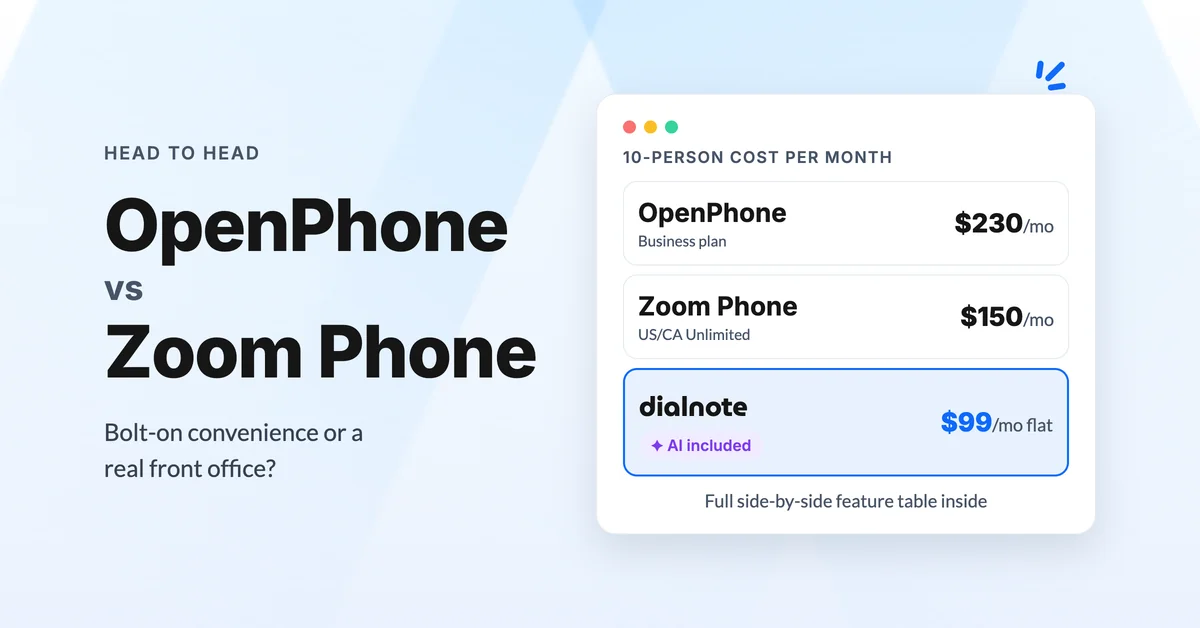
OpenPhone vs Zoom Phone: Which Fits Your Team?
Compare OpenPhone vs Zoom Phone on pricing, features, and AI answering, then see why dialnote may serve growing teams better than both.
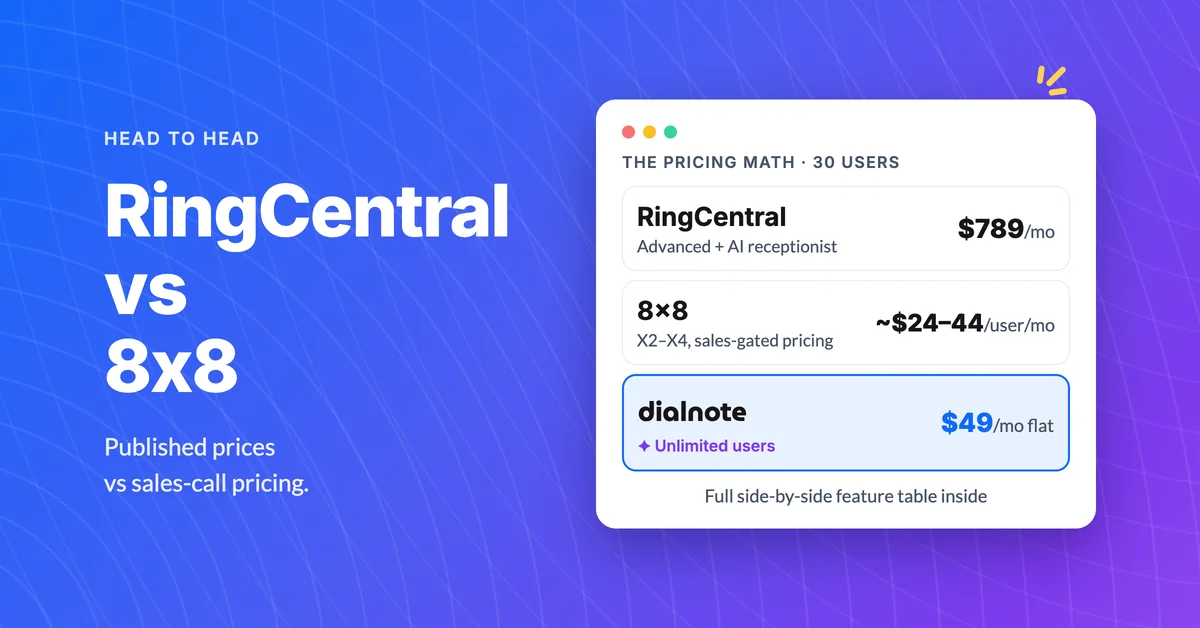
Is RingCentral or 8x8 the Better Business Phone?
Compare RingCentral vs 8x8 on pricing, AI features, and user reviews. Find out which business phone system wins and why dialnote is worth a look.
RingCentral vs Dialpad: Best Business Phone?
Compare RingCentral vs Dialpad on pricing, AI features, and real-world limits. Find out which business phone system fits your team.