RingCentral vs Nextiva for Business Phone Systems
Choosing between RingCentral vs Nextiva looks simple on paper. Both are established VoIP platforms. Both have been around long enough to earn enterprise trust. Both check the basics: calling, messaging, video, mobile apps. But once you get past the marketing pages, the differences start to matter a lot.
Jordan runs operations at a mid-size B2B services firm. She was tasked with replacing their aging phone system, and two names kept coming up: RingCentral and Nextiva. She spent three weeks reading comparison articles, getting on sales calls, and building cost spreadsheets. By the end of it, she wasn't sure she'd made any real progress. "Every article says the same things. I couldn't figure out where the actual costs were hiding." Sound familiar?
This comparison digs into what really separates RingCentral and Nextiva on pricing, features, AI, and user experience. We'll also look at a third platform, dialnote, that's worth adding to the mix. It addresses several gaps both tools leave behind, especially around AI automation and pricing predictability.
Let's get into it.
TL;DR:
- In the RingCentral vs Nextiva matchup, Nextiva is cheaper ($15/user/month vs $20) and rates higher on support (9.0 vs 7.8 on G2), while RingCentral wins on integration depth (300+ connectors vs ~20).
- Both platforms treat AI as a paid add-on: RingCentral's AI Receptionist is $39/month and its AI Conversation Expert is $60/user/month, and Nextiva ties AI to its Engage plan or higher.
- SMS caps catch teams off guard on both tools, and per-seat pricing keeps climbing as you add people.
- dialnote includes AI transcription, call summaries, an AI receptionist, AI SMS agents, and call evaluation on every plan, with unlimited-user pricing from $49/month and calling to 90+ countries.
A quick look at RingCentral and Nextiva
RingCentral has been around since 1999. It's one of the most recognized names in business communications, serving companies of all sizes with voice, video, messaging, and contact center tools under one roof. Its integration library is one of the strongest in the industry, with 300+ native connectors for CRM, helpdesk, and productivity apps.
Nextiva was founded in 2008 and positions itself as a unified customer experience platform. It started as a VoIP provider for small businesses and has since grown to include contact center capabilities, CRM-lite features, and multi-channel customer engagement tools. Nextiva's standout claim is customer support quality, and based on independent user reviews, it mostly delivers on that.
Both are capable platforms. Neither is a bad choice. But they're built for different priorities, and the right fit depends on what actually matters to your team. RingCentral leans into depth of integrations and enterprise-grade communications. Nextiva leans into customer experience features and value pricing for smaller teams.
If Dialpad is also on your shortlist, our Dialpad vs Nextiva comparison covers how Nextiva's AI tiers and pricing model hold up against another platform teams commonly evaluate alongside RingCentral.
How do RingCentral and Nextiva compare on features?
RingCentral and Nextiva cover the core business communications stack: VoIP calling, team messaging, video meetings, voicemail, call recording, and mobile apps. Where they diverge is depth vs breadth.
RingCentral goes deep on the communications side. You get advanced call monitoring (whisper, barge, listen), multi-level IVR, call queues, and analytics dashboards that work for managing larger teams. The 300+ integrations mean it works with pretty much every tool already in your stack, from Salesforce and HubSpot to Zendesk and Slack.
Nextiva goes broader. It layers in customer experience features like call pop (which shows customer history when a call comes in), basic CRM functionality, and reputation management tools that RingCentral doesn't offer natively.
For businesses that want communication and CRM in one place without a full enterprise CRM implementation, that's a meaningful difference. Nextiva also routes callers to the best-fit agent based on skills, language, or expertise, which is useful for customer-facing teams.
Here's how both platforms compare on key capabilities, alongside dialnote as a third option:
| Feature | RingCentral | Nextiva | dialnote |
|---|---|---|---|
| Starting price | $20/user/month | $15/user/month | $49/month (unlimited users) |
| Pricing model | Per seat | Per seat | Unlimited users or per seat |
| Unlimited users option | No | No | Yes |
| AI transcription | Add-on ($60/user/mo) | Engage plan ($25/user/mo) | Included |
| AI call summaries | Core plan | Engage plan | Included |
| AI receptionist | Add-on ($39/mo) | Not available | Included |
| AI SMS agent | Not available | Not available | Included |
| AI call evaluation | Not available | Not available | Included |
| Auto CRM updates | Limited | Basic (call pop) | Included |
| Bulk SMS | Capped by plan | Limited | Coming soon |
| Call queueing | Advanced plan | Core plan | Included |
| IVR | All plans | All plans | Included |
| Video conferencing | Included | Included | No (calls only) |
| International numbers | Limited | US/Canada focus | US, CA, UK, India, France |
| Calling limits | Fair use policy | US/Canada unlimited | In-region pool + wallet (fair use) |
| Integrations | 300+ | ~20 | CRM + productivity |
Which platform handles AI better?
Nextiva includes more AI in lower-tier plans than RingCentral does, but neither platform makes AI a first-class feature without upgrading or paying extra.
RingCentral has invested in AI, but the meaningful features cost significantly more than the base plans suggest. The AI Receptionist is $39/month as a separate add-on. The AI Conversation Expert (which gives you real-time transcription, sentiment analysis, and coaching prompts) is $60/user/month on top of your base plan. If you're on the Core plan at $20/user/month and want both AI features, you're looking at $80-100/user/month in total. For a 20-person team, that's a significant jump.
Nextiva's AI features are more integrated into the product but tied to the Engage plan ($25/user/month annually) or higher. The Core plan at $15/user/month gives you standard calling without meaningful AI. Engage adds call transcription and post-call summaries, which is better than RingCentral's approach of making everything an add-on. But there's still no AI receptionist, AI-driven SMS responses, or AI call evaluation on any Nextiva plan today.
The jury's still out on which platform will have the stronger AI roadmap two years from now, but based on where things stand today, both treat AI as something you pay extra for rather than something built into the core product. That's a real gap for teams that are trying to get productivity gains from automation without a complicated add-on stack.
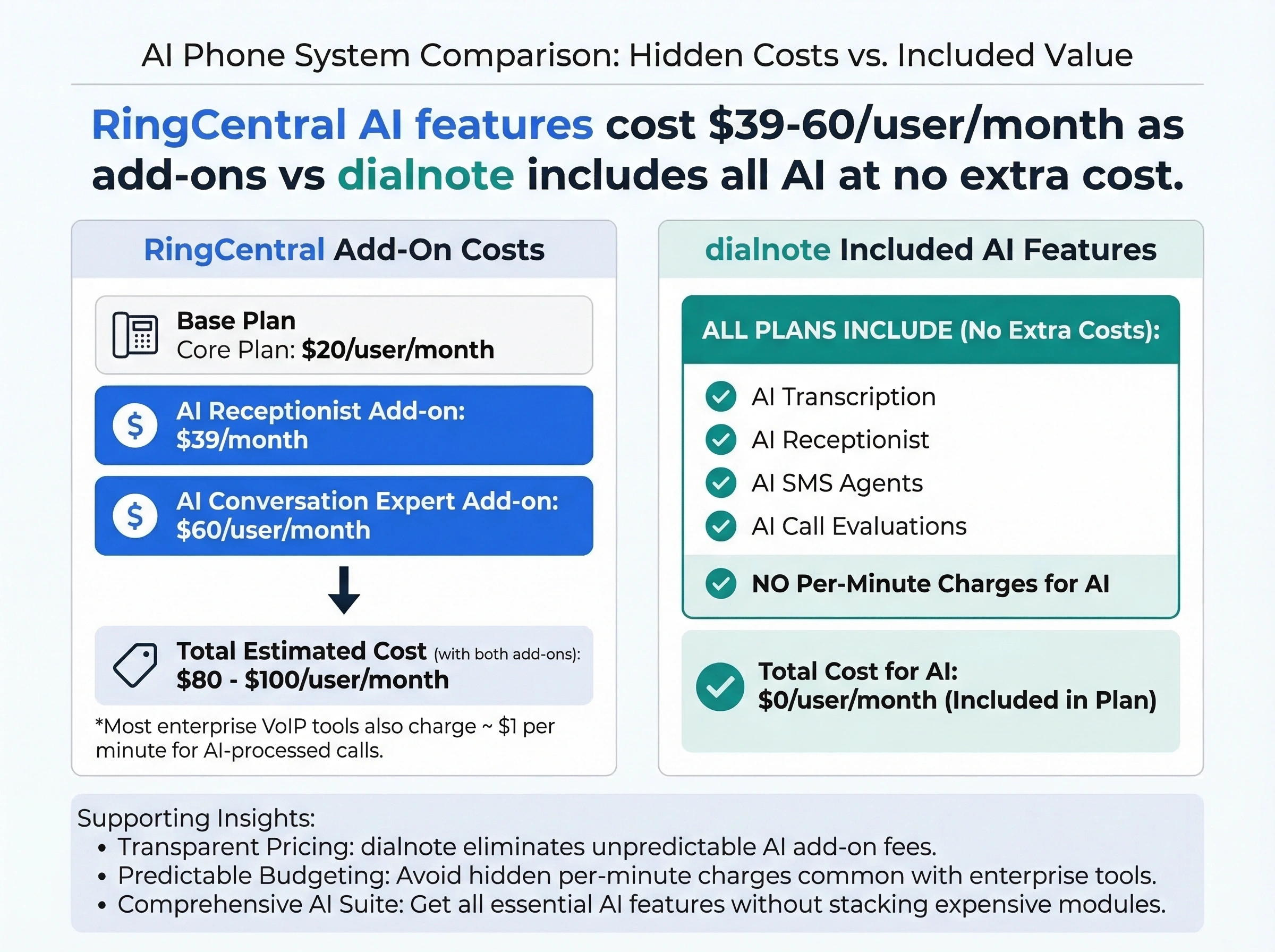
dialnote takes a different approach. AI transcription, call summaries, an AI receptionist, AI SMS agents, and AI call evaluations are all part of every plan, with no separate add-on subscriptions required.
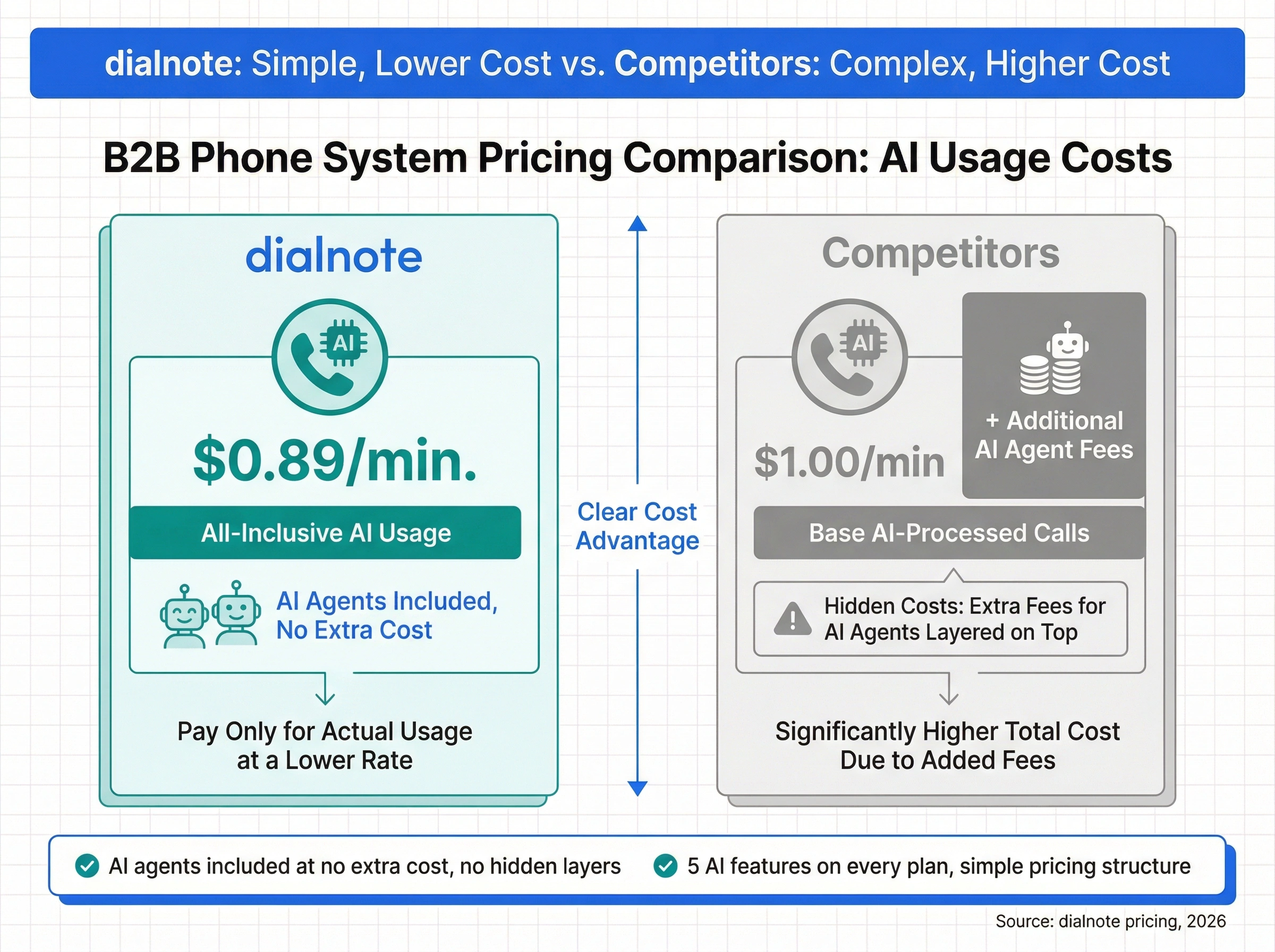
AI usage is charged at $0.89/min. Compare that to most enterprise VoIP tools that charge $1/min for AI-processed calls and then add another layer of fees for AI agents on top. With dialnote, the agents themselves don't cost extra. You only pay for actual usage, at a lower rate. You can also test the AI receptionist live on dialnote's website before signing up, which is a rare and useful option when you're evaluating tools.
What does RingCentral vs Nextiva actually cost?
Most comparison guides stop at the headline price. That's where the misleading begins.
RingCentral pricing (annual billing):
- Core: $20/user/month
- Advanced: $25/user/month
- Ultra: $35/user/month
- AI Receptionist add-on: +$39/month
- AI Conversation Expert add-on: +$60/user/month
- SMS caps: 25-100 messages/user/month depending on plan, then overages apply
Nextiva pricing (annual billing):
- Core: $15/user/month
- Engage: $25/user/month
- Power Suite CX: $75/user/month (contact sales for enterprise)
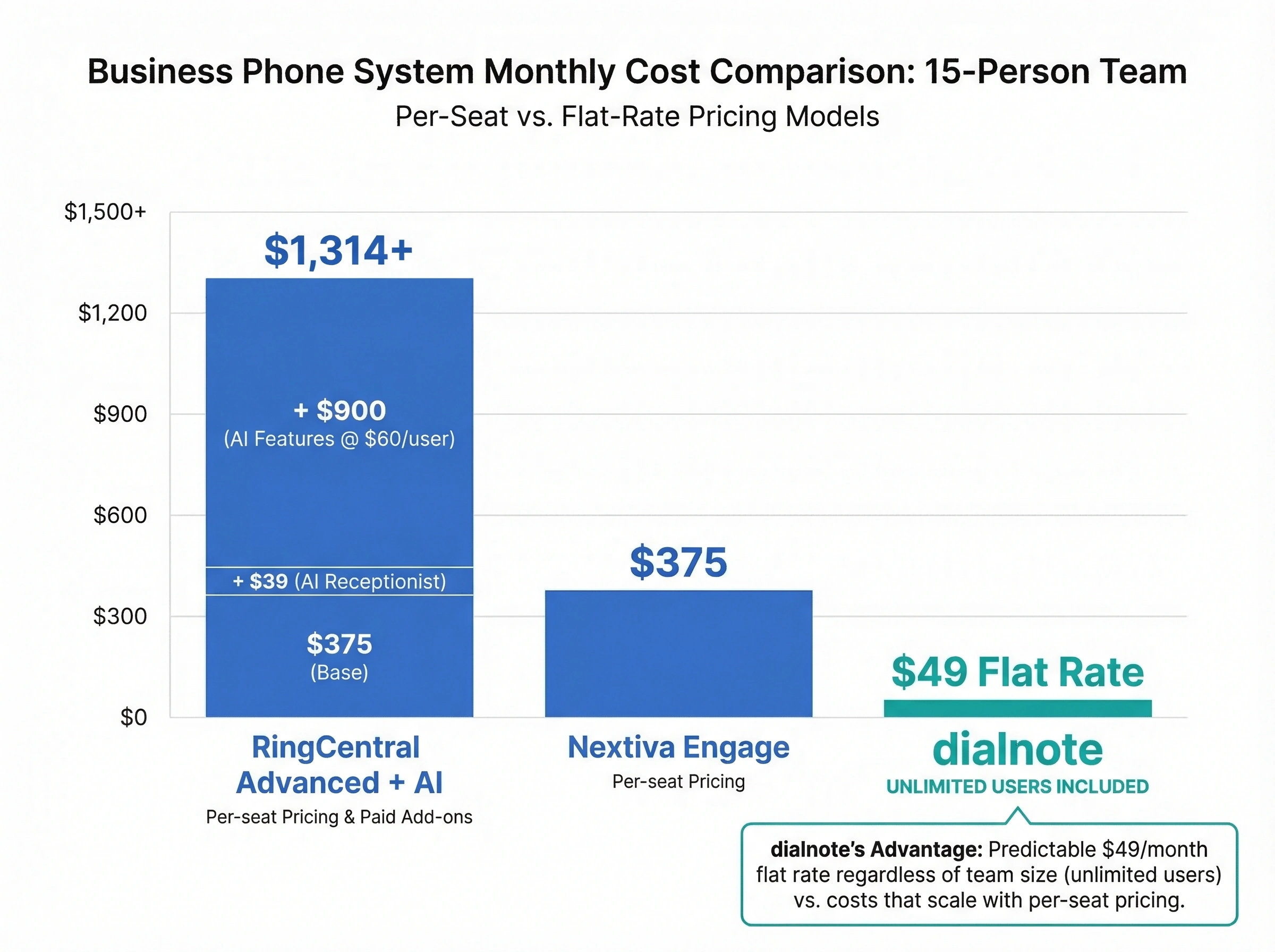
Nextiva is meaningfully cheaper than RingCentral at comparable feature tiers. A 15-person team on Nextiva Engage pays $25 × 15 = $375/month. RingCentral Advanced for the same team costs $25 × 15 = $375/month at the base, but add the AI Receptionist ($39) and the gap widens. If that same team wants AI conversation features on RingCentral, it's $60 × 15 = $900/month in add-ons alone.
But what does that actually cost your team? Honestly, most businesses hit RingCentral's SMS limits within a few months and don't realize it until the overage invoice arrives. The 25-message per user cap on the Core plan is a real operational problem for any team doing outbound outreach or customer follow-ups via text. Nextiva has SMS limits too, though they're less publicized.
Worth flagging: switching from monthly to annual billing cuts about 33% off RingCentral plan costs. If you're evaluating on monthly pricing, the real annual rate is significantly lower. Both platforms use this approach to make monthly pricing look worse by comparison.
dialnote's pricing model is different by design. Its unlimited users pricing plans start at $49/month. A 15-person team pays the same as a 5-person team. As your team grows, the phone bill stays flat. Per-seat plans are available for very small teams that need billing under $49/month, but the unlimited model is where the real value shows up for growing businesses.
What real users say about RingCentral and Nextiva
User reviews are consistent enough on both sides to draw useful patterns.
RingCentral users on G2 and Capterra frequently flag billing complexity, slow support wait times, and unexpected overage charges. "I didn't know the SMS caps were that low until I got the overage invoice," one G2 reviewer noted. Others cite challenges porting phone numbers away from the platform and long resolution times for technical issues. According to G2, RingCentral's support scores 7.8 out of 10 from over 743 reviewers.
Nextiva fares better on support. According to G2, Nextiva's customer support scores 9.0 from over 2,700 customers. US-based support with shorter wait times gets mentioned consistently in positive reviews. Complaints tend to cluster around mobile app stability (crashes after updates are a recurring theme) and the learning curve for the contact center features on higher-tier plans.
According to Gartner Peer Insights, Nextiva holds a 4.7-star rating versus RingCentral's 4.5 in the contact center space. Not a massive gap, but it tracks with the broader pattern: Nextiva wins on support experience, RingCentral wins on integration depth. Which one matters more depends on how your team actually uses the tool day-to-day.
Where both platforms fall short
Despite being established products, RingCentral and Nextiva share several gaps that matter for modern teams.
AI is an add-on, not a foundation. Both platforms built their core products well before AI became central to business communications. The result is AI features that feel retrofitted rather than integrated. You pay extra, configure separately, and the experience isn't as cohesive as tools built with AI from the start.
Per-seat pricing scales against you. Every new hire means another seat charge. For fast-growing teams, that cost compounds quickly. Neither platform offers a meaningful flat-rate alternative for teams that want predictable pricing as they scale.
International coverage is limited. RingCentral focuses primarily on North America and major European markets. Nextiva is even more US/Canada-centric. Teams with global operations often end up patching in separate local number providers, which adds complexity and cost to an already complicated setup.
SMS limits catch teams off guard. Both platforms cap SMS usage well below what most active sales or customer success teams actually need. Overages happen fast, and they add up across a team of any meaningful size.
Support and reliability expectations differ by plan tier. Both platforms offer 99.999% uptime on paper, but user reviews suggest support quality varies depending on what plan you're on and how much revenue you represent to the provider.
Why dialnote stands out as a modern alternative
dialnote was built to include AI as a core product capability, not a paid upgrade. It's part of the SmartReach.io group, which builds B2B SaaS tools used by thousands of teams worldwide, competing with platforms like Outreach, Salesloft, Lemlist, and Pardot. That's a team with serious engineering depth and a proven track record in B2B tooling. dialnote isn't a new startup finding its footing. It's a product backed by a group that's been doing this for years.
After 25 years in SaaS and business marketing, one thing I keep coming back to is that pricing complexity is rarely your friend. When a team can't easily answer "what will we pay next month?", that's a product problem, not a budgeting problem. dialnote's unlimited users model solves that directly. You know what you're paying. Your CFO can plan around it. That predictability has real value.
The AI capabilities are what most teams notice first. AI transcription, call summaries, an AI receptionist, AI-powered SMS agents, and call evaluation are all part of every plan, with no add-on subscriptions and no upgrade required. AI usage costs $0.89/min, which is lower than the $1/min most enterprise VoIP tools charge. And while competitors charge separately for AI agents on top of that, dialnote doesn't. The AI receptionist is also available to test live on dialnote's website, which is a meaningful signal that the team is confident in what it does.
On the global side, dialnote covers calling to 90+ countries, with local numbers in the US, Canada, UK, India, and France (more opened on request). If you take a number in your region and call within that same region, those minutes come from your plan's included pool under fair use, and international calls draw from one shared wallet at published per-country rates. For companies managing distributed or international teams, that removes a layer of complexity that most VoIP platforms leave you to solve elsewhere.
We've seen businesses move to dialnote specifically because they were tired of the pay-per-feature model. For a team doing real call volume with real follow-up work, the economics of included AI add up fast.
RingCentral vs Nextiva: which one should you choose?
Based on pricing, features, and user sentiment, here's a clear breakdown.
Choose RingCentral if:
- You need a large integration library (300+ connectors) and your tech stack already runs on multiple business tools
- You're managing a larger enterprise that benefits from advanced analytics and call monitoring capabilities
- Your primary need is reliable voice and messaging, and you're comfortable paying extra for AI features as add-ons
Choose Nextiva if:
- You want lower base pricing with strong customer support and solid uptime
- You need light CRM functionality like call pop built directly into your phone system without a separate CRM tool
- Your team is primarily US/Canada-focused and doesn't need significant international calling coverage
Choose dialnote if:
- You want AI automation included from day one without per-minute fees or plan upgrades
- Predictable flat-rate pricing matters more than per-seat flexibility as your team grows
- Your team operates across multiple countries and needs real global number coverage
- You want to test an AI receptionist before committing to any platform
If you're still early in the evaluation process, our guide on how to choose the right business phone system walks through the key decision factors. And if you've already looked at other options, our OpenPhone vs RingCentral comparison covers a similar evaluation from a different angle.
The VoIP market has plenty of solid options. The gap between a good product and the right product for your team usually comes down to a few things: how you want to pay, how much AI matters to your workflow, and where your team actually works. RingCentral and Nextiva are both strong. dialnote is worth a serious look if per-seat pricing and add-on AI costs don't fit the way your business operates.
Frequently asked questions
Nextiva edges out RingCentral for most small and mid-size businesses. It's cheaper at $15/user/month vs $20, and G2 users rate Nextiva's support at 9.0 vs RingCentral's 7.8. RingCentral wins on integration depth (300+ vs ~20).
dialnote includes AI transcription, call summaries, AI receptionist, and AI SMS agents on all plans with no add-on subscriptions. AI usage costs $0.89/min, less than competitors' $1/min, who also charge extra for AI agents. RingCentral and Nextiva lock AI behind higher-tier plans.
Yes, but most cost extra. The AI Receptionist is $39/month, and AI Conversation Expert is $60/user/month. Basic AI summaries are included on some plans, but advanced AI features are paid add-ons.
dialnote is a strong alternative with AI automation included, unlimited users pricing starting at $49/month, and calling to 90+ countries. It's built for teams that want AI productivity without complex per-user billing.
Both advertise unlimited calling, but fair use policies apply. RingCentral caps toll-free minutes by plan tier. Nextiva's unlimited applies to US/Canada. Always check the fair use policy before committing.

Written by
Lancelot Dsouza
Chief Marketing Officer, SmartReach.io
Lancelot Dsouza is the Chief Marketing Officer at SmartReach.io, where he built the Marketing, Sales, and Customer Success verticals from the ground up. With over 25 years of experience spanning digital marketing, business development, and strategic...
Lancelot Dsouza is the Chief Marketing Officer at SmartReach.io, where he built the Marketing, Sales, and Customer Success verticals from the ground up. With over 25 years of experience spanning digital marketing, business development, and strategic...
Related Articles
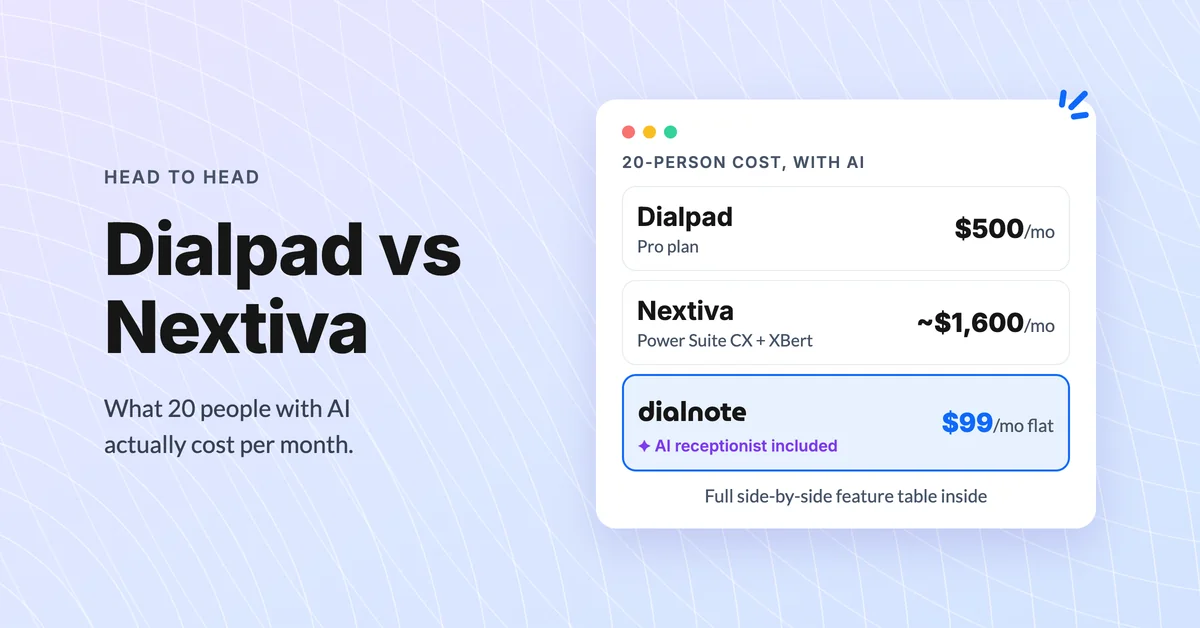
Dialpad vs Nextiva: Which Phone System Wins?
Compare Dialpad vs Nextiva on pricing, AI features, and real-world limits. Discover which business phone system fits your team best in 2026.
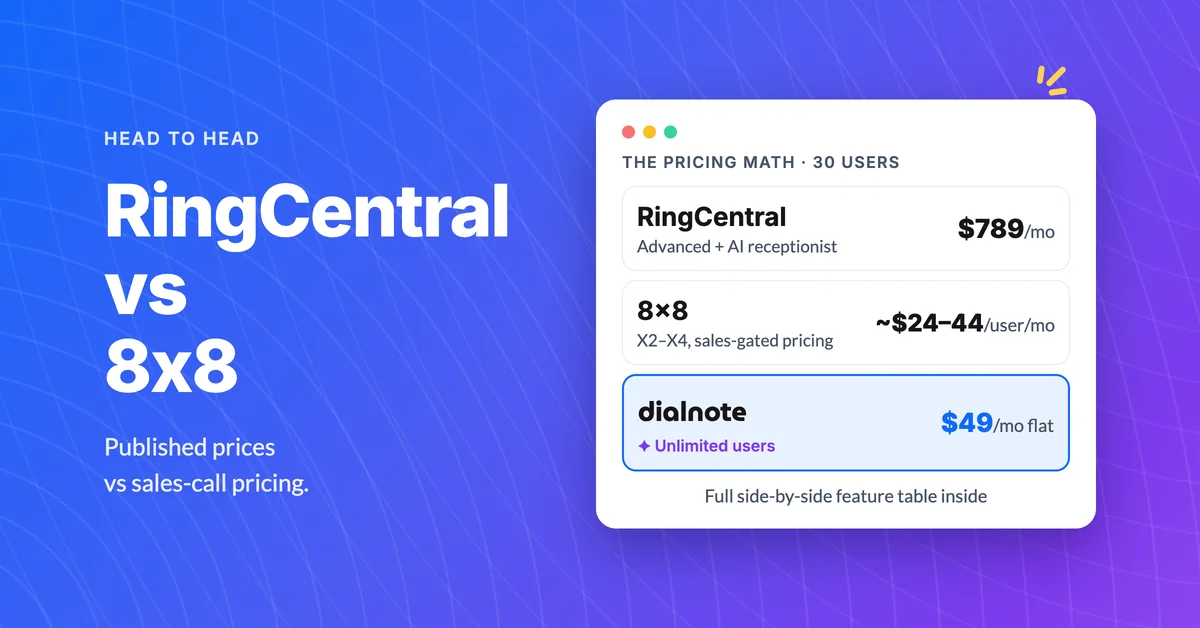
Is RingCentral or 8x8 the Better Business Phone?
Compare RingCentral vs 8x8 on pricing, AI features, and user reviews. Find out which business phone system wins and why dialnote is worth a look.
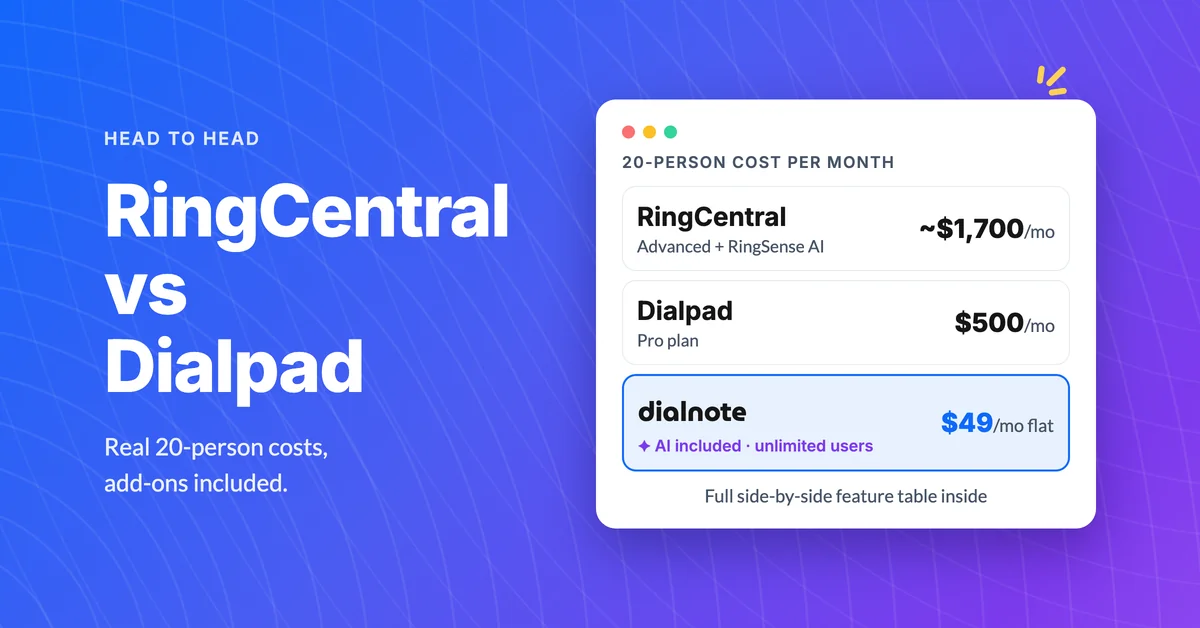
RingCentral vs Dialpad: Best Business Phone?
Compare RingCentral vs Dialpad on pricing, AI features, and real-world limits. Find out which business phone system fits your team.