OpenPhone vs Dialpad: Pricing & Features
Picking a business phone system shouldn't take a week of research. But when you start comparing OpenPhone vs Dialpad, that's exactly what happens. Feature lists, pricing tiers, AI add-ons, fair use fine print. It piles up fast.
Amy runs a sales team at a 20-person software company. She spent days reading comparison pages and sitting through demos. Both platforms looked promising, but in different ways. OpenPhone was clean and easy to pick up. Dialpad had the AI tools her reps kept asking about. The hard part was figuring out which one actually fit her team's workflow and budget. Sound familiar?
Both OpenPhone and Dialpad are solid products. But they're built for different kinds of businesses, and neither one gives you the full picture without pushing you into pricier plans. This OpenPhone vs Dialpad comparison breaks down the real differences in features, pricing, and AI capabilities.
We'll also bring in dialnote, an AI-first phone system from the team behind SmartReach.io (which competes with tools like Outreach.io and Salesloft), to show how a third option fills the gaps both leave behind.
TL;DR:
- In the OpenPhone vs Dialpad comparison, both start at $15/user/month (annual billing), but the per-seat model means a 15-person team pays $345 to $375/month.
- OpenPhone (now Quo) is the simpler pick for small teams that mostly call and text; Dialpad packs in video, real-time AI coaching, and call queues, but hides many of them behind higher tiers or a separate contact center product.
- Both advertise "unlimited" US/CA calling but enforce fair use caps (around 1,000 minutes for OpenPhone, roughly 3,000 for Dialpad).
- dialnote offers unlimited users for a flat $99/month (Business) with AI transcription, call summaries, and CRM auto-updates included, so your cost stays the same whether you have 5 seats or 50.
- You can port your existing number to any of the three; the switch usually takes about 1 to 2 weeks.
A quick look at OpenPhone and Dialpad
OpenPhone launched as a simple phone system for startups and small teams. It's built around calling, texting, and shared inboxes. In late 2025, OpenPhone rebranded to Quo and raised $105 million in growth financing. The product stayed mostly the same, just with a new name and a bigger push into AI-powered tools like Sona, their AI voice agent.
If you've been searching for "OpenPhone" lately, you've probably noticed some confusion. Review sites still use the old name. Some list it as "Quo (formerly OpenPhone)," while others stick with OpenPhone. We'll use "OpenPhone" here since that's what most people still search for. Just know it's officially Quo now.
Dialpad takes a different approach. It positions itself as an AI-powered unified communications platform with voice, video, messaging, and a contact center product. The company has been investing heavily in its proprietary AI, which it says has processed over five billion minutes of voice data. Dialpad serves everyone from small teams to large enterprises, and the feature list reflects that range.
Both platforms give you VoIP calling, mobile and desktop apps, and CRM integrations. But the similarities thin out fast once you look at how each handles AI, pricing, and team workflows. (If you're still weighing whether VoIP is the right move at all, our VoIP vs traditional phone lines breakdown covers the basics.)
OpenPhone vs Dialpad: how do the features compare?
OpenPhone focuses on the basics and does them well. You get calling and texting in the US and Canada, shared phone numbers, voicemail transcription, and a clean interface that's easy to pick up. For teams that mostly need voice and text, OpenPhone handles that without burying you in settings panels.
OpenPhone also added Sona, an AI voice agent that answers calls when your team isn't available. Sona greets callers, responds to common questions using info you provide, and captures messages. It's a solid tool for businesses that can't afford to miss calls after hours.
But Sona comes with limits. You get 10 free AI calls per month on the Starter plan, and it's more of a virtual receptionist than a real-time coaching tool.
Dialpad packs in more. Real-time call transcription, AI-powered coaching cards that pop up during live calls, automated post-call summaries, and sentiment analysis. Video meetings come built in, along with team messaging channels. If you want a single platform for voice, video, and internal chat, Dialpad covers that ground.
But here's the thing. Many of Dialpad's standout features, like custom integrations and call queues, live behind the Pro plan. And the AI contact center tools sit in a completely separate product with its own pricing. The Essentials contact center plan alone starts at $80/user/month. So what you see on the marketing page isn't always what you get on the plan you can afford.
One difference worth noting: Dialpad gives you real-time transcription on every plan, while OpenPhone reserves transcription for the Business tier. If live transcription matters to your team (and for sales teams reviewing calls, it really should), that's a point in Dialpad's favor at the base price level.
Then there's the question of call management. OpenPhone keeps it straightforward with basic call forwarding and shared numbers. Dialpad goes deeper with call queues, ring groups, and multi-level IVR menus. For teams that handle a high volume of inbound calls, those routing tools can mean the difference between a caller reaching someone and hitting voicemail.
Here's how all three platforms compare across the features that matter most:
| Feature | OpenPhone (Quo) | Dialpad | dialnote |
|---|---|---|---|
| Starting price | $15/user/mo | $15/user/mo | $49/mo (unlimited users) |
| Calling (US/CA) | Included (fair use) | Included (fair use) | Included (fair use) |
| International numbers | US + Canada only | 70+ countries | US, CA, UK, India, France |
| Shared phone numbers | ✓ | ✓ | ✓ |
| Video conferencing | ✗ | ✓ (built-in) | No (calls only) |
| AI call transcription | Business plan ($23/user) | ✓ (all plans) | ✓ (all plans) |
| AI call summaries | Business plan ($23/user) | ✓ (all plans) | ✓ (all plans) |
| AI receptionist/voice agent | Sona (10 free calls/mo) | Separate product | ✓ (1 agent Team, 5 Business, 10 Pro) |
| Real-time AI coaching | ✗ | Pro plan ($25/user) | Coming soon |
| AI call evaluations | ✗ | Enterprise only | ✓ (Pro plan) |
| AI call tags | Business plan | ✗ | ✓ (Pro plan) |
| Auto CRM updates | ✗ | ✗ | ✓ (Team plan+) |
| Call queueing | ✗ | Pro plan | ✓ (Pro plan) |
| SMS/messaging | Limited | 250 msgs/user/mo | 750 texts/mo on Team, then wallet |
| Call recording | Business plan | ✓ (all plans) | ✓ (automatic from Team) |
| CRM integrations | HubSpot, Salesforce | HubSpot, Salesforce, Zoho | HubSpot (Team+), Salesforce and Pipedrive (Business+) |
| Shared inboxes | ✓ | ✓ | ✓ |
What does each platform cost?
OpenPhone starts at $15/user/month (billed annually) for the Starter plan. This gets you calling, texting, voicemail transcription, and basic AI features. The Business plan bumps to $23/user/month and adds call recording, analytics, IVR menus, and more AI tools. The Scale plan runs $35/user/month for larger teams.
Dialpad's Standard plan starts at $15/user/month (annual billing). But watch the monthly pricing. If you pay month-to-month, it jumps to $27/user/month. That's almost double. The Pro plan costs $25/user/month annually and adds international SMS, CRM integrations, and more customization. Enterprise pricing isn't listed. You'll need to call sales.
But what are you actually getting for that price?
With both OpenPhone and Dialpad, you're paying per user. Every new hire adds to the bill. A 15-person team on OpenPhone Business runs $345/month. With Dialpad Pro, the same team costs $375/month. Those numbers climb steadily, and neither platform offers a way out of per-seat pricing.
dialnote flips that model. Instead of charging per seat, dialnote's pricing plans offer unlimited users starting at $49/month (Team), $99/month (Business), and $199/month (Pro). Your team of 5 pays the same as your team of 50. You don't have to worry about the cost every time you onboard someone new. (If you work alone, the Solo plan is $19/month for one user, without an AI agent.)
| OpenPhone (Business) | Dialpad (Pro) | dialnote (Business) | |
|---|---|---|---|
| 5 users | $115/mo | $125/mo | $99/mo |
| 15 users | $345/mo | $375/mo | $99/mo |
| 25 users | $575/mo | $625/mo | $99/mo |
| 50 users | $1,150/mo | $1,250/mo | $99/mo |
The cost gap gets wider with every seat you add. For teams planning to grow in the next year or two, per-user pricing can quietly eat into your budget.
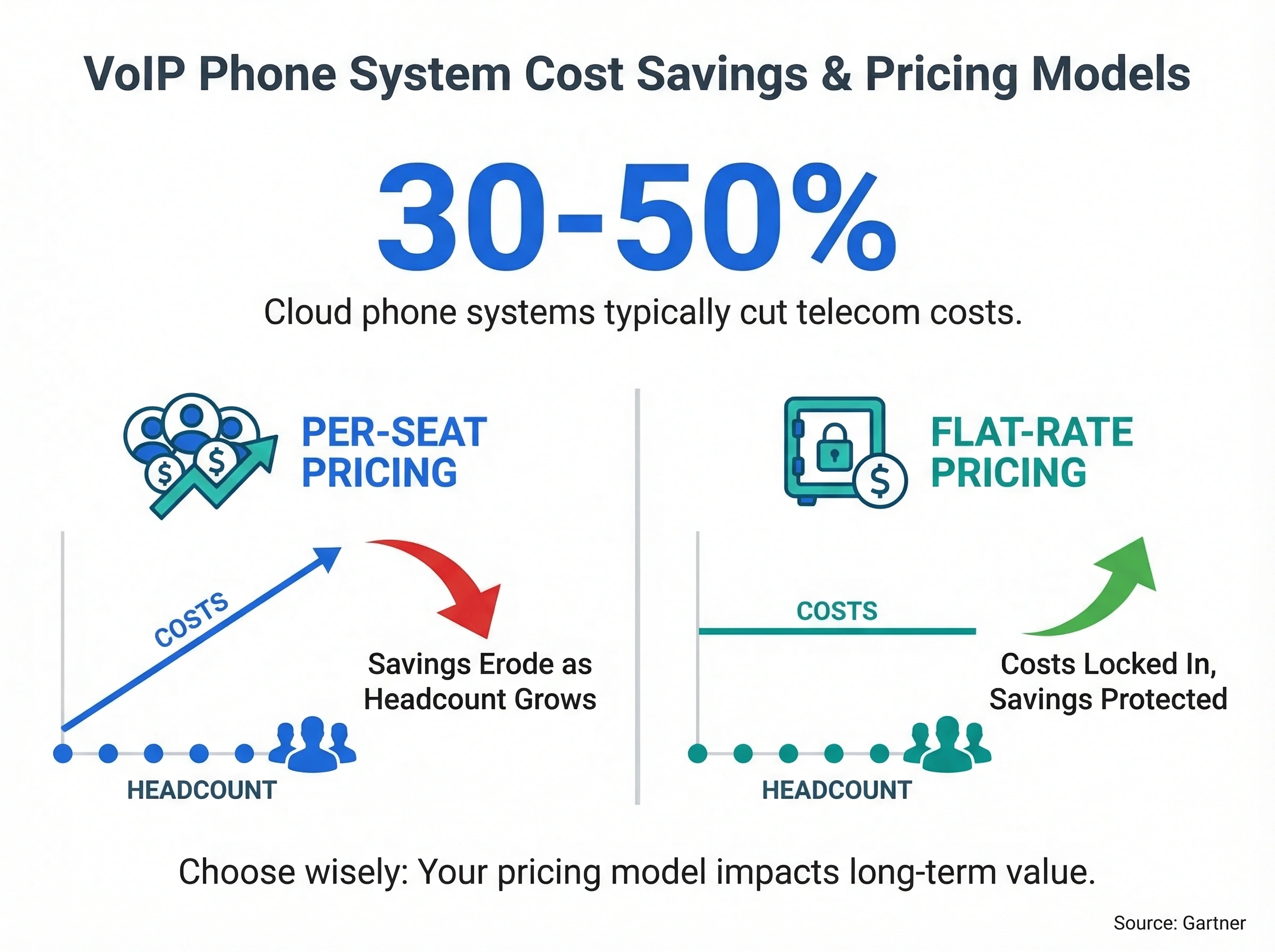
According to Gartner, businesses switching to cloud-based phone systems typically cut telecom costs by 30-50%. But those savings depend heavily on the pricing model you choose. Per-seat plans can erode the savings as your headcount grows, while flat-rate plans lock in your costs.
The "unlimited calling" fine print
Here's something most comparison articles won't tell you: none of these platforms actually offer truly unlimited calling. All three, OpenPhone, Dialpad, and dialnote, have fair use policies that cap your minutes.
OpenPhone's fair use limit sits around 1,000 minutes per user per month. Dialpad is more generous at roughly 3,000 minutes. For a sales team making 50+ calls a day, those limits get hit faster than you'd think. Once you go over, expect overage charges or a warning from the provider.
There's also add-on costs most comparison articles skip. OpenPhone charges $5/month per additional phone number. Dialpad charges $9/month per extra number, plus $15/month for toll-free numbers with a $0.02/minute surcharge. With dialnote's Business plan, you get 3 phone numbers included, and additional local numbers cost $5/month. Plus, dialnote offers numbers in the US, Canada, UK, India, and France (more countries opened on request), with calling to 90+ countries, and no enterprise contract needed.
The bottom line on pricing: factor in calling overage charges, add-on numbers, and per-seat costs together. The sticker price on a plan page rarely tells the full story.
Where do AI features fit in?
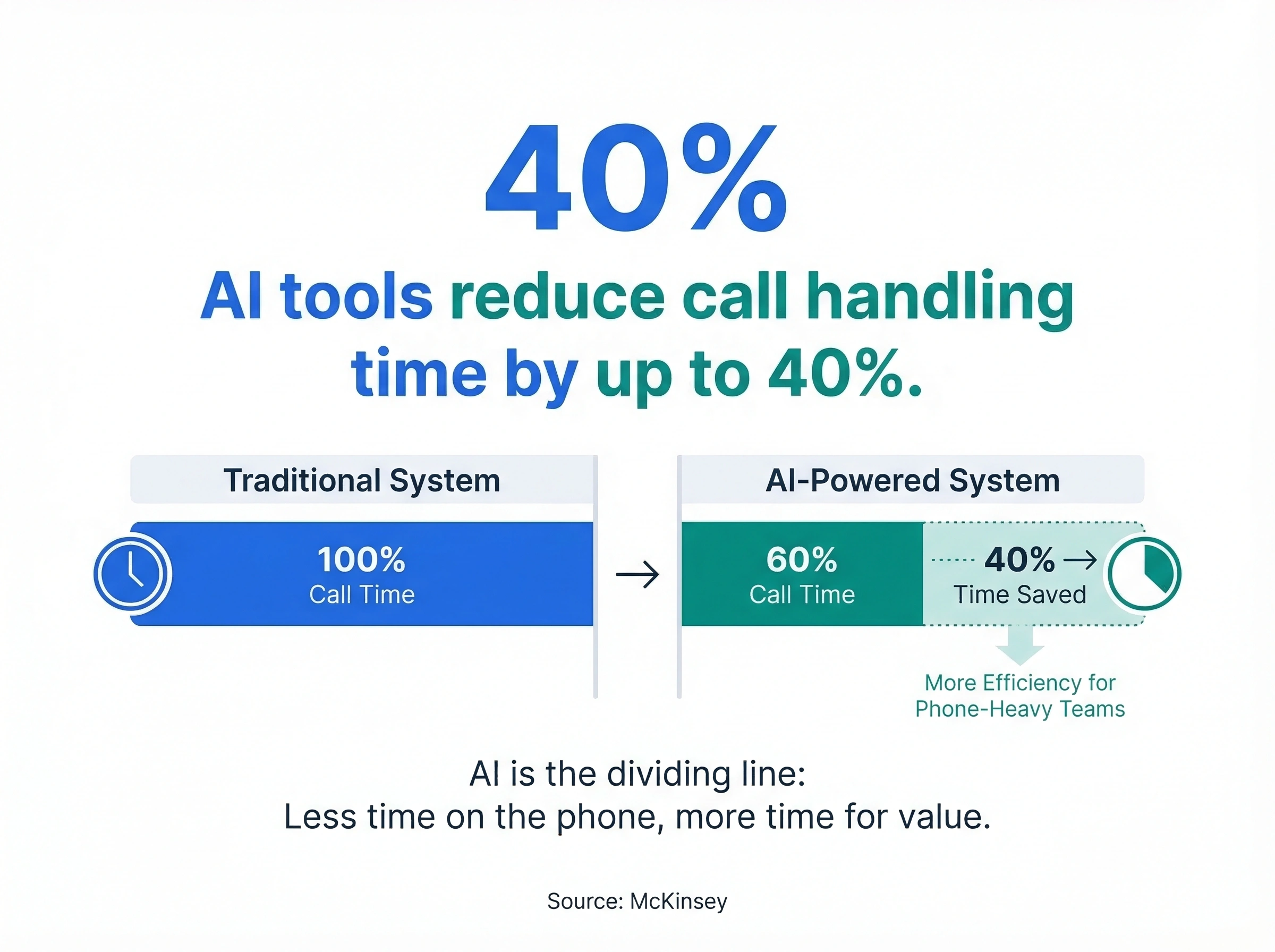
AI is quickly becoming the dividing line between phone systems that save time and ones that just make calls. According to McKinsey, AI-powered tools can reduce call handling time by up to 40%. That's not a small number when you're running a team that lives on the phone.
Dialpad has the strongest native AI story of the two established players. Its real-time transcription runs on all plans, and the AI coaching cards are genuinely useful. Managers can create custom cards that trigger during live calls when specific topics come up.
Rep mentions a competitor's name? A card pops up with talking points. Customer asks about pricing? The objection-handling script appears automatically. It's smart, and Dialpad says 97% of its contact center clients use AI features actively.
OpenPhone's AI capabilities are newer and more limited. Sona handles inbound calls, answers basic questions, and captures messages. AI call tags automatically categorize calls (like "Pricing Inquiry" or "Urgent") so managers can spot trends without listening to every recording. It's helpful, but it's focused on after-the-fact organization rather than real-time support.
So which platform gives you more AI for your money?
That depends on what you need AI to do. If you want live coaching during calls, Dialpad wins that specific feature. Its custom AI cards are a genuinely useful tool for sales managers who want to coach without hovering over reps' desks. If you want an AI agent answering calls 24/7, OpenPhone's Sona handles that, though it's limited to 10 free calls per month.
Zoom out a bit, though, and a pattern shows up. Both platforms treat their best AI features as premium upgrades rather than core functionality. Dialpad's most advanced AI tools sit in separate products (AI Contact Center starts at $80/user/month). OpenPhone's Sona is limited and call evaluations aren't available at all.
dialnote includes more AI in the plan itself. The Business plan ($99/month for unlimited users) includes AI call transcription, automatic call summaries with action items, and AI-powered CRM updates that log call details to HubSpot, Salesforce, or Pipedrive without your reps lifting a finger.
The Pro plan ($199/month, still unlimited users) adds AI call evaluations that score your reps' calls, AI call tags for automatic categorization, and up to 10 AI voice agents with branded voices in 14 languages. AI voice agents come with every plan from Team up, with no per-user or per-agent fee: AI calls are $25/mo for 65 with the AI call pack, or $0.49/min from the wallet without one. That gets you a 24/7 agent that handles calls, answers questions, captures leads, and transfers calls. (We wrote a full breakdown of AI answering service costs and setup if you want the details.)
Hard to say how much each vendor's AI accuracy really differs in practice, but the feature gaps are clear. dialnote bundles what others split across plans and add-ons.
Where both platforms fall short
Every phone system has trade-offs. Here's where OpenPhone and Dialpad leave room for improvement.
OpenPhone's gaps:
- No video meetings. If your team does video calls, you'll need a separate tool.
- AI features are limited on the Starter plan. You need the Business plan ($23/user/month) for call recording, analytics, and advanced AI.
- No call queueing or AI call evaluations on any plan.
- According to user reviews on G2 and TrustRadius, customer support response times can be slow, especially on lower-tier plans. One reviewer noted, "Got billed for a full year after trial. Support took weeks to fix it."
- Per-user pricing only. No unlimited seats option.
- Fair use calling limit of ~1,000 minutes, one of the lowest in the market.
Dialpad's gaps:
- The Standard plan looks affordable at $15/user/month, but month-to-month pricing nearly doubles to $27/user/month. That catch surprises a lot of buyers.
- Texting is capped at 250 messages per user per month on the Standard plan. For sales teams that text prospects, that's tight.
- Users on G2 and TrustRadius report occasional call quality issues, including dropped calls and audio lag during high-volume periods.
- Advanced AI features (contact center, agentic AI tools) require separate products with their own pricing. The base UCaaS product and the AI contact center are different purchases.
- Billing complaints show up regularly in reviews. Some users report being charged after cancellation.
Honestly? Both platforms make you pay extra for the features that save the most time. Call recording, AI transcription, and real-time analytics should be standard tools, not upsells on a higher plan.
Why dialnote might be the better pick
We've been watching the OpenPhone vs Dialpad debate play out for years. Both are solid tools. But after spending over two decades in B2B tech, here's what I've seen happen over and over: teams pick the cheapest plan, outgrow it in six months, and either pay a lot more or start the whole vendor search again.
And dialnote isn't a startup figuring things out. It's built by the same team behind SmartReach.io, a sales engagement platform that competes with Outreach.io, Salesloft, and Lemlist. They know what sales teams need because they've been building tools for them for years.
dialnote is built to skip the upgrade cycle. Here's what makes it different:
Unlimited users pricing that doesn't punish growth. The Business plan is $99/month for unlimited users. Your team of 10 pays the same as your team of 50. No per-seat math every time you hire.
AI included from day one, not gated behind add-ons. Call transcription, automatic summaries, CRM auto-updates, and voicemail transcripts come with the Business plan. No separate AI product. No per-feature charges.
A full AI voice agent with no per-user fee. dialnote's AI agent answers calls (in 14 languages from the Business plan), responds to questions, captures lead info, schedules follow-ups, and transfers calls. On the AI call pack, calls work out to about $0.38 each. Without a pack, AI calls bill at a published $0.49/min from the wallet. It works 24/7, and you can test the AI receptionist on dialnote's website before signing up.
Integrations that actually save time. dialnote connects natively to HubSpot, Salesforce, Pipedrive, Calendly, and Cal.com, plus 5,000+ apps via Zapier. But the real value is in the AI call summaries. After every call, dialnote pushes a summary with key points and next steps directly into your CRM. Your reps don't spend 10 minutes after each call typing up notes.
Calling to 90+ countries. dialnote sells local and toll-free numbers in the US, Canada, UK, India, and France, opens new countries on request, and covers calling to 90+ countries with transparent rates. You don't need an enterprise plan to work internationally.
No video bundled. dialnote doesn't build video like Dialpad does; teams keep their meetings on the Zoom or Meet account most of them already have.
This isn't about saying OpenPhone or Dialpad are bad products. They're not. But they're both built on per-seat pricing that charges you more as you grow, and they both keep their best AI features behind higher tiers or separate products.
Which OpenPhone vs Dialpad alternative fits your team?
Picking between OpenPhone vs Dialpad comes down to what your team needs most.
Pick OpenPhone if your team is small, mostly does calling and texting, and wants the simplest possible interface. It's clean, easy, and works well for teams under 10 who don't need advanced AI or video.
Pick Dialpad if you need built-in video meetings and want real-time AI coaching on calls. It's a strong choice for teams that are already using Dialpad's contact center tools.
Pick dialnote if you want AI features included from the start, unlimited users pricing that doesn't scale with headcount, and a phone system that handles the after-call busywork automatically. It's especially strong for growing teams and inbound call centers that need AI transcription, call summaries, CRM updates, a 24/7 AI voice agent, and (on Pro) call evaluations, all without paying per seat.
According to Fortune Business Insights, the global VoIP market is projected to grow from $195 billion in 2026 to nearly $389 billion by 2034. AI-powered features are a major driver of that growth. Picking a phone system today without strong AI capabilities is like buying a smartphone without apps. It works, but you're leaving a lot of value on the table.

The bottom line: if you're comparing OpenPhone vs Dialpad, you're already asking the right questions about what your team needs. Just don't stop at two options. A third one might save you more money and more time than either of them.
You can try dialnote's AI receptionist right on the website, or start a free 10-day trial to test the full platform. No credit card required.
Frequently asked questions
OpenPhone (now Quo) is a simple business phone for calling and texting. Dialpad is a broader platform with voice, video, messaging, and AI coaching tools. OpenPhone is simpler; Dialpad has more features but costs more per user at scale.
Both start at $15/user/month (annual billing). But per-seat pricing adds up fast. A 15-person team pays $345-$375/month. dialnote offers unlimited users for $99/month flat, which is far cheaper at that scale.
Not exactly. Both advertise unlimited US/CA calling, but enforce fair use limits. OpenPhone caps around 1,000 minutes and Dialpad around 3,000 minutes per user. Real businesses can hit these limits quickly.
Dialpad offers real-time AI coaching cards and transcription on all plans. OpenPhone's AI is newer with its Sona voice agent. dialnote's Business plan includes transcription, summaries, CRM auto-updates, and AI voice agents; AI calls are $25/mo for 65 with the AI call pack, or $0.49/min beyond it.
Yes. You can port your existing business number to most VoIP providers including dialnote. The process takes about 1-2 weeks, and your new provider handles the paperwork.

Written by
Lancelot Dsouza
Chief Marketing Officer, SmartReach.io
Lancelot Dsouza is the Chief Marketing Officer at SmartReach.io, where he built the Marketing, Sales, and Customer Success verticals from the ground up. With over 25 years of experience spanning digital marketing, business development, and strategic...
Lancelot Dsouza is the Chief Marketing Officer at SmartReach.io, where he built the Marketing, Sales, and Customer Success verticals from the ground up. With over 25 years of experience spanning digital marketing, business development, and strategic...
Related Articles
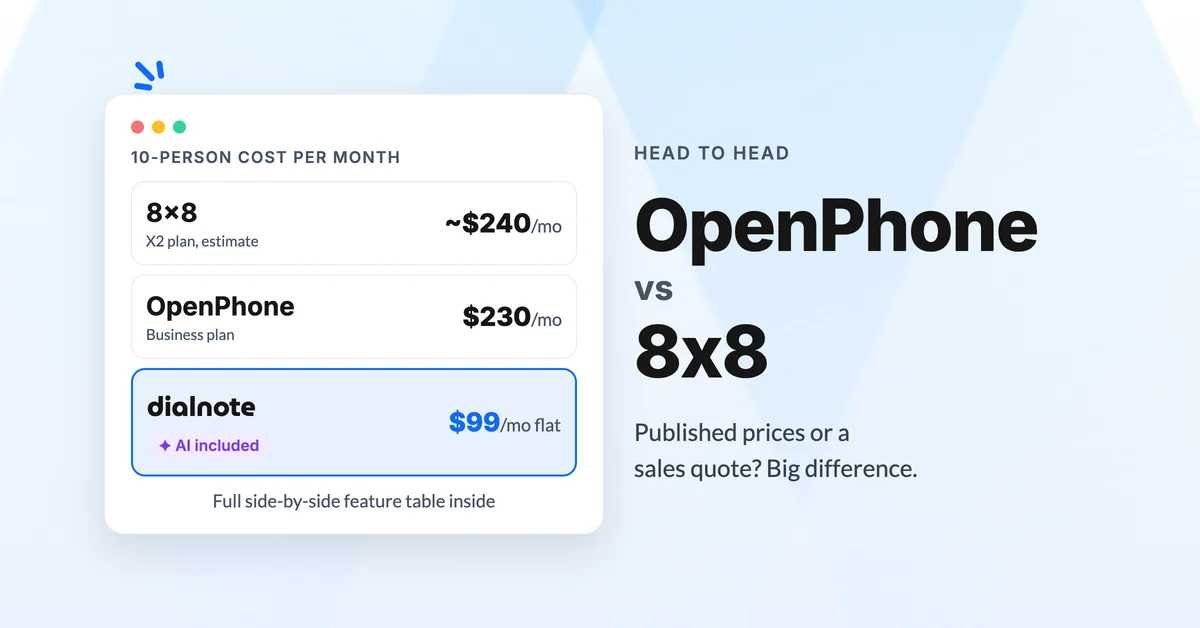
OpenPhone vs 8x8: Which Should You Choose?
Compare OpenPhone vs 8x8 on pricing, quote-only sales, and AI answering, then see why dialnote may fit small teams better than both.
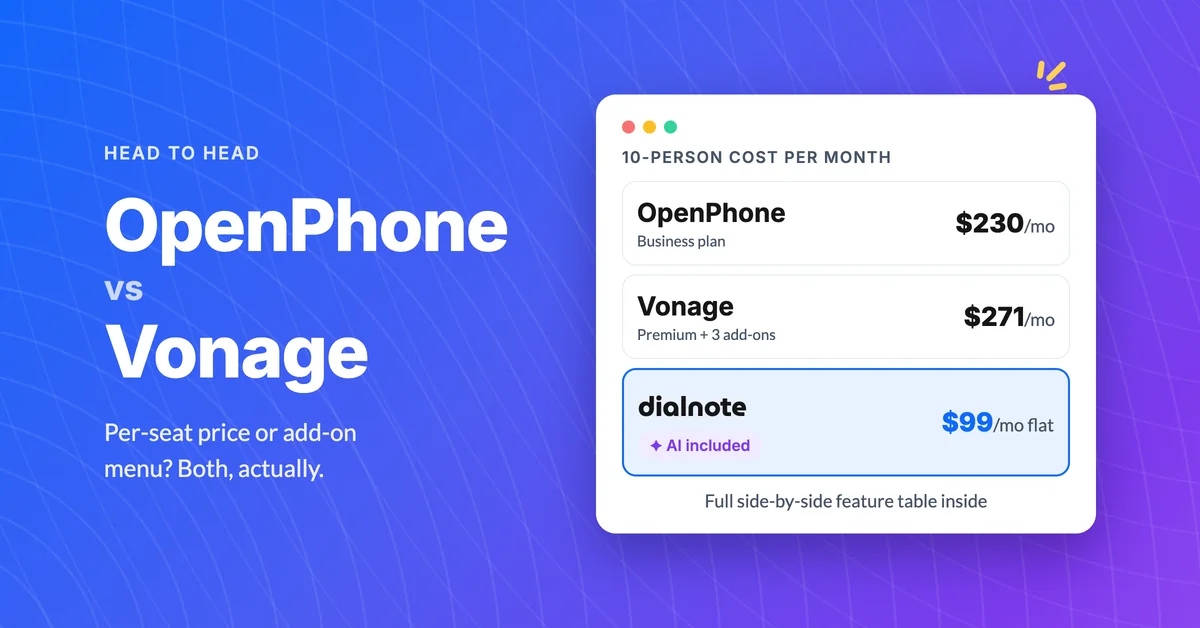
OpenPhone vs Vonage: Which Is Better Value?
Compare OpenPhone vs Vonage on pricing, add-on fees, and AI answering, then see why dialnote may be the better value for small teams.
OpenPhone vs JustCall: Which Is Better for Teams?
Compare OpenPhone vs JustCall on pricing, AI tiers, and hidden minimums, then see why dialnote may be the smarter pick for small teams.