Is RingCentral or 8x8 the Better Business Phone?
Nick manages operations at a 30-person B2B services firm. His phone system evaluation came down to two names: RingCentral and 8x8. Both have enterprise credibility. Both offer voice, video, and messaging under one roof.
Both have pricing pages that look reasonable until you start adding team members, AI features, and international numbers. Sound familiar?
The RingCentral vs 8x8 decision is one of the most common comparisons in the business phone market. Both platforms have been around for decades and have real strengths worth understanding. But they're built on different priorities, and those priorities affect what you actually pay, how much AI you get, and what the experience looks like when something breaks.
This guide covers both platforms head to head on pricing, features, AI capabilities, and real user feedback. We'll also look at a third option, dialnote, that's worth adding to your shortlist. It addresses several gaps both RingCentral and 8x8 share, particularly around AI automation and flat-rate pricing.
TL;DR:
- In the RingCentral vs 8x8 comparison, RingCentral wins on integrations (300+) and US/Canada call depth, while 8x8 wins on international calling (up to 48 countries) and unlimited SMS on every plan.
- Neither RingCentral nor 8x8 includes meaningful AI on their base plans. AI transcription, receptionist, and coaching features cost extra ($39-60/user/month) or sit behind the contact center tier.
- RingCentral publishes its pricing (Core $20, Advanced $25, Ultra $35 per user/month), but 8x8 hides its rates behind a sales call, with X2 around $24 and X4 around $44 per user/month.
- 8x8 rates higher on Gartner (4.6/5) than RingCentral (4.4/5), but 8x8 draws consistent complaints about slow support for smaller accounts.
- dialnote is a flat-rate alternative that includes AI transcription, call summaries, an AI receptionist, SMS agents, and call evaluation on every plan, with unlimited-user pricing from $49/month.
A quick look at RingCentral and 8x8
RingCentral launched in 1999 and is one of the most recognized names in business communications. It serves companies of all sizes with a full stack of voice, video, messaging, and contact center capabilities. Its integration library covers 300+ native connectors for CRM, helpdesk, and productivity tools. RingCentral also scores well on call management depth, advanced analytics, and call monitoring features that become more important as teams get larger.
8x8 has been around since the 1980s and positions itself as a unified communications platform built for global teams. Its clearest advantage is international calling: the X4 plan covers unlimited calls to 48 countries, far ahead of most US-centric VoIP providers. 8x8 also offers unlimited SMS on all plans and video meetings that support up to 500 participants on the base plan. It's a broader platform, but the added complexity shows up in the interface and, more consistently, in the support experience.
Both are mature, capable platforms. Neither is a poor choice for the right team. But the differences in pricing structure, AI positioning, and support quality carry more weight than most surface-level comparisons acknowledge.
How do RingCentral and 8x8 compare on features?
RingCentral and 8x8 both cover the core business communications stack: VoIP calling, team messaging, video meetings, call recording, mobile apps, and IVR. Where they diverge is in integration depth, global coverage, and how they handle SMS.
RingCentral goes deep on integrations and call management. Advanced call monitoring (whisper, barge, listen), multi-level IVR, call queues, and analytics dashboards all work well for managing larger teams. The 300+ integrations cover Salesforce, HubSpot, Zendesk, Slack, and hundreds of other tools most businesses already use.
8x8 goes broader on international reach and capacity. X2 covers unlimited calling to 14 countries. X4 covers 48. Video meetings support up to 500 participants on the base plan, with YouTube live streaming built in.
SMS is unlimited across all plans, which is a meaningful advantage over RingCentral's cap-based approach.
Does that actually matter for your team? It depends entirely on where your customers are and how you reach them. For a US-focused team doing outbound calls and CRM-heavy workflows, RingCentral's integration depth is hard to beat. For a distributed team with customers across Europe, Asia, or Latin America, 8x8's international calling coverage changes the math.
Here's how both platforms compare across key capabilities, alongside dialnote as a third option:
| Feature | RingCentral | 8x8 | dialnote |
|---|---|---|---|
| Starting price | $20/user/month | ~$24/user/month | $49/month (unlimited users) |
| Pricing model | Per seat | Per seat | Unlimited users or per seat |
| Unlimited users option | No | No | Yes |
| AI transcription | Add-on ($60/user/mo) | Contact center tier | Included |
| AI call summaries | Core plan | Contact center tier | Included |
| AI receptionist | Add-on ($39/mo) | Contact center tier | Included |
| AI SMS agent | No | No | Included |
| AI call evaluation | No | Contact center tier | Included |
| Auto CRM updates | Advanced plan | Salesforce, Freshdesk | Included |
| Bulk SMS | 25-200/user/mo (capped) | Unlimited | Coming soon |
| Call queueing | Advanced plan | All plans | Included |
| IVR | All plans | All plans | Included |
| SMS limits | 25-200/user/mo | Unlimited | Fair use |
| Integrations | 300+ | ~70 | Native CRM + Zapier (5,000+ apps) |
| Video conferencing | 100-200 participants | Up to 500 participants | No (calls only) |
| International numbers | Limited (add-on) | 14-48 countries | US, CA, UK, India, France |
| Calling limits | US/Canada unlimited; international metered | 3x average fair use; 14-48 countries | In-region pool + wallet (fair use) |
Which platform handles AI better?
AI is where the RingCentral vs 8x8 gap is most visible, and it's also where both platforms fall noticeably short compared to newer entrants.
RingCentral has invested in AI, but the meaningful features cost extra. The AI Receptionist (AIR), launched in early 2025, is a separate add-on at $39/month. It generates a setup from your website URL, handles inbound calls, books appointments, and integrates with Google Calendar and Outlook. That's genuinely useful.
The AI Conversation Expert, which adds real-time transcription, sentiment analysis, and coaching prompts, runs $60/user/month on top of your base plan. If you're on the Core plan at $20/user/month and want both AI features, your effective cost is $80-100/user/month in total. For a 15-person team, that's a big jump.
8x8 has built more AI into its contact center product. The Intelligent Customer Assistant handles self-service interactions across voice and digital channels. Agent Assist provides live guidance, call summaries, and next-best-action prompts during active calls. According to 8x8, Intelligent Customer Assistant contracts grew 75% year over year in Q1 FY2026, which suggests real adoption.
But these tools are primarily available at the contact center tier, not the standard UCaaS plans most small and mid-size businesses use. If you're on 8x8's base plan, AI is largely absent.
It's hard to say definitively which platform will have the stronger AI roadmap 18 months from now, but based on what's available today, both treat AI as something you pay extra for rather than something built into the product. That gap matters when you're trying to get real productivity gains from automation without managing a growing stack of add-on fees.
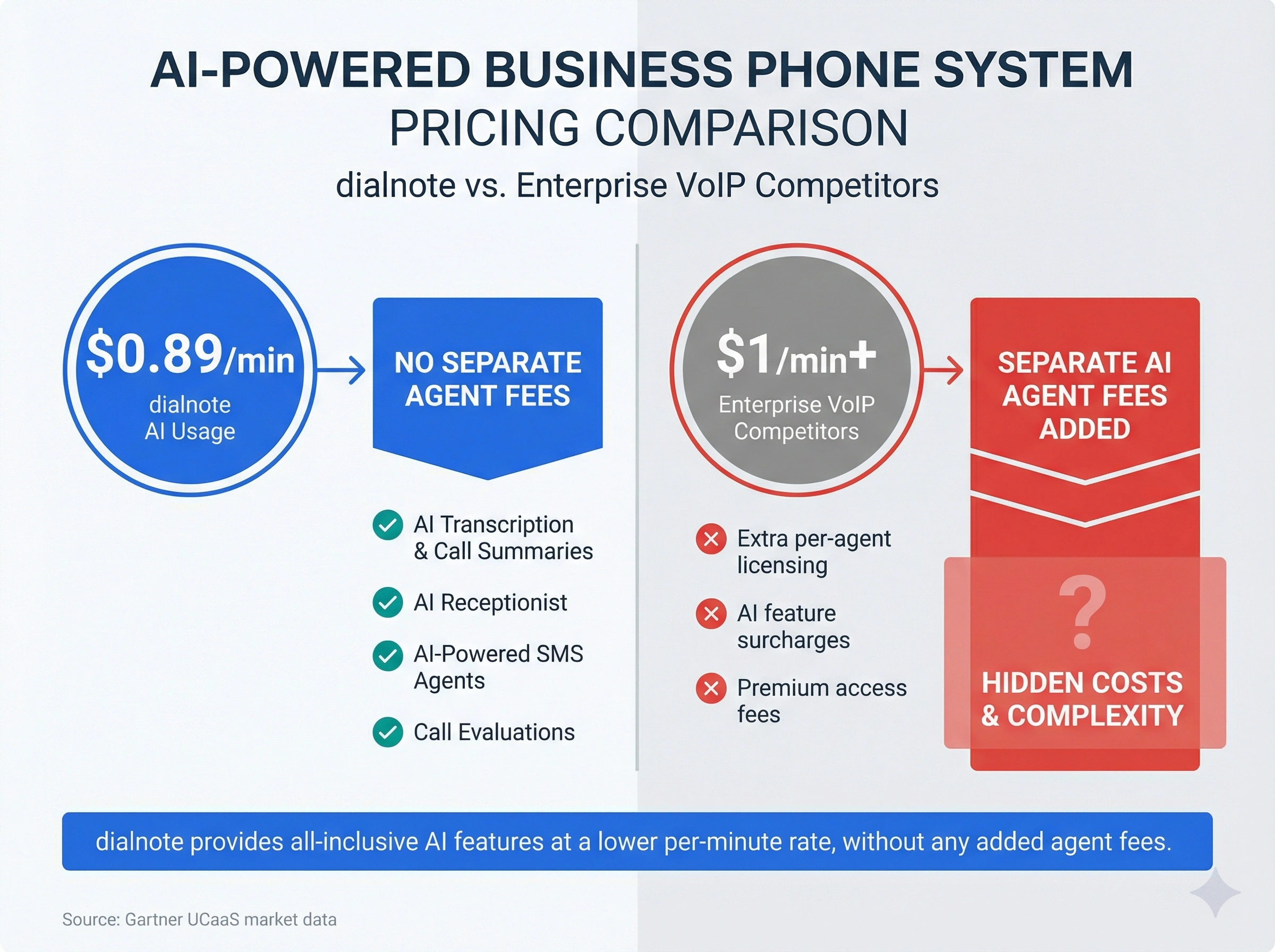
dialnote takes a different approach. AI transcription, call summaries, an AI receptionist, AI-powered SMS agents, and call evaluations are part of every plan, with no separate subscriptions required. AI usage runs at $0.89/min, lower than the $1/min most enterprise VoIP tools charge. Competitors also charge separately for AI agent access on top of per-minute rates. dialnote doesn't. You can also test the AI receptionist live on dialnote's website before signing up, which is a useful signal about product confidence.
What does RingCentral vs 8x8 actually cost?
The headline plan prices are just the starting point. What does that actually mean for your monthly bill?
RingCentral pricing (annual billing):
- Core: $20/user/month
- Advanced: $25/user/month
- Ultra: $35/user/month
- AI Receptionist add-on: +$39/month
- AI Conversation Expert add-on: +$60/user/month
- SMS overages apply after 25-200 messages/user/month, depending on plan
- Compliance and admin fees (~$3-5 per line) typically appear on invoices, not on the pricing page
8x8 pricing (annual billing):
- X2: ~$24/user/month
- X4: ~$44/user/month
- Higher contact center tiers go up to $140/user/month before add-ons
- 8x8 no longer publishes pricing publicly; you need a sales call to get current rates
- Enterprise deployments can carry $1,000-25,000+ in setup costs
RingCentral is more transparent. You can see the numbers before getting on a call. 8x8's pricing opacity, where the rate depends on a conversation with sales, creates friction during evaluation that some buyers find frustrating.
Both platforms advertise unlimited calling, but both apply fair use limits that real businesses hit regularly. RingCentral's unlimited covers US and Canada only. International calls require a Global Calling add-on. 8x8's fair use policy caps unlimited calling at roughly three times the average monthly usage across their customer base.
For active outbound teams, that limit is closer than it looks on paper. Worth factoring into your budget before you commit.
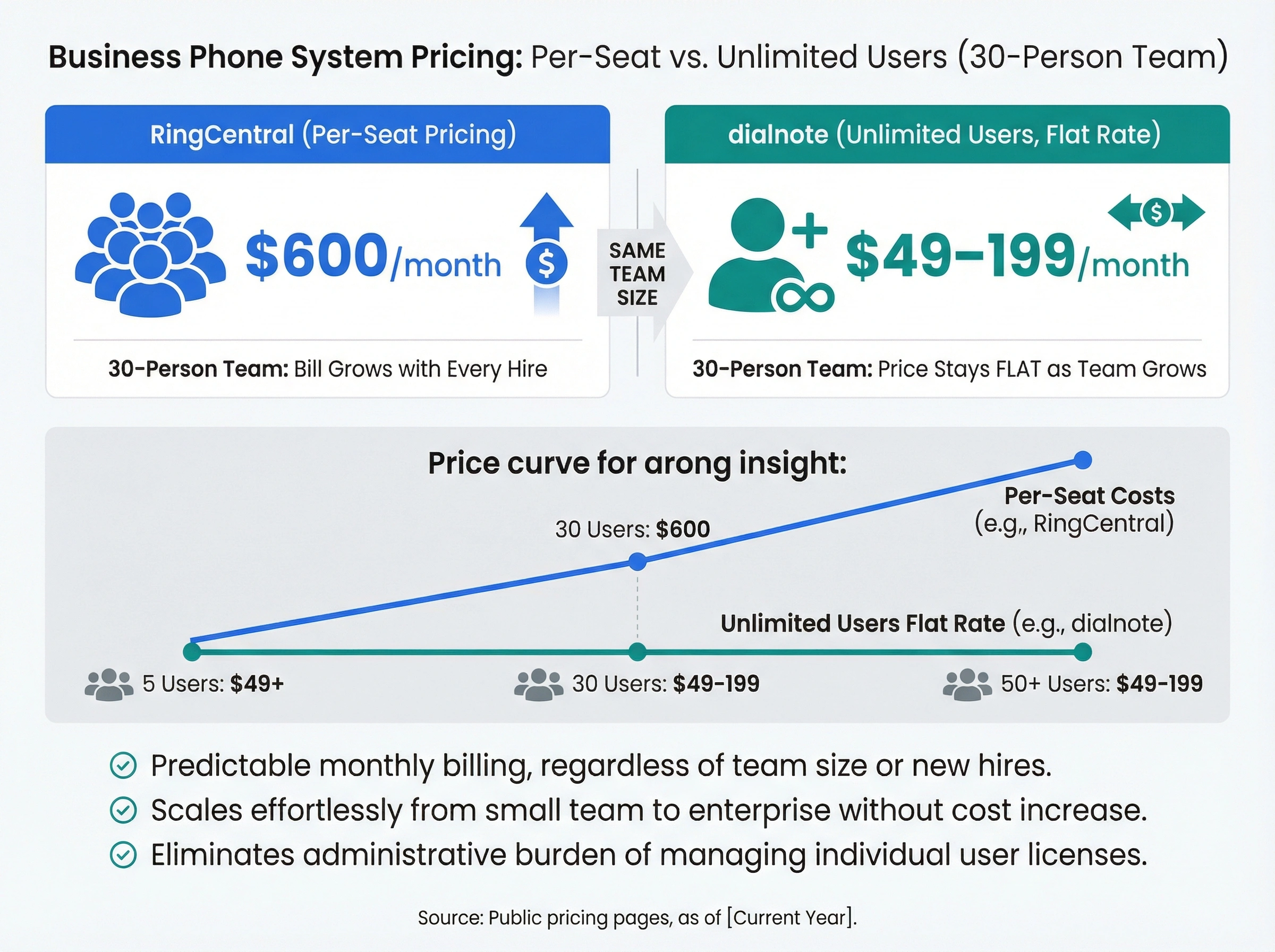
Per-seat pricing also means your bill grows with your team. A 30-person team on RingCentral Core pays $600/month. The same team on RingCentral Advanced, with just the AI Receptionist add-on, pays $789/month. Add AI Conversation Expert for 10 of those users, and you're looking at $1,389/month.
dialnote's pricing model works differently. Unlimited users plans start at $49/month. A 30-person team pays the same as a 5-person team on the same plan. Per-seat plans are available for smaller teams that want billing under $49/month, and you can see the full breakdown on dialnote's pricing plans page, but the unlimited model is where the real economics shift for growing businesses.
What real users say about RingCentral and 8x8
User reviews are consistent enough across platforms to draw useful patterns.
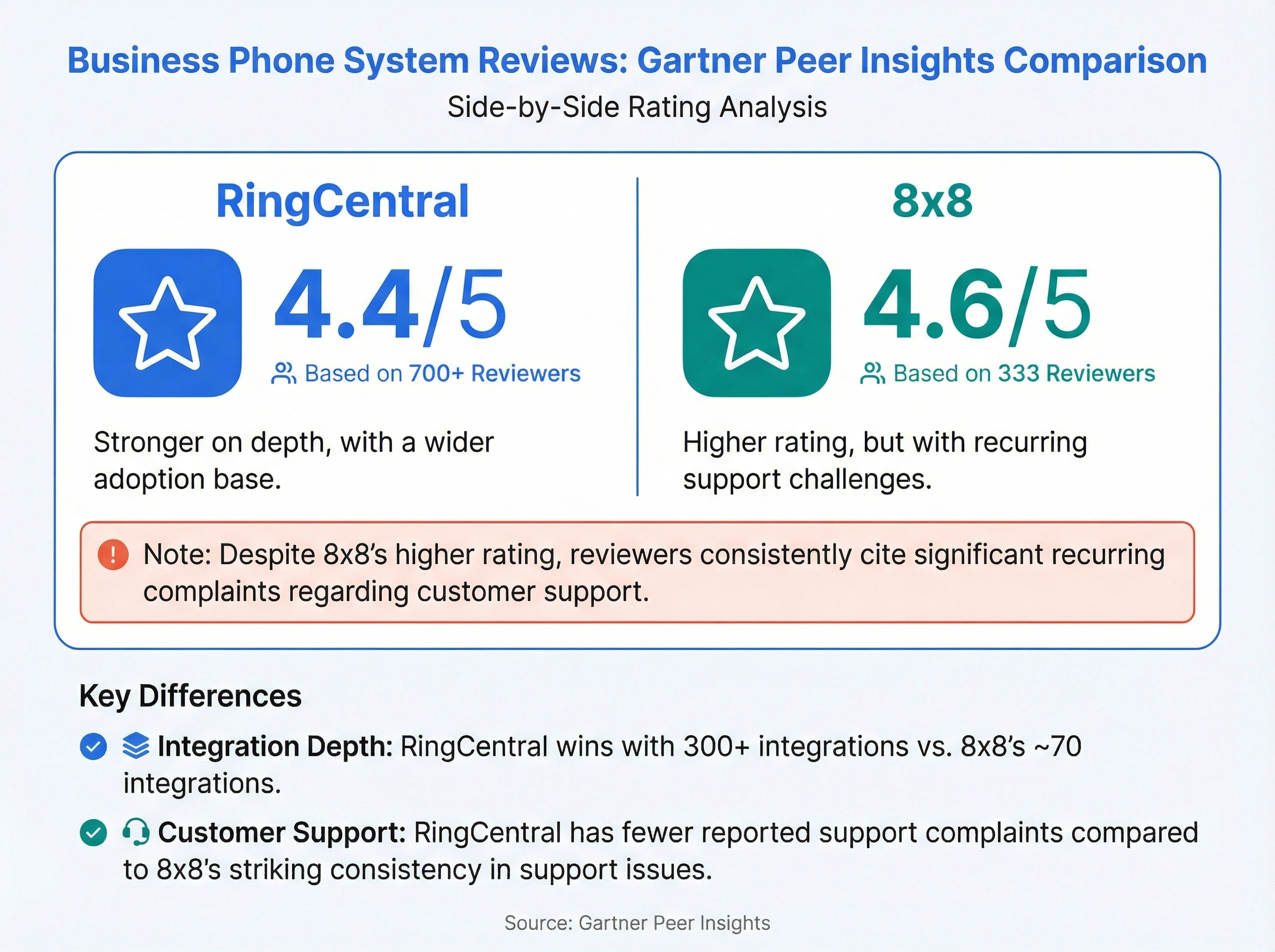
RingCentral users on G2 and Capterra frequently flag billing complexity, unexpected SMS overage charges, and slower support response times. The SMS cap on the Core plan, 25 messages per user per month, is genuinely limiting for any team doing regular outbound follow-ups or customer texting. Users also report challenges porting phone numbers away from the platform and an app experience that can be glitchy across updates. According to Gartner Peer Insights, RingCentral holds a 4.4/5 rating from over 700 reviewers in the UCaaS category.
8x8 scores 4.6/5 on Gartner from 333 reviewers, stronger than RingCentral's rating. But the support complaints are striking in their consistency. "Impossible to get a live person," "level two never contacts you back," and "overseas support with long resolution times" appear across G2, Capterra, and Gartner reviews with enough frequency to be a real pattern, not an exception.
For small and mid-size businesses that need fast resolution when something breaks, 8x8's support reputation is a genuine dealbreaker. Enterprise contracts with dedicated support channels change this calculus, but most teams don't get that level of access.
8x8 does win clearly on SMS. Unlimited SMS on all plans, versus RingCentral's hard caps, is a real operational advantage for customer-facing teams doing outbound outreach or follow-ups via text.
Where both platforms fall short
Despite their maturity, RingCentral and 8x8 share several gaps that matter for modern teams.
AI feels added on, not built in. Both platforms built their core products well before AI became central to business communications. The result is AI features that cost extra, configure separately, and don't feel as integrated as tools that started with AI as a foundation.
Per-seat pricing works against you as you grow. Every new hire is another seat charge. For fast-growing teams, that compounds quickly. Neither platform offers a meaningful flat-rate option for teams that want predictable costs regardless of headcount.
International coverage has real limits. RingCentral focuses primarily on North America. 8x8 is stronger globally, but even X4's 48-country coverage doesn't reach every market. Teams operating outside those lists often patch in separate local number providers, adding both cost and complexity.
SMS limits catch teams off guard. RingCentral's hard caps are a recurring complaint for active sales and customer success teams. 8x8 is better here, but its own fair use policy can limit heavy users without much upfront visibility.
Support quality varies by plan tier. Both platforms offer strong uptime guarantees on paper. In practice, user reviews consistently show support quality depends on contract size and account value. Smaller accounts report longer wait times and less resolution confidence.
Why dialnote is worth adding to your shortlist
dialnote was built with AI as a core product capability, not a paid upgrade. It's part of the SmartReach.io group, which builds B2B SaaS tools used by thousands of companies worldwide, competing with platforms like Outreach, Salesloft, Lemlist, and Pardot. This isn't a new startup finding its footing. It's a product backed by a group with serious engineering depth and a proven track record in B2B tooling.
After 25 years in SaaS and marketing leadership, one thing I keep coming back to is that pricing complexity is rarely your friend. When a finance team can't easily predict the next phone bill, that's a product design problem. dialnote's unlimited users model solves this directly.
Your bill stays flat whether you're at 10 people or 60. You know what you're paying. Your CFO can plan around it.
The AI features are what most teams notice first. Transcription, call summaries, an AI receptionist, AI-powered SMS agents, and call evaluation are all included on every plan. No add-on subscriptions, no tier upgrades required. AI usage runs at $0.89/min, which is lower than the $1/min most enterprise VoIP tools charge.
And while competitors charge separately for AI agent access on top of per-minute fees, dialnote doesn't. The AI receptionist is available to test live on dialnote's website, which is a genuinely useful option when you're evaluating platforms and want to see how the AI actually handles a call before you commit.
On the global side, dialnote covers calling to 90+ countries, with local numbers in the US, Canada, UK, India, and France (more opened on request). If you take a number in your region and call within that same region, those minutes come from your plan's included pool under fair use, and international calls draw from one shared wallet at published per-country rates. For teams with international customers or distributed offices, that removes a layer of complexity that most VoIP platforms leave you to solve elsewhere.
We've seen businesses move to dialnote specifically because they were tired of managing a growing list of add-on charges. For a team doing real call volume with real AI-driven follow-up workflows, the economics of included AI add up fast compared to paying $39-60/user/month just to access basic AI capabilities.
RingCentral vs 8x8: which platform should you choose?
Based on pricing, features, and user sentiment, here's a clear breakdown.
Choose RingCentral if:
- You need deep integrations across a large existing tech stack (300+ connectors)
- Your team is primarily US/Canada-focused and doesn't need international calling beyond North America
- You want advanced call monitoring and analytics, and you're comfortable paying for AI features as separate add-ons
Choose 8x8 if:
- You have significant international calling volume and the X4 country list covers your key markets
- Unlimited SMS on all plans matters for your customer outreach workflow
- You're an enterprise customer with a dedicated support contract, where the support issues smaller accounts experience are less likely to apply
Choose dialnote if:
- You want AI automation included from day one without per-agent fees or plan upgrades
- Flat-rate unlimited users pricing matters more than per-seat flexibility as your team grows
- Your team needs phone numbers across multiple countries and wants real global coverage
- You want to test an AI receptionist live before committing to any platform
If you're early in the evaluation process, our guide on how to choose the right business phone system walks through the key decision factors. And if RingCentral is already on your shortlist, the RingCentral vs Nextiva comparison covers a similar set of tradeoffs from a different angle.
The VoIP market has solid options at every price point. The difference between a capable platform and the right platform usually comes down to three things: how you want to pay as you grow, how central AI is to your daily workflow, and where your team actually operates. RingCentral and 8x8 are both established choices with real strengths. dialnote is worth a serious look if per-seat pricing and add-on AI fees don't fit the way your business runs.
Frequently asked questions
It depends on your needs. RingCentral wins on integrations (300+) and US/Canada call depth. 8x8 wins on international calling (48 countries on X4) and unlimited SMS. Neither includes meaningful AI on base plans — you'll pay extra on both.
RingCentral's main competitors are 8x8, Dialpad, Vonage, Zoom Phone, and Microsoft Teams Phone. For AI-first teams that want flat-rate pricing, dialnote is also worth comparing directly.
8x8's main competitors include RingCentral, Vonage, Dialpad, Zoom Phone, and Microsoft Teams Phone. dialnote competes directly on international coverage and AI features included on every plan with no add-on fees.
8x8 is most comparable to RingCentral and Vonage. It's strongest for teams that need international calling (14-48 countries) and unlimited SMS. Contact center buyers often compare it to Five9 and Genesys.
8x8 doesn't publish pricing publicly — you'll need a sales call. Based on available data, X2 runs around $24/user/month and X4 around $44/user/month (annual billing). Contact center tiers can reach $140/user/month before add-ons.
8x8 serves over 2 million users across thousands of businesses worldwide. It's common in mid-market and enterprise segments, particularly for teams with international calling needs. Current figures are in their public earnings reports.

Written by
Lancelot Dsouza
Chief Marketing Officer, SmartReach.io
Lancelot Dsouza is the Chief Marketing Officer at SmartReach.io, where he built the Marketing, Sales, and Customer Success verticals from the ground up. With over 25 years of experience spanning digital marketing, business development, and strategic...
Lancelot Dsouza is the Chief Marketing Officer at SmartReach.io, where he built the Marketing, Sales, and Customer Success verticals from the ground up. With over 25 years of experience spanning digital marketing, business development, and strategic...
Related Articles
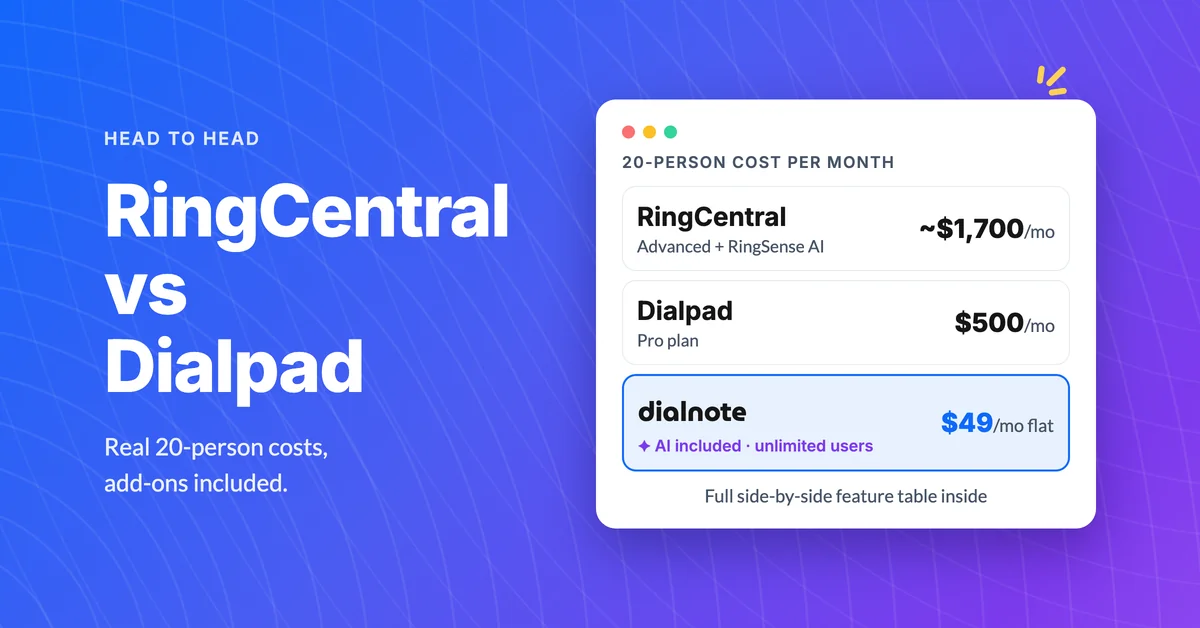
RingCentral vs Dialpad: Best Business Phone?
Compare RingCentral vs Dialpad on pricing, AI features, and real-world limits. Find out which business phone system fits your team.
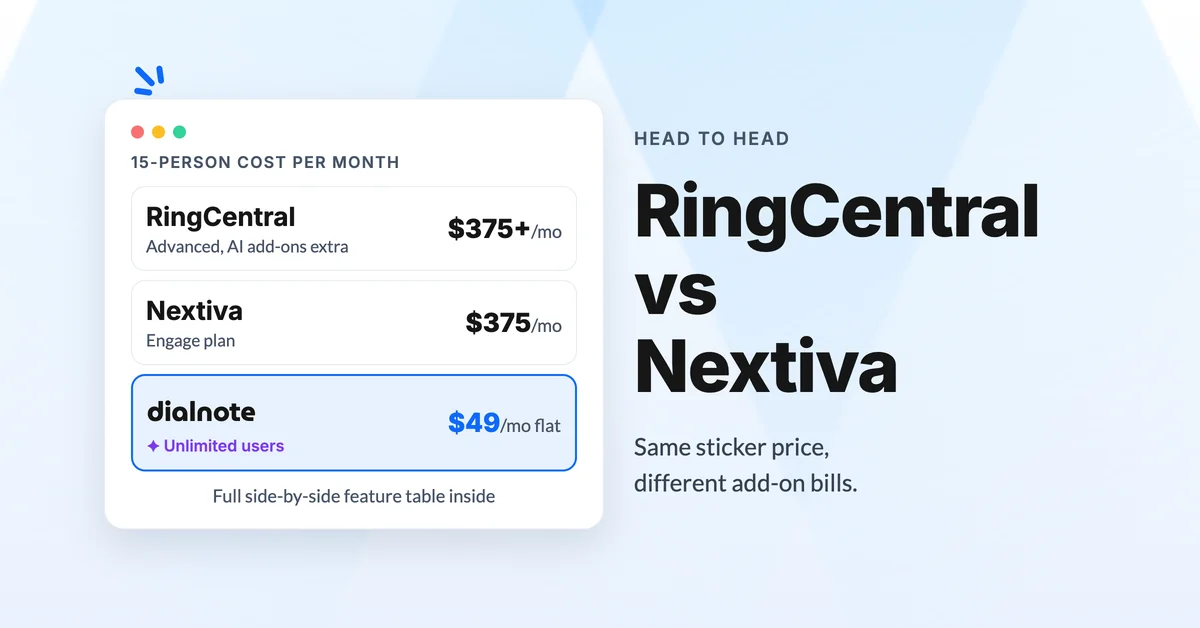
RingCentral vs Nextiva for Business Phone Systems
Compare RingCentral vs Nextiva on pricing, AI features, and user reviews. See why dialnote is the smarter choice for modern teams.
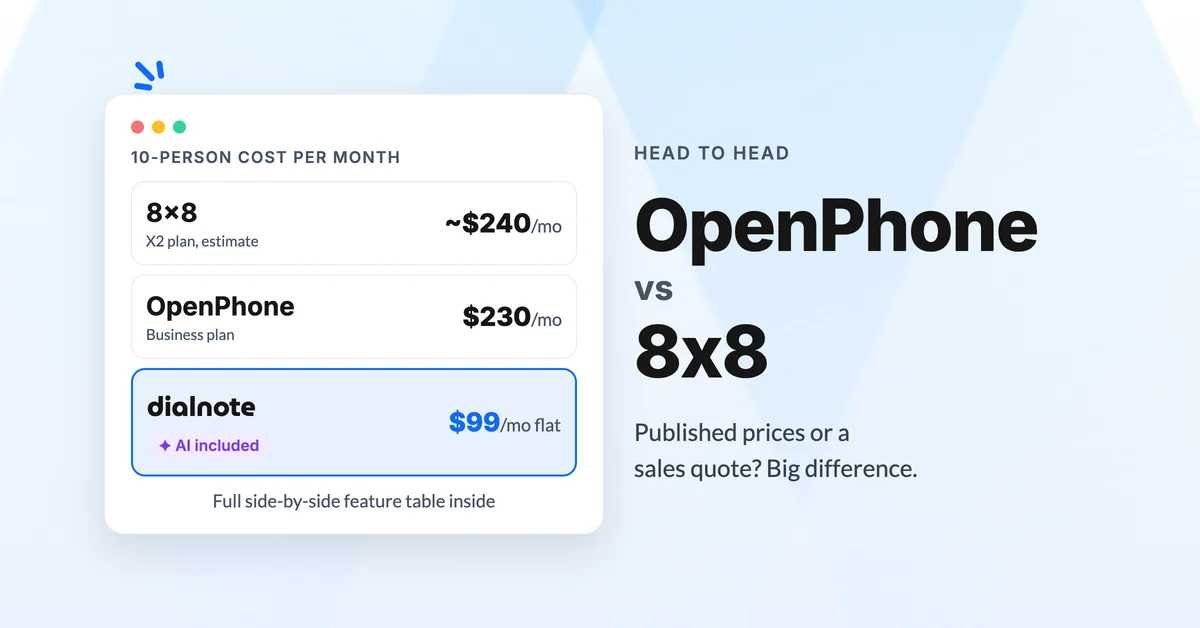
OpenPhone vs 8x8: Which Should You Choose?
Compare OpenPhone vs 8x8 on pricing, quote-only sales, and AI answering, then see why dialnote may fit small teams better than both.