Restaurant Phone System: 7 Picks and What They Cost
It's 7:10 on a Friday. Two servers are down, the pass is backed up, and the phone has rung four times in the last ten minutes. Nobody picks up. Three of those callers wanted takeout, and one of them is now ordering from the place two doors down.
Every restaurant owner I talk to knows this happens. Almost none of them know what it costs. A restaurant phone system is supposed to solve it, and the market has gotten genuinely confusing about how, because "phone system" now covers everything from a cheap virtual number to an AI that takes full orders with modifiers.
So this is a comparison of what's actually available, what each one is good at, and the arithmetic that tells you which tier you need.
TL;DR:
- A restaurant phone system handles takeout calls, reservations and the hours-and-directions questions that eat a host's shift, usually over the internet rather than a landline.
- Unanswered calls cost the US restaurant industry around $20 billion a year, roughly $28,700 per location.
- The real split is order-taking (AI reads your menu into a POS) versus call handling (every call answered, details captured, nothing lost). Most restaurants need the second and think they need the first.
- Per-user pricing is the trap. A restaurant with a host, two managers and an owner on the phone pays four times for the same phone line.
- dialnote is an AI business phone system with no per-user cost, flat from $49/mo, with a 10-day free trial. It handles calls, not POS order entry.
What should a restaurant phone system actually do?
A restaurant phone system answers inbound calls, routes them to whoever's free, and makes sure the ones nobody can take still get captured. At minimum that means a business number that rings more than one device, a queue so callers aren't dumped to voicemail during a rush, and some way of handling the call when every pair of hands is busy.
That last part is where the category splits, and it's worth being precise about it, because vendors use the same words for two different products.
Order-taking means an AI reads your menu, takes the order including modifiers, and pushes it into your POS. Loman, Bite Buddy and Slang.ai are built for this.
Call handling means every call gets answered, the caller's details get captured, and urgent ones reach a person. The order still gets typed by a human, but no call goes unanswered.
One question I hear constantly from customers: which one do we actually need? The honest answer is that most single-location restaurants overestimate how much of their call volume is complex ordering, and underestimate how much is "what time do you close" asked for the ninth time that evening.
What does a missed call really cost a restaurant?
Enough that it's worth counting rather than guessing.
According to QSR Magazine, analysis using National Restaurant Association location data puts unanswered calls at roughly $20 billion a year across the US restaurant industry, which works out to about $28,700 per location. The misses cluster in the dinner rush, which is the same window where the average ticket is highest.
Run it for a single restaurant. Say you take 25 calls on a Friday and miss 8 of them. If half of those were orders at a $38 average ticket, that's $152 gone on one shift. Across 52 Fridays, call it $7,900, and that's before you count Saturdays or the catering enquiry that never got through.
Here's where the math gets uncomfortable: the shift where you miss the most calls is the shift where you can least afford to. A quiet Tuesday has nobody calling and three people free to answer. Friday has the opposite of both.
Worth being honest about one thing. That $38 ticket and that 50% conversion are assumptions, not measurements. The useful version of this exercise is to count your own missed calls for two weeks before deciding anything. Most phone systems will show you the number, and it's usually worse than the guess.
When your phone peaks, and why that changes the answer
Restaurant call volume isn't spread evenly, and the shape of it is the whole buying argument.
Calls bunch into two windows: late morning, when catering and reservation enquiries come in, and the two hours either side of dinner service, when takeout orders and running-late calls pile up. The second window is the problem. It's when the most calls arrive, when they're worth the most, and when literally nobody has a free hand.
That pattern makes two things true at once. First, average call volume is a useless number for sizing a phone system, because you aren't staffing for the average, you're staffing for 7pm Friday. Second, the feature that matters most isn't the one vendors lead with. It's what happens to call number four when calls one, two and three are already being handled.
So when you're testing a system, test that. Ring the demo line four times in ninety seconds and see what the fourth caller hears. A queue with a position announcement keeps them. A busy signal doesn't. Voicemail is somewhere in between, and worse than most owners assume, because the caller who leaves a message has usually already started looking for somebody else.
The 7 best restaurant phone systems in 2026
Ranked by who they actually suit, not by who pays the most for placement.
1. Bite Buddy, best for high-volume takeout. Purpose-built AI phone ordering that takes full orders with modifiers and pushes them to your POS. If phone orders are a serious revenue line rather than a side channel, this is the category that fits. The tradeoff is that you're buying a restaurant-specific product, so it does less outside the ordering use case and the per-location fee applies whether this month was busy or dead.
2. Loman, best for AI ordering at a single location. Same idea, pitched at independents rather than groups. Takes orders, handles reservations, sends SMS confirmations. Worth a look if you run one site and the phone is genuinely an ordering channel. Less compelling if most of your volume already comes through a delivery app, because then the calls left on the line are the questions, not the orders.
3. 8x8, best for multi-site routing control. Restaurant groups that need per-location rules, holiday menus and lunch-break routing without rebuilding a menu tree per site. The routing depth is real and hard to match. Priced per user, which matters below, and the admin surface is heavier than a single restaurant will ever need.
4. Nextiva, best for single-location restaurants that want callers to hold. Strong queueing and on-hold messaging, so the dinner-rush caller stays on the line instead of hanging up. For a restaurant whose main loss is callers abandoning during the rush, that queue is the feature doing the work. Also per user, so cost climbs with the roster rather than with call volume.
5. RingCentral, best for established groups already standardised on it. Deep feature set, strong reliability record, and the most expensive way to solve a small restaurant's problem. If you already run it across a group, extending it to a new site is the path of least resistance. Starting fresh with one location, you're paying for an enterprise feature set you'll never open.
6. Grasshopper, best for the smallest budget. A virtual number with forwarding and voicemail transcription. No queueing, no AI. If the alternative is a mobile number on the door, it's a clear upgrade, and for a small cafe taking five calls a day it might be all you need. It won't help on a Friday though, because forwarding a busy line still ends in voicemail.
7. dialnote, best for flat pricing with AI answering included. dialnote is an AI business phone system with no per-user cost: shared numbers, call routing, and AI voice agents that answer, capture caller details and book appointments. Flat plans from $49/mo on Team and $199/mo on Pro, with a 10-day free trial. The honest limit: it handles calls, not POS order entry, so it won't push a pizza order into Toast.
Restaurant phone systems compared
| Best for | Pricing model | Takes orders into a POS | |
|---|---|---|---|
| Bite Buddy | High-volume phone ordering | Per location | Yes |
| Loman | AI ordering, single site | Per location | Yes |
| 8x8 | Multi-site routing rules | Per user, per month | No |
| Nextiva | Queueing so callers hold | Per user, per month | No |
| RingCentral | Large groups already on it | Per user, per month | No |
| Grasshopper | Smallest budget, basic needs | Flat, limited features | No |
| dialnote | Flat pricing, AI answering, no per-user cost | Flat monthly, unlimited users | No |
Per-user pricing deserves more attention than it gets in restaurant buying decisions. A restaurant isn't a sales team. The host answers, the manager answers, the owner answers from home at 10pm. On a per-user plan you're paying four times to cover one phone line, and that's before a seasonal hire.
What per-user pricing actually costs a restaurant
This is the part worth doing with a calculator, because it's where the cheap option stops being cheap.
Most business phone systems bill per user, per month. That model was designed for sales teams, where a seat maps to a person who makes calls all day. A restaurant doesn't work like that. One phone line gets answered by whoever is nearest, and the list of people who need access grows quietly: the host, the shift manager, the GM, the owner checking voicemail from home, the catering coordinator who only works weekends.
Here's the same restaurant on both models. The per-user figure below is $25/user/mo, which sits in the normal band for a mid-tier business plan, and it's an assumption rather than any one vendor's list price.
| People needing access | Per user at $25/mo | dialnote Team, flat | Annual difference |
|---|---|---|---|
| 3 (host, manager, owner) | $75/mo | $49/mo | $312 |
| 5 (+ second manager, catering) | $125/mo | $49/mo | $912 |
| 8 (+ seasonal and weekend staff) | $200/mo | $49/mo | $1,812 |
The crossover sits at two users. Above that, flat pricing wins and keeps winning, and the gap grows every time you add somebody to the schedule.
Now the honest other side, because this cuts both ways. If your restaurant is genuinely one person answering one phone, per-user pricing is cheaper and you should take it. A single-seat plan at $25 beats $49 and no amount of feature comparison changes that arithmetic. Flat pricing is a volume argument, and below two users there's no volume to argue about.
The second place dialnote loses: if phone ordering into your POS is the actual job, none of this matters. A system that captures a caller's details perfectly and can't push the order to Toast hasn't solved your problem. Buy the order-taking tier and accept the per-location fee.
Should a restaurant use AI phone ordering or a human answering service?
Use AI for volume and repetition. Use a human service for anything where a frustrated guest might end up on Google reviews. Most restaurants want AI on the hours-and-directions calls and a person on the complaint.
Think about what actually comes through the line on a Friday. What time do you close. Do you have a gluten-free base. Can I get a table for six at eight. I ordered twenty minutes ago and it still isn't here. The first three are identical every week and perfectly automatable. The fourth needs somebody with the authority to fix it.
| A human answering service | An AI phone system | |
|---|---|---|
| Best at | Complaints, large catering orders, anything brand-sensitive | Hours, directions, simple takeout, reservation requests |
| Breaks down when | Friday volume blows through your minute bucket | The order has eight modifiers and two substitutions |
| Costs | Per minute or per call, so the rush is the expensive part | Flat, so the rush is free |
The trap is treating this as either/or. The setups that work route by call type: AI picks up first, handles what it can, and transfers the rest to whoever's nearest the pass.
What about reservations?
Reservations are the use case most phone-system comparisons skip, and for a lot of restaurants they're half the inbound volume.
If you already run OpenTable or Resy, most reservation calls are people who couldn't work the app, want something the app won't allow, or are calling about a booking they already have. That's a different job from taking a reservation: it's handling an exception. An AI that can read availability and book a standard table handles maybe two-thirds of those calls, and the rest are the awkward ones where somebody wants a specific table or is asking about a birthday cake.
If you don't run a booking platform, the phone is your booking system, and the calculation changes. Then the thing you need is simply that somebody picks up, because an unanswered reservation call is a table that stays empty on your busiest night.
What to check before you sign
Four things, in the order they'll bite you.
- Count your missed calls first. Two weeks of real data beats any vendor's case study. If you're missing three a week, none of this is urgent. If you're missing thirty, the cheapest option is already too expensive.
- Check the pricing unit. Per user, per location, or flat. Add up everyone who'd need an account, including the seasonal hire, then multiply.
- Ask what happens at 7pm on a Friday, not what happens on a demo call. Queueing behaviour and simultaneous-call handling are what you're buying.
- Confirm the POS integration before you need it. If order-taking is the point, the integration list is the product. If it's call handling you're after, POS doesn't matter and you shouldn't pay for it.
For a deeper look at the human-versus-AI tradeoff, we went through it properly in AI receptionist vs live answering service, and the full missed-call arithmetic lives in the cost of missed calls.
Where a phone system won't help
Worth saying plainly, because the category oversells itself.
A phone system won't fix a kitchen that's forty minutes behind. If callers are hanging up because the quoted wait is unacceptable, answering faster just means hearing the bad news sooner. It also won't fix understaffing: an AI that captures a reservation request nobody follows up on has moved the problem, not solved it.
And there's one thing nobody has convincing public data on yet. We don't know how guests feel about AI taking their order over months rather than in a single interaction. The early signals are fine, but "fine on first contact" and "fine as a regular" are different questions, and anyone claiming certainty there is guessing.
If your phone is the problem, a restaurant phone system is a cheap fix for an expensive leak. Start by counting the calls you're missing, then pick the tier that matches what those calls are worth. You can see what flat pricing looks like on pricing, or how the AI answering side works on AI receptionist.
Frequently asked questions
It's the phone setup that handles a restaurant's inbound calls: takeout orders, reservations, hours and directions. Modern ones run over the internet rather than a landline, so calls can ring several devices, queue during a rush, and route to voicemail or an AI agent when nobody's free.
More than owners expect. Industry analysis puts unanswered restaurant calls at around $20 billion a year across the US, roughly $28,700 per location. Most of those misses land in the dinner rush, which is exactly when the calls are worth the most.
For simple orders and FAQs, yes. For a 14-item catering order with substitutions, not reliably. Most restaurants get the best result letting AI handle hours, directions and simple takeout, then transferring anything complicated to a person.
Yes, for call handling rather than order-taking into a POS. dialnote answers every call, captures caller details and books through Calendly or Cal.com, on flat plans from $49/mo with no per-user cost. It doesn't integrate with restaurant POS systems.
Most single-location restaurants land between $20 and $60 a month for calling, and more if they add AI answering. The number that matters isn't the monthly fee, it's whether it costs less than the orders currently going to voicemail.

Written by
Chinmayee Kelkar
Customer Success Specialist, SmartReach.io
Chinmayee Kelkar is a Customer Success Specialist at SmartReach.io with over 10 years of experience in customer service, client management, and business process optimization. She holds a Master's degree in Industrial and Organizational Psychology and...
Chinmayee Kelkar is a Customer Success Specialist at SmartReach.io with over 10 years of experience in customer service, client management, and business process optimization. She holds a Master's degree in Industrial and Organizational Psychology and...
Related Articles
Does Your Business Need an After Hours Answering Service?
Learn how an after hours answering service captures missed calls, compare pricing for live vs AI options, and set up 24/7 coverage for your business.
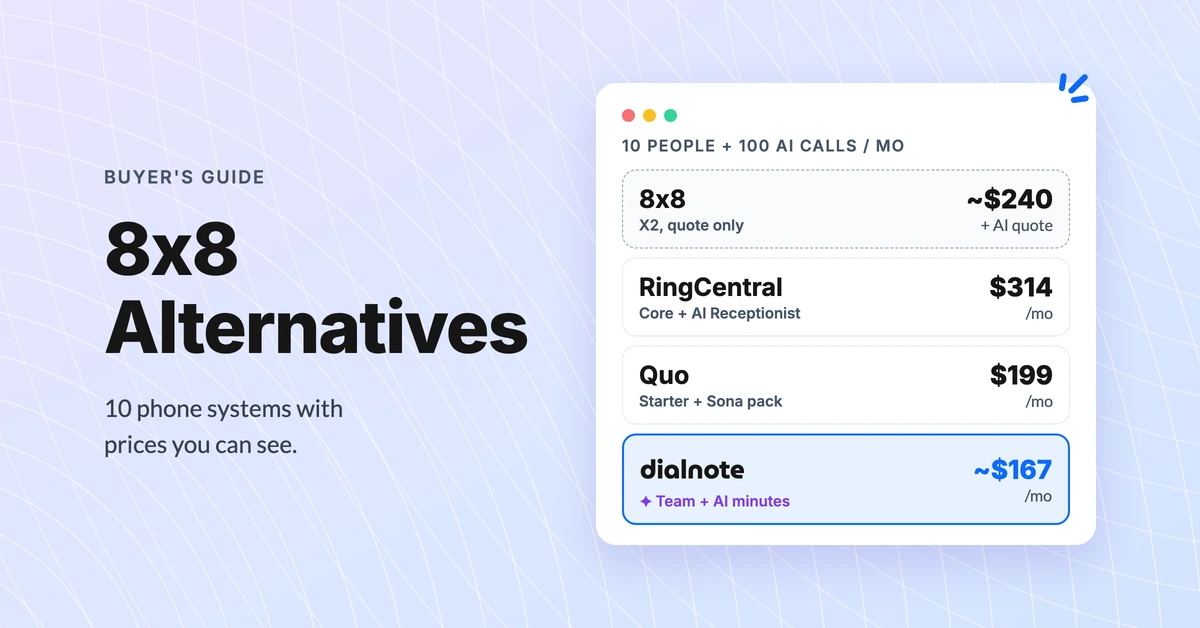
8x8 Alternatives: 10 Phone Systems With Public Prices
Compare 10 8x8 alternatives on real 10-person cost with AI answering. 8x8 quotes its price on a sales call; these publish theirs (October 2026).
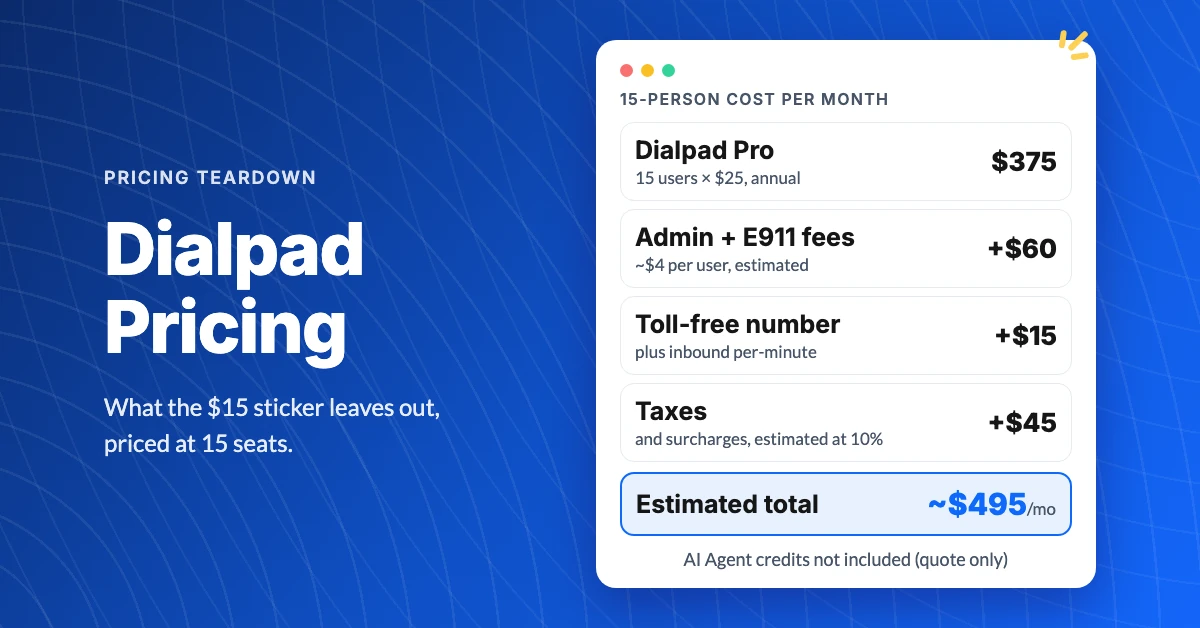
What Does Dialpad Pricing Really Cost a Small Team?
See what Dialpad pricing really costs: $15 to $35 per user, the 3-seat Pro minimum, per-text and admin fees, and real team math at 5, 15 and 30 people.