Is an AI Receptionist Better Than a Live Answering Service?
According to a Gartner survey, 91% of customer service leaders are under executive pressure to adopt AI in 2026. That kind of stat makes it tempting to drop human answering services entirely and go all-in on automation.
But hold on. An AI receptionist vs live answering service isn't an apples-to-apples comparison. They solve different problems, work differently, and cost differently. Picking the wrong one can mean dropped calls, frustrated customers, and wasted money.
Stan manages operations at a growing home services company. He's handling 150+ inbound calls per week with one front-desk person during the day and voicemail after hours. Calls are slipping through the cracks. He's narrowed his options to AI or a live answering service, but every comparison he finds reads like a sales pitch for one side.
If you're in the same spot, this guide gives you the real breakdown: pricing, pros, cons, edge cases, and a decision framework you can actually use. No hype, just the facts.
Here's what we'll cover: what each option actually does, what they cost when you dig past the marketing pages, where each one wins and loses, and a set of questions to help you figure out which one makes sense for your business right now.
TL;DR:
- In the AI receptionist vs live answering service debate, AI wins on cost, 24/7 uptime, and handling unlimited calls at once, while live agents win on empathy, off-script judgment, and sensitive or regulated calls.
- An AI receptionist runs about $25-$300/month flat, while a live answering service runs roughly $150-$1,950/month based on call volume, so most small businesses save around $1,600-$5,700 a year with AI.
- Pick AI if most of your calls are routine (scheduling, pricing, FAQs) and you need round-the-clock coverage; pick a live service if your calls are complex, emotional, or in a regulated industry like legal or medical.
- A hybrid setup, AI for routine calls and overflow with humans for complex ones, costs less than full live coverage and often fits businesses stuck in the middle.
What's the actual difference between these two options?
An AI receptionist (sometimes called a virtual receptionist or automated answering service) is software that answers your business phone using artificial intelligence. It talks to callers in a natural-sounding voice, books appointments, takes messages, routes calls, and answers common questions. It runs 24/7 without breaks, sick days, or scheduling headaches.
A live answering service is a team of real people at an external company. You pay them to answer your phone on your behalf. These agents follow scripts you provide, take messages, transfer callers, and handle more complex or sensitive conversations. Most services operate during business hours, though some offer after-hours coverage at a higher rate.
Here's a quick side-by-side:
| Feature | AI receptionist | Live answering service |
|---|---|---|
| Availability | 24/7/365 | Usually business hours (24/7 costs extra) |
| Simultaneous calls | Unlimited | Limited by staffing |
| Cost range | $25-$300/month | $150-$1,950/month |
| Setup time | Minutes to hours | Days to weeks |
| Emotional intelligence | Limited | Strong |
| Consistency | Always the same | Varies by agent |
| Scalability | Instant | Requires more agents |
| Complex call handling | Follows programmed flows | Thinks on their feet |
Both options beat voicemail. That's the baseline. But they're built for different situations, and the gap between them isn't as wide as it used to be. Two years ago, the choice was simpler: AI was cheap but clunky, and live was expensive but reliable. Today, AI voice quality has caught up dramatically, and the decision comes down to fit rather than capability.
So which one fits your business? Let's start with the money.
How much does each option really cost?
Cost is usually where business owners start comparing. On the surface, AI looks like the obvious winner. But the full picture has more layers than most comparison articles show.
AI receptionist pricing:
Most AI receptionists charge a flat monthly fee between $25 and $300. That typically covers unlimited calls, 24/7 availability, and core features like appointment booking and message-taking. Some providers charge per minute instead (around $0.10-$0.30 per minute), which can add up if you're a high-volume business.
Live answering service pricing:
Live services use a few different pricing models. Per-minute plans run $0.75-$1.50 per minute. Monthly packages start around $150 for a limited number of minutes (50-100) and climb to $1,950+ for heavy users. According to Ambs Call Center, the average small business pays $150-$400 per month for a live answering service.
The real math for a typical business:
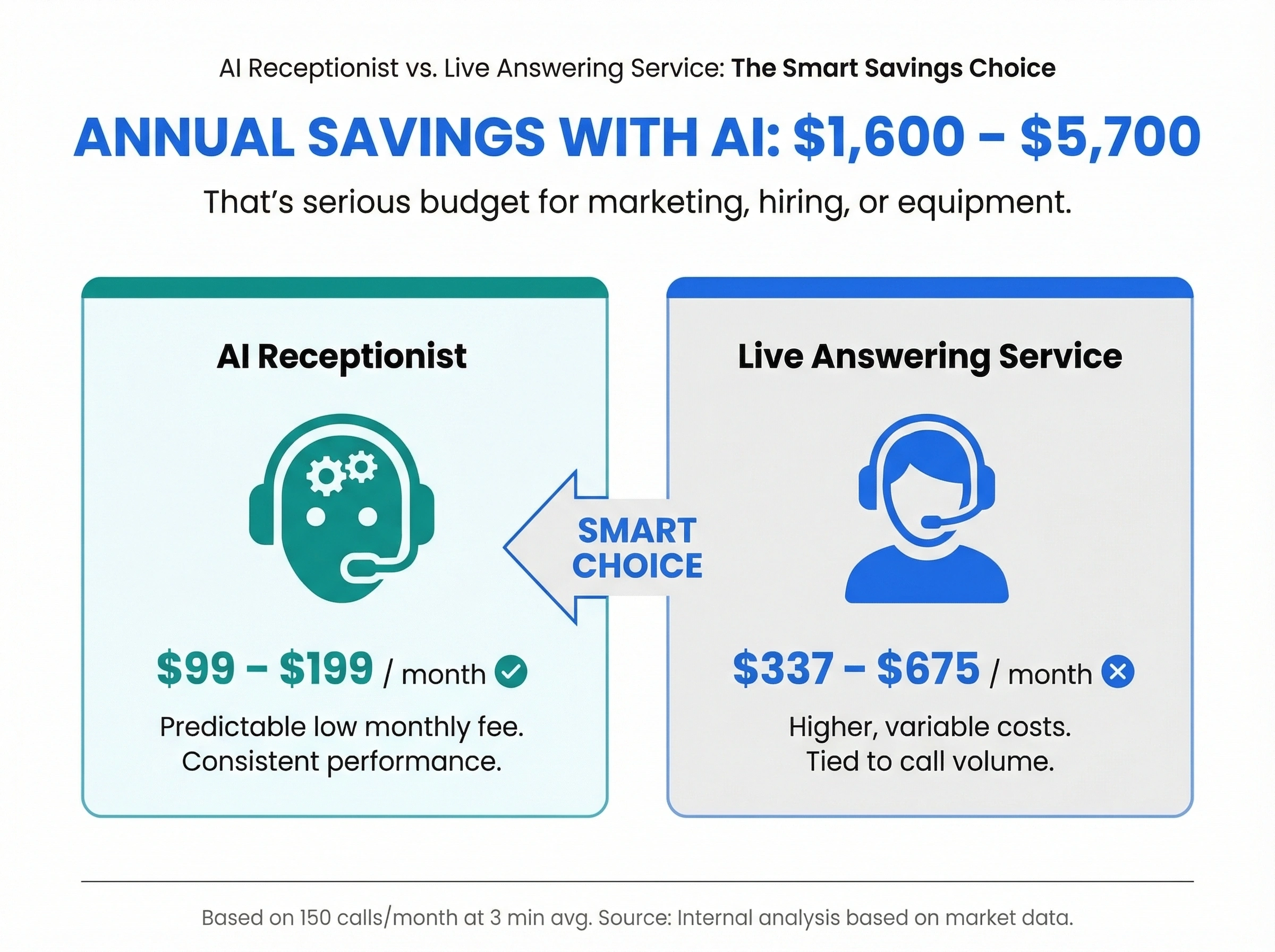
Let's say your business gets 150 calls per month averaging 3 minutes each. That's 450 minutes of talk time.
| AI receptionist | Live answering service | |
|---|---|---|
| Monthly cost | $99-$199 (flat) | $337-$675 (at $0.75-$1.50/min) |
| Annual cost | $1,188-$2,388 | $4,044-$8,100 |
| Cost per call | $0.66-$1.33 | $2.25-$4.50 |
| After-hours surcharge | None | Often 20-50% extra |
The annual savings with AI range from roughly $1,600 to $5,700. For a small business, that's serious budget you can put toward marketing, hiring, or equipment.
Hidden costs most comparisons skip:
Live services often charge setup fees ($50-$200), holiday surcharges, and per-call minimums. If your callers tend to chat longer than expected, per-minute billing adds up fast. AI services occasionally charge extra for integrations or premium features, but the base cost stays predictable.
Is that annual savings worth a tradeoff in call quality? That depends entirely on what kind of calls you're getting.
There's another cost factor worth mentioning: turnover. Live answering service agents leave and get replaced regularly. Each new agent needs time to learn your business, your scripts, and your caller expectations. During that learning curve, call quality dips. AI doesn't have turnover. Once it's configured, it performs identically every single day.
For an in-depth look at AI answering service costs, we've got a separate breakdown.
Where AI receptionists outperform live services
AI has some clear advantages that no amount of human staffing can match. These aren't hypothetical perks. They're measurable differences that show up in your call data.
Always on, never busy
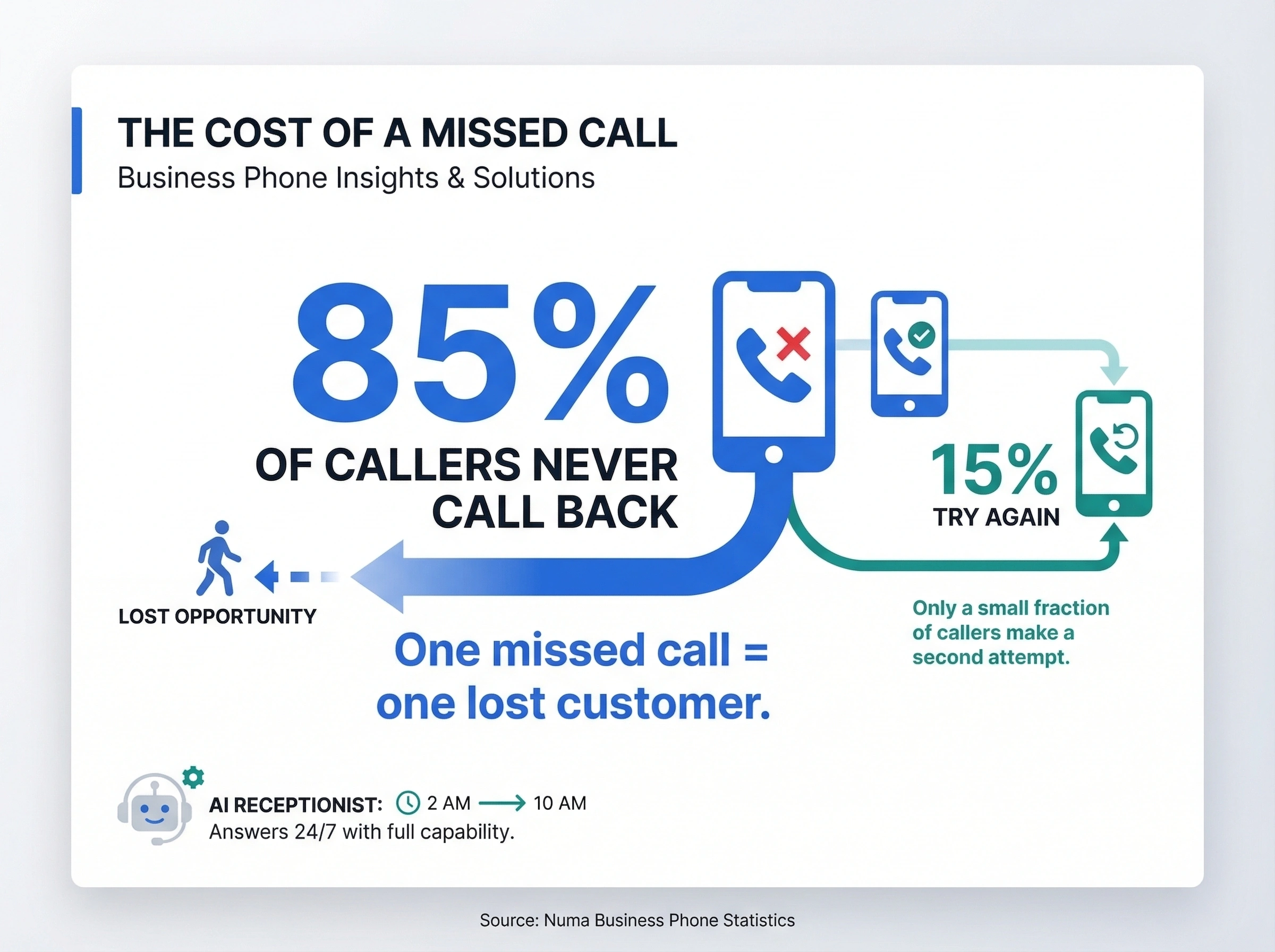
An AI receptionist doesn't sleep, take lunch breaks, or call in sick. It answers at 2 AM on a Sunday with the same capability as 10 AM on a Tuesday. For businesses that get after-hours calls (home services, property management, healthcare), this alone can justify the switch.
According to industry phone statistics, 85% of callers won't try again if you don't answer the first time. Every unanswered ring is likely a lost customer.
Handles call surges instantly
When five people call at the same time, a live service puts four of them on hold. AI handles all five simultaneously. No hold music, no waiting, no abandoned calls.
This matters most during seasonal peaks. Think tax season for accountants, storm damage calls for roofers, or back-to-school rushes for pediatric offices. These are the moments when you can't afford to miss calls, and they're exactly when live services get overwhelmed.
One home services company we looked at was losing an estimated 30% of its inbound calls during summer peak season because its live answering service couldn't keep up with volume. After switching to AI for frontline answering, every call got picked up within two rings. The overflow problem disappeared overnight.
Perfectly consistent
Every caller gets the same experience. AI doesn't have bad days, doesn't forget your script, and doesn't accidentally give wrong information. If you've ever dealt with a live service agent who went off-script or gave a caller incorrect hours, you know how valuable consistency is.
Faster setup, easier changes
Most AI receptionists get you running in under an hour. Need to update your greeting, add a new call flow, or change your business hours? You do it yourself in minutes. With a live service, changes go through an account manager and can take days. During busy periods, that delay can cost you.
Scales without renegotiating
As your call volume grows, AI costs stay flat or increase minimally. Live services scale linearly: more calls means more minutes means a bigger bill. For growing businesses, this pricing model makes a real difference over 12-24 months.
Where live answering services still win
AI is impressive. But it's not the right fit for every situation. Pretending otherwise leads to bad decisions, so let's be honest about where humans still have the edge.
Reading emotional cues
A caller who just had a pipe burst in their basement isn't thinking clearly. They're stressed, maybe panicking. A human agent can hear that in their voice and respond with genuine empathy: "I hear you, let's get someone out right away."
AI can follow a script for urgent situations, but it can't truly read or match emotions the way a person can. Not yet, anyway.
Honestly? For businesses that regularly handle high-emotion calls, like legal intake, medical emergencies, or insurance claims, live answering is still the stronger option. AI is getting better fast, but it's not there yet for the calls that really matter emotionally.
Handling the unexpected
Live agents think on their feet. When a caller says something that doesn't fit any predetermined flow, a human can improvise, ask follow-up questions, and piece together what's needed. AI follows its programming. If a caller's request falls outside the configured responses, AI either gives a generic answer or transfers the call.
For businesses where most calls are predictable (scheduling, directions, pricing questions), this isn't a problem. But if your calls frequently go off-script, the flexibility of a human agent has real value.
Building personal relationships
Some businesses thrive on personal connections. If your callers expect to hear "Oh hi, Mrs. Johnson, is this about the kitchen renovation?" then a dedicated receptionist, live or in-house, gives that warm, personalized touch that AI can approximate but not truly replicate.
For businesses where repeat callers are the norm and relationships drive revenue, this matters more than most people think. A boutique law firm with 50 regular clients is a very different situation than a plumbing company fielding cold calls from new customers every day. The law firm probably benefits more from a live service that remembers client names and case details. The plumber needs something that picks up every ring, fast.
Compliance in regulated industries
For HIPAA-compliant medical practices, attorney-client privileged communications, or financial advising, live services with compliance training offer a safety net that some AI solutions are still building out. The data isn't entirely clear on whether AI platforms handle sensitive data more or less securely than trained human agents, but the regulatory frameworks and legal precedents are better established for human-operated services right now.
What happens when calls get complicated?
Routine calls are easy for both options. The real test is what happens when things go sideways. Let's walk through four common scenarios.
Scenario 1: an angry caller
AI response: Follows its de-escalation flow. Acknowledges the issue, offers to connect them with a team member, takes detailed notes. It doesn't get flustered or take things personally, but it also can't truly empathize.
Live agent response: Picks up on tone, adjusts their approach, and can genuinely calm someone down through human connection. But quality varies. Some agents handle anger well, others don't.
Edge: Live, for most situations. But AI's consistency (never getting rattled, never snapping back) is an underrated advantage.
Scenario 2: a caller needs something unusual
AI response: If it's programmed for the situation, it handles it perfectly. If not, it transfers to your team or takes a detailed message.
Live agent response: Can think creatively, ask follow-up questions, and piece together a solution in real time.
Edge: Live, clearly. Unpredictable calls are where human judgment shines.
Scenario 3: ten calls come in at once
AI response: Answers all ten simultaneously. Each caller gets an immediate response with zero wait time.
Live agent response: Answers one or two. The rest wait on hold, and some hang up before they're ever connected.
Edge: AI, every time. This isn't close.
Scenario 4: a call at 3 AM
AI response: Answers instantly with full capability. Same greeting, same workflows, same quality as midday.
Live agent response: Depends on your plan. After-hours coverage with live services costs significantly more, and the agents handling overnight shifts may be less familiar with your specific business.
Edge: AI.
The pattern is consistent. AI wins on volume, speed, and availability. Live wins on complexity and emotional intelligence. Your call mix determines which advantage matters more for your business.
What about Stan from earlier? He ran the numbers on his 150+ weekly calls. About 70% were appointment requests, schedule changes, and basic pricing questions. The remaining 30% involved complaints, custom project scoping, or callers who needed more back-and-forth. For his mix, an AI receptionist handling the routine 70% with human escalation for the rest made the most sense financially and operationally.
Can you use both AI and live answering together?
Why choose one when you can run both?
More businesses are adopting hybrid setups, and it's a genuinely smart approach for companies that handle a mix of routine and complex calls. Here's how it typically works:
Option 1: AI first, human backup
AI handles all incoming calls as the front line. For anything it can't resolve (complex questions, emotional callers, VIP clients), it transfers to a live agent or directly to your team. This gives you 24/7 coverage with human support exactly where it counts.
Option 2: live during hours, AI after
Your live service answers during business hours when call complexity tends to be highest. AI takes over evenings, weekends, and holidays when most calls are simpler: appointment requests, basic questions, after-hours emergencies that need routing.
Option 3: AI for overflow
Your live service is the primary answer point. When all agents are busy during call surges, AI picks up the overflow so no call goes to voicemail. This is especially useful during seasonal spikes or marketing campaigns that drive sudden call volume.
The hybrid model costs more than AI alone but significantly less than full 24/7 live coverage. For businesses that can't afford to miss calls but also can't afford to mishandle sensitive ones, it's often the sweet spot.
According to Gartner's 2026 customer service research, customer service leaders should prioritize blending human strengths with AI intelligence. That's not just corporate advice. It's a practical strategy that works for businesses of every size. The companies getting the best results aren't choosing sides. They're using each option where it performs best.
Five questions to ask before you choose
Don't pick based on what sounds impressive or what a sales rep told you. Pick based on what your business actually needs right now.
1. What's your call volume?
Under 50 calls per month? Either option works, and cost differences are small. Over 200 calls per month? AI's flat pricing and unlimited capacity become a major advantage. At scale, the per-minute cost of live services adds up quickly.
2. How complex are your typical calls?
If 80% of your calls are appointment bookings, hours inquiries, or basic FAQs, AI handles that without breaking a sweat. If most calls need judgment, empathy, or detailed product knowledge beyond what a script can cover, live services make more sense.
3. Do you need 24/7 coverage?
If yes, AI is the clear winner for affordability. Round-the-clock live answering often doubles or triples your monthly cost, and overnight agents may not know your business as well as daytime staff.
4. How sensitive are your calls?
Legal intake, medical triage, financial advising: these call types favor live agents with compliance training. Scheduling, call routing, and message-taking? AI handles those reliably.
5. What's your growth plan?
If you're scaling fast and expect call volume to double in the next year, AI grows with you at minimal extra cost. Live services mean renegotiating contracts and paying more at each tier. A business going from 100 to 400 calls per month might see their live service bill triple, while their AI cost stays the same.
The bottom line on these questions
If you answered "high volume, mostly routine, need 24/7, not highly regulated, and growing fast," AI is your clear winner. If your answers lean toward "lower volume, complex calls, sensitive industries, and stable size," a live service probably serves you better. Most businesses fall somewhere in between, which brings us back to the hybrid model.
Myths that make this decision harder than it needs to be
There's a lot of outdated information floating around about both options. Let's clear up the most common ones.
Myth: "AI receptionists sound robotic."
Not anymore. Modern AI voice agents use natural language processing that's miles ahead of the robotic phone trees from five years ago. Most callers can't tell they're talking to AI during routine calls. The technology has improved dramatically since 2023.
Myth: "Live answering services are too expensive for small businesses."
Some are, but not all. Basic plans start around $50-$150 per month for low call volumes. The cost only spikes when you need lots of minutes or 24/7 coverage.
Myth: "AI can't handle my industry."
AI receptionists now work across dozens of industries: legal, medical, home services, real estate, insurance, automotive, and more. They're trained on industry-specific terminology and workflows. A dental AI receptionist knows what a crown prep is. A legal one understands the difference between a consultation request and an urgent filing deadline.
Myth: "You have to pick one or the other."
The hybrid model exists for good reason. Plenty of businesses run AI as their primary answer point and keep a live service for escalations or complex calls. It doesn't have to be all-or-nothing.
Myth: "Live agents always provide better service."
Sometimes, absolutely. But live agents also have off days, forget scripts, and make mistakes. AI is perfectly consistent every single time. For routine calls, AI often provides a better caller experience because there's zero hold time and zero variability.
Skip the myths. Look at your own call data and decide from there. If you don't have call data yet, start tracking it now. Even a simple spreadsheet logging call type, time of day, and outcome for two weeks gives you enough information to make a confident choice.
What does your call breakdown actually look like? If you don't know the answer, that's the first thing to figure out before spending money on either option.
How dialnote bridges the AI receptionist vs live answering gap
Most businesses comparing an AI receptionist vs live answering service are really asking one question: "How do I answer every call without blowing my budget or losing call quality?" If you've already decided on AI and just want to pick a tool, our best AI receptionist software guide ranks 9 platforms by real cost and features.
That's exactly what dialnote is built for.
dialnote's AI receptionist answers every call 24/7 with a natural-sounding voice agent. It books appointments, answers FAQs, captures lead information, and routes urgent calls to your team in real time. No hold music, no voicemail, no missed opportunities.
But dialnote goes beyond just picking up the phone:
- Smart call routing sends callers to the right person based on what they need, not just a menu tree
- AI voice agent technology handles full conversations, not just "press 1 for sales" interactions
- Call analytics show you exactly what's happening: how many calls, how long they last, what callers ask about, and where your leads come from
- Instant call summaries land in your inbox or app after every conversation, so you never lose context even when you can't take the call yourself
For businesses that want the consistency and affordability of AI with the option to route complex calls to your team, dialnote gives you both sides of the equation. It's an AI-first answering system with built-in human escalation, without the cost of a separate live service contract.
Setup takes minutes, not weeks. You keep your existing business number, configure your call flows, and go live the same day. There's no hardware to buy and no IT team needed.
And because dialnote handles VoIP calling alongside AI answering, you get a complete phone system instead of just another add-on. That means one platform for your business number, your AI receptionist, your call routing, and your analytics. No stitching together three different services and hoping they play nice with each other.
For businesses like Stan's, where the majority of calls are routine but some need a human touch, dialnote's approach means every call gets answered instantly by AI, and the ones that need your team get routed there without the caller repeating themselves.
Curious what it'd cost for your business? Check out dialnote's pricing to compare.
Making the right call for your business
There's no single right answer here. AI receptionists and live answering services both have a place, and the best choice depends on your call volume, complexity, budget, and where your business is headed.
For most small businesses handling routine calls at moderate volume, AI is the smarter, more affordable option. It's on 24/7, scales instantly, and costs a fraction of live services. If you're also weighing AI against a virtual receptionist service, that comparison is worth a look too.
For businesses in high-touch, regulated industries where every call needs a human ear, live answering still holds an edge, especially for sensitive intake and emotionally charged conversations.
And for businesses that want the best of both worlds, a hybrid setup or an AI-first platform like dialnote covers your bases without forcing you to choose.
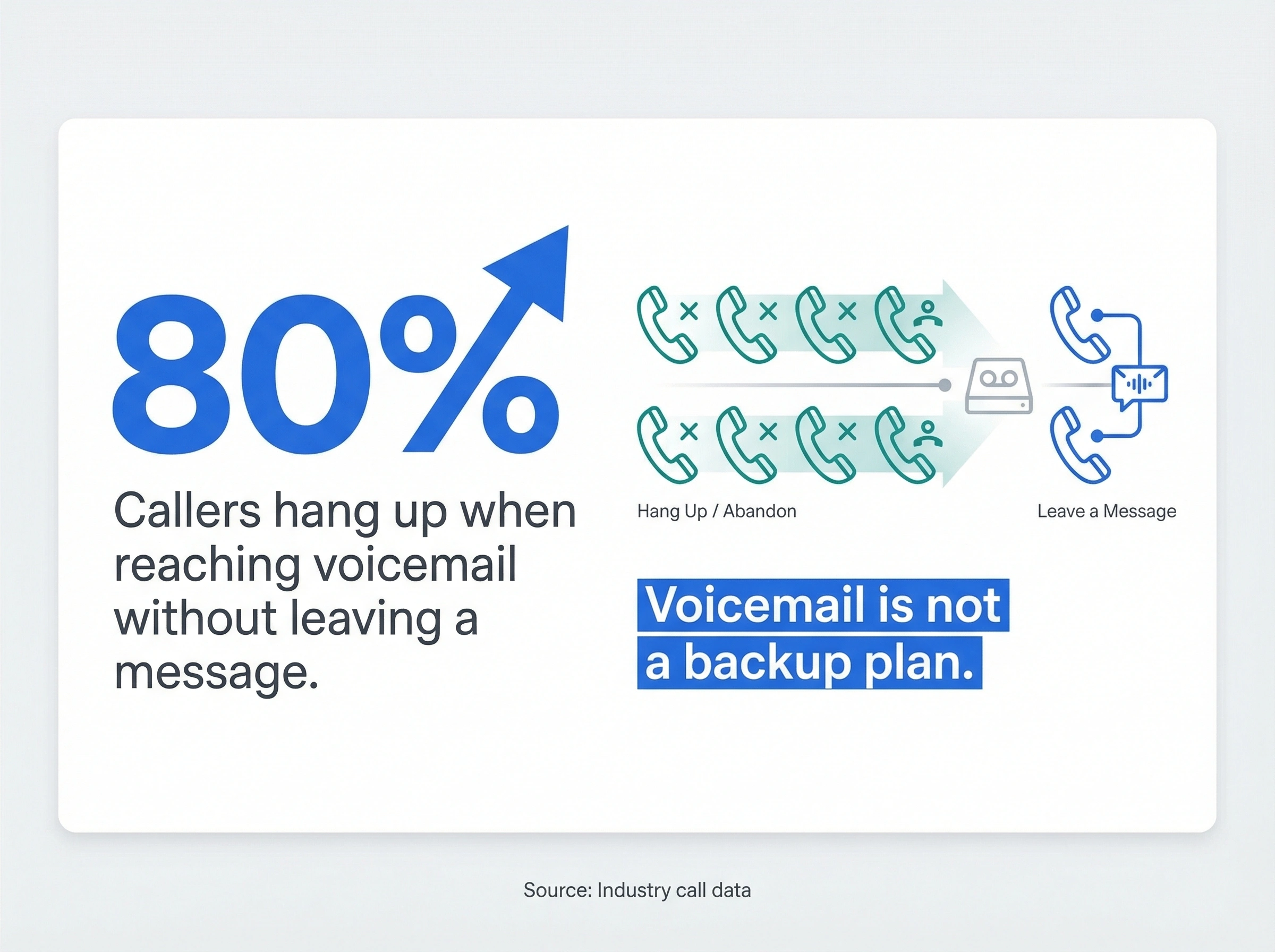
The one option that doesn't work? Letting calls go to voicemail while you weigh your choices. According to industry data, 80% of callers who reach voicemail hang up without leaving a message. Every day you wait is money walking out the door.
Whatever you decide, decide soon. Your next customer is already dialing. And right now, either an AI or a person could be answering that call instead of your voicemail.
Frequently asked questions
An AI receptionist is software that answers calls using artificial intelligence 24/7. A live answering service uses real people to answer your phone. AI costs less and handles unlimited calls, while live agents handle complex or emotional conversations better.
AI receptionists typically cost $25-$300 per month with flat pricing. Live answering services run $150-$1,950 per month based on call volume and minutes used. Most small businesses save $1,600-$5,700 annually with AI.
AI handles routine calls like scheduling and FAQs very well. For emotional or complex situations, it can take detailed notes and transfer to your team. Live agents are still better at reading tone and showing empathy during sensitive calls.
Yes. Many businesses run hybrid setups where AI handles routine calls and overflow, while live agents take complex or sensitive ones. This costs less than full live coverage but gives you human support where it matters most.
Look at your call volume, complexity, hours needed, and budget. If most calls are routine and you need 24/7 coverage, AI is the better fit. If calls are complex and emotionally sensitive, live answering makes more sense.

Written by
Upasana Sahu
Senior Digital Marketing Specialist, SmartReach.io
Upasana Sahu is a Senior Digital Marketing Specialist at SmartReach.io with over 10 years of experience in content marketing, SEO, and digital strategy. She manages end-to-end blog operations, from content creation and on-page/off-page SEO to traffic...
Upasana Sahu is a Senior Digital Marketing Specialist at SmartReach.io with over 10 years of experience in content marketing, SEO, and digital strategy. She manages end-to-end blog operations, from content creation and on-page/off-page SEO to traffic...
Related Articles
Best Answering Service for Small Business [2026]
Compare the best answering services for small business in 2026: live, AI, and hybrid options ranked by real cost per call and coverage.
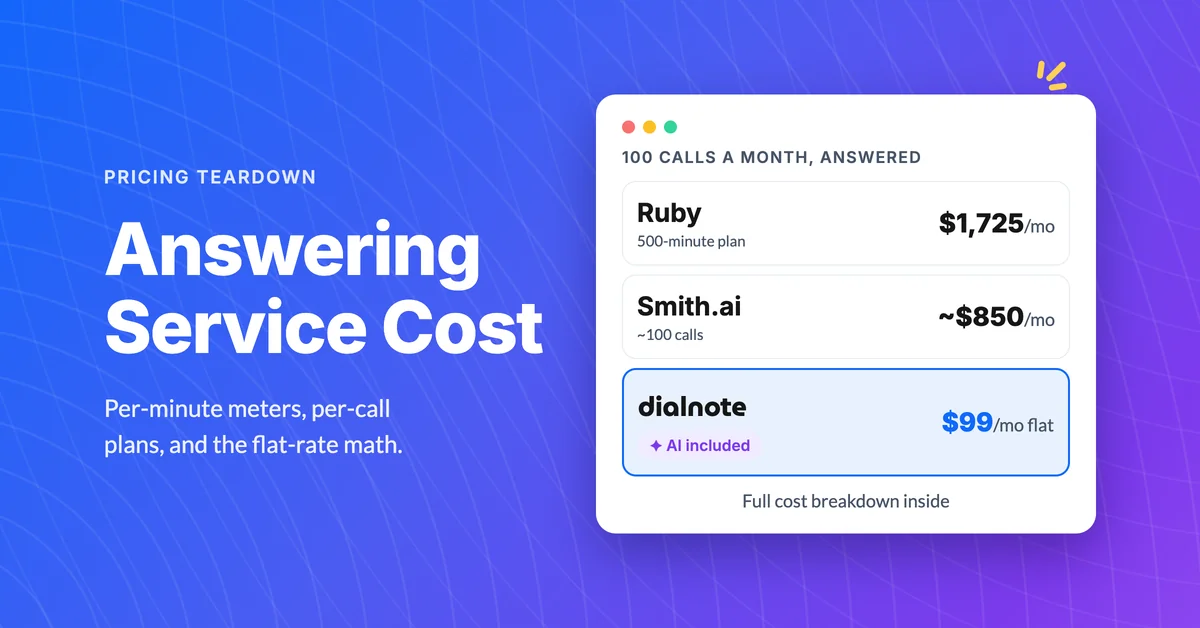
How Much Does an Answering Service Cost in 2026?
See what an answering service costs in 2026: per-minute live rates, per-call plans, hidden fees, and the flat-rate AI math at real call volumes.
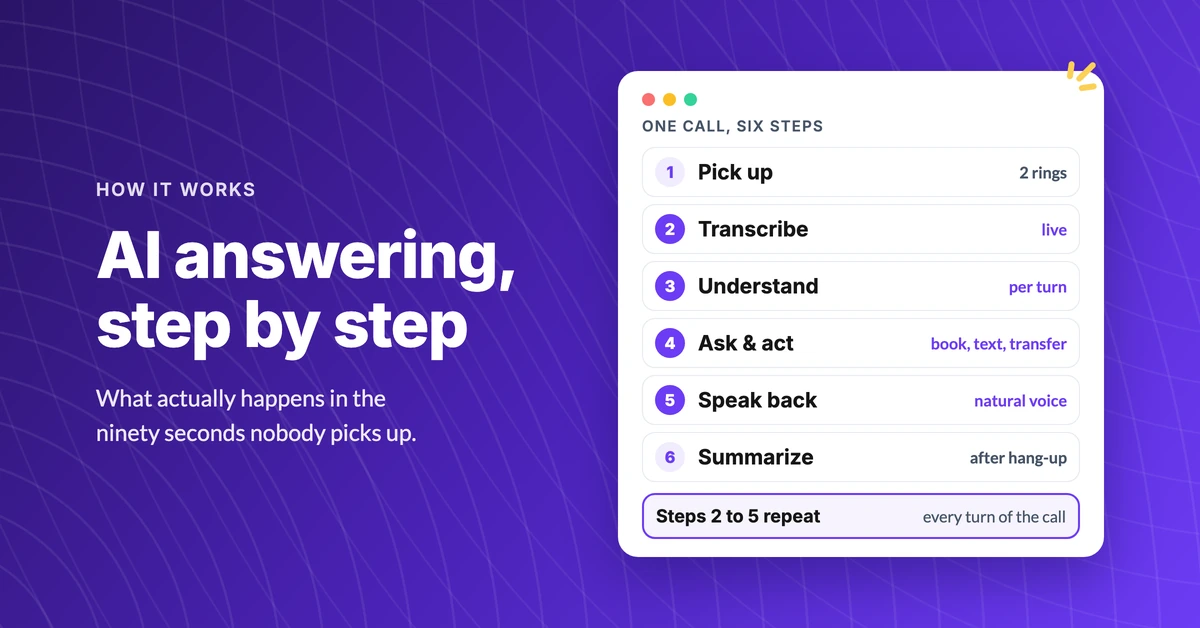
How Does an AI Answering Service Actually Work?
See how an AI answering service works, step by step: what happens in the first four seconds, what it can do on the call, and where it hands off to a human.