Can An AI Receptionist Help Your Roofing Business Grow?
Storm season doesn't send a calendar invite. It sends phone calls. Dozens of them, all at once, from homeowners staring at missing shingles, water-stained ceilings, and tarps that blew off overnight.
An AI receptionist for roofing companies exists to answer those calls when your crew can't. It picks up every ring, captures the caller's details, books inspections, and routes emergencies to your on-call team. All while your roofers are three stories up with nail guns in hand.
Carlos runs a 10-person roofing company in Dallas. Six roofers, two estimators, one office manager, and himself doing a little of everything. After last spring's hailstorm season, he asked his office manager to count the calls they missed over four weeks. The total was 143.
His average roof repair runs $1,800. Full replacements sit between $8,000 and $15,000. Even if just 20% of those missed callers would've booked, that's over $50,000 in lost revenue. During the four weeks when demand was highest and jobs were easiest to close.
Carlos isn't disorganized. He's facing a math problem every roofing company hits: storms create massive call spikes that no office staff of any size can handle. And unlike most home services, roofing calls are urgent. Nobody casually browses for a leak repair when rain is coming Thursday.
TL;DR:
- An AI receptionist for roofing answers every call 24/7, captures caller and damage details, books inspections, and routes emergencies to your on-call estimator, so storm-season leads don't go to voicemail.
- Home service businesses miss about 27% of inbound calls, and that can top 50% for roofers after a major storm, right when the highest-value jobs are on the line.
- Most callers won't leave a voicemail. Roughly 80% hang up and call the next roofer, so a missed call is usually a lost job, not a delayed one.
- An AI receptionist runs about $50 to $300 a month versus $2,800 to $3,200 for a full-time receptionist, and it scales up and down with your seasonal call volume.
- Look for roofing-specific training, smart emergency routing, calendar and insurance-claim handling, bilingual support, and clean text summaries when picking a provider.
What does a missed call really cost a roofing company?
More than the job itself, and the damage compounds fast.
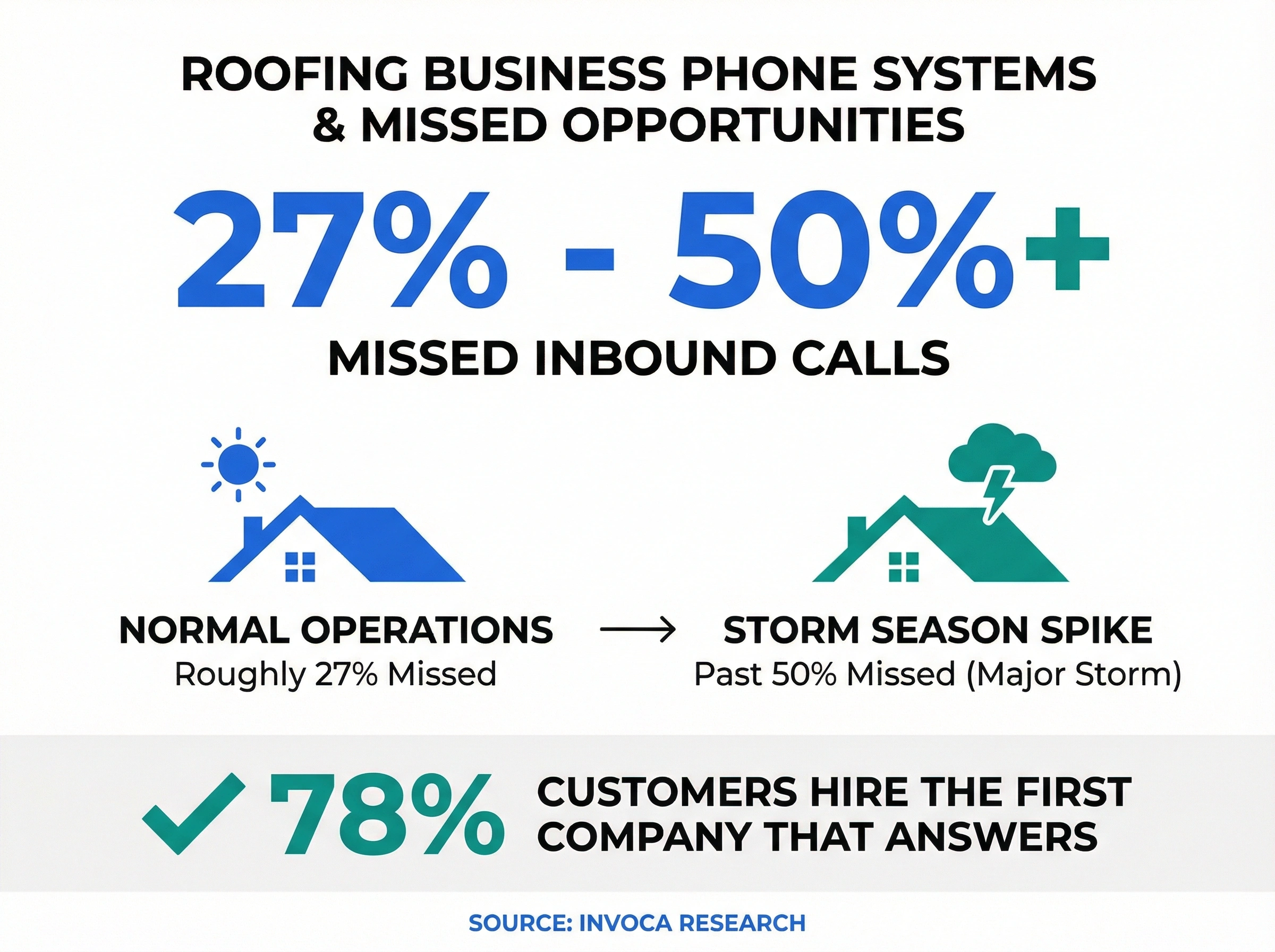
According to Invoca research, home service businesses miss roughly 27% of all inbound calls. For roofing companies after a major storm, that number can climb past 50%. Your phone rings most when your team has the least capacity to answer it.
Here's where it gets expensive. According to Forbes, 78% of customers hire the first service company that answers the phone. Not the cheapest. Not the highest rated. The first one that picks up.
Now layer in roofing-specific economics:
| Roofing service type | Avg. ticket value | Missed calls/week (storm season) | Est. monthly loss |
|---|---|---|---|
| Emergency leak repair | $500-$2,000 | 20-35 | $10,000-$70,000 |
| Full roof replacement | $8,000-$15,000 | 10-20 | $80,000-$300,000 |
| Roof inspection | $200-$500 | 15-25 | $3,000-$12,500 |
| Insurance claim assist | $10,000-$20,000 | 5-10 | $50,000-$200,000 |
| Gutter/flashing repair | $300-$800 | 10-15 | $3,000-$12,000 |
The insurance claim row is the one that should keep you up at night. A single storm-damage roof replacement with insurance involvement averages $12,000-$18,000 in revenue. Miss five of those calls in a week, and you've left $60,000-$90,000 on the table. That's not a rounding error. That's a new truck, two more crew members, and the marketing budget for the rest of the year.
And roughly 80% of callers won't leave a voicemail. They hang up and call the next roofer on Google. By the time you check your phone at the end of the day, those leads are already scheduled with your competitor.
Sound familiar?
Why is phone coverage so hard for roofing companies?
Roofing has unique challenges that make answering the phone harder than almost any other trade.
Your entire team works on rooftops. An electrician might answer a quick call between outlets. A plumber can step away from the pipe wrench for a minute. But a roofer tearing off old shingles at a 6/12 pitch? That phone stays in the truck. The work demands both hands, full attention, and a harness. Nobody's taking a call three stories up.
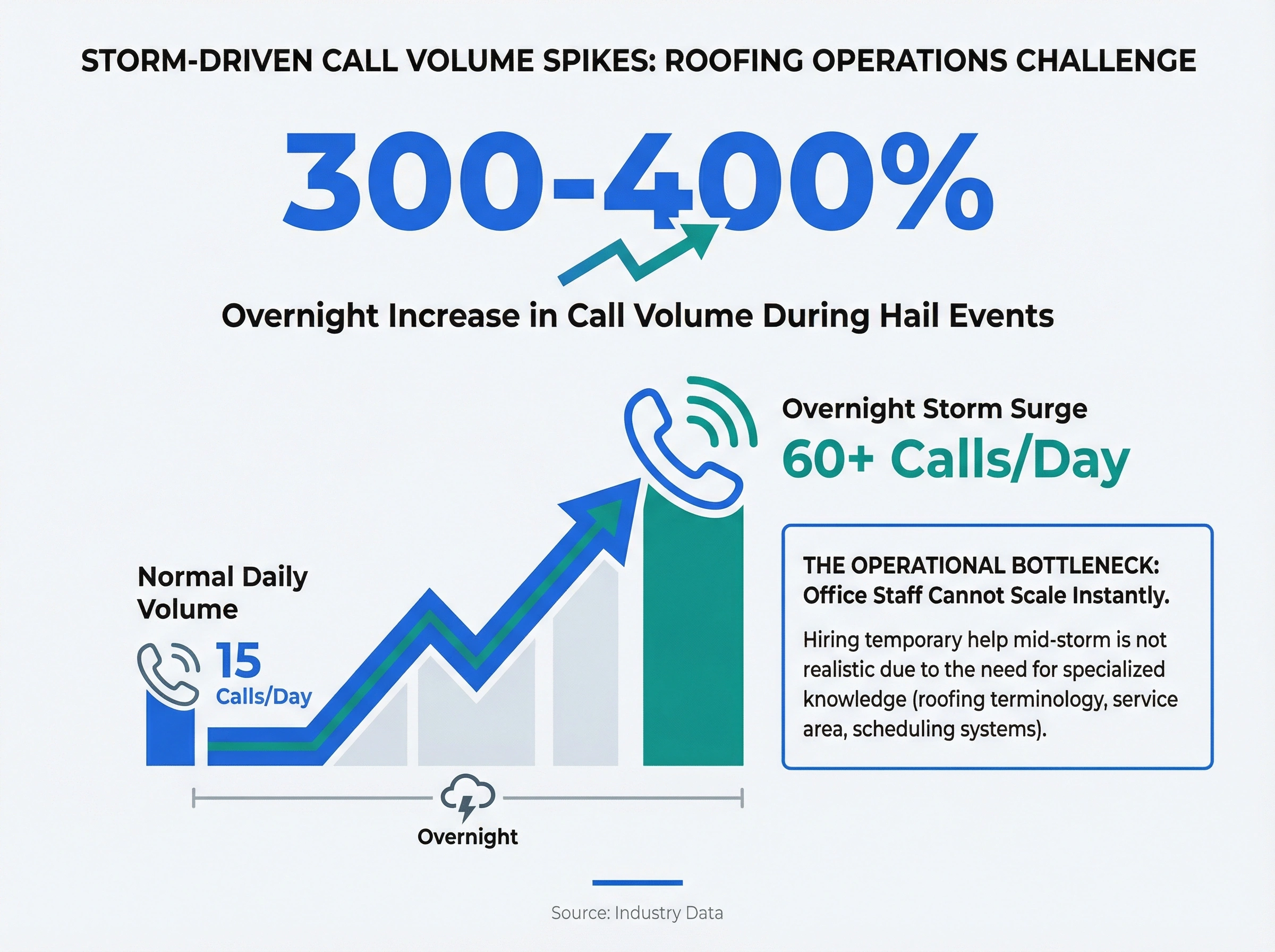
Storm surges are unpredictable and extreme. When a hailstorm rolls through, your call volume doesn't increase by 20%. It spikes 300-400% overnight. You go from 15 calls a day to 60+ in a few hours. No amount of office staff can scale that fast. And hiring temporary help mid-storm isn't realistic because you need someone who knows roofing terminology, your service area, and your scheduling system.
Every call is time-sensitive. A homeowner with an active roof leak isn't comparison shopping. They're calling the first three roofers they find and booking with whoever answers. Wait two hours to call back, and that $12,000 job is gone. According to HouseCallPro data, delays are a primary driver of lost leads in home services. Your speed of response directly determines your close rate.
Roofing seasons are compressed. In many markets, you've got a 6-8 month window for peak revenue. In northern states, winter shuts down most residential work entirely. That means the calls you miss during your active season hurt more because you can't make them up later.
So what happens to those calls when your crew is three stories up on a tear-off?
They disappear. Each one takes a potential $8,000+ job with it.
Here's my honest take after watching home service businesses across a dozen industries try to solve the phone problem: throwing more office staff at it doesn't scale. You'll always be either overstaffed during the quiet months or drowning during storm season. The smarter play is a system that flexes with your call volume automatically.
What can an AI receptionist handle for roofing businesses?
An AI receptionist answers your roofing company's phone 24/7. It's not a phone tree or a glorified voicemail box. It's a conversational AI that handles real calls the way a trained office person would.
Here's what it actually does, broken down by call type:
Storm damage and emergency calls
A homeowner wakes up to water dripping through their bedroom ceiling after last night's storm. They call your number at 6 AM in a panic. The AI picks up on the first ring, identifies the situation as urgent (active leak, interior water damage), collects the address and callback number, and routes the call straight to your on-call estimator's cell phone. The estimator gets a text summary with all the details before they even pick up.
New inspection requests
A neighbor noticed damaged shingles after a hailstorm. They call mid-afternoon. The AI greets them by your company name, asks about the damage they're seeing (missing shingles, dents, cracked tiles), finds out the roof age and type, and checks your schedule to book an inspection. The caller gets a text confirmation. You get a notification with the full picture.
Insurance claim inquiries
A homeowner's insurance adjuster told them they need three roofing estimates. They call you at 4:45 PM on a Friday. The AI captures the claim number, damage type, insurance company, and preferred inspection time. It flags the lead as high-value insurance work and books the estimate appointment.
Follow-up calls on active jobs
A client calls to ask when their materials will arrive, or whether Tuesday's install is still on schedule. The AI provides status based on the info in your system, or offers to have someone call back with specifics.
Commercial property calls
A property manager calls about roof maintenance for a strip mall with six units. The AI qualifies the inquiry, captures the property type, square footage, roof material, and current condition. It flags it as a commercial lead for priority follow-up.
After-hours inquiries
It's 9 PM on a Sunday. A homeowner is thinking about replacing their 20-year-old roof before the rainy season starts. They don't want to wait until Monday. The AI handles the full conversation, explains your services, and books a consultation for the next business day.
Here's how it all breaks down:
| Call type | What the AI does | Your involvement |
|---|---|---|
| Storm damage/leak | Identifies urgency, routes to on-call | Take the callback |
| New inspection request | Qualifies, books appointment | Review summary |
| Insurance claim | Captures claim details, books estimate | Follow up on lead |
| Active job follow-up | Provides update or books callback | Only if complex |
| Commercial inquiry | Qualifies, captures property details | Follow up on lead |
| After-hours booking | Full service, books next-day | Review next morning |
| Spam/solicitation | Declines politely | Never bothered |
The key difference from a traditional answering service? A roofing answering service run by humans has limited hours, takes messages, and charges per minute. An AI receptionist handles the full conversation, books the inspection, and gives you a clean summary. It's the difference between a sticky note that says "someone called about their roof" and a complete lead file ready for your estimator.
Before vs. after: how call handling changes with AI
The easiest way to see the impact is to compare a typical storm-season week with and without an AI receptionist. Let's use a mid-size roofing company running 6-10 crew members.
Without AI receptionist
| Metric | Typical week (storm season) |
|---|---|
| Total inbound calls | 80-120 |
| Calls answered | 35-55 (40-50%) |
| Calls to voicemail | 40-65 |
| Voicemails actually left | 8-13 (80% hang up) |
| After-hours calls missed | 20-30 |
| Emergency leak calls missed | 5-8 |
| Callbacks made | 10-15 (next day) |
| Inspections booked from calls | 20-30 |
| Estimated revenue captured | $40,000-$90,000 |
With AI receptionist
| Metric | Typical week (storm season) |
|---|---|
| Total inbound calls | 80-120 |
| Calls answered | 80-120 (100%) |
| Calls to voicemail | 0 |
| Voicemails actually left | N/A |
| After-hours calls answered | 20-30 (all of them) |
| Emergency leak calls routed instantly | 5-8 (all of them) |
| Inspections booked automatically | 40-65 |
| Inspections booked from calls | 50-80 |
| Estimated revenue captured | $100,000-$240,000 |
That's roughly double the revenue captured from the same number of inbound calls. The calls were coming in either way. The only difference is whether someone answered them.
Honestly, the jury's still out on whether AI handles complex roof damage assessments over the phone as well as a seasoned estimator who's been in roofing for 20 years. For those tricky calls where a homeowner is describing damage that could be anything from a cracked boot vent to full decking rot, a human expert still has the edge. But those calls represent maybe 5-10% of your total volume. The other 90% are routine inspection requests and repair inquiries that the AI handles faster and more consistently than any office staff.
There's a ripple effect here that's easy to overlook. When you answer every call, your online reviews improve. Responsiveness is one of the top factors in home service reviews. When every caller gets a friendly, immediate response, even if it's AI, your 5-star review count climbs. Better reviews mean more inbound calls, which creates a growth loop that compounds season over season.
Your marketing ROI improves too. You're paying for Google Ads, SEO, truck wraps, yard signs, and door hangers. All of that spend funnels into one action: a phone call. If nobody picks up, every marketing dollar was wasted. An AI receptionist makes sure the leads you're already paying for actually convert into booked inspections.
And here's something most roofing owners don't think about: the data. When every call is answered and summarized, you start seeing patterns. Which zip codes generate the most storm-damage calls. What time of day your highest-value leads call. Which services get the most inquiries. That kind of data is invisible when half your calls go to voicemail. Once you can see it, you can make smarter decisions about where to send your crews, your ad spend, and your expansion plans.
Is an AI receptionist worth it for a small roofing company?
But does the math actually hold up for a smaller shop?
Let's break it down for a 3-person roofing company: one owner who also estimates and sells, and two crew members.
Current costs of handling calls yourself:
You're answering the phone between jobs, during lunch, and while driving to estimates. Your spouse or a family member helps when they can. You miss about 10-15 calls a week during storm season. At an average ticket of $2,500, with 25% conversion, that's $6,250-$9,375 per week in lost revenue, or roughly $25,000-$37,500 per month during your busiest stretch.
Cost of a human receptionist:
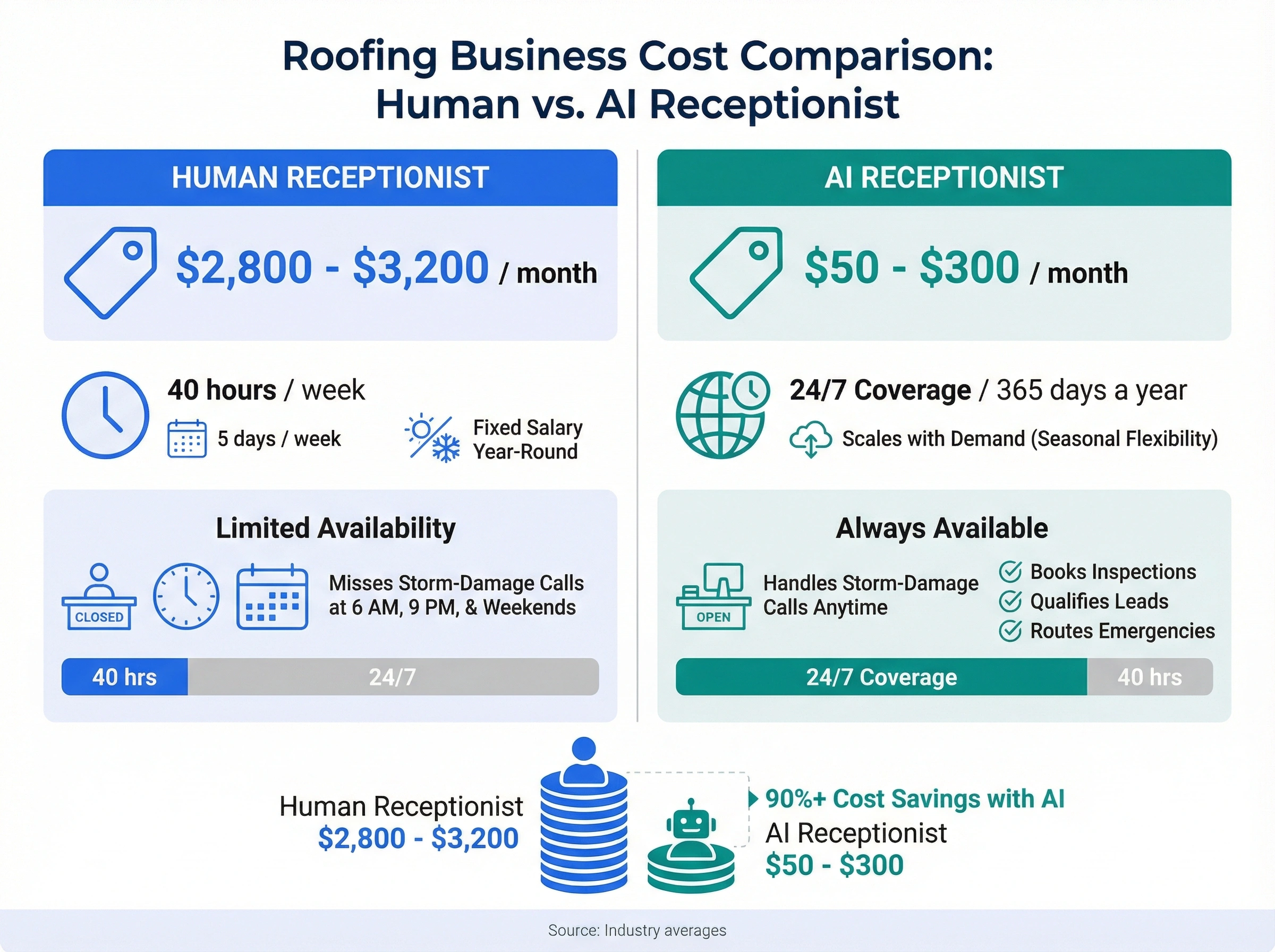
A full-time receptionist runs $2,800-$3,200 per month with basic benefits. They work 8 hours a day, 5 days a week. But storm-damage calls come at 6 AM, 9 PM, and all weekend long. Plus you're paying that salary year-round, even during the winter months when your phone barely rings.
Cost of a traditional answering service:
A human-based answering service charges $200-$500 per month for basic message-taking. They take a message and email it to you. They don't book inspections, they don't qualify insurance leads, and they don't know the difference between architectural shingles and three-tab.
Cost of an AI receptionist:
$50-$300 per month. Works 24/7, 365 days a year. Books inspections, qualifies leads, routes emergencies, and gives you organized call summaries. Scales with your call volume without scaling your costs.
Here's the side-by-side:
| Option | Monthly cost | Hours covered | Books inspections | Knows roofing | Scales with demand |
|---|---|---|---|---|---|
| DIY (yourself) | $0 (but lost revenue) | When available | No | Yes | No |
| Full-time receptionist | $2,800-$3,200 | 40 hrs/week | Yes | With training | No |
| Traditional answering service | $200-$500 | 24/7 | No | No | Partially |
| AI receptionist | $50-$300 | 24/7 | Yes | Yes (trained) | Yes |
Skip the traditional answering service entirely. They're a middleman that creates more work, not less. You still have to call every lead back, figure out what they need, and book the inspection yourself. You're paying someone to take notes you could've gotten from a voicemail.
The AI receptionist is the only option that actually removes work from your plate while capturing more revenue. For a small roofing company, it's not even close.
Why does this matter so much for roofers specifically? Because your average ticket value is higher than most home services. A missed plumbing call might cost you $300. A missed roofing call during storm season could cost you $12,000+. The stakes per missed call are simply bigger, which means the ROI on catching those calls is bigger too.
How to pick the right AI receptionist for your roofing company
Not every AI receptionist is built for the trades. Some are designed for dental offices or law firms and won't know the difference between flashing and felt paper. Here's what to look for.
Roofing-specific training. The AI should understand terms like ridge cap, drip edge, ice dam, soffit, fascia, underlayment, and TPO membrane from day one. If you have to spend weeks teaching it your vocabulary, pick a different provider.
Smart emergency routing. On a rainy Tuesday, a call about an active interior leak isn't the same priority as someone asking for a quote on a new roof next spring. The AI needs to tell the difference and route accordingly. Emergencies go straight to your on-call estimator's phone. Everything else gets booked and logged.
Calendar and scheduling integration. If the AI can't book directly into your schedule, it's just a fancy answering machine. Look for integrations with JobNimbus, AccuLynx, Google Calendar, or whatever tool you already use. The best systems factor in crew availability and service zones.
Insurance claim handling. A significant chunk of roofing revenue comes through insurance. Your AI should know how to capture claim numbers, adjuster contact info, and damage descriptions in a format that makes your insurance coordinator's job easier.
Bilingual capability. Depending on your service area, you might get calls in Spanish or other languages. An AI that handles multiple languages means you don't lose leads over a language barrier. In markets like Houston, Miami, Phoenix, or Los Angeles, this isn't optional.
Clear call summaries. You don't want recordings you have to listen to. You want text summaries: who called, what damage they're seeing, roof age, how urgent it is, and when they're available for an inspection. Bonus if the system tags calls by type (emergency leak, insurance claim, new install, repair).
Month-to-month pricing. Roofing is seasonal. Your call volume in April after a hailstorm might be ten times what it is in December. Don't get locked into an annual contract. Pick a provider that lets you scale up and down as your business cycles shift.
How dialnote helps roofing companies answer every call
dialnote was built for businesses where the team spends their day in the field, not behind a desk. That describes every roofing company.
Here's how it works for roofers specifically:
An AI receptionist that speaks roofing. dialnote's AI receptionist understands the difference between wind damage and hail damage from day one. Callers describe their problem, and the AI asks the right follow-up questions: What type of roof? How old? Any visible damage from the ground? Interior water stains? It captures details your estimator actually needs to schedule the right visit.
Emergency routing that works at 6 AM. When someone calls before sunrise because water is pouring through their ceiling, dialnote's call routing identifies it as urgent and patches it through to your on-call estimator immediately. They get a text with the address, damage description, and symptoms before they pick up.
One number for your entire team. With dialnote's shared numbers, your whole crew shares one business line. No more giving out personal cell numbers to clients. Your estimators, crew leads, and office staff all stay connected through one professional number, and calls get routed to the right person based on what the caller needs.
AI call summaries that replace sticky notes. Every call gets an automatic summary through dialnote's AI call tags and analytics. At the end of the day, you see a clean list: who called, what damage they described, how urgent it is, and what was booked. No more digging through voicemails or relying on handwritten messages from your office manager.
A full phone system, not just call answering. dialnote gives you a professional business calling system with text messaging built in. Send inspection confirmations, follow up with estimates, share photos of completed work. It's everything you need to run your roofing company's communications from your phone or tablet, on the roof or in the office.
See real-time call data. dialnote's call analytics show you exactly what's happening with your phone: peak call times, average response speed, conversion rates by call type. During storm season, you can see whether you need to add another estimator to the schedule or expand into an adjacent service area. It's the kind of visibility that turns phone calls into actual business intelligence.
A lot of roofing owners try to solve the phone problem with some combination of answering between jobs, having a spouse take calls, and hoping voicemail catches the rest. That works when you're running one crew. It falls apart the moment you try to grow past that. dialnote replaces all of it with a system that's on 24/7 and costs a fraction of a part-time hire, and you can see exactly what that runs on dialnote's pricing plans. If you want a deeper look at what a full phone system for home service businesses looks like, we've covered that in detail. And if you're a general contractor juggling multiple trades, the same principles apply at a bigger scale.
Your next roofing job is calling right now
Every roofing company owner has a story about the big job that got away. The commercial re-roof that went to a competitor because nobody answered on a Saturday. The $14,000 insurance replacement that called twice and gave up. The property manager who dropped your company from their preferred vendor list because you were hard to reach.
The roofing industry hasn't changed much when it comes to what makes a good company. You show up when you say you will, you do quality work, and you stand behind your warranty. But how homeowners find and choose their roofer has shifted completely. They search, they call, and they book with whoever picks up first.
An AI receptionist for roofing companies isn't about replacing your team. It's about making sure every call your marketing generates actually turns into a conversation. Every storm-damage lead gets captured. Every insurance inquiry gets logged. Every homeowner gets an answer, even at 6 AM on a Monday after a hailstorm rolled through town.
If you're curious about the impact, try tracking your missed calls for one week. Count them up. Multiply by your average job value. That number is what an AI receptionist is worth to your roofing business.
Get started with dialnote and stop letting your next roofing job go to voicemail.
Frequently asked questions
It answers your business phone 24/7, asks callers about their roof issue, captures details like damage type, roof age, and urgency, then books inspections or routes emergencies to your on-call estimator. You get a text summary of every call.
Most AI receptionist services cost $50-$300 per month. Compare that to $35,000-$45,000 a year for a full-time receptionist. Most roofing companies see ROI within the first week from captured storm-damage leads alone.
Yes. It identifies urgent situations like active leaks, interior water damage, or storm damage. It collects the address, damage details, and routes the call straight to your on-call estimator's phone immediately.
Modern AI receptionists sound natural and conversational. They understand roofing terms like ridge cap, flashing, underlayment, and shingle types. Most callers don't realize they're talking to AI.
No. AI receptionists work with your existing business phone number. Setup takes under 30 minutes and doesn't need any new hardware. It works on your phone, tablet, or any device with an internet connection.

Written by
Lancelot Dsouza
Chief Marketing Officer, SmartReach.io
Lancelot Dsouza is the Chief Marketing Officer at SmartReach.io, where he built the Marketing, Sales, and Customer Success verticals from the ground up. With over 25 years of experience spanning digital marketing, business development, and strategic...
Lancelot Dsouza is the Chief Marketing Officer at SmartReach.io, where he built the Marketing, Sales, and Customer Success verticals from the ground up. With over 25 years of experience spanning digital marketing, business development, and strategic...
Related Articles

Can an AI Receptionist Grow Your Pest Control Business?
Find out how an AI receptionist for pest control answers every call, books service appointments, and captures leads you'd otherwise lose.
Can An AI Receptionist Help Your HVAC Business Grow?
Find out how an AI receptionist for HVAC companies answers every call, books service appointments, and captures leads you'd otherwise lose to voicemail.

How Can an AI Receptionist Grow Your Electrical Business?
Find out how an AI receptionist for electricians answers every call, books jobs, and handles emergencies so your electrical business keeps growing.