The Cost of Missed Calls: Calculator and Worked Examples
Every business owner knows missed calls are bad. Almost nobody knows what they actually cost. The cost of missed calls hides in your phone logs as a handful of "missed" entries a week, and each one looks harmless on its own.
They're not harmless. Marcus runs a six-person plumbing company, and last Tuesday he was elbow-deep in a water heater swap when his phone buzzed three times. Two voicemails, one hang-up. The hang-up called the next plumber on Google, and a $2,400 job vanished in the time it took to tighten a fitting.
So how much are missed calls costing my business? That's the question this post answers with one formula and five fully worked examples. No hand-waving, no "studies suggest billions are lost". Just math you can redo with your own numbers in five minutes.
TL;DR:
- The formula: missed calls per week × 52 × % who never call back × % you would have closed × average job value.
- Use 69% as the never-call-back baseline (Quo's 16.7 million-call analysis), then adjust it for your own market.
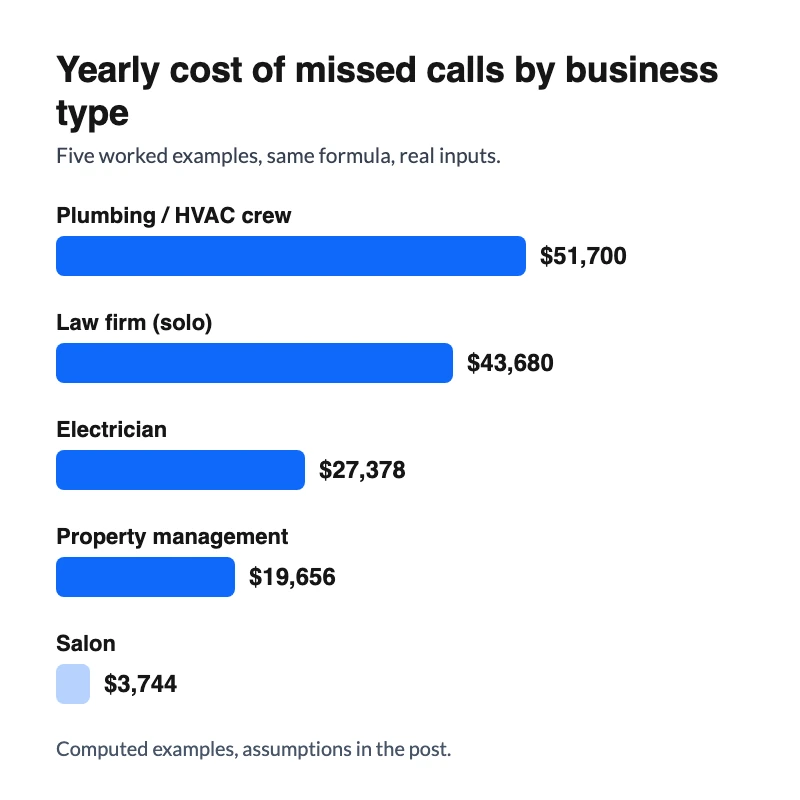
- Worked out across five businesses, the yearly cost runs from $3,744 for a staffed salon front desk to $51,700 for a two-tech plumbing crew.
- Most owners get two inputs wrong: they undercount missed calls (voicemail hides them) and overcount their close rate.
- Fixing it costs $150 to $400 a month for a live answering service, or a flat $19 to $99 for AI answering, so one saved job a month usually covers it.
Jump to: the formula · five worked examples · run your own numbers · break-even · when it doesn't matter
The missed call cost formula
Here's the whole calculation:
Missed calls per week × 52 × % who never call back × % you would have closed × average job value = yearly cost of missed calls
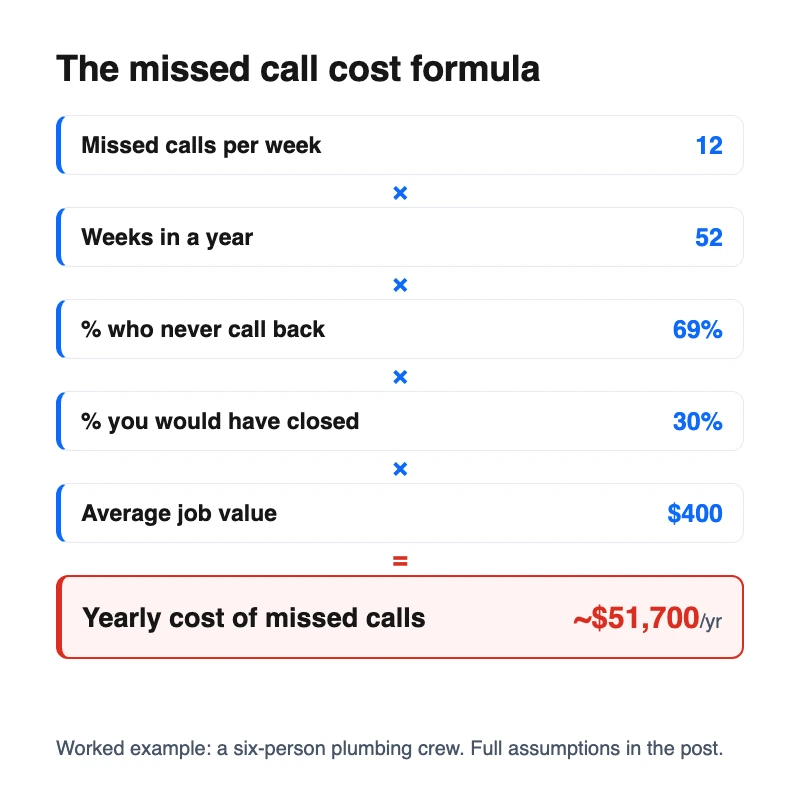
Each variable comes from somewhere real. Here's how to estimate all five from your own records.
Missed calls per week. Open your phone system's call log and count calls you didn't answer live, including ones that went to voicemail. Most systems show this in a report (dialnote users can pull the missed-call count straight from call reports). No log? Tally for one normal week.
52. The weeks in a year. This is the number that turns "a few missed calls" into a real annual figure.
% who never call back. Not everyone who hits voicemail is lost, but most are. Only about 6% of callers say they leave a voicemail (YouGov), and Quo's analysis of 16.7 million missed calls found 69% never get a callback within 48 hours. We've collected the research on this in our missed call statistics roundup. Start from that 69% baseline and adjust within 60-80% for how urgent your callers' problems are: emergencies churn fast, loyal regulars call back.
% you would have closed. Your normal close rate on inbound calls, not your best month. If half your calls are spam or vendors, bake that in here by cutting the rate.
Average job value. Your average ticket, invoice, or first-year revenue per new customer. Use your books, not your biggest job.
The cost of missed calls: five worked examples
Let's run the formula for five common small businesses. The inputs vary honestly: a salon with a staffed front desk misses fewer calls than a two-person plumbing crew, and its regulars call back more often. Sources for each average job value are linked so you can check the math.
1. Plumbing and HVAC crew (2 techs, no office staff)
Hands in a crawlspace can't answer a phone, so miss rates run high. The average plumbing repair costs $331 according to HomeAdvisor's plumbing cost data, and emergency calls bill 50-100% more, so $400 is a fair blended job value.
| Input | Value |
|---|---|
| Missed calls per week | 12 |
| % who never call back | 69% |
| % you would have closed | 30% |
| Average job value | $400 |
| Yearly cost of missed calls | ~$51,700 |
That's 12 × 52 × 0.69 × 0.30 × $400, using the measured 69% never-call-back baseline from the Quo data in our stats roundup above. More than fifty grand, and the inputs aren't even aggressive. We break this vertical down further, water heaters and repipes included, in our cost of missed calls for plumbers deep dive.
2. Electrician (solo plus apprentice)
Slightly lower volume, similar dynamics. Hiring an electrician costs $351 on average per Angi's 2026 electrician pricing data. We'll assume a 75% never-call-back rate, a notch above the 69% baseline, since electrical faults feel urgent.
| Input | Value |
|---|---|
| Missed calls per week | 8 |
| % who never call back | 75% |
| % you would have closed | 25% |
| Average job value | $351 |
| Yearly cost of missed calls | $27,378 |
3. Law firm consult (solo attorney)
Fewer missed calls, but each one is heavy. We'll only count likely new-client calls (3 a week) and use a conservative 10% consult-to-retain rate. Family law retainers typically run $3,000 to $5,000 per KGN Law Firm's retainer guide, so $3,500 is a modest job value. People calling lawyers are usually calling three firms that afternoon, which is why we assume a never-call-back rate at the top of the range.
| Input | Value |
|---|---|
| Missed new-client calls per week | 3 |
| % who never call back | 80% |
| % you would have closed | 10% |
| Average retainer value | $3,500 |
| Yearly cost of missed calls | $43,680 |
4. Salon (staffed front desk)
The contrast case. A front desk answers most calls, regulars call back, and tickets are small. A haircut runs $15 to $95 depending on service and city per Fash's haircut pricing data, so we'll use a $60 blended ticket, and we'll assume a 60% never-call-back rate, below the 69% baseline, because regulars retry.
| Input | Value |
|---|---|
| Missed calls per week | 5 |
| % who never call back | 60% |
| % you would have closed | 40% |
| Average ticket | $60 |
| Yearly cost of missed calls | $3,744 |
Still real money, but a different universe from the plumbing crew. Job value drives everything.
5. Property management (4 offices)
Here the lost call that matters is a prospective owner shopping for a manager. Management fees run 8-12% of monthly rent per Baselane's property management fee breakdown, so one door at $1,500 rent is worth about $1,800 a year in fee revenue. We'll assume a 70% never-call-back rate, right around the measured 69% baseline.
| Input | Value |
|---|---|
| Missed owner-lead calls per week | 2 |
| % who never call back | 70% |
| % you would have closed | 15% |
| First-year fee revenue per door | $1,800 |
| Yearly cost of missed calls | $19,656 |
And that's before counting the tenant calls that turn into bad reviews and non-renewals.
Run your own numbers
Here's the calculator. The inputs start on the worked example above, so change them to your own numbers, pulled from a real week of phone logs rather than memory.
Run your own numbers
The defaults are the six-person plumbing crew from the example above. Change any input and the yearly cost recomputes.
Missed calls a year
624
12 a week across 52 weeks
Jobs you lose
129
431 callers never come back, 30% of them would have booked
Yearly cost of missed calls
$51,700
about $4,300 a month at $400 a job
For scale: dialnote's Team plan is $49/mo flat for unlimited users, so a year of it costs about 1 saved job at your average ticket. 10-day free trial, no credit card. Your inputs are assumptions, not a quote: pull the real missed-call count from your phone logs before you trust the total.
Two numbers almost everyone gets wrong, in opposite directions:
You'll undercount missed calls. Voicemail hides them. A call that rings out feels handled because a message might be waiting, but most callers hang up without leaving one, so the miss never registers. Count every call you didn't answer live: after-hours, lunch, both-lines-busy, and the ones that died in your phone tree. Businesses that pull a real report are usually surprised.
You'll overcount your close rate. Owners quote their best-case rate, the one from a good month with warm referrals. Use your honest average on cold inbound calls, and if a chunk of your calls are spam or sales pitches, cut the rate to match. It's better to compute a smaller, true number than a big one you don't believe.
Break-even: what fixing missed calls costs
Now the other side of the ledger. What does it cost to answer every call?
A live answering service typically runs $150 to $400 a month for small-business plans, per Housecall Pro's answering service cost guide, with per-minute overages on top. Our full answering service cost breakdown covers the pricing traps in that model.
AI answering built into a business phone system costs far less. dialnote's flat plans start at $19 a month, and AI voice agents come with the Team plan at $49 a month, with agent conversation minutes billed pay-as-you-go on top.
Compare that against the smallest loss we computed. The salon, our weakest case, loses $3,744 a year, which is $312 a month. That's roughly the cost of a mid-tier live answering service and six to sixteen times the cost of an AI answering plan. Every other business on the list loses $1,600 to $4,300 a month.
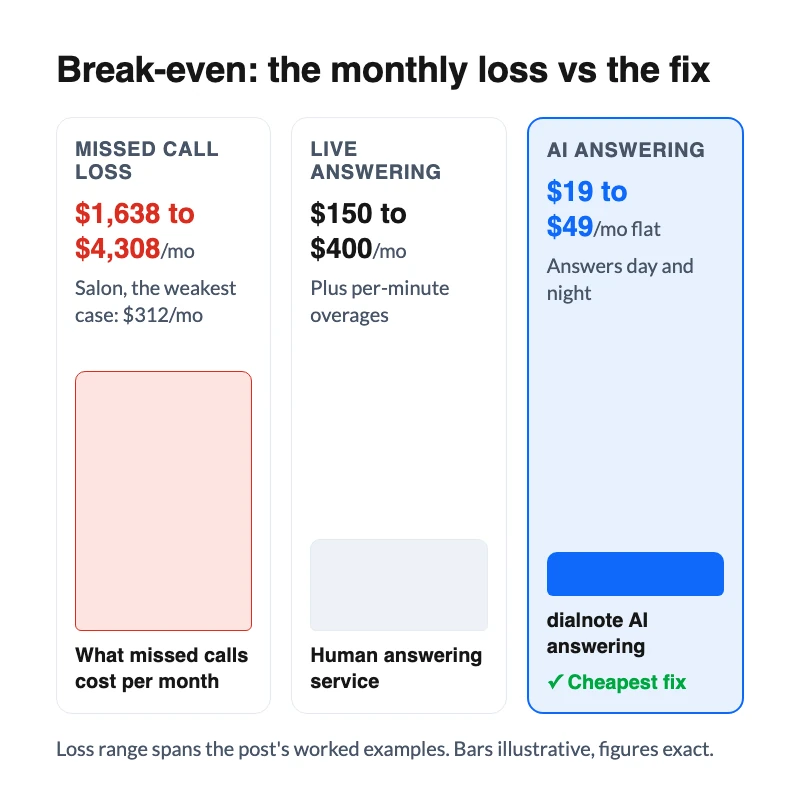
Here's the strong opinion, and I'll stand behind it: for most service businesses, one saved job per month pays for the fix. If your average job is worth more than $50, this isn't a close call. The break-even isn't "will this transform my business", it's "will this catch one caller a month who would've hired the next name on Google". It will.
Would you leave a $2,400 job on the table to save $49? That's what the plumbing math says is happening, week after week.
When missed calls don't cost much
Honesty matters more than a scary number, so here's when the formula spits out something small and you should believe it.
Appointment-only businesses with loyal clients. A therapist, a tutor, or a stylist whose book is full of regulars can miss calls all day. Those clients call back, text, or rebook online. The never-call-back rate for regulars is closer to 10% than 80%, and the formula collapses accordingly.
Solo operators who genuinely answer everything. Some consultants and one-person shops really do pick up 95% of calls because the phone rarely rings and they're at a desk. If your honest missed-call count is one or two a week, your yearly cost is lunch money. Don't buy a fix for a problem you don't have.
Businesses where new customers don't arrive by phone. If your pipeline is referrals, email, or a booking page, a missed call is usually a vendor. The formula still works, your close rate on inbound calls is just tiny.
The point of a calculator is that it can also tell you no. Run it before you spend anything.
Where dialnote fits
If your number came out ugly, the fix doesn't require hiring anyone. dialnote's AI agent answers your business line 24/7, asks the questions you set (name, job details, callback number) and logs the answers, books appointments through Calendly or Cal.com, sends an SMS with details, or transfers the call to a teammate when it needs a human. Every call lands in your reports, so next quarter you can rerun this formula with a much smaller first input.
We've covered what a 24/7 AI answering service costs and how to set one up separately. The short version for this post: the 10-day free trial needs no credit card, which means you can test the whole thing against one week of your real call volume before the trial ends. Your own call log becomes the verdict.
Find out what your missed calls actually cost
10-day free trial, no credit card needed. Your call reports do the math for you.
Run the formula this week. Whether the answer is $3,000 or $60,000, knowing the real cost of missed calls beats guessing, and it takes one report and five minutes of arithmetic to find out.
Frequently asked questions
Multiply missed calls per week by 52, then by the percent of callers who never call back, then by your close rate, then by your average job value. Example: 10 missed calls x 52 x 69% x 25% x $350 = about $31,400 a year.
It depends on your job value and miss rate. Our worked examples range from $3,744 a year for a salon to about $51,700 for a two-person plumbing crew. Pull your real missed-call count from your phone logs and run the formula with your own numbers.
Voicemail hides them. A call that rings out to voicemail still shows as "handled" in your head, but most callers hang up without leaving a message and dial a competitor instead. Count every call you didn't answer live, not just the ones with no voicemail.
A live answering service runs about $150 to $400 a month. AI answering built into a business phone system starts far lower: dialnote plans run $19 to $49 a month flat. For most service businesses, one saved job per month covers the cost.
When your clients are loyal and appointment-based, so they'll call back or text, or when you're a solo operator who genuinely answers almost every call. If new business rarely arrives by phone, your cost of missed calls is low. Run the formula anyway to confirm.

Written by
Upasana Sahu
Senior Digital Marketing Specialist, SmartReach.io
Upasana Sahu is a Senior Digital Marketing Specialist at SmartReach.io with over 10 years of experience in content marketing, SEO, and digital strategy. She manages end-to-end blog operations, from content creation and on-page/off-page SEO to traffic...
Upasana Sahu is a Senior Digital Marketing Specialist at SmartReach.io with over 10 years of experience in content marketing, SEO, and digital strategy. She manages end-to-end blog operations, from content creation and on-page/off-page SEO to traffic...
Related Articles
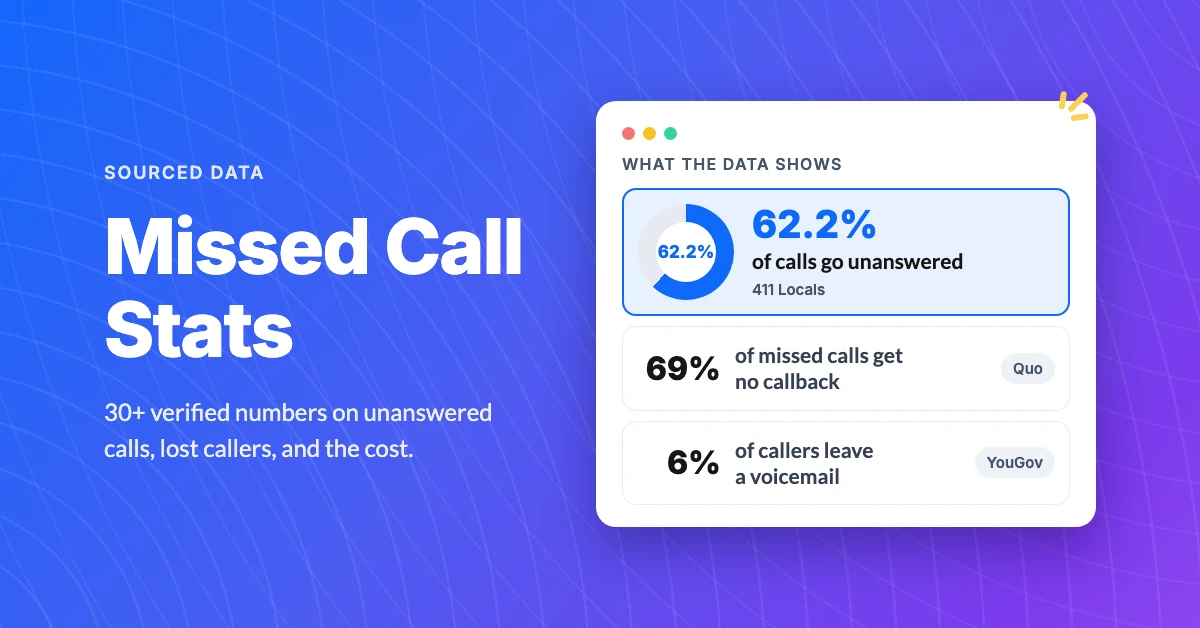
30+ Missed Call Statistics Small Businesses Need in 2026
See 30+ sourced missed call statistics for 2026: how many calls go unanswered, how few callers try again, and what that costs small businesses.
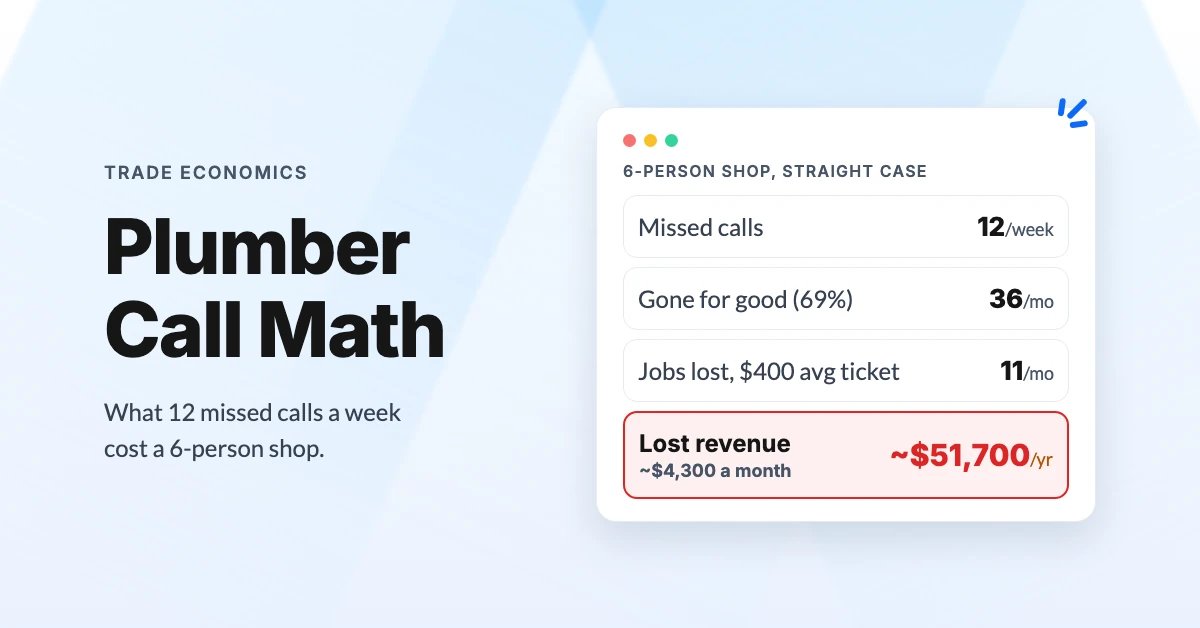
The Real Cost of Missed Calls for Plumbers (2026 Math)
Work out what missed calls cost your plumbing business: per-job values, after-hours miss rates, and a worked example that shows the yearly leak.

Missed Call Text Back: 15 Templates That Save the Job
Copy 15 missed call text back templates for service businesses, plus timing rules and worked examples that keep missed callers from booking elsewhere.