The Real Cost of Missed Calls for Plumbers (2026 Math)
A burst pipe at 9 PM on a Tuesday. The homeowner searches "plumber near me," taps the first result, and gets four rings and a voicemail. The cost of missed calls for plumbers hides inside that exact moment: by the fifth ring she's reading the second name on the list, and the second name picks up.
Marcus owns that first company. Six people: him, four techs, a part-time bookkeeper. He's not lazy and he's not bad at plumbing. At 9 PM he was at his kid's game with his phone in the truck, and at 2 PM the next day two more calls rolled to voicemail while he was elbow-deep in a water heater swap.
Most posts about plumber missed calls stop there and wave at a scary number. This one builds the number line by line, shows every assumption, then reruns the whole thing with deliberately cautious inputs so you can see the floor as well as the ceiling. Bring your own call log and argue with any line you want.
TL;DR:
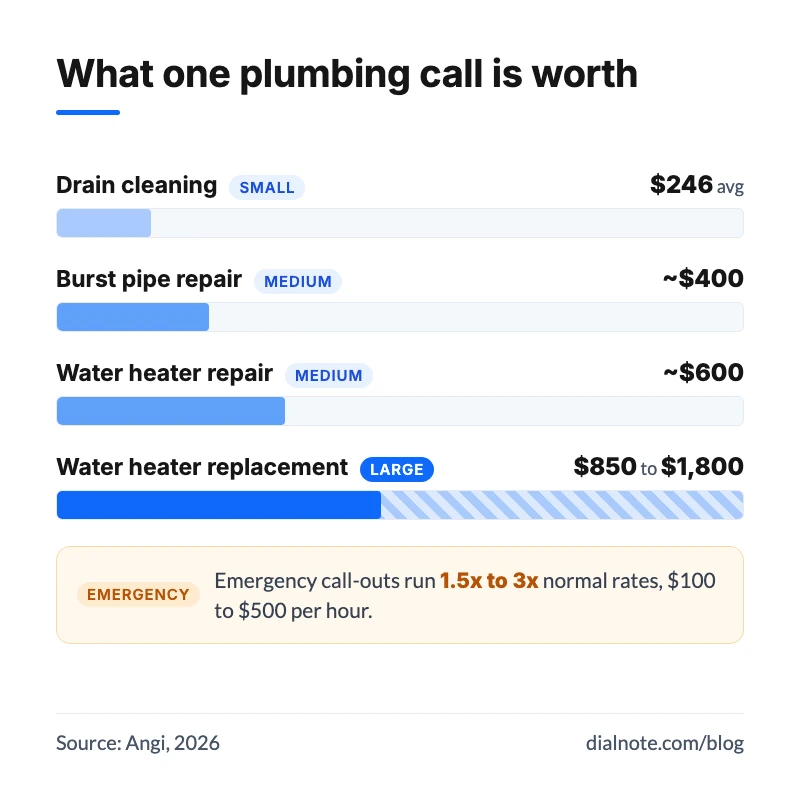
- Plumbing jobs are worth real money: about $246 for drain cleaning, $850 to $1,800 for a water heater replacement, and 1.5 to 3 times normal rates for emergency work (Angi, 2026).
- A 6-person shop with ordinary miss rates leaks about $4,300 a month, roughly $51,700 a year, in our straight-case math.
- Rerun with conservative inputs, the same shop still leaks about $14,300 a year. That's the floor, and it's still too big to ignore.
- Fixes range from free-and-leaky (voicemail, forwarding to your cell) to $99+ a month for live answering (with only 50 minutes included), to $49 to $99 flat for AI answering that books jobs 24/7.
Jump to: what it really costs · the worked example · the conservative rerun · what plumbers try first · do the audit
What's the real cost of missed calls for plumbers?
Two inputs set the price of a missed call: what the job behind it was worth, and how likely that caller was to book with you if you'd answered. Start with job values, because plumbing tickets are bigger than most owners give them credit for.
| Job type | Typical 2026 price | Bucket |
|---|---|---|
| Drain cleaning | $147 to $352, average $246 | Small |
| Burst pipe repair | around $400, before water damage | Medium |
| Water heater repair | around $600 | Medium |
| Water heater replacement | $850 to $1,800 | Large |
| Emergency call-out | 1.5x to 3x normal rates, $100 to $500 per hour | Emergency |
Those figures come from Angi's 2026 cost guides: drain cleaning, general plumbing repair, water heater work, and emergency plumber rates. Notice the shape of that table. The calls you're most likely to miss, evenings and weekends, are the ones sitting in the large and emergency buckets.
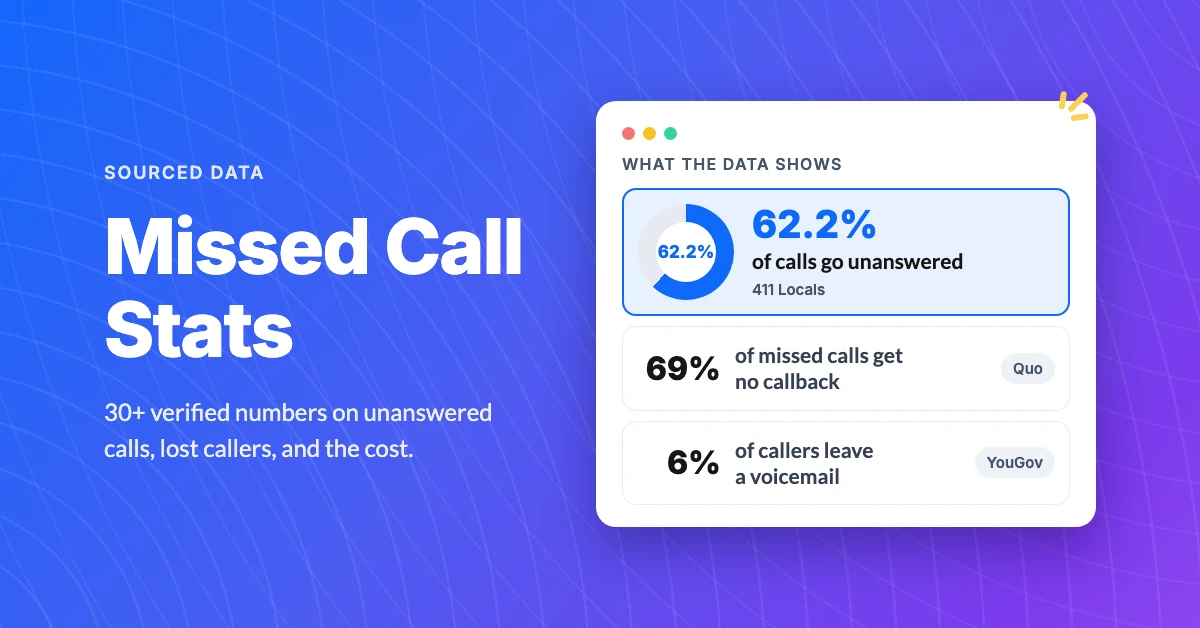
Now the miss rates. Our missed call statistics roundup pulls the industry numbers together, and three of them matter here: 62.2% of calls to small businesses went unanswered in the only direct measurement anyone has published (411 Locals), 69% of missed callers never call back within 48 hours (Quo's analysis of 16.7 million missed calls), and only a tiny minority will leave a voicemail. Plumbing sits at the bad end of every one of those curves.
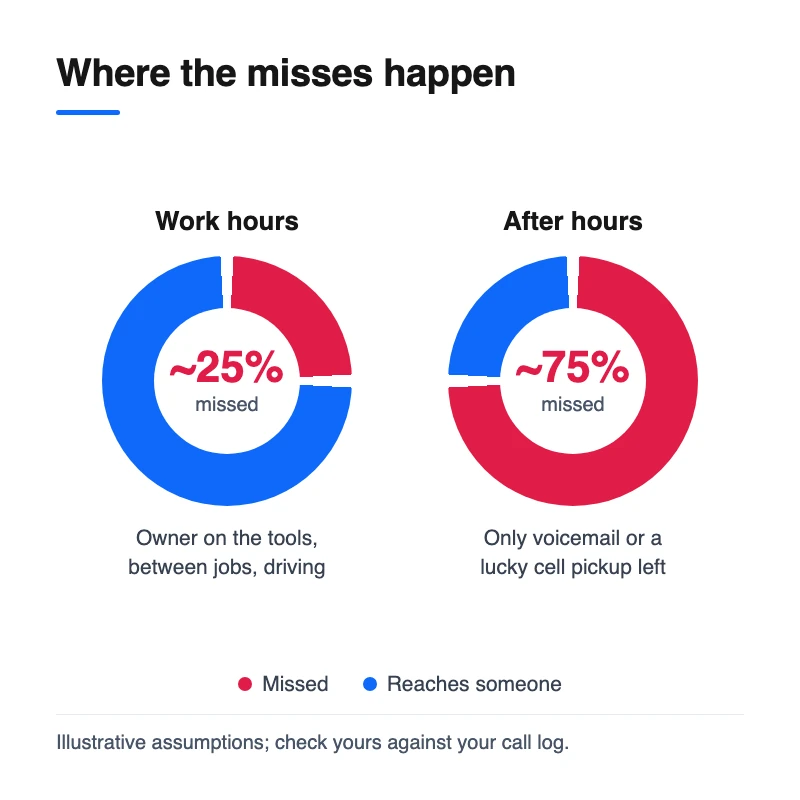
Why? Because the trade splits into two windows, and both work against you. During work hours you're on a ladder, under a sink, or driving between jobs, so a chunk of daytime calls ring out even when business is slow. After close, nobody's on the phone at all, and voicemail catches only the rare patient caller. The after-hours window is also when the burst pipes and dead water heaters happen.
The worked example: a 6-person shop, line by line
Take Marcus's company: him, four techs, a part-time bookkeeper who covers the phone some mornings. Here's every assumption, labeled, so you can swap in your own numbers.
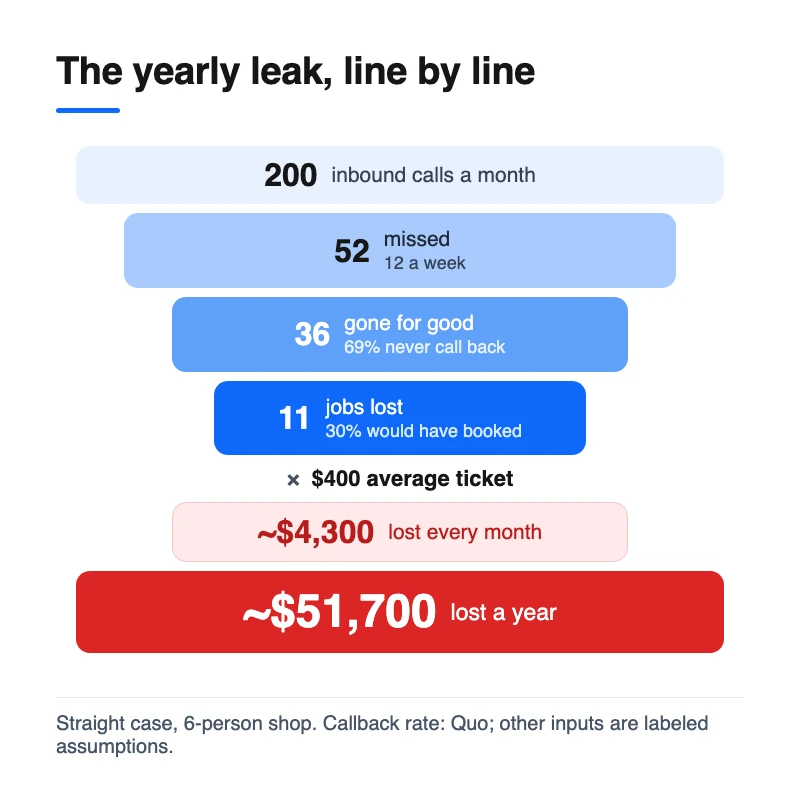
- 200 inbound calls a month. About 46 a week for a 6-person shop running ads and a Google Business Profile. Assumption, and the one you should check first against your own log.
- 12 missed calls a week, 52 a month. Between jobs, hands in a drain, driving, and everything after close. That's a 26% miss rate on 200 calls, well under the 62.2% unanswered rate the small-business data reports, so it's on the careful side. Assumption.
- 69% of missed callers never call back. The one sourced rate in the chain: Quo's analysis of 16.7 million missed calls, from the stats roundup above.
- 30% would've become jobs if you'd answered. Strips out spam, price shoppers, and quotes you'd lose anyway. Assumption.
- $400 average ticket. Below a straight blend of the Angi table above, since small drain jobs outnumber water heaters. Assumption.
Stack it up:
| Line | Straight case |
|---|---|
| Inbound calls per month | 200 |
| Missed calls per month (12 a week) | 52 |
| Callers gone for good (69% never call back) | 36 |
| Real jobs you'd have won (30%) | 11 |
| Average ticket | $400 |
| Lost revenue per month | ~$4,300 |
| Lost revenue per year | ~$51,700 |
The conservative rerun, so nobody can call this scare math
Maybe your shop answers better than that. Fine. Let's cut every input hard: fewer misses, a lower never-call-back rate, a lower close rate, a smaller ticket.
| Line | Conservative case |
|---|---|
| Missed calls per month (8 a week) | 33 |
| Callers gone for good (60% never call back) | 20 |
| Real jobs you'd have won (20%) | 4 |
| Average ticket | $300 |
| Lost revenue per month | ~$1,200 |
| Lost revenue per year | ~$14,300 |
Sound low? That's the version where almost everything goes your way, and it's still $14,300. Here's the opinion part, stated plainly: even the conservative number is too much to ignore. When the floor of the problem is $1,200 a month and every fix on the market costs a fraction of that, doing nothing isn't caution, it's the most expensive option on the table. The broader math works the same outside the trades too, and we've run it for other industries in what missed calls actually cost.
What plumbers try first, and where each fix leaks
Most shops climb the same ladder. Each rung catches more calls than the last, and each has an honest cost.
Voicemail. Free, and nearly useless for new business. Emergency callers don't leave messages, they call your competitor. Voicemail keeps the patient minority: the existing customer, the vendor, the reschedule.
Forwarding to your cell (or the bookkeeper's). Also free, and it works right up until it doesn't. You can't answer from a crawlspace, she doesn't work Thursdays, and neither of you is picking up at 11 PM. Plus every call you do take interrupts billable work.
A live answering service. A real fix with a real bill: entry plans run about $99 to $350 a month (PATLive at $99 for 50 minutes, Ruby at $250 for 50, AnswerConnect at $350 for 200, prices checked September 2026), and busy-season minutes push the bill well past the sticker. We've broken the billing models down in our answering service cost guide. The bigger leak is what happens on the call: most operators take a message, and a message at midnight is barely better than voicemail.
AI answering. Software picks up instead of a person, so coverage is 24/7 and the price stops being metered labor: typically $49 to $99 a month flat, plus per-minute usage. It books jobs on the call instead of taking messages. The trade-off is setup effort and the occasional fumbled edge case, which is why you test it before trusting it.
| Fix | Monthly cost | What it catches | Where it leaks |
|---|---|---|---|
| Voicemail | $0 | The rare caller who leaves a message | Most callers hang up and dial the next plumber |
| Cell forwarding | $0 | Calls when your hands are free | Crawlspaces, driving, nights, weekends |
| Live answering service | $99 to $350 entry, plus minutes | A human, 24/7 | Takes messages instead of booking; bills climb with volume |
| AI answering | $49 to $99 flat, plus usage | Every call, 24/7, booked on the spot | Needs setup and test calls; edge cases |
If your leak is mostly nights and weekends, the after-hours answering service guide compares these options for that window specifically.
Where dialnote fits, and where it honestly doesn't
dialnote is an AI business phone system with an AI receptionist built in. When that 9 PM burst-pipe call comes in, the AI answers, asks the questions you've set up as details to collect from callers (job type, address, how urgent), and then acts: books a slot through your Calendly or Cal.com link, sends the caller an SMS confirmation, or transfers a true emergency straight to your on-call tech. After the call, the details sync to your CRM if you use HubSpot, Salesforce, or Pipedrive.
The money side maps cleanly onto the tables above. Plans are flat at $19, $49, $99, and $199 a month, with AI voice agents included from the Team plan at $49, and AI calls at a published $25/mo for 65 with the AI call pack, or $0.49 a minute from the wallet without one. Against a $1,200-a-month conservative leak, one recovered water heater job covers the whole bill.
Now the honest part. A solo plumber who answers 95% of his own calls doesn't need this yet; his leak is a call or two a month, and his cell is doing the job. Same if your calls are mostly existing customers who'll happily call back. This math only pays when calls are actually escaping, which is why the audit comes first. Would you hand a competitor $1,200 a month on purpose? No, but you also shouldn't spend $49 to fix a leak you haven't measured. For the full picture of what an AI receptionist changes day to day in a plumbing shop, we've covered that separately in our AI receptionist for plumbers guide, including a step-by-step setup for emergency calls. Other trades can see the same approach in AI phone agents by industry.
Run this math on your own missed calls
10-day free trial, no credit card needed.
Do the audit before you buy anything
Pull last month's call log tonight. Count the inbound calls that rang out during work hours, then count everything that landed after close. Multiply the total by your booking rate and your average ticket, exactly the way the tables above do it.
Or just put your numbers straight in here. It starts on Marcus's shop, so change what doesn't match yours.
Run your own numbers
The defaults are the six-person plumbing crew from the example above. Change any input and the yearly cost recomputes.
Missed calls a year
624
12 a week across 52 weeks
Jobs you lose
129
431 callers never come back, 30% of them would have booked
Yearly cost of missed calls
$51,700
about $4,300 a month at $400 a job
For scale: dialnote's Team plan is $49/mo flat for unlimited users, so a year of it costs about 1 saved job at your average ticket. 10-day free trial, no credit card. Your inputs are assumptions, not a quote: pull the real missed-call count from your phone logs before you trust the total.
If your number looks like the conservative case, you've found $14,300 a year hiding in your phone. If it looks like the straight case, you've found a second truck's worth of revenue. Either way, you'll know the real cost of missed calls for your plumbing business by Friday, and the fix costs less than one of the jobs you're losing.
Frequently asked questions
It depends on the job behind it. Angi puts drain cleaning around $246, a water heater replacement at $850 to $1,800, and emergency work at 1.5 to 3 times normal rates. Blend those with realistic booking odds and each missed call averages out to roughly $80 in lost revenue.
Our worked example for a 6-person shop lands at about $51,700 a year in the straight case and $14,300 in a deliberately conservative one. Your number depends on call volume, miss rates, and average ticket, so run the same math against your own call log.
Because nobody's on the phone. Techs clock out, the office closes, and calls roll to voicemail, which most callers won't use. They dial the next plumber instead. After-hours calls also skew urgent and high-ticket, so those misses are the most expensive ones.
No. Most callers hang up on voicemail and call the next plumber, especially in an emergency. Voicemail catches the patient minority. Anything that answers live, a person or an AI receptionist, captures far more of the callers your marketing already paid for.
Pull last month's call log from your phone system. Count unanswered inbound calls during work hours, then count everything after close. Multiply by your booking rate and average ticket. Most owners have never done this once, and the first pass is usually a shock.

Written by
Upasana Sahu
Senior Digital Marketing Specialist, SmartReach.io
Upasana Sahu is a Senior Digital Marketing Specialist at SmartReach.io with over 10 years of experience in content marketing, SEO, and digital strategy. She manages end-to-end blog operations, from content creation and on-page/off-page SEO to traffic...
Upasana Sahu is a Senior Digital Marketing Specialist at SmartReach.io with over 10 years of experience in content marketing, SEO, and digital strategy. She manages end-to-end blog operations, from content creation and on-page/off-page SEO to traffic...
Related Articles
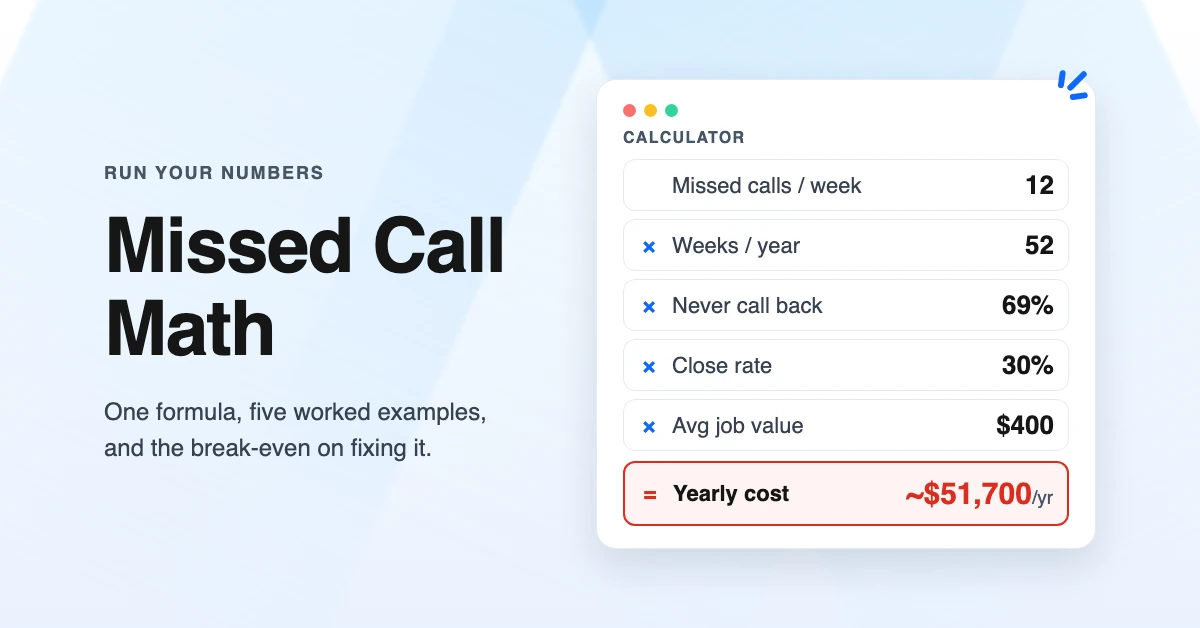
The Cost of Missed Calls: Calculator and Worked Examples
Calculate the cost of missed calls for your business with a simple formula, five worked examples by industry, and the break-even point for fixing it.
30+ Missed Call Statistics Small Businesses Need in 2026
See 30+ sourced missed call statistics for 2026: how many calls go unanswered, how few callers try again, and what that costs small businesses.

Missed Call Text Back: 15 Templates That Save the Job
Copy 15 missed call text back templates for service businesses, plus timing rules and worked examples that keep missed callers from booking elsewhere.