Grasshopper vs Google Voice: Which Wins? [2026]
Grasshopper vs Google Voice is the classic first business-phone decision: two cheap ways to put a professional number on top of the cell phone you already carry. They get compared as twins. They're priced like opposites, and picking by sticker instead of structure is how a $10 line becomes a $270 bill, or a $14 one becomes a missed-call machine.
The short version: Grasshopper sells flat plans priced by numbers and extensions, so it gets cheaper per person as your team grows. Google Voice sells per-user seats bolted onto Google Workspace, so it's brilliant for one person and expensive for ten. And neither one can answer a call when you're busy, which is the gap that ends up mattering more than the price.
Elena hit the decision the way most solo professionals do. A solo family-law attorney, she wanted a business number that wasn't her personal cell, priced Google Voice at $10 (plus the Workspace she already paid for) and Grasshopper at $14, and flipped a coin, basically. Either would've been fine for the number. Neither answered the call that came in during her Tuesday deposition, and the client who left no voicemail signed elsewhere. The number was never her problem. The answering was.
We'll referee the two honestly on cost, features, texting, and reliability, and bring in dialnote as the third column for the answering gap both share.
TL;DR:
- Grasshopper wins for small teams: flat plans at $14, $25, and $55 a month (annual billing) with unlimited users on the upper two, no per-seat math. Google Voice wins for solo owners already on Google Workspace: $10/user plus the required Workspace seat.
- At 10 people the gap is stark: $55 flat on Grasshopper Small Business vs about $270 for Google Voice Standard plus Workspace seats (Grasshopper prices as of October 2026).
- Neither answers a call: both route misses to voicemail transcription, Grasshopper has no built-in AI agent (its receptionist is a Smith.ai-powered add-on; Smith.ai's AI tier is $150/month for 75 calls bought direct), and Google Voice's auto-attendant starts on the $20 tier.
- dialnote is the third option for the answering gap: $49/month flat with unlimited users and a 24/7 AI receptionist included, AI calls at $25/month for 65 with the AI call pack, or $0.49/minute from the wallet without one.
- Numbers port freely between all three in 1 to 3 weeks.
Jump to: quick look · feature table · real cost · the answering gap · the verdict
A quick look at Grasshopper and Google Voice
Grasshopper has sold the same simple thing since 2003: a business number (local, toll-free, or vanity) that forwards to your existing phones, with extensions, a basic auto-attendant, business texting, and voicemail transcription. It's priced by infrastructure, not people: True Solo at $14/month (1 number, 1 user, 1 extension), Solo Plus at $25 (1 number, unlimited users, 3 extensions), and Small Business at $55 (4 numbers, unlimited extensions), all annual billing; billed monthly they're $18, $32, and $70.
Google Voice for business is a Google Workspace add-on: Starter at $10/user/month (up to 10 users), Standard at $20 (adds the auto-attendant, ring groups, and desk-phone support), and Premier at $30 (international expansion). Every user also needs a paid Workspace seat, from about $7/user/month, which the pricing pages mention more quietly than they should. In exchange you get Google-grade infrastructure, spam filtering, and an app that feels like the Gmail you already run.
Same category, opposite designs: one bills the phone line, the other bills every person who touches it.
Grasshopper vs Google Voice: how do the features compare?
| Feature | Grasshopper | Google Voice | dialnote |
|---|---|---|---|
| Starting price | $14/mo flat (annual) | $10/user/mo + Workspace seat | $19/mo (Solo); $49/mo Team, unlimited users |
| Pricing unit | Numbers + extensions, flat | Per user, per month | Flat per account |
| 10-person cost | $55/mo (Small Business) | ~$270/mo (Standard + Workspace) | $49/mo flat |
| Auto-attendant | Basic, all plans | Standard tier ($20/user) and up | Phone menu included ($49 plan) |
| AI receptionist | No built-in agent; Smith.ai-powered add-on, price not published | None on any plan | Included; answers 24/7 in 14 languages |
| Missed-call handling | Voicemail + transcription | Voicemail + transcription | AI answers, captures lead details, books meetings |
| Business texting | Yes, with A2P registration required | Limited; US numbers, lighter SMS feature set | Yes (US/CA), A2P registration handled in onboarding |
| International calling | US/CA focus; outbound abroad gated by a $500 deposit | Premier tier; per-minute rates | Calling reach across 90+ countries |
| Integrations / API | None | Workspace ecosystem only | Key integrations, after-call CRM sync |
| Reliability reputation | Dated apps, missed-notification complaints | Google infrastructure, strong uptime | Modern stack, smaller track record |
| Support | Phone + chat, mixed reviews | Workspace support tiers, self-serve heavy | Chat + email |
Word to the table-skimmers: the rows that decide this comparison are the pricing unit and the missed-call row. Everything else is detail.
What does each one really cost?
Solo, the honest math favors Google Voice, narrowly. If you already pay for Workspace, Voice adds $10 and you're done: $120 a year for a clean second line with Google reliability. Grasshopper True Solo runs $14 on annual billing ($18 monthly), and its one-extension setup does about the same job with a more dated app. If you're not on Workspace, the required seat erases Google's edge: $17 a month total vs Grasshopper's $14.
For teams, the math flips hard. Google Voice compounds twice, Voice seat plus Workspace seat, per person. Ten people on Standard: $200 for Voice, about $70 for Workspace, roughly $270 a month. The same ten people on Grasshopper Small Business: $55 flat, and Solo Plus at $25 technically covers unlimited users if three extensions are enough. That's a $2,580-a-year gap for the same basic job.
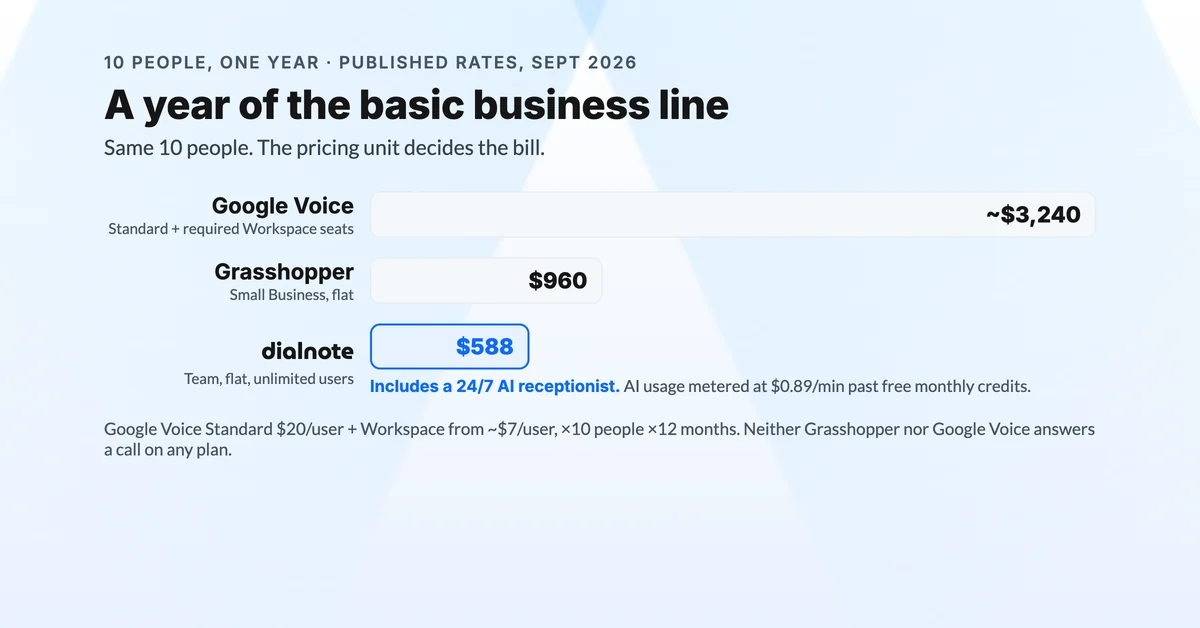
Both vendors keep quieter costs off the sticker. Grasshopper's international outbound calling requires a $500 deposit and 60 days of account history, and its A2P texting registration has a track record of stalling business SMS for weeks. Google Voice's auto-attendant, the feature that makes it feel like a business system, starts on the $20 tier, doubling the per-user price the day you want callers greeted with a menu.
For the record, dialnote's math in that chart: Team is $49/month flat with unlimited users, $588 a year, with the AI receptionist and phone menu included and AI calls from $25/month for 65 with the AI call pack. The flat unit is the same design bet Grasshopper made in 2003, applied to a system that answers. The full dialnote vs Grasshopper comparison covers the rest.
The crossover table: Workspace status decides the winner
The single biggest variable in this matchup is one most comparisons skip: whether you already pay for Google Workspace. It moves Google Voice's real per-user cost between $10 and $17, and that moves every crossover:
| Your situation | Google Voice real cost | Beats Grasshopper Solo Plus ($25 flat)? | Beats Grasshopper Small Business ($55 flat)? |
|---|---|---|---|
| Already on Workspace, Starter tier (no auto-attendant) | $10/user | Only at 1-2 users | Up to 5 users |
| Already on Workspace, Standard tier (auto-attendant) | $20/user | Only at 1 user | Up to 2 users |
| Not on Workspace, Starter tier | ~$17/user | Only at 1 user | Up to 3 users |
| Not on Workspace, Standard tier | ~$27/user | Never | Up to 2 users |
Two things fall out of that table. Google Voice is a solo product wearing a team product's marketing: the moment you want the auto-attendant (Standard tier) for more than one person, Grasshopper's flat $25 wins, and by three people even the $55 plan wins. And the "already on Workspace" column is doing all of Google's work; if you're a Microsoft 365 shop, Google Voice was never actually $10.
For calibration, dialnote's Solo plan is $19/month, so on a pure one-line price race it loses to both Google Voice at $10 and Grasshopper at $14, and there's no point pretending otherwise. The $49 Team plan enters the argument when the question stops being "what's the cheapest number?" and becomes "what happens when I can't pick up?", which neither finalist answers without a paid add-on.
Three offices, priced end to end
The crossovers, applied to three real shapes. September 2026 rates, annual billing.
The solo attorney on Workspace: Google Voice for the line, but the line was never the problem
Elena from the intro: solo practice, already paying for Workspace, light call volume, every new client starts as a call. Google Voice Starter adds $10 a month, $120 a year, and it's the most reliable cheap line she can buy; Grasshopper True Solo at $14 buys the same job with a weaker app. On the line decision, Google Voice wins.
But run her real numbers. A family-law intake is worth four to five figures, and her missed-intake problem lives in the hours she's in court, where both products route callers to voicemail. dialnote's Team plan at $49 plus AI usage answers those calls, asks her intake questions, and books the consult; one recovered client a year pays for the plan several times over. The honest advice: take Google Voice at $10 if voicemail genuinely isn't costing her clients yet, and switch categories the first month it visibly does.
The 4-person landscaping crew: Grasshopper, comfortably
One shared business number, four phones in trucks, no Workspace subscription, texting for quotes. Google Voice Standard (they'd want the auto-attendant) without existing Workspace: 4 × $27 = $108 a month. Grasshopper Solo Plus: $25 flat, unlimited users on one number with three extensions, which fits sales/scheduling/everything-else fine. That's $996 a year of difference for the same forwarding.
The pick: Grasshopper, and it's the shape Grasshopper is best at. The caveats to plan around: confirm the A2P texting registration completes before quote season, and know that the three-extension ceiling and absent integrations are where this setup eventually pinches. At this size, dialnote's $49 Team plan is $24 more a month than Solo Plus; worth it the month missed calls start costing jobs, not before.
The 10-person office on Workspace: Grasshopper on price, Google Voice on fit, dialnote on function
Ten people, already on Workspace Standard, want ring groups and an auto-attendant. Google Voice Standard: 10 × $20 = $200 a month on top of existing Workspace, about $2,400 a year. Grasshopper Small Business: $55 flat, $660 a year, with a more basic attendant and no Workspace integration. dialnote: $49 flat, $588, with the phone menu plus the AI receptionist neither rival has.
The pick depends on what the office actually misses. If calls get answered live and the need is routing polish inside a Google shop, Google Voice Standard is defensible and the Workspace admin console is genuinely convenient at 10 seats. If the need is a professional number at the lowest team price, Grasshopper wins by $145 a month. And if reception is understaffed and calls are dying in voicemail between meetings, the cheapest option is the one that answers: the whole reason a third column exists in this comparison.
Which one answers calls when you can't?
Neither. That's the honest headline of this whole comparison, and it's the reason the winner between these two still loses jobs.
Grasshopper is a forwarding layer: a missed call becomes a transcribed voicemail, and its answer to "who picks up when I can't?" is a paid Virtual Receptionist add-on powered by Smith.ai. Grasshopper doesn't publish the price; bought direct, Smith.ai's AI receptionist is $150 a month for 75 calls as of October 2026, about eight times the True Solo plan billed monthly. Google Voice is the same story with better filtering: strong spam blocking, voicemail transcription, ring groups on Standard, and nothing that holds a conversation on your behalf at any tier.
According to FCC consumer guidance, your number stays yours across providers, but no rule keeps your callers waiting: most callers who hit voicemail on a first contact simply dial the next result. That's the missed-call gap both products share by design, and it's where the category has moved past them.
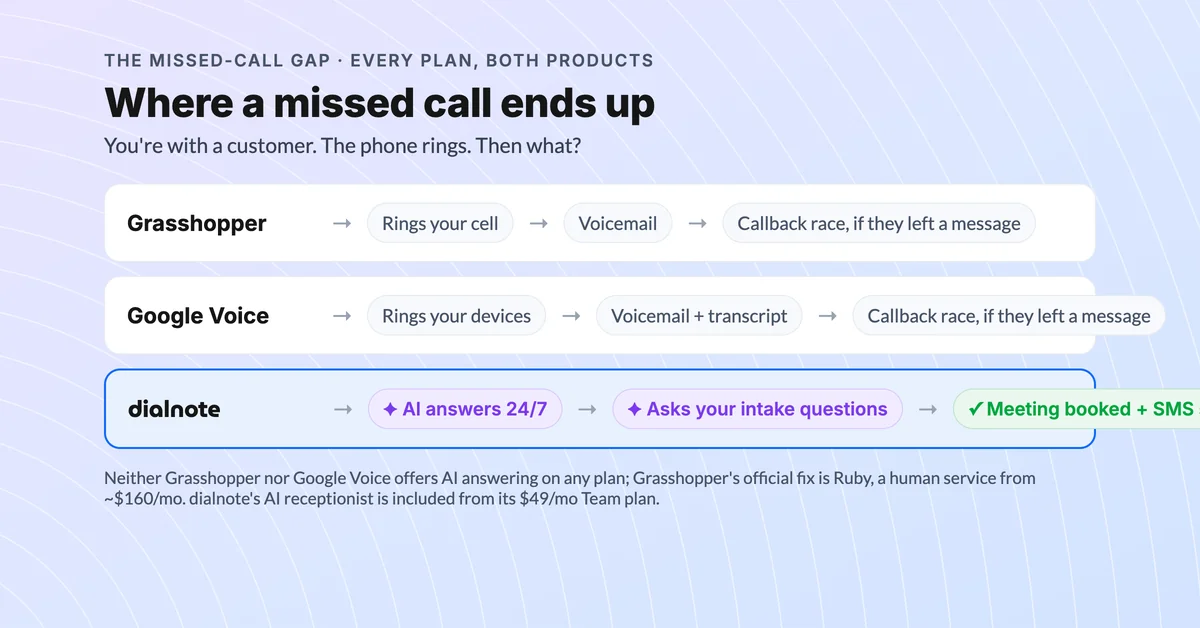
This is where the third column stops being a footnote. dialnote is an AI business phone system with no per-user pricing. AI voice agents answer calls, capture leads, and book meetings 24/7. Plans from $19/mo. On the $49 Team plan, the AI receptionist answers around the clock in 14 languages, asks the intake questions you configure, books meetings through Calendly or Cal.com, texts confirmations, and transfers to a teammate when someone's free, with a phone menu routing calls first so the AI only handles what you choose. One honest caveat: AI calls cost extra (about $0.38 each on the AI call pack), and there's no live human tier, so a practice that wants human warmth on every call should price a live answering service anyway.
Ready to stop paying by the call?
10-day free trial, no credit card needed.
How does business texting compare?
Neither treats texting as the main event, and it shows in different ways.
Grasshopper supports real business SMS on your business number, but US carriers require A2P 10DLC registration for business texting, and Grasshopper's registration process is a recurring complaint magnet: reviewers report weeks-long stalls where outbound texts silently fail while the campaign registration sits in limbo. If appointment reminders or quote follow-ups are part of how you work, that's not a cosmetic bug. Ever texted a customer a confirmation and had it just not arrive? That's what an unregistered campaign looks like from your side.
Google Voice texts fine for light, conversational use on US numbers, but the feature set is thin for business: no scheduled sends, no templates, no campaign tooling, and international SMS support is patchy. Google's own docs steer heavier messaging use toward other products, which tells you where Voice sits in the roadmap.
The practical read: for one person replying to customers, both are adequate and Google Voice is smoother. For a team running reminder and follow-up texts, both need care, and Grasshopper needs its A2P paperwork confirmed working before you rely on it. Registration timing also matters when switching providers; start re-registration before any port so messages keep flowing.
When do you outgrow them?
Every cheap tool has a moment where it quietly stops being cheap. These two have different ones.
Google Voice's moment is arithmetic: the day you cross a few users, the per-seat stack (Voice plus Workspace) passes every flat competitor, and by ten people you're paying premium money for a basic product. Its Starter tier also hard-caps at 10 users, so growth forces a tier decision on top of the math.
Grasshopper's moment is functional: the day your workflow needs more than forwarding. Three extensions on the $25 plan pinch fast; there's no API, no CRM hook, and no answering, so the fix for each new need is another subscription bolted on. "The upgrade trigger we hear most isn't price, it's the first week a business realizes voicemail is where its leads go to die," says Akhilesh Betanamudi, dialnote's co-founder. "People shop for a cheaper line and discover they needed a different category."
What's the earliest warning sign for either? Watch your voicemail count against your callback speed. When messages regularly wait more than an hour, the line item you're saving on is costing you jobs off the books.
What do users actually say?
Grasshopper sits at 3.9 on G2 and around 2.1 on Trustpilot, and the negative reviews rhyme: apps that feel dated, push notifications that fail silently (a brutal flaw in a product whose whole job is telling you the phone rang), A2P registration stalls that block business texting for weeks, and cancellation that requires contacting support rather than clicking a button. The positives are real too: the flat pricing is genuinely simple, and vanity and toll-free numbers are easy.
Google Voice doesn't accumulate review volume the way standalone tools do, but the pattern is consistent: people trust the infrastructure, calls connect, spam filtering works, and the app is clean. The complaints are about ambition, not reliability: the SMS feature set is thin, support leans self-serve, hardware options are limited, and the product has visibly not been Google's priority for years. Choosing it is a bet that Google keeps maintaining a product it rarely talks about; we think the bet's reasonable, and we'd still make it with eyes open.
How do you switch or port between them?
Porting between Grasshopper, Google Voice, or any other provider is routine: about 1 to 3 weeks, with the receiving provider handling the paperwork. The sequence that avoids downtime:
- Sign up with the new provider first; don't cancel anything yet.
- If business texting matters, start A2P re-registration with the new provider now, since it can take longer than the port itself.
- Submit the port request from the new provider's side with a recent bill or account details from the old one.
- Keep the old account active and forwarding until the port confirms.
- Test inbound calls and texts on the new service, then close the old account.
Google charges a small port-out fee on personal accounts only; business ports are free on both sides. The provider-switching guide covers the full sequence, including the overlap week that catches stragglers.
Where both fall short
The shared gaps, stated plainly:
- Nothing answers. Missed call, voicemail, callback race. It's a solved problem, and neither product solves it without a paid add-on.
- Texting is second-class. Grasshopper's A2P stalls and Google Voice's thin SMS tooling both frustrate teams that live in text threads.
- No integrations that matter. Grasshopper has no API and no CRM hooks; Google Voice integrates with Google and stops there. Call data goes nowhere.
- Growth punishes one, stagnation the other. Google Voice's per-user math turns cheap into expensive at exactly the moment your business succeeds; Grasshopper's aging apps and 3-extension mid-tier pinch as workflows mature.
None of this makes them bad buys. It makes them narrow ones: a professional number with forwarding, done cheaply. If that's genuinely the whole job, both deliver it.
Grasshopper or Google Voice: which should you pick?
Choose Google Voice if you're solo or a 2-3 person shop already living in Google Workspace, your call volume is light, and you want the most reliable cheap line on the market. At $10 over the Workspace you already pay, nothing touches it.
Choose Grasshopper if you're a team on a budget that wants one flat bill, vanity or toll-free numbers, and unlimited users without per-seat math. At $25 to $55 flat it's the cheapest way to put a shared business number in front of ten people, dated apps and all.
Choose dialnote if the reason you're shopping is missed calls, not missing numbers. It keeps Grasshopper's flat-pricing logic ($49/month, unlimited users), adds the thing neither finalist has (a 24/7 AI receptionist that captures leads and books meetings), and its live demo answers on the homepage if you want to hear it before trusting it.
The quiet truth of this matchup: the coin flip Elena almost made is usually fine, because for a pure second line the two products are closer than their fans admit. What's not fine is buying either one to solve a missed-call problem. They don't, they won't, and a Smith.ai AI receptionist at $150 a month for 75 calls costs more than a system that answers by itself.
Start a free 10-day trial of dialnote, no credit card required, and find out what your voicemail's been costing you.
Frequently asked questions
For teams, Grasshopper: its $25 and $55 plans are flat with unlimited users, while Google Voice charges $10 to $30 per user plus a required Google Workspace subscription. For a solo owner already on Workspace, Google Voice's $10 plan is the cheaper line.
Grasshopper sells flat plans: $14, $25, and $55 a month on annual billing, priced by numbers and extensions rather than people. Google Voice runs $10 to $30 per user per month and requires Google Workspace (from about $7/user) on top. Ten people: $55 flat vs about $270, as of October 2026.
Yes. Google Voice for business is a Workspace add-on, so every user needs a paid Workspace seat (from about $7/user/month) before the $10 to $30 Voice charge. The free personal Google Voice is US-only, single-user, and not meant for business lines.
Not on their own. Both send missed calls to voicemail. Grasshopper sells a Virtual Receptionist add-on powered by Smith.ai at an unpublished price; Google Voice has none. dialnote includes a 24/7 AI receptionist on its $49/month flat plan.
Yes, in either direction, and out to any other provider. Ports take about 1 to 3 weeks; the receiving provider handles the paperwork. Google charges a small port-out fee for personal accounts but not business ones. Keep the old account active until the port confirms.
Grasshopper Small Business: $55/month flat (annual) with unlimited extensions. Google Voice Standard: $200/month plus about $70 in required Workspace seats, so roughly $270. dialnote's Team plan runs $49/month flat with unlimited users and an AI receptionist included. Rates as of October 2026.

Written by
Prateek Bhatt
Co-Founder, SmartReach.io
Prateek Bhatt is a product leader, programmer, and serial entrepreneur with over 12 years of experience building SaaS and AI-powered tools for sales and customer service teams. As Co-Founder of SmartReach.io - a multichannel outreach platform used by...
Prateek Bhatt is a product leader, programmer, and serial entrepreneur with over 12 years of experience building SaaS and AI-powered tools for sales and customer service teams. As Co-Founder of SmartReach.io - a multichannel outreach platform used by...
Related Articles
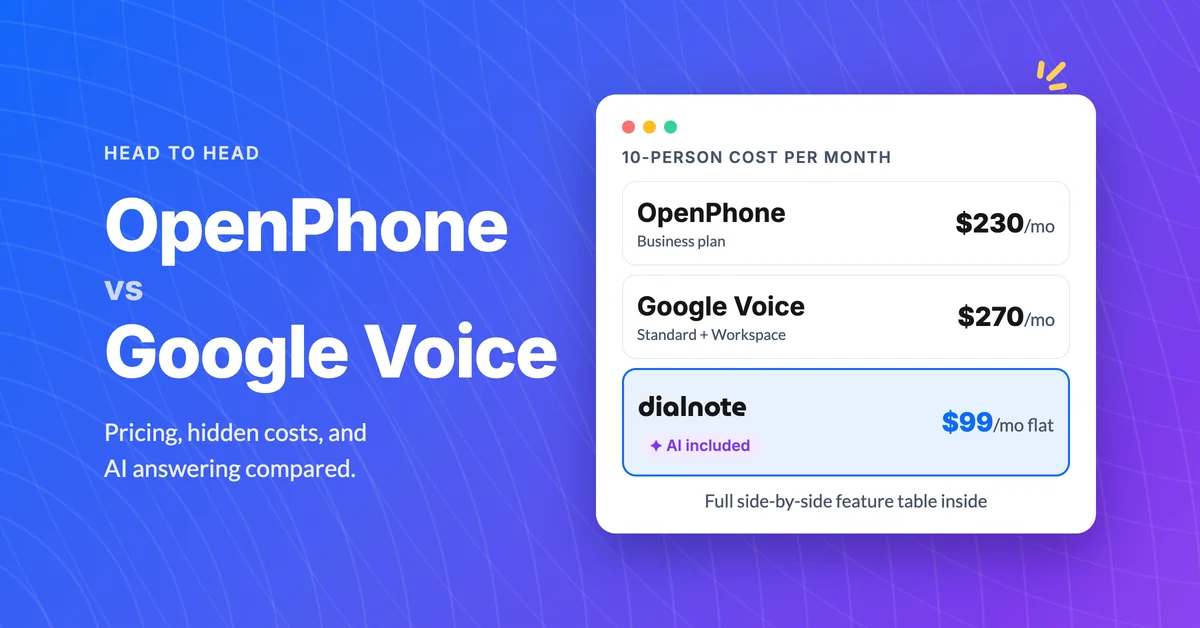
OpenPhone vs Google Voice: Which Should You Pick?
Compare OpenPhone vs Google Voice on pricing, features, and hidden costs, then see why dialnote may be the smarter pick for small teams.
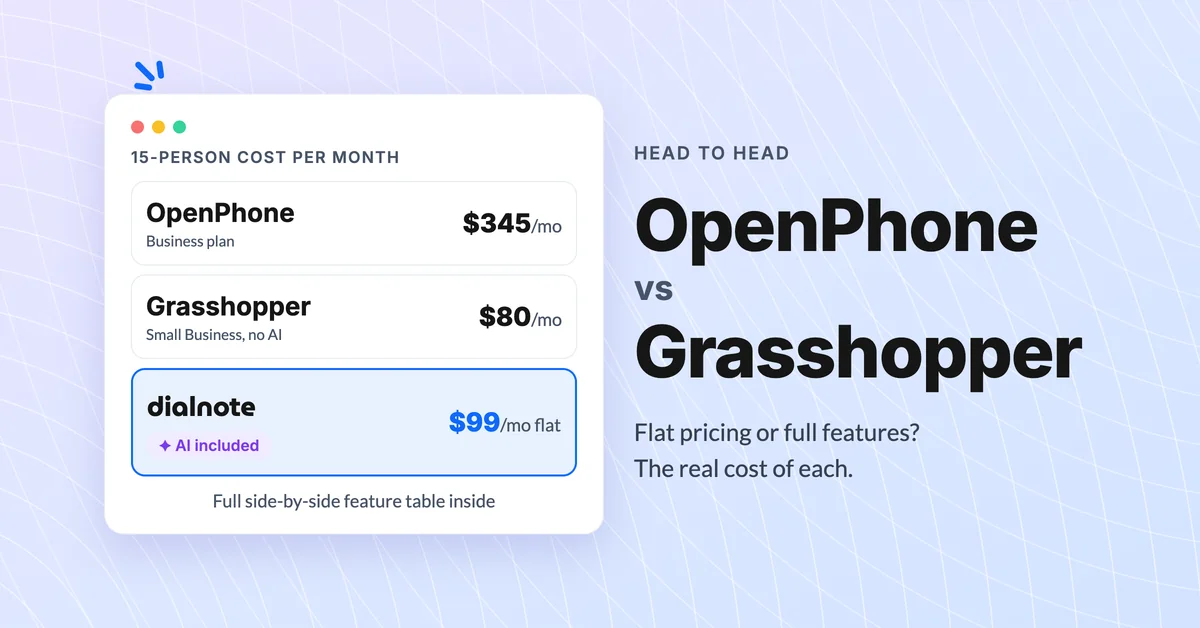
OpenPhone vs Grasshopper: Best for Small Business?
Compare OpenPhone vs Grasshopper on pricing, features, and AI answering, then see why dialnote may fit growing small businesses better.

Google Voice Alternatives: 7 Picks for Business
Compare 7 Google Voice alternatives built for serious business use by AI features, multi-level IVR, CRM sync, and real per-user costs.