Smith.ai vs Ruby: Which Answering Service Wins?
Smith.ai and Ruby are the two biggest names in premium call answering, and they've been trading customers for years. Ask around and you'll hear the same review of both: great receptionists, painful invoices. So the Smith.ai vs Ruby question usually isn't about quality at all. It's about which meter empties your wallet slower.
And they do run different meters. Smith.ai bills per call, with a mix of AI and human receptionists doing the answering. Ruby bills per receptionist minute, with humans doing nearly all of it. That one difference shapes everything: what you pay, what a busy month does to your bill, and which kinds of calls each service handles best.
Elena, a solo family-law attorney, learned this the hard way. She can't answer intake calls mid-deposition, and every missed intake is a case lost, so she priced both services. Ruby's entry plan was $250 a month for 50 receptionist minutes. Smith.ai wanted $300 for 30 calls. Her napkin math said one good marketing month would blow past either bucket, and she'd be paying more to answer the phone than for her entire software stack. Sound familiar?
This comparison breaks down what each service really costs, where each one wins, and what their own customers complain about. We'll also show a third option, dialnote, that answers the same calls for a fraction of either price.
TL;DR:
- In the Smith.ai vs Ruby matchup, Smith.ai is a hybrid of AI and human receptionists billed per call ($300/mo for 30 calls, about $10 each), while Ruby is human-first and billed per receptionist minute ($250/mo for 50 minutes, an effective $5.00/min).
- Smith.ai wins on structured intake, CRM integrations, and predictable per-call costs; Ruby wins on warmth, polish, and dedicated-feeling service.
- Both get expensive fast as call volume grows, and both leave you paying for a separate phone system underneath.
- dialnote answers the same routine calls with a 24/7 AI receptionist on a $49 flat plan that includes a full phone system with unlimited users. AI calls run about $0.38 a call on the AI call pack, so a five-minute call costs about $0.77 instead of $10 to $25.
Smith.ai and Ruby: a quick overview
Smith.ai is a hybrid answering service: AI handles the routine layer while North America-based human receptionists take the calls that need judgment. Ruby is a human-first virtual receptionist service known for receptionists so warm that callers assume they sit in your office.
Smith.ai built its reputation with law firms and professional services. Its receptionists don't just take messages: they run intake workflows, qualify leads with your questions, update your CRM, and book consultations. The AI layer keeps costs below what an all-human service would charge, and there's a separate self-serve AI receptionist product starting around $95 a month for businesses that want software only.
Ruby has been the premium human option for two decades. Its pitch is connection: friendly, professional receptionists who make small businesses sound bigger. Ruby has added AI features alongside its humans at no extra charge, but the model is still fundamentally people answering phones, billed by the minute.
Here's how they stack up at a glance, with dialnote included as the AI-first reference point:
| Smith.ai | Ruby | dialnote | |
|---|---|---|---|
| Who answers | AI + human receptionists | Human receptionists (with AI assists) | AI receptionist (+ your team) |
| Billing model | Per call | Per receptionist minute | Per AI call (pack) or per AI minute |
| Entry price | $300/mo, 30 calls | $250/mo, 50 minutes | $49/mo flat, unlimited users |
| Effective rate | ~$10/call | $5.00/min | ~$0.38/call on the AI call pack ($25 for 65) |
| Overage | $8.50-$11.50/call | ~$3-5/min (third-party figures) | Wallet at $0.49/min beyond the pack |
| 24/7 coverage | Included | Available | Included |
| Appointment booking | $1.50/call add-on | Included (uses minutes) | Included (Calendly, Cal.com) |
| Phone system included | No | No | Yes, from $19 (AI from $49) |
| G2 rating | 4.9 | 4.5 | 4.0 |
Prices are as of August 2026 and shift often, so check each vendor before you buy. Now let's get into where the money actually goes.
Smith.ai vs Ruby: how does the pricing compare?
Smith.ai is usually cheaper per conversation, and its per-call billing is easier to predict. Ruby's per-minute buckets look smaller on the pricing page but cost more per answered call once you do the division.
What Smith.ai charges
Smith.ai's managed plans start at $300 a month for 30 calls, billed monthly, and climb to $2,100 for 300 calls. That's roughly $10 per answered call, whether the call runs one minute or ten. Go past your bucket and each extra call costs $8.50 to $11.50.
The catch is the add-ons. Booking an appointment adds $1.50 per call. Sending a text adds $0.50. Recording adds $0.25. A Spanish line and live-agent handoffs carry their own fees too. So two callers who need appointments booked can cost more than five who just leave a message, and a 2025 policy change made even silent and spam calls billable. The sticker price is only the start.
What Ruby charges
Ruby sells buckets of receptionist minutes: $250 for 50, $395 for 100, $720 for 200, and $1,725 for 500. The entry plan works out to $5.00 a minute, and even the biggest bucket only gets you down to about $3.45.
Plus, a receptionist minute isn't just talk time. Time spent relaying your message afterward counts too, so a three-minute intake call can burn four or five billable minutes. Ruby spent years defending a class action over exactly how those minutes were counted, including rounding calls up to the next 30-second block, and settled in 2021. The pricing page now stresses that there are no hidden fees, which is fair. But the meter itself hasn't changed.
The five-minute call test
We ran the numbers on a single typical call: five minutes of talking, answered and relayed, appointment booked. Here's what that one call costs on each service's entry plan:
| Smith.ai | Ruby | dialnote | |
|---|---|---|---|
| One 5-minute booked call | ~$11.50 ($10 + $1.50 booking) | ~$25 (5 min at $5.00/min) | ~$0.77 on the AI call pack ($2.45 at $0.49/min) |
| 60 such calls a month | ~$690 | ~$1,500 | ~$50 (2 AI call packs) + $49 plan |
What does that look like over a year? For a business fielding 60 booked calls a month, the gap between Ruby and an AI receptionist is north of $15,000. These are estimates, and your call mix will shift them, but the ranking doesn't change: Ruby is the most expensive way to answer a call, Smith.ai is the middle, and AI is the floor.
One more cost both services hide in plain sight: neither one is a phone system. Ruby and Smith.ai forward and answer calls, but your business lines live somewhere else, on a separate bill. Factor that in when you compare totals.
Where Smith.ai wins
Smith.ai is the stronger pick when your calls follow a process. Its receptionists work from your intake playbook: qualify the lead, collect the details, push everything into your CRM, book the consultation. For law firms and agencies running structured intake at volume, that workflow depth is the whole product.
The per-call billing model also fits chatty callers better. A 12-minute intake conversation costs the same $10 as a 2-minute one, while on Ruby that call would run $60 at entry-plan rates. If your callers tend to talk, Smith.ai's meter is the kinder one.
And the hybrid AI layer means Smith.ai can price below all-human rivals while keeping people available for the calls that need them. Its 4.9 rating on G2 is one of the strongest scores in the category, with receptionist quality the most-praised trait.
Where Ruby wins
Ruby is the stronger pick when the human touch is the point. Its receptionists are famously warm, and for businesses whose callers are stressed, elderly, or expecting a person (think family law, healthcare adjacent, high-end home services), that warmth converts.
Ruby also includes appointment scheduling and call handling in its minutes without per-task fees. There's no $1.50-per-booking line item; everything just draws from the bucket. Some owners find that simpler to reason about than Smith.ai's add-on menu, even when it costs more overall.
That said, we'll be honest about the limits of this win. Ruby's advantage is qualitative, and you pay a $5.00-per-minute premium for it. Whether the warmth is worth the meter depends entirely on what a single won-over caller is worth to you. For an attorney whose average case is five figures, maybe. For a salon, almost certainly not.
What do users actually say?
Across G2, Capterra, Trustpilot, and BBB, both services get praised for the same thing and criticized for the same thing: the people are great, the bills aren't.
Smith.ai patterns: The 4.9 G2 score reflects genuine love for receptionist quality and intake depth, especially from law firms. The recurring complaints are about invoices: surprise overages when volume spikes, per-call add-ons stacking up, and charges continuing after cancellation. The most common negative review theme is billing, not answering.
Ruby patterns: Reviewers consistently describe Ruby's receptionists as friendly and polished, and the 4.5 G2 score has held steady for years. The complaints cluster around cost: bills that jump when call volume rises, prices that climb year over year, and frustration at paying full receptionist rates for minutes spent on message relay. Nobody leaves Ruby over call quality. They leave over what each answered call costs.
Notice the shape of both complaint patterns? Neither service has a quality problem. Both have a meter problem. That's worth sitting with, because it means switching between them mostly swaps one meter for another.
Where both services fall short
Both Smith.ai and Ruby share three structural gaps that no plan tier fixes.
The meter never stops. Per call or per minute, you pay more every time your marketing works. According to a Gartner survey, 91% of customer service leaders are under executive pressure to adopt AI in 2026, and cost is a big reason why. Human answering pricing rewards slow months and punishes busy ones, which is backwards for a growing business.
You can't control which calls hit the meter. Wrong numbers, vendors, and quick "are you open?" calls all bill the same as a qualified lead. Neither service gives you a routing layer to decide which calls deserve a paid answer, because filtering calls would filter their revenue.
Neither is a phone system. You still pay for business lines, and your team's outbound calling, texting, and voicemail live in a separate tool. That's two or three bills doing the job one platform could do.
Honestly? Paying a person $5 a minute, or $10 a call, to take a name and number is the most expensive way to solve an already-solved problem. Message-taking, hours questions, lead capture, appointment booking: software handles all of that now, around the clock, for a tenth of the price. The open question is only where your calls stop being routine, and there's no universal line for that. It depends on your callers, so test with your own call log rather than trusting anyone's blanket claim, including ours.
The third option: an AI receptionist with its own phone system
If most of your answered calls are routine, dialnote replaces both the answering service and the phone bill underneath it.
The $49 Team plan covers business calling for your whole team with unlimited users, and it's where the AI receptionist and phone menu switch on. The AI answers 24/7, asks your qualifying questions, captures lead details, books through Calendly or Cal.com, transfers urgent calls to a teammate, and speaks 14 languages. AI calls are $25/mo for 65 calls with the AI call pack, or $0.49/min from your wallet without one.
The part Smith.ai and Ruby can't match is routing. dialnote's phone menu filters calls before they reach the AI, so billing questions go to a person, sales calls ring your cell, and only the calls you choose (say, new-client intake or after-hours coverage) touch the meter. Same coverage, a fraction of the metered minutes. On Ruby and Smith.ai, every answered call bills; here, you decide what's worth paying for.
The math from earlier is the argument. A five-minute booked call costs about $0.77 on dialnote's AI call pack, $11.50 on Smith.ai, and $25 on Ruby. Run 60 of those a month and dialnote comes in around $99 with the plan, roughly a seventh of Smith.ai's bill and a fifteenth of Ruby's. And the dialnote figure already includes the phone system the other two make you buy separately.
The honest trade-off: the receptionist is AI, not a person. For deeply emotional or complicated calls, a human still wins, which is why the transfer-to-teammate path exists. If your call log says most conversations need a person, a hybrid like Smith.ai (or keeping Ruby for daytime and AI for after-hours) makes more sense. Our AI receptionist vs live answering service breakdown walks through that decision call type by call type.
So which answering service should you pick?
Match the service to your call mix and what each answered call is worth to you.
Pick Smith.ai if your calls follow a structured intake process, you want humans in the loop with AI trimming the cost, and per-call pricing fits your long, chatty conversations. It's the strongest choice for law firms doing high-volume intake. Just budget for the add-ons, and read our Smith.ai alternatives guide first so you know the full field.
Pick Ruby if the warmth of a live human answering every call is genuinely what wins your customers, your call volume is modest, and you can absorb a $3.45 to $5.00 effective per-minute rate. If the receptionists are great but the meter stings, our Ruby Receptionists alternatives guide prices out the whole market.
Pick dialnote if most of your calls are routine, you're tired of paying premium human rates for message-taking, and you'd rather have the phone system and the receptionist on one flat bill. The Team plan is $49 a month for unlimited users, AI calls are from $25/mo for 65 with the AI call pack, and the pricing is public, so you can compare it against your current invoices in about two minutes.
Elena's decision came down to her call log. Thirty of her last 35 messages were name, number, and matter type: data entry at $5 a minute. She kept a human option in her back pocket for delicate calls and let AI handle intake. Her answering bill dropped by more than half, and no client ever mentioned the difference.
Whichever way you lean, do the five-minute call test with your own numbers before you sign anything. And if you want to hear the AI option first, start a free 10-day trial of dialnote, no credit card needed, and call your own number before you cancel anything else.
Frequently asked questions
The billing model. Smith.ai mixes AI with human receptionists and bills per call ($300/mo for 30 calls). Ruby is human-first and bills per receptionist minute ($250/mo for 50 minutes). Smith.ai suits structured intake; Ruby suits businesses that want warm, human conversations.
Usually, yes. Smith.ai's 30-call plan works out to about $10 per answered call. On Ruby's entry plan, a five-minute answered-and-relayed call costs around $25 at its $5.00 effective per-minute rate. But Smith.ai's per-call add-ons for booking, texts, and recording can narrow the gap.
Ruby has added AI features alongside its human receptionists at no extra charge, but the billing hasn't changed: you still pay by the receptionist minute. Smith.ai goes further with a separate self-serve AI receptionist plan starting around $95 a month.
An AI receptionist with its own phone system. dialnote's $49 plan covers business calling for unlimited users plus a 24/7 AI receptionist. AI calls are $25/mo for 65 with the AI call pack, so a five-minute call costs about $0.77 instead of $10 to $25.
Both court law firms. Smith.ai wins on structured intake: its receptionists qualify leads, fill CRMs, and book consultations on per-call pricing. Ruby wins on polish and warmth for firms where every caller expects a person. High-volume intake usually favors Smith.ai's model.

Written by
Upasana Sahu
Senior Digital Marketing Specialist, SmartReach.io
Upasana Sahu is a Senior Digital Marketing Specialist at SmartReach.io with over 10 years of experience in content marketing, SEO, and digital strategy. She manages end-to-end blog operations, from content creation and on-page/off-page SEO to traffic...
Upasana Sahu is a Senior Digital Marketing Specialist at SmartReach.io with over 10 years of experience in content marketing, SEO, and digital strategy. She manages end-to-end blog operations, from content creation and on-page/off-page SEO to traffic...
Related Articles
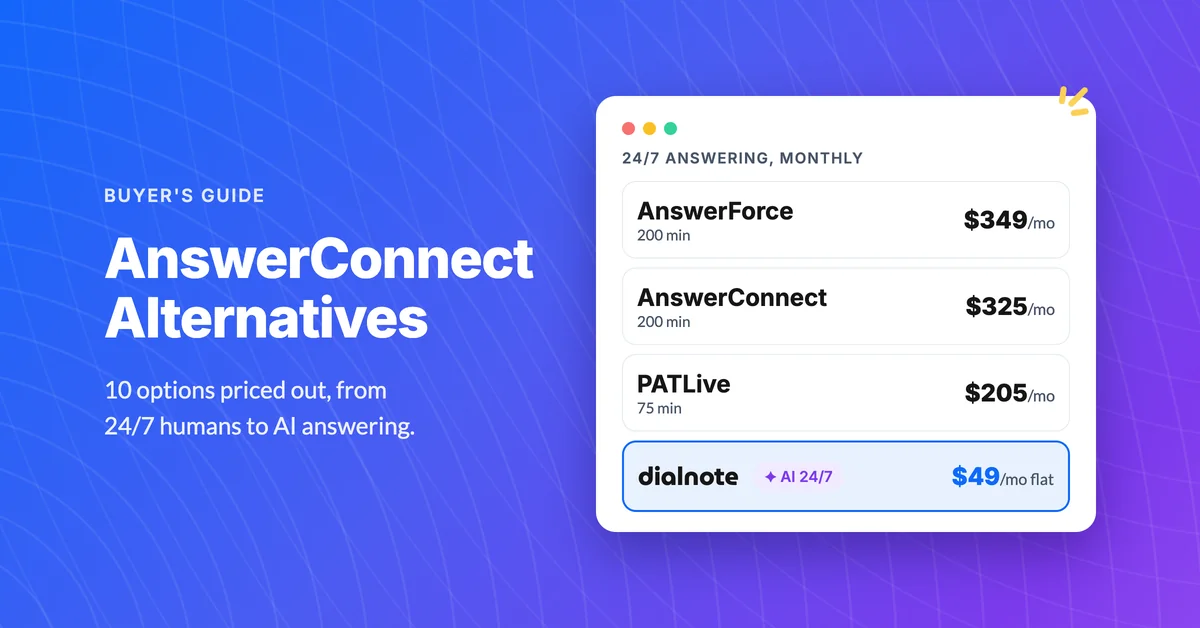
AnswerConnect Alternatives: 10 Better Options [2026]
AnswerConnect runs $325/mo for 200 minutes, and after-call work bills too. Compare 10 AnswerConnect alternatives on real cost per answered call.
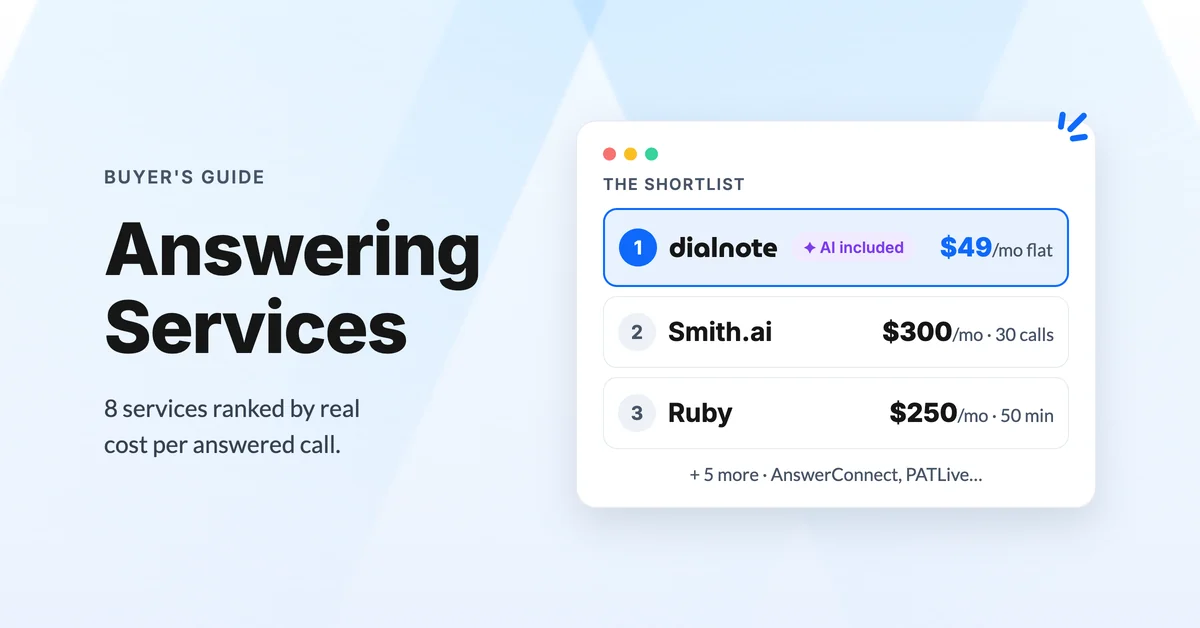
Best Answering Service for Small Business [2026]
Compare the best answering services for small business in 2026: live, AI, and hybrid options ranked by real cost per call and coverage.
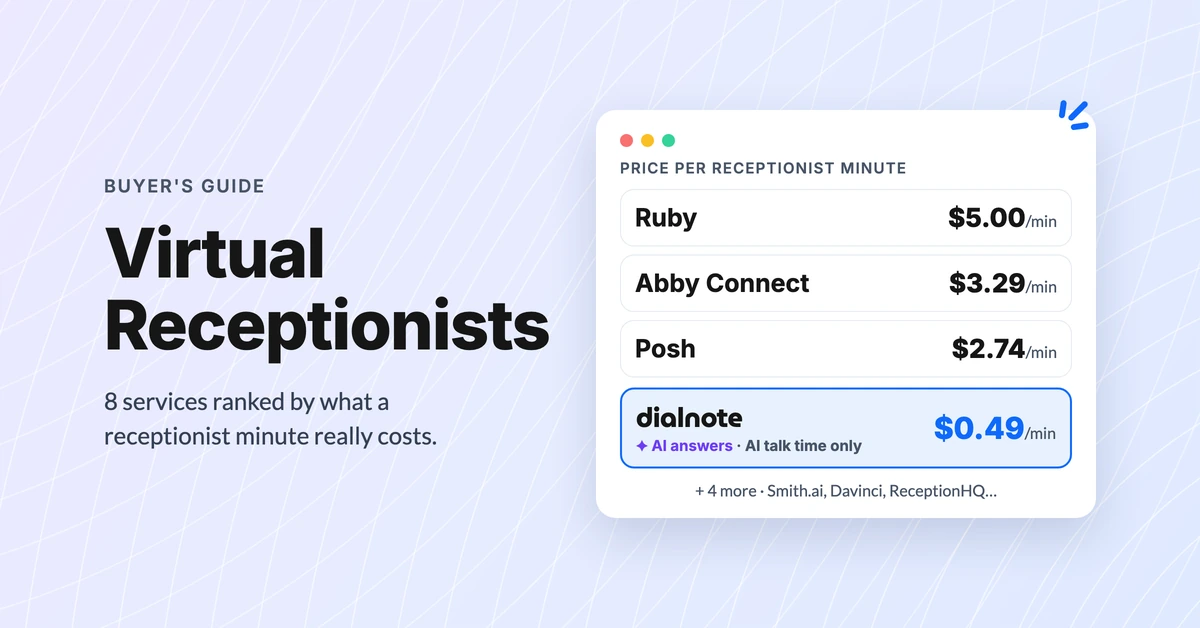
Best Virtual Receptionist Services Ranked [2026]
Compare the best virtual receptionist services of 2026 by price per receptionist minute, booking depth, and coverage, including the AI option.