Ruby Receptionists Alternatives: 10 Better Options [2026]
Ruby's receptionists are genuinely good. Ask around and you'll hear the same thing: friendly, professional, they sound like they sit in your office. The problem shows up on the invoice, because Ruby Receptionists bills by the "receptionist minute," and those minutes start at an effective $5.00 each.
That's why so many owners end up searching for Ruby Receptionists alternatives. The entry plan is $250 a month for just 50 minutes. Answer more calls, and the meter climbs: $395 for 100 minutes, $720 for 200. The better your marketing works, the more you pay to have someone say hello.
Megan runs a three-attorney family law office. She signed up with Ruby on the 100-minute plan and loved the service. Then a billboard campaign worked a little too well. Intake calls stretched her past 200 minutes, her bill crossed $900 with overages, and she realized most of those expensive minutes were spent taking messages her paralegal deleted the next morning. Good service. Wrong meter.
The fix isn't necessarily worse coverage. In 2026 you can route routine calls to an AI receptionist for well under a dollar a minute, keep humans for the calls that need them, or both. Here's the whole market, priced out.
TL;DR:
- Ruby bills by the receptionist minute: $250/mo for 50 minutes ($5.00/min effective) up to $1,725/mo for 500. Message-taking time counts against you.
- The best Ruby Receptionists alternatives fall into two camps: AI receptionists (about $0.15 to $0.50 per minute) and cheaper live-receptionist services (about $1.62 to $3.29 per minute).
- dialnote is our top pick: the $49 plan covers a full phone system (unlimited users) plus a 24/7 AI receptionist at $0.49/min, with a phone menu so AI only answers the calls you choose.
- If you're not ready for AI, AnswerConnect and PATLive deliver live answering at a third of Ruby's rate.
Quick comparison at a glance
| Tool | Who answers | Entry price | Effective rate | Rating |
|---|---|---|---|---|
| dialnote | AI (+ your team) | $49/mo flat, unlimited users | $0.49/min AI (+ free credits) | 4.5★ G2 |
| Smith.ai | AI + humans | $300/mo, 30 calls | ~$10/call | 4.9★ G2 |
| Rosie AI | AI only | $49/mo, 250 min† | ~$0.20/min | 4.2★ App Store |
| My AI Front Desk | AI only | $99/mo, 200 min† | ~$0.50/min | 4.8★ G2 (few) |
| Dialzara | AI only | $29/mo, 60 min† | ~$0.48/min | 4.6★ Trustpilot (few) |
| Goodcall | AI only | $79/agent/mo† | Per caller, unlimited min | 3.5★ G2 (few) |
| Abby Connect | Humans (dedicated team) | $329/mo, 100 min | ~$3.29/min | 4.5★ G2 |
| AnswerConnect | Humans, 24/7 | $325/mo, 200 min | ~$1.62/min | 4.5★ G2 |
| PATLive | Humans, 24/7 | $205/mo, 75 min | ~$2.34–2.73/min | 4.6★ G2 |
| Moneypenny | Humans (dedicated) | From ~$145/mo | Unpublished (per call) | 4.5★ Trustpilot |
| Ruby (reference) | Humans | $250/mo, 50 min | $5.00/min | 4.5★ G2 |
†AI-only means no phone system is included, so you'd still pay for business calling separately. Prices and ratings are as of August 2026 and shift often, so check each vendor before you buy.
Why are people looking for a Ruby Receptionists alternative?
The short answer: nobody leaves Ruby over call quality. They leave over what each answered call costs.
Ruby's plans are buckets of receptionist minutes: $250 for 50, $395 for 100, $720 for 200, and $1,725 for 500. Do the division and the entry plan works out to $5.00 a minute. And a receptionist minute isn't just talk time with your caller. Time spent relaying the message afterward counts too, so a three-minute intake call can burn four or five billable minutes.
What does that look like in practice? A typical five-minute answered-and-relayed call on the Starter plan costs you around $25. Ten calls a week and you've blown through the bucket before mid-month, into overage territory that third-party reviews peg at roughly $3 to $5 per extra minute. Reviewers on Capterra and ConsumerAffairs echo the same themes: bills that jump when volume spikes, and prices that keep climbing year over year.
Here's our honest take: paying $5 a minute for a person to take a message is the most expensive way to solve an already-solved problem. Message-taking, hours questions, appointment booking, lead capture. Software does all of that now, around the clock, for a tenth of the price.
There's history here too. Ruby spent years defending a class action (McKenzie Law Firm v. Ruby Receptionists) over how those minutes were counted, including rounding every call up to the next 30-second block and billing time callers spent on hold. Ruby settled, and the court approved the settlement in 2021. Ruby's pricing page now stresses that there are no hidden fees, which is fair. But the per-minute model that made rounding worth suing over is still the model.
What to look for in a Ruby Receptionists alternative
Before you switch, decide what you're actually optimizing for. The trap is replacing one expensive meter with another.
Human, AI, or both? This is the fork in the road. Live-receptionist services (Abby Connect, AnswerConnect, PATLive, Moneypenny) keep the human touch at a lower rate than Ruby. AI receptionists cost an order of magnitude less and never sleep, but they're software, and a rattled caller can tell. Hybrids like Smith.ai split the difference. If you're torn, our breakdown of an AI receptionist versus a live answering service walks through the trade-offs call type by call type.
The per-minute rate, and what counts as a minute. Every service meters something: minutes, calls, or callers. Ask what starts the clock. Does after-call work count? Spam? Hang-ups? Ruby taught the market that the fine print here is worth reading twice.
Whether you can control which calls hit the meter. This is the biggest lever, and most people miss it. If every call reaches your paid answering layer, you're paying for wrong numbers and robocalls. A phone menu fixes that: route billing and sales to a person or a mailbox, and send only the calls that need answering (say, new-client intake) to the AI. Same coverage, a fraction of the metered minutes.
A phone system, not just an answering layer. Ruby forwards calls; it isn't your phone system. Neither are most AI-only tools. If you're paying $30 to $100 elsewhere for business lines, a tool that bundles the phone system and the receptionist on one flat plan usually wins on total cost.
A receptionist that does more than take messages. Whoever answers should ask your qualifying questions, book real appointments on your calendar, and hand urgent calls to a human. Our guide to the best AI receptionist software digs into what separates a capable agent from a toy.
The 10 best Ruby Receptionists alternatives in 2026
We've split the list in two. First, AI-first options that cut the cost per call the furthest. Then, live-receptionist services for teams that want humans answering, just at a saner rate than Ruby's.
1. dialnote: best overall Ruby Receptionists alternative
dialnote is built for teams that want the receptionist and the phone system on one bill. The $49 plan covers business calling for your whole team with unlimited users, and it's where the AI receptionist and phone menu switch on. That one plan replaces both your Ruby bucket and the phone service Ruby was forwarding to.
The cost logic is the opposite of Ruby's. AI voice usage runs $0.49 a minute with free credits included each month, so the five-minute call that costs about $25 on Ruby's Starter plan costs roughly $2.45 here. And the phone menu routes calls before they reach the AI, so wrong numbers, vendors, and calls your team wants to take never touch the meter. The AI answers 24/7, captures leads with your questions, books through Calendly or Cal.com, transfers to a teammate, and handles 14 languages.
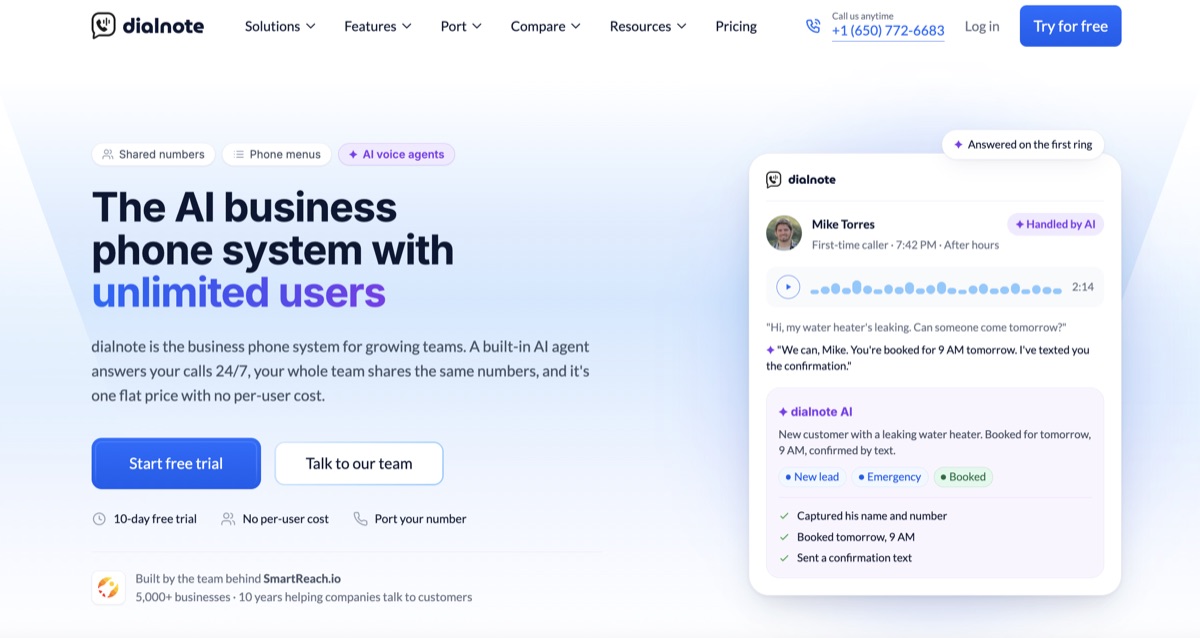
| TeamUnlimited users; AI receptionist + phone menu, most popular | $49/mo |
| BusinessUnlimited users; advanced routing | $99/mo |
| ProUnlimited users | $199/mo |
| AI voice usageMetered, with free credits each month to test | $0.49/min |
The $49 plan covers your whole team's phone system (unlimited users) and turns on the AI receptionist and phone menu. AI voice usage is billed at $0.49/min, with free credits to start. (The $19 Solo plan is phone-only, no AI.) As of August 2026.
Pros
- One flat plan from $49 covers the phone system (unlimited users) and the AI receptionist, replacing both your Ruby bill and your phone bill
- A phone menu routes only the calls you choose to the AI, so spam and wrong numbers never hit the meter
- AI voice at $0.49/min with free monthly credits, versus Ruby's $3.45 to $5.00 effective per-minute rate
- Answers 24/7, captures leads, books via Calendly or Cal.com, transfers to a teammate, 14 languages
Cons
- The receptionist is AI, not a live human, so deeply emotional or complex calls are better routed to your team
- AI usage is metered per minute, so all-AI answering at high volume still adds up (the phone menu manages that)
- A newer name than incumbents, built for small and mid-size teams rather than enterprise call centers
Ready to stop paying by the call?
10-day free trial, no credit card needed.
What users say: Teams that switch from per-minute human services describe the same relief: the meter anxiety disappears. With routing in place, the AI only answers what it should, so a busy month no longer means a scary invoice.
Best for: Teams that want a receptionist and a phone system on one flat plan, with routing to control exactly what the AI answers, instead of paying by the minute for every hello.
2. Smith.ai: best hybrid of AI and humans
Smith.ai is the closest like-for-like Ruby replacement, because it's the other big name in premium answering. The difference is the mix: Smith.ai layers AI over North America-based human receptionists, so routine calls cost less while complicated ones still reach a person. It bills per call rather than per minute, which some people find easier to predict.
Just know that the meter problem doesn't vanish, it changes shape. Managed plans start at $300 a month for 30 calls, add-ons (booking, texting, recording) carry per-call fees, and busy months still swing the bill. We've covered that story in depth in our Smith.ai alternatives guide.
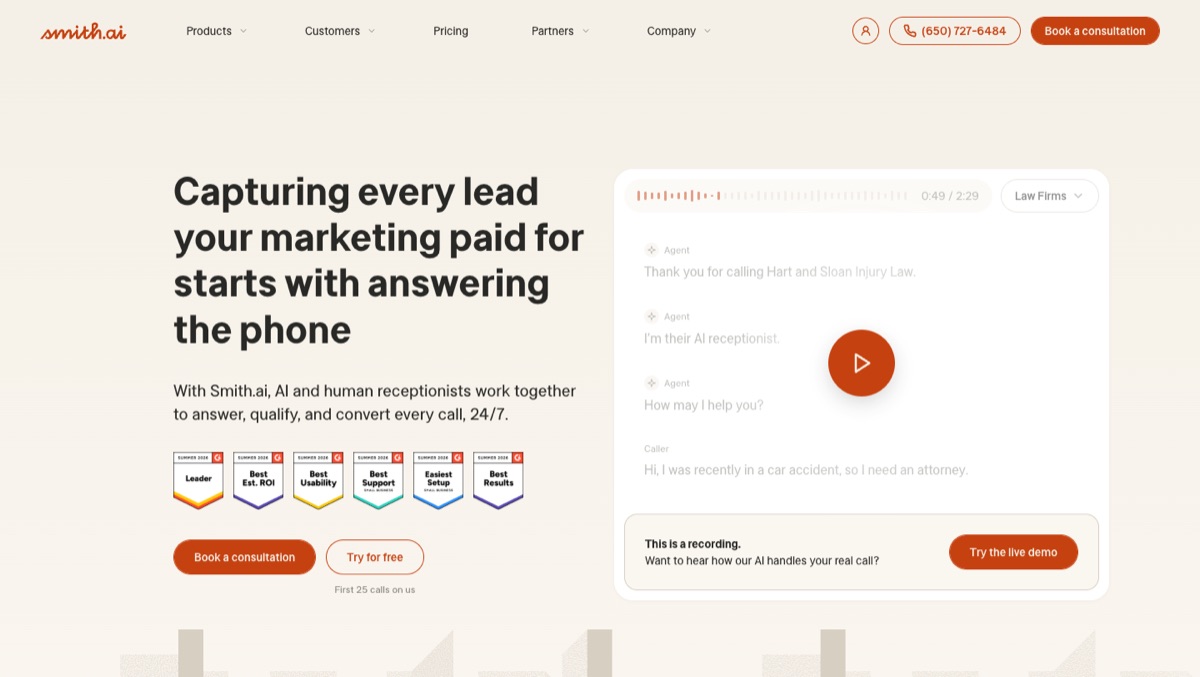
| AI ReceptionistSelf-serve AI plans, billed per call | From ~$95/mo |
| Virtual Receptionists30 calls, human-staffed, billed monthly | $300/mo |
| OverageBeyond the plan bucket | $8.50–11.50/call |
Per-call pricing with per-call add-ons for booking, texting, and recording. As of August 2026.
Pros
- Human receptionists with AI support, the most Ruby-like experience on this list
- Per-call billing is easier to predict than Ruby's per-minute buckets
- Deep CRM and intake integrations, popular with law firms
Cons
- Still premium-priced: $10 a call on the entry managed plan before add-ons
- Booking, texts, and recording each carry extra per-call fees
- Billing complaints (overages, post-cancellation charges) are the most common negative review theme
What users say: Smith.ai holds a 4.9 on G2, one of the strongest scores in the category, with praise for receptionist quality. The recurring complaints are about invoices, not people.
Best for: Firms that want to keep humans in the loop with AI trimming the cost, and can live with per-call pricing.
3. Rosie AI: simplest AI option for solo owners
Rosie is a no-frills AI receptionist for solo operators and tiny teams. It goes live fast, sounds natural, blocks spam, and answers in English and Spanish. For someone leaving Ruby's Starter plan, the math is stark: Rosie's $49 plan includes 250 minutes, five times Ruby's bucket at a fifth of the price.
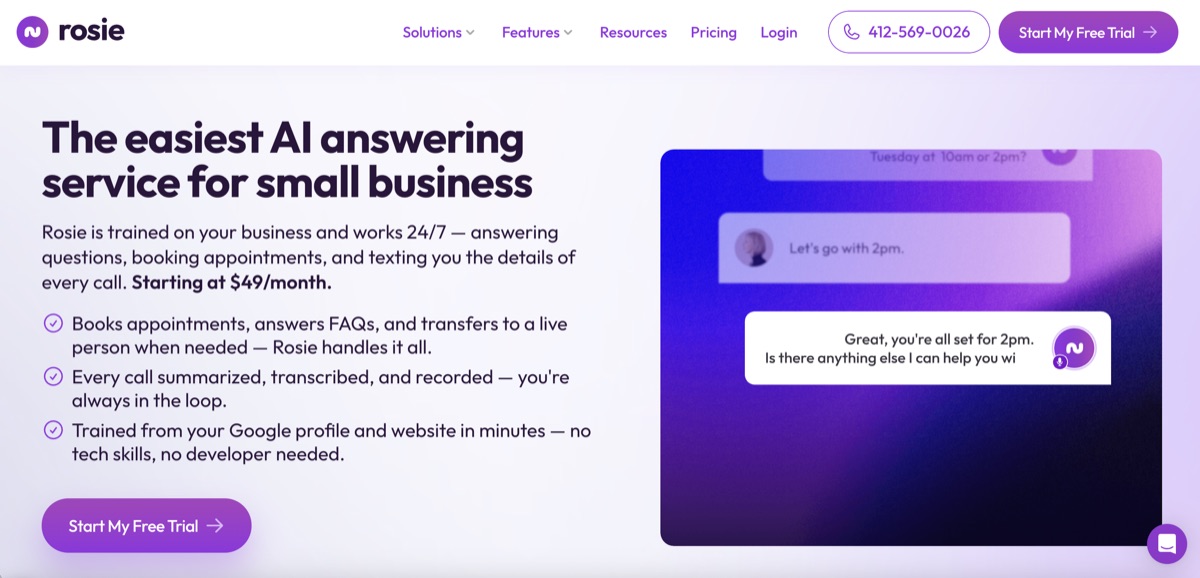
| Professional250 minutes | $49/mo |
| Scale1,000 minutes, adds booking + live transfer | $149/mo |
| Growth2,000 minutes, custom training | $299/mo |
AI-only (no phone system). Effective ~$0.15–0.25/min; overage ~$0.25/min. Booking and live transfers start on the $149 Scale plan. As of August 2026.
Pros
- Fast to go live with no tech skills
- Natural voice that most callers don't clock as AI
- 250 minutes for $49, versus Ruby's 50 minutes for $250
Cons
- Only knows what's on your website, and defaults to taking a message otherwise
- No phone system and no human backup
- In-call booking is locked to the $149 tier
What users say: Independent reviews are still thin, so most of what you'll read is vendor-sourced. Treat the claims as directional until a real review base builds up.
Best for: One-to-three person shops that need reliable 24/7 answering and message-taking at the lowest possible effort.
4. My AI Front Desk: cheapest turnkey AI receptionist
My AI Front Desk is a self-serve AI receptionist you can set up in about five minutes. It answers around the clock, books appointments, captures leads, transfers calls, and handles texts. There's even a free tier with about 20 voice minutes, enough to hear it handle your own questions before you pay anything.
| FreeAbout 20 voice minutes | $0/mo |
| Business-in-a-Box200 voice minutes, most popular | $99/mo |
| EnterpriseVolume voice, white-glove onboarding | Custom |
AI-only (no phone system, so you still need a business line). AI usage effectively $0.25–$0.50/min, with $0.25/min overage. As of August 2026.
Pros
- Most people are live in about five minutes
- Cheap 24/7 call capture and booking
- Free tier to test before spending a dollar
Cons
- Struggles with complex, emotional, or off-script callers
- Per-minute overages push the bill above the base rate
- Email-only support and no human fallback
What users say: Reviews are limited but positive, with praise for the fast setup and price. The recurring caution is billing: watch the trial terms, since at least one reviewer was charged when a trial rolled over.
Best for: Solo operators who want the cheapest credible DIY receptionist and have low to moderate call volume.
5. Dialzara: cheapest flat entry price
Dialzara is a turnkey AI receptionist with published pricing and no sales gate. It answers 24/7, books against a live calendar, qualifies leads, and ships a library of prebuilt industry prompts and voices. At $29 a month it has the lowest entry price on this list, though the 60-minute bucket is snug.
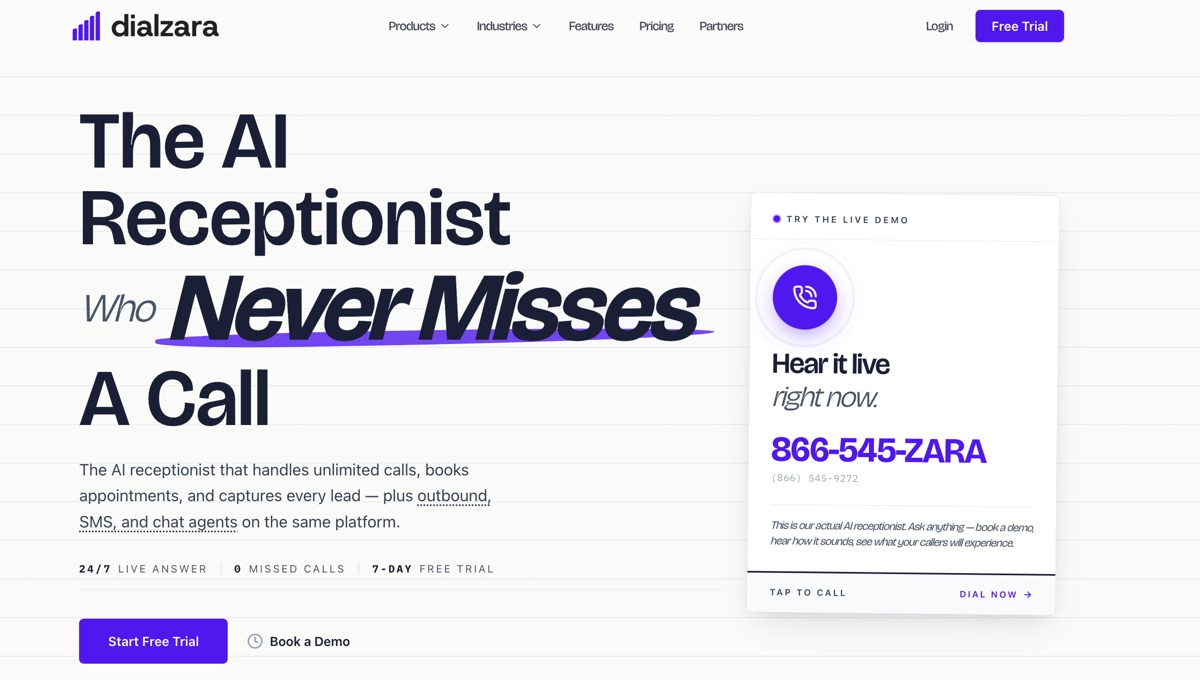
| Business Lite60 minutes | $29/mo |
| Business Pro220 minutes, adds live transfers + CRM | $99/mo |
| Business Plus500 minutes | $199/mo |
| Business Elite1,000 minutes, priority SLAs | $349/mo |
AI-only (no phone system). Overage $0.48 down to $0.35/min. Live transfers and CRM sync start on the $99 Pro plan. 7-day free trial, no contract. As of August 2026.
Pros
- Quick, easy setup with hands-on, founder-led onboarding
- Natural-sounding voices for a low price
- No contract, monthly billing, cancel anytime
Cons
- Feature-light beyond single-location answering (no advanced IVR or queues)
- Thin reporting and analytics
- Live transfers and CRM sync are locked to the $99 plan
What users say: The review base is small (a handful of Trustpilot reviews, no real G2 presence). Reviewers like the setup and voices; the honest caveat is that it's built for basic use cases.
Best for: Small businesses that want a cheap, contract-free receptionist they can switch on themselves.
6. Goodcall: predictable per-caller pricing
Goodcall is an AI phone agent for local service businesses, and its pricing answers Ruby's core complaint head-on: it bills by unique caller with unlimited minutes, so a chatty customer can't inflate your bill. If your calls run long (intake conversations, quote requests), that model is worth a look. If you've already tried it and found the voice robotic, our Goodcall alternatives guide covers the upgrades.
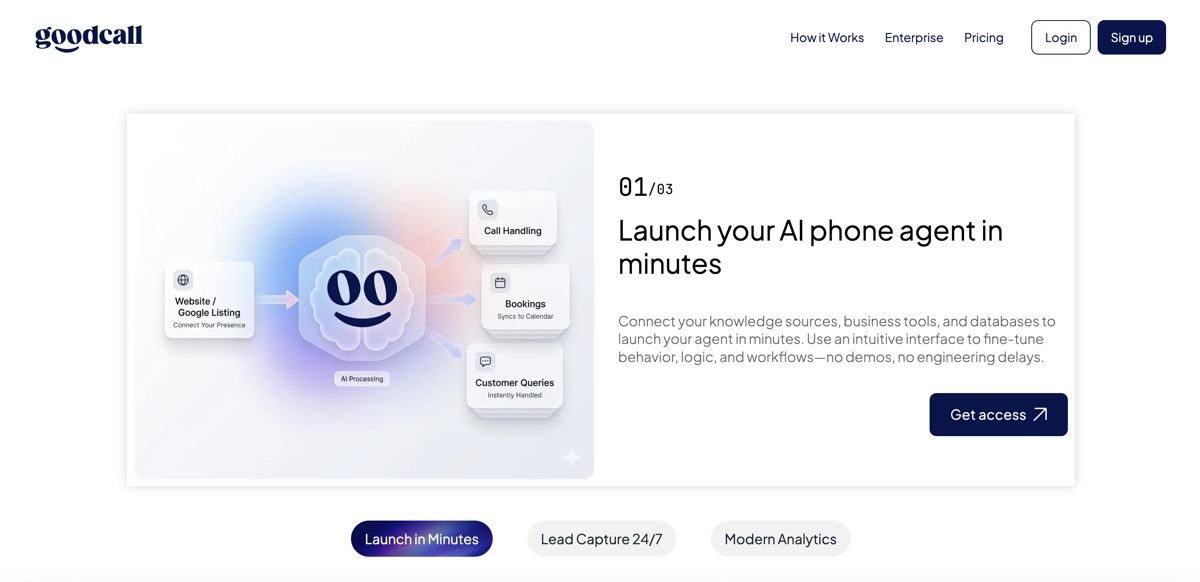
| StarterPer agent, 100 unique callers | $79/mo |
| GrowthPer agent, 250 unique callers | $129/mo |
| ScalePer agent, 500 unique callers | $249/mo |
AI-only (no phone system). Billed per unique caller, $0.50 per extra caller over the cap. Annual billing ~15% off. As of August 2026.
Pros
- Unlimited minutes: call length never touches your bill
- Free entry option to test it
- Handles the basics well: hours, location, and message-taking
Cons
- Voice can sound robotic with noticeable lag
- Zapier-only integrations and no native CRM
- Per-caller caps and $0.50 overages add up as you grow
What users say: The review base is thin. What's out there praises the simplicity and price but flags a robotic voice and hard-to-reach support. Treat the sentiment as directional, not proven.
Best for: Local shops with long calls that want a bill based on how many customers called, not how long they talked.
Live receptionist services (if you still want humans)
Not ready to hand calls to software? Fair. These four keep live receptionists on the line at rates well below Ruby's. The trade-off is that every one of them still runs a meter, so read the billing fine print with the same care Ruby taught you.
7. Abby Connect: best dedicated human team
Abby Connect assigns you a small dedicated team of receptionists (typically five to ten people) plus a success manager, so callers hear familiar voices instead of a random operator. It's the most Ruby-like service culture on this list, at a slightly better rate, and it now sells AI receptionist plans alongside the human ones.
| Live receptionist100 minutes, dedicated team | $329/mo |
| Extra minutesBeyond the bucket | $2.99/min |
| AI receptionistSeparate AI-answering plans | $99–690/mo |
Live plans billed by the receptionist minute, like Ruby. Free trial available. As of August 2026.
Pros
- Dedicated team that learns your business, closest to Ruby's feel
- Strong onboarding and a named success manager
- Bilingual answering and an AI option under the same roof
Cons
- Still per-minute billing at premium rates ($3.29/min effective at entry)
- Reviewers report upselling and overage charges for spam and ring time
- Business-hours coverage on standard plans; 24/7 costs more
What users say: Around a 4.5 on G2, with consistent praise for receptionist quality and onboarding. The negative reviews cluster on billing: spam calls and ring time eating paid minutes.
Best for: Firms that specifically want Ruby's dedicated-team feel and will pay near-Ruby rates for a better-managed version of it.
8. AnswerConnect: best-value 24/7 human answering
AnswerConnect is the volume play among live services: around-the-clock human answering at roughly $1.62 a minute effective, about a third of Ruby's entry rate. It answers 24/7 on every plan, books appointments, and plugs into common CRMs and schedulers.
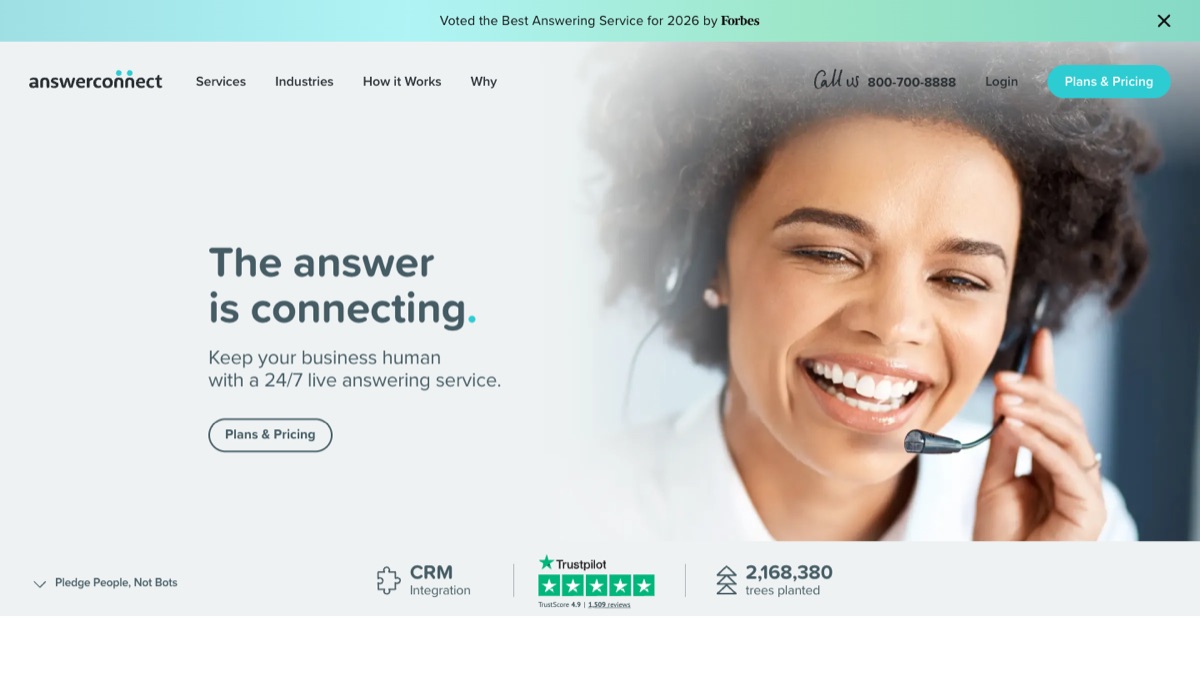
| Entry200 minutes, 24/7 answering | $325/mo |
| Growth300 minutes | $425/mo |
| SetupCharged on signup | One-time fee |
True 24/7 human answering on all plans. Per-minute billing beyond the bucket. As of August 2026.
Pros
- Real 24/7 and holiday coverage included, not an upsell
- Roughly double Ruby's minutes for a similar monthly spend
- Calendar and CRM integrations that let receptionists book for you
Cons
- Receptionists are shared, not dedicated, so scripts carry the context
- Per-minute billing still punishes long calls
- Quality can vary by shift, a common note in reviews
What users say: A large, mostly positive review base around 4.5 on G2. Praise centers on responsiveness and true 24/7 coverage; complaints mention occasional script misses on complex accounts.
Best for: Businesses with real overnight and weekend call volume that want humans answering all of it without Ruby's rate.
9. PATLive: best scripted human answering
PATLive is a US-based answering service known for deeply customizable call scripts: screening, transfers, appointment scheduling, lead collection, and event registrations. It also offers a low $60 base plan billed purely per minute, which suits lumpy, seasonal call volume better than a fixed bucket.
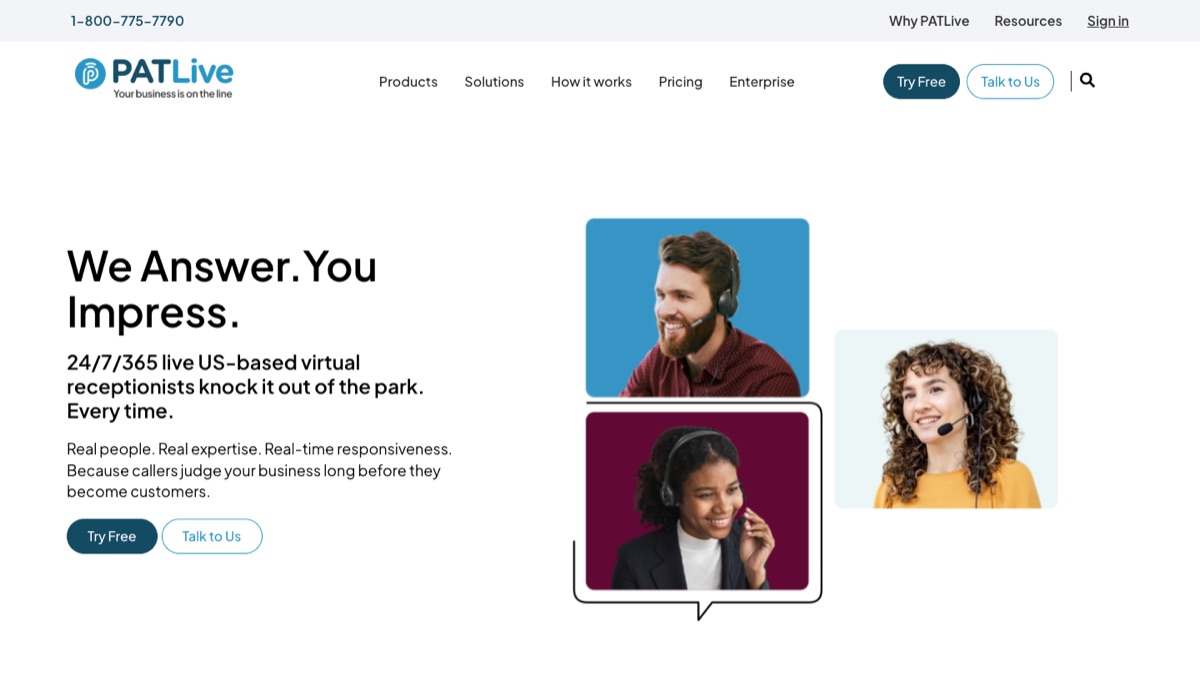
| BasicNo minutes included, $2.34/min as used | $60/mo |
| Starter75 minutes | $205/mo |
| Pro600 minutes | $1,050/mo |
24/7 US-based receptionists. Per-minute billing throughout. As of August 2026.
Pros
- Highly customizable scripts, including screening and live transfers
- Pay-as-you-go option with no big bucket commitment
- 24/7 coverage with US-based receptionists
Cons
- Per-minute rates ($2.34 to $2.73 effective) still triple most AI options
- Complex scripts take real setup effort
- Costs scale linearly with growth, the same trap as Ruby at a lower slope
What users say: Around a 4.6 on G2 with praise for receptionist professionalism and script flexibility. Negative reviews are rare and mostly about per-minute costs at volume.
Best for: Businesses with seasonal or unpredictable volume that want humans on a pay-for-what-you-use meter.
10. Moneypenny: best premium human brand
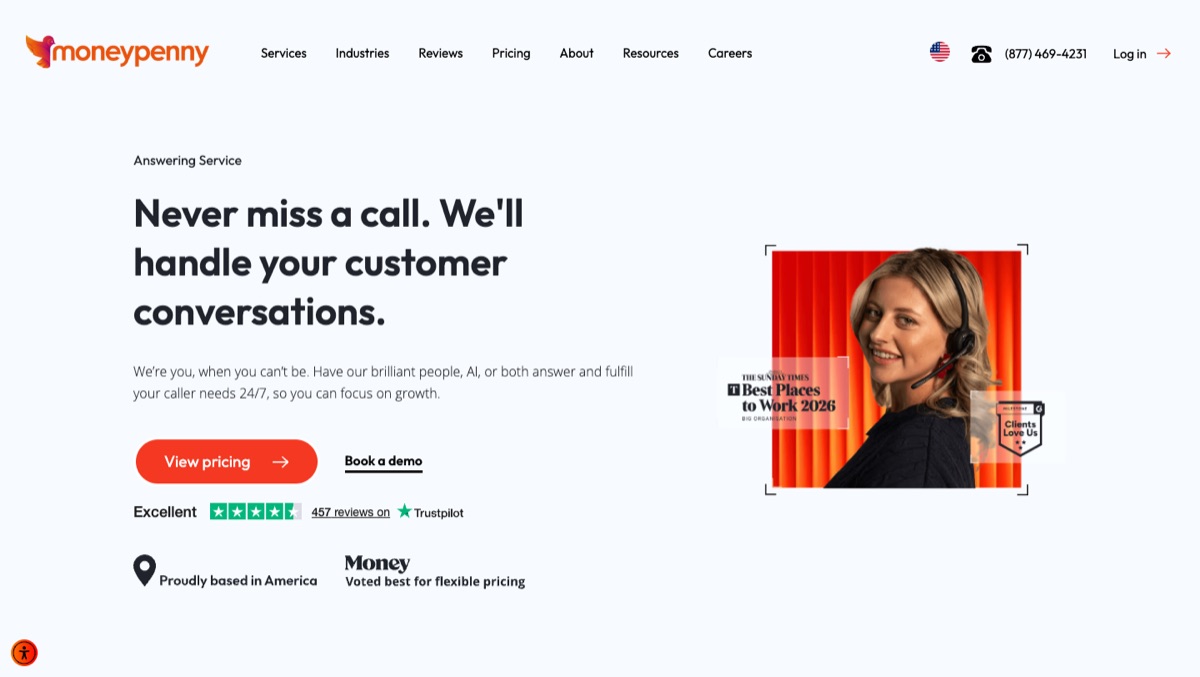
Moneypenny is the UK's biggest name in call answering, and its US operation (which absorbed VoiceNation) gives you a dedicated receptionist backed by a team. It's the white-glove option: polished, corporate, and popular with law and property firms.
One honest caveat: Moneypenny doesn't publish US pricing, and third-party figures (starting around $145 a month, with most businesses landing at $300 to $400 for full coverage) are estimates. We can't verify what you'd actually pay without going through their sales process, so treat the numbers here as directional.
| Entry (est.)Third-party estimate, per-call billing in the US | ~$145/mo |
| Typical (est.)With 24/7 coverage and overages | $300–400/mo |
| QuotePricing via sales only | Custom |
US pricing is unpublished; figures are third-party estimates as of August 2026. UK and US operations bill differently (per minute vs per call).
Pros
- Dedicated receptionist who learns your business, with team backup
- Strong brand reputation and polished, corporate-grade service
- Handles overflow and after-hours as well as full answering
Cons
- No published US pricing, so comparison shopping means talking to sales
- Premium rates comparable to Ruby once coverage is added
- US billing works per call while the UK bills per minute, which makes cross-checking reviews confusing
What users say: Moneypenny holds a 4.5 "Excellent" on Trustpilot with praise for receptionist quality and polish. The grumbles that do surface are about billing clarity after the VoiceNation transition, not the people.
Best for: Firms that want the most polished human answering available and don't mind opaque pricing to get it.
How to choose the right Ruby Receptionists alternative
Ten options is a lot. Here's the short way through.
Start with one question: do your calls need a human, or do they just need answering? Pull up your last 30 messages from Ruby. If most are name-number-reason notes, you're paying $5 a minute for data entry, and any AI option on this list handles it. If most are sensitive conversations (upset clients, delicate intake), stay with humans or a hybrid: Smith.ai, Abby Connect, AnswerConnect, PATLive, or Moneypenny. We'll be straight with you: there's no universal line for where AI stops being good enough. It depends on your callers, so test with your own calls.
Then check what runs the meter. Per minute (dialnote, Rosie, Abby, AnswerConnect, PATLive), per call (Smith.ai, Moneypenny US), or per caller (Goodcall). Match the model to your call shape: long calls favor per-caller pricing, high volume favors flat plans plus routing.
Then count the bills you're paying. Ruby plus a phone system is two bills. An AI-only tool plus a phone system is still two bills. dialnote's whole pitch is collapsing them into one $49 flat plan, which is why it wins most total-cost comparisons; see the pricing next to your current stack.
Then test before you commit. Call the number yourself. Ask a tricky question about your own business. If it's AI, listen for whether it books a real appointment or just takes a message. If it's humans, call at 2 a.m. and see who picks up. A five-minute test call beats any feature table, including this one.
The bottom line
Ruby isn't a bad service. It's a great service wearing a 2010s price tag, and the receptionist-minute model quietly punishes every business that grows.
The market has moved. Live-receptionist services now deliver Ruby's core job at $1.62 to $3.29 a minute. AI receptionists deliver it at cents on the dollar and never sleep. And dialnote folds the whole stack together: from the $49 plan you get a full phone system with unlimited users, a 24/7 AI receptionist at $0.49/min with free credits to test, and a phone menu that decides which calls are worth metering at all.
If you're tired of doing minute math every time the phone rings, start a free 10-day trial of dialnote, no credit card needed, and hear it answer your own calls before you cancel anything.
Frequently asked questions
For most small teams, dialnote. From the $49 plan you get a full phone system (unlimited users) plus a 24/7 AI receptionist at $0.49/min, and a phone menu routes only the calls you choose to the AI. That's a fraction of Ruby's $5.00 effective per-minute rate on its Starter plan.
Cost, mostly. Ruby bills by the receptionist minute, and plans start at $250 a month for just 50 minutes. Busy months mean overages, and reviewers report frequent price increases. The receptionists themselves are rarely the complaint. The meter is.
Ruby's Starter plan is $250/mo for 50 receptionist minutes, an effective $5.00 per minute. Bigger plans bring that down to about $3.45/min (Enterprise, $1,725/mo for 500 minutes). Time receptionists spend relaying messages counts toward your minutes too. Verified August 2026.
For routine calls (hours, messages, booking, lead capture), modern AI handles the job around the clock at roughly a tenth of the cost. For emotional or complicated calls, a human still wins. Many teams route routine calls to AI and keep a person for the rest.
AI-only tools like Dialzara ($29/mo for 60 minutes) and Rosie ($49/mo for 250 minutes) have the lowest sticker prices, but neither includes a phone system. If you need business calling too, dialnote's $49 flat plan with AI at $0.49/min usually wins on total cost.
Ruby has added AI features alongside its human receptionists at no extra charge, but the billing model hasn't changed: you still pay by the receptionist minute. The alternatives on this list cost less because AI does the answering, not because Ruby lacks AI.

Written by
Upasana Sahu
Senior Digital Marketing Specialist, SmartReach.io
Upasana Sahu is a Senior Digital Marketing Specialist at SmartReach.io with over 10 years of experience in content marketing, SEO, and digital strategy. She manages end-to-end blog operations, from content creation and on-page/off-page SEO to traffic...
Upasana Sahu is a Senior Digital Marketing Specialist at SmartReach.io with over 10 years of experience in content marketing, SEO, and digital strategy. She manages end-to-end blog operations, from content creation and on-page/off-page SEO to traffic...
Related Articles

Best Virtual Receptionist Services Ranked [2026]
Compare the best virtual receptionist services of 2026 by price per receptionist minute, booking depth, and coverage, including the AI option.
AnswerConnect Alternatives: 10 Better Options [2026]
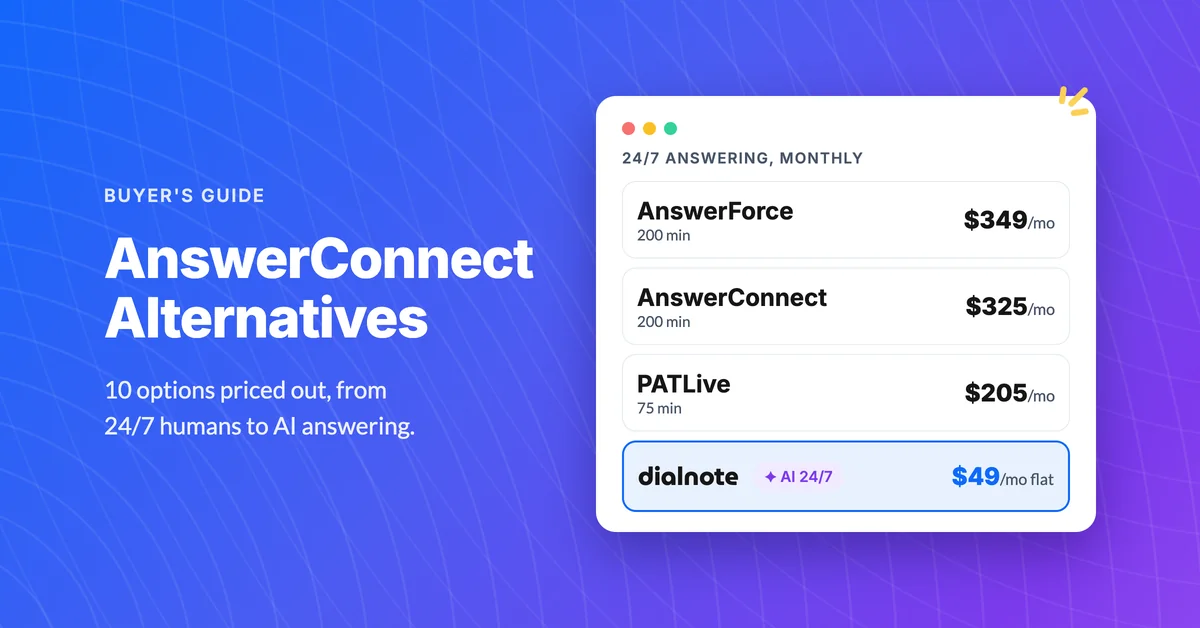
AnswerConnect runs $325/mo for 200 minutes, and after-call work bills too. Compare 10 AnswerConnect alternatives on real cost per answered call.
Best Answering Service for Small Business [2026]
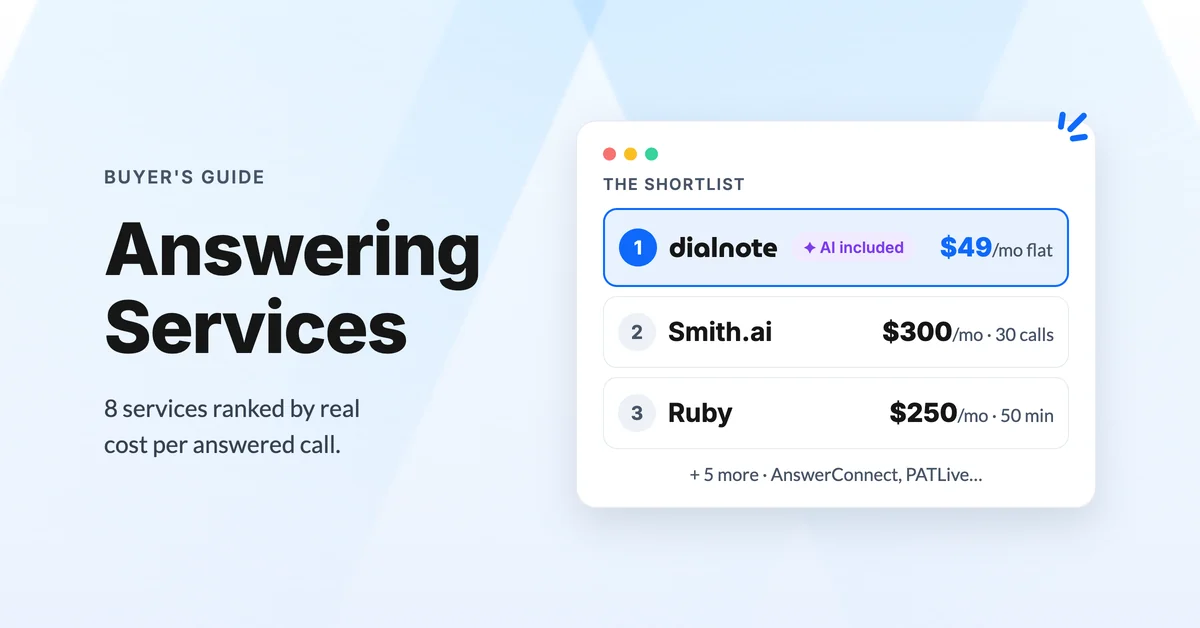
Compare the best answering services for small business in 2026: live, AI, and hybrid options ranked by real cost per call and coverage.