Best Virtual Receptionist Services Ranked [2026]
A virtual receptionist service sells you human minutes: a trained remote receptionist greets your callers by script, takes messages, transfers calls, and sometimes books appointments, billed at $2 to $5 per minute. The best virtual receptionist services earn that rate. The rest charge it anyway.
Elena learned the difference the expensive way. She's a solo family-law attorney, and every new client starts as a phone call she can't take because she's in a consultation or in court. So she collected three quotes: Ruby at $250 a month for 50 minutes, Abby Connect at $329 for 100 minutes, Posh at $130 for 50. Then a service she trialed took a perfect message at 2 pm from a ready-to-hire client. Elena called back at 5. The client had signed with the firm whose phone got the consult booked, not noted. The message wasn't the job; the booked appointment was.
That's the lens for this ranking: what does a receptionist minute cost, and does it end in a message or an outcome? We've ranked the eight virtual receptionist services small businesses actually shortlist, live, hybrid, and AI, using published pricing as of October 2026. dialnote is our product, so every claim sits next to its receipt, and we say plainly where a rival wins.
TL;DR:
- The best virtual receptionist services by category: dialnote for AI answering (a 24/7 AI receptionist plus a full business phone system, $49/month flat, AI calls from $25/month for 65 with the AI call pack), Ruby for premium live answering, Abby Connect for a dedicated human team, Smith.ai for the AI-plus-human hybrid.
- Live receptionist minutes cost $2.15 to $5.00 each depending on the service; AI receptionist minutes cost cents. At 100 minutes a month, that's the gap between $4,740 and about $888 a year.
- Budget live picks: Posh ($130/month for 50 minutes) and ReceptionHQ (plans from $25/month). Davinci adds admin work; Moneypenny sells same-voices continuity at premium published rates.
- Watch three things on any quote: the effective per-minute rate, whether calls end in booked appointments or relayed messages, and what after-hours coverage actually costs.
Jump to: the shortlist · how we ranked · full reviews · the verdict
The shortlist at a glance
| Service | Type | Starting price | Effective rate | Books appointments |
|---|---|---|---|---|
| dialnote | AI receptionist + phone system | $49/mo flat | About $0.38/AI call on the AI call pack ($25/mo for 65), or $0.49/min | Yes, Calendly and Cal.com, in-call |
| Ruby | Live, premium | $250/mo, 50 min | ~$5.00/min | On higher plans |
| Abby Connect | Live, dedicated team | $165/mo, 50 min | ~$3.30/min, no setup fee | Yes, plan-dependent |
| Smith.ai | AI + humans | $300/mo, 30 calls | ~$10/call | Yes |
| Posh | Live, budget | $130/mo, 50 min | ~$2.60/min | Basic |
| Davinci Virtual | Live + admin tasks | $129/mo, 50 min | ~$2.58/min | On premium plans |
| ReceptionHQ | Live, pay-as-you-go | From $25/mo | ~$2.15/min on 100-min plan | Basic |
| Moneypenny | Live, dedicated | $165/mo, 50 min | ~$3.30/min | Yes |
What does a virtual receptionist service include?
A virtual receptionist service is a remote team (or, increasingly, software) that answers your business calls in your company's name. The standard package: a custom greeting, message-taking, call transfers to your cell, and delivery of the details by text or email. Better plans add appointment scheduling, lead intake questions, bilingual answering, and light admin work like outbound confirmation calls.
What it is not: a phone system. Nearly every service on this list rides on top of phone service you're already paying for, and forwards calls back to it. It's also usually not 24/7 by default; most live services staff business hours and charge a premium for nights and weekends.
The billing unit is the thing to understand before any feature list. Live services sell receptionist minutes or calls in monthly bundles, and the bundle sizes are small: 50 minutes covers roughly a dozen 4-minute calls. A month with a busy week blows through it, and overage rates (Abby Connect bills extra minutes at your plan's rate, about $3.29 on the 100-minute plan) make the sticker price a floor, not a price.
How we picked the best virtual receptionist services
Every service got scored on the same four axes, and it's worth stealing them for your own shortlist:
- Effective cost per receptionist minute. Monthly price divided by included minutes, plus the overage rate. This one number explains most of the ranking.
- What happens to the caller's information. A relayed message still needs a callback, and callbacks are where leads die. Services that book directly into a calendar or capture structured intake details rank higher.
- Coverage hours at the listed price. "24/7 available" and "24/7 included" are different claims.
- Whether the website price is the invoice price. Setup fees, per-minute overages, and quote-only pricing all cost points.
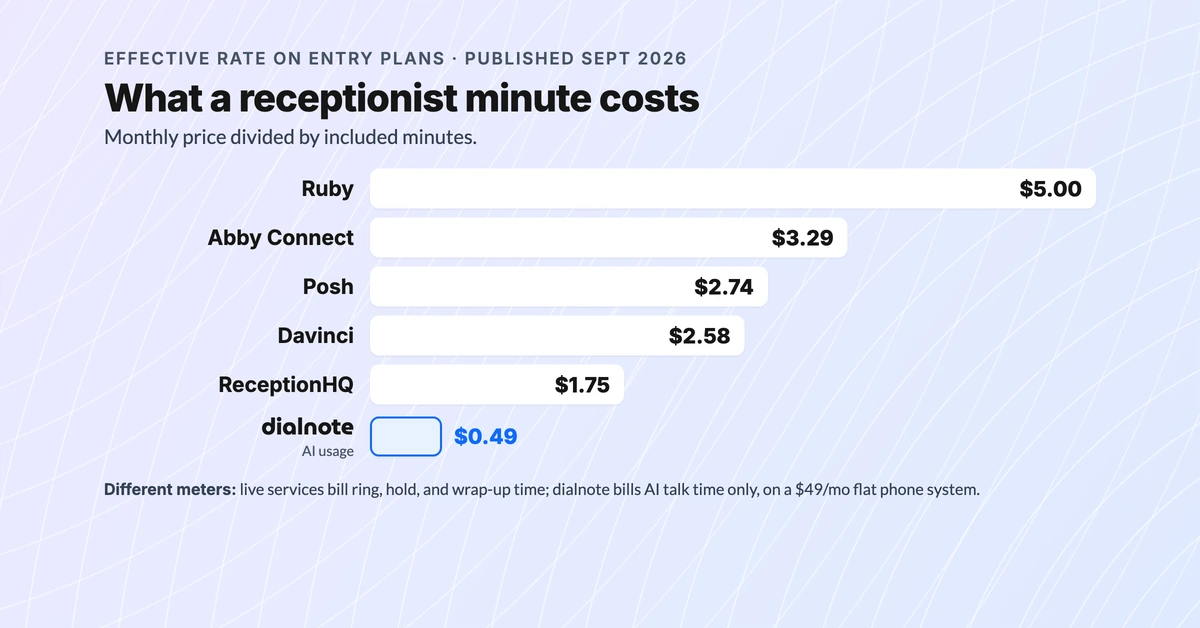
We used each provider's published pricing as of October 2026 and flagged estimates as estimates. One honest disclosure: dialnote is an AI service, and this list ranks it first for the jobs AI handles well. Where your calls need live human judgment, the live entries below are the better buy, and each entry says so.
According to the U.S. Bureau of Labor Statistics, a full-time in-house receptionist earns a median of about $37,000 a year before benefits. Every option on this list is priced against that number, which is why even a $500 monthly plan can read as a bargain, and why the math below still deserves your attention.
1. dialnote: best AI virtual receptionist service
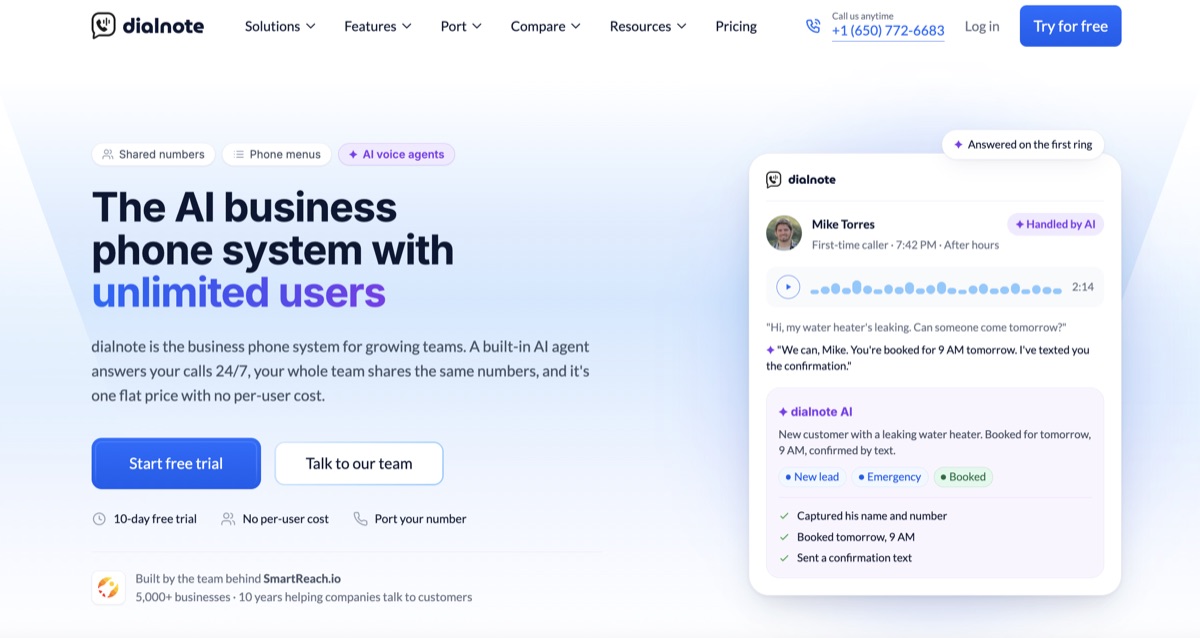
dialnote is an AI business phone system with no per-user pricing. AI voice agents answer calls, capture leads, and book meetings 24/7, starting on the Team plan at $49/mo for unlimited users. As a virtual receptionist, dialnote works differently from everything else on this list: instead of renting human minutes on top of your phone bill, the AI receptionist is built into the phone system itself. It answers 24/7 (in 14 languages on Business and up), asks the intake questions you configure, books meetings through Calendly or Cal.com during the call, sends SMS confirmations, and transfers to a teammate when someone's free.
| SoloPhone system for 1 user, AI summaries, no AI agent | $19/mo |
| TeamUnlimited users; AI receptionist + phone menu, recommended starter | $49/mo |
| BusinessUnlimited users; advanced routing | $99/mo |
| AI call pack65 AI calls; $0.49/min without a pack | $25/mo |
Flat pricing per account, not per user or per minute bundle. 10-day free trial, no credit card. As of October 2026.
Pros
- Answering, booking, and the phone system itself on one flat bill, with no minute bundles to ration
- Books into Calendly or Cal.com mid-call and texts the confirmation, instead of relaying a message
- A phone menu sends only the calls you choose to the AI, so you control which calls use the AI
- 24/7 coverage costs the same as business hours
Cons
- No live human receptionists; calls that need judgment or empathy are better served by Ruby or Smith.ai
- AI calls cost extra (the AI call pack, or $0.49/min past it), so all-day AI answering still shows up on the bill
- Newer brand with few third-party reviews so far
Ready to stop paying by the call?
10-day free trial, no credit card needed.
Best for: small businesses whose calls are mostly structured (new inquiries, bookings, reschedules) and who'd rather solve the phone bill and the answering problem in one move. The AI answers live on the homepage demo, which is the fastest way to judge whether it's good enough for your callers.
2. Ruby: best-known live virtual receptionist
Ruby is the name the category built its reputation on: warm, US-based receptionists, strong with law firms and professional services, billed at $250 a month for 50 receptionist minutes, then $395 for 100. That's an effective $5.00 a minute at entry, the highest on this list, and Ruby's polish is what the premium buys.
| 50 minutes~$5.00 per receptionist minute | $250/mo |
| 100 minutes~$3.95/min | $395/mo |
| 200 minutes~$3.60/min | $720/mo |
| 500 minutes~$3.45/min | $1,725/mo |
Billed by the receptionist minute; unused minutes don't roll over. As of October 2026.
Pros
- The most polished live-answering experience in the category
- Deep experience with legal and professional-services intake
- Mobile app with call handoff and status controls
Cons
- Highest effective rate on this list at entry
- Minutes include hold time and wrap-up, not just talk time
- No phone system and no meaningful AI tier
Best for: professional practices where a live, unmistakably human receptionist is part of the brand and call volume stays modest. If the meter's the problem, our Ruby alternatives guide prices the exits.
3. Abby Connect: best dedicated receptionist team
Abby Connect assigns a small dedicated team to your account rather than a shared pool, so the same few people learn your business and answer most of your calls. Plans start at $165 a month for 50 minutes, and $329 buys 100 (about $3.29 a minute). Extra minutes bill at your plan's rate, there's no setup fee, and AI-answered minutes count at half rate, so a plan stretches twice as far when AI takes the call.
Pros
- Dedicated team model: callers hear familiar voices, not a random agent
- Bilingual answering and appointment scheduling available
- An AI tier exists for overflow and after-hours
Cons
- Among the higher per-minute rates on this list
- Overage at the full plan rate makes busy months expensive
- No phone system underneath; it forwards to what you already pay for
Best for: businesses that want continuity of voice from a small, dedicated team. Honestly, the overage rule is the line item to watch: every minute past the bundle bills at your plan's full rate, so a busy month on the 100-minute plan costs about $3.29 for each extra minute.
4. Smith.ai: best hybrid of AI and humans
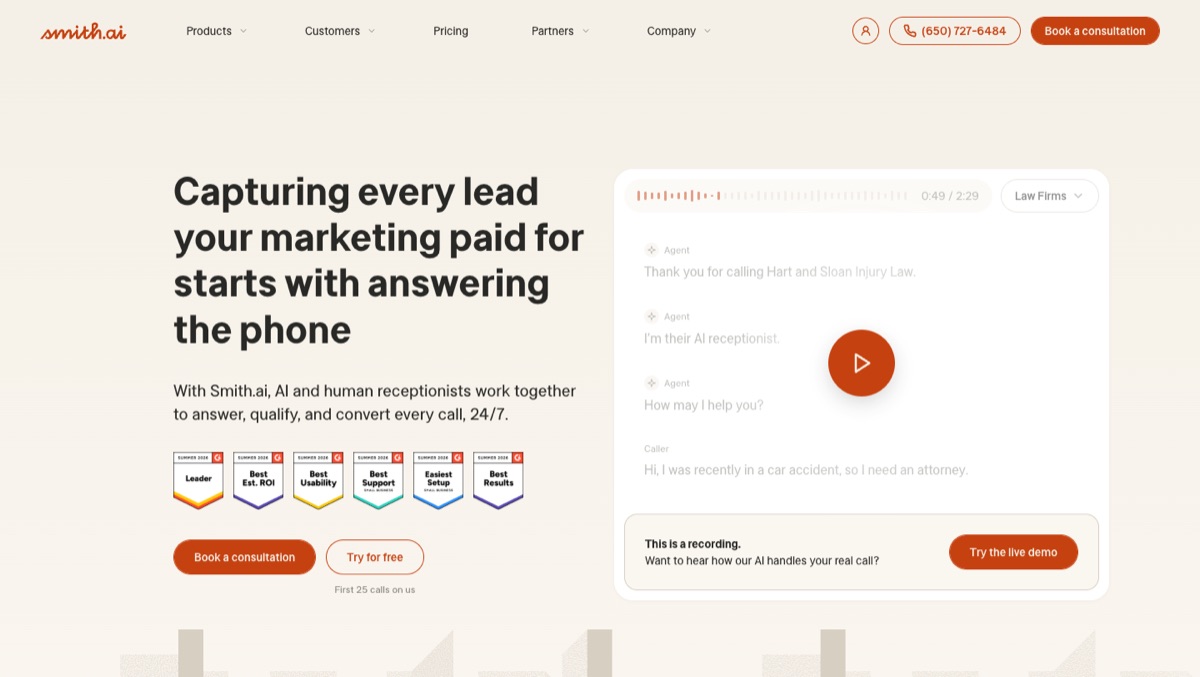
Smith.ai staffs trained human receptionists on top of its AI layer and bills per call rather than per minute: $300 a month for 30 calls (about $10 each), scaling to $2,100 for 300. The human layer is excellent, CRM-literate, and script-faithful, and per-call billing is easier to forecast than minutes.
Pros
- The strongest human-in-the-loop option when calls genuinely need judgment
- Per-call billing is predictable at stable volumes
- Good CRM and intake integrations
Cons
- $10 per answered call multiplies fast at volume
- No phone system included
- The AI-only tier competes with cheaper AI-first options
Best for: businesses where some calls need a human's judgment and the rest can go to AI, with one vendor managing the split. Our Smith.ai alternatives teardown covers the pricing ladder in detail.
5. Posh: best budget live receptionist
Posh undercuts the premium brands at $130 a month for 50 minutes, roughly $2.60 a minute, with 24/7 live answering available and a usable app. You give up some of Ruby's polish and the dedicated-team feel, but the receptionists are competent and the price is honest.
Pros
- Roughly half of Ruby's effective entry rate
- 24/7 live answering available
- Simple app for statuses, transfers, and messages
Cons
- Shared agent pool, lighter customization
- Booking depth is basic compared to Abby or Smith.ai
- Still a meter: 50 minutes is a dozen short calls
Best for: small businesses that want a real human answering at the lowest credible live rate. Is a $120 saving per month worth slightly less polish? For most trades and local services, yes.
6. Davinci Virtual: best for receptionist plus admin work
Davinci Virtual prices live answering from $129 a month for 50 minutes (about $2.58 a minute), and its premium plans ($249 and $319) add what most rivals don't: appointment scheduling, outbound calling, bilingual receptionists, and administrative tasks. It's the closest thing on this list to a part-time office assistant.
Pros
- Premium plans include outbound calls and admin tasks, not just answering
- Competitive per-minute rate at entry
- Pairs with Davinci's virtual-address products for a full front-office setup
Cons
- The interesting features live on the pricier premium plans
- Business-hours staffing; it's not a 24/7 play
- Interface and reporting feel dated next to newer rivals
Best for: businesses that want one vendor to answer calls and do light admin work between them.
7. ReceptionHQ: best low-volume entry point
ReceptionHQ has the gentlest on-ramp in live answering: plans start at $25 a month with per-call billing, and its 100-minute tier runs $215 (about $2.15 a minute, among the lowest live rates on this list). US-based receptionists, 24/7 availability, no lock-in contracts.
Pros
- Lowest entry price in live answering
- Per-minute rate on bundled plans beats most premium brands
- No lock-in contracts, and per-call plans skip the setup fee
Cons
- Message-taking depth, not full intake or booking workflows
- Per-call fees on the smallest plans add up quickly at volume
- Fewer integrations than category leaders
Best for: very low call volumes, a few important calls a week that just need a professional pickup and a relayed message.
8. Moneypenny: best same-voices continuity
Moneypenny assigns dedicated receptionists who become, functionally, your part-time front desk. Callers notice the continuity. Its US pricing is published: $165 a month for 50 minutes (about $3.30 a minute), $265 for 100, and $422 for 200, with extra minutes at $1.67 to $2.28.
Pros
- Dedicated receptionists who genuinely learn your business
- Polished, UK-honed service culture
- Handles scheduling and overflow with continuity of voice
Cons
- Premium per-minute rates at every tier
- AI answering is a separate call-based plan (from $69 for 25 calls)
- No phone system included
Best for: firms that want the same familiar voices every day and accept premium per-minute rates to get it. We'll admit some uncertainty here: dedicated-team services claim the continuity converts more callers, and it sounds right, but we haven't found public data that isolates the effect. Price it as a preference, not a proven lift.
What does a year of receptionist coverage cost?
Take one realistic volume, 100 receptionist minutes a month, and annualize the plans that cover it. Ruby's 100-minute plan: $395 × 12 = $4,740 a year. Abby Connect: $329 × 12 = $3,948. Davinci's 100-minute business plan: $239 × 12 = $2,868. ReceptionHQ: $215 × 12 = $2,580. The AI route: dialnote's Team plan at $49 × 12 = $588, plus 100 minutes a month of AI calls. At about 4 minutes a call, that's 25 calls, and one AI call pack ($25 a month, $300 a year) covers them, about $888 all-in. The same minutes at the $0.49 per-minute rate would cost $588 a year instead of $300.
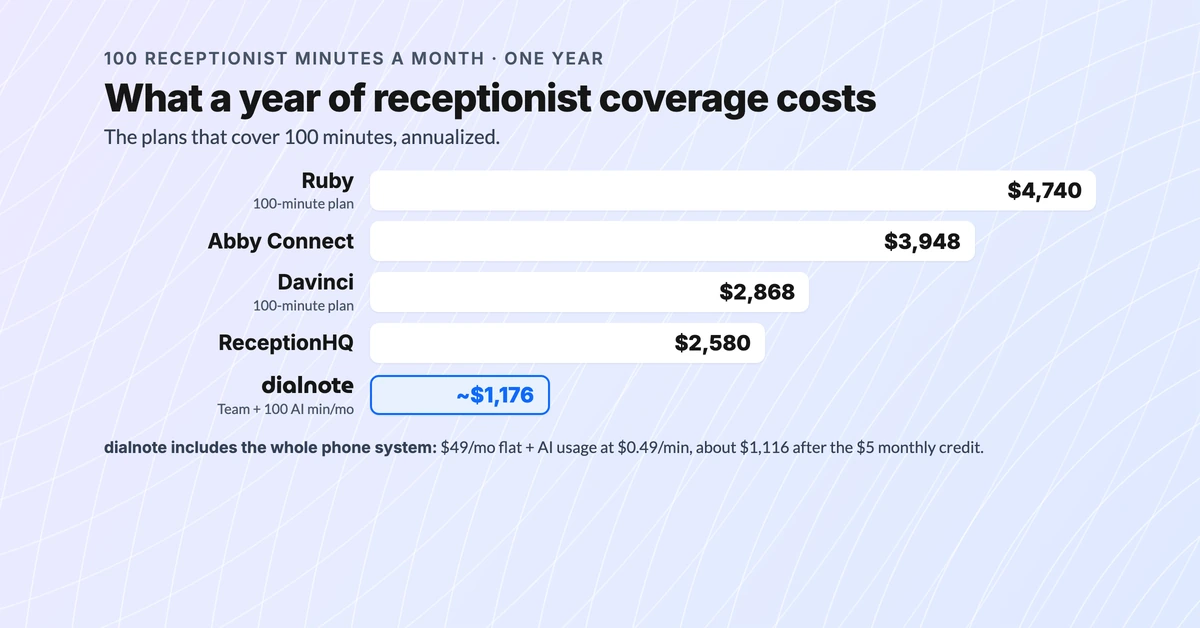
Two things make that comparison sharper than it first looks. The live totals sit on top of a phone bill you're still paying separately; the AI figure includes the phone system for the whole team. And the live bundles are ceilings: minute 101 costs $1.67 or more depending on the vendor, while a busy month on the AI side moves the bill by dollars. What does the same busy season cost when the extra minutes cost cents, not dollars? Run your own volume on the pricing calculator.
Can an AI virtual receptionist replace a live one?
For structured calls, mostly yes; for judgment calls, not yet. The honest split, from watching both categories all year: greeting, intake questions, appointment booking, reschedules, directions, and hours are now handled cleanly by good AI receptionists, around the clock, in multiple languages, at software prices. Live receptionists still win when a caller is upset, confused, or off-script, when the conversation needs empathy or negotiation, and when your brand depends on callers never suspecting software.
"The buying mistake we see isn't choosing humans or choosing AI," says Akhilesh Betanamudi, dialnote's co-founder. "It's paying human rates for the calls a machine handles better, at 2 am, in Spanish, on the first ring."
The practical answer for a lot of small businesses is a split: let AI take the structured majority and route the exceptions to a human, whether that's a hybrid vendor like Smith.ai or a live service kept on a small plan behind an AI front door. And test before you commit either way. Call the service's own demo line, throw your hardest real scenario at it (a schedule conflict, an address correction, an impatient caller), and listen like a customer. That one call tells you more than any pricing table, including this one. If the alternative you're actually weighing is hiring, the receptionist-vs-AI hiring math runs those numbers separately.
Which virtual receptionist service should you pick?
The same ranking, matched to situations:
| Your situation | Pick | Why |
|---|---|---|
| Structured calls, want booking and the phone system on one bill | dialnote | 24/7 AI receptionist inside a $49/mo flat phone system |
| Professional practice, human voice is part of the brand | Ruby | The category's most polished live answering |
| Want familiar voices from a small dedicated team | Abby Connect | Dedicated team from $165/mo for 50 minutes |
| Some calls need human judgment, the rest can be AI | Smith.ai | The strongest managed hybrid, ~$10/call |
| Live answering on a budget | Posh | ~$2.60/min undercuts the premium brands |
| Answering plus light admin and outbound work | Davinci Virtual | Premium plans include scheduling and admin tasks |
| A few important calls a week | ReceptionHQ | Plans from $25/mo, no contracts |
| Continuity above all, budget flexible | Moneypenny | Dedicated receptionists at premium published rates |
The verdict: dialnote is the best virtual receptionist service for small businesses whose calls are mostly bookable, structured work, because it's the only option here where the receptionist, the booking, and the phone system arrive on one $49/month plan, with AI calls at a published $25/month for 65 on the AI call pack, instead of a separate per-minute service. Ruby, Abby Connect, and Smith.ai are the right calls when live human judgment is what your callers actually need, and Posh and ReceptionHQ prove you don't have to pay Ruby rates to get a human on the line.
Whichever way you lean, do the two checks this article keeps coming back to: divide every quote down to its per-minute rate, and ask what happens to the caller's information after hello. The wider answering-service ranking applies the same math to the message-taking end of the market if your needs run simpler than a full receptionist.
Start a free 10-day trial of dialnote, no credit card required, and hear your own AI receptionist answer this week.
Frequently asked questions
dialnote is the strongest pick when AI answering works for you: $49/month flat includes a 24/7 AI receptionist plus the phone system. For live humans, Ruby leads on polish, Abby Connect on dedicated teams, and Smith.ai on the AI-plus-human hybrid.
Live services bill by the receptionist minute: Ruby is $250/month for 50 minutes, Abby Connect $329/month for 100, Posh $130/month for 50, ReceptionHQ $215/month for 100. AI services run $49 to $99/month in software fees plus cents per minute. Prices as of October 2026.
The better ones do. Live services like Ruby, Abby Connect, and Davinci book on their higher plans, usually into scheduling tools you connect. AI receptionists book directly: dialnote's AI schedules through Calendly or Cal.com during the call and texts the confirmation.
Most live services staff business hours, with nights and weekends costing extra or routing to voicemail. Moneypenny and ReceptionHQ offer after-hours coverage at a premium. AI receptionists answer around the clock at no extra charge, which is where they pull furthest ahead.
For structured calls, yes. dialnote's AI receptionist answers 24/7 and books meetings on a $49/month flat plan. AI calls are $25/mo for 65 with the AI call pack, or $0.49/min beyond it. Emotionally hard or unusual calls are still better with live services.

Written by
Upasana Sahu
Senior Digital Marketing Specialist, SmartReach.io
Upasana Sahu is a Senior Digital Marketing Specialist at SmartReach.io with over 10 years of experience in content marketing, SEO, and digital strategy. She manages end-to-end blog operations, from content creation and on-page/off-page SEO to traffic...
Upasana Sahu is a Senior Digital Marketing Specialist at SmartReach.io with over 10 years of experience in content marketing, SEO, and digital strategy. She manages end-to-end blog operations, from content creation and on-page/off-page SEO to traffic...
Related Articles
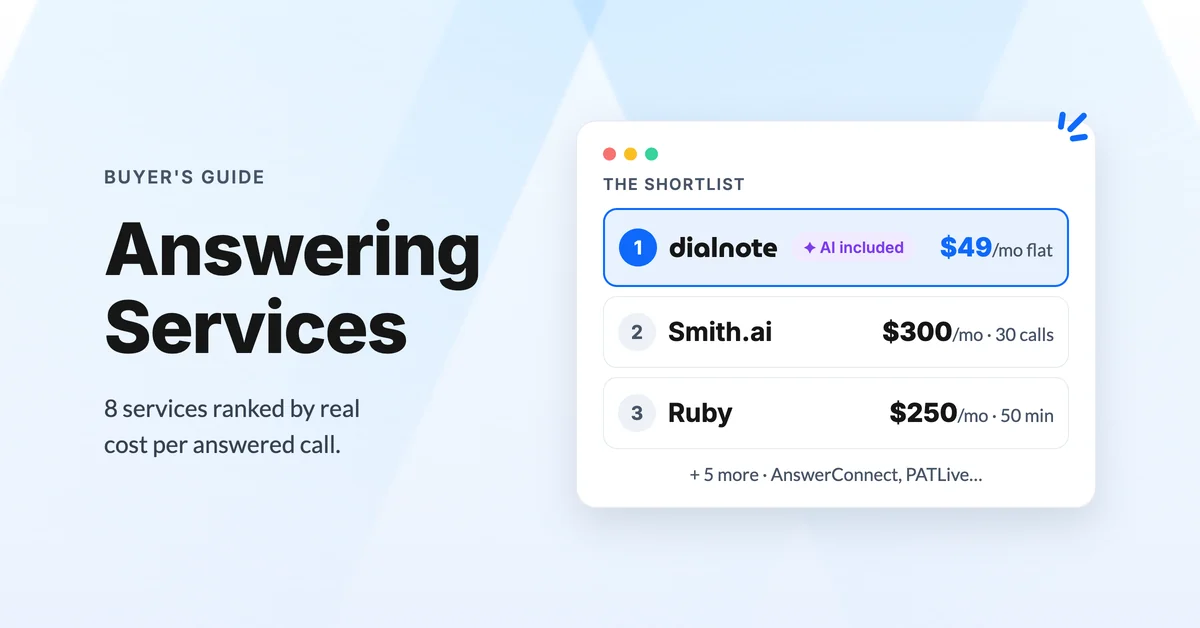
Best Answering Service for Small Business [2026]
Compare the best answering services for small business in 2026: live, AI, and hybrid options ranked by real cost per call and coverage.
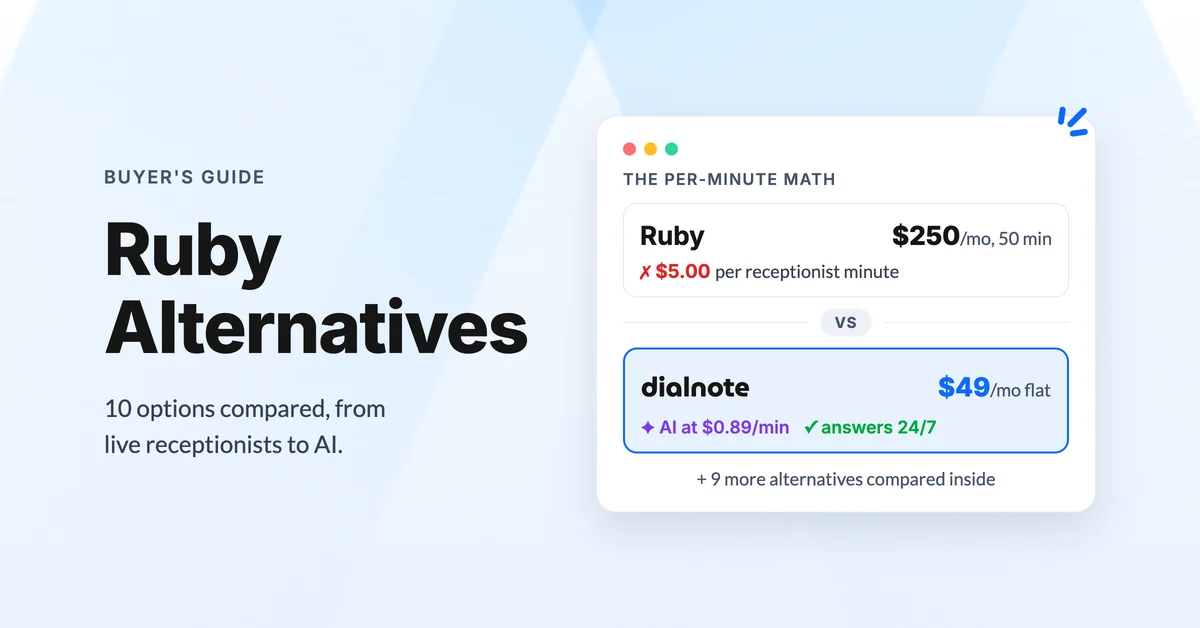
Ruby Receptionists Alternatives: 10 Better Options [2026]
Ruby charges $250/mo for 50 receptionist minutes. Compare 10 Ruby Receptionists alternatives, what each really costs, and how to cut the bill with AI.
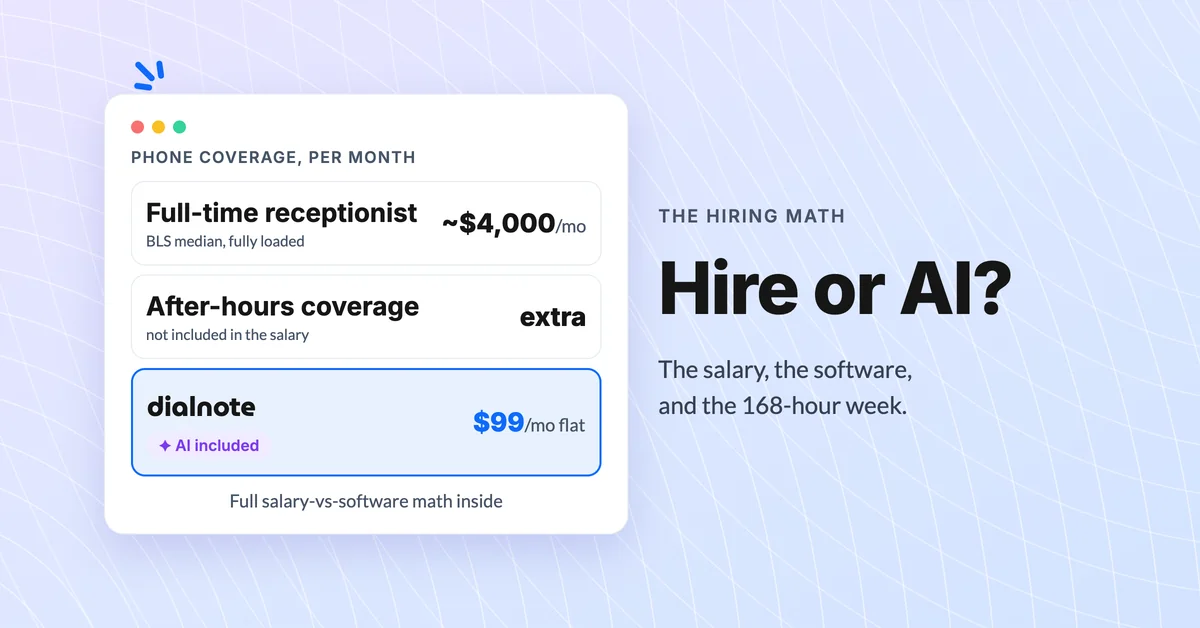
AI Receptionist vs Hiring: What Each Really Costs
Compare an AI receptionist vs hiring a receptionist: salary and benefits math, coverage hours, and what each option really costs over a year.