Best Answering Service for Small Business [2026]
Choosing the best answering service for small business use used to mean one decision: which team of humans takes your messages. In 2026 it means choosing between three different animals: live services billing $2 to $5 a minute, AI receptionists that answer around the clock for a flat software fee, and hybrids mixing both. Price gaps between them aren't percentages; they're multiples.
Dana's story is the whole market in miniature. She manages a three-lawyer family-law practice, the classic answering-service customer: every missed intake call is a potential five-figure client calling the next firm on the list. The firm priced Ruby at $250 a month for 50 receptionist minutes, and Dana did the division: their intake calls run 8 to 12 minutes, so the plan covered five of them. A week's worth. Then she priced an AI receptionist that captures the same intake details for less per month than one hour of Ruby time. The question stopped being "which service?" and became "what am I actually paying for a picked-up phone?" Sound familiar?
We've ranked the eight options small businesses actually shortlist, live, AI, and hybrid, using each provider's published pricing and the effective per-call math. dialnote is our product, so we've put the receipts next to every claim and told you honestly where a rival is the better fit.
TL;DR:
- The best answering service for small business overall is dialnote: a 24/7 AI receptionist plus a full business phone system from $49/month flat, with AI calls at $25/month for 65 on the AI call pack or $0.49/minute from the wallet without one.
- Best hybrid: Smith.ai ($300/month for 30 calls, about $10 per answered call). Best premium live: Ruby ($250/month for 50 minutes, an effective $5+/minute). Best live volume: AnswerConnect ($350/month, 200 minutes).
- Budget AI picks: Rosie AI ($49/month, 250 minutes) and Goodcall ($79/agent/month), though neither includes a phone system.
- The structural difference: live services meter every minute of every call; AI services make answering a flat software cost. At small-business call volumes, that's routinely a $2,000 to $14,000 a year difference.
Jump to: the shortlist · how to choose · full reviews · the verdict
The shortlist at a glance
| Service | Type | Starting price | Effective rate | Includes a phone system |
|---|---|---|---|---|
| dialnote | AI receptionist | $49/mo flat | ~$0.38/AI call on the pack, $0.49/min without | Yes, unlimited users |
| Smith.ai | AI + humans | $300/mo, 30 calls | ~$10/call | No |
| Ruby | Humans (premium) | $250/mo, 50 min | ~$5/min | No |
| AnswerConnect | Humans, 24/7 | $350/mo, 200 min | ~$1.75/min, $49.99 setup | No |
| PATLive | Humans, 24/7 | $99/mo, 50 min | ~$1.98/min | No |
| Goodcall | AI only | $79/agent/mo | 100 unique callers, then $0.50 each | No |
| Rosie AI | AI only | $49/mo, 250 min | ~$0.20/min | No |
| Moneypenny | Humans (dedicated) | $165/mo, 50 min | ~$3.30/min | No |
What counts as an answering service in 2026?
The term is doing double duty now, so let's define it before ranking anything. An answering service, in the classic sense, is a third party whose humans pick up your overflow calls and take messages; the industry grew out of telephone answering bureaus and, later, offshore call centers. A virtual receptionist service is the upgraded version of the same idea: remote humans (Ruby, Moneypenny) who greet callers by your script, transfer, and sometimes book; we've ranked those separately. Both bill you for human time, by the minute or by the call.
"The category kept its name and changed its species," is how Akhilesh Betanamudi, dialnote's co-founder, puts it. "Businesses still search for an answering service; what they increasingly buy is software."
The third generation changed the noun. An AI receptionist, increasingly marketed as an "AI answering service," is software that holds the conversation itself: it greets, asks your intake questions, books appointments, and texts confirmations, with no human minutes to meter. That's why this list mixes what look like different products; searchers use one phrase for all three generations, and honestly, the generations compete for the same job. When we say "answering service" below, we mean anything that picks up your phone when you can't, and we'll always say which kind you're buying. If you want to see what happens inside one of those calls, here's how an AI answering service works, step by step.
How should you choose an answering service?
Three questions sort the whole market faster than any feature list.
What does a picked-up call cost you? Divide the monthly price by the calls it covers. Ruby's entry plan is about $5 a minute; a 12-minute call costs $60. Smith.ai is about $10 a call. AI options run cents per minute. Whether the human premium is worth 10 to 50 times more depends entirely on what your callers need.
What happens to the information? A message relayed by text is not a booked appointment. The options that capture lead details, book directly into your calendar, and log to your CRM save you the callback, and the callback is where leads die.
Does it come with a phone system? Every live service on this list rides on top of phone service you buy separately. The AI options split: Rosie and Goodcall are also add-ons, while one option on this list is itself the phone system, which changes the total bill more than any line item.
According to Fortune Business Insights, VoIP and AI-forward calling keeps growing at over 10% a year, and answering is where small businesses feel it first: the picked-up phone used to be a payroll decision, and now it's a software line item.
How we ranked: every service is scored on the same four axes: effective cost per answered call at small-business volumes, what happens to the caller's information (message vs booked appointment), coverage hours, and whether the price on the website is the price on the invoice. We used each provider's published rates as of October 2026, flagged estimates as estimates, and where dialnote loses a matchup (live human judgment, dedicated-receptionist continuity), the entry says so.
1. dialnote: best overall answering service for small business
dialnote is an AI business phone system with no per-user pricing. AI voice agents answer calls, capture leads, and book meetings 24/7, starting on the Team plan at $49/mo for unlimited users. In this category, dialnote works as an AI answering service that also replaces the phone bill underneath it: the AI receptionist answers 24/7 (in 14 languages on Business and up), asks the lead-capture questions you configure, books meetings through Calendly or Cal.com, sends confirmation texts, and transfers to a teammate when someone's free, on top of unlimited users, shared numbers, recording, and analytics.
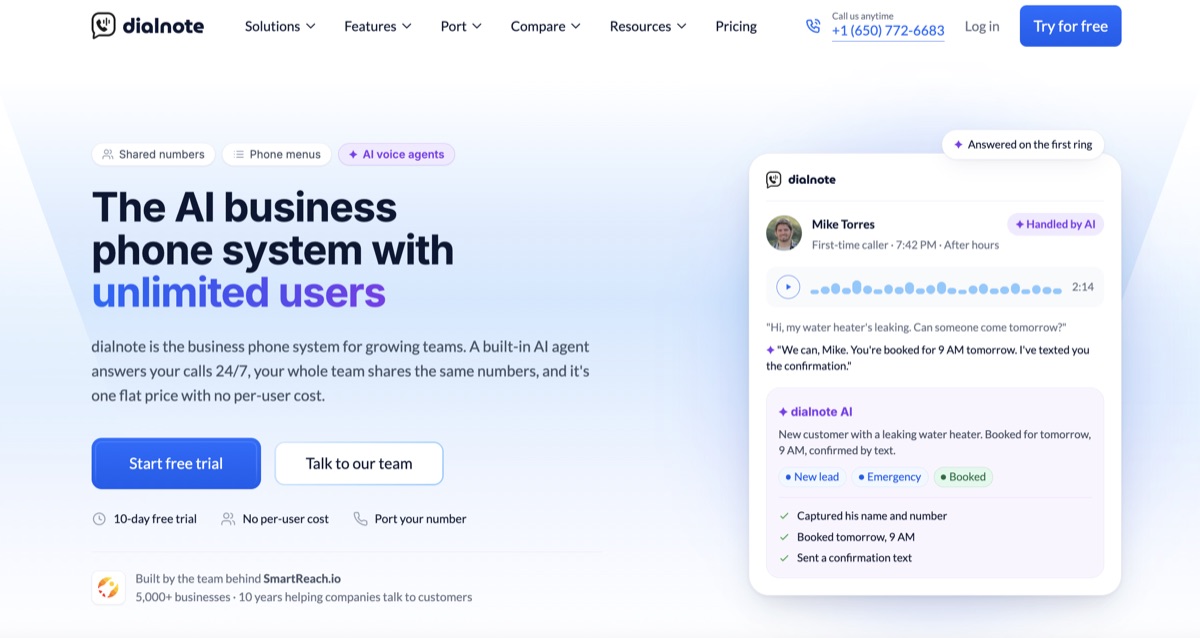
| SoloPhone system for 1 user, AI summaries, no AI agent | $19/mo |
| TeamUnlimited users; AI receptionist + phone menu, recommended starter | $49/mo |
| BusinessUnlimited users; advanced routing | $99/mo |
| AI call pack65 AI calls; $0.49/min from the wallet beyond it | $25/mo |
Flat pricing per account, not per user. 10-day free trial, no credit card. As of October 2026.
Pros
- One flat plan covers the whole team's phone system and the AI receptionist; AI calls are about $0.38 a call on the AI call pack
- Books via Calendly or Cal.com, transfers to teammates, sends SMS, answers in 14 languages on Business and up
- A phone menu sends only the calls you choose to the AI, so you decide which calls use AI calls
- Published pricing for everything, including the AI rate
Cons
- AI calls are usage-priced (pack or per minute), so letting the AI answer every call still adds up
- No live human agents on staff; hybrid needs are better served by Smith.ai
- Newer brand with few third-party reviews so far
Ready to stop paying by the call?
10-day free trial, no credit card needed.
Best for: small businesses that want the missed-call problem solved and the phone bill simplified in one move. The AI receptionist demo answers live on the site, which remains the fastest way to judge it.
2. Smith.ai: best hybrid of AI and humans
Smith.ai layers trained human receptionists on top of its AI, billed per call: managed plans start at $300 a month for 30 calls (about $10 each) and climb to $2,100 for 300. There's also a separate self-serve AI receptionist with a free 25-call tier and a $150/month Pro plan for 75 calls. The human layer is genuinely good: professional, script-following, CRM-literate.
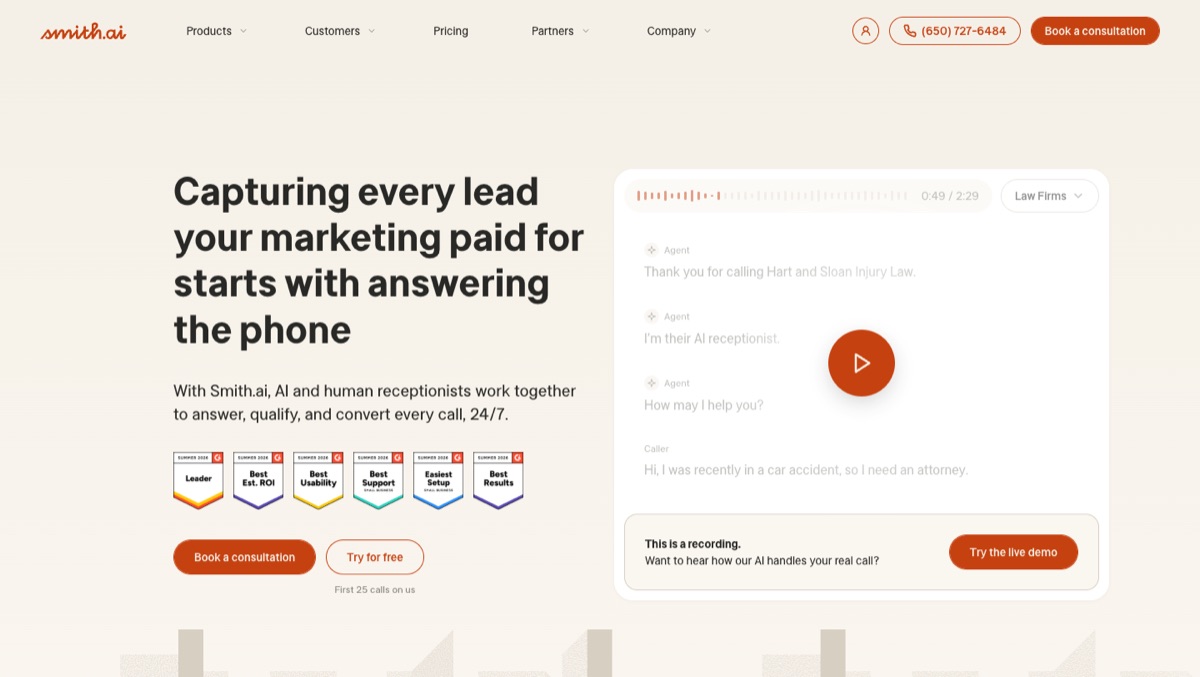
| Managed, 30 calls~$10 per answered call | $300/mo |
| Managed, 300 callsVolume tier | $2,100/mo |
| Self-serve AI Pro75 AI-answered calls, no human layer | $150/mo |
Per-call billing; overflow and after-hours handled by plan rules. As of October 2026.
Pros
- The strongest human-in-the-loop option when calls genuinely need judgment
- Per-call billing is easier to predict than per-minute
- Good CRM and intake integrations
Cons
- $10 per answered call multiplies brutally at volume
- No phone system included; it rides on top of your existing service
- The AI-only plan competes with options that cost a third as much
Best for: businesses where a meaningful share of calls needs a human's judgment, and the budget accepts $10 a call for it.
3. Ruby: best premium live answering
Ruby is the live-answering brand people know, and it bills like it: receptionist minutes at $250 a month for 50, then $395 for 100, $720 for 200, and $1,725 for 500. That's an effective $5+ a minute at entry, so a single 12-minute call runs about $60. The agents are warm and well-trained; the meter is the issue.
| 50 minutes~$5.00 per receptionist minute | $250/mo |
| 100 minutes~$3.95/min | $395/mo |
| 200 minutes~$3.60/min | $720/mo |
| 500 minutes~$3.45/min | $1,725/mo |
Billed by the receptionist minute; unused minutes don't roll over. As of October 2026.
Pros
- Genuinely warm, well-trained human receptionists
- Strong brand trust, especially with law firms and professional services
- App with call handoff and status controls
Cons
- The most expensive effective rate on this list at entry ($5+/minute)
- A busy week can exhaust a plan in days
- No phone system, no AI tier; the model is the meter
Best for: professional practices where the sound of a human receptionist is part of the brand, at modest call volumes. Our full Ruby alternatives guide prices the escape routes.
4. AnswerConnect: best live service for volume
AnswerConnect is the volume play among live services: 24/7 human answering at roughly $1.75 a minute on its $350/month, 200-minute plan, plus a $49.99 setup fee. Per minute it's a third of Ruby's entry rate, and the around-the-clock staffing is real.
Pros
- True 24/7 live coverage
- Among the best per-minute rates in live answering
- Scales to real volume without Ruby-level pricing
Cons
- Shared agent pool; less boutique than Ruby or Moneypenny
- Still $300+ a month before your phone system costs anything
- Per-minute billing still punishes chatty callers
Best for: businesses with real round-the-clock call volume that want humans answering all of it.
5. PATLive: best straightforward live answering
PATLive keeps live answering simple: 24/7 agents, $99 a month for 50 minutes (about $1.98 a minute) or $189 for 100, with scripting and message delivery that just work.
Pros
- Simple plans, solid 24/7 coverage
- Cheaper entry point than Ruby or Smith.ai
- Good scripting flexibility
Cons
- Per-minute meter with mid-pack rates
- No AI tier and no phone system
- Fewer integrations than the category leaders
Best for: small businesses that want dependable live answering without the premium brand markup.
6. Goodcall: best AI for multi-location basics
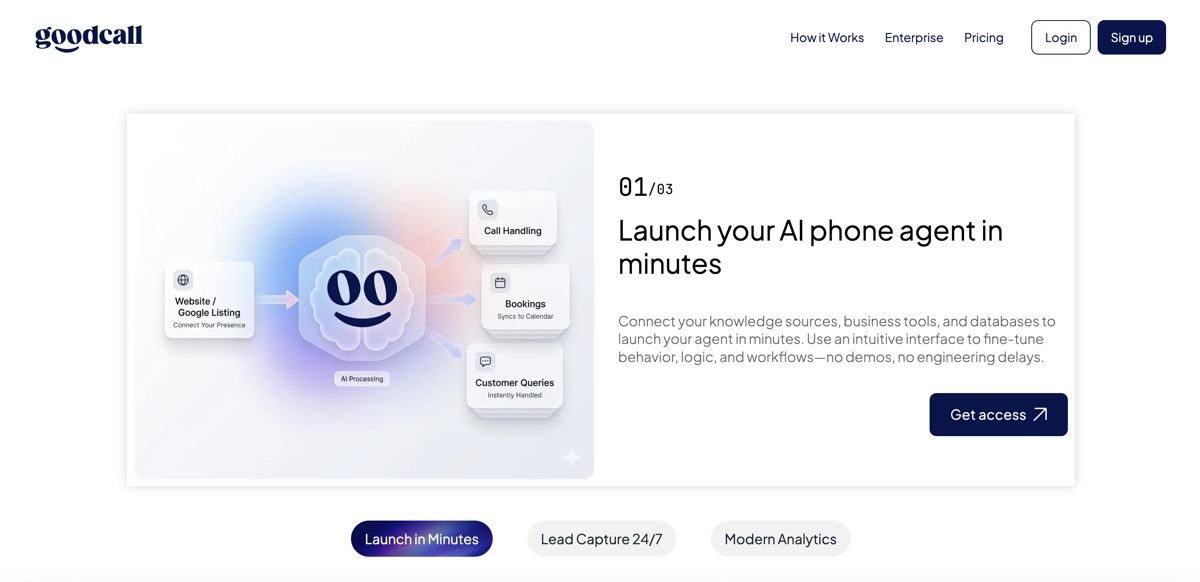
Goodcall sells AI-only answering at $79 per agent per month with unlimited minutes but a 100-unique-caller cap ($0.50 each after), aimed at franchises and multi-location businesses that want a consistent scripted agent everywhere.
Pros
- Flat per-agent pricing with unlimited minutes
- Fast setup for scripted, FAQ-style answering
- Fits multi-location consistency needs
Cons
- AI only, with no human escalation path
- No phone system included
- Less depth in booking and CRM workflows than the leaders
Best for: multi-location businesses standardizing a scripted AI greeter across sites.
7. Rosie AI: best budget AI answering
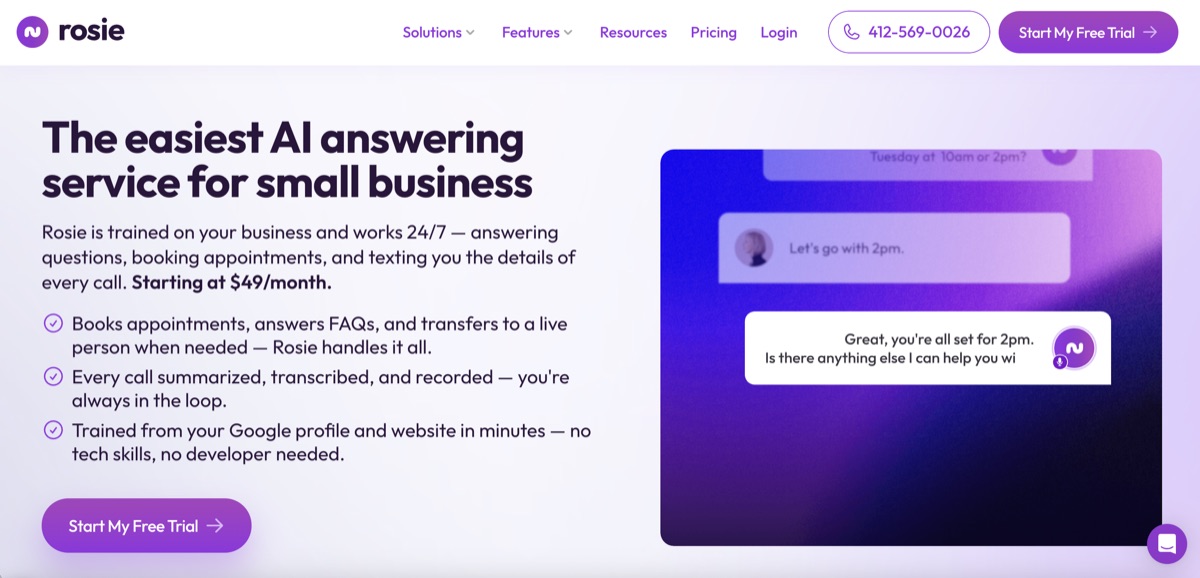
Rosie is the lowest sticker on the list: $49 a month for 250 minutes of AI answering (about $0.20 a minute). It greets, answers basics, and takes messages competently.
Pros
- Cheapest credible answering option on the list
- Simple setup for basic greeting and message capture
- Per-minute effective rate near the bottom of the market
Cons
- No phone system; it's an add-on to service you already pay for
- Lighter booking and integration depth
- Minute caps return the meter anxiety at volume
Best for: solo operators who want the phone answered for less than a dinner out, and can live with the basics.
8. Moneypenny: best dedicated-receptionist feel
Moneypenny assigns a consistent receptionist team to your account, which callers notice. Its US pricing is published: $165 a month for 50 minutes (about $3.30 a minute), $265 for 100, and $422 for 200, with extra minutes at $1.67 to $2.28. A separate AI answering plan starts at $69 for 25 calls.
Pros
- Dedicated receptionists who learn your business
- Polished, UK-honed service culture
- Good for firms that want continuity of voice
Cons
- Premium per-minute rates at every tier
- AI answering is a separate call-based plan, not built into the human service
- No phone system included
Best for: firms that want the same familiar voices answering every day and will pay premium per-minute rates for it.
What does the math look like across a year?
Small-business budgets live in years, so annualize the three main paths at a modest volume (roughly 100 answered calls a month, average 4 minutes). Ruby's 500-minute plan: $1,725 × 12 = $20,700 a year. Smith.ai's 90-call Basic plan plus a few overage calls lands around $915 a month, roughly $11,000 a year. The flat-rate pick, dialnote Business: $99 × 12 = $1,188, plus three AI call packs a month ($75, covering 97 of the 4-minute calls) with the last 3 calls at $0.49/minute covered by the $12 monthly credit (about $900 a year), call it about $2,100 all-in.
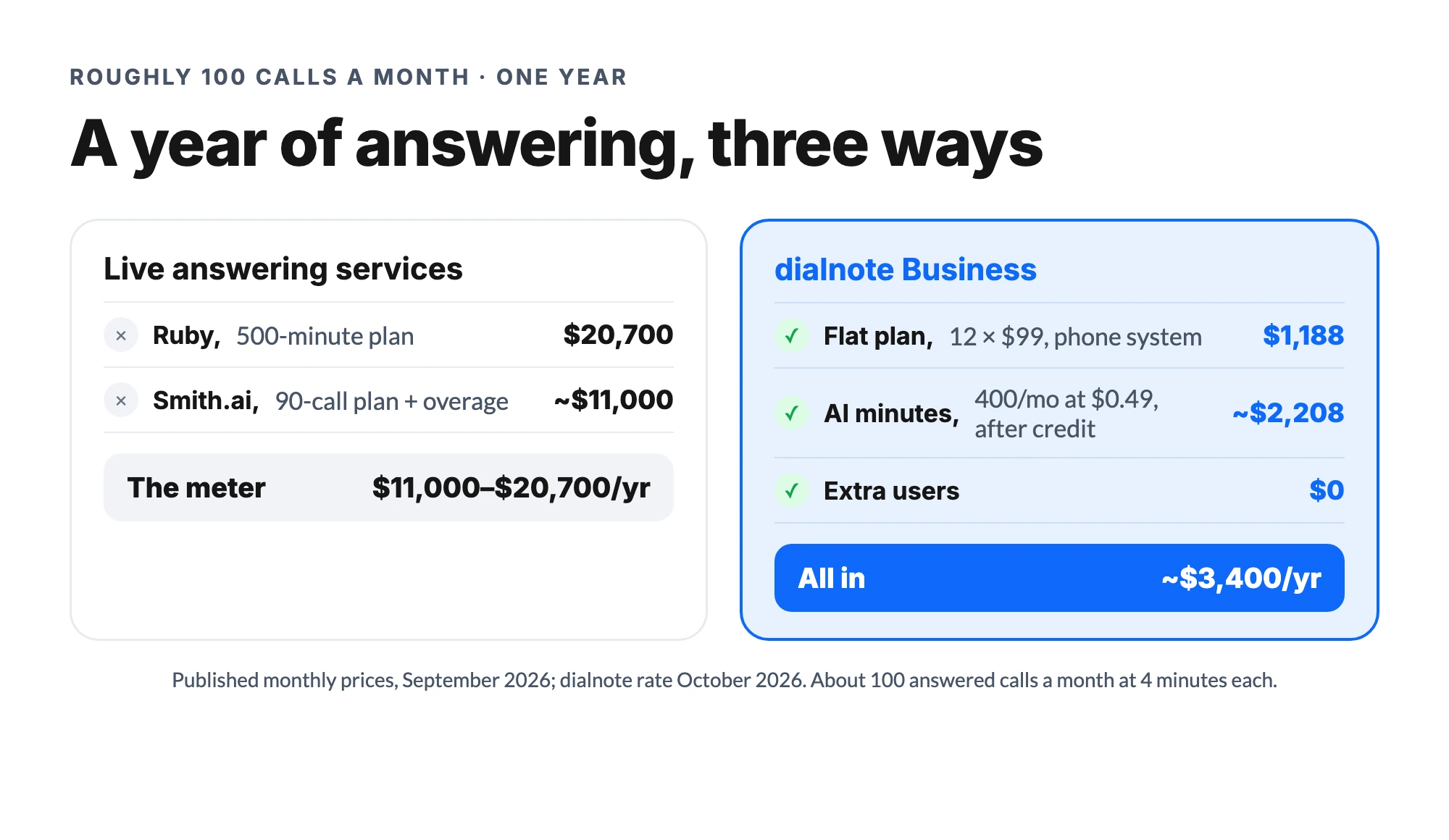
That's the repo of this whole category in three numbers: $20,700, $11,000, or about $2,100 for the same year of answered calls. The live options buy real human warmth with the difference. Whether that warmth is worth a used car every year is your call, literally. Run your own volume on the cost calculator.
Why is AI answering 10-50x cheaper? (And what's the catch?)
The price gaps in this list look like typos, so let's explain them, because a smart buyer should distrust a $0.20 rate sitting next to a $5.00 one until the economics make sense.
Live answering costs what it costs because you're renting human minutes. An agent earns a wage, serves several clients, and the service layers on training, quality control, facilities, and margin; $2 to $5 per delivered minute is what that stack genuinely costs to run in North America (offshore centers run cheaper, with trade-offs your callers can hear). Nobody's gouging you; the model just has a floor set by payroll.
AI answering removed the payroll from the minute. Once the software exists, an answered call costs compute, which is why Rosie can charge $49 for 250 minutes and dialnote can sell AI calls at about $0.38 a call on its AI call pack with the receptionist itself included. The low price isn't a red flag by itself. It's the labor leaving the bill.
So where are the real catches with cheap AI? Three places to check before you sign anything:
- What surrounds the answering. Rosie's $0.20/minute is real, and it buys answering only: it rides on top of a phone system you're paying for separately, and its booking and CRM depth is thin. dialnote's Team plan costs the same $49, but the AI comes attached to the whole phone system: numbers, team calling, recording, transfers, and per-number behaviors. If you're a solo operator with a phone setup you love and you just want basic message-taking, Rosie genuinely is the better buy, and we'd rather tell you that than have you find out mid-contract. The moment you want the call booked, transferred, or logged, the all-in option wins on both capability and total cost.
- The caps. Cheap AI plans meter too; 250 minutes vanishes fast at real volume, and the overage or upsell is where the sticker stops being the price.
- The conversation quality. A bad AI answering cheaply is still a bad first impression. Test with your own hardest call (an address, a schedule conflict, an impatient caller) before trusting any vendor's demo, including ours: the AI answers live on the homepage, which is exactly this test.
What about after-hours coverage specifically?
If nights and weekends are your main gap, weight the ranking differently. The live 24/7 options (AnswerConnect, PATLive) genuinely staff the small hours, but you're paying the same per-minute rates for a 2 am wrong number as a 2 pm lead. The AI options don't price time of day at all, and after-hours calls skew urgent and money-attached, which is exactly the traffic you least want rationed by a meter. For a deeper cut on that slice, our after-hours answering guide covers setups and scripts.
Which answering service fits your business?
Here's the same verdict as a decision table, matched to real situations:
| Your situation | Pick | Why |
|---|---|---|
| Law or professional practice, low volume, long intake calls | Smith.ai or Ruby | Human judgment on high-stakes calls; per-call beats per-minute at long call lengths |
| Home services, after-hours calls are the leak | dialnote | 24/7 AI answering with booking; no per-user cost as you staff up for the busy season |
| Clinic or salon, booking is everything | dialnote | Calendar-connected answering (Calendly/Cal.com); message-taking alone just creates callbacks |
| High round-the-clock volume, must be human | AnswerConnect | Best live per-minute rate at 24/7 scale |
| Solo, happy with current phone, want basic AI coverage | Rosie AI | Cheapest credible answering; accept the caps and thin booking |
| Multi-location, consistent scripted greeter | Goodcall | Flat per-agent AI across sites |
| Brand runs on a familiar human voice | Moneypenny | Dedicated receptionists, at premium published rates |
Choose dialnote if you want the phone answered 24/7, leads captured and booked, and the phone system itself, on one flat bill. It's the best answering service for small business buyers who want the whole problem solved, not rented by the minute.
Choose Smith.ai if a meaningful share of your calls needs live human judgment and you'll pay ~$10 a call for the hybrid.
Choose Ruby or Moneypenny if the premium human voice is part of your brand and volume is low.
Choose AnswerConnect or PATLive if you need humans around the clock at the best live rates.
Choose Rosie or Goodcall if you just need a basic AI answering add-on on top of your existing phone service.
And if the real alternative on your desk isn't a service at all but a job posting, we've done the hiring math separately: a full-time receptionist runs about $48,000 a year fully loaded for 40 hours a week of coverage, which reframes every number on this page. The full cost teardown also walks the per-minute fine print if pricing is your deciding factor.
One last calibration note: prices here are entry plans, and real bills land higher once volume meets the meter, so re-run any shortlist against your own call log before deciding. We're honestly unsure how long the live incumbents can hold per-minute pricing as AI answering keeps improving; the gap in capability shrinks every quarter while the gap in price doesn't. What we can say today: test the missed-call path before you buy anything. Call your own number when nobody's free, listen to what a customer would hear, and price fixing that.
Start a free 10-day trial of dialnote, no credit card required, and your calls get answered this week.
Frequently asked questions
It depends on the job. dialnote is the strongest all-in pick (AI receptionist plus a full phone system, $49/month flat). Smith.ai leads the hybrid AI-plus-human category, Ruby leads premium live answering, and AnswerConnect is the 24/7 live volume play.
Live services bill by usage: Ruby starts at $250/month for 50 receptionist minutes, Smith.ai at $300/month for 30 calls, AnswerConnect around $350/month for 200 minutes. AI services run far less: $49 to $99 a month with usage-based AI rates.
For structured jobs (greeting callers, capturing lead details, booking appointments, texting confirmations), a good AI now handles the work around the clock at a published usage rate. Live agents still win for emotionally difficult or highly unusual calls.
The 24/7 live options (AnswerConnect, PATLive, Smith.ai's staffed hours) cover nights at a price. AI receptionists answer around the clock at no extra cost, which is why after-hours coverage is where AI options pull furthest ahead.
Mostly branding. "Answering service" usually means a shared pool of agents taking messages; "virtual receptionist" implies more per-business customization like booking and call routing. Both bill by minutes or calls; AI options bundle the receptionist into software.

Written by
Upasana Sahu
Senior Digital Marketing Specialist, SmartReach.io
Upasana Sahu is a Senior Digital Marketing Specialist at SmartReach.io with over 10 years of experience in content marketing, SEO, and digital strategy. She manages end-to-end blog operations, from content creation and on-page/off-page SEO to traffic...
Upasana Sahu is a Senior Digital Marketing Specialist at SmartReach.io with over 10 years of experience in content marketing, SEO, and digital strategy. She manages end-to-end blog operations, from content creation and on-page/off-page SEO to traffic...
Related Articles
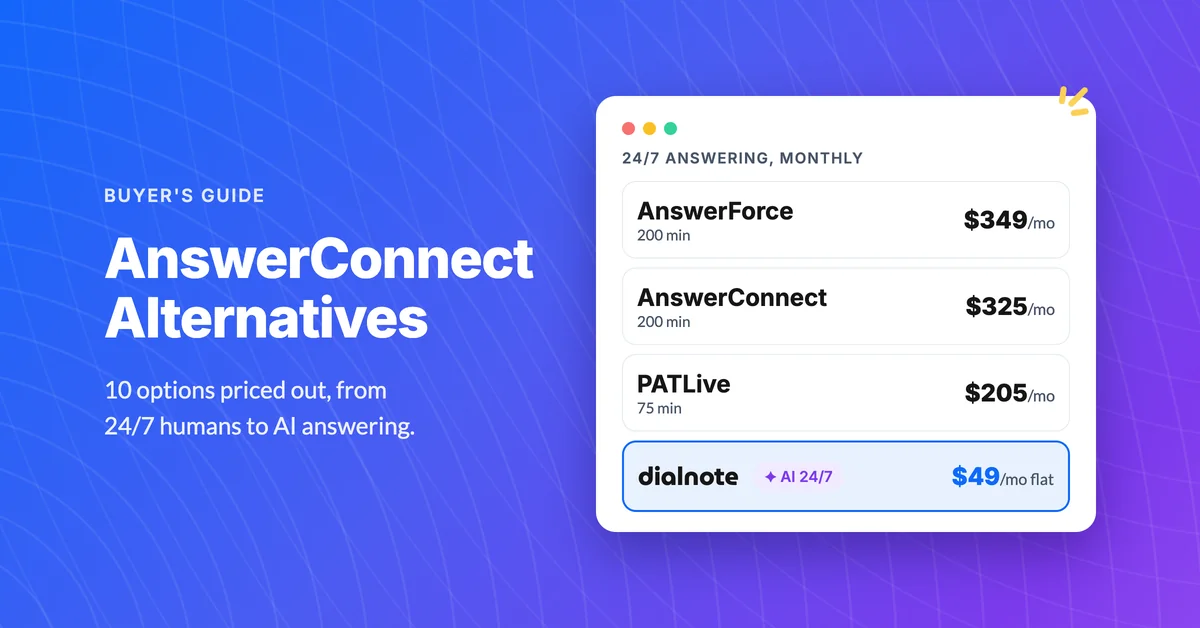
AnswerConnect Alternatives: 10 Better Options [2026]
AnswerConnect runs $325/mo for 200 minutes, and after-call work bills too. Compare 10 AnswerConnect alternatives on real cost per answered call.
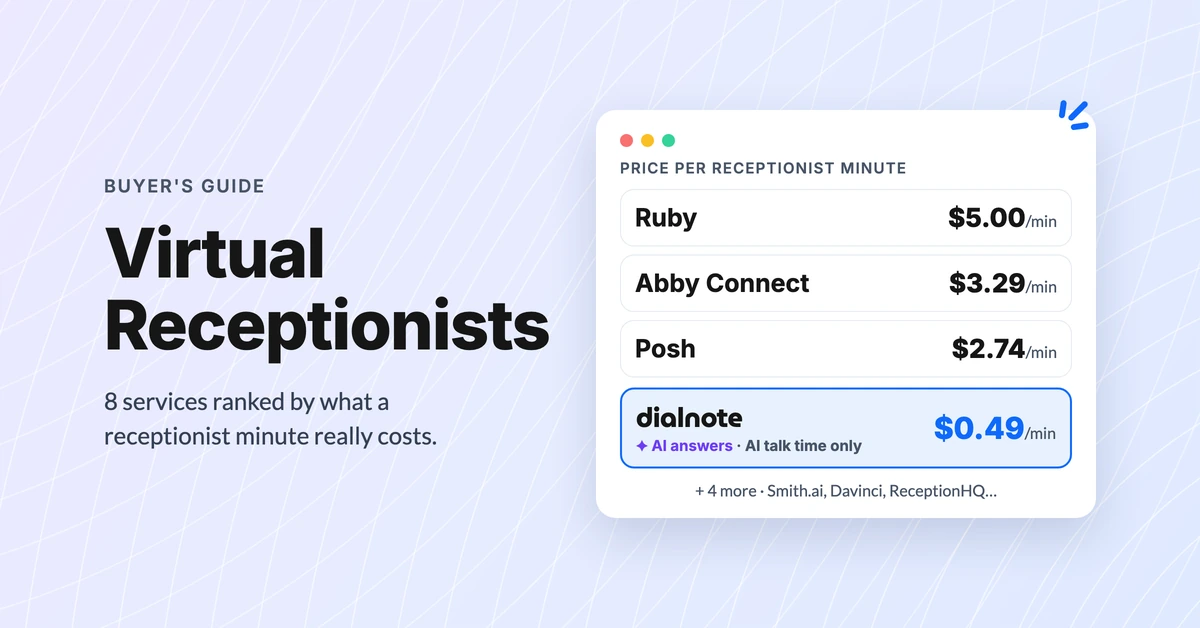
Best Virtual Receptionist Services Ranked [2026]
Compare the best virtual receptionist services of 2026 by price per receptionist minute, booking depth, and coverage, including the AI option.
Is an AI Receptionist Better Than a Live Answering Service?
Compare an AI receptionist vs live answering service on cost, quality, and 24/7 coverage. See which option fits your business better.