How Much Does an Answering Service Cost in 2026?
Having priced a phone product ourselves at dialnote, I can tell you the answering service cost question is really three different questions wearing one trench coat: what's the sticker, what's the effective rate per answered call, and what does a year look like at your actual volume. Providers advertise the first number, comparison sites repeat it, and buyers shop on it. Your budget, though, only ever meets the third, usually about ninety days after you signed.
Marcus, who runs a ten-person HVAC company, learned the difference the expensive way. He signed a live answering plan at "$250 a month," reasonable, he thought, for never missing a call. First summer storm season, his callers held for quotes, minutes piled up, and the month closed at over $800. The service worked exactly as sold. The sticker just wasn't the price. Sound familiar?
This teardown lays out every pricing model in the answering market with the real 2026 rates (checked against each provider's own pricing page), the hidden costs that inflate them, and the worked math at real call volumes. (Looking specifically for AI answering costs? That's a separate teardown; this one covers the whole market, live services included.)
TL;DR:
- Typical answering service cost in 2026: live services run $99 to $350 a month at entry (PATLive $99/50 min, Ruby $250/50 min, Smith.ai $300/30 calls, AnswerConnect $350/200 min) and scale up fast with usage.
- The number that matters is the effective rate: roughly $1.75 to $5 per minute for live services at entry, about $10 per answered call on per-call plans.
- Hidden costs (rounded billing increments, spam calls hitting the meter, no rollover, holiday staffing) push real bills 20 to 40% past the plan price.
- AI answering resets the model: dialnote's Team plan is $49 flat including the phone system, and AI calls are $25/mo for 65 calls with the AI call pack, or $0.49/min from your wallet without one.
- At 100 calls a month, premium live answering runs about $20,700 a year against about $1,500 for dialnote with every call AI-answered, a gap of over $19,000.
- The switching points are arithmetic: per-minute beats a $10 per-call plan only on calls under 2 to 6 minutes depending on provider, and entry buckets run dry as early as call 12.
Jump to: pricing models · real 2026 rates · which model is cheapest · hidden costs · the math at your volume · the verdict
How do answering services charge?
Three billing models cover the whole market, and knowing which one you're reading is half the skill of comparing quotes.
Per receptionist minute. The classic model: you buy a bucket of minutes, and every second an agent spends on your callers draws it down. Ruby ($250/month for 50 minutes), PATLive ($99 for 50) and AnswerConnect ($350 for 200) work this way. The catch is arithmetic: nobody controls how long callers talk, so nobody controls the bill.
Per answered call. Smith.ai's model: $300 a month covers 30 calls, about $10 each, whatever their length. More predictable, and brutal in a different way: the wrong-number call and the fifteen-minute quote call cost the same $10.
Flat software fee. The AI model: the receptionist is software, so answering stops being metered labor. Rosie sells AI minutes cheap ($49/month for 250), Goodcall sells AI agents capped by caller count ($79/agent for 100 unique callers), the big phone systems sell AI receptionists as add-ons (RingCentral, Nextiva, Zoom), and dialnote folds the AI receptionist into a flat-rate phone system ($49 a month on Team, unlimited users) with AI calls from $25/mo for 65 with the AI call pack.
"Per-minute pricing survives on the buyer not doing the division," as Lancelot Dsouza, dialnote's CMO, likes to say on sales calls. Having built against all three models, I agree with him. Always convert any quote to cost per answered call before you compare anything else.
What are the real answering service rates in 2026?
Here's the market, using published entry plans and their effective rates:
| Service | Model | Entry price | What it covers | Effective rate |
|---|---|---|---|---|
| PATLive | Live, per minute | $99/mo | 50 minutes | ~$1.98/min |
| Ruby | Live, per minute | $250/mo | 50 minutes | ~$5.00/min |
| Smith.ai | Hybrid, per call | $300/mo | 30 calls | ~$10.00/call |
| AnswerConnect | Live, per minute | $350/mo | 200 minutes | ~$1.75/min |
| Moneypenny | Live, quoted | from ~$145/mo (est.) | Per call, unpublished | typically $300-400/mo all-in |
| Rosie AI | AI, per minute | $49/mo | 250 minutes | ~$0.20/min |
| Goodcall | AI, per agent | $79/agent/mo | 100 unique callers | $0.50 per extra caller |
| Zoom Virtual Agent Receptionist | AI, standalone | $29.99/mo | 100 minutes | overage not published |
| RingCentral AI Receptionist | AI, standalone or add-on | $49/mo ($39 add-on) | 100 minutes | $0.50/min after |
| Nextiva XBert | AI, standalone | $99/mo | 100 AI conversations | $0.99 per extra conversation |
| dialnote | AI + phone system | $49/mo flat (Team) | Whole team + AI receptionist | ~$0.38 per AI call on the AI call pack ($25 for 65), or $0.49/min without |
Prices are each provider's published monthly plan, checked on their own pricing pages in September 2026. Notice that most AI add-ons cap you at around 100 minutes or conversations and then meter, and they sit on top of whatever phone system you already pay for.
Scaling up doesn't rescue the live math so much as soften it: Ruby's 500-minute tier is $1,725 a month (about $3.45 a minute), and Smith.ai's 300-call tier is $2,100 (still $7 a call). The per-unit price falls; the bill climbs.
How do you estimate your own call volume?
Before any quote makes sense, you need two numbers most owners guess wrong: how many calls you'd want answered, and how long they run. Here's the five-minute version customers can actually do:
- Pull last month's call log from your phone system or carrier. Count inbound calls during the hours you'd want covered, and don't forget the after-hours ones that went to voicemail; those are the whole point.
- Subtract the junk honestly. Spam and wrong numbers are typically 20 to 30% of inbound volume, and on live services they bill like customers. On systems with a phone menu in front of the AI, they mostly never hit the meter.
- Estimate handle time at 3 to 5 minutes for service businesses; intake-heavy practices (legal, medical) run longer, which punishes per-minute plans hardest.
- Multiply through each model. Volume × minutes × rate for per-minute plans; volume × per-call rate for hybrids; flat plan + AI call packs ($25 for 65 calls) + any overflow at $0.49/min, less the $5 monthly credit, for dialnote.
Run those four steps and most of the market eliminates itself. A 40-call month can live happily on a small live plan; a 150-call month on per-minute billing is a car payment.
Step 1 is the only one that takes real digging on a legacy line, where the call log lives in a carrier portal or a paper bill. The faster way is the Reports page in dialnote, which keeps both numbers on one screen from the first day of the 10-day free trial:
- Click Reports in the left sidebar
- Set Date Range to Last 30 days
- Read the Total Calls and Missed Calls overview cards
- Click View missed call details to see when the misses cluster
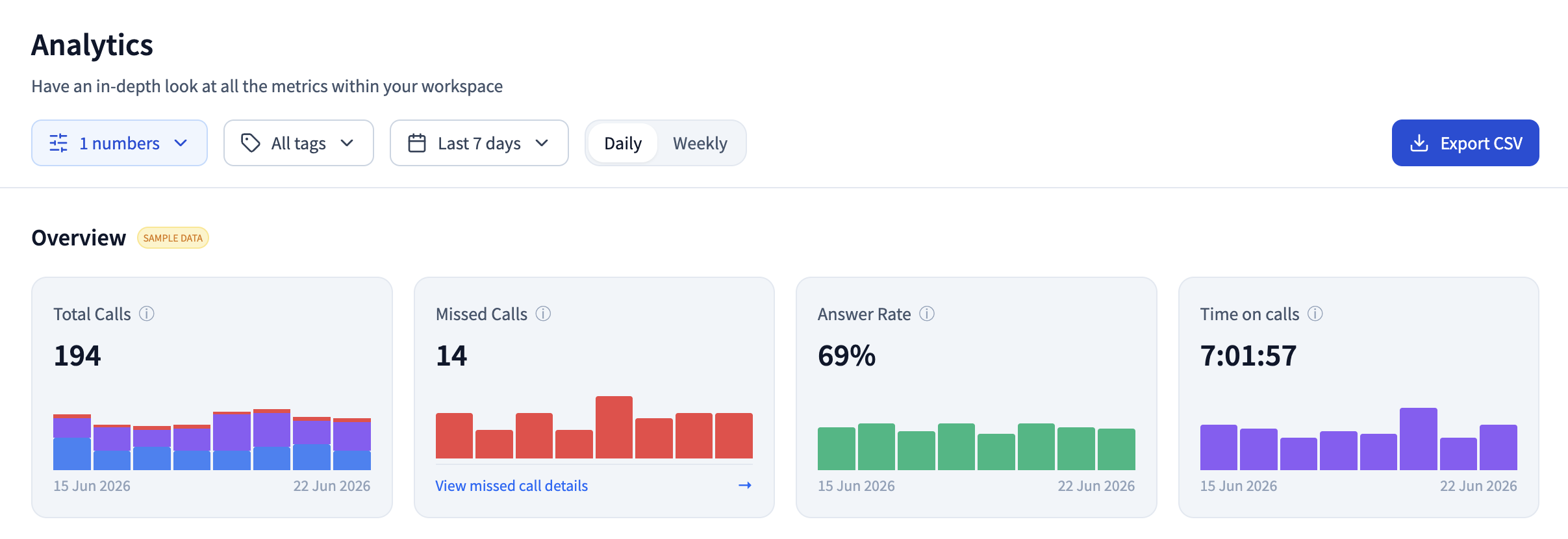
The missed-call timeline is the chart that picks your answering model for you. Misses stacked after 6 PM argue for AI answering, since nights are exactly where live per-minute billing hurts most. Misses spread across the workday mean the desk is understaffed, and a phone menu plus an overflow queue may fix that before you pay anyone to answer.
Which pricing model is cheapest at your volume?
Now that you have your two numbers, you can stop comparing providers and start comparing models. Per-minute, per-call and flat each win in a different band, and the switching points are arithmetic rather than opinion.
Per-minute beats per-call below the break-even call length. Set the two models equal and solve for minutes: break-even length = per-call price ÷ per-minute rate. Against Smith.ai's $10 entry call, that gives you a clean threshold for each live provider.
| Compared with a ~$10 per-call plan | Effective rate | Break-even call length | Per-minute wins if your average call is |
|---|---|---|---|
| AnswerConnect | ~$1.75/min | 5.7 minutes | under 5 min 40 sec |
| PATLive | ~$1.98/min | 5.1 minutes | under 5 minutes |
| Ruby | ~$5.00/min | 2.0 minutes | under 2 minutes |
Read that last row carefully, because it's the one that surprises people. At Ruby's effective rate, any call longer than two minutes costs more than a $10 per-call plan would have. Most service-business calls run three to five minutes. So for a typical caller, the premium per-minute plan is the more expensive of the two live models, not the cheaper one.
Every metered plan has a cliff, and it's earlier than you'd think. Your bucket isn't a budget, it's a runway. At a four-minute average call, here's the call number where each entry plan runs dry and overage pricing takes over:
| Plan | Entry price | Included | Your bucket runs out at |
|---|---|---|---|
| Ruby | $250/mo | 50 minutes | call 12 |
| PATLive | $99/mo | 50 minutes | call 12 |
| Smith.ai | $300/mo | 30 calls | call 30 |
| AnswerConnect | $350/mo | 200 minutes | call 50 |
Twelve calls. That's Ruby's and PATLive's entry plans gone by the second week of a quiet month. This is the single most useful number to carry into a sales conversation, and it appears on nobody's pricing page.
Flat pricing has no crossover in the small-business range, and that's the finding. We went looking for the volume where a metered live plan becomes cheaper than a flat AI plan, and inside normal small-business volumes it isn't there. The reason is the meter itself: live plans charge $1.75 to $5 a minute for human time, while a 4-minute AI call on dialnote's call pack comes to about $0.77, on top of a $49 plan that already includes the phone system. At that rate dialnote stays under AnswerConnect's $350 entry price all the way to 250 answered calls a month (about $255), and by call 50 that 200-minute bucket has already overflowed into overage at $2.50 a minute, so the crossing never actually happens.
Which means the honest summary is this: at every volume we priced, from 12 to 250 answered calls a month, the flat model came out cheaper, and the live premium isn't buying throughput. It's buying human judgment on the calls that need it. That's a real thing to buy. It's just worth knowing that's what you're paying for, rather than assuming the price gap closes at volume. It doesn't.
So which model fits you?
- Average call under 2 minutes, low volume: per-minute, on the cheapest effective rate you can find.
- Long or unpredictable calls: per-call, where a fifteen-minute quote costs the same as a two-minute one.
- Any volume where the calls are routine (hours, booking, lead capture, messages): flat, because none of those calls need a metered human.
- Distressed or high-stakes callers: pay the live premium deliberately, and route only those calls to it.
What does an answering service cost by business type?
The same rate card lands very differently depending on who's calling you.
Home services (HVAC, plumbing, roofing): high urgency, high after-hours share, calls are money-attached quotes. Per-minute live billing is at its worst here (storm week = budget blowout), and 24/7 AI answering is at its best. This is the profile where the AI receptionist model was practically designed.
Law firms and professional practices: longer intake calls, higher stakes per lead, and a brand argument for the human voice. This is Ruby and Smith.ai's home turf, and the per-minute premium is most defensible here, though many firms now run AI intake first and reserve humans for qualified callers.
Clinics and salons: rarely classic answering-service customers (the per-minute math never worked for them), but heavy adopters of the AI generation: appointment traffic, lunchtime and evening booking, price-sensitive. Booking capability matters more than warmth; anything that can't write to your calendar just creates callback work.
Retail and e-commerce: lower call stakes, mostly order and hours questions. Hard to justify $2+ a minute; a good AI or even a rich phone menu covers most of it.
The hidden costs in answering service pricing
None of these are scams; they're just the parts of the meter the sales page doesn't dwell on.
Billing increments. Many live services bill in rounded increments, so a 61-second call can meter as two minutes. Over a month of short calls, rounding alone inflates the bill double digits.
Spam pays full fare. The agent doesn't know it's a robocall until they've answered it, and answering it is what you pay for. Wrong numbers, solicitors, and misdials all draw down the same expensive minutes.
No rollover. Buy 200 minutes, use 90, and the 110 leftovers usually vanish. Quiet months subsidize the provider, busy months trigger overage rates.
After-hours and holiday premiums. Some services staff nights and holidays at higher rates or restrict them to bigger plans. If you're pricing a 24 hour answering service, check whether "24/7" is a feature or a surcharge, because night calls are exactly the ones a small team can't take itself.
The phone system you still need. Every live service and most AI add-ons ride on top of phone service you're buying separately. Add $100 to $300 a month for a team phone system before the answering line item even starts, unless the answering is the phone system.
What does an answering service cost at real volumes?
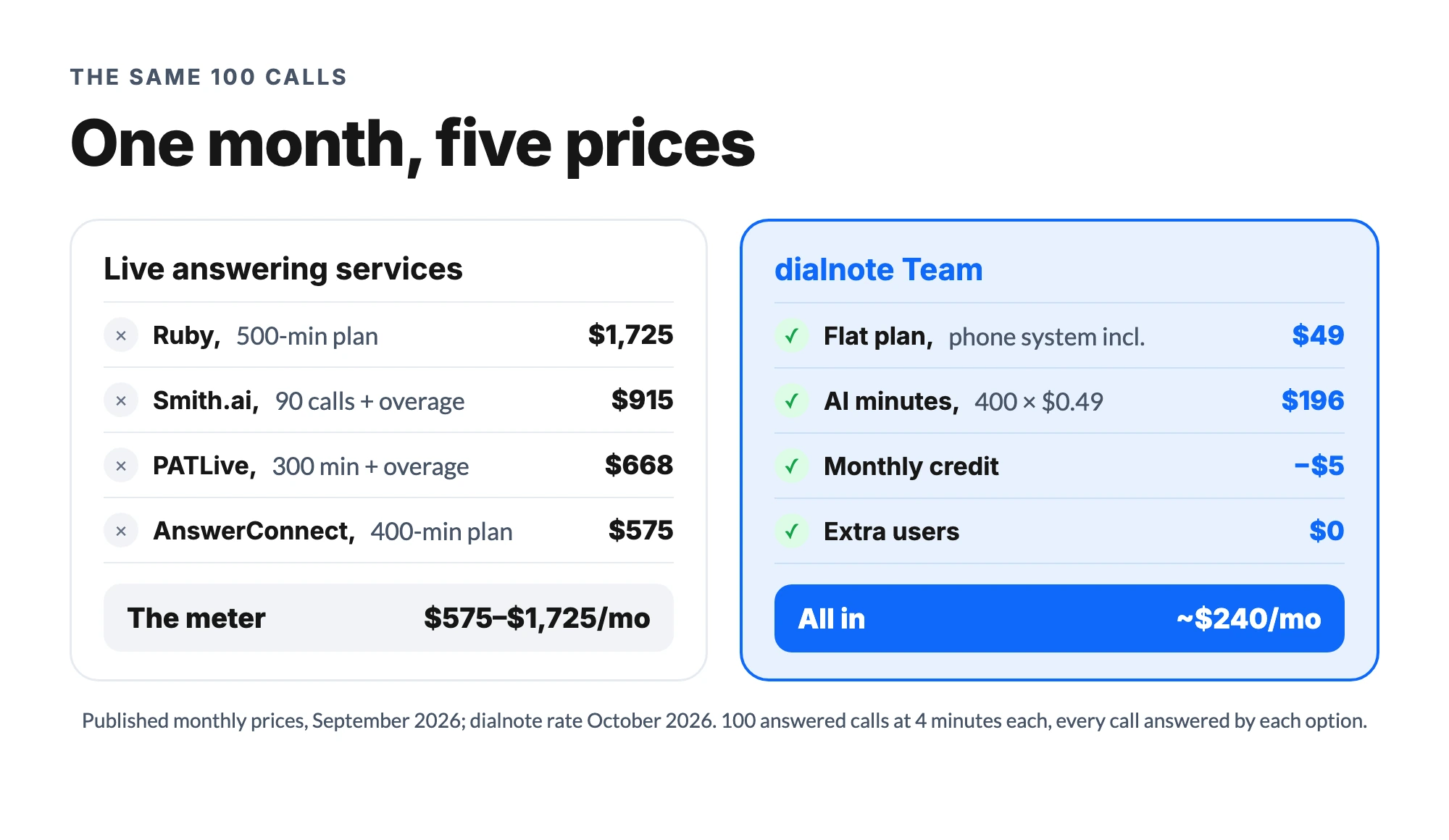
Let's price a genuinely typical small-business month: about 100 answered calls, averaging 4 minutes each (400 minutes). Here's the honest math.
Ruby: 400 minutes needs the 500-minute plan at $1,725/month. Smith.ai: 100 calls means the 90-call plan plus ten calls of overage, $915. AnswerConnect: 400 minutes fits its Standard plan at $575. PATLive: the 300-minute plan plus 100 minutes of overage, $668. The flat-rate model: dialnote's $49 Team plan plus three AI call packs ($75, covering 97 of the four-minute calls) and the last 3 calls at $0.49/min ($5.88, nearly all covered by the $5 monthly credit), about $125 for the month with every single call answered by the AI and the phone system included. Put a phone menu in front of it to screen out spam and wrong numbers, and the real figure lands lower.
Now the yearly frame, because budgets live in years. Ruby at that volume: $1,725 × 12 = $20,700. Smith.ai: about $11,000. PATLive: about $8,000. AnswerConnect: $6,900. dialnote: about $1,500, phone system included. The gap between premium live answering and AI answering at this volume is over $19,000 a year, which is a part-time wage, recovered from a phone bill.
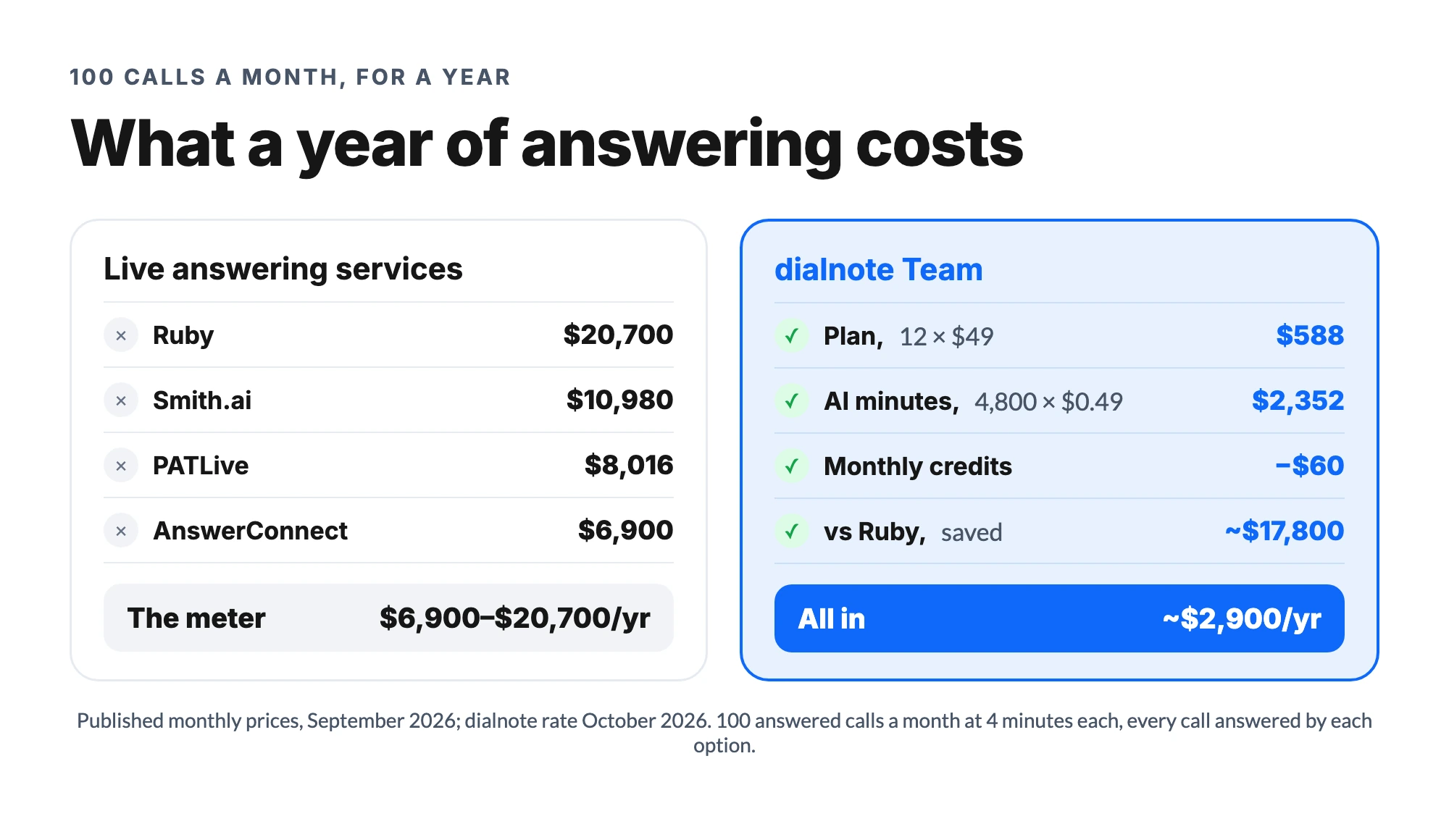
Your volume will differ, so do the division on your own numbers: last month's answered-call count times your average handle time, priced through each model, and the cost calculator runs the dialnote side for any team size. Whatever you choose, choose it on that arithmetic, not the sticker.
Human vs AI answering: the same months, priced
The biggest fork in this market is live humans vs AI, so let's price that fork directly at three realistic volumes, all at a 4-minute average call. The formulas are shown so you can swap your own numbers.
| Monthly volume | Live per-minute (PATLive) | Live premium (Ruby) | Per-call (Smith.ai) | AI flat (dialnote Team) |
|---|---|---|---|---|
| 40 calls (160 min) | $314 | $720 | $415 | $49 + $25 (1 pack) + ~$16 AI overflow − $5 credit ≈ $85 |
| 100 calls (400 min) | $668 | $1,725 | $915 | $49 + $75 (3 packs) + ~$6 AI overflow − $5 credit ≈ $125 |
| 250 calls (1,000 min) | $1,499 | over $1,725 (custom) | $2,100 | $49 + $200 (8 packs) + ~$11 extra call minutes − $5 ≈ $255 |
Formulas: live = the cheapest published plan for your minutes or calls, including published overage; dialnote = $49 Team plan + the cheapest mix of AI call packs ($25 for 65 calls, so a 4-minute call uses two) and $0.49/min for calls the packs don't cover, − $5 monthly wallet credit, plus any call minutes beyond the 700 included. That prices every call as AI-answered, the same job the live services are doing, so it's a fair fight rather than a flattering one.
Your month won't match any of these rows exactly, so run your own two numbers:
What would your month cost?
Enter your own two numbers. Each service is priced on its cheapest published plan for that volume.
PATLive
$668/mo
live, billed per receptionist minute
Ruby
$1,725/mo
live, billed per receptionist minute
Smith.ai
$915/mo
live, billed per answered call
AnswerConnect
$575/mo
live, billed per receptionist minute, plus a $49.99 one-time setup fee
dialnote Team
$125/mo
$49 flat for unlimited users + 3 AI call packs at $25 (65 calls each) + 12 AI minutes at $0.49, less the $5 monthly credit. Phone system included.
Every call is priced as fully answered by each option, before taxes and rounding rules. Competitor plans are their published monthly prices, checked September 2026. dialnote's 10-day free trial lets you test it on real calls.
Why is the gap this large? Because the two models price different things. A live service prices labor: an agent's wage, training, quality control, and margin land on every minute. According to the Bureau of Labor Statistics, the median US receptionist earns $18.27 an hour (May 2025), and once a service adds training, quality control, coverage, and margin, North American live answering lands at a real floor around $1.50 to $2 a minute, with premium brands at $3 to $5. An AI receptionist prices software: once built, an answered call costs compute, so the marginal minute is cents. Neither price is dishonest; they're different machines doing an overlapping job.
Which machine handles the job better is a separate question from cost, and we've covered it properly in our AI receptionist vs live answering service comparison: where AI outperforms, where humans still win, and how the hybrid setups work. And if you've already decided on AI and want that side's costs in detail (setup, caller experience, mistakes to avoid), the AI answering service cost guide is the deep dive. This article's job is the market-wide math, and the math says: at typical small-business volumes, live answering runs roughly 4.5 to 14 times the AI total, so the human layer needs to be earning that multiple on every call it touches.
What does a missed call cost you? (The break-even math)
Every answering service quote should be judged against the cost of the problem, so here's the other side of the ledger. Take your average job or client value and your realistic missed-call count. A home-services business averaging $400 jobs that misses even 10 calls a month, converting a conservative 2 of them, is leaving $800 a month on the table. Against that, at a 100-call month: the AI option pays for itself with one saved job, AnswerConnect needs about one and a half, and Ruby's 500-minute plan needs four to five saved jobs a month, every month, just to cover itself.
That's the honest way to read every number in this article. An answering service isn't a cost center or a savings; it's a conversion tool, and each pricing model sets a different bar for how much conversion it must deliver. Per-minute premium pricing can absolutely clear its bar in high-ticket practices. It rarely clears it at $400 a job.
Setup fees and contracts, briefly: some live providers add one-time setup fees (typically $50 to $100) and discount for annual commitments; most AI options are monthly with free trials, dialnote's is 10 days, no credit card. Never sign an annual answering contract before a month of real call data; your volume estimate will be wrong in some direction, and flexibility is worth more than the discount.
When is live answering worth the premium?
Honesty cuts both ways, so here's where the expensive options earn it. If your callers are distressed (a law firm's intake, a funeral home, an emergency line), a trained human's judgment and warmth is the product, and $5 a minute can be cheap for it. If your brand promise is white-glove, Moneypenny's dedicated receptionists sound like your office in a way software doesn't. And hybrids like Smith.ai make sense where a subset of calls genuinely needs a person and the rest can flow to AI.
What the premium no longer buys, in my view, is basic coverage: greeting, lead capture, booking, and messages. AI receptionists do those jobs around the clock now, without the meter, and the market's prices haven't caught up to that fact. We're genuinely unsure how long live entry plans hold their current rates; I'd expect per-minute prices to fall as AI keeps eating the routine calls. But you're buying at today's prices.
How do you keep any answering bill down?
Whichever model you pick, four habits protect the budget:
- Put a menu in front of the meter. A simple phone menu ("press 1 for booking, 2 for hours") deflects the calls that never needed a human or an AI, and on metered plans that's pure savings. Spam mostly gives up at the menu.
- Route by time and type. Send business-hours calls to your team first and only overflow to the service; let after-hours go straight to it. Paying $2 a minute for calls your own staff could have taken is the most common leak I see.
- Right-size quarterly, not annually. Volume drifts with seasons. Metered buckets that fit January drown in July; check usage against plan every quarter and move one tier at a time.
- Audit what the summaries tell you. Whatever you buy, read a month of call summaries or agent messages. They'll tell you which calls actually need answering, which need booking, and which need nothing, and that's the data that right-sizes everything else.
A worked example of why increments matter: a service billing in 30-second increments turns your 70-second average call into 90 billed seconds, a 29% surcharge that never appears on any price page. Two providers with identical per-minute rates can differ by a third on real bills purely on rounding rules, so ask for the increment in writing.
So what should you pay?
Pay $99 to $350 a month (and up with volume) if you need live humans: PATLive and AnswerConnect for value, Ruby and Moneypenny for the premium voice, Smith.ai for the hybrid. Budget 20 to 40% above the sticker for the meter's reality.
Pay $30 to $99 a month if you just need an AI add-on (Zoom, Rosie, Goodcall, RingCentral, Nextiva) on top of a phone system you already have, and watch the 100-minute or 100-caller caps.
Pay $49 a month plus your AI calls if you want the whole problem solved at once. dialnote is an AI business phone system with no per-user pricing. AI voice agents answer calls, capture leads, and book meetings 24/7. Plans from $19/mo. It bundles the 24/7 AI receptionist (lead capture, booking through Calendly or Cal.com, texts, transfers, CRM-synced summaries) with the phone system itself, unlimited users, and every rate published, including the AI call pack at about $0.38 a call. Our ranked answering-service guide compares all eight options if you want the full field, and if the alternative you're weighing is hiring an actual receptionist, we've done that math too.
One practical note if you're switching models rather than starting fresh: your number comes with you. Porting a business number between systems takes about 1 to 3 weeks with no downtime for callers, and our switching guide has the checklist. Nobody should stay on an expensive meter out of fear of changing the number on the trucks; that fear is the meter's best salesman, and it's unfounded.
The bottom line on answering service cost: the sticker is a decoy, the effective rate is the price, and the yearly total is the truth. Do the division before anyone's sales team does it for you.
Start a free 10-day trial of dialnote, no credit card required, or price your own call volume in two minutes.
Frequently asked questions
Live services start at $99 to $350 a month and scale with usage: PATLive $99 for 50 minutes, Ruby $250 for 50 minutes, Smith.ai $300 for 30 calls, AnswerConnect $350 for 200 minutes. AI answering starts around $30 to $99 a month plus usage.
Both models exist. PATLive, Ruby and AnswerConnect bill by the minute ($1.75 to $5 effective at entry); Smith.ai bills per call ($10 each at entry). Per-call is easier to predict; per-minute punishes talkative callers. Flat-rate AI replaces both meters.
Watch for setup fees, per-minute billing in rounded increments, holiday surcharges, charges for wrong numbers and spam calls that agents answer, and plans where unused minutes don't roll over. The meter usually reads higher than your call log suggests.
AI add-ons run $30 to $99 a month (Zoom, Rosie, Goodcall, RingCentral, Nextiva). dialnote's Team plan is $49 with the phone system, and AI calls are $25/mo for 65 with the AI call pack, or $0.49/min beyond it. At 100 calls a month that's about $125, against $575 to $1,725 for live answering.
It depends on call length. Against a $10 per-call plan, per-minute wins on calls under about 5 minutes at PATLive's or AnswerConnect's rate, under 2 at Ruby's. Per-call wins on long calls. Flat AI on call-pack pricing came out cheapest at every volume we priced, 12 to 250 calls a month.
Fewer than most buyers expect. At a 4-minute average call, Ruby's $250/month plan and PATLive's $99 plan each cover about 12 calls, Smith.ai's $300 plan 30 calls, and AnswerConnect's $350 plan about 50. Past those counts you're paying overage rates.
If missed calls cost you jobs, usually yes: one recovered $400 job a month pays for most options. The real question is which model: at $5 a minute, live answering must recover four or five jobs a month; at flat AI rates the break-even is about one.

Written by
Akhilesh Betanamudi
Co-Founder, SmartReach.io
Akhilesh Betanamudi is a technology entrepreneur and engineer with over 12 years of experience in hardware engineering, SaaS, and business communications. As Co-Founder of SmartReach.io - a sales engagement platform for startups and enterprises, he h...
Akhilesh Betanamudi is a technology entrepreneur and engineer with over 12 years of experience in hardware engineering, SaaS, and business communications. As Co-Founder of SmartReach.io - a sales engagement platform for startups and enterprises, he h...
Related Articles
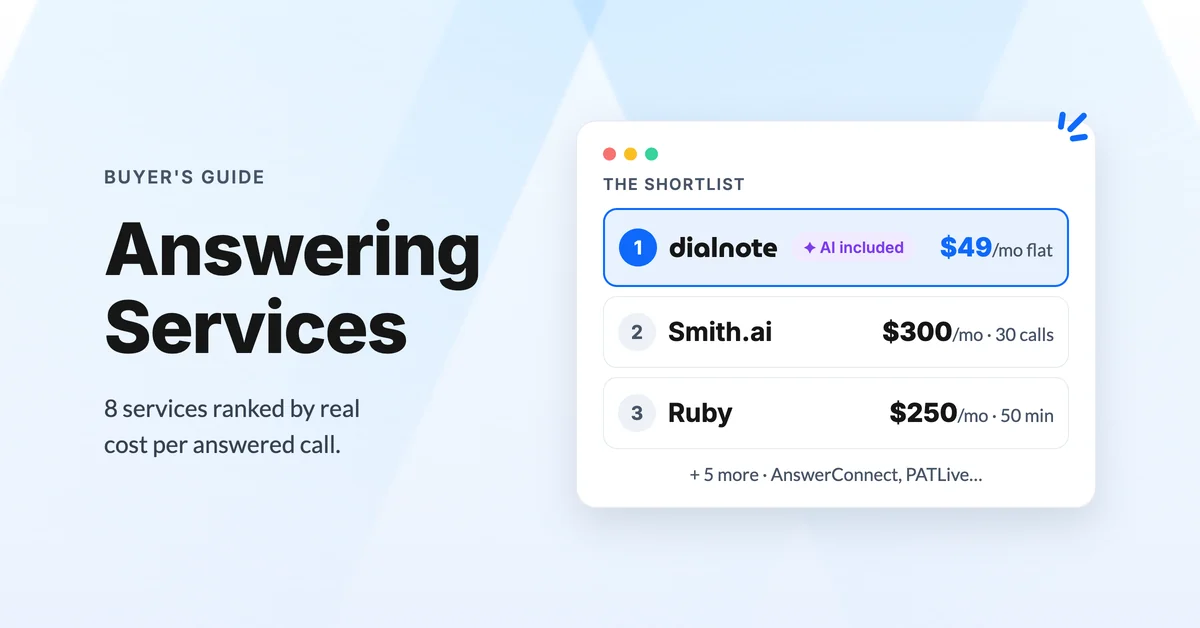
Best Answering Service for Small Business [2026]
Compare the best answering services for small business in 2026: live, AI, and hybrid options ranked by real cost per call and coverage.
Is an AI Receptionist Better Than a Live Answering Service?
Compare an AI receptionist vs live answering service on cost, quality, and 24/7 coverage. See which option fits your business better.
How Does an AI Answering Service Actually Work?
See how an AI answering service works, step by step: what happens in the first four seconds, what it can do on the call, and where it hands off to a human.