OpenPhone vs Vonage: Which Is Better Value?
From a CTO's perspective, the OpenPhone vs Vonage comparison is really a comparison of two eras of product design. Vonage helped invent internet calling and still sells like it's assembling a phone closet: a lean base plan, then a menu of paid add-ons for the parts you actually wanted. OpenPhone arrived a decade later and sells the opposite way: one modern app, most things included, per seat.
Both approaches can be rational. But one of them produces invoices that surprise people, and I've reviewed enough telecom bills to know which.
Ray runs an eight-person roofing company on Vonage. The base price looked great when he signed: about $21 a user. Then the business grew up around it. Call recording for quote disputes: an add-on. A call queue for the busy season: an add-on. A shared inbox so the office could see customer texts: another add-on. His "cheap" system now invoices like a cable bundle, and it still can't answer a call by itself. Sound familiar?
This comparison walks through what OpenPhone and Vonage actually include, what the add-on math does to the sticker price, and where dialnote, a flat-rate AI-first system, fits for teams that want the full kit without the menu.
TL;DR:
- In the OpenPhone vs Vonage matchup, Vonage's advertised Premium rate ($20.99/user/month at 1-4 seats, about $19.59 at 5-19, annual billing) undercuts OpenPhone's Business tier ($23/user/month), but Vonage sells recording, queues, and shared inboxes as paid add-ons.
- OpenPhone (rebranded to Quo in late 2025) includes more per seat: texting, shared numbers, and the credit-metered Sona AI agent.
- A 10-person team pays about $196/month on Vonage before add-ons (roughly $271 with recording, a queue, and a shared inbox) or $230/month on OpenPhone Business.
- dialnote's Business plan is $99/month flat with unlimited users, and recording, queues, texting, and a 24/7 AI receptionist are included.
- Numbers port out of both platforms in about 1 to 3 weeks.
Jump to: feature comparison · what each costs · AI answering · the verdict
A quick look at OpenPhone and Vonage
Vonage is one of the oldest names in VoIP, now part of Ericsson, selling both a business phone product and a developer API platform. The business product is solid, mature plumbing: reliable calling, desk-phone support, and a long feature catalog, much of it priced separately. Advertised rates assume an annual agreement; month-to-month runs near $30 per user.
OpenPhone is the newer generation: an app-first phone built around calling, texting, and shared team inboxes. In late 2025 it rebranded to Quo and pushed into AI with Sona, its voice agent. You'll still see both names in reviews and docs; same product, and a Quo vs Vonage search lands on this same comparison.
The architectural difference matters more than the brand age. Vonage prices the base low and meters the value; OpenPhone bundles the modern features and prices the seat higher. Which one wins depends entirely on how many of the "extras" your business considers basics.
OpenPhone vs Vonage: how do the features compare?
The short answer: OpenPhone includes more of what a modern team expects at its list price, while Vonage's base plan is leaner than it looks, with the gaps sold back to you as add-ons.
The add-on list is the story. On Vonage, company-wide automatic call recording is about $50/month extra. Each call queue is about $15/month. A shared team inbox is about $10/month. CRM integration (Salesforce) is about $5/month. None of these are exotic requests; they're the features growing teams ask for in their first quarter. OpenPhone folds recording, phone menus, and CRM integrations into its $23/user Business tier, with texting and shared numbers on every plan.
Where Vonage genuinely leads: desk-phone support, a mature global network, and the developer APIs, which are excellent if you have engineers who want to build custom call flows. OpenPhone has nothing comparable there, and honestly, most 10-person businesses don't need it.
One nuance in Vonage's favor that flat comparisons miss: its rate card rewards scale. The $20.99 small-team rate drops to about $19.59 at 5-19 seats and $17.49 at 20-99, which is better per-seat economics than most rivals offer at volume. The catch is that the add-ons don't shrink with it; the $50 recording fee is the same whether it covers four people or forty.
Here's the side-by-side, with dialnote as the third column:
| Feature | OpenPhone (Quo) | Vonage Business | dialnote |
|---|---|---|---|
| Starting price | $15/user/mo | $20.99/user/mo (annual) | $19/mo (Solo) |
| Cost for a 10-person team | $230/mo (Business) | ~$196/mo + add-ons | $99/mo flat |
| Where it's available | US + Canada numbers only | Multiple countries | Worldwide (calling to 90+ countries) |
| Flat-rate unlimited users | ✗ | ✗ | Yes ($49/mo Team and up) |
| Calling (US/CA) | Included (fair use) | Included | Included (fair use) |
| Desk phone support | ✗ (app-first) | ✓ | App-first |
| Business texting | ✓ (every plan) | ✓ | Yes (US/CA) |
| Shared numbers / team inbox | ✓ | +$10/mo add-on | Yes |
| Auto-attendant / phone menu | Business plan | ✓ | Yes |
| Call queues | ✗ | +$15/mo per queue | Yes |
| Auto call recording | Business plan | +$50/mo add-on | Yes (Business plan+, automatic) |
| AI call summaries | Business plan | ✗ | Yes (Business plan+) |
| AI receptionist / voice agent | Sona (credit-limited) | ✗ | Yes (included, 14 languages) |
| CRM integrations | HubSpot, Salesforce (Business) | +$5/mo add-on (Salesforce) | HubSpot, Salesforce, Pipedrive, Zoho |
| Developer APIs | Limited | ✓ (its specialty) | No |
And note the availability rows: OpenPhone sells US and Canadian numbers only, while Vonage operates internationally on per-user plans. dialnote is open to businesses worldwide, with numbers in the US, Canada, UK, India, and France today (more countries opened on request), calling to 90+ countries, and business texting included.
What does each one really cost?
Sticker prices: Vonage Premium at $20.99/user/month for small teams (dropping to about $19.59 at 5-19 seats, annual billing), OpenPhone at $15 (Starter) to $23 (Business) per user. Vonage looks cheaper at 10 seats. Now build the system your office actually asked for.
Say Ray's team needs automatic recording, one call queue, and a shared inbox, which is a modest ask. On Vonage: about $196 base + $50 + $15 + $10, roughly $271/month, before CRM sync or any AI capability (there's none to buy at this level). On OpenPhone Business: $230/month with recording and menus in, but call queues aren't available at all, and the AI agent meters out after about 10 calls.
Here's the 10-person picture:
| OpenPhone (Business) | Vonage (Premium, base) | Vonage (with 3 add-ons) | dialnote (Business) | |
|---|---|---|---|---|
| 5 users | $115/mo | $105/mo | $180/mo | $99/mo |
| 10 users | $230/mo | $196/mo | $271/mo | $99/mo |
| 25 users | $575/mo | $437/mo | $512/mo | $99/mo |
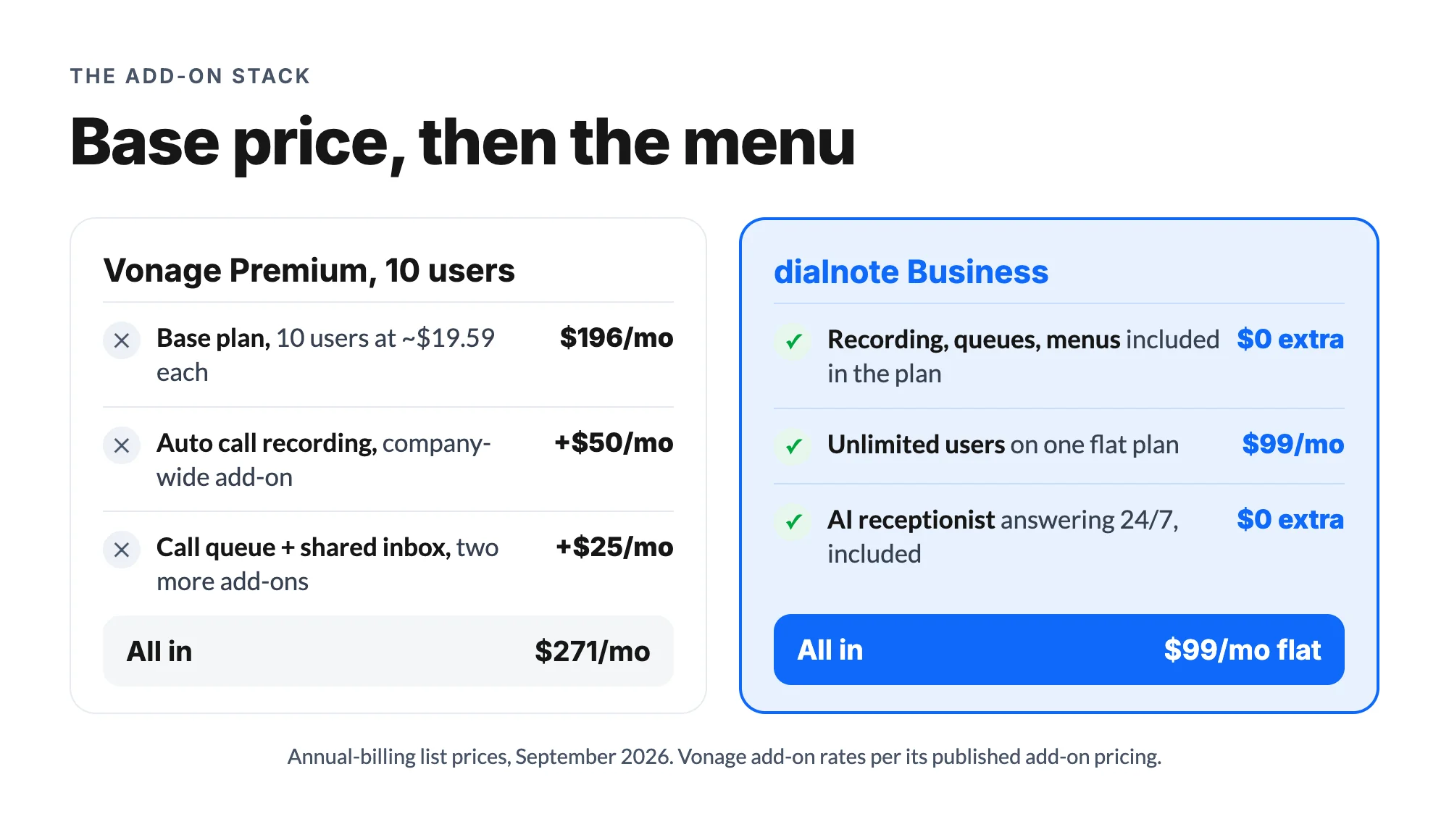
dialnote's pricing is the third model: $49/month (Team), $99/month (Business), $199/month (Pro), unlimited users, with recording, queues, phone menus, texting, and the AI receptionist included rather than itemized. One note on the dialnote column: the flat plan covers the phone system and every seat, and AI calls are the one usage charge: $25/mo for 65 calls with the AI call pack, or $0.49/minute from your wallet without one. A light month costs little extra, and Vonage has no AI answering at this level to compare it against anyway.
If you do sit down with a Vonage quote, three questions cut through the menu fast: which of these features are add-ons at renewal (prices can change independently of the seat rate), what does month-to-month cost if we drop the annual agreement, and what's the total with recording, queues, and the shared inbox included? The answers turn a $21 sticker into a comparable number in about five minutes, and reps answer them straight when asked directly.
Two fine-print flags before you sign either way. Vonage's advertised rates assume a 12-month agreement; month-to-month is nearly $30/user. And OpenPhone's "unlimited" US/CA calling carries a fair-use cap around 1,000 minutes per user. The plan page is the opening bid, not the bill.
What does a year of each cost?
Small-business budgets live in years, not months, so run the multiplication once and look at it straight. Vonage with the three add-ons: $271 × 12 = $3,252 for year one, before overages, extra numbers, or a single price change. OpenPhone Business: $230 × 12 = $2,760. dialnote Business: $99 × 12 = $1,188, and the number doesn't move if you hire.
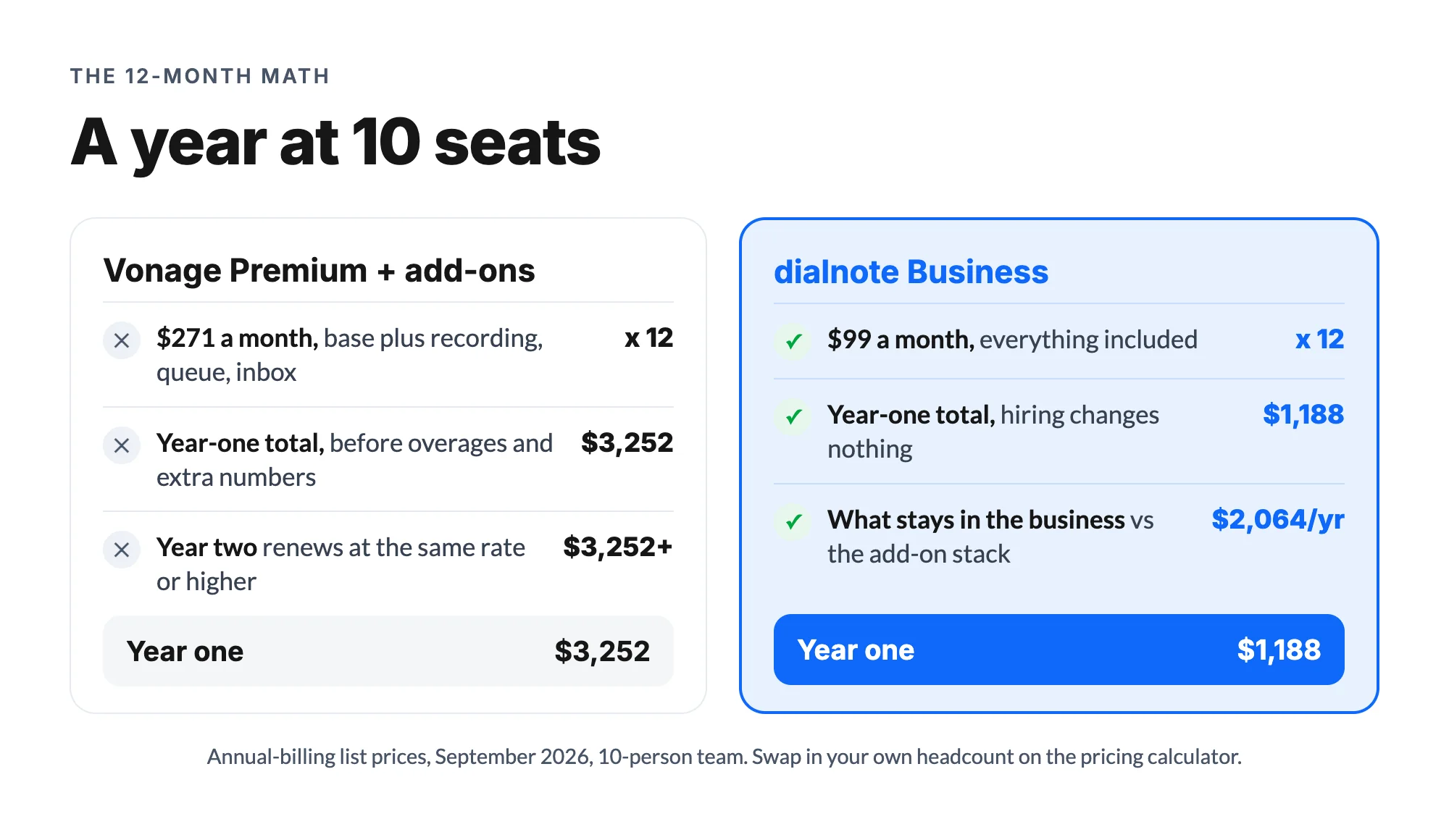
That's $2,064 a year staying in the business versus the Vonage stack, $1,572 versus OpenPhone, roughly a month of a part-timer's wages, recovered from the phone bill alone. Swap in your own headcount on the cost calculator and the gap only widens as the team grows.
Which one answers calls when nobody can?
Here's the question I'd put above the whole add-on menu, because it's the one neither pricing page answers. When the office is on roofs, in meetings, or gone for the day, what happens to the caller?
Vonage's answer is routing: menus, ring groups, and (paid) queues deliver the call to a mailbox with dignity. There's no AI answering to buy at this product level at all. It's 2010's best answer, still on sale.
OpenPhone's answer is Sona, a real AI agent that greets callers, answers common questions, and takes messages. The meter is the limit: about 10 AI-handled calls a month included, then credit packs from $25/month.
dialnote treats the missed call as the product's reason to exist. The AI receptionist answers 24/7 in 14 languages, asks your qualifying questions, books meetings through Calendly or Cal.com, sends texts, and hands off to a teammate when someone's free, then drops the AI call summary into your CRM. And the behavior is configurable per number: full AI answering, an automated text-back, a we'll-call-you-back message, or plain voicemail with a transcript. You can try the AI receptionist live before creating an account.
I'll be straight about the uncertainty: Vonage's parent has deep AI research capability, so an AI answering feature could appear in the business product eventually. But roadmaps don't answer this quarter's calls.
What are they like to run day to day?
Vonage's daily reality is dependable and dated. Calls work, desk phones work, and the admin portal does everything, eventually, once you find the right menu. The add-on architecture shows up operationally too: features arrive as separate line items to enable, bill, and audit, and somebody has to own that. Teams with an IT-minded office manager cope fine; teams without one just don't turn the features on, and then wonder why the "phone system" is only a phone.
OpenPhone's daily reality is the one-thread app: every customer's calls, texts, and voicemails in a single conversation the whole team can see. New hires learn it in an afternoon. The trade-offs are the per-seat bill, no desk phones, and no call queues at any price.
There's also the quieter line item: phone numbers themselves. OpenPhone includes one number per user and sells extras at $5/month. Vonage prices additional numbers and toll-free service separately, like everything else. dialnote's Business plan includes 3 numbers, with additional local numbers at $1.25/month, which matters once sales, support, and ad tracking each want their own line. Small numbers, but they compound the same direction as everything else on these bills.
How do you switch without losing your number?
Same four steps whichever direction you move:
- Open the new account first. Never cancel the old service before the port completes; a closed account can forfeit the number.
- Submit the port from the new provider's side with your current account number and PIN. The receiving provider files the paperwork.
- Run both in parallel for the 1 to 3 weeks the port takes; your existing line works throughout.
- Confirm, then cancel. Once test calls land on the new system, close the old account and stop the old billing.
Callers dial the same number before, during, and after. Our switching guide has the full checklist.
Where both fall short
Vonage's gaps:
- The features teams consider basic (auto recording, queues, shared inbox, CRM sync) are all paid add-ons.
- No AI answering, summaries, or transcription intelligence in the business product's standard lineup.
- Advertised pricing assumes an annual agreement; month-to-month costs roughly 40% more.
- The interface and admin experience feel a generation older than app-first rivals.
- Per-seat pricing, so growth raises the bill even before the add-ons.
OpenPhone's gaps:
- Per-user pricing, with the useful features on the $23/user Business tier.
- Sona is credit-metered: about 10 free AI calls a month, then paid packs.
- No call queues at all, and no desk-phone option.
- US and Canadian numbers only, with a fair-use cap around 1,000 minutes per user.
- The Quo rebrand still splits its reviews and documentation across two names.
Why dialnote might be the better pick
dialnote is an AI business phone system with no per-user pricing. AI voice agents answer calls, capture leads, and book meetings 24/7. Plans from $19/mo. We built its architecture around a simple observation: the add-on menu exists for the seller's benefit, not the buyer's. Every line item on Ray's Vonage bill is something the phone system should have just done.
One flat plan, the whole system. $49 (Team), $99 (Business), $199 (Pro) per month with unlimited users. Recording, queues, menus, texting, analytics: included, not itemized.
The AI receptionist as standard equipment. It answers around the clock, captures lead details, books meetings, texts confirmations, and syncs summaries to HubSpot, Salesforce, Pipedrive, or Zoho.
Modern app, no phone closet. Everything runs from iOS, Android, and desktop apps on the devices your team already carries.
Open worldwide. Numbers in the US, Canada, UK, India, and France today (more countries opened on request), with calling to 90+ countries.
If you're mapping the wider field, our Quo (OpenPhone) alternatives guide ranks more options, our Vonage alternatives breakdown prices nine replacements with their add-ons, and the dialnote vs Vonage comparison goes feature by feature. Weighing Ooma instead? Our OpenPhone vs Ooma breakdown covers it.
"Every add-on is a feature the system already knows you need," says Akhilesh Betanamudi, dialnote's co-founder. "Charging separately for it is a choice, and buyers should read it as one."
OpenPhone or Vonage: which should you pick?
Pick Vonage if you want desk phones, international per-user plans, or developer APIs to build custom call flows, and you have someone who'll happily manage an add-on catalog. The plumbing is genuinely proven.
Pick OpenPhone if you want the modern app experience with texting and light AI, your team fits the per-seat math, and you'll never miss call queues.
Pick dialnote if you're tired of both games, the seat meter and the add-on menu, and what you actually need is the phone answered, recorded, and logged on one flat bill. It's built for the team whose Vonage invoice stopped making sense.
Ray's ending is worth sharing because it generalizes. He didn't leave Vonage because it broke; he left because the fourth add-on request in a year made him total the invoice. The replacement wasn't about features at all: it was one number on one line, with the recording, the queue, the inbox, and an AI answering the calls his crew couldn't. According to Fortune Business Insights, the VoIP market's growth keeps concentrating in exactly these simplified, AI-forward systems, and the add-on menu is the model that growth is leaving behind.
The bottom line on OpenPhone vs Vonage: one charges you per person, the other charges you per feature. The better value is the system where the things you need aren't extras in the first place.
Start a free 10-day trial of dialnote, no credit card required, or run your team's numbers against both.
Frequently asked questions
OpenPhone (now Quo) is a modern app-first phone with texting and an AI agent built in. Vonage is a veteran VoIP platform that sells a lean base plan and adds features like recording and call queues as paid add-ons. Simplicity vs configurability.
The advertised Premium rate is $20.99/user/month (annual, 1-4 seats), dropping to about $19.59 at 5-19 seats. Month-to-month runs near $30. The catch is add-ons: auto recording ($50/mo), call queues ($15/mo each), and CRM integration ($5/mo) are extra.
Yes. Company-wide automatic call recording is an add-on at about $50 per month on top of your per-user plan. OpenPhone includes auto recording on its Business plan, and dialnote includes it on Business and up.
Vonage Premium runs about $196/month for 10 users before add-ons; OpenPhone Business is $230/month. Stack Vonage's recording, queue, and inbox add-ons and it passes $270. dialnote's Business plan is $99/month flat for unlimited users.
Yes. Both release numbers through standard porting. Open the new account first, submit the port with your account number and PIN, and keep the old service active until the switch completes, usually 1 to 3 weeks.

Written by
Neil D'Souza
Chief Technology Officer, SmartReach.io
Neil D'Souza is a seasoned software engineer and technology leader with over 20 years of experience in building scalable products across SaaS, data analytics, and business communications. As Chief Technology Officer at SmartReach.io, he oversees the...
Neil D'Souza is a seasoned software engineer and technology leader with over 20 years of experience in building scalable products across SaaS, data analytics, and business communications. As Chief Technology Officer at SmartReach.io, he oversees the...
Related Articles
OpenPhone vs 8x8: Which Should You Choose?
Compare OpenPhone vs 8x8 on pricing, quote-only sales, and AI answering, then see why dialnote may fit small teams better than both.
OpenPhone vs JustCall: Which Is Better for Teams?
Compare OpenPhone vs JustCall on pricing, AI tiers, and hidden minimums, then see why dialnote may be the smarter pick for small teams.
OpenPhone vs Ooma: Which Should Your Business Use?
Compare OpenPhone vs Ooma on pricing, texting limits, and AI answering, then see why dialnote may fit small businesses better than both.