OpenPhone vs JustCall: Which Is Better for Teams?
We spent years building sales tools at SmartReach.io, so I've watched hundreds of teams shop this exact comparison. Here's the pattern I see with OpenPhone vs JustCall: people treat them as interchangeable "business phone apps," but they're aimed at different jobs. OpenPhone wants to be your front office. JustCall wants to be your sales floor.
That distinction decides everything, including whether either is worth what you'll actually pay.
Marcus runs a ten-person HVAC company: two people selling, eight in the field. A consultant pitched him JustCall for the sales pair, and the demo looked great. Then the quote came in. The features his whole company needed (a line that gets answered, texts that get seen, calls logged to the CRM) sat across different tiers, per seat, with a 2-user minimum on the entry plan and the AI tier at triple the price. He wasn't buying a phone system anymore; he was buying a sales platform for ten people so two could use a dialer. Sound familiar?
This comparison breaks down what each platform really costs at team size, where the minimums and meters hide, and where dialnote, a flat-rate AI-first phone system, fits for teams that need answered calls more than autodialed ones.
TL;DR:
- In the OpenPhone vs JustCall matchup, OpenPhone starts at $15/user/month while JustCall's Team plan is $29/user/month with a 2-user minimum ($58/month entry), both annual billing.
- JustCall's real strength is outbound sales tooling: dialers, coaching, campaigns. Its AI voice agents sit on the $89/user/month Pro Plus tier, with a $0.99/minute overage on every plan.
- OpenPhone (rebranded to Quo in late 2025) is the better everyday business phone: shared numbers, first-class texting, and the credit-metered Sona AI agent.
- Per-seat math bites both ways: a 10-person team pays $230 to $290 a month, and $890 if they want JustCall's AI tier. dialnote's Business plan is $99/month flat, AI receptionist included.
- Numbers port out of both platforms in about 1 to 3 weeks.
Jump to: feature comparison · what each costs · AI answering · the verdict
A quick look at OpenPhone and JustCall
OpenPhone built a clean, app-first business phone: calling, texting, shared numbers, one thread per customer. In late 2025 it rebranded to Quo and added Sona, its AI voice agent. Reviews and docs still use both names; same product, and a Quo vs JustCall search ends up at this same comparison.
JustCall grew up on the sales side. Auto-dialers, SMS campaigns, call coaching, AI conversation intelligence, and a long list of CRM hooks. It's genuinely good at powering an outbound team's calling day, and I say that as someone who competed near this space for years. The catch is that everything is tiered and metered like a sales tool: Team at $29/user/month (2-user minimum), Pro at $49, and Pro Plus at $89 for the AI voice agents, with a $0.99/minute overage that applies on every plan (all annual billing).
So before comparing features, ask the honest question: are you buying a phone system for the whole business, or a dialer for the two people who prospect? Mixing those up is how a phone bill triples.
OpenPhone vs JustCall: how do the features compare?
The short answer: JustCall out-guns OpenPhone on sales tooling, OpenPhone out-simples JustCall as a daily phone, and both charge per seat for it.
OpenPhone's strengths are front-office: shared numbers with a team inbox, texting as a first-class channel, voicemail transcription, and Sona answering missed calls (about 10 AI-handled calls a month included, then credit packs). Its integrations cover HubSpot and Salesforce on the Business tier.
JustCall's strengths are pipeline: power dialers, campaign texting, live coaching, and AI analytics. But feature placement matters: CRM auto-logging arrives on Pro ($49/user), and the AI voice agents on Pro Plus ($89/user). The features that make JustCall special are exactly the ones on its priciest tiers.
Here's the side-by-side, with dialnote as the third column:
| Feature | OpenPhone (Quo) | JustCall | dialnote |
|---|---|---|---|
| Starting price | $15/user/mo | $29/user/mo (2-user min) | $19/mo (Solo) |
| Cost for a 10-person team | $230/mo (Business) | $290/mo (Team) | $99/mo flat |
| Where it's available | US + Canada numbers only | Available globally | Worldwide (calling to 90+ countries) |
| Flat-rate unlimited users | ✗ | ✗ | Yes ($49/mo Team and up) |
| Calling (US/CA) | Included (fair use) | Metered; $0.99/min overage | Included (fair use) |
| Outbound dialers / campaigns | ✗ | ✓ (its specialty) | No (inbound-first) |
| Shared numbers / team inbox | ✓ | ✓ | Yes |
| Business texting | ✓ | ✓ (campaign-oriented) | Yes (US/CA) |
| Auto-attendant / phone menu | Business plan | ✓ | Yes |
| Call recording | Business plan (auto) | ✓ | Yes (Business plan+, automatic) |
| AI call summaries | Business plan | Higher tiers | Yes (Business plan+) |
| AI receptionist / voice agent | Sona (credit-limited) | Pro Plus ($89/user) | Yes (included, 14 languages) |
| CRM auto-logging | Business plan | Pro plan ($49/user) | Yes (after-call sync) |
| CRM integrations | HubSpot, Salesforce | Broad (tiered) | HubSpot, Salesforce, Pipedrive, Zoho |
And note the availability rows: OpenPhone sells US and Canadian numbers only, full stop, while JustCall sells globally on per-user plans. dialnote is open to businesses worldwide, with numbers in the US, Canada, UK, India, and France today (more countries opened on request), calling to 90+ countries, and business texting included.
Full disclosure on our own column: dialnote is inbound-first. If your core need is an outbound dialer grinding through lead lists, JustCall is the specialist and we're not going to pretend otherwise. The comparison that matters is what each costs when what you actually need is the phone answered.
What does each one really cost?
Sticker prices first: OpenPhone $15/$23/$35 per user, JustCall $29/$49/$89 per user, both annual. Now the fine print that changes the math.
JustCall's Team plan carries a 2-user minimum, so the entry price is really $58/month. CRM auto-logging, which most sales teams consider table stakes, means Pro at $49/user. And the AI voice agents everyone asks about live on Pro Plus at $89/user, with the $0.99/minute overage still applying. OpenPhone's version of the same story is milder: the features you want are on Business at $23/user, and Sona's meter starts after about 10 AI calls a month.
One more line item worth checking before you commit to any of the three: texting compliance. US carriers now require A2P registration for business texting, and each platform walks you through it differently. It's not a cost so much as a setup step, but sales teams planning SMS campaigns on JustCall should budget the registration lead time before launch day, or the campaign tool sits idle while the paperwork clears.
Here's the 10-person picture:
| OpenPhone (Business) | JustCall (Team) | JustCall (Pro Plus, AI) | dialnote (Business) | |
|---|---|---|---|---|
| 5 users | $115/mo | $145/mo | $445/mo | $99/mo |
| 10 users | $230/mo | $290/mo | $890/mo | $99/mo |
| 25 users | $575/mo | $725/mo | $2,225/mo | $99/mo |
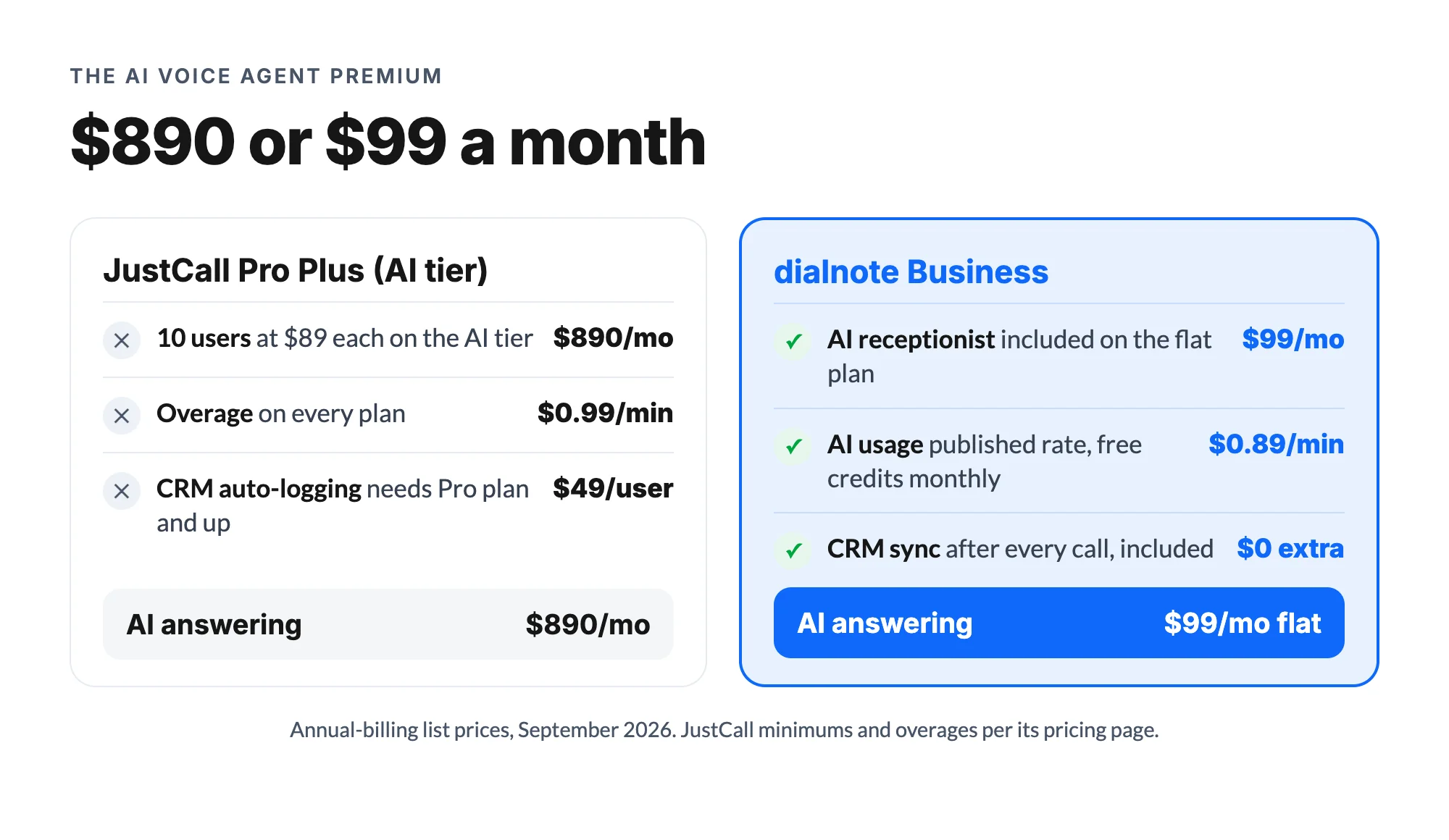
That third column is the one to sit with. $890 a month buys ten seats of JustCall's AI tier. dialnote's pricing puts the AI receptionist, recording, and CRM sync on a $99/month flat Business plan with unlimited users, and prices AI calls at a published $25/mo for 65 with the AI call pack, or $0.49/minute from the wallet without one. Team is $49, Pro is $199, Solo is $19. Nobody counts seats.
One note on the dialnote column: the flat plan covers the phone system and every seat, and AI calls are billed on top: about $0.38 a call on the AI call pack, or $0.49/minute without one. Light months cost little extra; heavy months are still cheaper than a per-seat AI tier.
After a decade of watching SaaS pricing evolve, here's my opinion: per-seat pricing made sense for software people sit in front of all day. A phone system isn't that. Charging $89 a seat so an AI can answer a shared line is a sales-tool pricing model applied to a utility, and small teams feel it immediately.
Which one answers calls when nobody's free?
Strip away the dialers and tiers and this is the question most 5-to-20-person businesses are actually asking. When we talked to service businesses while building dialnote, the number that kept coming up wasn't the software bill at all; it was the value of the calls nobody answered.
OpenPhone's answer is Sona: a real AI agent, included, but metered at roughly 10 AI-handled calls a month before credit packs from $25/month. It's a taste, not coverage.
JustCall's answer is its AI voice agents, which are capable, and gated behind the $89/user tier with per-minute overage. It's built to qualify inbound leads for sales teams that already live in JustCall, not to be a small business's receptionist.
dialnote makes this the headline feature. The AI receptionist answers 24/7 in 14 languages, asks your qualifying questions, books meetings through Calendly or Cal.com, sends texts, and transfers to a teammate when someone's free, then drops the AI call summary into your CRM. And the behavior is yours to set per number: full AI answering, an automated text-back, a we'll-call-you-back message, or plain voicemail with a transcript. You can try the AI receptionist live before creating an account.
What are they like to run day to day?
Having sold to sales teams for years, I can tell you the daily experience gap here is bigger than the feature gap.
JustCall runs like a sales floor. Reps live in dialer queues and campaign views, managers live in dashboards and coaching scorecards, and admins live in tier management. When your team is built for that rhythm, it hums. When it isn't, the everyday feel is heavy: field techs don't need dispositions and call scores to return a customer call, and someone has to own the admin of a genuinely deep platform. The $0.99/minute overage also changes behavior in a subtle way; teams start watching the meter, and a phone you hesitate to use is quietly failing at its job.
OpenPhone runs like a group chat with a dial pad. One thread per customer, texting that just works, and an interface a new hire learns in an afternoon. The lightness is the point, and also the limit: there's no dialer, campaigns, or coaching, so the two salespeople who wanted those still don't have them.
The practical question for a mixed team like Marcus's: which tool do the other eight people live in? Buying the sales platform for everyone means paying specialist prices for people who just need the phone answered and logged.
How do you switch without losing your number?
Same playbook whichever platform you're leaving:
- Open the new account before touching the old one. A canceled account can surrender your number; an active one can't lose it mid-port.
- File the port from the new provider. You'll need the account number and PIN from your current provider; the receiving side handles the rest.
- Run both in parallel while you wait. Ports take about 1 to 3 weeks, your existing service works throughout, and you can use the overlap to set up routing and train the team.
- Verify, then cancel. Once the port completes and test calls land correctly, close the old account.
Customers dial the number they've always dialed. The switch is invisible from the outside, which is exactly how it should be.
Where both fall short
JustCall's gaps:
- Entry price is really $58/month (2-user minimum), and the good features climb tiers fast.
- AI voice agents cost $89/user/month, with a $0.99/minute overage on every plan.
- CRM auto-logging needs Pro at $49/user.
- It's a sales platform first; as a whole-company phone it's heavy and priced like tooling.
- Per-seat pricing punishes exactly the growth it's sold to enable.
OpenPhone's gaps:
- Per-user pricing, with the useful features on the $23/user Business tier.
- Sona is credit-metered: about 10 free AI calls a month, then paid packs.
- No outbound dialer or campaign tools at all.
- US and Canadian numbers only, with a fair-use cap around 1,000 minutes per user.
- The Quo rebrand still splits its reviews and search results across two names.
Why dialnote might be the better pick
dialnote is an AI business phone system with no per-user pricing. AI voice agents answer calls, capture leads, and book meetings 24/7. Plans from $19/mo. We built it after years of building sales software, and the lesson we carried over was about pricing as much as product: the phone system should get cheaper relative to your business as you grow, not more expensive.
Flat pricing, unlimited users. $49 (Team), $99 (Business), $199 (Pro) per month. Marcus's ten people cost $99, and the two who sell cost nothing extra.
The AI receptionist included, not tiered. Answering, lead capture, booking, texts, transfers, and CRM-synced summaries, on the flat plan, with AI calls from $25/mo for 65 on the AI call pack.
Routing that fits mixed teams. Phone menus, ring groups, and after-hours rules send callers to the right person first, with the AI catching whatever falls through. Call analytics show which numbers and hours drive the volume, so staffing decisions stop being guesses.
Built for the calls you receive. If you need outbound dialers, use the specialist tools for the specialists and let the phone system handle the phone. dialnote's sales-team setup covers how growing teams run inbound properly.
Open worldwide. Numbers in the US, Canada, UK, India, and France today (more countries opened on request), calling to 90+ countries.
A visible exit ramp. Porting in from OpenPhone or JustCall takes about 1 to 3 weeks with no downtime; the switching guide has the checklist, and our full head-to-head with JustCall goes feature by feature.
"Specialist tools for the specialists, a flat system for everyone else," as Lancelot Dsouza, dialnote's CMO, puts it. "The expensive org chart is the one where everybody gets the specialist tool."
OpenPhone or JustCall: which is better for your team?
Pick JustCall if you're running a genuine outbound sales operation: dialers, campaigns, coaching, and the budget to pay for specialist tooling per seat. For that job, it's the stronger product here.
Pick OpenPhone if you want a clean, modern front-office phone with great texting, and per-seat pricing plus a metered AI agent fits your size. For a five-person team that mostly texts and takes calls, it's the simplest of the three to live with day to day, and the Sona free tier may genuinely cover a quiet line's missed calls.
Pick dialnote if what you actually need is the phone answered, the lead captured, and the CRM updated, at a price that ignores headcount. It's the option built for the ten-person business that was about to buy a sales platform just to stop missing calls.
Here's how Marcus's story resolved, because it's instructive. The two salespeople got a proper dialer, a specialist tool sized for two seats. The company got a flat-rate phone system with AI answering for everyone. Total monthly cost: less than half the all-JustCall quote, and the office stopped missing calls the same week. Right tool, right people, right price. That's the whole trick.
According to Fortune Business Insights, the VoIP market's growth is being driven by exactly this unbundling: businesses picking focused tools per job instead of one heavy platform for everyone. The suite pitch sounds efficient in the demo. The invoice tells a different story.
The bottom line on OpenPhone vs JustCall: they're both good at their actual jobs. The expensive mistake is buying either one for a job it wasn't built for, and the missed-call job belongs to neither.
Start a free 10-day trial of dialnote, no credit card required, or run the numbers for your team.
Frequently asked questions
OpenPhone (now Quo) is a front-office phone: shared numbers, texting, and light AI. JustCall is a sales-calling platform: auto-dialers, coaching, and campaign tools. One answers your business line; the other powers an outbound team's day.
Yes. JustCall's Team plan is $29/user/month on annual billing with a 2-user minimum, so the real entry price is $58/month. Some higher tiers carry minimums too, which surprises solo buyers comparing sticker prices.
They sit on the Pro Plus tier at $89/user/month (annual billing), with a $0.99/minute overage that applies on every plan. A 10-person team wanting JustCall's AI agents is looking at roughly $890/month before overages.
OpenPhone starts lower: $15/user/month vs JustCall's $29/user/month with a 2-user minimum (both annual). But both are per-seat, so 10 people cost $230 to $290 a month, vs $99 flat on dialnote's Business plan.
Yes. Both platforms release numbers through standard porting. Sign up with the new provider first, submit the port, and keep the old account active until it completes, usually 1 to 3 weeks with no downtime.

Written by
Prateek Bhatt
Co-Founder, SmartReach.io
Prateek Bhatt is a product leader, programmer, and serial entrepreneur with over 12 years of experience building SaaS and AI-powered tools for sales and customer service teams. As Co-Founder of SmartReach.io - a multichannel outreach platform used by...
Prateek Bhatt is a product leader, programmer, and serial entrepreneur with over 12 years of experience building SaaS and AI-powered tools for sales and customer service teams. As Co-Founder of SmartReach.io - a multichannel outreach platform used by...
Related Articles
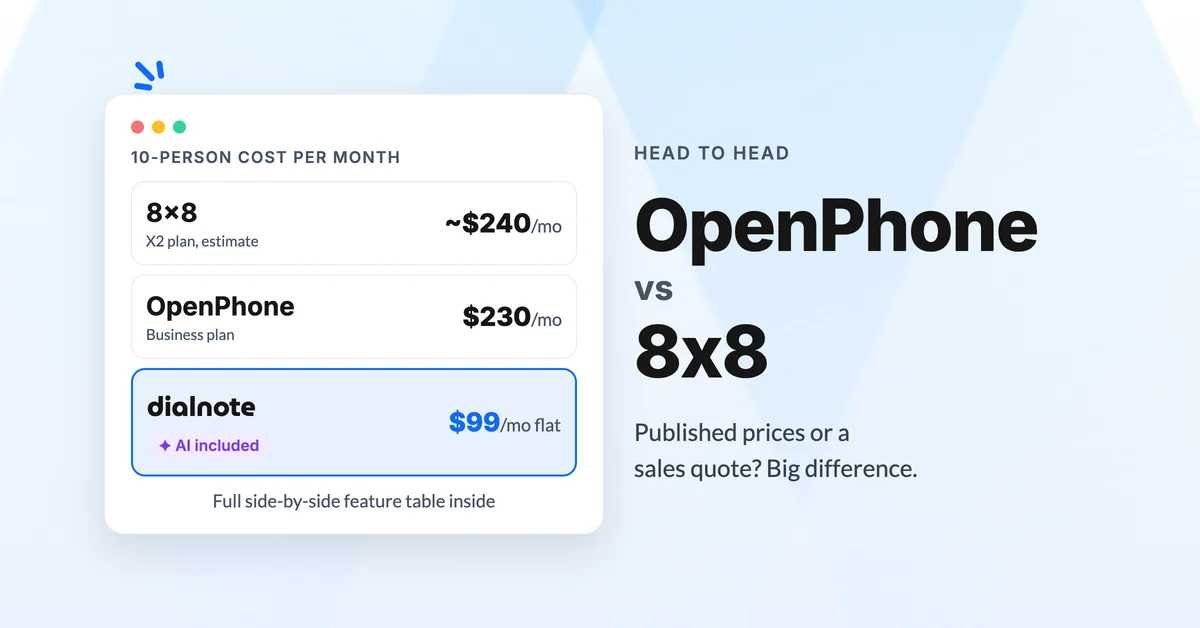
OpenPhone vs 8x8: Which Should You Choose?
Compare OpenPhone vs 8x8 on pricing, quote-only sales, and AI answering, then see why dialnote may fit small teams better than both.
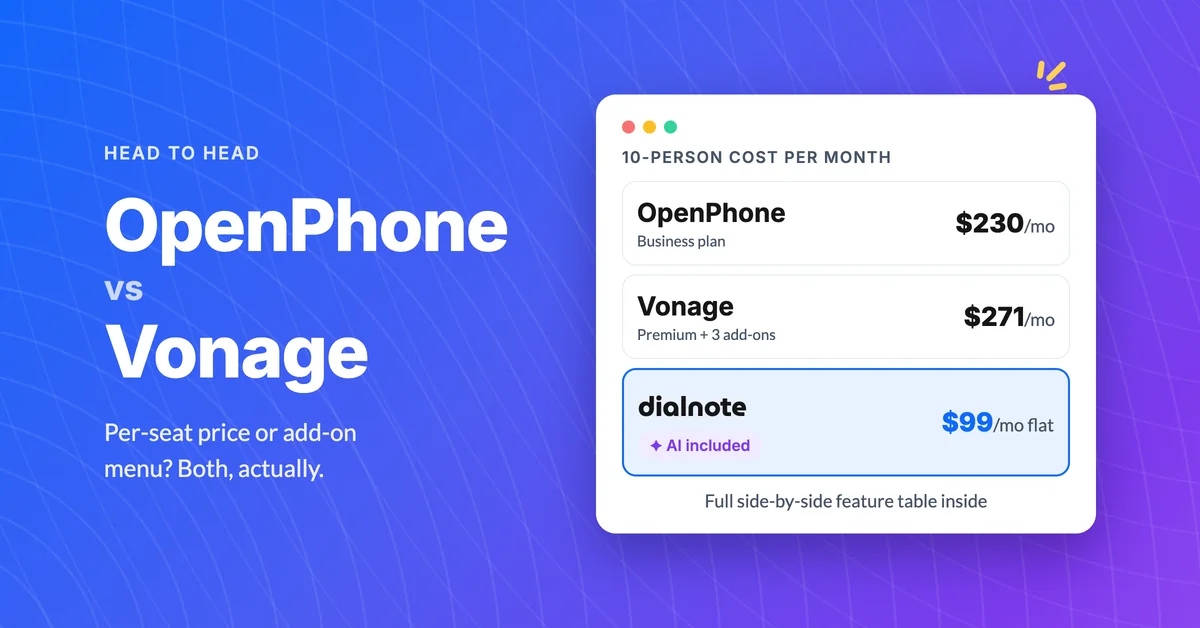
OpenPhone vs Vonage: Which Is Better Value?
Compare OpenPhone vs Vonage on pricing, add-on fees, and AI answering, then see why dialnote may be the better value for small teams.
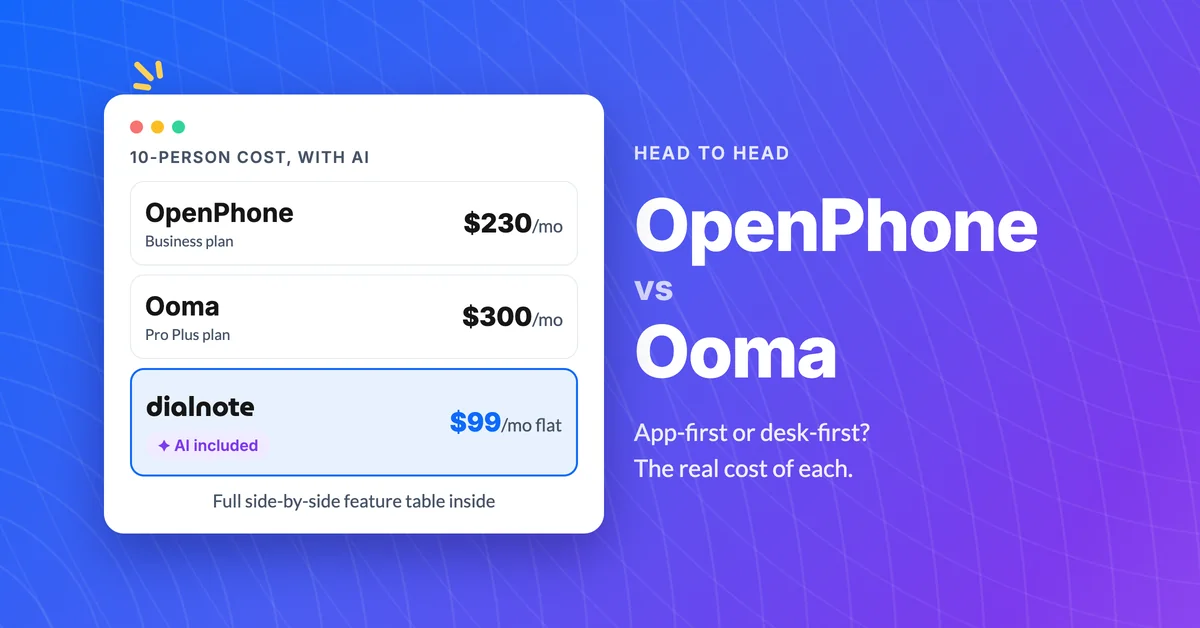
OpenPhone vs Ooma: Which Should Your Business Use?
Compare OpenPhone vs Ooma on pricing, texting limits, and AI answering, then see why dialnote may fit small businesses better than both.