OpenPhone vs 8x8: Which Should You Choose?
A question customers ask me surprisingly often: "Why can't I just see 8x8's prices?" That's the honest place to start an OpenPhone vs 8x8 comparison, because it tells you who each product is for. OpenPhone publishes its rates and lets you sign up in five minutes. 8x8 removed public pricing in 2023; the number you'll pay is decided on a sales call (we priced ten 8x8 alternatives that don't work that way).
Neither approach is wrong. But they select for very different buyers, and if you're a ten-person business, one of these sales processes was not designed with you in mind.
Dana runs a nine-person accounting practice with clients in three countries. An IT consultant recommended 8x8 for the international calling, and the product genuinely fit. The buying didn't: two discovery calls, a custom quote, and a proposal comparing bundles she hadn't asked about. Meanwhile her colleague set up a competing trial from a pricing page during lunch. Sound familiar?
This comparison covers what OpenPhone and 8x8 each do well, what the quote-only pricing means in practice, and where dialnote, a flat-rate AI-first system with published prices, fits between them.
TL;DR:
- In the OpenPhone vs 8x8 matchup, OpenPhone publishes its prices ($15 to $35/user/month, annual billing) while 8x8 sells by quote only; guides estimate its X2 plan around $24/user/month.
- 8x8's real strengths are international calling (unlimited to dozens of countries on higher tiers) and multi-location, compliance-heavy deployments.
- OpenPhone (rebranded to Quo in late 2025) is the easier everyday phone: self-serve setup, first-class texting, and the credit-metered Sona AI agent.
- Both are per-seat: a 10-person team runs $230 to $240 a month. dialnote's Business plan is $99/month flat with unlimited users and a 24/7 AI receptionist included.
- Numbers port out of both platforms in about 1 to 3 weeks.
Jump to: feature comparison · what each costs · AI answering · the verdict
A quick look at OpenPhone and 8x8
8x8 is a veteran unified-communications platform: voice, video, chat, and a contact-center product, sold to companies that want one vendor across many locations. It's strong on compliance certifications and famously strong on international calling, with higher tiers including unlimited calls to dozens of countries. Since 2023 it's been quote-only; current buyer guides converge on roughly $24/user/month for the entry X2 plan and $44 for X4 on annual billing, with negotiated discounts reported anywhere from 5% to 35%.
OpenPhone is the self-serve opposite: an app-first business phone built around calling, texting, and shared team inboxes, with public pricing and a five-minute signup. In late 2025 it rebranded to Quo and added Sona, its AI voice agent. You'll still see both names around; same product, and a Quo vs 8x8 search brings you to this exact comparison.
Here's how I frame it for customers: 8x8 is bought like enterprise software, OpenPhone is bought like an app. The product differences follow from that one fact. According to Fortune Business Insights, the VoIP market keeps growing at over 10% a year, and the growth is disproportionately self-serve; the quote-form era is shrinking.
OpenPhone vs 8x8: how do the features compare?
The short answer: 8x8 has the bigger platform, OpenPhone has the better small-team experience, and neither includes an AI receptionist answering your line.
8x8 brings video meetings, team chat, analytics, and the international calling story, plus desk-phone support and admin controls built for IT departments. The cost of all that surface area is complexity: getting the right plan configured is itself a project, and several of the strongest features live in higher tiers you'll price on a call.
OpenPhone keeps the surface small and sharp: shared numbers, one thread per customer across calls and texts, voicemail transcription everywhere, and Sona answering missed calls (about 10 AI-handled calls a month included, then credit packs). No video, no desk phones, no enterprise compliance stack, and for most ten-person teams, no loss.
Here's the side-by-side, with dialnote as the third column:
| Feature | OpenPhone (Quo) | 8x8 | dialnote |
|---|---|---|---|
| Starting price | $15/user/mo (published) | ~$24/user/mo (quote only, est.) | $19/mo (Solo) |
| Cost for a 10-person team | $230/mo (Business) | ~$240/mo (X2, est.) | $99/mo flat |
| Where it's available | US + Canada numbers only | Global (via sales) | Worldwide (calling to 90+ countries) |
| Flat-rate unlimited users | ✗ | ✗ | Yes ($49/mo Team and up) |
| Self-serve signup | ✓ | ✗ (quote + sales process) | Yes |
| Published pricing | ✓ | ✗ (removed in 2023) | Yes |
| International calling | Metered per minute | Unlimited to dozens of countries (higher tiers) | 90+ countries, per-country rates |
| Video meetings | ✗ | ✓ | No (calls only) |
| Business texting | ✓ (first-class) | ✓ (basic) | Yes (US/CA) |
| Shared numbers / team inbox | ✓ | ✓ | Yes |
| Auto-attendant / phone menu | Business plan | ✓ | Yes |
| Call recording | Business plan (auto) | Higher tiers | Yes (Business plan+, automatic) |
| AI call summaries | Business plan | Higher tiers | Yes (Business plan+) |
| AI receptionist / voice agent | Sona (credit-limited) | ✗ (contact-center product separate) | Yes (included, 14 languages) |
| CRM integrations | HubSpot, Salesforce (Business) | ✓ (tiered) | HubSpot, Salesforce, Pipedrive, Zoho |
On the availability rows: OpenPhone sells US and Canadian numbers only, while 8x8 serves businesses globally through its sales process. dialnote is open to businesses worldwide, self-serve, with numbers in the US, Canada, UK, India, and France today (more countries opened on request), calling to 90+ countries, and business texting included.
What does each one really cost?
With OpenPhone the answer is on the website: $15 (Starter), $23 (Business), $35 (Scale) per user per month on annual billing, with the features most teams want on Business.
With 8x8 the honest answer is "it depends on your negotiation." The guide-estimated $24/user X2 rate is a starting point; buyers report discounts from 5% to 35%, which sounds nice until you realize it means the sticker was padded for the conversation. For a small business, quote-only pricing has three hidden costs: your time in sales cycles, the certainty you can't put in a budget, and the renewal, where the discount you negotiated has a way of expiring.
If you do take the 8x8 sales call, go in with four questions and it becomes a fair fight: What's the all-in per-user price at my exact headcount, on annual and monthly terms? Which countries does unlimited international calling cover on the tier you're quoting me, specifically? What does this renew at in year two? And what happens to my discount if we shrink by two seats? Write the answers down; the quote PDF won't always contain them.
Here's the 10-person picture, using the tiers teams actually compare:
| OpenPhone (Business) | 8x8 (X2, estimate) | dialnote (Business) | |
|---|---|---|---|
| 5 users | $115/mo | ~$120/mo | $99/mo |
| 10 users | $230/mo | ~$240/mo | $99/mo |
| 25 users | $575/mo | ~$600/mo | $99/mo |
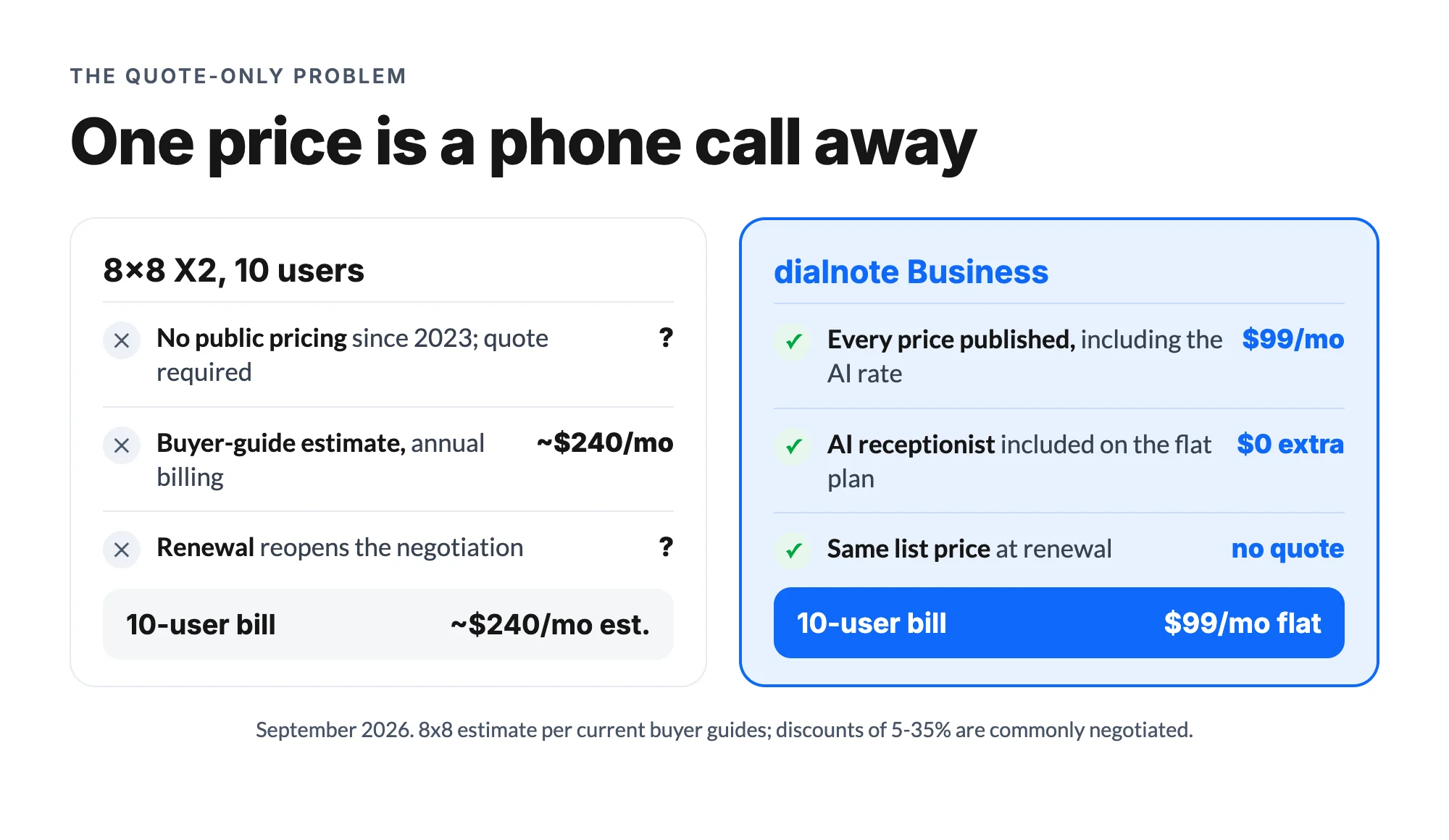
dialnote's pricing takes the opposite position from 8x8 on purpose: every price is published, including the AI rate. Plans run $49/month (Team), $99/month (Business), and $199/month (Pro) with unlimited users, plus a $19/month Solo plan. One note on the dialnote column: the flat plan covers the phone system and every seat, and AI calls are $25/month for 65 with the AI call pack, or $0.49/minute from the wallet without one. Light AI months can run on the wallet alone; busy ones are still cheaper than a per-seat tier.
One fine-print flag on each side: OpenPhone's "unlimited" US/CA calling has a fair-use cap around 1,000 minutes per user, and 8x8's headline international calling belongs to the higher tiers, so confirm which countries your quoted plan actually covers before you sign.
What does a year of each cost?
Put the quote in yearly terms before you sign it, because that's the number your budget actually feels. 8x8's estimated $240 × 12 = roughly $2,880 for year one, pending your negotiation and again at renewal. OpenPhone Business: $230 × 12 = $2,760. dialnote Business: $99 × 12 = $1,188, published, with no renewal conversation.
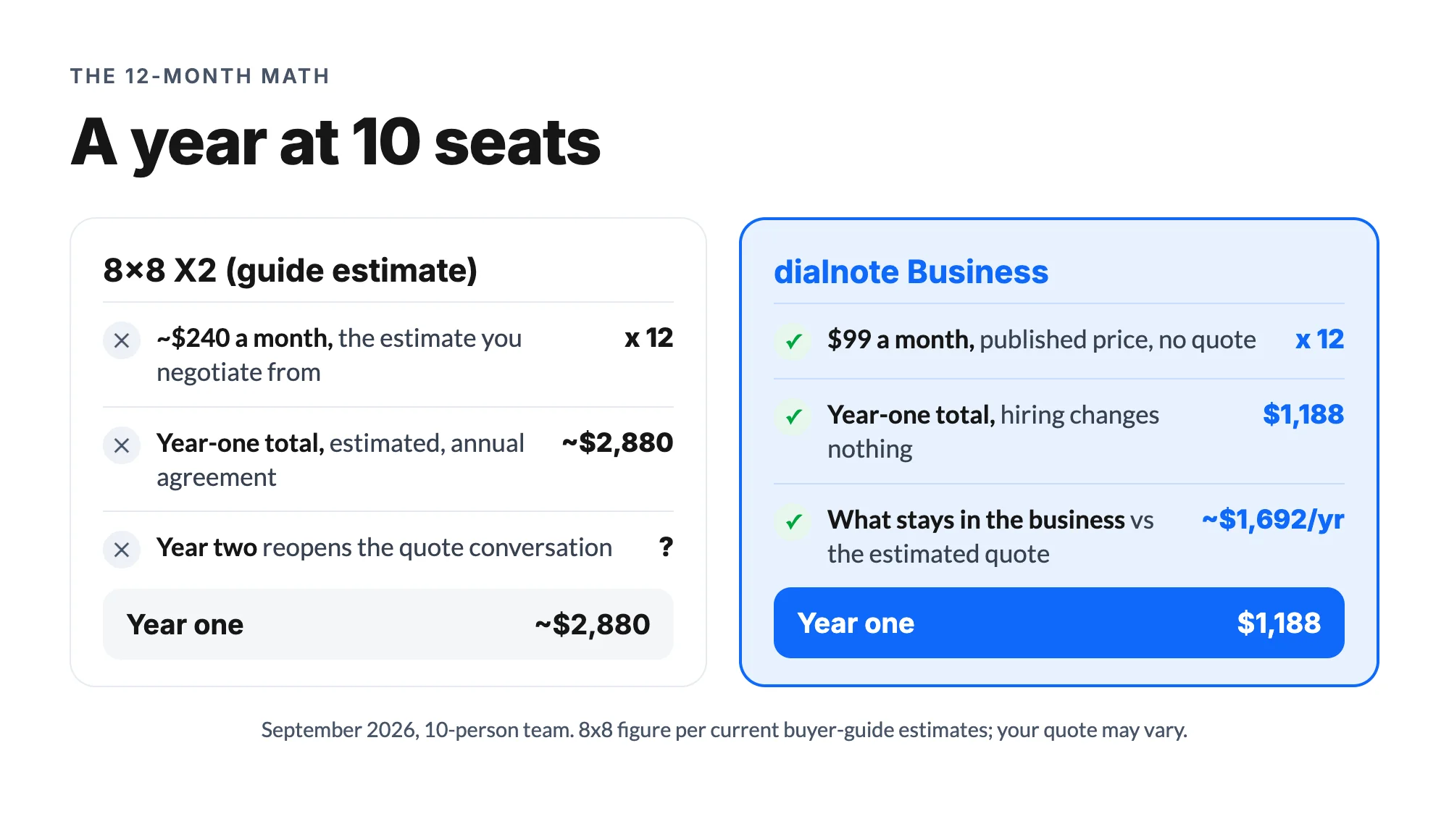
That's about $1,692 a year kept versus the 8x8 estimate, and the more useful part is the certainty: one of those yearly numbers is a fact you can budget, and two are estimates that reopen every renewal. Run your own headcount on the cost calculator to see your version of the gap.
Which one answers calls when your team can't?
This is the question I ask every customer to test before choosing anything, because it's where the money actually leaks. Dana's practice misses calls during client meetings; a roofing crew misses them on roofs; every business has its version.
8x8's answer is routing and voicemail. The auto-attendant and ring groups are competent, and the separate contact-center product goes much further, at contact-center prices, for contact-center buyers. For a small business on X2, an unanswered call ends in a mailbox.
OpenPhone's answer is Sona: a genuine AI agent, included, but metered at roughly 10 AI-handled calls a month before credit packs from $25/month. Enough to try; not enough to rely on.
dialnote makes the missed call the main event. The AI receptionist answers 24/7 in 14 languages, asks the qualifying questions you set, books meetings through Calendly or Cal.com, sends texts, and transfers to a teammate when someone's free, then syncs the AI call summary to your CRM. And you pick the behavior per number: full AI answering, an automated text-back, a we'll-call-you-back message, or plain voicemail with a transcript. You can try the AI receptionist live before creating an account.
I'll admit what I can't know from the outside: 8x8's roadmap may bring AI answering down from the contact center into the business plans eventually. Today, it isn't there, and today is when your phone is ringing.
One clarification that saves people a wrong turn: if what you actually run is a contact center, with agents, queues, service levels, and workforce management, then 8x8's separate contact-center product is its real weapon, and neither OpenPhone nor any small-business phone system is the right comparison. That's a different purchase with different budgets. This article is for the other 95% of small businesses, where "contact center" means whoever's nearest the phone.
What are they like to run day to day?
8x8's daily reality depends on who you are in the org chart. For IT, it's a proper platform: admin controls, compliance reports, a vendor who signs things. For the nine people using it, it's a capable but heavyweight suite where the everyday actions sit a few clicks deeper than they should. Small businesses without an IT owner often end up using a fraction of what they're paying for.
OpenPhone's daily reality is the opposite: light, fast, learnable in an afternoon, with every customer conversation in one shared thread. The cost is the ceiling: no video, no queues, no desk phones, and the per-seat bill climbing as you hire.
The buying experience difference carries into support too. Self-serve products live and die by their help docs and chat support; quote-sold products route you through account managers. Ask yourself which experience you want on the day the phones misbehave.
A small operational note that surprises people on both platforms: extra phone numbers are their own line item. OpenPhone includes one number per user with extras at $5/month, and 8x8's number pricing depends, like everything, on the quote. dialnote's Business plan includes 3 numbers with additional local numbers at $1.25/month. If your marketing runs separate tracked lines, ask this question early; it's the kind of detail that never makes the demo.
How do you switch without losing your number?
The port process is the same in any direction:
- Open the new account first. Don't cancel anything until the port completes; a closed account can release your number.
- Submit the port from the new provider's side with your account number and PIN. They file the paperwork with both carriers.
- Work normally during the wait. Ports take about 1 to 3 weeks, and your existing line works the whole time.
- Confirm the cutover, then cancel the old service.
Your customers keep dialing the number they've always known. Our switching guide walks through every step.
Where both fall short
8x8's gaps:
- No published pricing since 2023; budgeting requires a sales cycle, and renewals reopen it.
- The suite is heavy for small teams, and the best features (including the international calling story) sit in higher tiers.
- No AI answering in the business plans; that lives in a separate contact-center product.
- The admin and user experience feel built for IT departments, not nine-person offices.
- Per-seat pricing, so growth raises the bill.
OpenPhone's gaps:
- Per-user pricing, with the useful features on the $23/user Business tier.
- Sona is credit-metered: about 10 free AI calls a month, then paid packs.
- US and Canadian numbers only, and international calls are metered per minute.
- No video meetings or desk-phone support.
- The Quo rebrand still splits reviews and documentation across two names.
Why dialnote might be the better pick
The pattern in this comparison: 8x8 asks you to buy like an enterprise, OpenPhone asks you to pay per seat forever, and neither answers the phone for you. dialnote is an AI business phone system with no per-user pricing. AI voice agents answer calls, capture leads, and book meetings 24/7. Plans from $19/mo. It was designed against all three.
Published, flat pricing. $49 to $199 a month, unlimited users, every rate on the website including the AI's. No quotes, no negotiation, no renewal surprise.
The AI receptionist included. Answering, lead capture, booking, texts, transfers, and CRM-synced summaries on the flat plan.
Self-serve like an app, reach like a suite. Sign up in minutes; numbers in the US, Canada, UK, India, and France today (more countries opened on request), calling to 90+ countries.
The after-call work handled. Automatic recording, AI summaries, and sync to HubSpot, Salesforce, Pipedrive, or Zoho.
If you're weighing the wider field, our Quo (OpenPhone) alternatives guide ranks more options, and the dialnote vs 8x8 comparison goes feature by feature.
"Unpublished pricing is a segmentation strategy, and small businesses are the segment it's designed to filter out," says Neil D'Souza, dialnote's CTO. "If reading the price requires a meeting, the product wasn't built for you."
OpenPhone or 8x8: which should you choose?
Pick 8x8 if you're a multi-location or compliance-heavy business with real international calling volume and an IT owner who wants one accountable vendor. That's who it's built and priced for.
Pick OpenPhone if you want a light, self-serve team phone with great texting, your calling stays in the US and Canada, and the per-seat math fits your headcount.
Pick dialnote if you want published flat pricing, worldwide availability, and an AI receptionist that actually answers, without either the enterprise sales cycle or the seat meter. It's built for the team that just wants to see the price, sign up, and stop missing calls.
Dana's practice, for the record, ended up splitting the difference: international calling turned out to be four numbers' worth of per-minute charges, cheaper than any suite, and the real problem was the calls missed during client meetings. Once she priced the actual problem instead of the impressive one, the decision took an afternoon. That's my standing advice from the support desk: write down what your phone problem costs you per month, then buy against that number, not against a feature list.
The bottom line on OpenPhone vs 8x8: one hides the price and sells the platform, the other publishes the price and sells the seat. If what you're really buying is answered calls at a knowable cost, that's a third product.
Start a free 10-day trial of dialnote, no credit card required, or see your team's math side by side.
Frequently asked questions
OpenPhone (now Quo) is a self-serve, app-first phone for small teams with published prices. 8x8 is a full unified-communications suite sold through sales quotes, strongest for international calling and multi-location businesses. Different buyers entirely.
8x8 stopped publishing prices in 2023, so you have to request a quote. Current buyer guides put the entry X2 plan around $24/user/month and X4 around $44/user/month on annual billing, with negotiated discounts reported between 5% and 35%.
International calling. Higher 8x8 tiers include unlimited calling to dozens of countries, which most rivals meter per minute. Multi-location and compliance-heavy businesses are its natural buyers.
Slightly, at the tiers teams compare: OpenPhone Business is $23/user/month published, and 8x8's X2 is estimated around $24/user/month via quote. Both are per-seat, so 10 users run $230 to $240 a month, vs $99 flat on dialnote's Business plan.
Yes. Both support standard porting. Open the new account first, submit the port request with your account details, and keep the old service active until the transfer completes, usually 1 to 3 weeks.

Written by
Pratiksha Singh Tomar
Customer Success Specialist, SmartReach.io
Pratiksha Singh Tomar is a Customer Success Specialist at SmartReach.io with over 9 years of experience in business development, client relationship management, and communication technology. Before SmartReach, she spent nearly a decade at Shreeram Te...
Pratiksha Singh Tomar is a Customer Success Specialist at SmartReach.io with over 9 years of experience in business development, client relationship management, and communication technology. Before SmartReach, she spent nearly a decade at Shreeram Te...
Related Articles
OpenPhone vs Vonage: Which Is Better Value?
Compare OpenPhone vs Vonage on pricing, add-on fees, and AI answering, then see why dialnote may be the better value for small teams.
OpenPhone vs JustCall: Which Is Better for Teams?
Compare OpenPhone vs JustCall on pricing, AI tiers, and hidden minimums, then see why dialnote may be the smarter pick for small teams.
OpenPhone vs Ooma: Which Should Your Business Use?
Compare OpenPhone vs Ooma on pricing, texting limits, and AI answering, then see why dialnote may fit small businesses better than both.