Grasshopper Pricing: What You Pay and What You Don't Get
Grasshopper pricing looks like the simplest bill in business phones: three flat plans at $18, $32 and $70 a month, no per-user charge, unlimited calling minutes. That part's true, and it's why Grasshopper still wins a lot of first-number decisions. The catch isn't a hidden per-seat fee. It's what the price leaves out, and what each missing piece costs when you bolt it back on.
Priya runs a three-person mobile dog-grooming business out of two vans. She picked Grasshopper Solo Plus at $32 a month because it let all three of them share one number for free. Fourteen months later she was paying for a second number, a texting fee, and $150 a month for a Smith.ai AI receptionist, because the vans were missing booking calls while the clippers were running. Her "$32 phone system" was a $193.50 one.
Was it a bad choice? Not at the start. It just stopped being the cheap one.
We've built phone and outreach software for over a decade, and the pattern is always the same: the sticker answers "what does the number cost?" and the invoice answers "what does the system cost?" This teardown covers both, with every figure priced month to month and checked against the live US pricing pages in October 2026.
TL;DR:
- Grasshopper pricing is flat per account: True Solo $18, Solo Plus $32 and Small Business $70 a month billed monthly, as of October 2026. Annual billing cuts that to $14, $25 and $55.
- Every plan includes unlimited US and Canada calling minutes. Users are capped at one on True Solo and unlimited on the other two.
- The add-ons move the bill: extra numbers are $10 a month, extra extensions $5, and texting costs $19.50 to register plus a $1.50 monthly fee.
- Grasshopper has no built-in AI agent. Its Virtual Receptionist is a Smith.ai-powered add-on at an unpublished price; bought direct, Smith.ai's AI receptionist is $150 a month for 75 calls.
- For a 3-person team with two numbers and AI answering, Grasshopper plus Smith.ai lands near $193.50 a month. dialnote, an AI business phone system, covers the same setup for $76 on its $49 Team plan with the $25 AI call pack (65 calls). Without AI, Grasshopper is the cheaper pick.
Jump to: plans at a glance · what each plan includes · hidden fees and add-ons · AI answering · team math · vs dialnote · cutting the bill · the verdict
Grasshopper pricing plans at a glance
So how much does Grasshopper cost? Grasshopper pricing runs $18 to $70 a month billed monthly, or $14 to $55 on annual billing, priced per account rather than per person. Here are the three Grasshopper plans as listed on its US pricing page in October 2026:
| Plan | Billed monthly | Annual billing | Per year (monthly) | What you get |
|---|---|---|---|---|
| True Solo | $18/mo | $14/mo | $216 | 1 user, 1 number, 1 extension |
| Solo Plus | $32/mo | $25/mo | $384 | Unlimited users, 1 number, 3 extensions |
| Small Business | $70/mo | $55/mo | $840 | Unlimited users, 4 numbers, unlimited extensions |
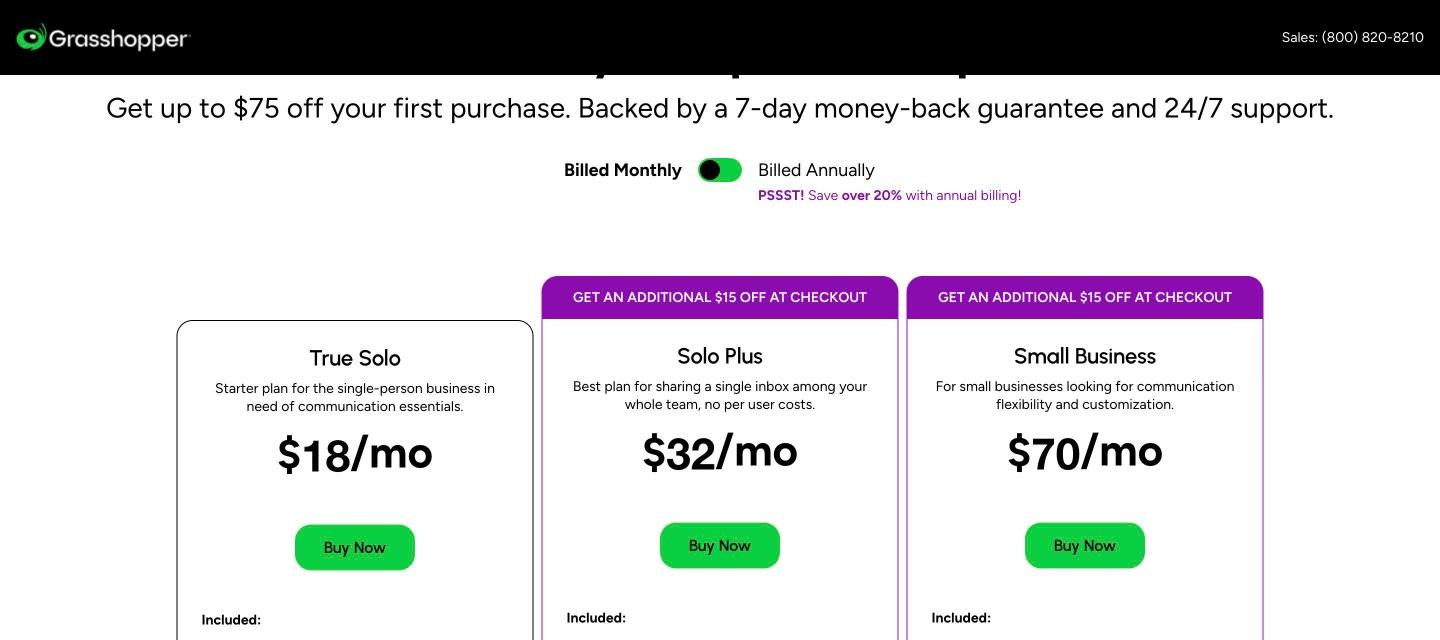
Three things are worth knowing before you compare these numbers to anything else.
First, the unit is the number, not the person. Solo Plus covers unlimited users on one number, which is genuinely unusual. A five-person crew can share a single line for $32 a month, and no per-seat vendor gets close to that.
Second, extensions are the real tier limit. An extension is a place a call can be routed: a person, a department, a voicemail box. True Solo has one, Solo Plus has three, and Small Business has unlimited. Most teams outgrow a plan by running out of extensions or numbers, not users.
Third, the advertised price is the annual one. Grasshopper's pricing page headline says plans start at $14 a month, which is the annual rate. Month to month, every plan costs about 28% more, and that's the price we use throughout this post, because it's what you pay without committing for a year.
Older guides still quote the Small Business plan at $80 a month. That was the price until recently. It's $70 month to month now, and $55 on annual billing.
What does each Grasshopper plan include?
Each Grasshopper plan includes unlimited calling, business texting (once registered), mobile and desktop apps, voicemail transcription and virtual fax. The tiers differ on routing and recording, which is where the cheap plan stops being enough.
| Feature | True Solo | Solo Plus | Small Business |
|---|---|---|---|
| Users | 1 | Unlimited | Unlimited |
| Phone numbers | 1 | 1 | 4 |
| Extensions | 1 | 3 | Unlimited |
| Call recording | Not included | Included | Included |
| Phone menu (IVR) | Not included | Included | Included |
| Simultaneous call handling | Not included | Included | Included |
| AI call summaries and call sentiment | Not included | Included | Included |
| Unlimited calling minutes | Included | Included | Included |
True Solo ($18 monthly, $14 annual) is a forwarding line. One person, one number, one extension, and calls ring through to your cell. There's no phone menu, no recording, and no way to take a second call while you're on the first. For a solo consultant who wants a business number that isn't their personal one, it does the job well.
Solo Plus ($32 monthly, $25 annual) is where Grasshopper becomes a small phone system. Recording, a phone menu, call transfers and simultaneous calls all switch on, and the user cap disappears. Three extensions is the ceiling, so "press 1 for bookings, 2 for billing, 3 for everything else" uses all of it.
Small Business ($70 monthly, $55 annual) adds three more numbers and lifts the extension cap. It's the plan for a business with separate lines (a main line, a toll-free number, a second location) and more than three places to route calls.
Which plan do most small businesses actually need? In our experience, Solo Plus. True Solo is too thin the moment a second person answers the phone, because it can't transfer a call or take two at once. Small Business only earns its extra $38 a month when you need separate numbers for separate jobs.
A quick way to check: count the places a caller should be able to reach. If it's three or fewer and they all share one number, Solo Plus fits. If you need a second number for a second location or a toll-free line, price Solo Plus plus $10 numbers against Small Business before you upgrade.
What doesn't appear on any tier? Integrations. Grasshopper has no CRM sync and no API, so call data stays inside Grasshopper.
And there's no AI agent that holds a conversation. The AI on Solo Plus and up summarizes calls after they happen. It doesn't answer them.
The hidden fees and add-ons that change the bill
The add-ons are where a flat plan starts to vary. These come from Grasshopper's US pricing page in October 2026, except where marked as reported.
| Add-on | Billed monthly | Annual billing | What it's for |
|---|---|---|---|
| Extra phone number | $10/mo each | $9/mo each | A second line, toll-free or another area code |
| Extra extension | $5/mo each | $3/mo each | Past Solo Plus's 3 extensions (not on True Solo) |
| Texting registration | $19.50 one time | $19.50 one time | Carrier registration required to send business texts |
| Texting fee | $1.50/mo | $1.50/mo | Ongoing messaging fee once registered |
| Virtual Receptionist | Not published | Not published | AI, live or hybrid answering, powered by Smith.ai |
| International calling | Varies | Varies | Outbound calls outside the US and Canada |
| Professional Voice Studio | Quote | Quote | Recorded greetings by a voice artist |
The texting fees aren't Grasshopper being greedy. US carriers require every business that texts from a local number to register its brand and use case, a process called A2P 10DLC. Every provider passes that cost along in some form, so don't count it against Grasshopper alone. The part that does vary is how smoothly registration goes, and Grasshopper's reviews include plenty of owners whose texts stalled for weeks while it sat pending.
Extra numbers add up faster than people expect. At $10 each, a business that wants a main line, a toll-free number and one per van pays $30 a month in numbers on top of Solo Plus. That's nearly as much as the plan itself.
Then there's tax, the fee nobody quotes. Grasshopper's pricing page says "pricing subject to sales tax", and like every US phone provider it also passes through federal and state telecom charges. The biggest of those flows from the Universal Service Fund, and the FCC sets the contribution factor each quarter, so the amount moves.
Third-party invoice reviews put Grasshopper's taxes and fees at roughly $10 to $20 a month on a typical account. I'd treat that range as reported, not verified. We couldn't see a live invoice, and it depends heavily on your state.
Does Grasshopper have an AI receptionist?
Not built in. Grasshopper sells a Virtual Receptionist add-on powered by its partner Smith.ai, with AI, live and hybrid options, and it doesn't publish the price on its pricing or receptionist pages. Its own plans add AI call summaries and sentiment from Solo Plus up, but those analyze calls after they end.
That distinction matters more than it sounds. A summary tells you what a caller wanted. An AI agent answers the caller while your hands are full, asks your questions, and books the job. Only the second one stops a missed call from becoming a lost customer.
Since Grasshopper won't quote it, the honest benchmark is Smith.ai's own price list. Bought direct, as of October 2026, Smith.ai's AI receptionist comes in three tiers: Free covers 25 calls a month and charges $3 a call after that, Pro is $150 a month for 75 calls, and Enterprise is $500 a month for 300 calls.
We price AI answering in this post at Smith.ai Pro, $150 for 75 calls, because its call allowance is the closest match to the AI call pack's 65 calls for $25. If your volume is very low, the free tier is genuinely cheaper: up to 25 AI calls a month costs nothing extra. Ask Grasshopper for its own add-on price in writing before you sign, since it may differ from Smith.ai's direct list.
Here's the strong opinion: answering the phone shouldn't be a $150 bolt-on to a $32 phone system. When the add-on costs nearly five times the plan, the plan isn't really the product anymore. That's not a knock on Smith.ai, which does good work. It's a knock on the shape of the bill.
What does Grasshopper cost a 1, 3 or 8-person business?
Because Grasshopper is flat, team size barely moves the price. The things that move it are how many numbers you need and whether you want AI answering. Here are three common setups, billed monthly, with texting registered, before taxes, as of October 2026:
| Setup | Grasshopper plan and add-ons | Grasshopper monthly | With Smith.ai AI (Pro) |
|---|---|---|---|
| Solo, 1 number, texting | True Solo $18 + $1.50 texting | $19.50 | $169.50 |
| 3 people, 2 numbers, texting | Solo Plus $32 + $10 number + $1.50 | $43.50 | $193.50 |
| 8 people, 4 numbers, texting | Small Business $70 + $1.50 | $71.50 | $221.50 |
Each setup also pays the $19.50 texting registration once. On annual billing, the base rows drop by $4 to $15 a month.
The first column is the Grasshopper most people picture, and it's cheap. The second column is the one Priya ended up on, and it isn't. Adding AI answering multiplies the bill by 3 to 9 times, because the AI costs more than any of the plans.
Here are the same three setups on dialnote, also billed monthly. Texting there carries the same $19.50 carrier registration plus $2 a month in carrier fees, and AI calls come from the $25 AI call pack (65 calls a month):
| Setup | dialnote plan | dialnote monthly | With AI call pack |
|---|---|---|---|
| Solo, 1 number | Solo $19 (receives texts but can't send them; no AI agent) | $19 | $76 on Team $49 + $2 + $25 |
| 3 people, 2 numbers, texting | Team $49 + $2 carrier fees | $51 | $76 |
| 8 people, 4 numbers, texting | Business $99 + $5 number + $2 | $106 | $131 |
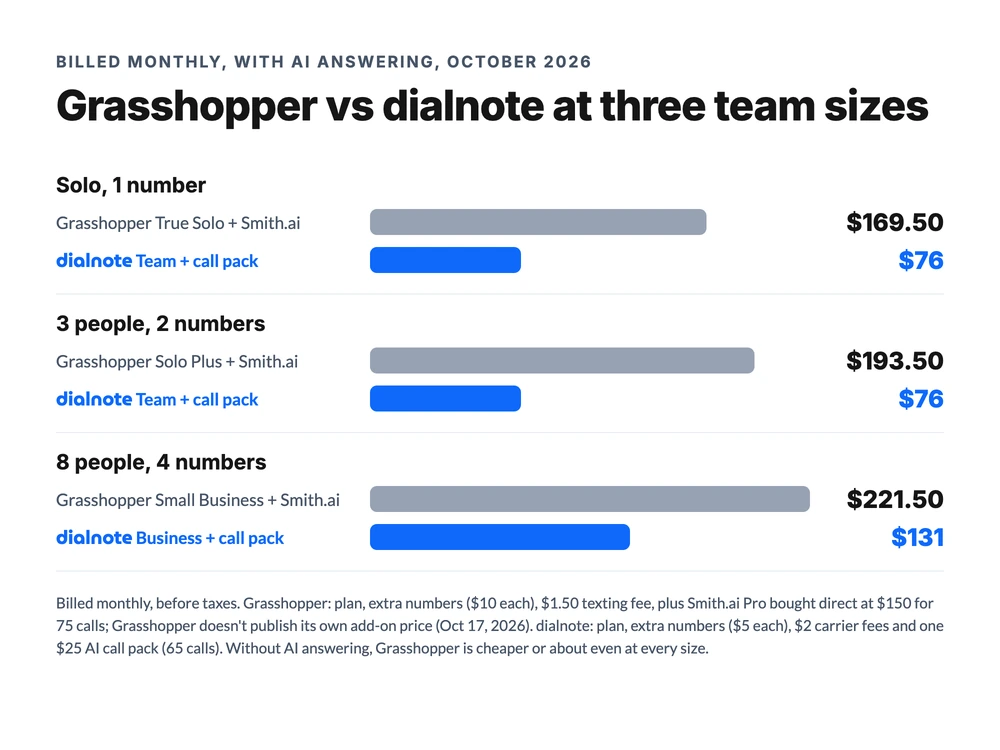
Read the two tables together and the crossover is clear. Without AI answering, Grasshopper is cheaper or about even at every size. At 3 people it's $43.50 against $51, and at 8 people it's $71.50 against $106. The 8-person row in the second table uses Business because its 1,400 shared calling minutes suit an office that talks all day, while Grasshopper's minutes are unlimited on every plan. That's a real Grasshopper advantage, and it's worth more the more your team talks.
With AI answering, the order flips. Smith.ai Pro costs $150 for 75 calls, while one AI call pack costs $25 for 65. The gap runs from about $90 to $118 a month, roughly $1,085 to $1,410 a year.
The exception is very low volume. A crew whose AI would handle 25 calls a month or fewer can use Smith.ai's free tier, and then the 3-person Grasshopper setup stays at $43.50. At 65 calls the free tier's $3 per-call charge adds $120, which already puts Grasshopper well above $76.
So the decision isn't Grasshopper vs anyone on price. It's whether you need the phone answered when nobody can pick up, and how often. Which side of that line are you on?
A three-year look at a growing crew
Flat pricing is supposed to protect you from growth. It mostly does, until growth means more numbers. Here's Priya's crew over three years, billed monthly, with AI answering on both sides:
| Year | Crew | Grasshopper setup | Grasshopper / year | dialnote setup | dialnote / year |
|---|---|---|---|---|---|
| Year 1 | 3 people, 2 numbers | Solo Plus + 1 number + Smith.ai Pro | $2,322 | Team + AI call pack | $912 |
| Year 2 | 5 people, 3 numbers, 5 extensions | Solo Plus + 2 numbers + 2 extensions + Smith.ai Pro | $2,562 | Team + 1 number + AI call pack | $972 |
| Year 3 | 7 people, 4 numbers | Small Business + Smith.ai Pro | $2,658 | Business + 1 number + AI call pack | $1,572 |
| Three years | $7,561.50 | $3,475.50 |
Both totals include the one-time $19.50 texting registration. The gap is about $4,090 over three years, and the AI add-on more than accounts for it. Run the same three years without AI and Grasshopper comes out ahead, $2,161.50 against $2,575.50, mostly because the bigger crew moves up to Business in year 3 for its larger minute pool.
One honest caveat on both sides: AI call volume isn't fixed. A crew whose AI handles 130 calls a month needs a second $25 call pack, and on Smith.ai it runs past the 75-call Pro allowance into per-call charges. If your volume is high, get both quotes at your real number.
Monthly vs annual: is the discount worth it?
Annual billing saves about 22% on Grasshopper. On True Solo that's $48 a year, and on Small Business it's $180 a year, real money for a small business.
The trade is commitment. Grasshopper's pricing page offers a 7-day money-back guarantee on your first purchase, and a 7-day free trial with no credit card before that. After that, third-party reviews report that annual plans aren't refunded or prorated if you cancel early. If you're not sure the setup will last 12 months, the monthly premium is the price of keeping your options open.
There's also the exit to plan for. Cancelling Grasshopper has historically meant contacting support rather than clicking a button, according to its reviews, and you'll want your number ported out before the account closes. Porting is routine and usually takes one to three weeks, so start it while the old service is still running.
My rule of thumb: pay annually only for the part you're certain about.
A solo forwarding line you'll keep for years? Annual. A team setup you might replace once missed calls start costing jobs? Monthly, until you know.
Grasshopper vs dialnote, side by side
dialnote is the AI business phone system priced for your whole team: shared numbers, call routing, branded AI voice agents that answer, qualify, and book, and automatic CRM sync, all included, with no per-user cost. It's flat-priced like Grasshopper, which makes this an honest comparison: two flat bills, built for different jobs.
| Grasshopper | dialnote | |
|---|---|---|
| Pricing model | Flat per account: $18 / $32 / $70 a month, about 22% less annually | Flat per account: $19 / $49 / $99 / $199 a month, 20% off annually |
| Users | 1 on True Solo, unlimited from $32 | 1 on Solo, unlimited from $49 |
| Calling minutes | Unlimited US and Canada on every plan | Shared monthly pool, 700 minutes on Team |
| AI answering | No built-in agent; Smith.ai-powered add-on, price not published (Smith.ai direct: $150 a month for 75 calls) | AI agent on Team and up; AI calls $25 a month for 65 on the AI call pack |
| Texting | Every plan, $19.50 registration + $1.50 a month | Team and up, 750 texts a month on Team |
| CRM and integrations | None, no API | HubSpot on Team; Salesforce, Pipedrive, Slack on Business; Zapier |
| Free trial | 7 days, no card | 10-day free trial, no credit card |
Best for: Grasshopper is the better pick for a solo owner or a small crew that wants a cheap shared number with unlimited minutes and no learning curve. dialnote is the better pick when missed calls cost jobs, when a CRM should know about every call, or when the team wants AI answering without paying more for it than for the phone system.
dialnote's honest limits: the Solo plan can't send texts and has no AI agent, calling minutes come in a pool instead of unlimited, and there's no live human receptionist option. If you want a person answering every call, a live service is still the right purchase. The full dialnote vs Grasshopper comparison covers features beyond price.
How do you keep a Grasshopper bill down?
If you're staying on Grasshopper, and plenty of businesses should, five moves keep the bill close to the sticker.
- Buy extensions before you buy numbers. An extra extension on Solo Plus is $5 a month billed monthly. An extra number is $10. If what you need is another place to route calls ("press 2 for the second van"), an extension does the job for half the price.
- Don't jump to Small Business for one more number. Solo Plus with three extra numbers is $62 a month, still under Small Business at $70. The upgrade pays off once you also need more than three extensions: two extra extensions tip it over.
- Use the checkout promo, then pay annually if you're sure. Grasshopper's pricing page offered $15 off Solo Plus and Small Business at checkout on monthly billing in October 2026, and $20 to $75 off annual plans. Combined with the annual rate, that's a real first-year saving.
- Register for texting before you need it. The $19.50 registration is a one-time cost, but the wait isn't fixed. Start it the week you sign up, not the week a customer asks for a text confirmation.
- Get the AI price in writing before you buy it. Ask Grasshopper what its Virtual Receptionist costs and how many calls it covers, then compare against Smith.ai's direct $150 for 75 calls and a flat call pack. If your volume is under 25 calls, check whether the free tier covers you.
A sixth move is free: look at the voicemail count every Friday. If messages wait more than an hour for a callback most weeks, the cheapest plan is probably costing you jobs that never show up on any invoice.
When is Grasshopper the cheaper pick?
Grasshopper is the cheaper pick when you need a professional number and nothing has to answer it for you. Three situations where I'd tell someone to buy it:
- A solo forwarding line. True Solo at $18 a month beats dialnote Solo at $19 (and $14 vs $15 on annual billing), and unlike that plan it can send texts. For a consultant, tutor or freelancer whose calls are mostly scheduled, it's hard to beat.
- A small crew sharing one number. Solo Plus at $32 covers unlimited users. If three extensions are enough and voicemail is fine when everyone's busy, nothing in the flat-priced market is cheaper.
- A chatty team on a tight budget. Unlimited minutes on every plan is a real advantage. A team on the phone all day with no AI needs will spend less on Grasshopper than on any plan with a minute pool.
What tips the balance the other way? Usually one of three moments: the first booking call lost to voicemail, the first time you want call notes in a CRM, or the extension count hitting three. Any one of those changes which bill is the cheap one.
If you're already past that point, our Grasshopper alternatives guide prices ten other options, and if you're comparing two cheap lines, the Grasshopper vs Google Voice breakdown settles that matchup.
Is Grasshopper worth the price?
For what it's built to do, yes. Grasshopper is one of the few phone systems where the pricing page tells most of the truth: flat plans, unlimited users from $32, unlimited minutes, and a clear list of add-ons. That's more than most per-seat vendors can say.
The question is whether forwarding is still the job. Grasshopper was designed in an era when the best a small business could hope for was a professional greeting and a voicemail transcript. Today callers expect someone, or something, to pick up. Grasshopper's answer is a partner add-on it won't price publicly, and that's where its pricing stops being simple.
Here's how I'd decide. Price your Grasshopper plan with the numbers and texting you actually need. Then ask whether a missed call has cost you a customer in the last month.
If not, Grasshopper is a sensible buy, and you should pay annually. If it has, price the AI on both sides at your real call volume, using dialnote's pricing page for the flat side. And if you move, porting your number from Grasshopper is free in the US and Canada.
Priya's version of that math took ten minutes on a napkin between grooming appointments. Yours shouldn't take longer.
Price an AI-answered phone system against your Grasshopper bill
10-day free trial, no credit card required. Unlimited users from the Team plan.
Frequently asked questions
Grasshopper costs $18, $32 or $70 a month billed monthly, or $14, $25 and $55 on annual billing, as of October 2026. Prices are per account, not per user. Extra numbers ($10 a month), texting fees and sales tax are added on top.
For a simple shared number, yes: flat pricing, unlimited users from the $32 plan and unlimited US and Canada calling. It's weaker for teams that need CRM sync or an AI agent, since Grasshopper has no integrations and sells AI answering as a separately priced Smith.ai-powered add-on.
Yes. Its Virtual Receptionist is a Smith.ai-powered add-on, and Grasshopper doesn't publish the price. Bought direct, Smith.ai's AI receptionist is $150 a month for 75 calls as of October 2026. dialnote includes an AI agent on its $49 Team plan, with AI calls at $25 a month for 65.
Yes. Grasshopper offers a 7-day free trial with no credit card, and paid plans carry a 7-day money-back guarantee on the first purchase. dialnote runs a 10-day free trial, also with no credit card required.
Per-user business VoIP usually runs about $10 to $35 per user a month on annual billing: Zoom Phone is $10.50 to $24.50 and RingCentral $20 to $35. Flat plans price the account instead. Grasshopper runs $18 to $70 billed monthly, and dialnote $19 to $199 with unlimited users from $49.

Written by
Prateek Bhatt
Co-Founder, SmartReach.io
Prateek Bhatt is a product leader, programmer, and serial entrepreneur with over 12 years of experience building SaaS and AI-powered tools for sales and customer service teams. As Co-Founder of SmartReach.io - a multichannel outreach platform used by...
Prateek Bhatt is a product leader, programmer, and serial entrepreneur with over 12 years of experience building SaaS and AI-powered tools for sales and customer service teams. As Co-Founder of SmartReach.io - a multichannel outreach platform used by...
Related Articles
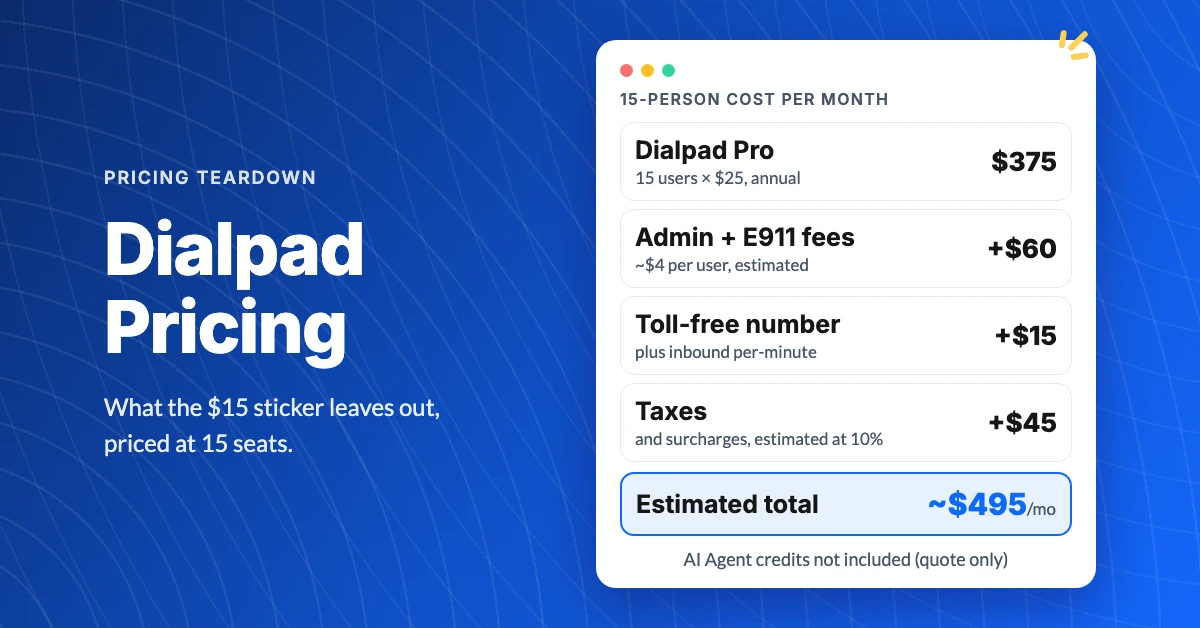
What Does Dialpad Pricing Really Cost a Small Team?
See what Dialpad pricing really costs: $15 to $35 per user, the 3-seat Pro minimum, per-text and admin fees, and real team math at 5, 15 and 30 people.
How Much Does RingCentral Really Cost per User?
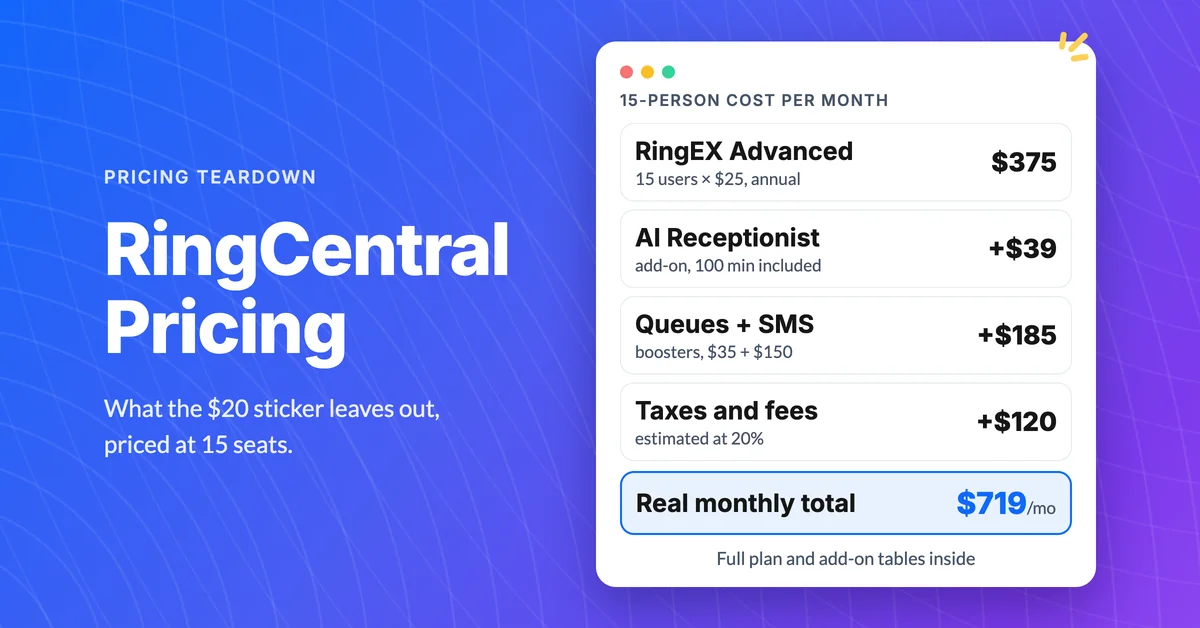
RingCentral cost per user starts at $20, but add-ons, SMS caps and regulatory fees decide the real bill. See the 15-person math and the flat-rate comparison.
Grasshopper vs Google Voice: Which Wins? [2026]
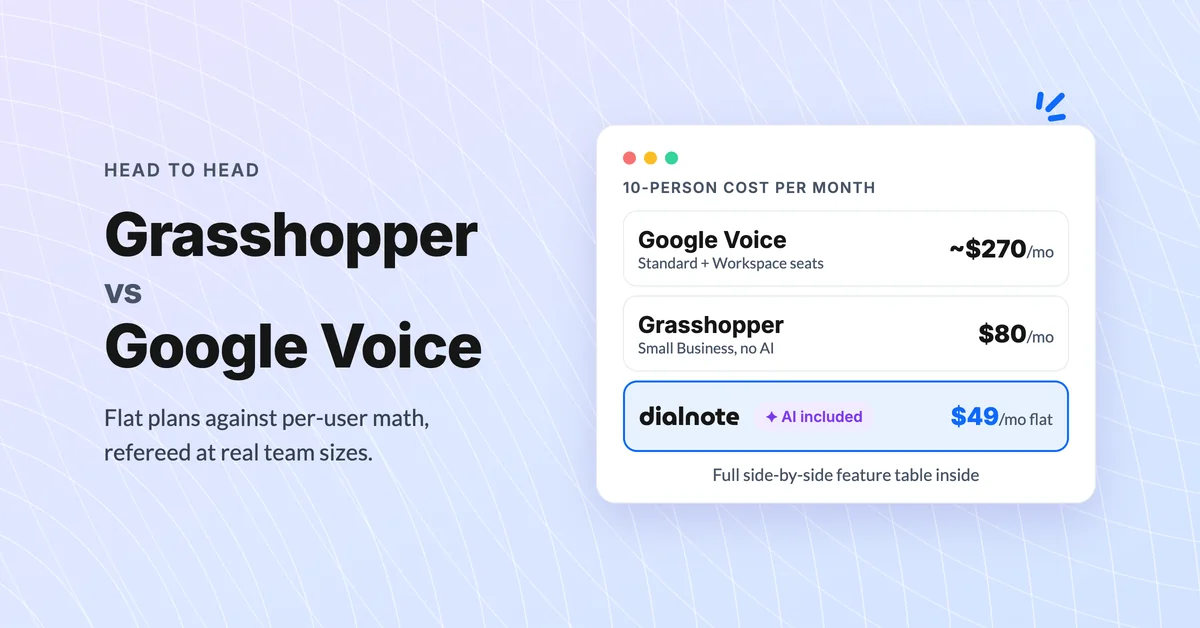
Compare Grasshopper vs Google Voice on real team cost, texting rules, and what happens to missed calls, plus a third flat-rate AI option.