Ruby receptionist pricing and what a minute really costs
Ruby receptionist pricing looks like the simplest page in the industry: four plans, four prices, and every feature included on all of them. What the page doesn't show is what happens after your last included minute, or what Ruby counts as a minute in the first place. Those two details decide the bill.
Dana manages the front desk at an eight-person dental clinic. Lunch hour and after-hours calls kept going to voicemail, so she signed up for Ruby's 100-minute plan at $395. Her calls are short, she figured, two minutes or so. That's about 50 calls covered.
Her first month had 120 calls, and the invoice was $1,565.
What happened? Ruby's minutes aren't talk time. They include hold time, they round up to the next full minute, and they keep running while the receptionist types up the message. Her two-minute calls billed as three. And past 100 minutes, every extra minute cost $4.50.
This guide prices every Ruby plan, including six that aren't on its pricing page and the overage rates that only appear in Ruby's help center, at the call volumes a small business actually sees. All figures are from Ruby's own pages, checked in October 2026.
TL;DR:
- Ruby receptionist pricing starts at $250 for 50 receptionist minutes, then $395 for 100, $720 for 200 and $1,725 for 500 a month as of October 2026. Ruby's help center lists six more plans, up to $7,875 for 2,500 minutes.
- Overage isn't on Ruby's pricing page. Its help center lists $5.40 a minute on the 50-minute plan, $4.50 on 100 and $4.40 on 200, falling to $3.30 on the largest plan.
- A receptionist minute includes hold time and after-call work, rounded up to the next minute. One extra billable minute per call adds $262.50 a month at 100 calls.
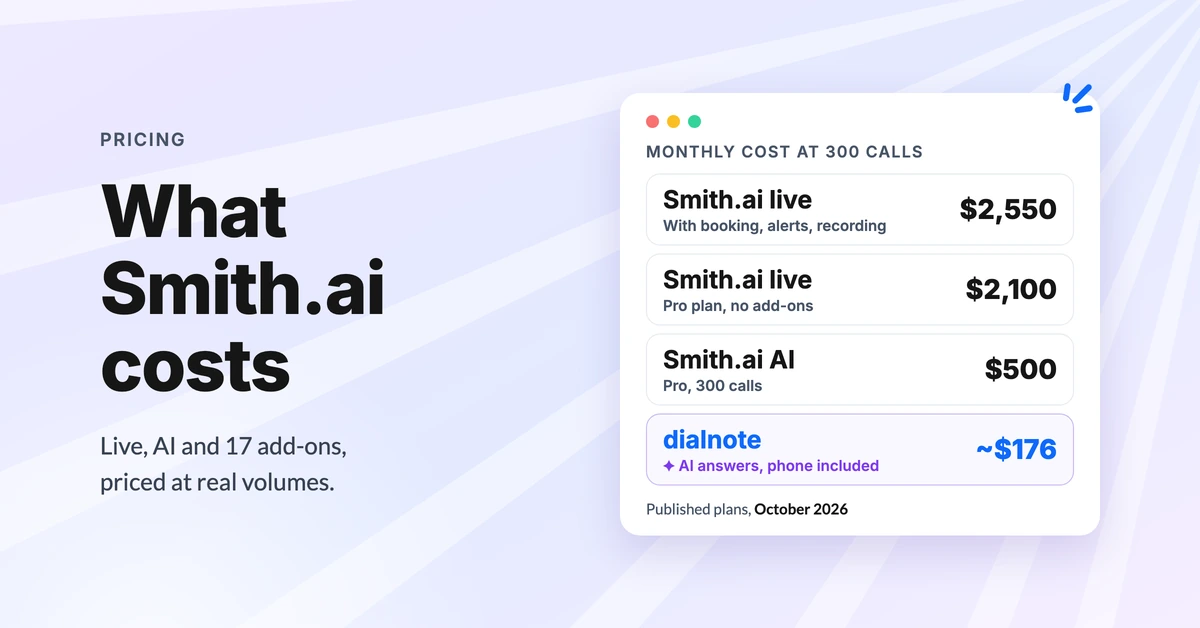
- At 300 three-minute calls a month, Ruby costs $3,127.50. Smith.ai's live plan costs $2,100, and dialnote, an AI business phone system, about $176 on the $49 Team plan with AI call packs, phone system included.
- Ruby is worth it when every caller needs a warm human voice. For routine calls, you're paying $3 to $5 a minute for work software now does.
Jump to: plans at a glance · the larger plans · overage rates · what's a minute · cost at 100, 300 and 600 calls · plan changes · vs dialnote · when Ruby wins · verdict
Ruby receptionist pricing at a glance
So how much does a Ruby receptionist cost? Ruby's pricing page lists four virtual receptionist plans, which is all most people ever see of Ruby Receptionists pricing. The only difference between them is the number of receptionist minutes:
| Plan | Monthly price | Minutes included | In-plan rate | Overage rate |
|---|---|---|---|---|
| 50 minutes | $250 | 50 | $5.00 a minute | $5.40 a minute |
| 100 minutes | $395 | 100 | $3.95 a minute | $4.50 a minute |
| 200 minutes (most popular) | $720 | 200 | $3.60 a minute | $4.40 a minute |
| 500 minutes | $1,725 | 500 | $3.45 a minute | $4.00 a minute |
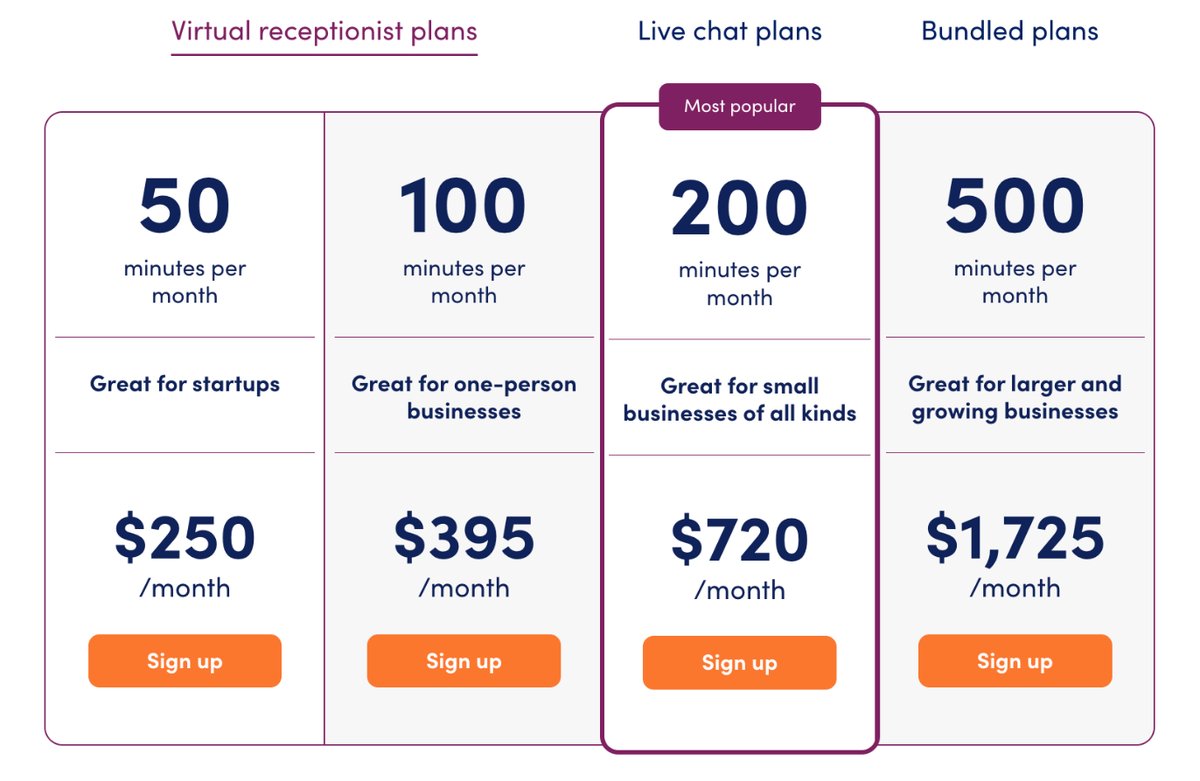
Every plan includes the same service: 24/7 live answering (nights, weekends and holidays too), Spanish and bilingual answering, scheduling, lead qualification and intake, payment collection, outbound call help, AI-powered transcripts and call sentiment, and phone service hosting. There are no activation, setup or onboarding fees.
That's genuinely simple. You won't find a list of per-call add-ons like Smith.ai's. The catch sits one column over, in the overage rate, and it's higher than the in-plan rate on every plan.
Ruby also bundles live website chat at 20% off: $115 for 10 chats, $268 for 30 or $416 for 50 a month, added to your receptionist plan.
The six plans not on Ruby's pricing page
Ruby's pricing page tops out at 500 minutes and says to talk to sales for more. Its billing help article (updated December 2025) lists the full ladder, including the minute range each plan is recommended for:
| Plan | Monthly price | Recommended for | Overage rate |
|---|---|---|---|
| 50 minutes | $250 | 0 to 76 minutes | $5.40 |
| 100 minutes | $395 | 77 to 172 minutes | $4.50 |
| 200 minutes | $720 | 173 to 311 minutes | $4.40 |
| 350 minutes | $1,210 | 312 to 471 minutes | $4.25 |
| 500 minutes | $1,725 | 472 to 706 minutes | $4.00 |
| 750 minutes | $2,550 | 707 to 957 minutes | $3.85 |
| 1,000 minutes | $3,350 | 958 to 1,436 minutes | $3.65 |
| 1,500 minutes | $4,945 | 1,437 to 1,915 minutes | $3.50 |
| 2,000 minutes | $6,400 | 1,916 to 2,433 minutes | $3.40 |
| 2,500 minutes | $7,875 | 2,434 minutes or more | $3.30 |
Two patterns jump out. The in-plan rate falls from $5.00 a minute to $3.15 as plans grow, so volume discounts are real. And Ruby's own recommended ranges run well past each plan's included minutes, which tells you overage isn't an accident. It's part of how the ladder is designed.
The 350-minute plan is worth knowing about. It sits between $720 and $1,725, and it's the cheapest fit for anyone using 312 to 471 minutes. Without the help article, you'd likely jump straight to the 500-minute plan.
What does Ruby charge for extra minutes?
Ruby charges $3.30 to $5.40 for each minute past your plan, depending on the plan, per its help center (October 2026). The FAQ only says extra minutes bill "according to the overage rate associated with your plan".
Here's what that means in dollars. On the 100-minute plan, going 50 minutes over costs $225, so a $395 plan becomes $620. At that point, the 200-minute plan ($720) is only $100 away, and it would absorb another 50 minutes before charging more.
Ruby does warn you. The Ruby app sends an alert when you've used 85% of your minutes, and another at 100%. That's useful, but an alert can't stop the phone from ringing.
What counts as a Ruby receptionist minute?
A Ruby receptionist minute isn't the same as talk time. According to Ruby's FAQ, here's what goes on the meter:
- Rounding: calls bill in 60-second increments, rounded up. A 10-second call bills as a full minute.
- Hold time counts: the clock starts when the receptionist receives the call, including time the caller spends on hold.
- After-call work counts: time spent completing your call details after the caller hangs up is billed too.
- Transfers stop the clock: once a call is transferred to you or your voicemail, talk time stops counting.
- Outbound calls count: if a receptionist calls someone for you, their time on the call and the follow-up email are both billed.
So a two-minute conversation with a short hold and a minute of message entry can easily bill as three or four minutes. That's not a trick. It's what a human receptionist's time actually costs. But it's the gap between what you estimate and what you pay.
Where will your own calls land? Honestly, it's hard to say. Ruby doesn't publish an average billable length per call, and it varies with how much your receptionists write up after each one. Pull a month of call logs, add a minute per call for wrap-up, and pick the plan from that number.
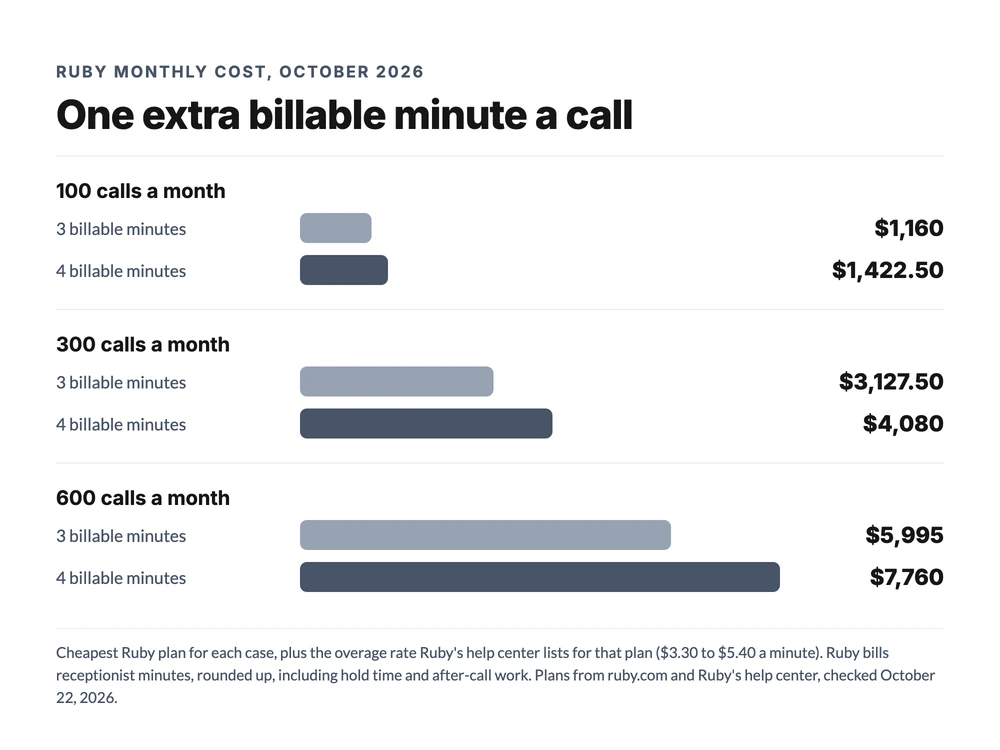
How much does one extra billable minute per call cost? At 100 calls a month, going from three billable minutes to four moves Ruby's cheapest option from $1,160 to $1,422.50. That's $262.50 a month, or $3,150 a year, for a minute you probably didn't notice.
Ruby receptionist cost at 100, 300 and 600 calls
At 300 three-minute calls a month, Ruby costs $3,127.50, against $2,100 for Smith.ai's live receptionists, as of October 2026. Here's Ruby at three volumes and two call lengths, using its cheapest plan for each case (plan plus published overage):
| Option | 100 calls | 300 calls | 600 calls |
|---|---|---|---|
| Ruby, 3 billable minutes a call | $1,160 | $3,127.50 | $5,995 |
| Ruby, 4 billable minutes a call | $1,422.50 | $4,080 | $7,760 |
| Smith.ai live (per call, any length) | $915 | $2,100 | $4,650 |
| dialnote AI business phone system, Team + AI call packs (3-minute calls) | $99 | about $176 | about $332 |
How the Ruby cells work:
- 100 calls at 3 minutes (300 minutes): the 200-minute plan plus 100 minutes at $4.40. That beats the 350-minute plan ($1,210) by $50.
- 300 calls at 3 minutes (900 minutes): the 750-minute plan plus 150 minutes at $3.85.
- 600 calls at 3 minutes (1,800 minutes): the 1,500-minute plan plus 300 minutes at $3.50.
- The 4-minute row: the same method on 400, 1,200 and 2,400 minutes, which lands on the 350, 1,000 and 2,000-minute plans.
- Smith.ai bills per call, so call length doesn't change its row. Our Smith.ai vs Ruby comparison covers the two services beyond price.
- dialnote: the $49 Team plan plus AI call packs at $25 for 65 calls (at 600 calls, nine packs plus a few calls at $0.49 a minute), with a few dollars of extra call minutes at higher volumes, less Team's $5 monthly credit.
Look at the Smith.ai row. Once your calls average three minutes or more, Smith.ai's per-call billing is cheaper than Ruby's per-minute billing at every volume here. If your calls are short, under about two minutes, Ruby can come out ahead. Any Ruby answering service cost comparison should start with your average call length. Our answering service cost guide works through that crossover in detail.
Dana's clinic, priced properly
Dana's 120 calls a month bill at about three minutes each, or 360 minutes. Here's what each Ruby plan would cost her:
| Ruby plan | Base | Overage | Total |
|---|---|---|---|
| 100 minutes (her first choice) | $395 | 260 minutes at $4.50 = $1,170 | $1,565 |
| 200 minutes | $720 | 160 minutes at $4.40 = $704 | $1,424 |
| 350 minutes | $1,210 | 10 minutes at $4.25 = $42.50 | $1,252.50 |
| 500 minutes | $1,725 | None | $1,725 |
The right plan saves her $312.50 a month over the one she picked. But even the right plan is $1,252.50 for lunch-hour and after-hours coverage, about $10.44 for every call answered.
The plan-change rules that lock you in
Ruby's help center sets three rules for changing plans, and they matter more than they look:
- New accounts get a three-billing-cycle calibration window. Ruby frames the first three months as the period to find the right plan.
- Upgrades apply to the current billing cycle, so you can move up mid-month to stop overage.
- Downgrades apply to the next cycle, and only after three consecutive billing periods on the same plan.
Rule three is the one to plan around. Say a busy spring, after your first three months, pushes you onto the 500-minute plan. When things calm down, you're on $1,725 a month for three billing periods before you can step back down. A one-month spike can cost you three months of the bigger plan.
The rest of Ruby's terms are customer-friendly. There's no long-term contract, cancellation takes effect at the end of your billing period, and first-time customers get a full refund if they cancel within 21 days or before using 500 receptionist minutes, whichever comes first.
Ruby vs dialnote, side by side
dialnote is the AI business phone system priced for your whole team: shared numbers, call routing, branded AI voice agents that answer, qualify, and book, and automatic CRM sync, all included, with no per-user cost. It's a different kind of product from Ruby, so here's how they compare as of October 2026:
| Ruby | dialnote | |
|---|---|---|
| Who answers | Live receptionists, with AI tools assisting them | An AI agent, with transfers to your team |
| How it bills | Receptionist minutes, $3.15 to $5.00 in-plan, $3.30 to $5.40 overage | $49 flat on Team for unlimited users, plus AI calls at $25 for 65 |
| What you're metered on | Hold time and after-call work, rounded up | AI-answered calls in packs, $0.49 a minute past them |
| Phone system | Phone service hosting available | Included: numbers, routing, a phone menu and apps |
| Cost at 300 calls (3 minutes) | $3,127.50 | About $176 |
| Best for | Callers who expect a warm, live person | Teams that want routine calls answered and a phone system in one bill |
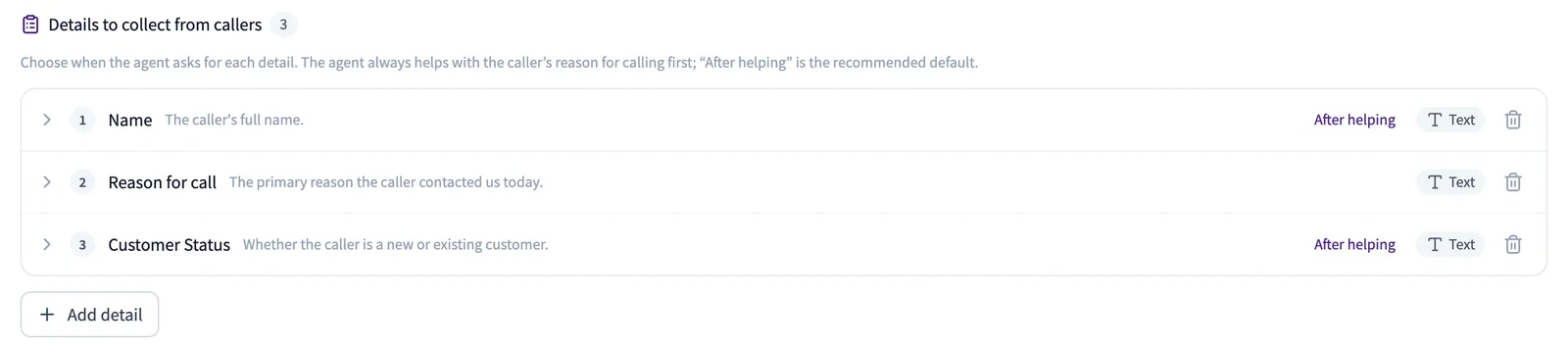
That's where Dana's intake questions would live: the AI agent asks every caller the same things her receptionists do, logs the answers, and books through Calendly or Cal.com. The honest limit is that it's not a person. A patient in pain who wants reassurance gets transferred to the clinic or leaves a message, and the pricing page lists exactly what each plan includes.
When is Ruby the better pick?
Ruby is the better pick when the voice on the phone is part of what you're selling. That covers a few clear cases:
- Callers who need warmth. Medical, legal, financial and funeral services, where a caller is anxious and a person's tone matters. It's what Ruby is known for.
- Short calls. Under about two billable minutes a call, Ruby's per-minute billing can beat per-call services like Smith.ai.
- Predictable volume. If your minutes barely move month to month, you can sit inside one plan and never touch overage.
- Bilingual callers. Spanish and bilingual answering is included on every plan, with no extra per-call fee.
Want to see who answers for less, live or AI? Our roundup of Ruby Receptionists alternatives compares ten options on the same basis.
Is Ruby worth the price?
Ruby is a good service with an expensive meter. The receptionists are well reviewed, every feature is included, and there's no contract. If your callers need a person, it's a reasonable choice, as long as you pick the plan from your real billable minutes and know the overage rate before you need it.
My honest take: the per-minute model punishes the businesses that are growing. Every busy month either costs overage or locks you into a bigger plan for three billing periods. And most of the calls on that meter (hours, directions, booking, "can someone call me back") don't need a $4-a-minute human to answer them.
Dana kept Ruby for after-hours patients who call in pain, and put an AI agent on the lunch-hour and routine calls. Her Ruby plan dropped to 50 minutes. The AI side costs less than her old overage did in a single week.
See what your call volume costs when routine calls are AI-answered
10-day free trial, no credit card required. AI agent from the Team plan.
Frequently asked questions
Ruby's virtual receptionist plans cost $250 for 50 minutes, $395 for 100, $720 for 200 and $1,725 for 500 a month as of October 2026. Its help center lists larger plans up to $7,875 for 2,500 minutes. Every plan has the same features.
Extra minutes bill at your plan's overage rate. Ruby's help center lists $5.40 a minute on the 50-minute plan, $4.50 on 100 and $4.40 on 200, down to $3.30 on 2,500 (October 2026). The Ruby app alerts you at 85% and 100% of your minutes.
Ruby bills in 60-second increments, rounded up. The clock covers hold time and the time a receptionist spends finishing your message after the caller hangs up. It stops counting once a call is transferred to you or your voicemail.
Under 25 calls a month, Smith.ai's free AI tier. Around 100 callers, Goodcall ($79 for 100 unique customers) and dialnote ($99 for 100 calls, Team plan plus two AI call packs, phone system included) were lowest as of October 2026. Ruby has no AI-only plan.
No. Ruby bills month to month and cancellation takes effect at the end of the billing period. First-time customers get a money-back guarantee if they cancel within 21 days or before using 500 minutes, whichever comes first.

Written by
Lancelot Dsouza
Chief Marketing Officer, SmartReach.io
Lancelot Dsouza is the Chief Marketing Officer at SmartReach.io, where he built the Marketing, Sales, and Customer Success verticals from the ground up. With over 25 years of experience spanning digital marketing, business development, and strategic...
Lancelot Dsouza is the Chief Marketing Officer at SmartReach.io, where he built the Marketing, Sales, and Customer Success verticals from the ground up. With over 25 years of experience spanning digital marketing, business development, and strategic...
Related Articles
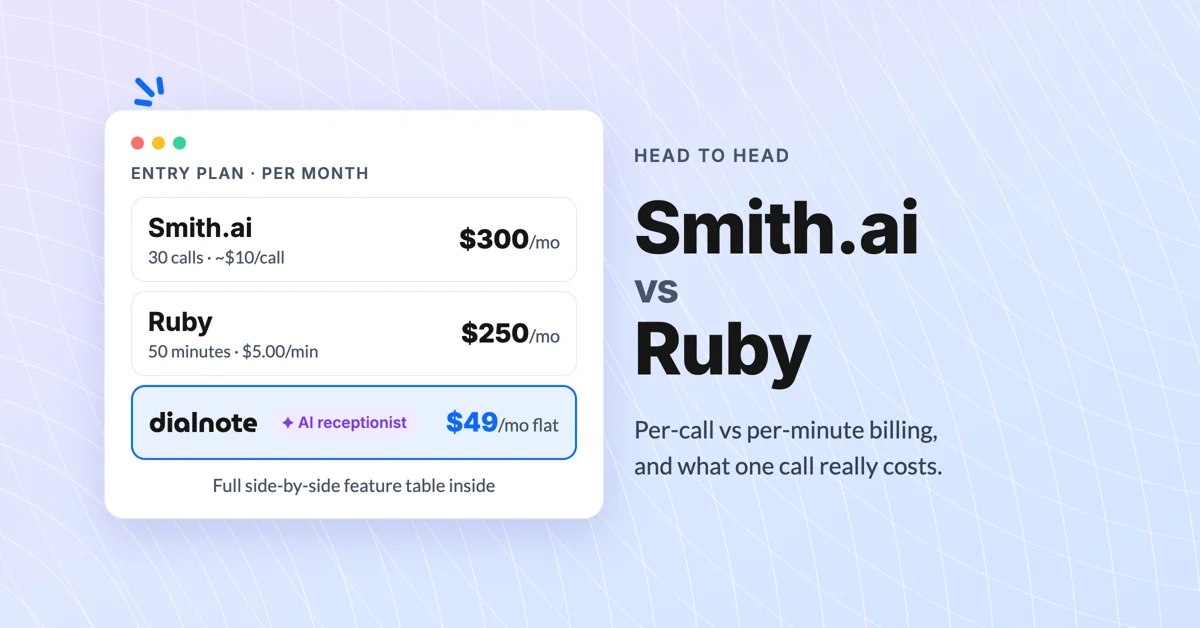
Smith.ai vs Ruby: Which Answering Service Wins?
Compare Smith.ai vs Ruby on pricing, billing models, and AI features. See what each answering service really costs, plus a cheaper third option.
Smith.ai pricing and what each add-on really costs
Check Smith.ai pricing plan by plan: live receptionists from $300 for 30 calls, AI from free, 17 add-on fees, and the real bill at 100 to 600 calls.

How Much Does an Answering Service Cost in 2026?
See what an answering service costs in 2026: per-minute live rates, per-call plans, hidden fees, and the flat-rate AI math at real call volumes.