Goodcall pricing and what each extra customer costs
Goodcall pricing starts with a promise most AI answering services can't make: no per-minute charges. The meter is people, not time. You pay for how many different customers your agent talked to this month, and nothing else moves the bill.
That's a genuinely different model, and it's worth understanding before you compare Goodcall AI pricing with anything priced by the minute or the call. A plan that looks expensive next to a $49 sticker can be the cheapest thing on the market for the right business. It can also hide its limits in places you won't look until the second invoice.
Ray runs operations for a property management company with four buildings. Tenants call about the same leaky faucet three times, and the leasing line rings all August. He put Goodcall's $79 Starter plan on the main office number, mostly because every repeat call was free.
His normal month was 90 different callers, so the bill was $79. His leasing month was 160, and the bill came to $126.40. Still cheap.
The surprise was somewhere else entirely: Starter allows one team member, so none of his four site managers could log in, and call history vanished after 30 days. So what does Goodcall really cost once you size the plan to the job?
This guide prices all the Goodcall plans at the call volumes a small business actually sees, explains what a "unique customer" is, and shows where the per-customer model beats everyone and where it doesn't. All figures come from Goodcall's pricing page, checked in October 2026.
TL;DR:
- Goodcall pricing is $79 a month for 100 unique customers (Starter), $129 for 500 (Growth) and $299 for 2,000 (Scale) as of October 2026, with extra customers at 79¢, 26¢ and 15¢ each. Enterprise is quoted.
- Minutes are never metered. A unique customer is one phone number, once a month. Repeat calls are free, and spam and wrong numbers don't count.
- At 300 calls a month (about 200 customers by Goodcall's own ratio), Goodcall costs $129 on Growth. dialnote, an AI business phone system, is $49 a month on Team for unlimited users and about $176 at 300 calls with AI call packs, phone system included.
- Goodcall is the cheaper option whenever the AI answers every call: $79 against $99 at 100 calls, $129 against about $176 at 300. It's a forwarding destination, not a phone system, so business calling stays a separate bill.
- Watch the plan limits that aren't prices: team members (1 on Starter), workers (5), call history (30 days) and external tools (1).
Jump to: plans at a glance · what a unique customer is · what each plan includes · cost at 100, 300 and 600 calls · what the price leaves out · vs dialnote · when Goodcall wins · verdict
Goodcall pricing at a glance
So how much does Goodcall cost per month? $79, $129 or $299 on its three published plans, before any extra customers, as of October 2026. Every plan bills per account, not per agent, and every plan includes a local phone number. Here's the lineup:
| Plan | Monthly price | Unique customers included | Extra customers | Goodcall's call estimate |
|---|---|---|---|---|
| Starter | $79 | 100 | 79¢ each | About 150 calls a month |
| Growth | $129 | 500 | 26¢ each | About 750 calls a month |
| Scale | $299 | 2,000 | 15¢ each | About 3,000 calls a month |
| Enterprise | Custom | More than 2,000 | Volume pricing | Quoted |
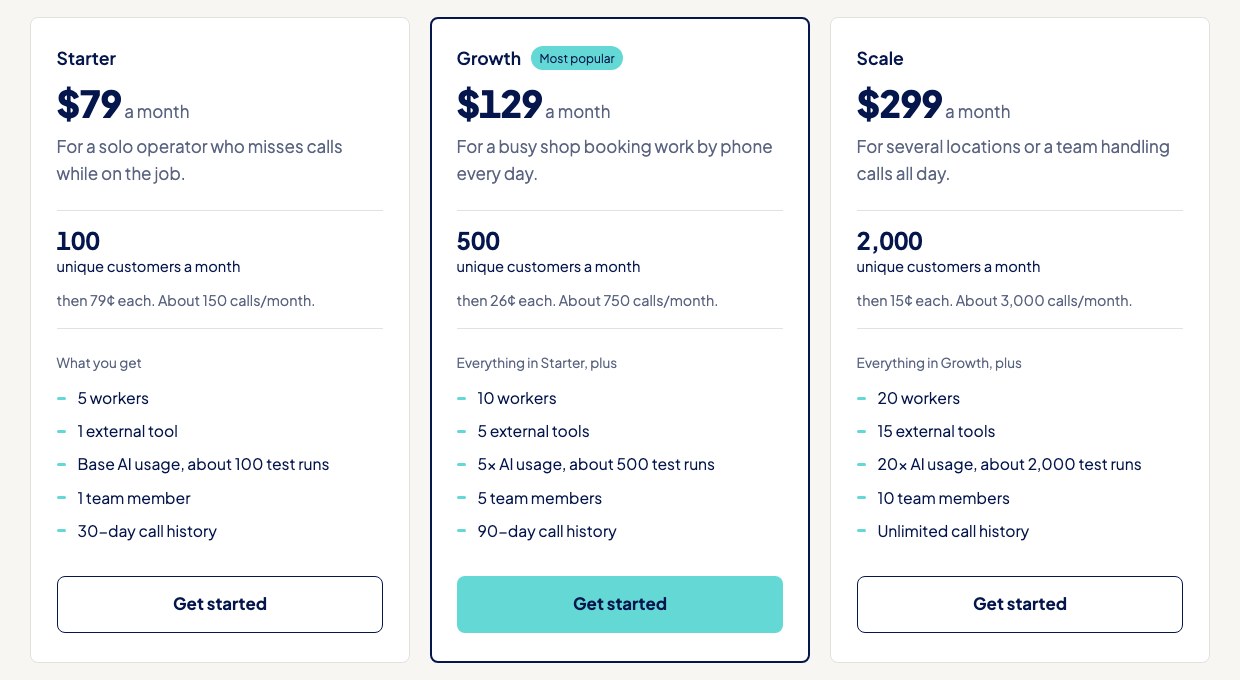
Three things stand out. First, the price per included customer falls fast: 79¢ on Starter, 26¢ on Growth, 15¢ on Scale, and the overage rate on each plan matches it, so there's no penalty rate for going over. Second, Goodcall's own call estimates assume about 1.5 calls per customer, which is the ratio we'll use below. Third, there's no annual discount listed and no free plan, just a demo agent you can build and test before you connect a number.
The plan names are also a little misleading about size. Starter is pitched at a solo operator, Growth at "a busy shop booking work by phone every day", and Scale at several locations or a team on the phone all day. In practice, the feature limits push most multi-person teams to Growth, as Ray found out.
What counts as a unique customer?
A unique customer on Goodcall is one phone number that interacts with your AI agent in a calendar month, as of October 2026. The same number can call once or fifty times and it counts once. Each different number counts separately. Spam calls and wrong numbers don't count at all.
That definition has two edges. The friendly edge: a tenant who calls three times about one repair, or a patient who calls back to move an appointment, costs nothing extra. For businesses with a loyal, repeat-calling customer base, this is the fairest AI meter on the market, and I'd say that plainly.
The sharp edge: Goodcall counts numbers, not people. A customer who calls from a cell and then from an office line is two customers. A busy season full of first-time callers (a leasing month, a cold snap for an HVAC company, a tax deadline for an accountant) is exactly when the count climbs.
Goodcall also says it never meters minutes, calls or tokens. There's a separate "AI usage" allowance on each plan (about 100 test runs on Starter, 500 on Growth, 2,000 on Scale), and you can top it up $5 at a time. The page describes it as test calls you make while checking your agent, not live customer calls. We honestly don't know what else it might cover, because the page doesn't say, so if you plan to test heavily, ask.
What does each Goodcall plan include?
Every Goodcall plan includes the AI agent, a local phone number and unlimited agent-powered edits, as of October 2026. What changes by tier is workers, external tools, logins, call history and test runs, and those limits decide which plan you can actually run on:
| Limit | Starter ($79) | Growth ($129) | Scale ($299) |
|---|---|---|---|
| Workers (specialist agents: booker, message taker, knowledge expert) | 5 | 10 | 20 |
| External tools (an API, an MCP server or your own code block) | 1 | 5 | 15 |
| Team members who can log in | 1 | 5 | 10 |
| Call history | 30 days | 90 days | Unlimited |
| AI usage (test runs) | About 100 | About 500 | About 2,000 |
A few notes on what these mean in practice:
- Workers are the specialists your agent hands a call to. The operator and greeter are free; everything else counts. Five is plenty for one location with one script.
- External tools are how Goodcall connects to anything else: an API, an MCP server, or code you write. Each tool counts once no matter how many workers use it. Transfers and hang-ups don't count. Zapier is available too.
- Team members is the quiet one. On Starter, one login. If anyone else needs to read transcripts or change the script, that's Growth.
- Call history on Starter is 30 days, so a dispute about what a caller said in June can't be settled in August.
Every plan also lets you keep your existing number by forwarding it to Goodcall. Enterprise adds volume pricing, onboarding and an SLA.
Here's the honest read: for any business with more than one person on the phones, Growth is the real entry price. $129 buys five logins, 90 days of history and 500 customers. Starter is for a true solo operator.
Goodcall cost at 100, 300 and 600 calls
At 300 calls a month, Goodcall costs $129 on the Growth plan, as of October 2026. Because Goodcall bills by customer rather than call, the table below converts calls to customers using Goodcall's own estimate of about 1.5 calls per customer:
| Option | 100 calls (about 67 customers) | 300 calls (about 200 customers) | 600 calls (about 400 customers) |
|---|---|---|---|
| Goodcall, cheapest plan | $79 (Starter) | $129 (Growth) | $129 (Growth) |
| Goodcall, Starter with extra customers | $79 | $158 | $316 |
| dialnote Team + AI call packs | $99 | about $176 | about $332 |
How each cell works:
- Goodcall at 300 calls: 200 customers on Starter is $79 plus 100 extra at 79¢, or $158. Growth covers 500 customers for $129, so it's cheaper to upgrade. That crossover sits at 164 customers, roughly 245 calls.
- Goodcall at 600 calls: 400 customers fits inside Growth's 500 with room to spare, so the bill doesn't move. On Starter it would be $316.
- dialnote: the $49 Team plan plus AI call packs at $25 for 65 calls (two packs at 100 calls, five at 300, nine at 600), with any remainder at $0.49 a minute, assuming 3-minute calls. At 300 and 600 calls, a few dollars of call minutes beyond the plan's included minutes are added, less Team's $5 monthly credit.
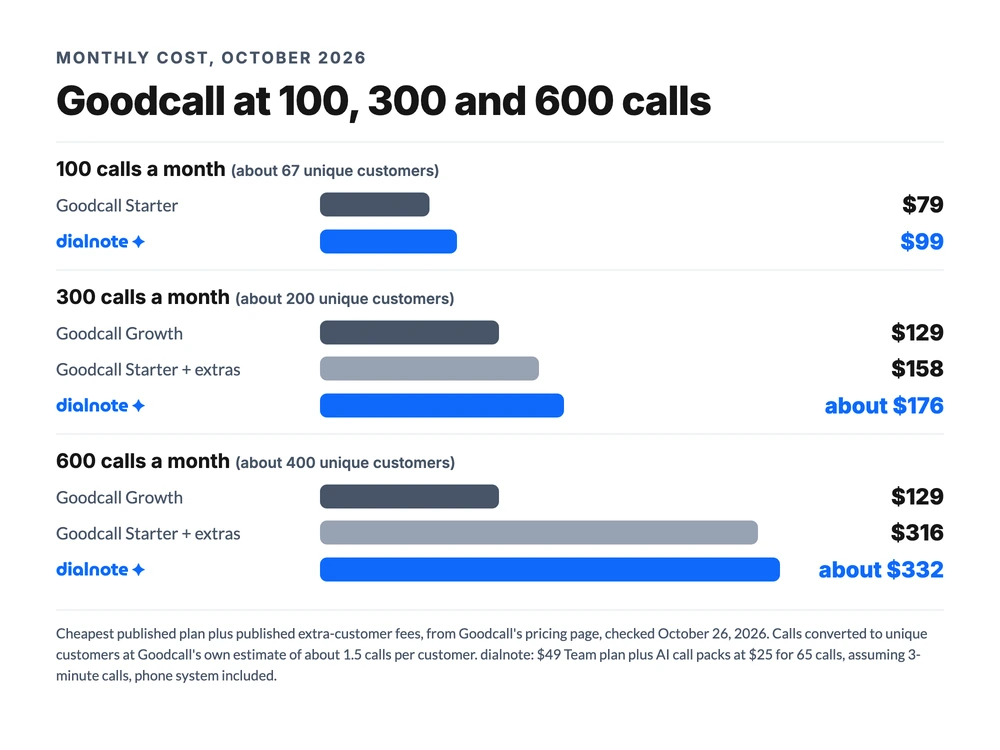
Read that table carefully, because it says something most comparison posts won't. If the AI answers every call, Goodcall's plan is cheaper than dialnote's AI call packs at every volume shown: $20 less at 100 calls, and about $200 less at 600. What it doesn't include is a phone system, which is the next section.
Do your customers call back? If your repeat-caller ratio is higher than Goodcall's 1.5, the per-customer model gets better still. A clinic where every patient calls twice is paying for half its calls.
Ray's leasing season
Ray's four buildings generate about 135 calls from 90 different numbers in a normal month, and about 240 calls from 160 numbers in August. Here's both months on Starter, then on Growth:
| Normal month (90 customers) | Leasing month (160 customers) | |
|---|---|---|
| Starter plan | $79 | $79 |
| Extra customers at 79¢ | $0 | $47.40 (60 customers) |
| Starter total | $79 | $126.40 |
| Growth total | $129 | $129 |
Over a year with two leasing months, Starter costs about $1,043 and Growth costs $1,548. On price alone, Starter wins by about $500. Ray moved to Growth anyway, for the four extra logins and the 90-day history. That's the pattern with Goodcall: the feature limits, not the customer caps, decide your plan.
What Goodcall's price doesn't include
Goodcall's price is for an AI agent that answers a number you forward to it. Three things sit outside that:
- A phone system. Goodcall gives you a local number or takes a forwarded one. It doesn't give your team extensions, shared lines, a mobile app, call routing between people, or outbound calling on a business caller ID. If you have those today you keep paying for them, and if you don't, you'll need them from someone.
- Booking against a live calendar. Goodcall's pricing page lists a booker among its workers, but doesn't name which calendars it checks. Our Goodcall alternatives guide found, as of August 2026, that the agent captures booking requests and passes them along rather than locking a slot in your calendar mid-call. Verify this in the demo agent before you rely on it.
- Native integrations. Connections run through Zapier, an API, an MCP server or your own code, and the number of external tools is capped by plan (1 on Starter). There's no built-in CRM sync.
None of these are hidden costs. They're just costs that land on a different invoice, which matters when you compare Goodcall's $129 with a flat phone system that bundles answering. Our answering service cost breakdown runs that whole-bill math across billing models.
Goodcall vs dialnote, side by side
dialnote is the AI business phone system priced for your whole team: shared numbers, call routing, branded AI voice agents that answer, qualify, and book, and automatic CRM sync, all included, with no per-user cost. That makes it a different kind of purchase from Goodcall, so here's how the two compare as of October 2026:
| Goodcall | dialnote | |
|---|---|---|
| What you're buying | An AI agent on a forwarded or included number | A team phone system with the AI agent built in |
| How it bills | $79 to $299 a month by unique customers, no minute metering | $49 flat on Team for unlimited users, plus AI calls at $25 for 65 |
| Phone system | Not included (one local number, forwarding) | Included: numbers, routing, a phone menu, mobile and desktop apps |
| Booking | Booker worker; calendar checking not stated on the pricing page | The AI agent books through Calendly or Cal.com in-call |
| Integrations | Zapier, an API, an MCP server or your own code, capped by plan | HubSpot, Salesforce and Pipedrive sync after the call; Slack on Business and up |
| Cost at 300 calls | $129 | About $176 |
| Best for | All-AI answering at volume, especially with repeat callers | Teams that want routine calls answered and the phone system in one bill |
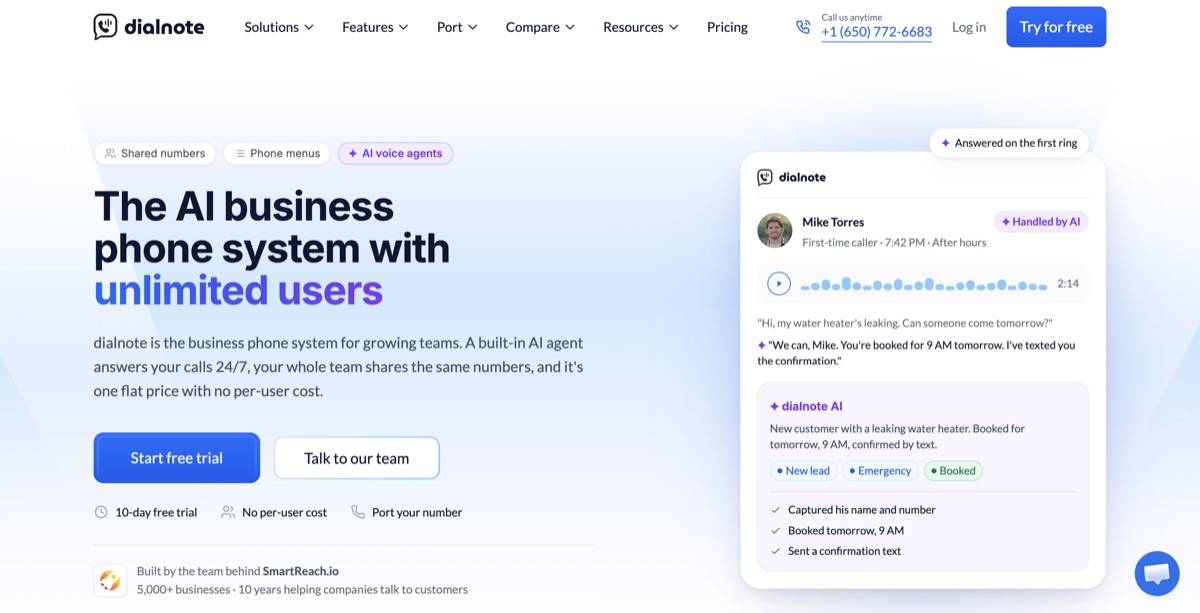
The honest trade-off cuts both ways. dialnote meters AI calls by the pack or the minute, so an all-AI setup at 400 calls a month costs more than Goodcall's $129, and neither product offers a live human. What dialnote adds is everything around the agent: the phone system your team already pays for somewhere, a phone menu that sends only the calls you choose to the AI, and transfers to a teammate when a caller needs one. dialnote's plans start at $49 for unlimited users, and the AI agent comes with Team.
When is Goodcall the better pick?
Goodcall is the better pick when the AI will answer nearly every call and your callers come back. Four cases:
- Repeat-caller businesses. Property management, clinics, pharmacies, anywhere one customer calls several times a month. Every repeat call is free.
- High all-AI volume. With no human in the loop, Goodcall's $129 for 500 customers beats per-call and per-minute pricing at every volume in this guide, and the gap widens as calls climb.
- Long calls. A 15-minute intake costs the same as a 30-second message. Per-minute services punish exactly this.
- Multi-location on one agent. Scale's 2,000 customers for $299 is cheap coverage for a franchise group, with unlimited history and 10 logins.
If you're weighing it against other AI-only services, the alternatives guide linked above prices ten of them on the same basis.
Is Goodcall worth the price?
For a solo operator or an all-AI front line, yes. Goodcall's prices are published, the overage rate equals the plan rate, spam doesn't count, and the per-customer model is the kindest one in the category for businesses whose callers keep calling. I'd pick it over any per-minute AI service for a clinic or a property manager without much hesitation.
The caveats are about what it isn't. It isn't a phone system, so your team's calling stays a separate bill. Its plan limits, not its prices, push most teams to $129. And whether its booker can lock a real slot in your calendar is something to test in the demo agent before you forward a number.
Ray kept Goodcall on Growth for the leasing line. For the four site offices, where staff need to call tenants back on a business number and route maintenance calls between buildings, he needed a phone system anyway, and the question became whether the agent should live inside it. That's the comparison worth running on your own call log: not Goodcall's price against another AI agent's, but Goodcall plus your phone bill against one flat plan that includes both.
Price your call volume with an AI receptionist built into the phone system
10-day free trial, no credit card required. AI agent from the Team plan.
Frequently asked questions
Goodcall costs $79 a month for 100 unique customers on Starter, $129 for 500 on Growth, or $299 for 2,000 on Scale, as of October 2026. Extra customers bill at 79¢, 26¢ or 15¢ each. Enterprise is quoted. There's no free plan, but a demo agent is free to build and test.
No. Goodcall never meters minutes, calls or tokens. Its pricing page (October 2026) counts only unique customers: one phone number, once a month. A caller who rings five times counts once, and a 20-minute call costs the same as a 30-second one.
One phone number that interacts with your agent in a calendar month, as of October 2026. Repeat calls from the same number are free. Spam and wrong numbers don't count. The same person calling from two phones counts twice, since Goodcall counts numbers, not people.
Not a timed trial. Goodcall lets you build a demo agent, test it and hear it answer for free, and you only start paying when you connect a phone number. There's no free plan for real calls; the cheapest paid plan is $79 a month as of October 2026.
At volume, often yes. Goodcall covers 500 unique customers for $129 a month as of October 2026. dialnote, an AI business phone system, is $49 on Team for unlimited users plus $25 per 65 AI calls, about $176 at 300 calls, with the phone system and in-call Calendly or Cal.com booking included.

Written by
Upasana Sahu
Senior Digital Marketing Specialist, SmartReach.io
Upasana Sahu is a Senior Digital Marketing Specialist at SmartReach.io with over 10 years of experience in content marketing, SEO, and digital strategy. She manages end-to-end blog operations, from content creation and on-page/off-page SEO to traffic...
Upasana Sahu is a Senior Digital Marketing Specialist at SmartReach.io with over 10 years of experience in content marketing, SEO, and digital strategy. She manages end-to-end blog operations, from content creation and on-page/off-page SEO to traffic...
Related Articles
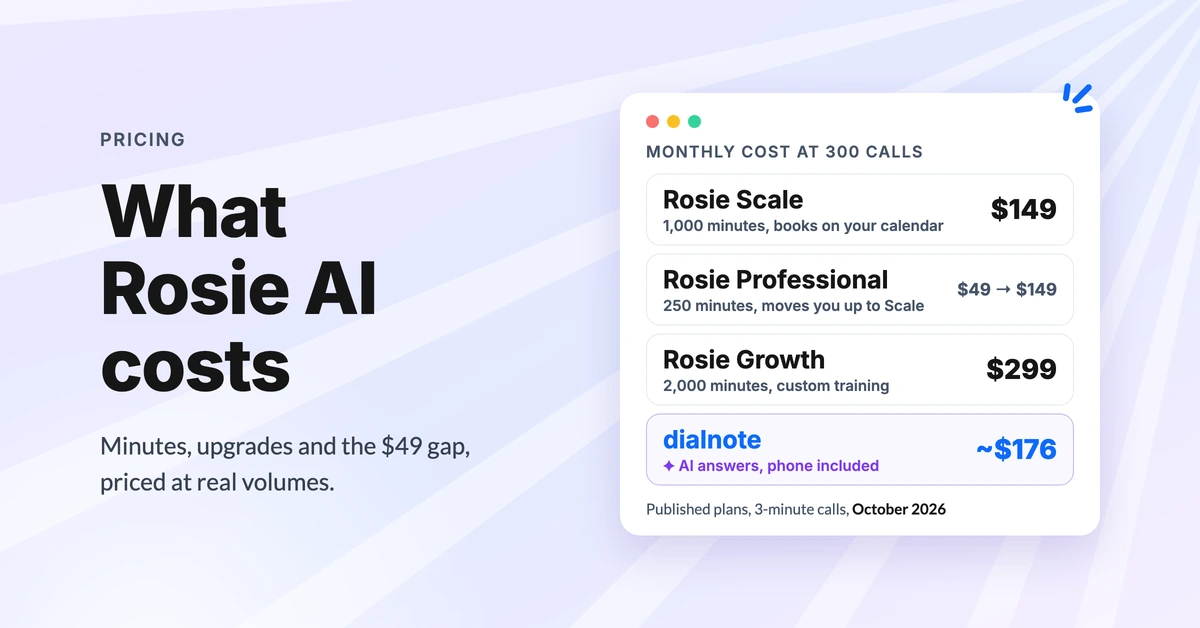
Rosie AI pricing and what the $49 plan leaves out
Check Rosie AI pricing before you sign: $49 for 250 minutes, $149 to book on your calendar, how the automatic upgrade works, and the bill at 100 to 600 calls.
Smith.ai pricing and what each add-on really costs
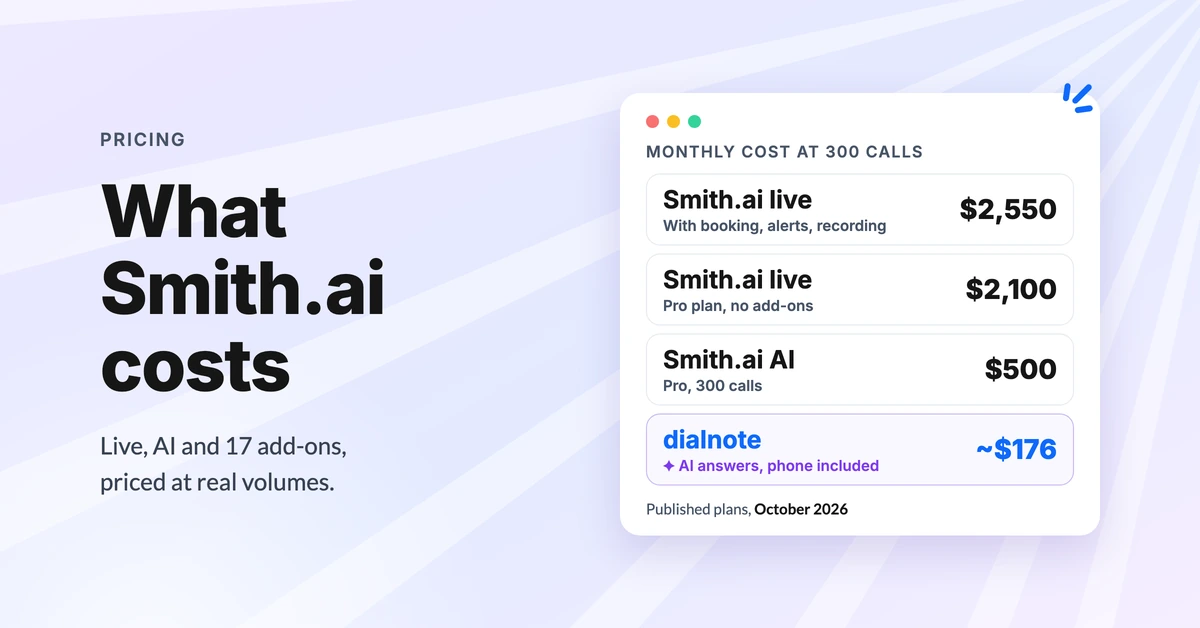
Check Smith.ai pricing plan by plan: live receptionists from $300 for 30 calls, AI from free, 17 add-on fees, and the real bill at 100 to 600 calls.
Smith.ai Alternatives: 10 Better Options [2026]
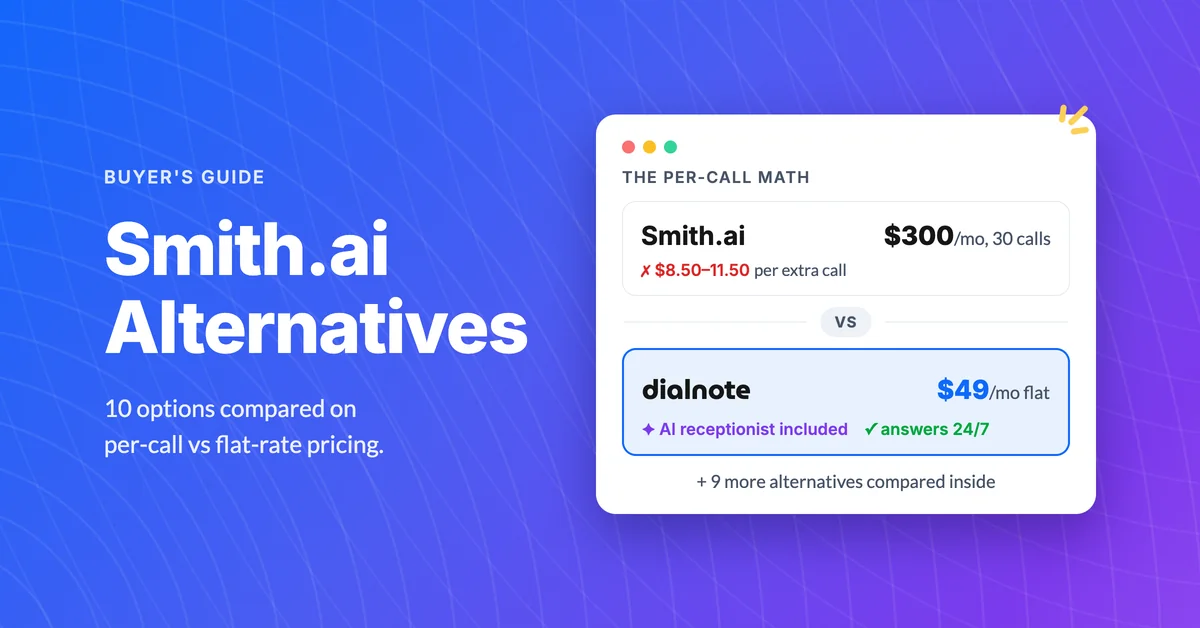
Smith.ai bills per call and the add-ons stack up. Compare 10 Smith.ai alternatives, how each charges for AI usage, and how routing cuts the cost.