How Much Does RingCentral Really Cost per User?
RingCentral cost per user starts at $20 a month, and almost nobody pays that. It's not a bait and switch, it's how per-seat unified communications is packaged: the headline buys a license, and the things a working business actually needs (an AI receptionist, call queues, texting at real volume, a toll-free number that isn't rationed) are sold beside it. Ten years of pricing conversations have taught me that the gap between sticker and invoice is where phone budgets go to die.
Ray runs operations for a property management company: four offices, 15 staff, one shared maintenance line per location. He priced RingCentral Advanced at $25 a user and told his CFO the phone system would run about $375 a month. The first full invoice, after the AI Receptionist add-on, the SMS booster his leasing agents needed, and a block of fees nobody had mentioned, came in over $700. Nothing was mis-sold. He'd just budgeted the license and bought a system. Sound familiar?
Below is every published RingCentral number, the add-ons that move the total, the fees that ride along, and the honest team math at 5, 15 and 30 people. All rates verified against RingCentral's published pricing in September 2026.
TL;DR:
- RingCentral cost per user spans three RingEX tiers: Core $20, Advanced $25, and Ultra $35 a month on annual billing; month-to-month runs $30, $35 and $45.
- No tier includes an AI agent that answers calls. AI Receptionist starts at $39/month and AI Conversation Expert is $60/user/month, both add-ons.
- Texting and toll-free minutes are capped on every plan (Core allows 25 texts per user a month), so real usage means a Business SMS Booster at $25 per texting user.
- Taxes and recovery fees add roughly 15 to 30% to the invoice; one documented bill added 28.2%.
- A 15-person team on Advanced with realistic add-ons lands near $719/month, about $8,600 a year. Flat-rate alternatives price differently: dialnote's Business plan is $99/month for unlimited users with the AI receptionist included.
Jump to: plans at a glance · add-ons · taxes and fees · 15-person math · the verdict
What does RingCentral cost per user?
RingCentral cost per user runs $20 to $35 a month on annual billing, or $30 to $45 month-to-month, depending on tier. Here are the current published RingEX rates, verified in September 2026:
| Plan | Annual billing | Month-to-month | Monthly premium | Built for |
|---|---|---|---|---|
| Core | $20/user/mo | $30/user/mo | +50% | Calling, basic IVR, on-demand recording |
| Advanced | $25/user/mo | $35/user/mo | +40% | Adds auto recording, advanced routing, CRM integrations |
| Ultra | $35/user/mo | $45/user/mo | +29% | Adds unlimited storage, bigger caps, device analytics |
Two things deserve a second look before anything else.
First, the month-to-month premium is steep. Core costs 50% more if you won't sign a term, which is a strong hint about where the business model lives. RingCentral advertises savings of up to 33% for paying annually, and that's real, but it's a discount for surrendering flexibility, not a lower price.
Second, the tier names describe seats, not capability. Moving up the ladder mostly raises caps and adds recording and analytics. It doesn't add an AI agent that answers your phone. That stays an add-on at every tier, which is the single most misread fact in RingCentral pricing.
How RingCentral packages its products
Part of what makes RingCentral pricing hard to compare is that RingEX isn't the whole catalogue. There are three separate things you can buy, and quotes often mix them.
RingEX is the business phone system: calling, texting, video, and the auto-attendant. The $20 to $35 per-user ladder above is RingEX. This is what most small businesses mean when they say "RingCentral."
RingCX is the contact center product, sold separately for teams running inbound support or outbound campaigns at volume. It carries its own per-agent pricing well above RingEX rates and isn't something a 15-person service business needs. If a quote you've been given mentions RingCX, check whether anyone asked for it.
AI Receptionist is sold both as a RingEX add-on and as a standalone product for businesses that only want AI call answering. The bundled add-on runs $39 a month; standalone pricing sits near $49.
Why does the packaging matter for price? Because the cheapest-looking quote is usually RingEX Core with nothing attached, and the system you were imagining when you started shopping is RingEX Advanced plus two or three add-ons. Those are different products with the same logo, and they're roughly $20 a user apart once fees land.
What does each RingEX plan actually include?
The plan differences come down to caps more than features, and caps are what generate surprise invoices.
| Feature | Core | Advanced | Ultra |
|---|---|---|---|
| SMS texts per user per month | 25 | 100 | 200 |
| Toll-free minutes included | 100 | 1,000 | 10,000 |
| Video participants | 100 | 100 | 200 |
| Call recording | On-demand | Automatic + on-demand | Automatic + on-demand |
| File and message storage | Limited | Limited | Unlimited |
Core ($20/user/mo annual) covers unlimited domestic calling in the US and Canada, a basic auto-attendant, and Google and Microsoft integrations. The texting cap is the thing to notice: 25 messages per user per month is roughly one conversation. Any business that texts customers will pass it in week one.
Advanced ($25/user/mo annual) is the realistic starting tier for most teams. Automatic call recording, advanced call routing, CRM integrations, and 1,000 toll-free minutes. If you're comparing RingCentral against anything else, price Advanced, not Core. Vendors publish the entry tier and sell the middle one.
Ultra ($35/user/mo annual) raises storage to unlimited, lifts toll-free to 10,000 minutes, and doubles video capacity. It's built for larger deployments with compliance and archiving expectations.
Here's what no RingEX tier includes at any price: an AI agent that answers and handles calls, call queue callbacks and live queue dashboards, and uncapped texting. Those aren't tier upgrades. They're separate purchases, which brings us to the part of the bill that actually decides the total.
The add-ons that change the real price
This is where the budget moves. Every price below comes from RingCentral's published add-on pricing as of September 2026.
| Add-on | Price | What it's for |
|---|---|---|
| AI Receptionist | From $39/mo | AI call answering and routing |
| AI Conversation Expert (ACE) | $60/user/mo | Conversational intelligence on calls |
| Call Queues Booster | $35/mo | Callbacks, smart routing, live queue dashboard |
| Business SMS Booster | $25 per SMS-enabled user/mo | Texting past the plan cap |
| RingCentral Webinar | $30/host/mo | Webinar hosting |
| RingCentral Rooms | $39/room/mo | Meeting room hardware licensing |
| Push-to-talk | $5/user/mo | Walkie-talkie style calling |
| International numbers | From $5.99/user/mo | Numbers outside US and Canada |
| Additional vanity numbers | $30 one-time plus $4.99 setup | Memorable numbers |
Look at what those first four items are. An AI receptionist, conversation intelligence, working call queues, and normal texting: that's not an exotic wish list, that's a modern small-business phone system. Bought together on a 15-seat account, they add several hundred dollars a month on top of the licenses.
The AI Receptionist add-on deserves its own note, because its pricing shape matters more than its price. Bundled with RingEX it's $39 a month (about $49 standalone) and includes 100 AI minutes. Past that the meter reads $0.50 a minute, billed in 30-second increments.
Sit with those numbers for a second. A hundred minutes is roughly 25 answered calls at a four-minute average, which is a slow fortnight for most service businesses. Call 26 onwards costs $2 apiece. A month where the AI handles 150 calls, the kind of month a storm or a campaign produces, adds about $250 to the invoice on top of the $39.
And the 30-second increment is its own quiet surcharge. A 70-second call bills as 90 seconds, so a business whose AI calls average just over a minute pays a rounding premium of nearly a third that appears on no price page anywhere.
So the feature designed to catch the calls you'd otherwise lose costs the most in exactly the months you're busiest. I've argued against this shape publicly for years, and I'll keep doing it. Answering your phone shouldn't be something a business rations.
What RingCentral's taxes and fees add to the bill
Every US telecom bill carries surcharges, and some of them are genuinely mandated. It's worth separating the two kinds, because they're not the same thing.
The mandated part is real. Telecom providers must contribute a percentage of interstate end-user revenue to the federal Universal Service Fund, and that percentage is large: the FCC set the proposed third-quarter 2026 contribution factor at 38.8% of interstate revenues. Carriers are allowed to recover that from customers, though the FCC doesn't require them to pass it on.
Then there's the carrier's own recovery fee. RingCentral invoices include a Compliance and Administrative Cost Recovery Fee of roughly $3 per seat. That one isn't a government charge. It's RingCentral recovering its cost of compliance, presented in the same block of the invoice as the taxes, which is a common practice across the industry and a confusing one for buyers.
The rest of the fee stack:
- E911 recovery fee: about $0.99 per seat per month
- Federal and state surcharges: vary by state
- 411 directory lookups: billed per call
- Inbound payphone calls: $0.99 per call surcharge
How much does this all add? Published invoice analyses put it at 15 to 30% above the service charge, and one documented RingCentral invoice showed $452.83 in service charges attracting $178.06 in taxes and fees, an uplift of 28.2%. I'd budget 20% as a floor and treat anything lower as a pleasant surprise.
What does RingCentral cost a 15-person team?
Let's price Ray's actual situation: 15 staff across four offices, leasing agents who text tenants, and a maintenance line that needs queueing. Advanced tier, annual billing, September 2026 rates.
| Line item | Calculation | Monthly |
|---|---|---|
| RingEX Advanced licenses | 15 users × $25 | $375 |
| AI Receptionist | Account add-on | $39 |
| Call Queues Booster | Account add-on | $35 |
| Business SMS Booster | 6 texting users × $25 | $150 |
| Subtotal | $599 | |
| Taxes and recovery fees | ~20% (conservative) | $120 |
| Total | $719 |
That's $8,628 a year, and it assumes annual billing. On month-to-month the licenses alone jump to $525, pushing the total near $960 a month, or $11,500 a year.
Notice how the total splits. The licenses everyone budgets for are 52% of the bill. The other 48% is add-ons and fees, and none of it appeared on the pricing page Ray screenshotted for his CFO.
Run the same math at other team sizes and the shape holds:
| Team size | Advanced licenses | Add-ons (AI, queues, SMS for 40% of team) | + 20% fees | Monthly total | Yearly |
|---|---|---|---|---|---|
| 5 people | $125 | $124 | $50 | ~$299 | ~$3,588 |
| 15 people | $375 | $224 | $120 | ~$719 | ~$8,628 |
| 30 people | $750 | $374 | $225 | ~$1,349 | ~$16,188 |
The per-seat model does exactly what per-seat models do: every hire raises the bill, permanently, for the same phone system. Doubling from 15 to 30 people nearly doubles the cost, even though the auto-attendant, the call flows and the number configuration you built don't change at all.
There's a third dimension most buyers skip, and it's the one that decides whether a contract was a good idea: the multi-year total. Ray's company plans to reach 25 staff inside two years, which is ordinary growth for a property manager adding a building. Priced as a three-year path, his RingCentral spend looks like this:
| Year | Headcount | Monthly total | Annual |
|---|---|---|---|
| Year 1 | 15 | ~$719 | ~$8,628 |
| Year 2 | 20 | ~$924 | ~$11,088 |
| Year 3 | 25 | ~$1,137 | ~$13,644 |
| Three-year total | ~$33,360 |
Roughly $33,000 to answer the phone, and that's before any renewal increase. The growth he's planning for, the good news he'd celebrate in every other line of his budget, arrives on the phone bill as a 58% cost rise for a system that does exactly what it did on day one. That's the per-seat trade in one table. Whether it's worth it depends entirely on how much of RingCentral's breadth those 25 people actually touch.
The contract terms that cost the most
Price is one thing. Terms are the thing that traps you when the price stops working.
Annual commitments carry real exit costs. BBB complaints document early termination charges equal to 100% of the remaining contract value. On a 100-user deployment at $25 a user with 18 months to run, that math reaches $45,000. Even at small-business scale, leaving 14 months early on a 15-seat Advanced contract is a four-figure decision.
Auto-renewal is the default. Term agreements typically renew unless cancelled inside a notice window. Diary the notice date the week you sign, because the renewal notice tends to arrive when you've stopped thinking about your phone system.
Seats are easier to add than remove. Adding a user takes a click. Reducing your seat count usually waits for renewal. Teams that hire seasonally end up paying peak headcount all year.
Am I certain every account sees these terms? No, and that's worth saying plainly. Enterprise agreements get negotiated, and reported experiences skew toward the unhappy. But you should assume standard terms apply to you and get any exception in writing before signing.
Does RingCentral offer a free trial or discounts?
Yes to both, with conditions attached to each.
The free trial covers RingEX and is capped rather than open. Expect limits on the number of users and on trial minutes, and expect some sign-up paths to ask for card details before the trial starts. It's enough to judge the interface. It isn't enough to see what a real month costs you, which is the number you actually need.
Volume discounts are real and they're negotiable. Published per-seat rates drop as seat counts rise, and sales teams have room to move on multi-year terms. If you're buying more than about 20 seats, treat the published price as an opening position.
Nonprofit and education pricing exists on request rather than on the pricing page. Ask.
One negotiating note worth more than a discount: push for add-ons to be bundled into the per-seat rate rather than for the seat rate to be cut. A $2 per-seat discount saves a 15-person team $360 a year. Getting the AI Receptionist and Call Queues Booster folded in saves $888, and unlike a seat discount, it doesn't get eaten as you hire.
What no discount fixes is the shape of the bill. Every negotiation happens inside per-seat pricing, so a good deal today becomes a worse deal with every person you add. That's the structural question, and it's worth answering before the pricing one.
How RingCentral pricing compares to flat-rate alternatives
The comparison worth making isn't cheaper versus more expensive. It's metered versus flat, because the two models fail in different places.
Per-seat pricing is honest about what it sells: a license per person. It suits companies with stable headcount and a preference for capability breadth (video, webinars, contact center, rooms) over price predictability. RingCentral genuinely wins on breadth. It's a deeper product than most of the market, and for a 200-seat enterprise with a contact center, that depth is the point.
Flat pricing sells the system rather than the seat. dialnote is an AI business phone system with no per-user pricing. AI voice agents answer calls, capture leads, and book meetings 24/7 on the Team plan. The AI receptionist comes with the $49 Team plan with no per-user or per-agent fee, adding staff doesn't change the subscription, and every tier bills monthly. The honest limit: AI calls are paid by use, $25/mo for 65 calls with the AI call pack or $0.49/min from your wallet without one, so a business that routes every call to the AI sees a usage line rather than a pure flat bill, and the product surface is narrower than RingCentral's.
| RingCentral Advanced | dialnote Business | |
|---|---|---|
| Pricing model | $25 per user per month (annual) | $99 per month flat, unlimited users |
| 15-person cost | ~$719/mo with add-ons and fees | $99/mo plus AI usage |
| AI call answering | Add-on from $39/mo | Included in the plan |
| Texting | Capped, booster at $25 per texting user | Included segment pool on the plan |
| Billing commitment | Annual for advertised rate | Monthly at every tier |
| International calling | Numbers from $5.99/user/mo | Calling to 90+ countries |
| Free trial | Limited trial | 10-day free trial, no credit card |
| Depth (video, webinars, contact center) | Extensive | Narrower product surface |
One caveat on that table, because a one-sided comparison isn't worth reading. RingCentral's product surface is genuinely wider. If you need webinars, meeting rooms and a full contact center on one contract with one support relationship, that breadth is real, and no flat-rate answering-first system matches it. The table above compares cost structure, not capability breadth, and those are different purchases.
Best for: RingCentral is the better pick for larger organizations that want unified communications breadth in a single vendor and have stable headcount. dialnote is the better pick when unanswered calls are costing jobs, the team is growing, and per-seat math is the problem you're trying to escape. If you're already shopping, our RingCentral alternatives roundup ranks ten options, and the head-to-head comparison puts the two side by side on features rather than price alone.
How do you keep a RingCentral bill down?
If you're staying, four moves protect the budget.
- Right-size the tier per user, not per company. Not everyone needs Advanced. Field staff who only take calls can often sit on Core while your office and sales seats take the higher tier. Mixed-tier accounts are allowed, and most buyers never ask.
- Audit add-ons against actual usage quarterly. The SMS booster bought for a campaign, the webinar host license from a launch, the extra rooms: these persist long after the reason does. Pull the add-on list every quarter and cancel what nobody used.
- Negotiate at renewal, in writing, before the notice window. List price is a starting position on multi-seat deals. Ask for the add-ons to be bundled rather than the license discounted, because bundled add-ons don't inflate when you hire.
- Meter what the AI Receptionist actually handles. If the add-on's minute allowance runs out most months, you're on the wrong side of a meter. Price the annual overage before renewing, because that's the number that decides whether metered AI still makes sense for you.
A worked example of why the fee line matters: two providers quoting identical per-seat rates can differ by a fifth on the real invoice purely on recovery fees and surcharge policy. Always ask for a sample invoice at your seat count, not a quote. Quotes show licenses. Invoices show reality.
Is RingCentral worth the price?
For the right company, yes, and I don't say that grudgingly. If you need one vendor covering phone, video, webinars, meeting rooms and a contact center, with the compliance posture a larger organization requires, RingCentral's breadth justifies its per-seat model. Few competitors cover that much ground.
For a 5 to 30 person service business whose real problem is that calls go unanswered, my view is that the model works against you. You'd be paying per seat for a system whose most valuable function, answering the phone when nobody can, is the one part sold separately and metered by the minute. That's backwards. The businesses that lose the most to missed calls are exactly the ones least able to predict a metered bill.
Run your own numbers before deciding. Take your headcount, price Advanced (not Core), add the AI Receptionist and any booster you'd genuinely use, then add 20%. Compare that annual figure against a flat-rate option at the same team size. Our business phone system cost guide walks the same math across the market, our pricing page runs a live calculator for any team size, and if you've already decided to move, porting your number from RingCentral takes care of the switch.
Whatever you choose, choose it on the invoice, not the sticker. Ray's CFO would tell you the same thing, and he'd use fewer words.
Price a flat-rate phone system against your RingCentral quote
10-day free trial, no credit card required. Unlimited users on every plan.
Frequently asked questions
RingEX Core is $20/user/month on annual billing, Advanced $25, and Ultra $35. Month-to-month billing costs $30, $35 and $45 for the same tiers, as of September 2026. Those rates exclude add-ons, taxes and regulatory recovery fees, which typically add 15 to 30% to the invoice.
Yes. The AI Receptionist is a separate add-on starting at $39/month, and AI Conversation Expert runs $60/user/month, per RingCentral's published add-on pricing in September 2026. No RingEX tier includes an AI agent that answers calls, so AI answering is always an extra line on the bill.
Invoices carry a Compliance and Administrative Cost Recovery Fee of about $3 per seat and an E911 fee near $0.99 per seat, plus federal and state surcharges. Per-call charges apply to 411 lookups and inbound payphone calls. One documented invoice added 28.2% to the service charge.
Yes, and the gap is wide. RingCentral advertises savings of up to 33% for annual billing, and Advanced drops from $35 to $25 per user. The trade is a term commitment, and BBB complaints document early termination charges equal to the remaining contract value.
About $719 a month on Advanced annual billing once you add the AI Receptionist ($39), Call Queues Booster ($35), SMS boosters for six texting users ($150) and roughly 20% in taxes and fees. That's near $8,600 a year for phone service.
RingCentral offers a limited free trial on RingEX, typically capped by users and minutes and requiring card details for some sign-up paths. By comparison, dialnote runs a 10-day free trial with no credit card required and bills monthly at every tier.

Written by
Lancelot Dsouza
Chief Marketing Officer, SmartReach.io
Lancelot Dsouza is the Chief Marketing Officer at SmartReach.io, where he built the Marketing, Sales, and Customer Success verticals from the ground up. With over 25 years of experience spanning digital marketing, business development, and strategic...
Lancelot Dsouza is the Chief Marketing Officer at SmartReach.io, where he built the Marketing, Sales, and Customer Success verticals from the ground up. With over 25 years of experience spanning digital marketing, business development, and strategic...
Related Articles
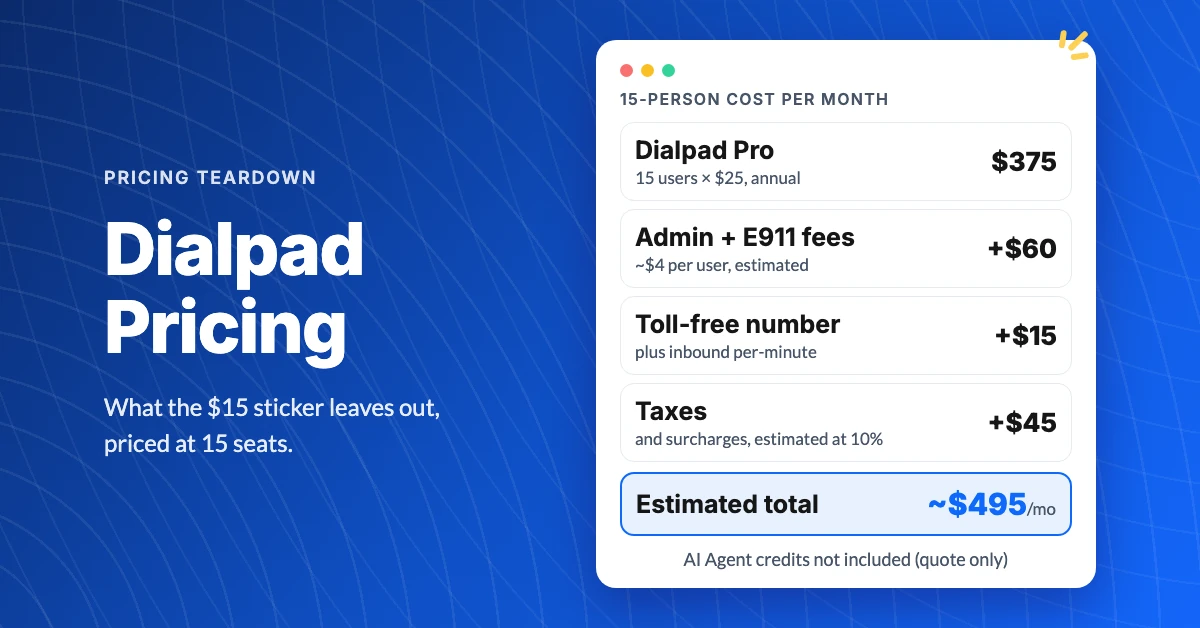
What Does Dialpad Pricing Really Cost a Small Team?
See what Dialpad pricing really costs: $15 to $35 per user, the 3-seat Pro minimum, per-text and admin fees, and real team math at 5, 15 and 30 people.
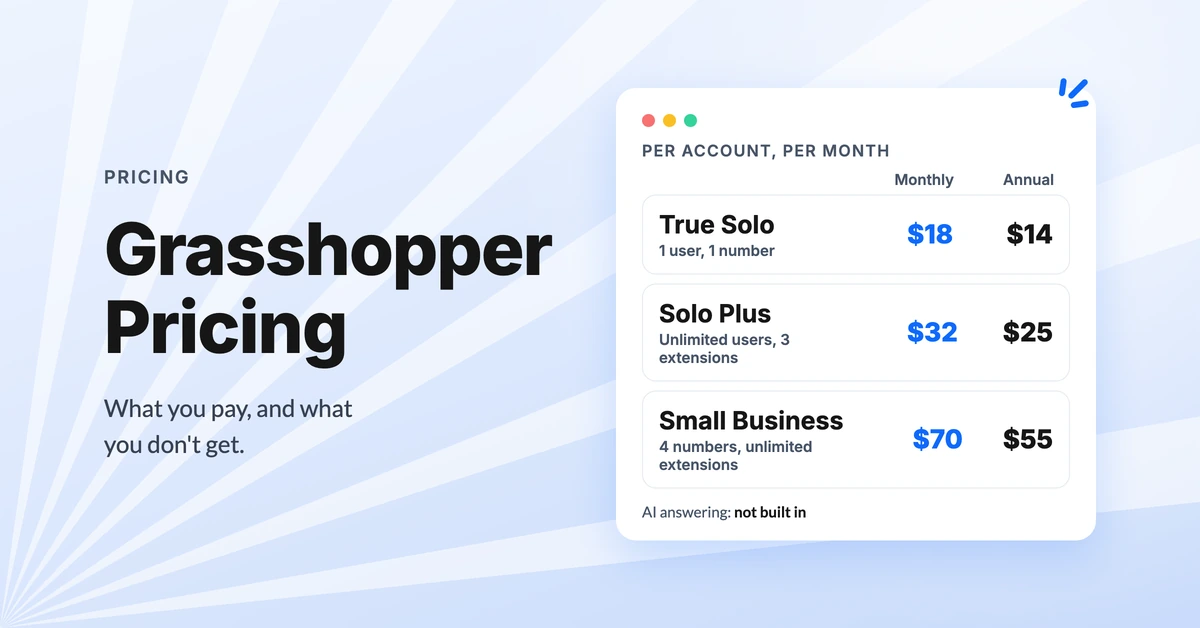
Grasshopper Pricing: What You Pay and What You Don't Get
See Grasshopper pricing plan by plan: $18 to $70 a month, less on annual billing, the hidden texting and number fees, and the real cost with AI answering.
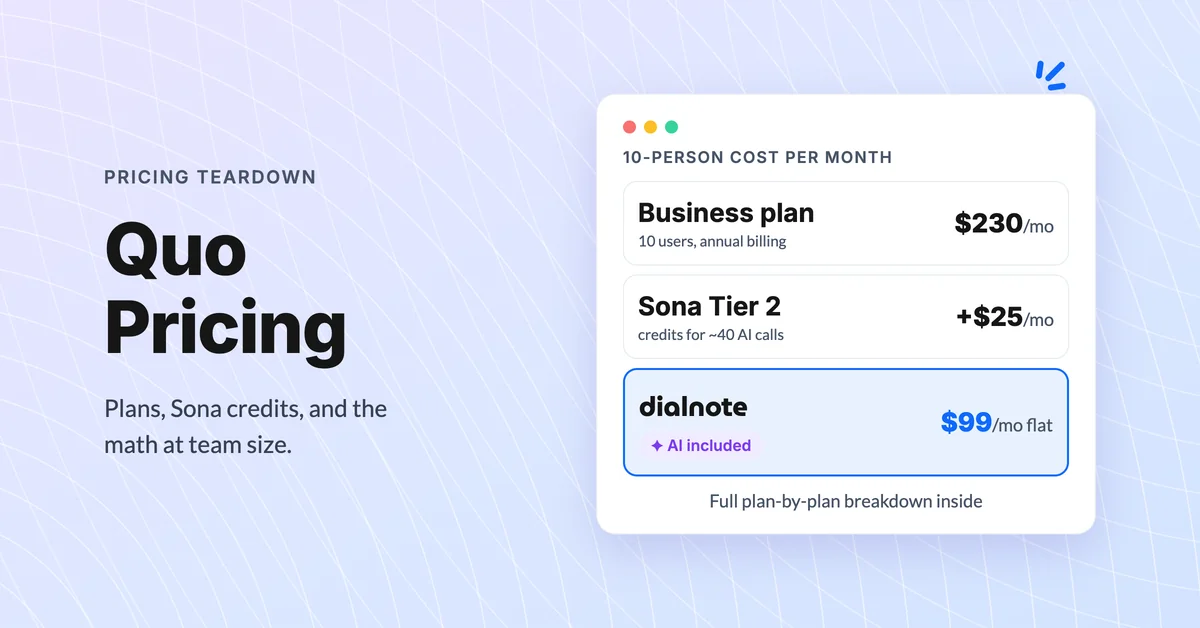
Quo Pricing Explained: What You'll Actually Pay
See what Quo pricing really costs in 2026: plan rates, Sona AI credits, add-ons, and 10-person team math, plus a flat-rate alternative to compare.