Quo Pricing Explained: What You'll Actually Pay
Quo pricing looks refreshingly simple on the plan page: three tiers, one number per user, unlimited calling. Having priced a phone product ourselves, I can tell you the plan page is where pricing stories start, not where they end. The real Quo bill has four moving parts: the seat price, the billing cycle, the Sona AI credit meter, and the add-ons, and each one moves the total in only one direction.
Sam runs a six-person property management company and asked me a version of this question last month: "Quo says $15 a user. Why is my colleague's 10-person shop paying $255?" This post is the long answer. We'll lay out every published number, do the team math honestly, and then show the same math on a flat-rate model so you can compare like for like.
One naming note before the numbers, since searches split between two brands: OpenPhone rebranded to Quo in late 2025. OpenPhone pricing and Quo pricing are the same topic, and everything below uses the current Quo rates.
TL;DR:
- Quo pricing has three plans: Starter $15, Business $23, and Scale $35 per user per month on annual billing; month-to-month runs $19, $33, and $47.
- Every plan includes the Sona AI agent with 1,000 free credits a month, which is about 10 AI-handled calls; real coverage means credit tiers from $25/month, with per-call overages of $0.45 to $1.00.
- The features most businesses want (auto recording, phone menus, CRM integrations, AI summaries) sit on Business, so the realistic per-user price is $23, not $15.
- A 10-person team on Business with the first Sona tier pays about $255/month on annual billing, or roughly $355 month-to-month.
- Flat-rate alternatives change the math entirely: dialnote's Business plan is $99/month with unlimited users and the AI receptionist included.
Jump to: plans at a glance · Sona AI costs · hidden costs · 10-person math · the verdict
Quo pricing at a glance
Here are the current published rates, verified against Quo's pricing page as of September 2026:
| Plan | Annual billing | Month-to-month | Built for |
|---|---|---|---|
| Starter | $15/user/mo | $19/user/mo | Calling, texting, voicemail transcripts, Sona starter credits |
| Business | $23/user/mo | $33/user/mo | Adds auto recording, phone menus, HubSpot/Salesforce, AI summaries, analytics |
| Scale | $35/user/mo | $47/user/mo | Adds AI call tags, dedicated onboarding, priority support |
Every plan includes one local or toll-free number per user, unlimited calling and texting to US and Canadian numbers (with fair-use limits), the Quo API, and Sona with 1,000 free monthly credits. The free trial runs 7 days.
Two structural things to notice before we go deeper. First, the jump from Starter to Business is where most of the value lives, which is why the realistic Quo price for a working business is $23 a user, not the $15 headline. Second, the month-to-month premium is steep: Business jumps 43% to $33 if you won't commit annually.
What does each Quo plan actually include?
Starter ($15/user/mo annual) covers the basics well: calling, first-class texting, shared numbers, voicemail transcripts, and Sona's starter credits. What it lacks defines it: no auto call recording, no phone menus, no CRM integrations, no AI summaries, and email-only support. It's a fine solo plan and a frustrating team plan.
Business ($23/user/mo annual) is the real product. Automatic call recording, phone menus (IVR), HubSpot and Salesforce integrations, AI call summaries and transcripts, group calling, transfers, analytics, and live chat support. If you're comparing Quo against any serious alternative, this is the tier to price.
Scale ($35/user/mo annual) adds AI call tags, dedicated onboarding, priority support, and inbound phone support. It exists for bigger teams with compliance and support expectations; most businesses under 20 seats won't need it.
It's also worth listing what no Quo tier includes, because absences don't appear on pricing pages. There are no call queues on any plan, no video meetings (you'll keep paying for Zoom or Meet), no desk-phone support, and no numbers outside the US and Canada. None of these are add-ons you can buy; they're simply not in the product. If any of them is on your requirements list, no Quo tier at any price solves it.
From a product perspective, this is a well-built ladder; each tier has a clear job. The pricing question isn't whether the ladder makes sense. It's what happens when you multiply it by headcount and add the meter, so let's do that.
How much does Sona AI really cost?
Sona is Quo's AI voice agent, and its pricing is the part most buyers misread. Sona is "included on every plan," which is true the way a test drive is included with a dealership visit.
The meter works in credits: one AI-handled call costs 100 credits, and every plan includes 1,000 free credits a month. That's about 10 answered calls. Miss three calls a day, which is a quiet week for most service businesses, and your free tier is spent by Thursday of week one.
Past the free tier, you buy monthly credit packs:
| Sona tier | Monthly price | Included credits | ≈ AI calls | Overage per call |
|---|---|---|---|---|
| Included | Free | 1,000 | ~10 | $1.00 |
| Tier 2 | $25 | 4,000 | ~40 | $0.75 |
| Tier 3 | $49 | 10,000 | ~100 | $0.65 |
| Tier 4 | $99 | 25,000 | ~250 | $0.55 |
| Tier 5 | $199 | 60,000 | ~600 | $0.45 |
Is that expensive? It depends what you compare it to. Against hiring an answering service, it's cheap. Against systems that price per account instead of per seat (dialnote's AI call pack is 65 calls for the same $25, on a plan with unlimited users), Sona's credits are a second meter stacked on a bill that already grows with every hire, and the overage rates punish exactly the busy months the AI was supposed to rescue.
Honestly, my main critique isn't the price; it's the shape. Sona's credits sit on top of a per-seat bill, so a busy month and a new hire both raise the same invoice, and phone systems work best when answering the phone isn't something you ration.
The hidden costs in Quo pricing
None of these are secrets; they're all published. They're just not on the headline.
The annual commitment. The advertised rates require annual billing. Pay monthly and Business goes from $23 to $33 per user, a 43% premium for flexibility.
Extra numbers. Each user gets one number; additional numbers are $5/month apiece. Separate lines for sales, support, and ad tracking add up quietly.
The fair-use cap. "Unlimited" US/CA calling caps out around 1,000 minutes per user per month, among the lower limits in the market. Phone-heavy teams should read that clause before signing.
US and Canada only. Quo sells US and Canadian numbers exclusively. If your business needs a local presence anywhere else, no add-on fixes that; international calls and texts are metered per minute and per message.
The seat meter itself. The biggest "hidden" cost isn't a fee, it's the model: every hire raises the bill, forever. A team that doubles pays double, for the same phone system.
What does Quo cost a 10-person team?
Let's price Sam's colleague honestly: 10 people, the Business tier (because the Starter gaps aren't livable for a team), and the first Sona credit tier (because 10 free AI calls isn't coverage).
| Line item | Annual billing | Month-to-month |
|---|---|---|
| Business plan × 10 users | $230/mo | $330/mo |
| Sona Tier 2 credits | $25/mo | $25/mo |
| Two extra numbers | $10/mo | $10/mo |
| Total | $265/mo | $365/mo |
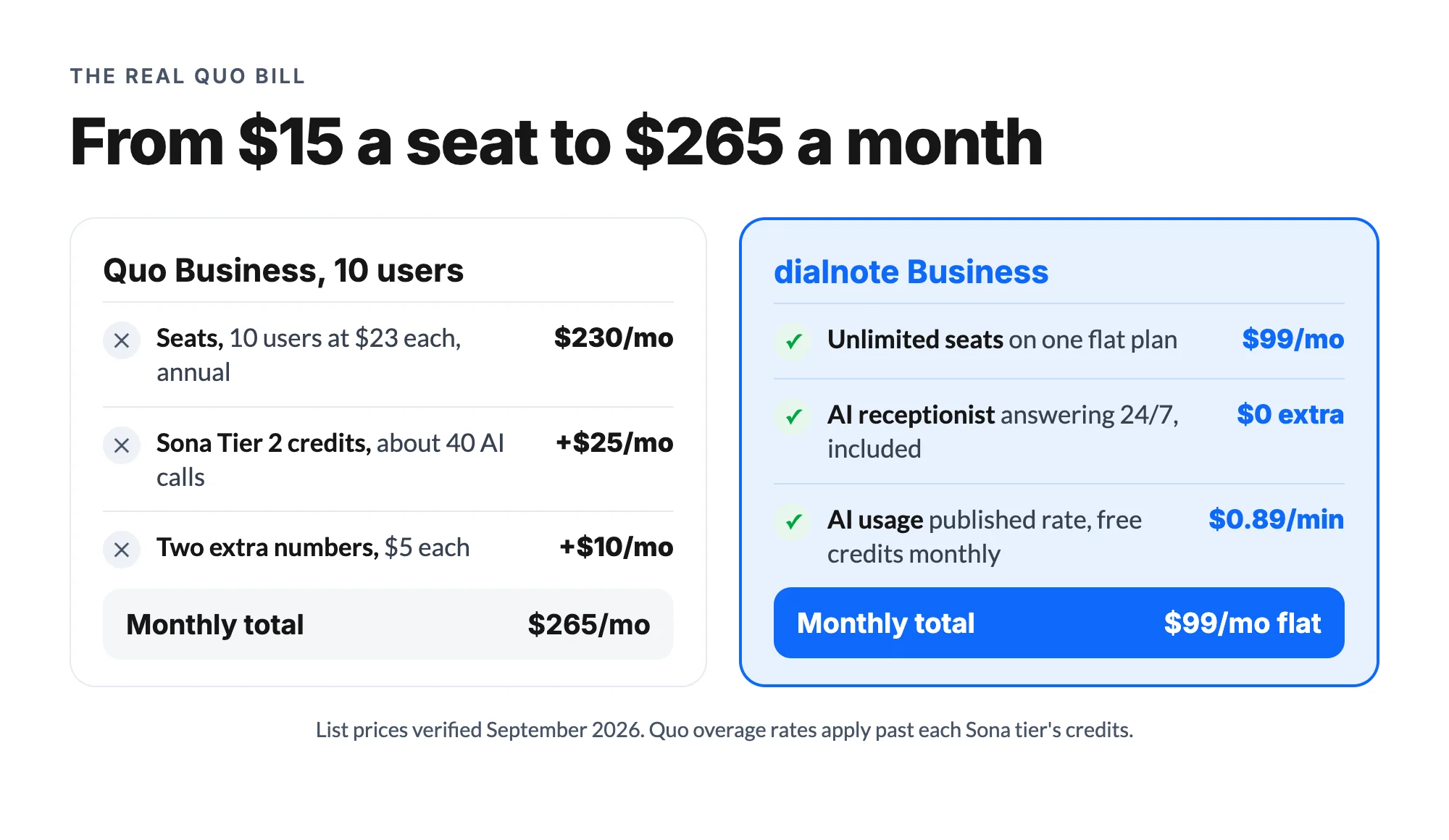
That's the honest Quo number for a working 10-person business: roughly $255 to $265 a month on annual billing before any overages, and $355 to $365 if you keep monthly flexibility. Not outrageous for what's included, but a long way from "$15 a user," and it climbs with every hire.
For the full context on how that compares across the market, our Quo (OpenPhone) alternatives guide prices the whole field, and the head-to-heads (vs Google Voice, vs Grasshopper, vs Zoom Phone) run the same math against specific rivals.
How do you keep a Quo bill under control?
If you're already on Quo, or going in with eyes open, four habits keep the bill honest:
- Commit annually if you're staying. The 43% month-to-month premium on Business is the single biggest avoidable cost. Decide within the 7-day trial, not after six months of $33 seats.
- Right-size the Sona tier quarterly. The credit packs don't roll over, so a $49 tier feeding a $25 tier's call volume is pure waste. Check the usage report every quarter and move one tier at a time.
- Audit your numbers. Extra lines at $5/month have a way of surviving the campaigns that justified them. Kill the ones nothing routes to.
- Watch the minutes, not just the calls. The ~1,000-minute fair-use cap is per user per month. A couple of phone-heavy people can trip it while the team average looks fine, and overage conversations always start after the bill.
None of this changes the model; it just stops the model from charging you for inattention.
What does Quo pricing look like by team size?
The honest answer changes with headcount, so here's the quick version.
Solo: Starter at $15/month (annual) is genuinely good value, and among the best per-seat deals in the market at one seat. The 10 free Sona calls might even cover a quiet line.
Five people: Business at $115/month plus the $25 Sona tier lands at $140. Defensible, but this is where flat-rate plans catch up: a $99 unlimited-seat plan plus a $25 AI call pack ($124) already beats it.
Ten people and up: $255 to $265 and climbing with every hire. At this size the per-seat model is working against you, and the comparison stops being close; the same team runs $99 flat elsewhere ($124 with a 65-call AI pack). Twenty seats is $485 versus $124, and there's no tier that fixes arithmetic.
Quo pricing vs flat-rate alternatives
Now the same team on the other model. dialnote is an AI business phone system with no per-user pricing. AI voice agents answer calls, capture leads, and book meetings 24/7. Plans from $19/mo. It prices the account, not the seat: $49/month (Team), $99/month (Business), and $199/month (Pro), all with unlimited users, plus a $19/month Solo plan. The Business plan includes what Quo's Business tier includes (auto recording, phone menus, CRM sync, AI summaries) plus the part Quo meters hardest: a 24/7 AI receptionist that answers, captures lead details, books meetings through Calendly or Cal.com, sends texts, and transfers to a teammate when someone's free.
| Quo (Business + Sona Tier 2) | dialnote (Business) | |
|---|---|---|
| 5 users | $140/mo | $99/mo |
| 10 users | $255/mo | $99/mo |
| 25 users | $600/mo | $99/mo |
| 50 users | $1,175/mo | $99/mo |
One note on the dialnote column: the flat plan covers the phone system and every seat, and AI calls are billed on top: $25/mo for 65 calls with the AI call pack, or $0.49/minute from the wallet without one. That's 65 calls for the same $25 Quo charges for about 40 Sona calls, so match Quo's Tier 2 and the dialnote column reads $124 at every size. Heavy months don't multiply by your headcount. Billing is monthly, cancel anytime, and the free trial runs 10 days with no credit card, against Quo's 7.
There's also the availability difference: dialnote is open to businesses worldwide, with numbers in the US, Canada, UK, India, and France today (more countries opened on request) and calling to 90+ countries. The full feature-by-feature rundown lives on our dialnote vs OpenPhone comparison page.
We're genuinely unsure how Quo's pricing will evolve; a company that just raised $105 million usually invests in growth, and pricing experiments tend to follow funding. The numbers above are what's published today, and we've dated them accordingly.
What does a year of Quo cost?
Annualize the honest 10-person number and the comparison sharpens. Quo Business with Sona Tier 2 and two extra numbers: $265 × 12 = $3,180 for year one, before any per-call overages. The same team on dialnote Business: $99 × 12 = $1,188, or $1,488 with a $25 AI call pack every month to match Sona Tier 2. And because Quo bills per seat, hiring two people mid-year adds roughly $552 to the annual run rate; on the flat plan it adds nothing.
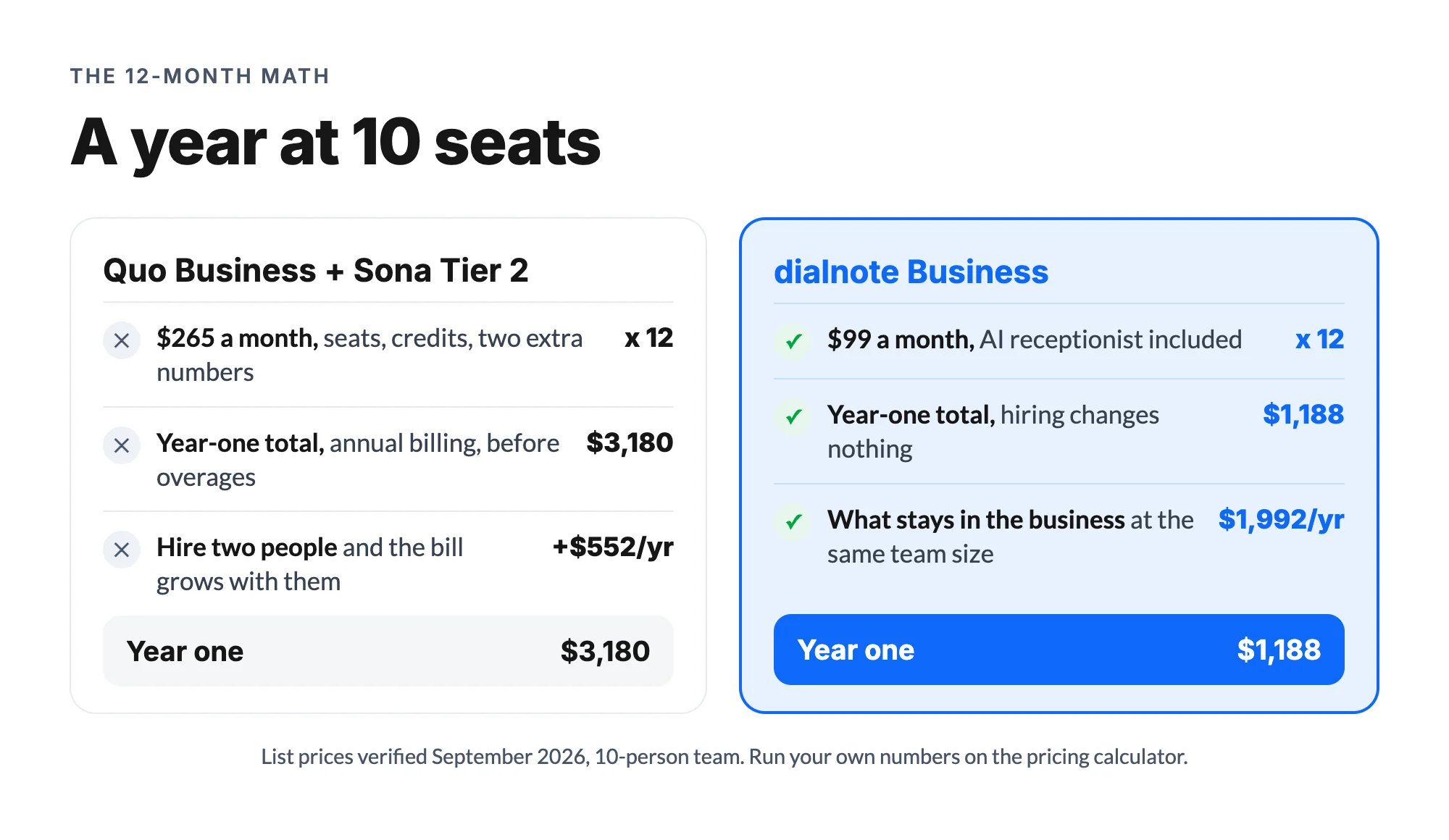
That's $1,692 to $1,992 a year, kept or spent, on functionally the same job: business calls answered, recorded, and logged. If you're deciding at a different team size, the cost calculator does this arithmetic for any headcount.
How does Quo pricing sit against the market?
According to Fortune Business Insights, the VoIP market compounds at over 10% a year, so per-seat pricing is being stress-tested by growing teams constantly. Zoom out and Quo's per-seat rates are mid-pack, not an outlier. Dialpad and Nextiva both start at $15/user/month on annual billing, Google Voice starts at $10 but requires a paid Workspace subscription on top, and Grasshopper sells flat plans from $14/month that skip most modern features. Quo's $23 Business tier buys a genuinely better everyday app than most of that list; our head-to-heads with Dialpad, Google Voice, and Grasshopper walk the details.
What separates Quo's bill from its per-seat peers isn't the seat rate; it's the Sona credit ladder stacked on top. Dialpad includes transcription on every plan with no per-call meter. Nextiva sells its AI receptionist as a flat $99/month add-on rather than per-call credits, and RingCentral prices its AI Receptionist from $39/month with a 100-minute cap before overage. Quo is the only one in this group where the AI answering your phone gets more expensive with every call it answers. Whether that's fair depends on your volume; that it's different is just a fact worth knowing before you commit.
And one more time for the searchers who arrived here from the old brand: OpenPhone pricing is Quo pricing. Nothing about the rebrand changed a number on this page.
"Credit ladders are the per-seat model's answer to AI, and they inherit its flaw," says Prateek Bhatt, dialnote's co-founder. "The bill scales with exactly the thing you bought the product to welcome: more answered calls."
Is Quo worth the price?
For the right buyer, yes. Quo is a polished product with the best texting experience in its class, and the Business tier is fairly priced per seat against per-seat rivals; our comparisons with Dialpad and RingCentral show it holding its own.
Quo pricing works for you if you're a small, stable team of one to five people, your call volume is modest enough that 10 to 40 AI calls a month genuinely covers you, and you'll commit annually for the good rate.
Quo pricing works against you if you're hiring (every seat compounds), your missed-call volume is the problem you're solving (the credit ladder meters your solution), or you need any presence outside the US and Canada.
A flat-rate system fits better if you want the bill decoupled from headcount and the AI receptionist treated as standard equipment rather than a metered add-on. That's the model dialnote was built on, and for the 10-person team above it's the difference between $265 and $99 a month.
Back to Sam's original question, why the 10-person shop pays $255: it's not a trick, it's just the model doing what per-seat models do, quietly and monthly. The colleague isn't overpaying for Quo; they're paying exactly what Quo costs once a real team uses it for real work. Whether that's worth it depends entirely on whether a flat $99 was sitting one comparison away.
The bottom line on Quo pricing: the $15 headline is real but not representative. Price the Business tier, add the Sona tier you'd actually need, multiply by the team you'll have next year, and compare that number, not the plan page, against the alternatives.
Start a free 10-day trial of dialnote, no credit card required, or run your own team's math side by side.
Frequently asked questions
Quo has three plans: Starter at $15, Business at $23, and Scale at $35 per user per month on annual billing. Month-to-month costs more: $19, $33, and $47. Every plan includes one number per user and unlimited US/CA calling under fair-use limits.
Yes. OpenPhone rebranded to Quo in late 2025 alongside a $105 million financing round. The plans, pricing structure, and product are the same thing under a new name, so OpenPhone pricing and Quo pricing are one topic.
Every plan includes 1,000 free Sona credits a month, which covers about 10 AI-handled calls. After that you buy credit tiers from $25/month (about 40 calls) up to $199/month, with per-call overage rates from $1.00 down to $0.45.
Yes. Quo gives you one week to try the product before the first charge. dialnote's free trial runs 10 days with no credit card required, and it bills monthly at every tier with no annual commitment for the listed price.
On Business at $23/user (annual billing), 10 users run $230/month. Add the $25 Sona credit tier for real AI coverage and you're near $255/month, and about $355 on month-to-month billing. A flat-rate plan like dialnote's $99/month Business covers the same team.

Written by
Akhilesh Betanamudi
Co-Founder, SmartReach.io
Akhilesh Betanamudi is a technology entrepreneur and engineer with over 12 years of experience in hardware engineering, SaaS, and business communications. As Co-Founder of SmartReach.io - a sales engagement platform for startups and enterprises, he h...
Akhilesh Betanamudi is a technology entrepreneur and engineer with over 12 years of experience in hardware engineering, SaaS, and business communications. As Co-Founder of SmartReach.io - a sales engagement platform for startups and enterprises, he h...
Related Articles
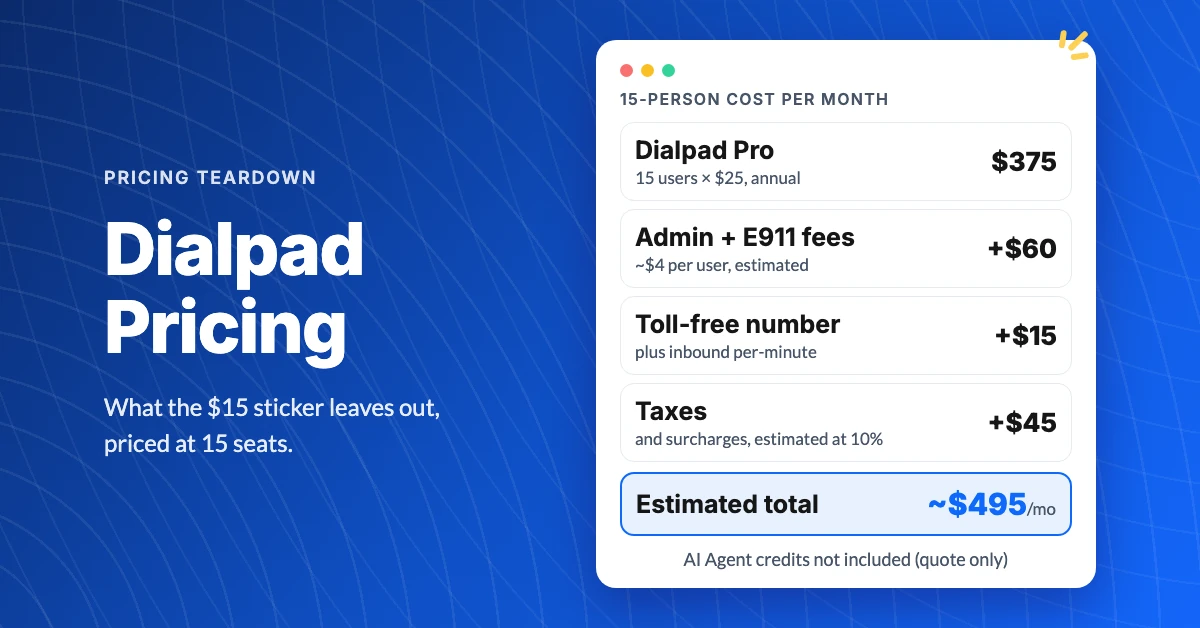
What Does Dialpad Pricing Really Cost a Small Team?
See what Dialpad pricing really costs: $15 to $35 per user, the 3-seat Pro minimum, per-text and admin fees, and real team math at 5, 15 and 30 people.
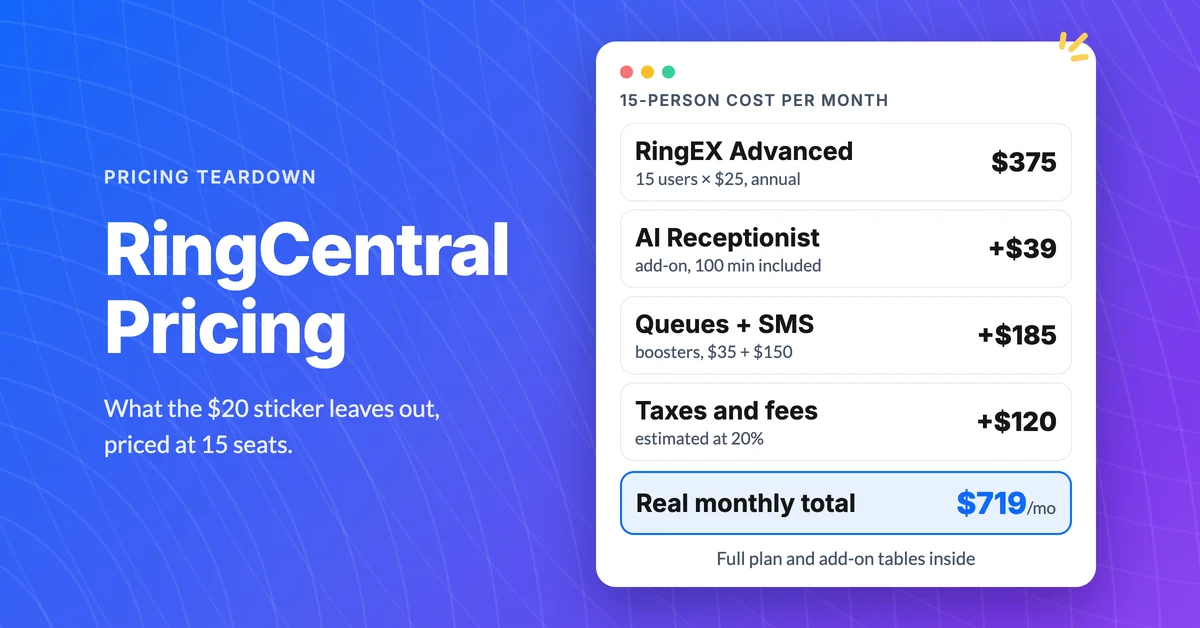
How Much Does RingCentral Really Cost per User?
RingCentral cost per user starts at $20, but add-ons, SMS caps and regulatory fees decide the real bill. See the 15-person math and the flat-rate comparison.
OpenPhone vs 8x8: Which Should You Choose?
Compare OpenPhone vs 8x8 on pricing, quote-only sales, and AI answering, then see why dialnote may fit small teams better than both.