OpenPhone vs Zoom Phone: Which Fits Your Team?
Your team already lives in Zoom, so Zoom Phone feels like the obvious next click. That's exactly the pull that makes the OpenPhone vs Zoom Phone question tricky: one is a phone system that wants to run your front office, the other is a checkbox in a suite you've already bought. Convenience is on one side, purpose-built features on the other.
Dana manages a nine-person accounting practice. They run every client meeting on Zoom, so when the old landline contract ended, she added Zoom Phone licenses without much thought. It worked, technically. Calls connected. But six months in, tax season exposed the gaps: no shared view of client texts, voicemails scattered across personal inboxes, and nothing answering when all nine people were mid-meeting. Sound familiar?
This comparison breaks down what OpenPhone and Zoom Phone each actually deliver, what the per-seat math looks like as you grow, and where both leave the missed-call problem unsolved. We'll also bring in dialnote, an AI-first phone system with flat pricing, as the third option worth checking before you commit either way.
TL;DR:
- In the OpenPhone vs Zoom Phone matchup, Zoom Phone wins on entry price ($15/user/month for US & Canada Unlimited, annual billing) while OpenPhone's useful tier is Business at $23/user/month.
- Zoom Phone's edge is ecosystem: one app, one bill, one admin console with your meetings. Its weakness is everything front-office: texting, shared numbers, and AI answering.
- OpenPhone (rebranded to Quo in late 2025) is the stronger standalone phone: shared team inboxes, first-class texting, and the credit-metered Sona AI agent.
- Both charge per user, so a 10-person team pays $150 to $230 a month. dialnote's Business plan is $99/month flat with unlimited users and an AI receptionist included.
- Numbers port between all three platforms in about 1 to 3 weeks.
Jump to: feature comparison · what each costs · AI answering · the verdict
A quick look at OpenPhone and Zoom Phone
These two come from opposite directions. OpenPhone launched as a standalone business phone built around calling, texting, and shared team inboxes. In late 2025 it rebranded to Quo and pushed deeper into AI with Sona, its voice agent. Review sites still mix the two names; it's the same product. So if you got here searching Quo vs Zoom Phone, this is that comparison.
Zoom Phone is a module inside the Zoom platform. You can buy it standalone (metered calling from $10.50/user/month, or US & Canada Unlimited at $15/user/month, both annual billing) or bundled with video in Workplace plans like Pro Plus at around $20.50/user/month. Its pitch isn't features. It's gravity: your team already has Zoom open all day, and the phone slots into the same client, contacts, and admin console.
So the real question isn't which product has the longer feature list. It's whether "already there" beats "built for the job." According to Fortune Business Insights, the VoIP market keeps growing at over 10% a year, and bundled suites are a big driver. Convenience sells. Whether it serves is a different question.
OpenPhone vs Zoom Phone: how do the features compare?
The short answer: OpenPhone is the better phone, Zoom Phone is the better add-on. OpenPhone treats calls and texts as the product. Zoom Phone treats them as an extension of meetings.
Where Zoom Phone gets thin is the front-office layer. Texting exists but it's an afterthought, not a shared team channel. There's no team inbox where two people work the same number's conversations. And while Zoom has been adding AI across its platform, the plans small businesses actually buy don't include anything answering your business line.
OpenPhone covers that layer well: shared numbers, one thread per customer across calls and texts, voicemail transcription everywhere, and Sona answering missed calls (about 10 AI-handled calls a month before you're buying credit packs). What OpenPhone can't match is Zoom's meeting stack; there's no built-in video at all.
Here's the side-by-side, with dialnote as the third column:
| Feature | OpenPhone (Quo) | Zoom Phone | dialnote |
|---|---|---|---|
| Starting price | $15/user/mo | $10.50/user/mo (metered) | $19/mo (Solo) |
| Cost for a 10-person team | $230/mo (Business) | $150/mo (Unlimited) | $99/mo flat |
| Where it's available | US + Canada numbers only | US/CA plans (global plans exist) | Worldwide (calling to 90+ countries) |
| Flat-rate unlimited users | ✗ | ✗ | Yes ($49/mo Team and up) |
| Unlimited US/CA calling | Included (fair use) | $15/user/mo plan | Included (fair use) |
| Video meetings | ✗ | ✓ (the whole point) | Yes (Zoom integration) |
| Shared numbers / team inbox | ✓ | ✗ | Yes |
| Business texting | ✓ (first-class) | Basic | Yes (US/CA) |
| Auto-attendant / phone menu | Business plan | ✓ | Yes |
| Call recording | Business plan (auto) | Ad hoc (auto on higher tiers) | Yes (Business plan+, automatic) |
| AI call summaries | Business plan | Higher tiers / add-ons | Yes (Business plan+) |
| AI receptionist / voice agent | Sona (credit-limited) | ✗ | Yes (included, 14 languages) |
| CRM integrations | HubSpot, Salesforce (Business) | Via marketplace apps | HubSpot, Salesforce, Pipedrive, Zoho |
| Lives inside Zoom | ✗ | ✓ (native) | Partly (video via Zoom) |
Don't skim past the availability row. OpenPhone sells US and Canadian numbers only; if your business needs a local number (or local texting presence) anywhere else, it can't provide one. Zoom Phone's standard plans cover the US and Canada too, with global coverage sold as bigger plans. dialnote is open to businesses worldwide, with numbers in the US, Canada, UK, India, and France today (more countries opened on request), calling to 90+ countries, and business texting included.
One honest note in Zoom's favor: if your team genuinely runs on Zoom all day, one client for meetings and calls is a real workflow win, and admin lives in one console. That's worth something. The question is what you give up for it.
What does each one really cost?
The sticker prices look friendly. Zoom Phone US & Canada Unlimited is $15/user/month, OpenPhone Business is $23/user/month, both on annual billing. But both are per-seat, and per-seat math compounds with every hire.
There's also the bundle trap on the Zoom side. The standalone $15 plan covers calling, but teams that want the full Workplace suite land on bundles like Pro Plus at roughly $20.50/user/month. That's fine if you were paying for Zoom anyway. It stings when you realize the "cheap add-on" quietly became a second phone-system-sized line item.
Watch the totals as headcount grows, using OpenPhone Business and Zoom Phone US & Canada Unlimited:
| OpenPhone (Business) | Zoom Phone (US/CA Unlimited) | dialnote (Business) | |
|---|---|---|---|
| 5 users | $115/mo | $75/mo | $99/mo |
| 10 users | $230/mo | $150/mo | $99/mo |
| 25 users | $575/mo | $375/mo | $99/mo |
| 50 users | $1,150/mo | $750/mo | $99/mo |
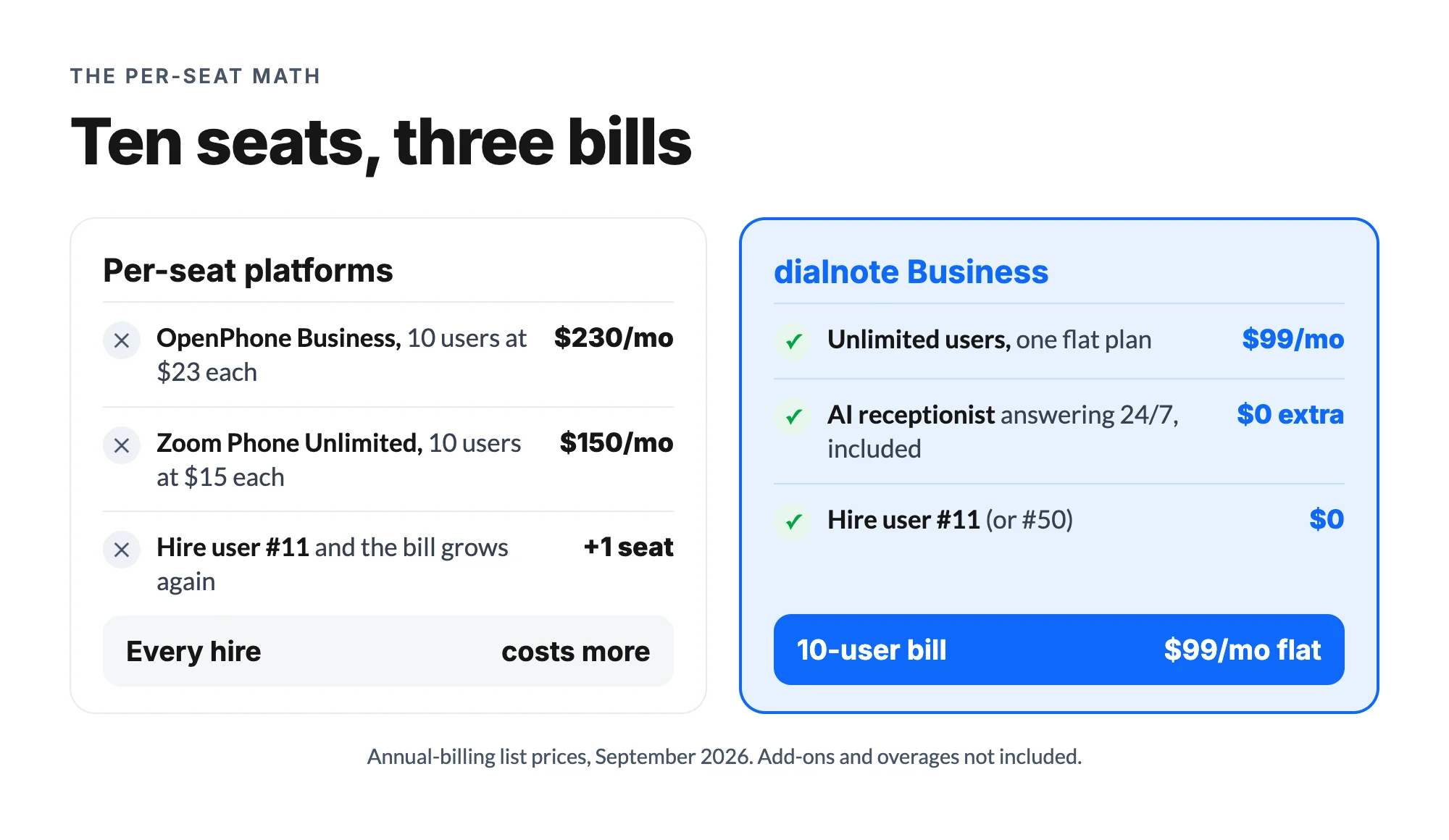
dialnote's pricing removes headcount from the bill entirely: $49/month (Team), $99/month (Business), and $199/month (Pro), all with unlimited users, plus a $19/month Solo plan. The 10-person practice paying $150 to $230 above pays $99, and hiring number eleven costs nothing. The dialnote vs OpenPhone breakdown shows the same gap against Quo's plans.
One note on the dialnote column: the flat plan covers the phone system and every seat, and AI calls are $25/mo for 65 calls with the AI call pack, or $0.49/minute from your wallet without one, with free wallet credits each month. Light months cost little or nothing extra; heavy months are still cheaper than a per-seat AI tier.
Two fine-print items before you sign anything. First, fair use: OpenPhone's "unlimited" US/CA calling caps out around 1,000 minutes per user. Second, extras: toll-free numbers, international calling, and added numbers are chargeable add-ons on both platforms. The plan-page price is the floor, not the bill.
Which one answers calls when you can't?
According to McKinsey, AI-powered tools can reduce call handling time by up to 40%, and the biggest share of that saving comes from calls a human never has to touch at all. Neither platform in this comparison is built to capture it for you.
Here's the question that separates a phone line from a phone system, and during Dana's tax season it was the only question that mattered: what happens to the call nobody can take?
Zoom Phone's answer is routing plus voicemail. The auto-attendant sends callers to the right group, and unanswered calls end in transcribed voicemail. Solid plumbing. But when all nine accountants are in client meetings (which is exactly when clients call), routing just decides whose voicemail the lead dies in.
OpenPhone's answer is Sona, a real AI agent that greets callers, answers common questions, and takes structured messages. The catch is the meter: roughly 10 AI-handled calls a month are included, then you're buying credit packs from $25/month.
dialnote treats the missed call as the main event. Its AI receptionist answers 24/7 in 14 languages, asks your lead-capture questions, books meetings through Calendly or Cal.com, sends texts, and transfers to a human when one's free. Afterward, the AI call summary syncs to your CRM. And if full AI answering is more than you want, the same system can send an automated text back, play a we'll-call-you-back message, or take a plain voicemail with a transcript. You choose the behavior per number. You can test the AI receptionist on dialnote's site before signing up.
We're honestly unsure how far Zoom will push AI into Phone specifically; the company ships AI features constantly, but the phone product hasn't been the priority. Buying today means buying what's on the shelf today.
What are they like to live with day to day?
Feature tables can't show you Tuesday at 2 PM, so here's the daily texture of each.
Zoom Phone's daily reality is one app for everything. Calls ring in the same client as your meetings, presence syncs automatically (in a meeting means your line shows busy), and contacts carry across. For a team that's on camera half the day, that's genuinely pleasant. The friction shows up at the edges: a customer texts a photo and the thread feels bolted on, two people can't co-own a number's conversation history, and the admin who manages licenses starts noticing add-on line items for toll-free service and extra numbers.
OpenPhone's daily reality is a dedicated phone app that feels like a shared workspace. Every customer has one thread (calls, texts, voicemails, internal notes), teammates on the same number see everything, and texting behaves like a modern messenger. The cost is a second app alongside Zoom and a second bill, and the knowledge that recording, menus, and integrations sit a tier up.
There's also a quieter operational difference: number management. OpenPhone includes one number per user and sells extras at $5/month. Zoom Phone treats extra numbers and toll-free as add-ons too. dialnote's Business plan includes 3 numbers, with additional local numbers at $1.25/month, which matters if you run separate lines for sales, support, and ads.
How do you switch without losing your number?
Whichever direction you move, porting follows the same safe sequence:
- Open the new account first. Never cancel the old service before the port completes; a closed account can forfeit the number.
- Submit the port from the new provider's side. You'll need your current account number and PIN; the new provider files the paperwork with both carriers.
- Work normally while it processes. Ports take about 1 to 3 weeks and your existing line keeps working the whole time.
- Confirm, then cancel. Once calls route to the new system, close the old account and stop the old billing.
Your customers keep dialing the same number throughout. Nobody outside the business needs to know anything changed.
"Bundles optimize for the buyer's convenience, not the caller's experience," is how Neil D'Souza, dialnote's CTO, frames it. "Your customer never sees the suite. They hear whether anything picks up."
Where both fall short
Zoom Phone's gaps:
- No AI receptionist or voice agent answering your line on standard plans.
- Texting is basic, and there's no shared team inbox for working conversations together.
- The good stuff assumes the wider Zoom bundle; standalone, it's a thin product.
- Per-seat pricing, plus add-ons for toll-free and international use.
- It's a calling feature inside a meetings company. Phone is not the main product.
OpenPhone's gaps:
- Per-user pricing, with the useful features on the $23/user Business tier.
- Sona is credit-metered: about 10 free AI calls a month, then paid packs.
- No video meetings at all; you'd still pay Zoom for that.
- Fair-use calling cap of roughly 1,000 minutes per user.
- US and Canadian numbers only, and the Quo rebrand still splits its reviews and documentation across two names.
Our take: bolting the phone onto the meeting suite optimizes for the buyer, not the caller. The purchase is easier; the missed call is just as missed.
Why dialnote might be the better pick
The pattern in this comparison: Zoom Phone wins on convenience, OpenPhone wins on phone features, and neither solves the call that rings while everyone's busy. dialnote is an AI business phone system with no per-user pricing. AI voice agents answer calls, capture leads, and book meetings 24/7. Plans from $19/mo. It starts from that exact problem.
Flat pricing that ignores headcount. $49 to $199 a month, unlimited users. Dana's nine seats cost $99 on Business; seat ten through twenty cost nothing more.
An AI receptionist included, with no per-seat AI fee. It answers around the clock, captures the details you configure, books meetings, and hands off to a teammate when someone's free. Each AI call costs about $0.38 on the AI call pack, a published price you can check before you sign.
The Zoom part, kept. dialnote integrates with Zoom for video, so teams like Dana's keep their meeting workflow and fix the phone layer, instead of buying phone features from a meetings company.
The after-call work handled. Automatic recording, AI summaries, and CRM sync to HubSpot, Salesforce, Pipedrive, or Zoho on the Business plan.
Open worldwide. Numbers in the US, Canada, UK, India, and France today (more countries opened on request), with calling to 90+ countries.
If you're leaning toward leaving OpenPhone entirely, our Quo (OpenPhone) alternatives guide ranks the wider field, and the switching guide covers the move itself.
OpenPhone or Zoom Phone: which fits your team?
Pick Zoom Phone if your team genuinely lives in Zoom, your call volume is light, and one app plus one bill matters more than texting, shared inboxes, or AI answering. As a convenience add-on for a meetings-first team, it's fine.
Pick OpenPhone if the phone is a real channel for your business: you text customers, share numbers across teammates, and want a modern standalone app, and you're comfortable with per-seat pricing plus metered AI.
Pick dialnote if missed calls cost you money and you want the AI receptionist, recording, and CRM sync included on a flat bill, with Zoom still handling your meetings through the integration. It's built for exactly the team that's outgrown "the phone that came with the meetings."
Back to Dana's accounting practice for the epilogue. She kept Zoom for meetings, moved the phones to a system with AI answering, and the next tax season played out differently: every overflow call got answered, qualified, and booked while her team stayed in their client meetings. The Zoom subscription didn't change. The phone stopped being the weak link.
That's the pattern worth copying. Meetings tools are excellent at meetings; the mistake is assuming the phone is a solved problem because a suite includes one. Your callers experience the phone, not the bundle, and they judge the business on whether someone (or something) picks up.
The bottom line on OpenPhone vs Zoom Phone: convenience and capability are both real, but they're answers to different questions. Ask the third question, the one about the call nobody took, and the comparison changes shape.
Start a free 10-day trial of dialnote, no credit card required, or run your team's numbers against both.
Frequently asked questions
No. Zoom Phone is a separate license. The US & Canada Unlimited plan runs $15/user/month on annual billing, or you can buy bundles like Pro Plus (around $20.50/user/month) that pack video and phone together.
OpenPhone (now Quo) is a standalone business phone with shared numbers, texting, and the Sona AI agent. Zoom Phone is a calling add-on for the Zoom ecosystem: great if you live in Zoom meetings, thinner on texting and front-office features.
Not in the plans most small businesses buy. Zoom has been adding AI across its platform, but there's no included AI receptionist answering your business line. OpenPhone's Sona covers about 10 AI calls a month free; dialnote includes one 24/7.
At the entry tiers, yes. Zoom Phone US & Canada Unlimited is $15/user/month vs OpenPhone Business at $23/user/month. But both are per-seat, so a 10-person team still pays $150 to $230 a month, vs $99 flat on dialnote.
Yes. OpenPhone, Zoom Phone, and dialnote all support porting your business number in or out. The process takes about 1 to 3 weeks, your new provider handles the paperwork, and callers notice nothing.

Written by
Upasana Sahu
Senior Digital Marketing Specialist, SmartReach.io
Upasana Sahu is a Senior Digital Marketing Specialist at SmartReach.io with over 10 years of experience in content marketing, SEO, and digital strategy. She manages end-to-end blog operations, from content creation and on-page/off-page SEO to traffic...
Upasana Sahu is a Senior Digital Marketing Specialist at SmartReach.io with over 10 years of experience in content marketing, SEO, and digital strategy. She manages end-to-end blog operations, from content creation and on-page/off-page SEO to traffic...
Related Articles
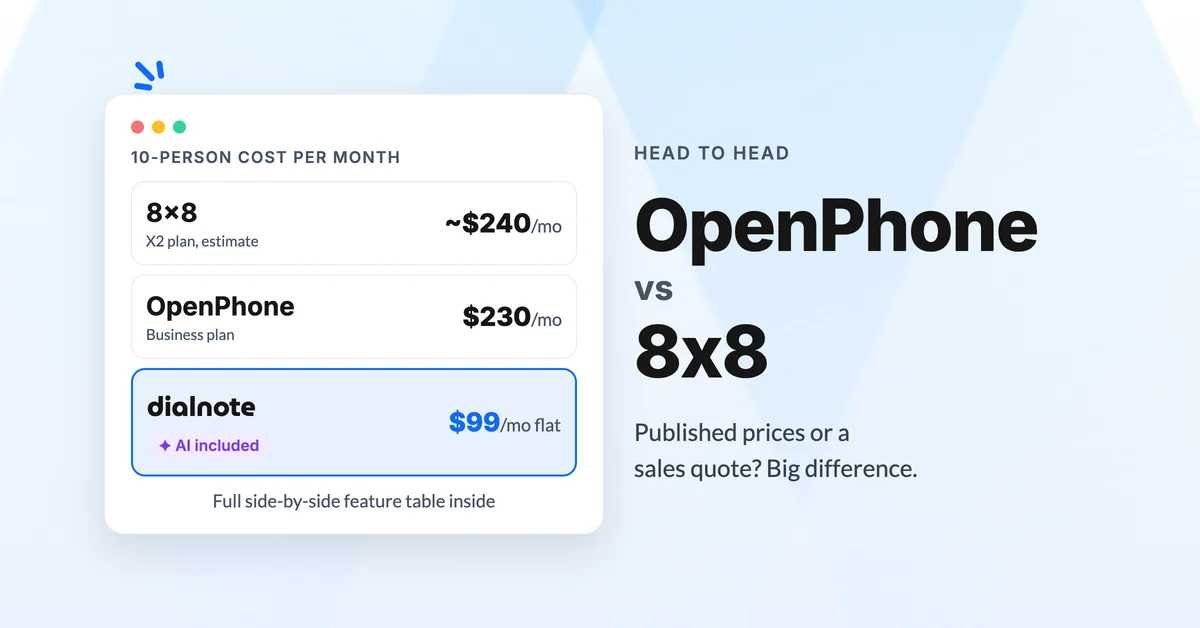
OpenPhone vs 8x8: Which Should You Choose?
Compare OpenPhone vs 8x8 on pricing, quote-only sales, and AI answering, then see why dialnote may fit small teams better than both.
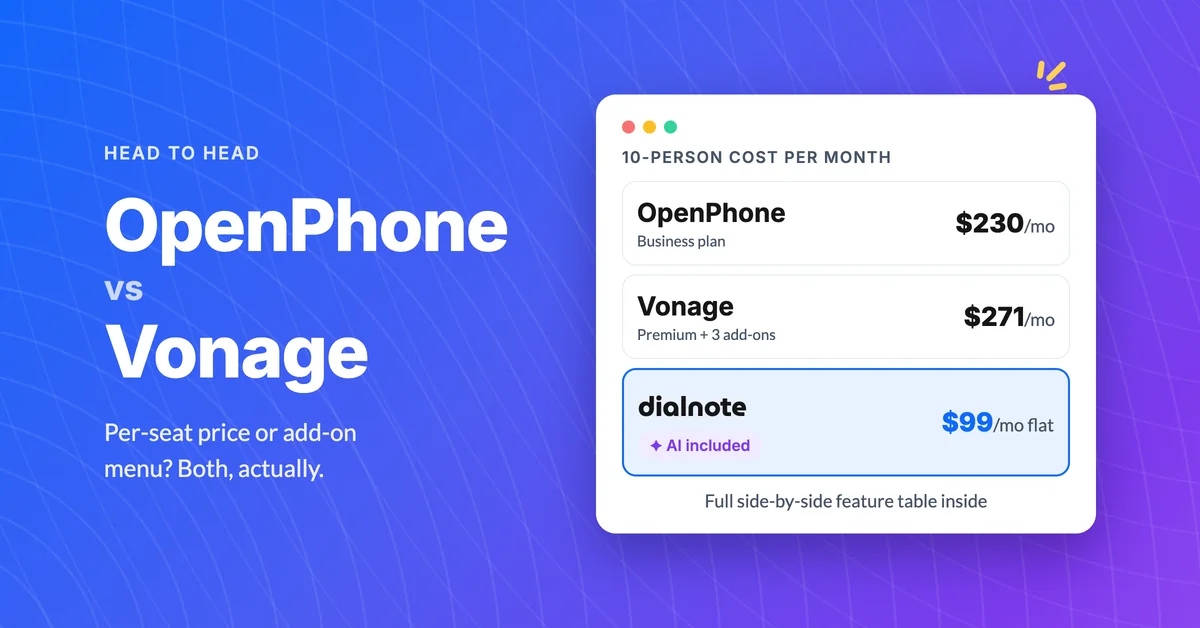
OpenPhone vs Vonage: Which Is Better Value?
Compare OpenPhone vs Vonage on pricing, add-on fees, and AI answering, then see why dialnote may be the better value for small teams.
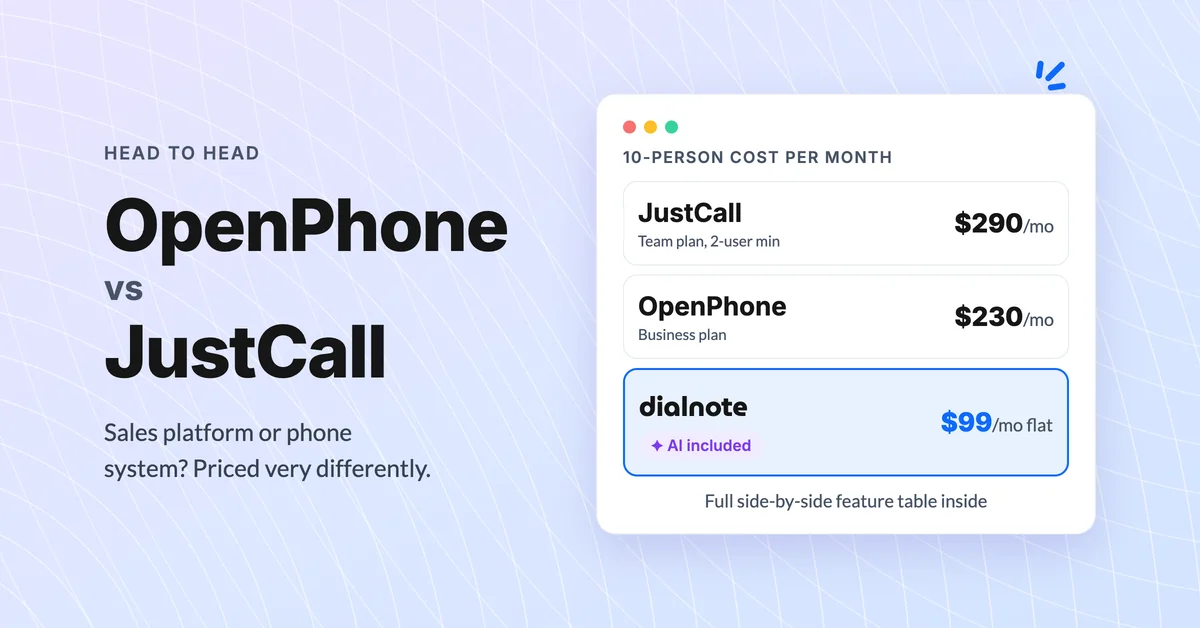
OpenPhone vs JustCall: Which Is Better for Teams?
Compare OpenPhone vs JustCall on pricing, AI tiers, and hidden minimums, then see why dialnote may be the smarter pick for small teams.