OpenPhone vs Grasshopper: Best for Small Business?
After two decades in B2B tech, I've noticed most phone-system comparisons pretend the two products do the same job. OpenPhone vs Grasshopper is a case where they genuinely don't. One is a modern VoIP system trying to run your whole front office. The other is a 20-year-old virtual number service that forwards calls to the phones you already own.
That difference matters more than any feature checklist. So let's get the real question on the table early: do you need a phone layer, or a phone system?
Ray runs an eight-person roofing crew. He bought Grasshopper years ago for one reason: a professional number on the yard signs that rang his cell. It did that job fine. But last spring his office manager asked for three things: recordings of quote calls, a shared view of customer texts, and something to catch the calls that came in while crews were on roofs. Grasshopper had no answer for any of them. Sound familiar?
This OpenPhone vs Grasshopper comparison covers features, real pricing, and the missed-call problem neither fully solves. We'll also bring in dialnote, an AI-first system with flat pricing, because it fills exactly the gap between these two.
TL;DR:
- In the OpenPhone vs Grasshopper matchup, Grasshopper wins on price for teams: flat plans at $14, $25, and $80 per month with unlimited users, vs OpenPhone's $15 to $35 per user per month.
- Grasshopper's low price buys a thin toolset: no call recording, no CRM integrations, no shared team inbox, and no AI on any plan.
- OpenPhone (rebranded to Quo in late 2025) is the stronger system: shared numbers, business texting, and the Sona AI agent, but per-user pricing means a 15-person team pays $345/month on Business.
- dialnote sits between them: $99/month flat (Business) with unlimited users, and it includes the AI receptionist, recording, and CRM sync the other two charge extra for or skip.
- Numbers port out of both platforms in about 1 to 3 weeks.
A quick look at OpenPhone and Grasshopper
Grasshopper is one of the oldest names in small-business phone. Its model is simple: you keep your existing phones and cell plans, and Grasshopper adds a business number on top, with extensions, custom greetings, call forwarding, and voicemail transcription. Local, toll-free, and vanity numbers are all available. It's owned by GoTo and aimed squarely at solo operators and small crews.
OpenPhone came at the problem a decade later as a full VoIP app. Your business line lives in an app on any device, teammates share numbers and see one conversation history, and texting is a first-class channel. In late 2025, OpenPhone rebranded to Quo and leaned into AI with Sona, its voice agent. You'll still see both names around; they're the same product.
Here's my honest framing: Grasshopper answers "how do I look professional without changing anything?" OpenPhone answers "how does my team work calls together?" Those are different questions, and the price tags reflect it.
OpenPhone vs Grasshopper: how do the features compare?
The short answer: OpenPhone out-features Grasshopper almost everywhere except price structure. Grasshopper's flat-rate, unlimited-users model is genuinely better designed for growth than OpenPhone's per-seat billing. The problem is what's inside the flat rate.
Grasshopper gives every plan unlimited US calling and texting, mobile and desktop apps, custom greetings, extensions, voicemail transcription, and instant response (an automatic text back after a missed call). That's the whole story. There's no call recording on any plan. No CRM integrations. No shared team inbox, so two people can't work one number's conversations together. And nothing AI-powered at all.
OpenPhone covers all of that on its Business plan: shared numbers, auto call recording, phone menus, HubSpot and Salesforce integrations, AI call summaries, and the Sona agent for missed calls (about 10 AI-handled calls a month before credits run out).
Here's the side-by-side, with dialnote as the third column:
| Feature | OpenPhone (Quo) | Grasshopper | dialnote |
|---|---|---|---|
| Pricing model | Per user | Flat rate | Flat rate |
| Starting price | $15/user/mo | $14/mo | $19/mo (Solo) |
| Where it's available | US + Canada numbers only | US + Canada only | Worldwide (calling to 90+ countries) |
| Unlimited users on flat price | ✗ | ✓ | Yes ($49/mo Team and up) |
| Calling (US/CA) | Included (fair use) | Unlimited US | Included (fair use) |
| Toll-free / vanity numbers | Toll-free ✓ | ✓ (incl. vanity) | Yes |
| Shared numbers / team inbox | ✓ | ✗ | Yes |
| Business texting | ✓ | ✓ (US, basic) | Yes (US/CA) |
| Auto-attendant / phone menu | Business plan | Greetings + extensions only | Yes |
| Call recording | Business plan (auto) | ✗ (not offered) | Yes (Business plan+, automatic) |
| AI call summaries | Business plan | ✗ | Yes (Business plan+) |
| AI receptionist / voice agent | Sona (credit-limited) | ✗ (instant-response texts only) | Yes (included, 14 languages) |
| CRM integrations | HubSpot, Salesforce (Business) | ✗ | HubSpot, Salesforce, Pipedrive, Zoho |
| Analytics / reporting | Business plan | Basic call reports | Yes |
Notice the pattern? Grasshopper's column is mostly about presenting a number. OpenPhone's is about operating one. That's not a knock; plenty of one-person businesses only need the first thing. But teams grow into the second thing fast.
The availability row matters too. Both of these are North America products: OpenPhone sells US and Canadian numbers only, and Grasshopper serves US and Canadian businesses only, with international outbound calling gated behind a $500 deposit and a 60-day account history. dialnote is open to businesses worldwide, with numbers in the US, Canada, UK, India, and France today, more countries opened on request, calling to 90+ countries, and business texting included. If your business or your customers sit outside North America, that row settles the comparison by itself.
What does each one cost, really?
This is where the comparison gets interesting, because Grasshopper's pricing model is the one I'd design, attached to the feature set I wouldn't.
Grasshopper sells three flat plans, priced by numbers and extensions rather than people: True Solo at $14/month (1 number, 1 user, 1 extension), Solo Plus at $25/month (1 number, unlimited users, 3 extensions), and Small Business at $80/month (4 numbers, unlimited users, unlimited extensions). Monthly billing runs higher ($18, $32, and $92). Add users freely; the bill doesn't move.
OpenPhone charges per user: $15/month on Starter, $23 on Business, $35 on Scale (annual billing; monthly is $19, $33, and $47). Every hire adds to the bill, and the features teams actually want live on Business.
Watch what happens as headcount grows:
| OpenPhone (Business) | Grasshopper (best-fit plan) | dialnote (Business) | |
|---|---|---|---|
| 1 user | $23/mo | $14/mo (True Solo) | $19/mo (Solo plan) |
| 5 users | $115/mo | $25/mo (Solo Plus) | $99/mo |
| 15 users | $345/mo | $80/mo (Small Business) | $99/mo |
| 25 users | $575/mo | $80/mo (Small Business) | $99/mo |
On raw dollars, Grasshopper wins the team columns. But look at what those dollars buy: at $80/month, your 15-person business still has no call recording, no CRM sync, no shared inbox, and nothing answering when you can't. You're paying less because you're getting a 2006 product at 2026 prices. That's my opinion, and I'll stand by it: Grasshopper has the right pricing model wrapped around the wrong decade's feature set.
dialnote's pricing takes Grasshopper's flat model and attaches the modern system to it: $49/month (Team), $99/month (Business), and $199/month (Pro), unlimited users on all three. The $99 Business plan lands within $20 of Grasshopper's top plan while including the recording, integrations, and AI answering that column is missing. Already on OpenPhone? See dialnote vs OpenPhone, line by line.
One fine-print note that applies across the board: "unlimited" calling always has fair-use limits. OpenPhone's sits around 1,000 minutes per user per month. If your crew lives on the phone, ask about caps before you sign anything.
Does either one answer calls for you?
Here's the question I'd rank above every feature table, because the Fortune Business Insights VoIP-market numbers all point the same direction: the growth is in systems that do something with a call, not just carry it. For a service business, the missed call is the expensive call. Somebody dialing a roofer, a plumber, or a clinic is usually ready to buy, and if nobody answers, the next number on their list gets the job.
Grasshopper's answer is instant response: a missed caller automatically gets a text ("Sorry we missed you, we'll call right back"). It's better than silence. But it can't answer a question, capture what the job is, or book anything. The lead still has to wait for a human, and plenty won't.
OpenPhone's answer is Sona, a real AI agent that greets callers, handles common questions, and takes structured messages. The catch is the meter: roughly 10 AI-handled calls a month are included before you're buying credit packs from $25/month. For a business whose whole problem is call volume, the meter starts running exactly when you need it most.
dialnote makes the AI receptionist the headline feature rather than an add-on. It answers 24/7 in 14 languages, asks the lead-capture questions you configure, books meetings through Calendly or Cal.com, sends texts, and transfers to a teammate when a human should take over. Afterward, the AI call summary syncs to your CRM automatically. You can try the AI receptionist live on dialnote's site before you sign up for anything.
And you're not forced into the AI answering every call. dialnote covers the whole missed-call spectrum, and you pick per line: the AI receptionist takes the call, or an automated text goes back to the caller (Grasshopper's instant response, included), or a voice message tells them nobody's free and someone will call back shortly, or the call simply lands in voicemail with a transcript. Grasshopper offers one of those four. OpenPhone offers two. dialnote lets you choose.
I'm genuinely unsure how long Grasshopper can hold its position with no AI story at all; GoTo may have modernization plans we haven't seen. But if you're buying today, you can only buy what's on the shelf today.
What are they like to run day to day?
On paper the gap looks academic. In the field, it's the difference between a phone number and a front office.
Grasshopper's daily reality: calls to your business number ring the personal phones you've pointed them at. That's frictionless on day one; nobody installs anything they don't already have. But the seams show quickly. Your crew answers business calls on personal cells, so when someone quits, their call history and customer texts walk out the door with them. Two people can't see the same conversation. And because the system is a forwarding layer, "who talked to this customer last, and what was said?" has no answer anywhere.
OpenPhone's daily reality is the opposite: everything lives in one app. A customer's calls, texts, voicemails, and internal notes sit on a single thread any teammate on that number can see. New hire? Add a seat (and pay for it), and they inherit the full history. The cost is the per-seat bill and the habit change of taking calls in an app instead of the native dialer.
There's a third daily-use detail worth knowing: numbers. Grasshopper's Small Business plan includes 4 numbers; extras cost more, and vanity numbers are a genuine strength. OpenPhone includes one number per user and charges $5/month for extras. dialnote's Business plan includes 3 numbers with additional local numbers at $1.25/month, useful if you run separate lines for ads, sales, and support.
My rule of thumb after watching dozens of teams make this call: the moment two people need to handle one number, forwarding-based systems start costing you deals you never see. You don't notice a missing shared inbox. You notice the job that went to a competitor because the callback slipped.
How do you switch without losing your number?
Both platforms let your number leave. The process is the same either way:
- Open an account with the new provider first, and don't cancel the old one. A closed account can release your number before the port begins.
- Submit the port request from the new provider's side. You'll need your current account number and PIN. The new provider files the paperwork with both carriers.
- Work normally while you wait. Ports take about 1 to 3 weeks, and your existing line keeps working the whole time.
- Confirm, then cancel. When the port completes, calls route to the new system instantly. Only then do you close the old account.
Callers never notice. The number on the yard signs, the invoices, and the Google listing stays exactly the same.
Where both fall short
Grasshopper's gaps:
- No call recording, on any plan. For quote-heavy businesses, that's a dealbreaker by itself.
- No CRM integrations and no API to build your own.
- No shared team inbox; extensions forward calls, but nobody sees one shared history.
- No AI features beyond automatic text-backs.
- US and Canada only, and international outbound calling requires a $500 deposit on an account at least 60 days old.
- Texting is basic and US-focused, and number verification for business texting has gotten stricter industry-wide.
OpenPhone's gaps:
- Per-user pricing that climbs with every hire; the $80 Grasshopper price buys only 3 to 4 OpenPhone Business seats.
- The best features (recording, menus, integrations, AI summaries) sit on the $23/user Business tier.
- Sona is credit-metered, at about 10 free AI calls a month.
- Fair-use cap around 1,000 minutes per user, low for phone-heavy teams.
- The Quo rebrand has split its reviews and documentation across two names.
Why dialnote might be the better pick
The pattern through this whole comparison: Grasshopper has the pricing model, OpenPhone has the feature set, and neither has both. dialnote is an AI business phone system with no per-user pricing. AI voice agents answer calls, capture leads, and book meetings 24/7. Plans from $19/mo. It was built for exactly this gap by the team behind SmartReach.io, which has spent years building sales tools for teams that live on conversations.
Flat pricing, real system. $49 to $199 a month, unlimited users. Ray's eight-person crew pays $99 on Business, within $20 of Grasshopper's top plan, and every seat gets the full system.
The missed-call problem actually solved. The AI receptionist answers around the clock, captures the job details you tell it to collect, books the meeting, and texts confirmations. No credit meter deciding which missed calls matter.
Recording, summaries, and CRM sync included. Automatic call recording and AI summaries land in HubSpot, Salesforce, Pipedrive, or Zoho on the Business plan. The office manager's three requests from the intro? All standard.
Room to grow. Calling reach across 90+ countries, local and toll-free numbers, and analytics that show which numbers and hours drive the calls.
An easy exit from either platform. Porting takes about 1 to 3 weeks with no caller-facing downtime. If you're coming from Grasshopper specifically, the port your number from Grasshopper page covers the steps, and our switching guide has the full checklist.
"Flat pricing wasn't a pricing decision for us, it was a product decision," says Prateek Bhatt, dialnote's co-founder. "The moment a business counts seats before adding a teammate to the phones, the phone system has failed at its job."
OpenPhone or Grasshopper: which fits your business?
Pick Grasshopper if you're solo or a tiny crew, you want a professional number over your existing phones for the lowest flat price, and recording, integrations, and AI genuinely don't matter to you yet. For that job, $14 to $25 a month is fair.
Pick OpenPhone if your team works calls and texts together all day, you want shared numbers and a modern app, and you're comfortable paying per seat for it. It's the more capable product of the two, full stop.
Pick dialnote if you want Grasshopper's flat-rate math with OpenPhone's feature depth, plus an AI receptionist neither of them includes. It's strongest for service businesses where a missed call is a lost job and headcount is growing.
If you're still mapping the wider field, our Grasshopper alternatives guide and OpenPhone alternatives guide rank more options. But if the choice is between these two, decide what you're really buying: a number that forwards, or a system that answers.
Start a free 10-day trial of dialnote, no credit card required, or run your team's numbers against both.
Frequently asked questions
Grasshopper is a virtual number layer that forwards business calls to your existing phones. OpenPhone (now Quo) is a full VoIP system with shared numbers, team inboxes, and AI tools. Grasshopper is simpler; OpenPhone does far more per dollar at team size.
For teams, usually yes. Grasshopper's plans are flat: $14 to $80 per month regardless of user count, while OpenPhone charges $15 to $35 per user. A 15-person team pays $80 on Grasshopper vs $345 on OpenPhone Business, but gets far fewer features for it.
No. Grasshopper's closest feature is instant response, an automatic text sent after a missed call. It can't answer questions, capture lead details, or book meetings. OpenPhone's Sona handles about 10 AI calls a month free; dialnote includes a 24/7 AI receptionist.
No, call recording isn't offered on any Grasshopper plan. OpenPhone includes automatic recording on its Business plan ($23/user/month), and dialnote includes it on Business and up ($99/month flat).
Yes. Both numbers are portable. Submit a port request with your new provider, keep the old account active until it completes, and the switch takes about 1 to 3 weeks with no downtime for callers.

Written by
Lancelot Dsouza
Chief Marketing Officer, SmartReach.io
Lancelot Dsouza is the Chief Marketing Officer at SmartReach.io, where he built the Marketing, Sales, and Customer Success verticals from the ground up. With over 25 years of experience spanning digital marketing, business development, and strategic...
Lancelot Dsouza is the Chief Marketing Officer at SmartReach.io, where he built the Marketing, Sales, and Customer Success verticals from the ground up. With over 25 years of experience spanning digital marketing, business development, and strategic...
Related Articles
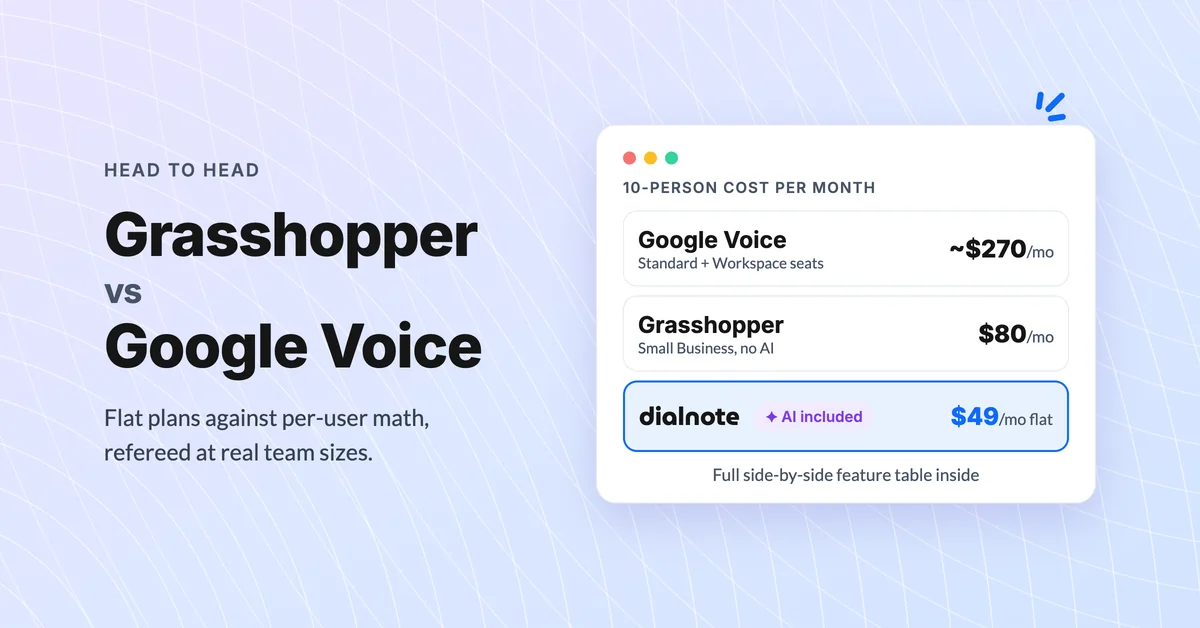
Grasshopper vs Google Voice: Which Wins? [2026]
Compare Grasshopper vs Google Voice on real team cost, texting rules, and what happens to missed calls, plus a third flat-rate AI option.
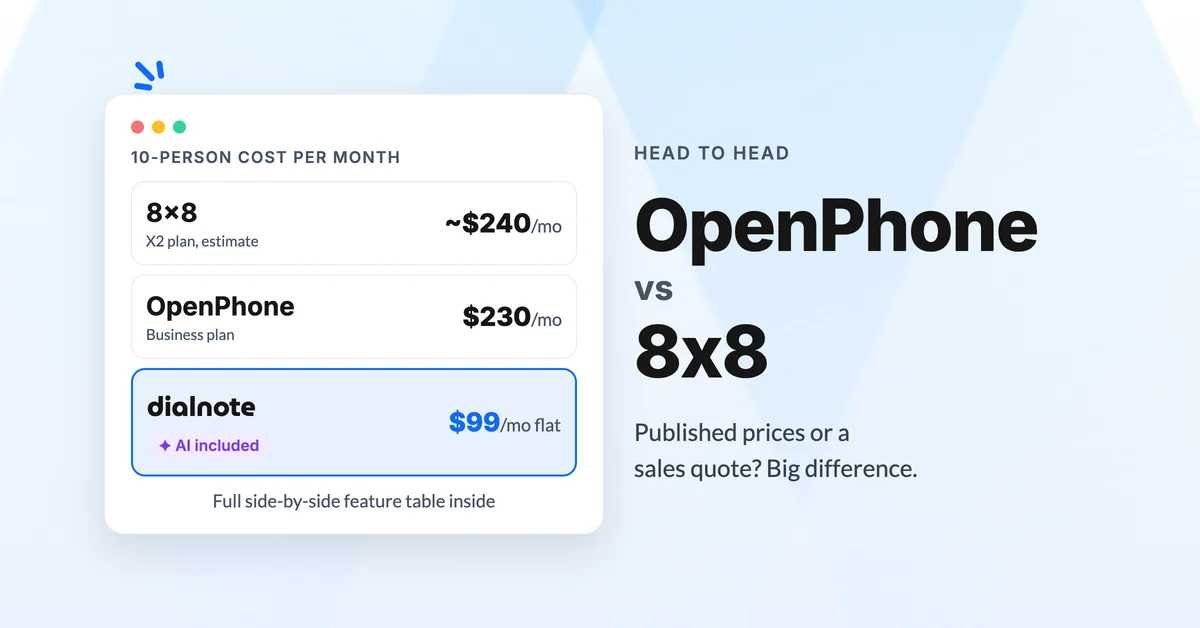
OpenPhone vs 8x8: Which Should You Choose?
Compare OpenPhone vs 8x8 on pricing, quote-only sales, and AI answering, then see why dialnote may fit small teams better than both.
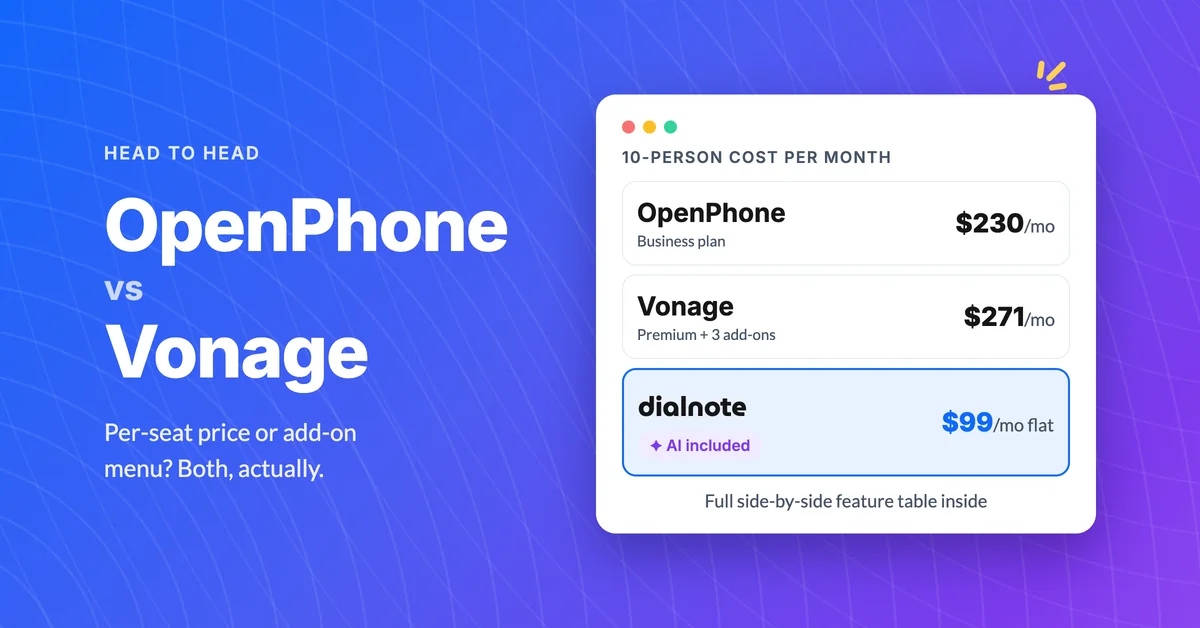
OpenPhone vs Vonage: Which Is Better Value?
Compare OpenPhone vs Vonage on pricing, add-on fees, and AI answering, then see why dialnote may be the better value for small teams.