How Much Does a Business Phone System Cost in 2026?
The advertised price of a business phone system is almost never the price you end up paying. The sticker says $25 per user. The invoice says something else.
Ray learned this the slow way. He runs operations for a property management company with 4 offices and 15 staff, and his phone bill grew every time the company hired. Fifteen seats at $42 each was costing more than rent on the smallest office. And he still couldn't tell which location was dropping tenant calls. Sound familiar?
Business phone system cost comes down to three things: the pricing model, the features you actually need, and the fees nobody mentions on the pricing page. Get those three right and you can put a real number in your budget. Get them wrong and your bill creeps up with every hire.
TL;DR:
- Business phone system cost runs $15-$50 per user, per month for most cloud systems, with entry plans at $10-$25 and advanced plans at $40-$100+.
- Taxes, regulatory fees, porting, and add-ons typically push the real bill 15-25% above the advertised price.
- Traditional landlines cost $40-$60 per line plus hardware and installation, which is why most small businesses have moved to cloud VoIP.
- Flat-rate pricing flips the math for growing teams: an unlimited-user plan at $49/month flat costs a 10-person team $1,764 over three years instead of $10,800+. Jump to the math.
How much does a business phone system cost?
A business phone system costs $15 to $50 per user, per month for a typical cloud-based setup. Entry plans run $10-$25 per user, mid-tier plans $25-$45, and advanced plans with AI and analytics reach $40-$100+. Flat-rate providers skip per-user pricing entirely and charge $19-$199 per month for the whole team.
Here's how the per-user tiers break down:
| Plan tier | Typical price (per user/month) | What's usually included |
|---|---|---|
| Entry | $10-$25 | Business number, calling, voicemail, basic forwarding, mobile app |
| Mid-tier | $25-$45 | Auto attendant, call recording, CRM integrations, analytics |
| Advanced | $40-$100+ | AI features, advanced analytics, international calling, priority support |
Those ranges hold up against what the big names publish. According to Forbes Advisor's pricing guides, RingCentral's plans run $30 to $45 per user monthly, while budget options like Zoom Phone start at $10 per user. Those are the month-to-month rates; our RingCentral pricing breakdown covers the annual tiers, add-ons and fees that decide the real invoice.
So a 10-person team on a mid-tier per-user plan lands around $250-$400 a month before taxes and fees. A 3-person shop can get going for under $75. That's the quick answer. The rest of this guide covers why your quote might land somewhere very different.
One note on how we got these numbers: we pulled the published list prices of nine major providers while building our own pricing comparisons, so the ranges above come from current price pages, not recycled stats from 2022. Pricing in this market moves fast.
What changes the price
The biggest cost factor is the type of system you pick. After that, it's team size, features, and contract terms. Two businesses with the same headcount can pay wildly different amounts based on these choices alone.
System type: landline, on-premise, or cloud
This decision sets your cost floor before you compare a single provider:
| System type | Monthly cost | Upfront cost | Best for |
|---|---|---|---|
| Traditional landline | $40-$60 per line | Installation + wiring | Almost nobody in 2026 |
| On-premise PBX | $20-$50 per user + maintenance | $500-$1,000+ per user in hardware | Businesses with strict on-site requirements |
| Cloud VoIP | $15-$50 per user (or flat rate) | Usually $0 | Most small and mid-size teams |
Landlines charge per line and then charge again for features that cloud systems include free: voicemail transcription, call forwarding, conferencing. In the UK the math is even harsher, because copper line rental is roughly doubling through 2026 ahead of the January 2027 switch off. On-premise PBX systems have real upfront hardware costs plus ongoing IT maintenance. Cloud systems run on the phones and laptops you already own.
That's why the market has largely settled this question. If you're still weighing the options, our cloud vs on-premise comparison walks through the tradeoffs in detail. For most small businesses, cloud wins on cost alone.
Features that push you up a tier
Providers are smart about tier design. The one feature you really want, like call recording or CRM sync, often sits one tier above the plan you were planning to buy. Common tier-jumpers include:
- Auto attendants and IVR menus (route callers without a receptionist)
- Call recording (often gated to mid or top tiers)
- CRM integrations (HubSpot, Salesforce, Pipedrive)
- Analytics dashboards (answer rates, missed calls, call volume by location)
- AI features (AI receptionists, transcription, call summaries)
Budget for the tier that has what you need, not the tier on the billboard. A $20 plan you outgrow in a month is more expensive than a $35 plan that fits.
Team size and contract terms
Per-user pricing scales linearly with headcount, which is exactly the problem for growing teams. Volume discounts exist but rarely kick in below 20-50 seats. Annual contracts usually knock 10-20% off the monthly rate, but they lock you in, so test a system on a monthly plan or free trial before committing to a year.
The annual discount is worth taking once you're confident. On a $30 seat, 15% off saves $54 per seat per year, which is $540 across ten seats. Just make sure you've run the system through a real busy week first, because an annual contract on a system your team hates is the most expensive discount there is.
Phone numbers scale separately from seats, and it's worth pricing them on purpose. A single local number is usually included. Additional local numbers commonly run $5-$15 each per month, toll-free numbers a bit more, and international numbers vary widely by country. A 4-location business doesn't need 15 seats worth of numbers; it needs 4 good ones that each ring the right team.
Why doesn't the invoice match the quote?
Because the quote leaves out taxes, regulatory fees, and one-time charges. A plan advertised at $25 per user commonly lands at $30-$32 per user once everything is applied. That's not a scam, but it should be expected, not discovered.
Here's what to look for before you sign:
- Taxes and regulatory fees. Federal, state, and local telecom taxes plus regulatory recovery fees typically add 15-25% to your bill, depending on where your business is registered.
- Number porting. Moving your existing business number over can cost $10-$30 per number with some providers. Others include it free, and it's worth asking directly.
- Setup and onboarding fees. Some providers charge $50-$200 to get you configured. Cloud systems designed for self-service usually don't.
- Hardware. Desk phones run $80-$400 each. The honest question is whether you need them at all: most teams now run entirely on mobile and desktop apps.
- Add-ons. Extra phone numbers, international calling, SMS bundles, and AI minutes are commonly priced separately. This is where "cheap" plans quietly get expensive.
- Internet capacity. VoIP rides on your existing connection, and each active call uses roughly 100 Kbps. Most offices already have plenty of headroom, but a team taking dozens of simultaneous calls on a thin connection may need an upgraded plan, which is a phone cost even though it shows up on a different bill.
AI features deserve a special mention because pricing there is still unsettled. Some providers include AI answering in top tiers, others sell it as a metered add-on, and honestly, we're not sure where AI minute pricing settles over the next couple of years. The whole category is repricing as the underlying costs drop. If AI answering matters to you, compare the add-on math specifically, not just the base plan.
If your motivation for reading this is cutting an existing bill, we've written a dedicated guide on VoIP cost savings for small businesses with the switching math.
Per-user vs flat-rate pricing: run the math
Per-user pricing charges you for every person who touches the phone system. Flat-rate pricing charges one monthly price for the whole team. For teams that are growing, the gap between the two compounds every single month.
We ran the numbers on a 10-person team over three years:
| Pricing model | Monthly cost | 3-year total |
|---|---|---|
| Per-user at $30/user | $300 | $10,800 |
| Per-user at $30/user + 20% fees | $360 | $12,960 |
| Flat-rate plan at $49/month | $49 | $1,764 |
That's not a rounding error. It's the difference between a phone bill and a real budget line. And the per-user column assumes you never hire anyone, which defeats the point of running a growing business.
Honestly? Per-user pricing is the worst deal in business phones for small teams. It made sense when providers had per-line costs to pass through. Cloud systems don't, and the model survives mostly because buyers are used to it. If every new hire raises your software bill across five different tools, the phone system is the easiest one to take off that list.
Flat-rate providers are built around exactly this: one price for the whole account, typically $19-$49/month at solo and small-team tiers, with no per-user charge anywhere. Ray's 15-seat problem simply doesn't exist on flat pricing, and his sixteenth hire costs $0 extra on the phone bill.
To be fair, per-user pricing isn't always wrong. If you're a 2-person shop that will stay a 2-person shop, a cheap per-user plan can cost less than a flat team plan. Do the math at your headcount, then do it again at the headcount you expect in two years.
How to budget for a business phone system
You can put a reliable number on paper in about an hour. Work through these five steps:
- Count users and phone numbers separately. Ten people might share three numbers, or need ten direct lines. Numbers and seats are priced differently, and confusing the two inflates quotes.
- List your must-have features, then find their tier. Auto attendant? Recording? CRM sync? Match each to the tier where a provider actually includes it, and price that tier.
- Ask for the loaded monthly cost. Request a quote with taxes, regulatory fees, and surcharges included for your state. This one question surfaces the 15-25% gap before it hits your invoice.
- Price the one-time costs. Porting your numbers, any hardware, and setup fees. For most cloud systems this can be $0, but confirm it.
- Run a 3-year total at future headcount. Multiply the loaded monthly cost by 36 months at the team size you expect, not the size you have. This is where per-user and flat-rate pricing separate dramatically.
What should you actually budget? For most small teams on per-user pricing, plan for $25-$35 per user, per month, loaded. On flat-rate pricing, plan for $19-$99 per month total, depending on team size and features. If a quote comes in far outside those ranges, ask what's driving it.
And put a reminder in your calendar to redo step 5 once a year. Phone pricing shifts fast, headcount changes faster, and the plan that fit you at six people is often the wrong one at eleven. An hour a year keeps the bill honest.
For a deeper walkthrough of the selection process itself, including questions to ask on sales calls, see our guide on how to choose a business phone system.
Business phone system cost by team size
Here's what realistic monthly budgets look like at four common team sizes, with taxes and fees baked in on the per-user side:
| Team size | Per-user pricing (loaded) | Flat-rate pricing |
|---|---|---|
| Solo operator | $12-$35/month | From $19/month |
| 5-person shop | $125-$220/month | From $49/month |
| 10-person team | $300-$430/month | $49-$99/month |
| 25 people, multi-location | $750-$1,100/month | $99-$199/month |
Solo operators sit in the one spot where per-user pricing can genuinely win. One seat at $15 is $15. If that's you, buy on features and call quality, not on pricing model. A solo attorney who takes intake calls between consultations cares more about a professional number, business-hours routing, and voicemail transcription than about seat math.
Small shops of 3-8 people are where the models start to diverge. Five seats at $30 loaded is $150 a month, or $1,800 a year, for capability a flat $49 plan matches. This is also the size where feature gating bites hardest, because small teams want mid-tier features (auto attendant, recording) on entry-tier budgets.
10-person teams are past the crossover point in almost every case, as the 3-year table earlier shows. At this size, also start weighing what the system tells you: answer rates, missed-call counts, and per-line reporting stop being nice-to-haves once nobody personally sees every call anymore.
Multi-location teams should price numbers and visibility, not just seats. Ray's actual requirement wasn't 15 phone lines. It was 4 location numbers that each ring a team, plus one report showing answer rates per office. If a quote prices that as 15 full seats, you're paying for the wrong shape of system.
One caveat on the table: per-user ranges assume mid-tier plans, and your quote will vary by state taxes and the add-ons you pick. Treat these as budgeting anchors, not promises.
Where dialnote fits in the cost picture
dialnote is an AI business phone system with no per-user pricing. AI voice agents answer calls, capture leads, and book meetings 24/7. Plans from $19/mo. The full lineup runs $19 to $199 per month for the whole account, not per person.
- Solo: $19/month with 1 phone number, for one-person businesses.
- Team: $49/month with 2 numbers and unlimited seats, the fit for most small teams.
- Business: $99/month with 3 numbers, adding AI answering depth and analytics.
- Pro: $199/month with 5 numbers, for larger or multi-location teams.
Every plan includes calling to 90+ countries, and AI voice agents can answer in 14 languages. Because seats are unlimited on team plans, the 3-year math from the table above is literal: hiring doesn't change your phone bill.
There's a 10-day free trial with no credit card required, which is the cheapest way to test whether the numbers in this guide hold up for your specific team. For the bigger picture of what a modern system includes beyond price, our business phone system overview covers the full feature stack.
What a business phone system should cost you
Expect $15-$50 per user, per month on per-user pricing, plus 15-25% in taxes and fees. Expect $19-$199 total per month on flat-rate pricing. Landlines and on-premise systems cost more than either, in both money and patience.
The real lesson from Ray's 15-seat bill isn't that phones are expensive. It's that the pricing model matters more than the sticker price. A team of three can pick almost anything. A team that's hiring should run the 3-year math before signing, because that's where a $25 sticker becomes a five-figure line item.
Put your own numbers in, and if flat-rate pricing wins the math for your team, run the trial and check the real bill against this guide.
Check the real bill against this guide
10-day free trial, no credit card needed.
Frequently asked questions
Most cloud phone systems cost $15-$50 per user, per month. Entry plans run $10-$25, mid-tier plans $25-$45, and advanced plans $40-$100+. Flat-rate providers charge one price for the whole team instead, starting around $19-$49/month.
Yes, usually by a wide margin. Landlines run $40-$60 per line plus installation and per-feature fees. Cloud VoIP runs $15-$50 per user with features like voicemail, routing, and auto attendants included.
Expect taxes and regulatory fees (often 15-25% on top of the sticker price), number porting charges, one-time setup fees, desk phone hardware if you want it, and add-on pricing for AI features, recording, or extra numbers.
On per-user pricing at $30/user, about $300/month before taxes and fees, or roughly $10,800 over three years. On a flat-rate plan like dialnote's $49/month Team plan, the same team pays $1,764 over three years.

Written by
Lancelot Dsouza
Chief Marketing Officer, SmartReach.io
Lancelot Dsouza is the Chief Marketing Officer at SmartReach.io, where he built the Marketing, Sales, and Customer Success verticals from the ground up. With over 25 years of experience spanning digital marketing, business development, and strategic...
Lancelot Dsouza is the Chief Marketing Officer at SmartReach.io, where he built the Marketing, Sales, and Customer Success verticals from the ground up. With over 25 years of experience spanning digital marketing, business development, and strategic...
Related Articles
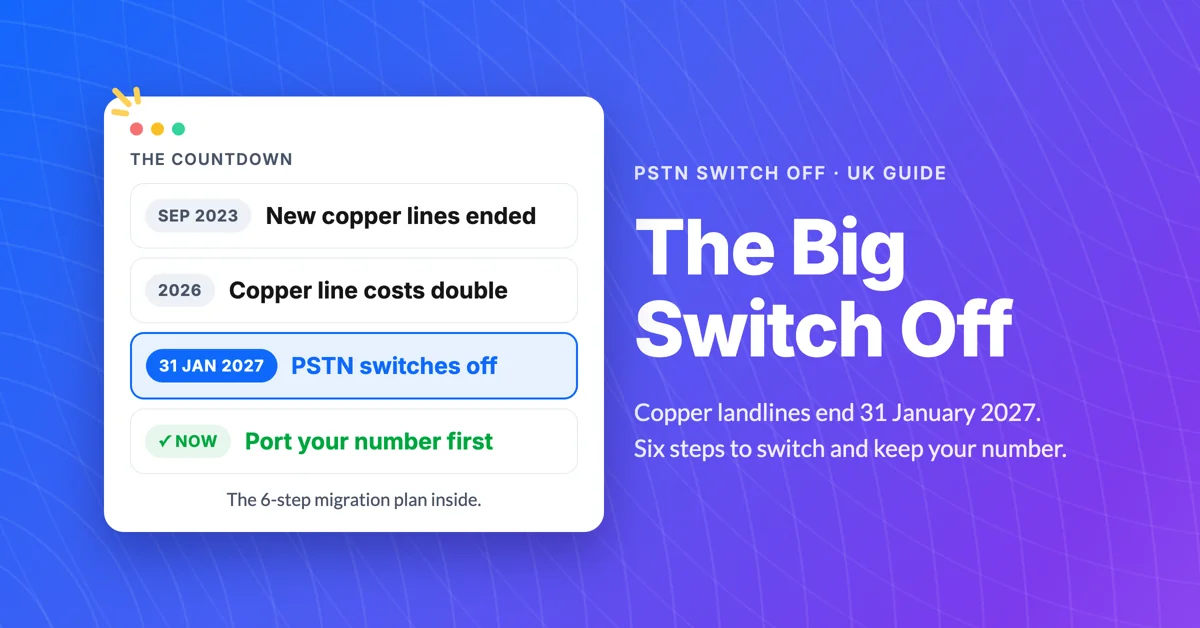
UK PSTN Switch Off: What Businesses Must Do Before 2027
Learn what the UK PSTN switch off means for your business: the January 2027 deadline, rising landline costs, and 6 steps to switch without losing your number.
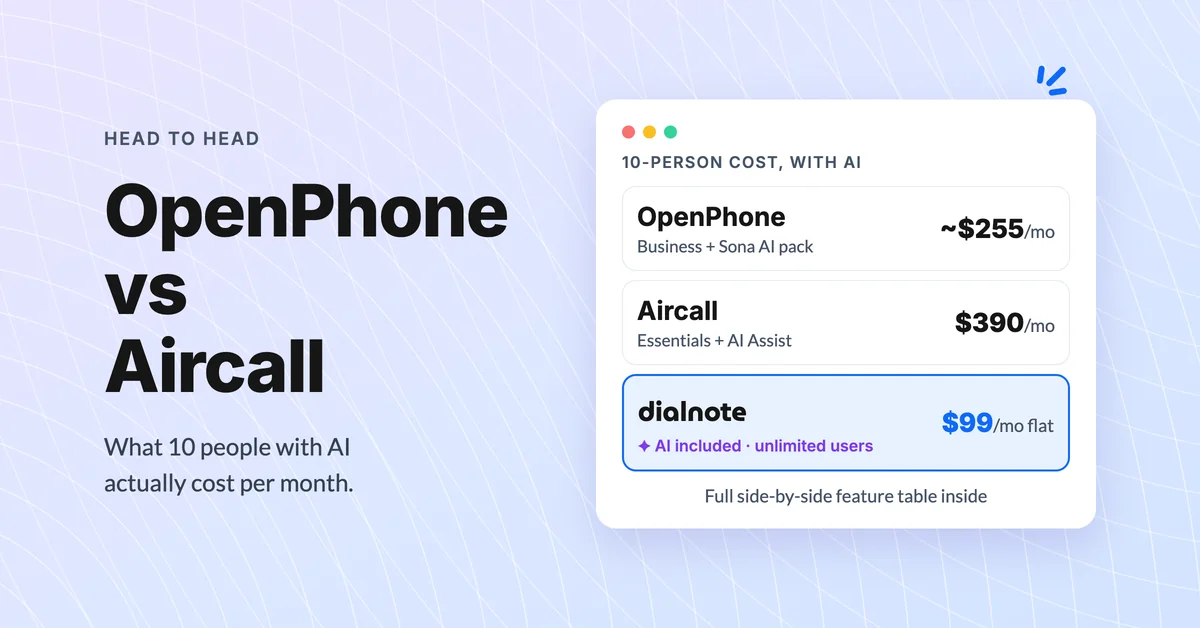
OpenPhone or Aircall, which is better for your business?
Compare OpenPhone vs Aircall on pricing, AI features, and integrations to find the best VoIP for your business. Plus, see how dialnote stacks up.
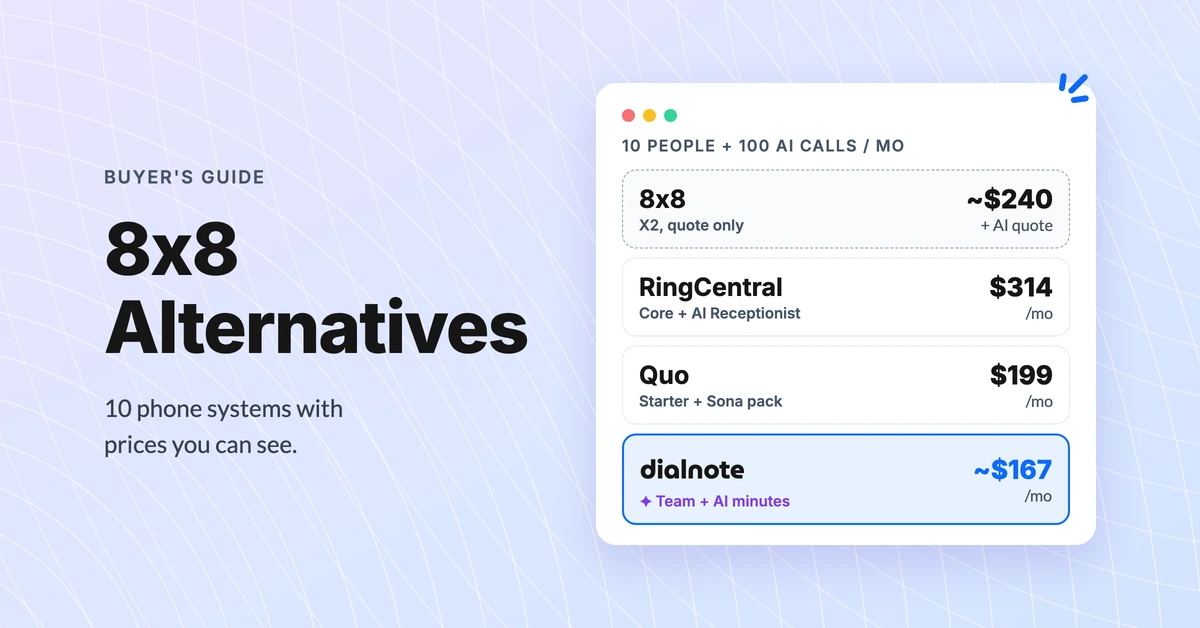
8x8 Alternatives: 10 Phone Systems With Public Prices
Compare 10 8x8 alternatives on real 10-person cost with AI answering. 8x8 quotes its price on a sales call; these publish theirs (October 2026).