UK Landline Price Increases: The Real Cost of Waiting
There's a tax on doing nothing this year, and it's printed on your phone bill. The UK landline price increases running through 2026 aren't the usual inflation nudge: wholesale copper line costs roughly double between April and October, on a network that shuts down entirely on 31 January 2027.
Ray noticed it the way operations people do, in a variance column. His property company runs 4 offices, each with a couple of copper lines for the front desk and the fax nobody uses. The March invoice looked normal. The April one didn't, and when he called to ask, the provider read him a schedule: another rise in July, another in October. Waiting, it turns out, is now the most expensive phone plan his company has ever had.
Here's what's rising, why, what it means in pounds for a small business, and the cheaper move that ends it.
TL;DR:
- The UK landline price increases are wholesale: Openreach raised copper line costs about 20% in April 2026, 40% in July, and 40% in October, roughly doubling them in one year.
- One published example: a 20-line business paying ~£213 a month in March 2026 reaches ~£501 by October.
- The rises are deliberate. They're the eviction notice for a network that switches off on 31 January 2027.
- Every month on copper now buys doubled rental on a dying line; a flat-rate cloud plan usually costs less than the copper it replaces.
- Move in autumn: port your number first, then cancel, and skip the January migration queue.
Jump straight to: why prices are rising · the 2026 timeline · what waiting costs you · the cheaper move
Why are UK landline prices going up?
Because the network behind them is closing, and the pricing is designed to move you. Openreach retires the copper PSTN on 31 January 2027, and through 2026 it has been raising the wholesale cost of copper line rental so that staying becomes visibly worse than leaving. Providers pass those wholesale rises straight through to the line rental on your bill.
Why would Openreach make its own product more expensive? Because keeping a century-old network alive for a shrinking number of users costs more every year: the parts are scarce, the engineers who service it are retiring, and every pound spent propping up copper is a pound not spent on the fibre that replaces it. The consumer side moved first (BT raised voice-only line rental in March, as ISPreview reported); the business side is where the rises really bite.
Our honest read: this isn't a money grab, it's an eviction notice. And like most eviction notices, it's doing the recipients a favor they haven't priced yet, because the replacements are better and mostly cheaper.
The 2026 price rise timeline
The wholesale schedule stacks three rises inside seven months. Cloudswitched published the math for a typical 20-line business, and it's worth staring at:
| Date | What changes | 20-line business example (monthly) |
|---|---|---|
| March 2026 | Baseline | ~£213 |
| 1 April 2026 | Wholesale rise ~20% | ~£256 |
| 1 July 2026 | Wholesale rise ~40% | ~£358 |
| 1 October 2026 | Wholesale rise ~40% | ~£501 |
| 31 January 2027 | PSTN switches off | £0, because the lines stop working |
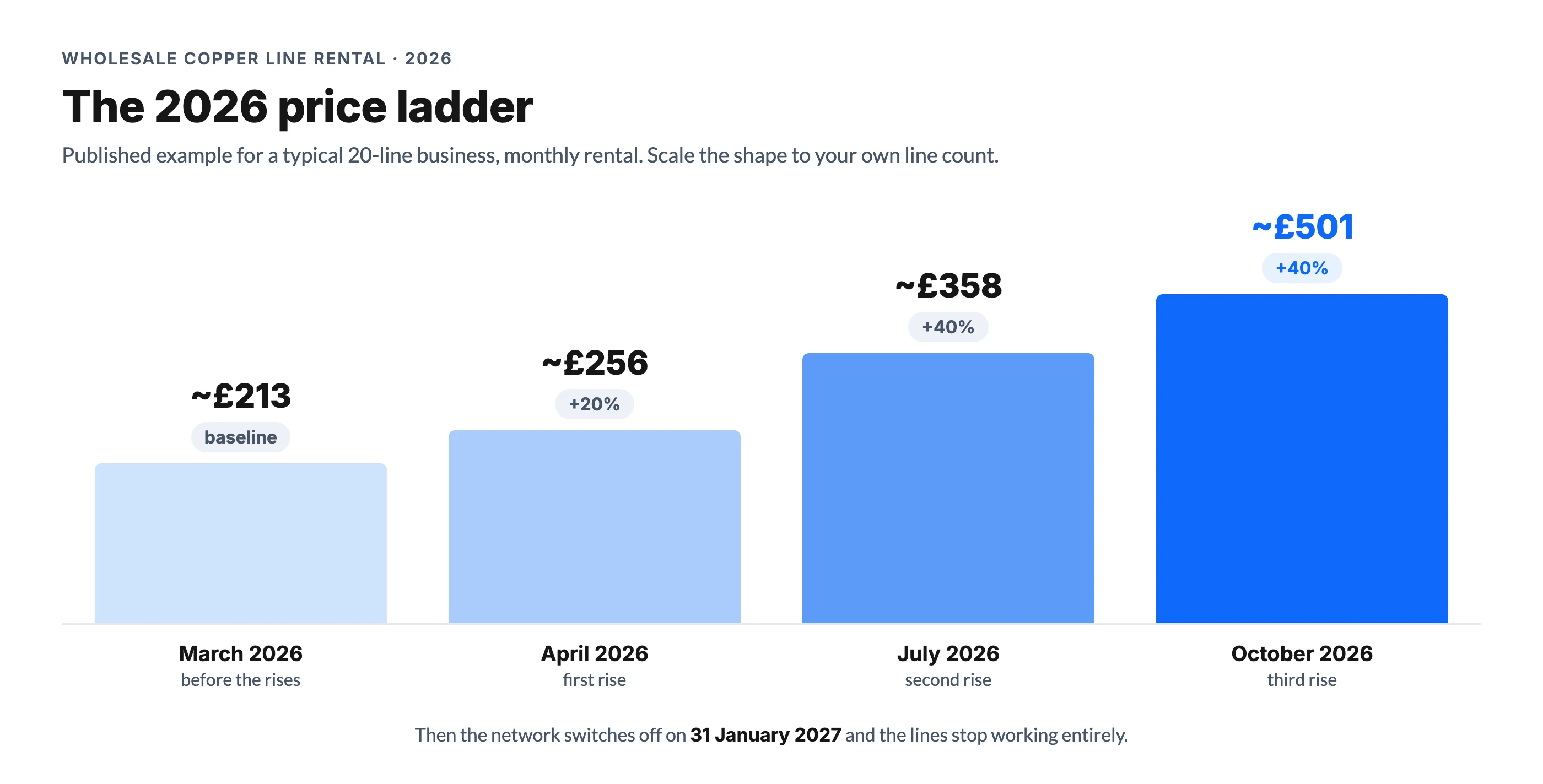
Sound dramatic for a small business with two lines instead of twenty? Scale it down and the shape is identical: whatever a copper line cost you in March, expect roughly double by the end of the year. The percentages don't care how many lines you have.
The last row is the one that reframes the whole table. This isn't a price curve you can ride out; it's a countdown with a fee attached. Everything else about the deadline, including what happens to alarms, card machines, and ISDN systems, is in our UK PSTN switch off guide.
What waiting actually costs your business
Run it on a real shape. Ray's 4 offices hold 8 copper lines. Say they cost £25 each in March, £200 a month across the company. On the 2026 schedule that's heading for roughly £400 a month by October, £4,800 a year, for lines that die in January anyway and that never once told Ray which office missed a call.
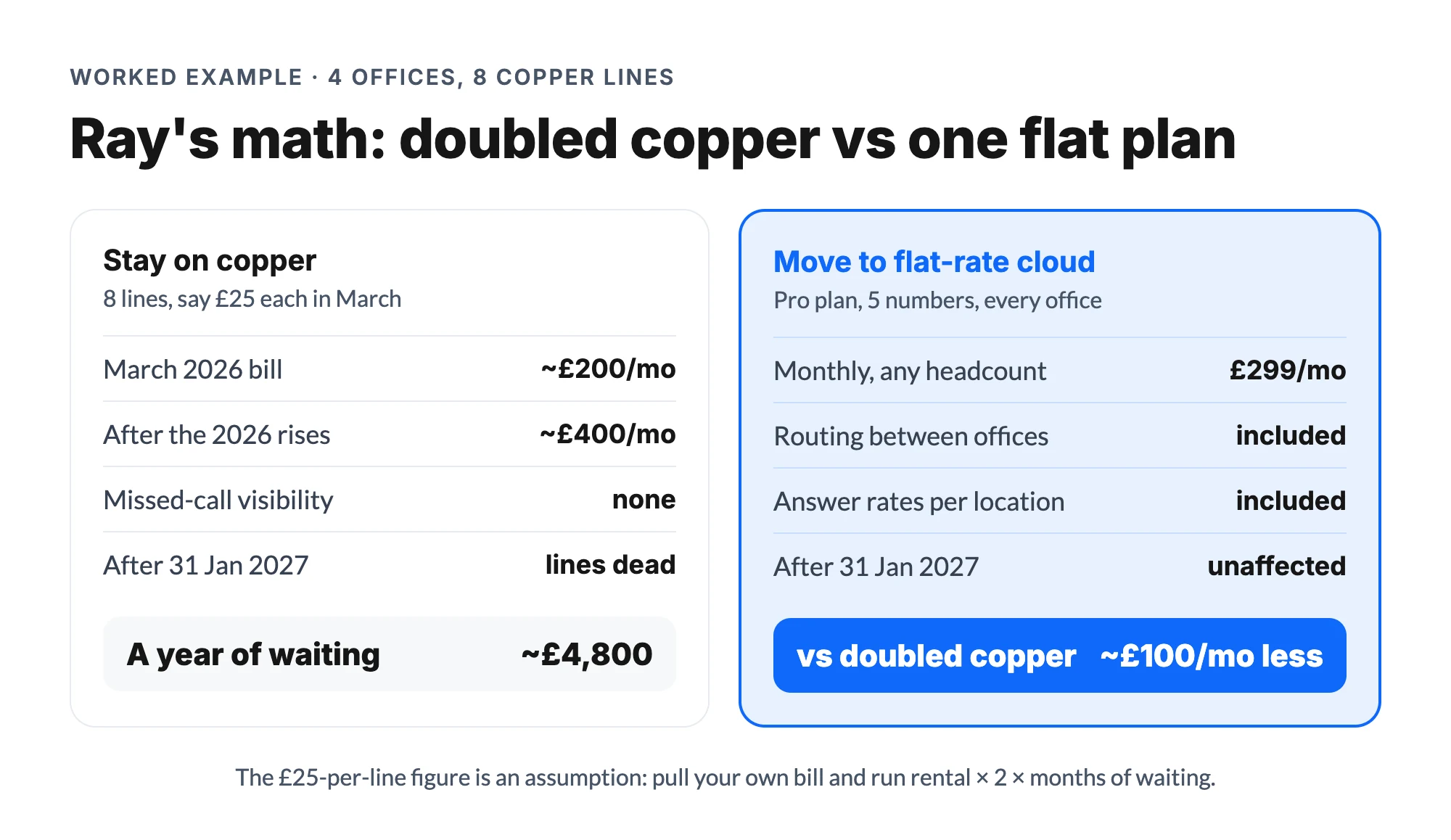
Now the same math on the other side of the fence. A flat-rate cloud system prices Ray's whole company at a fixed number: on our UK plans that's £299 a month for the Pro tier that fits a multi-location setup, with 5 numbers, call routing between offices, and answer-rate reporting per location. That's roughly £100 a month less than his doubled copper bill, before counting a single feature the copper never had. A two-line, six-person business does even better: doubled copper heads toward £100 a month, while a £79 flat Team plan covers everyone.
How to find the rises on your own bill
Business phone invoices bury the copper. Look for line items called "line rental", "WLR" (wholesale line rental), "analogue line", or "PSTN single line", one per copper line you hold, and compare the same item across your March and July invoices. That delta is the schedule at work. Multi-service invoices from bundled providers are the sneakiest, because a £25 rise inside a £400 telecoms-and-broadband bill reads like noise until you isolate the line items.
While you're in there, count lines you forgot you had. Fax lines, alarm lines, a card terminal's socket, the old modem line in the back office: each is paying the same doubling rental, and businesses that audit usually find at least one line nobody has used in years. Cancelling a dead line is the fastest £300-a-year decision in this whole migration (once the numbers you care about are safely ported).
Already in a contract? Do the exit math anyway
If you recently re-signed on copper, don't assume you're stuck. Compare the early-termination fee against the rental rises you'd pay through to January 2027, remembering the network retires regardless of what your contract says. Providers facing the same switch off are often more flexible about migrating you to their own digital product than the contract terms suggest, and a written quote for both paths turns a vague fear into a two-line comparison.
The waiting tax compounds in quieter ways too. Every month of delay is a month closer to the January porting queue, when around 350,000 business sites, as Comms Business counts them, squeeze through the same providers and engineers. Autumn movers pick their transfer date; January movers take what's left.
The £25-a-line figure is an assumption, so pull your own bill and do the two-minute version: current line rental, times two, times the months you plan to wait. That's the price of deciding later. We can't tell you exactly what your provider will charge next quarter, but on this schedule, "about double" has been a safe bet all year.
The cheaper move: switch before the queue
Every serious replacement runs over broadband and treats the copper bill as a thing to delete, not renegotiate. For most small teams that means a cloud VoIP system: your ported number, routing, voicemail, and call history in one app-based service. dialnote is an AI business phone system with no per-user pricing. AI voice agents answer calls, capture leads, and book meetings 24/7. Plans from $19/mo. The UK plans run £29 a month for a solo line or £79 flat for a whole team, with full pricing published down to the per-minute rates. The wider menu, including virtual landlines, broadband digital voice, and SIP trunking for PBX hardware, is compared in our landline alternatives guide.
Whichever you choose, the sequence protects both your number and your budget:
- Pull your latest phone bill and list every copper line and what it now costs. This is the number that doubles.
- Pick the replacement that fits your shape (flat-rate cloud for teams, simpler options for solo traders).
- Port your numbers first, cancel second. The porting paperwork takes an afternoon; a ceased line can take its number with it.
- Cancel the copper the day the new system answers, and stop paying rental on a network with months to live.
There's a 10-day free trial with no credit card on our side of the fence, which is the cheap way to test the math on your own call volume before committing to anything. Keep your latest copper invoice next to it during the trial week: comparing two real bills settles this faster than any brochure comparison ever will.
Put a flat bill next to your copper one
10-day free trial, no credit card. Run it against your own call volume.
Quick glossary for the jargon on your bill
The letters and invoices in this migration lean on acronyms, so here's the decoder:
- PSTN is the Public Switched Telephone Network, the UK's copper phone network that switches off on 31 January 2027.
- WLR is wholesale line rental, the price providers pay Openreach for each copper line. It's the number doubling through 2026, and it flows straight into your bill.
- VoIP is voice over internet protocol, calls carried over broadband instead of copper. Every serious landline replacement is a form of it.
- ISDN is the copper-era digital line that fed office phone systems; it retires on the same date as the PSTN.
- ADSL and FTTC are broadband types delivered over the same copper network, which is why some businesses change broadband and phones in the same season.
- Openreach is the company that runs the UK's physical phone and broadband network, and the one retiring the copper.
Stop paying the waiting tax
The UK landline price increases of 2026 only look like bad news if you plan to stay. Read them the way they're intended: the network is closing, the rent went up to say so, and the replacements cost less than the thing they replace. Ray's variance column stopped being a mystery the day he read the October schedule; it became a to-do item.
Pull your bill, run the times-two math, and if a flat number for the whole team beats it, start the trial this week. The rises stop the day you stop renting copper.
Frequently asked questions
Openreach is raising wholesale copper line charges through 2026, roughly doubling them between April and October, to move the last businesses off the network before the PSTN switch off on 31 January 2027. Providers pass those rises straight through to line rental bills.
Wholesale copper costs roughly double across 2026. One published example: a 20-line business paying about £213 a month in March 2026 faces around £501 by October after rises of 20%, 40%, and 40%. Then the network switches off entirely on 31 January 2027.
They can. ADSL and FTTC broadband arrive over the same copper network that's being retired, and Openreach is moving those areas to full fibre on its own schedule. If your internet is copper-based, plan the phone and broadband moves together rather than twice.
Stop paying the rises and migrate: audit your copper lines, pick a digital replacement (usually cloud VoIP), port your numbers before cancelling anything, and upgrade devices like alarms and card terminals with their suppliers. Autumn movers skip the January queue.

Written by
Lancelot Dsouza
Chief Marketing Officer, SmartReach.io
Lancelot Dsouza is the Chief Marketing Officer at SmartReach.io, where he built the Marketing, Sales, and Customer Success verticals from the ground up. With over 25 years of experience spanning digital marketing, business development, and strategic...
Lancelot Dsouza is the Chief Marketing Officer at SmartReach.io, where he built the Marketing, Sales, and Customer Success verticals from the ground up. With over 25 years of experience spanning digital marketing, business development, and strategic...
Related Articles
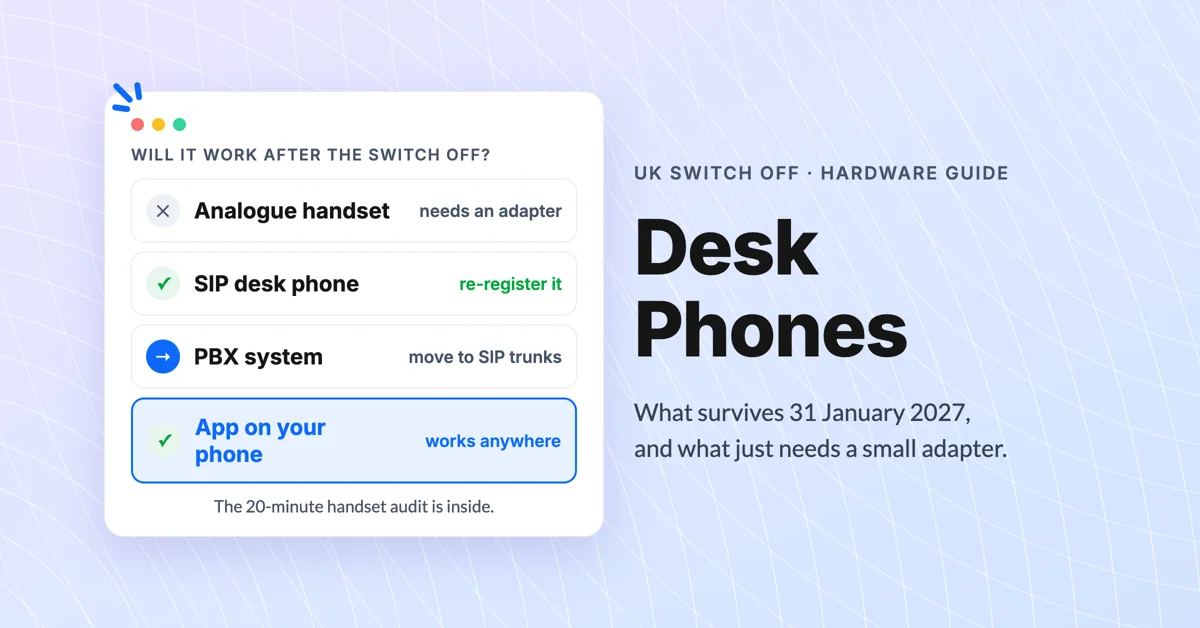
Desk Phones After the UK Switch Off: What Still Works
Find out which desk phones after the UK switch off keep working, which need an adapter, and when to let the handsets go before the 2027 deadline.
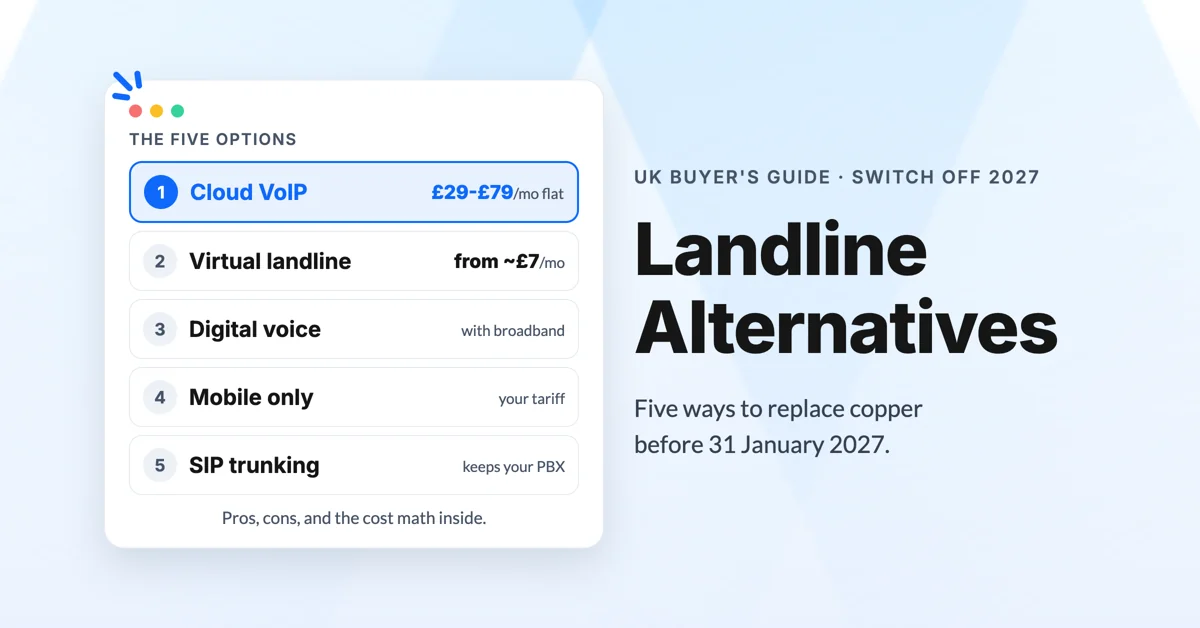
Best Landline Alternatives for UK Small Businesses (2026)
Compare the best landline alternatives for UK small businesses before the 2027 switch off: cloud VoIP, digital voice, mobile and SIP, with real costs.
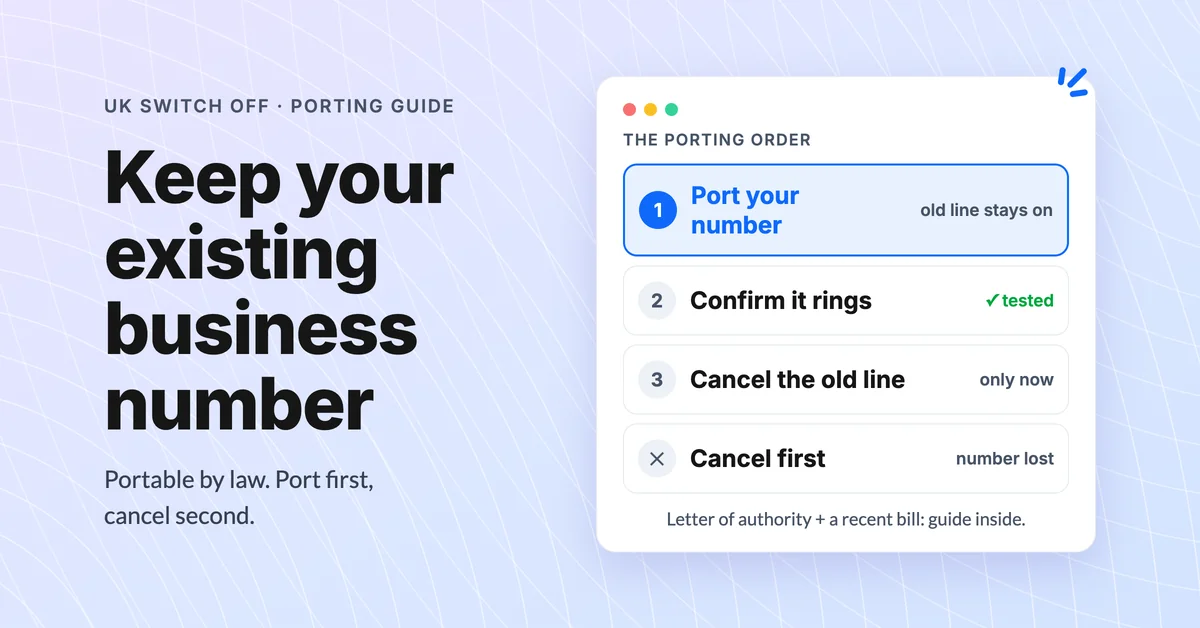
UK Landline Switch Off: Don't Lose Your Business Number
Don't lose your business number in the UK landline switch off: Ofcom porting rights, the port-first rule, and 5 steps to move it safely before 2027.