UK PSTN Switch Off: What Businesses Must Do Before 2027
The UK's copper phone network has a shutdown date. On 31 January 2027, the PSTN switch off ends more than a century of analog phone lines, and every business line still running on copper simply stops working. Openreach has said, publicly and repeatedly, that the date won't move.
Marcus runs a six-person plumbing firm, and his provider's letter went in the drawer marked "later." He's got a shop line, a card terminal on the same socket, and an alarm line he forgot he pays for. Last month a £1,800 boiler enquiry rang the shop while everyone was on jobs. If those lines die in January with no replacement live, the next one doesn't ring anywhere. Sound familiar?
The PSTN switch off isn't a tech story, it's a deadline with a price tag attached. Here's what's actually happening, what it costs to wait, and the six steps that get you moved without losing your number.
TL;DR:
- The PSTN switch off happens on 31 January 2027: the UK's copper network shuts down and analog landlines and ISDN lines stop working.
- According to Comms Business, around 350,000 UK business sites were still on copper lines as of August 2026.
- Waiting is expensive: wholesale copper line costs roughly double across 2026 as providers push the last users off the network.
- Your number survives if you port it to a new provider before cancelling the old line, never the other way round.
- The standard replacement is a cloud VoIP phone system running over the broadband you already have.
Jump straight to: the 6-step plan · keeping your number · your replacement options · what switching costs
What is the PSTN switch off?
The PSTN switch off is the permanent shutdown of the UK's Public Switched Telephone Network, the copper wiring that has carried analog phone calls since the Victorian era. Openreach retires the network on 31 January 2027, and every phone service still running on it stops working. Calls move to digital services that run over broadband instead.
None of this is sudden. New copper lines haven't been sold since September 2023, and the original deadline of December 2025 was pushed back once to protect vulnerable households. That extension is spent. Openreach has confirmed the 2027 date is final, and exchanges have been migrating in waves for over two years already.
Why kill a network that still works? Age and parts. The equipment behind the PSTN is decades old, spares are scarce, and engineers who can service it are retiring faster than they're being replaced. Keeping it alive now costs more than replacing it, which is exactly why the pricing (more on that below) is designed to push everyone off.
What's being switched off (and what isn't)
Everything that plugs into a copper phone line is affected, and that covers more than phones. The switch off takes out analog voice lines and both flavors of ISDN, plus every device quietly riding on those lines.
| Service | Status after 31 January 2027 |
|---|---|
| Analog phone lines (single or multi-line) | Stops working |
| ISDN2 and ISDN30 (older office phone systems) | Stops working |
| Fax lines | Stops working |
| Alarm, lift, and door-entry lines | Stops working unless upgraded |
| Card terminals on phone lines | Stops working unless upgraded |
| VoIP phone systems | Unaffected |
| Mobile phones | Unaffected |
| Full-fibre broadband | Unaffected |
The non-phone kit is the part businesses miss. An alarm panel dialing out over copper, a lift emergency line, a card machine on the shop's phone socket: each needs its own digital upgrade from its own supplier, and those suppliers have their own lead times. If you run older office phone hardware on ISDN, our SIP trunking guide explains how those systems connect to the digital world, and our desk phones guide shows which handsets survive and which need an adapter.
Broadband deserves a mention too. If your internet is ADSL or FTTC (fibre to the cabinet), it arrives over the same copper. Openreach is upgrading those areas to full fibre on its own schedule, but it means some businesses will change broadband and phones in the same season. Plan them together, not separately.
Why waiting gets expensive in 2026
Doing nothing has a monthly cost, and it's climbing on purpose. Wholesale line rental rose in April 2026 and rises again in July and October, and Zen reports the wholesale cost of the copper line element roughly doubles by the end of the year. Providers pass that straight through to the businesses still holding on. The full 2026 price timeline, with worked examples of what waiting costs, is its own sobering read.
And plenty still are. According to Comms Business, around 350,000 UK business sites still had PSTN lines to replace as of August 2026. That's a lot of companies planning to squeeze through the same migration window, with the same providers, engineers, and porting teams, in the final few months.
So what does waiting actually buy you? Nothing good. You pay doubled line rental for a network that's being demolished, and then you join the January queue with everyone else. The businesses that move in autumn get the same outcome for less money and none of the deadline panic. We've watched this pattern in every forced migration: the early movers get options, the late movers get whatever's left.
Will you lose your business phone number?
No. UK numbers are portable under Ofcom's rules, and your number moves with you to a VoIP provider as long as you port it before the old line is cancelled. The order is everything: port first, cancel second. A number on a ceased line can be lost permanently, and that's the one mistake in this whole migration you can't undo. Our number porting guide walks the paperwork, the timeline, and the rejection traps step by step.
Porting itself is paperwork, not surgery. Your new provider asks for a letter of authority (a signed form saying you own the number), a recent phone bill, and the address on the account. Then the providers arrange a transfer date between themselves. Allow a few weeks for a straightforward port, longer for multi-line setups.
Nobody can say exactly how congested porting queues will get as the deadline closes in, but a process that takes weeks in a quiet month is a bad thing to start in January 2027. If your number matters to your business (and for most local firms it's on the van, the signage, and ten years of Google listings), start the port by autumn. Our guide to running a business number without a landline covers how a ported number behaves once it's digital.
How to prepare for the PSTN switch off in 6 steps
Preparing for the PSTN switch off is an afternoon of auditing and a few weeks of lead time, not an IT project. Here's the order that avoids the traps:
- List every copper line you pay for. Pull your phone bills and walk the building. Voice lines, fax lines, the line the alarm uses, the socket behind the card terminal. Businesses usually find more lines than they remembered paying for.
- Call the suppliers of the non-phone kit. Alarm, lift, door entry, and payment terminal suppliers all have digital upgrade paths. Their lead times are outside your control, so start these conversations first.
- Choose your replacement phone system. For most small businesses that's cloud VoIP: calls over your existing broadband, managed from an app, no new wiring. The next section compares the options.
- Port your numbers, then cancel. Sign up with the new provider, submit the porting paperwork, and keep the old line alive until the port completes. Never cancel first.
- Test before you rely on it. Ring every number, check the call routing, record the voicemail greeting, and make sure mobiles and desk phones ring the way you expect during a normal working day.
- Cancel the copper and bank the difference. Once calls flow through the new system, cease the old lines and stop paying doubled rental for a network with five months to live.
Steps 3 to 5 are where the weeks usually go, and they're the part dialnote compresses to one screen: a new account opens on the Quick Start page, which walks the replacement line from claimed number to tested call flow before you touch any port paperwork.
- Click Get Phone Number to claim the interim number your tests will run on
- Click Make a Call Now and ring your own mobile to hear the audio both ways
- Set Business Hours and record the voicemail greeting your callers will hear
- Go to Settings → Phone Numbers and click Port Existing once the flow already works
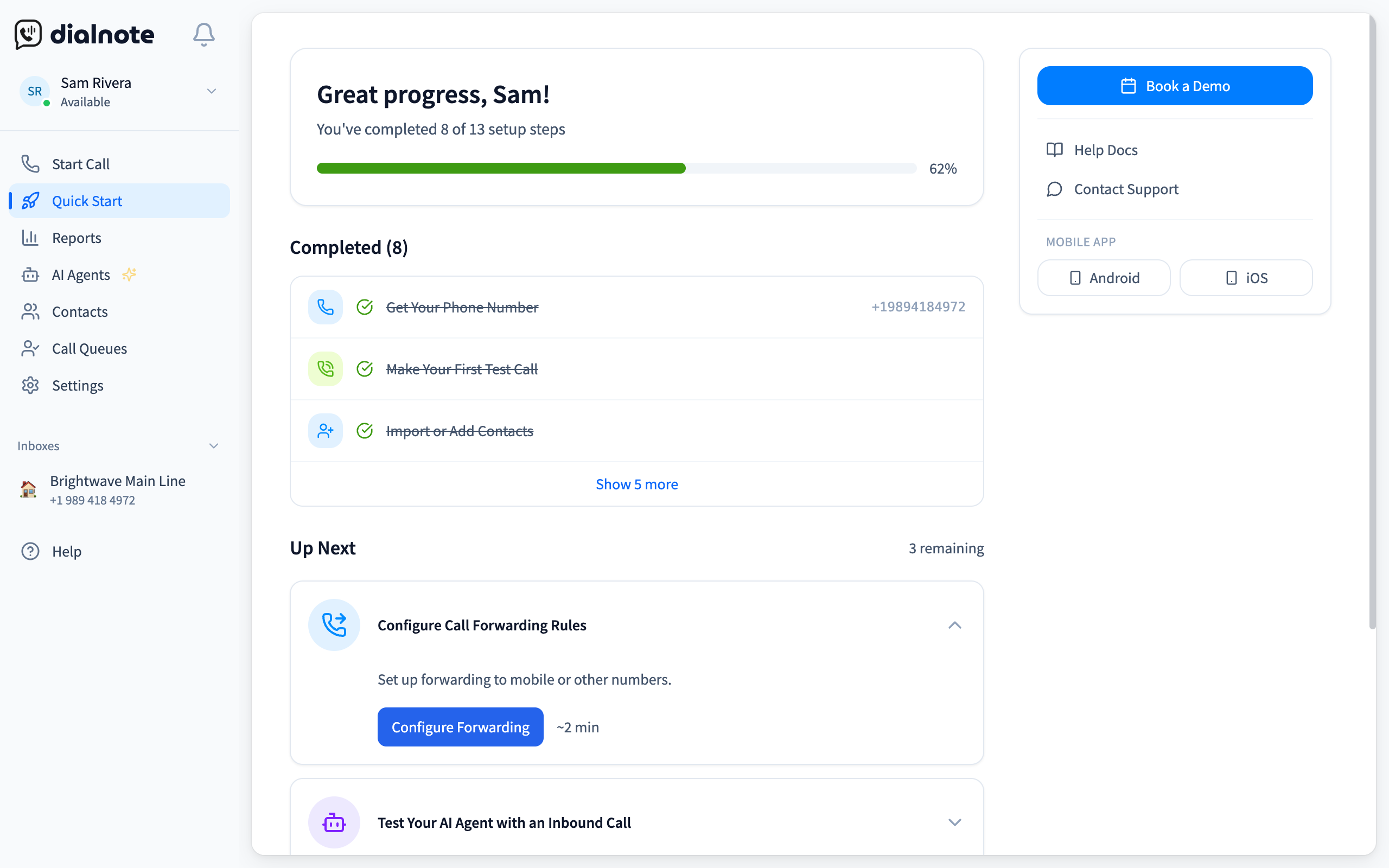
Every task closed on that page is one line of the switch-off letter you can stop worrying about. When the new flow rings the way the building expects, submit the port, keep the copper line idling until it completes, and cancel from a position where nothing depends on it.
Build the replacement line before the port paperwork
10-day free trial, no credit card needed.
Steps 1 and 2 are where the deadline risk actually lives, because they involve other people's schedules. Steps 3 to 6 are within your control and move at your pace.
What should replace your landline?
For a small business, the realistic options come down to three, and they're not equal. (The full five-option comparison, with pros, cons, and UK costs for each, gets its own guide.)
| Option | What it is | The catch |
|---|---|---|
| Like-for-like digital line | A single VoIP line that mimics your old landline | Same one-line limits, often similar rental, none of the upside |
| Cloud VoIP phone system | Your numbers, routing, and voicemail in one app-based system | Needs a decent broadband connection |
| Mobile only | Run the business on mobiles | Your landline number and its local presence get awkward |
Like-for-like sounds safe, right? Honestly, we think it's the worst option of the three for most small teams. You go through the full disruption of a migration and buy back your 1995 phone setup at 2027 prices: one line, one handset, no routing, no record of who called while you were up a ladder. The migration effort is the same either way, so the moment you're forced to switch is the moment to actually upgrade. A proper VoIP phone system gives every person on the team the business line in their pocket, and it's usually cheaper than the copper rental it replaces.
There's also an upgrade copper never offered. Marcus's actual problem was never the wire, it was the £1,800 enquiry that rang while every pair of hands was on a job. On a modern system an AI receptionist answers that call, takes the caller's details, and books the job, which is the difference between a migration that keeps the lights on and one that grows the business. If you're weighing the broader landline-versus-VoIP question, our VoIP vs traditional phone lines comparison goes deeper.
What switching actually costs
For most small businesses, switching costs less than staying put: a flat-rate cloud plan usually undercuts the copper rental it replaces, and the gap widens every time line rental rises. Budget for three things: the monthly plan, a small one-off carrier fee to port each UK number, and a working broadband connection, which you almost certainly already pay for.
We should say plainly where we stand here: dialnote is a cloud phone system, so we're not neutral. But the math is public, so let's run it on two real shapes of business.
Example 1: a six-person trades firm (Marcus). Say his two copper lines cost £25 each in early 2026, £50 a month before any calls. With wholesale line costs roughly doubling, that heads toward £100 a month by the switch off, and it still rings one handset at a time. On our Team plan the whole firm runs on £79 a month flat, about £13 a head, with call routing and AI answering included:
| Copper (by 2027) | Cloud, flat rate | |
|---|---|---|
| Two lines / whole team | ~£100/mo | £79/mo |
| Cost per person (6 staff) | ~£17 | ~£13 |
| Yearly total | ~£1,200 | £948 |
And the revenue side is bigger than the savings side: at £948 a year, one saved £1,800 boiler enquiry pays for almost two years of the system.
Example 2: a solo trader. One copper line at £25 heading toward £50 a month, against our Solo plan at £29 a month flat with a business number that rings your mobile. By 2027 the flat plan costs less than the copper line's rental alone, before you count a single call or the voicemail you no longer miss.
The £25 line rental is an assumption, so swap in the number from your own bill; the arithmetic takes a minute and usually points the same way. The cheapest way to test it properly is a 10-day free trial with no credit card: run it alongside the copper for a week and compare real bills, not brochure numbers.
Quick glossary for the switch off letters
The letters, invoices, and supplier calls in this migration lean on acronyms, so here's the decoder:
- PSTN is the Public Switched Telephone Network, the UK's copper phone network that switches off on 31 January 2027.
- ISDN is the copper-era digital line (ISDN2 and ISDN30) that feeds older office phone systems; it retires on the same date.
- VoIP is voice over internet protocol, calls carried over broadband instead of copper. Every serious replacement is a form of it.
- SIP is the protocol VoIP services use to set up calls; a SIP phone or SIP trunk is hardware that speaks it.
- ADSL and FTTC are broadband types delivered over the same copper network, which is why some businesses change broadband and phones in the same season.
- Openreach is the company that runs the UK's physical phone and broadband network, and the one retiring the copper.
- Stop sell is the industry term for the freeze on new copper lines, in force since September 2023.
The deadline is real, and so is the upside
The PSTN switch off gives every UK business the same homework: audit your lines, upgrade the kit that rides on them, port your numbers, and move to a digital system before 31 January 2027. Do it in autumn 2026 and it's a calm, cheaper migration. Do it in January and you're racing 350,000 other sites through the same door.
But the honest summary is that the deadline is doing most businesses a favor. Copper rental was quietly doubling anyway, and the replacement costs less and does more. Start with step 1 this week, list your lines, and if a flat-rate cloud system fits what you find, start a free dialnote trial and have your number ported long before the queue forms.
Frequently asked questions
The UK's PSTN network switches off on 31 January 2027. Openreach has confirmed the date won't move. Analog landlines and ISDN lines stop working after that, so businesses need a digital replacement in place before the deadline.
No, as long as you port the number to a new provider before your copper line is cancelled. UK numbers are portable by Ofcom rules. Port first, cancel second: if the line is ceased before the port completes, the number can be lost for good.
Your phone lines stop working on 31 January 2027, and you'll overpay until then, since wholesale copper line costs roughly double across 2026. Devices on those lines (alarms, lifts, card terminals) can also fail. Migrating early avoids both problems.
A cloud VoIP phone system is the standard replacement. Calls run over your existing broadband, your number ports across, and apps on mobiles and laptops replace or work alongside desk phones. Most small teams end up paying less than they did for copper line rental.

Written by
Akhilesh Betanamudi
Co-Founder, SmartReach.io
Akhilesh Betanamudi is a technology entrepreneur and engineer with over 12 years of experience in hardware engineering, SaaS, and business communications. As Co-Founder of SmartReach.io - a sales engagement platform for startups and enterprises, he h...
Akhilesh Betanamudi is a technology entrepreneur and engineer with over 12 years of experience in hardware engineering, SaaS, and business communications. As Co-Founder of SmartReach.io - a sales engagement platform for startups and enterprises, he h...
Related Articles
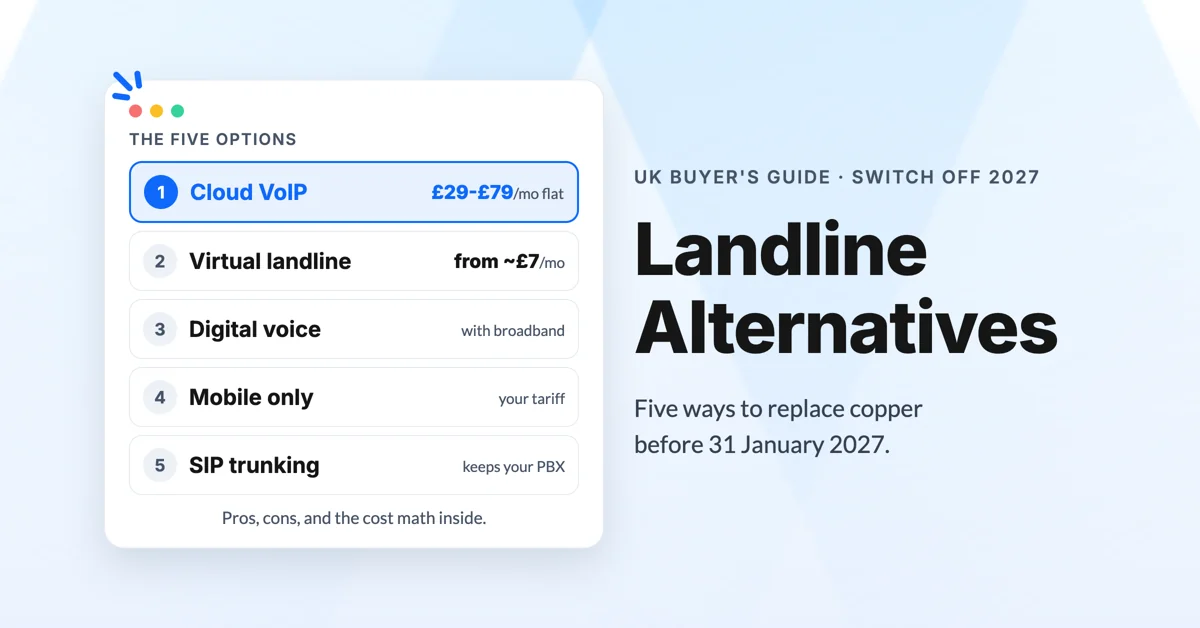
Best Landline Alternatives for UK Small Businesses (2026)
Compare the best landline alternatives for UK small businesses before the 2027 switch off: cloud VoIP, digital voice, mobile and SIP, with real costs.

OpenPhone or Aircall, which is better for your business?
Compare OpenPhone vs Aircall on pricing, AI features, and integrations to find the best VoIP for your business. Plus, see how dialnote stacks up.
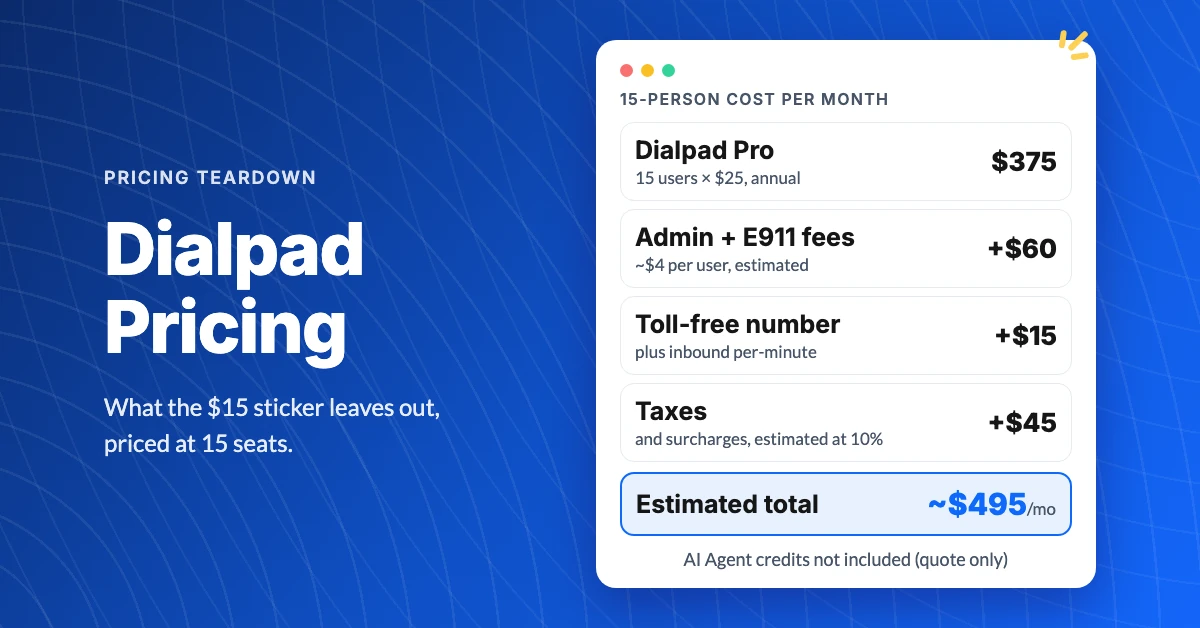
What Does Dialpad Pricing Really Cost a Small Team?
See what Dialpad pricing really costs: $15 to $35 per user, the 3-seat Pro minimum, per-text and admin fees, and real team math at 5, 15 and 30 people.