Google Voice pricing and what each plan really costs
Google Voice pricing looks like the simplest bill in business phones: free, $10, $20 or $30. Then you try to buy it for a team and find a second line on the invoice. Every user on a team plan needs a paid Google Workspace seat as well as the Voice license, so the real per-person number sits closer to $18, $28 or $38.
That's not a trick. It's just the part most price tables leave out, along with who can skip Workspace (one person can), which plan holds the features you actually need, and what international calls cost on top. Below is every way to buy Google Voice as of November 2026, the totals for 1, 3 and 10 users, and the point where it stops being the cheap option.
TL;DR
- Google Voice is free for personal use (one US user, no 911 calling). Business plans are $10 (Starter), $20 (Standard) and $30 (Premier) per user a month, billed monthly, as of November 2026.
- One person can buy Starter or Standard on a Gmail account with no Workspace. Teams pay a Google Workspace seat per user on top, from $7 a month on annual billing or $8.40 month to month.
- All in, a 10-person team on Standard pays about $284 a month with flexible Workspace seats, or $200 if the business already pays for Workspace for email.
- The auto attendant and ring groups start on Standard, automatic call recording only comes with Premier, and the $10 Starter team plan stops at 10 users.
- No Google Voice plan includes an AI agent that answers calls. dialnote, an AI business phone system, includes one on its $49 Team plan with unlimited users and no per-user cost.
Google Voice pricing at a glance
Google sells Voice six ways: one free personal account and five paid subscriptions. Two of the paid ones are for a single person and need only a Gmail account. The other three are Workspace add-ons priced per user.
| Plan | Price | Users | Needs Workspace? | Where it works |
|---|---|---|---|---|
| Free (personal) | $0 | 1 | No | US only |
| Voice Starter, standalone | $10 a month | 1 | No, a Gmail account | US only |
| Voice Standard, standalone | $20 a month | 1 | No, a Gmail account | US only |
| Starter for Workspace | $10 per user a month | Up to 10 | Yes | 14 countries |
| Standard for Workspace | $20 per user a month | Unlimited | Yes | 14 countries |
| Premier for Workspace | $30 per user a month | Unlimited | Yes | 14 countries, plus numbers abroad |
Prices are from Google's Voice plans page and Google's Workspace comparison of Voice subscriptions, read on November 5, 2026. Google shows monthly prices only. There's no annual discount on the Voice license itself, though the Workspace seat underneath it has one.
Two things in that table do most of the work. First, the jump from Starter to Standard is where the phone system features live: the auto attendant (a "press 1 for sales" menu), ring groups and call queuing. Second, the "Needs Workspace?" column is the hidden half of every team bill. Keep both in mind, because the rest of this guide is mostly arithmetic built on them.
Is Google Voice free?
Yes, for personal use. A free Google Voice account gives one person a US phone number that rings on the app, the web and linked phones. You get free calls and texts to most US and Canadian numbers, voicemail with transcripts, and spam filtering, all for $0.
The limits are what make it a personal product rather than a business one:
- One user, one number. There's no way to share it with a teammate or add a second line to the same account.
- US only. You need a US phone number to set it up, and the service is only offered in the US.
- No 911 calling. Free Google Voice doesn't support emergency calls, so it can't be anyone's only work phone.
- No business features. No auto attendant, no ring groups, no admin console, no recording of every call.
- Inactive numbers get reclaimed. Google can take back a free number that isn't used. It doesn't publish an exact window, and if it happens you get a short grace period to claim it back.
Porting an existing mobile number into a free account costs a one-time $20, and taking a number out later means paying $3 to release it first. Calls to most countries outside the US and Canada are charged per minute from a prepaid credit balance.
So who should use the free plan for work? A solo freelancer who wants a second number to give out instead of a personal cell, and who would never need a teammate to answer it. For that one job, $0 is very hard to beat. We cover the trade-offs in more depth in our Google Voice pros and cons breakdown.
Free vs paid Google Voice: what $10 a month buys
The step from free to $10 doesn't change much about how calls sound. It changes what the line is allowed to be: a work number with emergency calling, support and an owner other than you personally.
| Free (personal) | Voice Starter, $10 | |
|---|---|---|
| Who it's for | Personal use | Business use |
| 911 calling | No | Yes |
| Support | Help center and community forum | 24/7 support from Google |
| Desk phones | No | Yes |
| Call recording | Incoming calls, started by keypress | On-demand recording |
| Unlimited US calling and texting | Yes, with fair-use limits | Yes, with fair-use limits |
| Admin console and extra users | No | Only on Starter for Workspace |
The 911 row is the one that should decide it. If the number will ever be the main line for a shop, an office or a crew, it needs emergency calling, and that alone is worth the $10. Support matters too: when a free number stops ringing, there's no one to call.
Is anything missing from the $10 plan that people expect? Yes, and it's the thing most buyers assume comes with a "business" phone: a menu and a shared line. Neither is on Starter. Both start at $20.
What each paid Google Voice plan includes
Each paid plan adds a layer. The quick version: Starter is a better personal line, Standard is the first real phone system, and Premier is for companies with offices in several countries or a compliance team that wants every call recorded.
Voice Starter standalone: $10 a month, one person
This is the paid upgrade for a single US user who doesn't want Workspace. You sign up on a regular Gmail account and get a business-grade line: unlimited calling in the US, unlimited texting to US numbers, voicemail transcripts, on-demand call recording, desk phone support and 24/7 support from Google.
The catch: there's no auto attendant and no ring groups, and you can't add a second user. If someone else will ever need to answer the line, this plan is a dead end.
Voice Standard standalone: $20 a month, one person
Standard adds the features that make one person sound like a company. You get an auto attendant that greets callers and routes them by keypress, plus Google's "take notes for me" AI note-taking on calls, on top of everything in Starter.
The catch: it's still one user. A solo consultant who wants a menu ("press 1 to book, press 2 for billing") gets real value here. A two-person office doesn't, because the second person can't join the plan.
Starter for Workspace: $10 per user a month, up to 10 users
This is the cheapest way to put a team on Google Voice. Every user gets a number, the apps, voicemail transcripts and on-demand recording, managed from the Workspace admin console. It works in the 14 countries where Google sells Workspace Voice, not just the US.
The catch: two of them. There's no auto attendant and no ring groups, so every call rings one person's number. And Starter hard-caps at 10 users. Hire the eleventh person and the whole team has to move to Standard, which doubles the Voice line on your bill overnight.
Standard for Workspace: $20 per user a month, unlimited users
Standard is the plan most small businesses mean when they say "Google Voice for the office." It adds the auto attendant, ring groups (one number that rings several people), call queuing for those groups, SIP Link for connecting existing phone hardware, and no user cap.
The catch: every person in a ring group needs their own $20 license plus a Workspace seat, even the part-timer who answers five calls a week. You can't buy a cheaper "answers the shared line sometimes" seat.
Premier for Workspace: $30 per user a month
Premier adds automatic recording of every call, numbers in other countries for the same users, and advanced reporting through BigQuery exports. It's priced for companies with offices across several of the 14 supported countries, or with a legal or compliance reason to keep every conversation.
The catch: most small businesses that upgrade to Premier do it for one feature, automatic call recording, and pay $10 more per user per month across the whole team to get it.
The Workspace seat: the cost most price tables leave out
Here's the line that surprises people. Starter for Workspace, Standard and Premier are add-ons, so each user first needs a paid Google Workspace plan. Google's cheapest business tier, Workspace Business Starter, costs $7 per user a month on an annual plan or $8.40 on flexible month-to-month billing, as of November 2026.
That changes the real per-user Google Voice cost:
| Voice plan | Voice license | Plus Workspace (flexible) | All-in per user | All-in per user (annual Workspace) |
|---|---|---|---|---|
| Starter for Workspace | $10 | $8.40 | $18.40 | $17 |
| Standard for Workspace | $20 | $8.40 | $28.40 | $27 |
| Premier for Workspace | $30 | $8.40 | $38.40 | $37 |
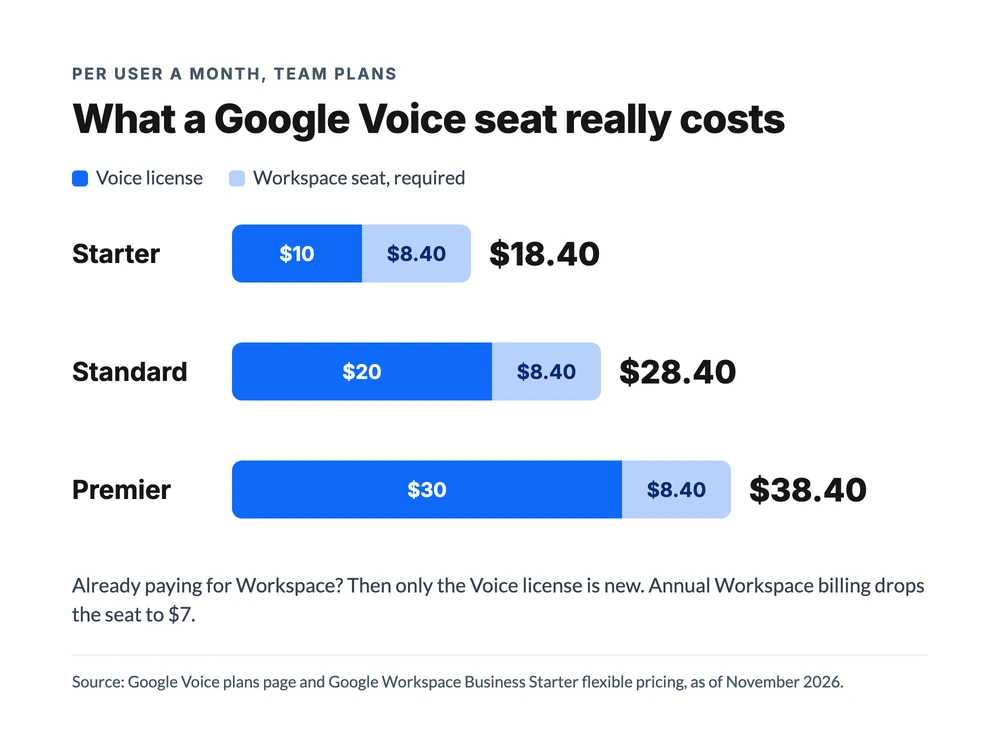
Is that fair to count? It depends on one question: would you pay for Workspace anyway?
If your business already uses Gmail on its own domain, Google Docs and Drive, the Workspace seat is a sunk cost. Voice only adds $10, $20 or $30, and that's genuinely good value. If you'd be buying Workspace only to get Voice, the seat is part of the phone bill, and it should be in your comparison. Most "Google Voice is $10" headlines quietly assume the first case.
What does Google Voice cost a 1, 3 or 10-person business?
The answer swings widely with team size, so here are the three totals most small businesses ask about. All figures assume monthly Voice billing and flexible Workspace seats at $8.40, which is how most teams start. The "already on Workspace" column counts only the Voice license.
| Team size | Plan | Monthly total | Per year | Already on Workspace (Voice only) |
|---|---|---|---|---|
| 1 person | Voice Starter standalone | $10 | $120 | n/a |
| 1 person | Voice Standard standalone | $20 | $240 | n/a |
| 3 people | Starter for Workspace | $55.20 | $662.40 | $30 a month |
| 3 people | Standard for Workspace | $85.20 | $1,022.40 | $60 a month |
| 3 people | Premier for Workspace | $115.20 | $1,382.40 | $90 a month |
| 10 people | Starter for Workspace | $184 | $2,208 | $100 a month |
| 10 people | Standard for Workspace | $284 | $3,408 | $200 a month |
| 10 people | Premier for Workspace | $384 | $4,608 | $300 a month |
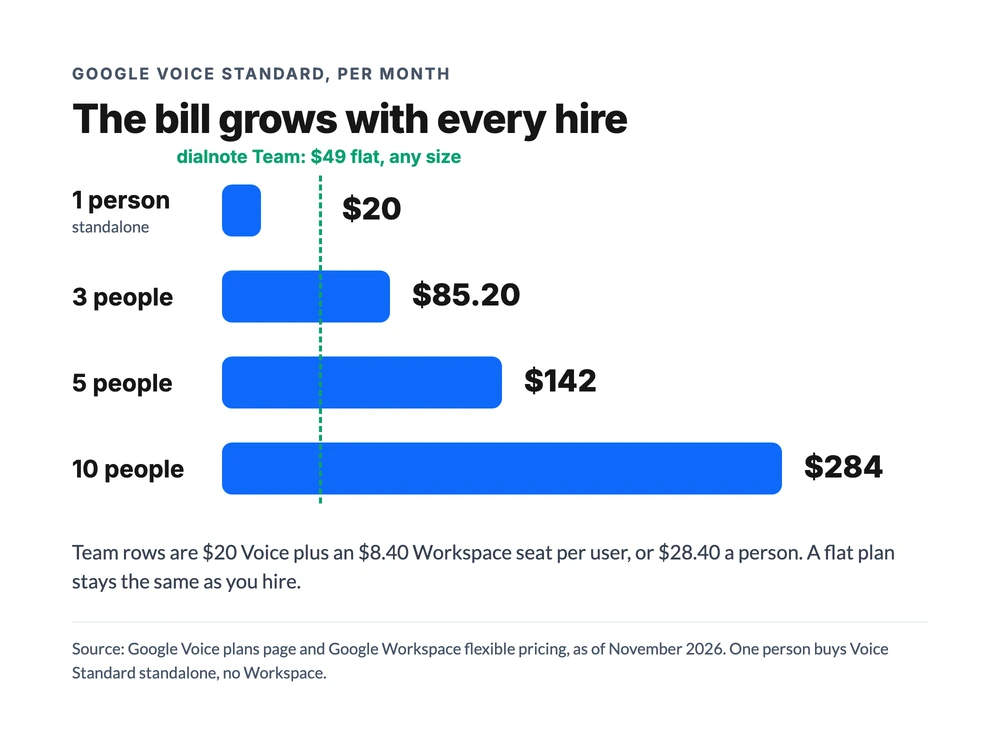
The pattern is simple: Google Voice is priced per head, so the bill grows in a straight line with every hire. One person on the standalone plan pays $10 or $20 and nothing else. Three people on Standard pay about $85, five pay $142, and ten pay about $284, which is $3,408 a year.
Notice the cliff between the solo and team rows. The standalone plans don't need Workspace, but they can't add users. So the day a solo owner hires a first assistant, they don't go from $20 to $40. They go from $20 to $56.80, because both people now need Standard for Workspace plus a Workspace seat each.
A worked example: Dana's 8-person dental clinic
Dana runs the front desk at an eight-person dental clinic: two dentists, hygienists, and a team of two at reception. The clinic already pays for Workspace Business Starter, because everyone needs a work email. So her real question isn't "what does Workspace cost?" It's "what does adding Voice cost?"
She needs a main number that rings both front-desk phones, a short menu for "new patients, existing patients, billing," and the dentists reachable on their own lines. That's Standard, because Starter has no ring groups or auto attendant. Eight users at $20 is $160 a month, or $1,920 a year, on top of the email she already pays for.
Could she license only the two front-desk staff? Technically yes, at $40 a month. But then the dentists and hygienists have no business numbers, and transfers to them go to personal cells. Most clinics end up licensing everyone who takes calls, which is how $40 becomes $160.
And at 6:15 on a Tuesday evening, when a patient with a cracked molar calls after the desk has gone home, all eight licenses send that call to the same voicemail. Google Voice gives Dana routing. It doesn't give her anyone, or anything, to answer.
Extra Google Voice costs on top of the plan
The license and the Workspace seat cover most of the bill. A few smaller costs sit around them.
- International calls. Calls to most US and Canadian numbers are free on every plan, though a few US and Canadian locations cost 1 cent a minute. Calls to other countries are charged per minute at the rates in Google's calling rates lookup, paid from a prepaid credit balance that's capped at $70.
- Porting a number in. Moving a mobile number into a free personal account costs a one-time $20. For Workspace, an admin creates a port order in the console.
- Porting a number out. Leaving a personal Google Voice account means paying $3 to release the number first. Workspace numbers port out through the admin console, and Google doesn't support moving a Workspace number to personal Voice, Google Fi or Google Fiber.
- Desk phones. Every paid plan supports Google-certified desk phones, but you buy the hardware separately, so price the handsets before you count on them.
- Numbers in other countries. Only Premier lets the same users hold numbers outside their home country.
- Taxes and fees. Google adds local taxes and regulatory fees on top of the listed price, so the invoice is always a little higher than the price page.
None of these is big on its own. The international rate is the one to check before you sign up if you call customers or suppliers abroad, because it's usage-based and the free calling stops at the US and Canadian borders.
Which Google Voice plan do you actually need?
Pick by the one feature you can't live without, not by the cheapest price. Here's the short decision list.
- You're one person and just need a separate number: free personal Voice, or the $10 Starter standalone if you want 911 and support.
- You're one person and want a phone menu: Voice Standard standalone at $20.
- You're 2 to 10 people and every call goes to one person's own number: Starter for Workspace at $10 per user.
- You need one number that rings several people, or a menu for a team: Standard for Workspace at $20 per user.
- You'll pass 10 users within the year: Standard, because Starter stops at 10.
- You must record every call automatically, or need numbers in other countries: Premier at $30 per user.
Most service businesses land on number four. Why? Because the moment two people share a phone line, you need ring groups, and ring groups start on Standard. That makes $28.40 per user, all in, the realistic Google Voice price for a small team that isn't already on Workspace.
Google Voice vs dialnote on price
The per-user model is the real dividing line. dialnote is the AI business phone system priced for your whole team: shared numbers, call routing, branded AI voice agents that answer, qualify, and book, and automatic CRM sync, all included, with no per-user cost.
Here's how the two bills compare month to month, as of November 2026:
| Team size | Google Voice Standard + Workspace (flexible) | Google Voice Standard, already on Workspace | dialnote Team | dialnote Team + AI call pack |
|---|---|---|---|---|
| 1 person | $20 (standalone) | $20 | $49 | $74 |
| 3 people | $85.20 | $60 | $49 | $74 |
| 8 people | $227.20 | $160 | $49 | $74 |
| 10 people | $284 | $200 | $49 | $74 |
The Team plan includes unlimited users, two numbers, 700 pooled calling minutes a month, IVR phone menus, business hours routing, automatic call recording and one AI voice agent. AI calls are bought as a call pack, $25 a month for 65 calls, on Team and up. That AI agent is the line item Google Voice doesn't sell at any price: it answers the calls nobody picks up, collects the details you ask it to, and books into Calendly or Cal.com.
So when is dialnote the better pick? Mostly when the phone is a shared job, not a personal one: a five-person plumbing crew or a clinic front desk doesn't need five Gmail-linked lines, it needs one number that rings the right people and something that picks up when they can't. dialnote is built around that shape, so a new hire doesn't add to the bill, the AI voice agent takes the calls that would've gone to voicemail and asks the questions you set, and nothing depends on whether you use Workspace for email. If you're one person, or your team lives in Gmail and rarely misses a call, Google Voice is still the simpler choice.
The honest wins for Google Voice:
- Solo is cheaper on Google Voice. One person pays $10 or $20 with no Workspace, against $19 for the Solo plan or $49 for Team.
- Domestic calling is unlimited. Google Voice doesn't meter US calls. The Team plan pools 700 minutes a month across everyone, so a busy front desk may need Business at $99, which includes 1,400.
- Call queuing comes sooner. Google includes call queuing for ring groups on Standard. On the other side, call queueing sits on the $199 Pro plan.
- It lives inside Gmail. If your team works in Workspace all day, Voice inside Gmail and the admin console is genuinely convenient.
For Dana's clinic, the fair comparison is $160 of extra Voice licenses against $74 for dialnote Team with the AI call pack, because she keeps Workspace for email either way. If the clinic's calls run past 700 minutes, Business at $99 still comes in under the Voice bill, and it's the same price whether the clinic has 8 people or 18. The feature-by-feature comparison lays the two side by side.
Price a whole-team phone system against your Google Voice bill
10-day free trial, no credit card required. Unlimited users from the Team plan.
If you decide to move, your existing Google Voice number can come with you. The Google Voice porting guide covers releasing the number and the timing, and how to keep it ringing during the switch.
How to keep a Google Voice bill down
If Google Voice is the right fit, a few habits keep the bill from creeping.
- License only the people who take calls. Every seat costs Voice plus Workspace. A bookkeeper who never answers the phone doesn't need a Voice license.
- Stay on Starter until you need a menu. If every caller wants a specific person, Starter's $10 does the job. Move up only when you need ring groups or an auto attendant.
- Use annual Workspace billing once you're sure. It drops the seat from $8.40 to $7, which is $16.80 a year per user.
- Plan the 10-user cliff. If you're at eight or nine people on Starter, budget for the move to Standard before the next hire, not after.
- Skip Premier just for recording. If on-demand recording (start it during the call) is enough, you don't need $10 more per user for automatic recording.
- Check international rates first. If you call one country often, look up its per-minute rate before you buy credit.
Is Google Voice worth the price?
For one person, yes. Free Google Voice is the best $0 second line in business phones, and the $10 or $20 standalone plans add 911, support and a phone menu without forcing you into Workspace. For a small team that already lives in Workspace, Standard at $20 per user is also fair, as long as everyone in the ring group really needs a license.
Where it stops being good value is the growing service business that doesn't need Workspace and does need its calls answered. Per-user pricing means every hire raises the bill, and no tier answers a missed call. That's the point where a flat-priced system like dialnote usually costs less and does more.
What we don't know is how long Google keeps these prices. The standalone single-user plans are recent, and Google has changed Workspace prices before. Check the Google Voice plans page before you commit, and if you're weighing other options, start with our list of Google Voice alternatives for business.
Frequently asked questions
Only the personal version. Free Google Voice gives one US user a number, calls and texts to the US and Canada, and voicemail transcripts for $0. It's meant for personal use, has no 911 calling, and charges per minute for most international calls. Business plans cost $10 to $30 a month.
Google Voice business plans cost $10 (Starter), $20 (Standard) or $30 (Premier) a month per user, as of November 2026. One person can buy Starter or Standard on a Gmail account with no Workspace. Teams also pay for a Google Workspace seat per user, from $7 a month on annual billing.
For teams, yes. Starter for up to 10 users, Standard and Premier are Workspace add-ons, so each user needs a paid Workspace seat. A single user in the US can skip Workspace and buy Voice Starter ($10) or Voice Standard ($20) on a personal Gmail account.
For one person, or a small team that already pays for Google Workspace, usually yes: $10 to $20 a user buys a reliable line with unlimited US calling. It gets expensive past a few users, because every seat costs Voice plus Workspace, and no plan includes an AI agent that answers calls.
Rates are per minute and vary by country. Google lists them in the Voice calling rates lookup, and paid calls draw from a prepaid credit balance capped at $70. Calls to most US and Canadian numbers are free, with a few places charged 1 cent a minute.

Written by
Upasana Sahu
Senior Digital Marketing Specialist, SmartReach.io
Upasana Sahu is a Senior Digital Marketing Specialist at SmartReach.io with over 10 years of experience in content marketing, SEO, and digital strategy. She manages end-to-end blog operations, from content creation and on-page/off-page SEO to traffic...
Upasana Sahu is a Senior Digital Marketing Specialist at SmartReach.io with over 10 years of experience in content marketing, SEO, and digital strategy. She manages end-to-end blog operations, from content creation and on-page/off-page SEO to traffic...
Related Articles
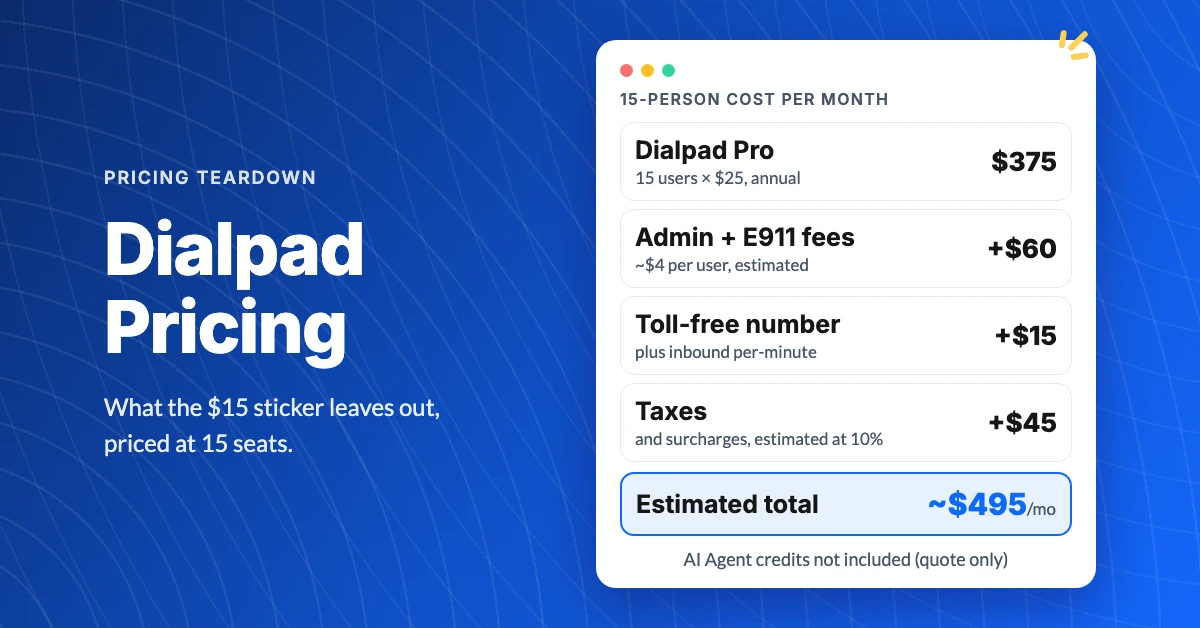
What Does Dialpad Pricing Really Cost a Small Team?
See what Dialpad pricing really costs: $15 to $35 per user, the 3-seat Pro minimum, per-text and admin fees, and real team math at 5, 15 and 30 people.
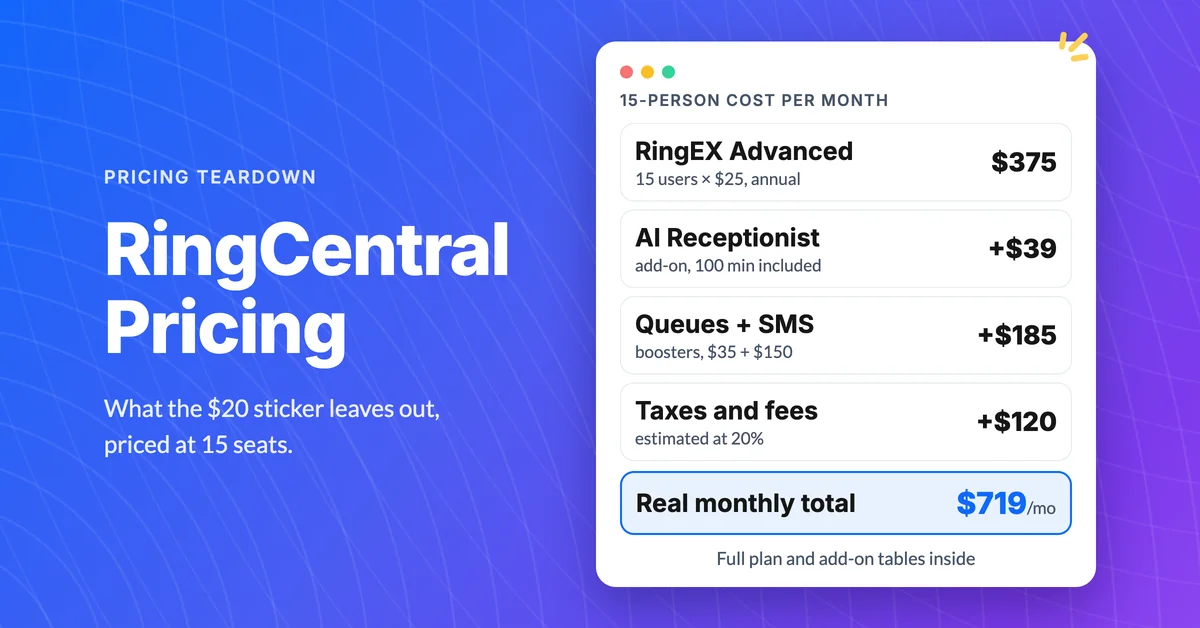
How Much Does RingCentral Really Cost per User?
RingCentral cost per user starts at $20, but add-ons, SMS caps and regulatory fees decide the real bill. See the 15-person math and the flat-rate comparison.
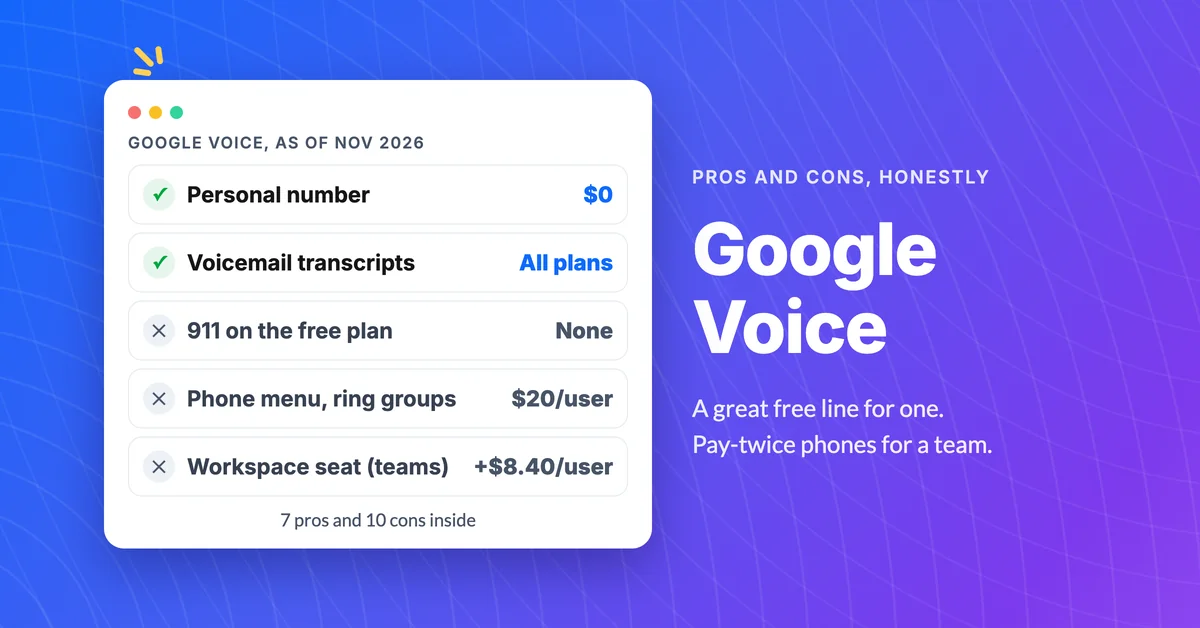
Google Voice pros and cons (7 pros, 10 cons)
Learn the real Google Voice pros and cons: what the free plan does well, where the paid plans fall short for teams, and the signs it's time to switch.