What Is A2P 10DLC Registration? Costs and Timelines
Your appointment reminders stopped working and nobody told you.
That's the part that catches service businesses off guard. There's no error message, no bounce, no red banner in your inbox. You send fifty reminder texts on Monday morning, the app shows fifty sent, and a third of them never reach a phone. The customers who no-show that week look like flaky customers. They're not. They're unregistered traffic getting quietly dropped by a carrier.
A2P 10DLC registration is the paperwork that stops that from happening. It's boring, it costs money, and it's mandatory if you text US customers from a normal 10-digit number. So let's get you through it without the acronym soup.
TL;DR:
- A2P 10DLC registration is how US carriers approve a business to text customers from a standard 10-digit local number. Until your campaign is approved, carriers filter those texts and they can fail silently, with no error and no bounce.
- It costs $19.50 as a one-time carrier fee per campaign registration, plus $2.00 a month for every active campaign. A rejected campaign costs another $19.50 to resubmit, because carriers bill for each vetting attempt.
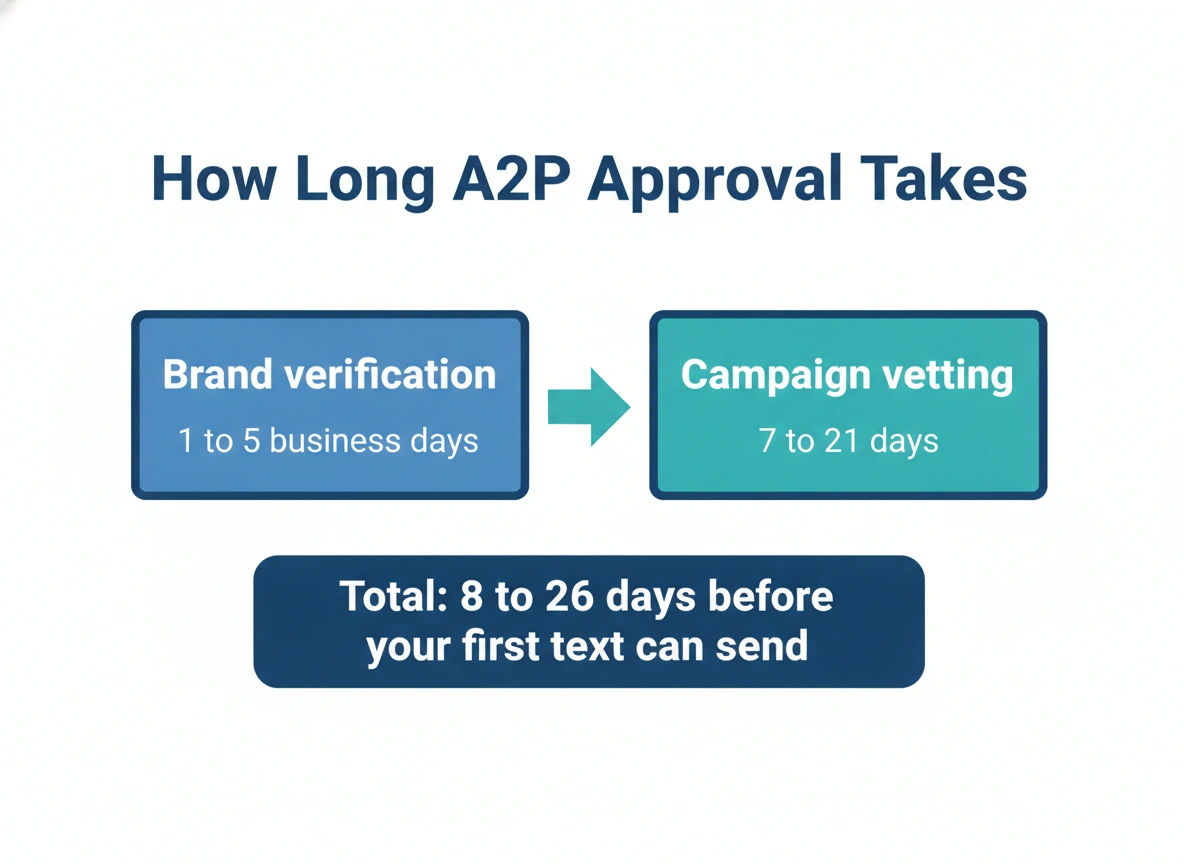
- Approval runs 1 to 5 business days for your brand and a further 7 to 21 days for the campaign, so plan on 8 to 26 days before your first business text can send.
- Only US local numbers go through this process. Toll-free numbers use separate toll-free verification, Canadian long codes have no registration regime, and the UK is outside the scheme entirely.
- Most rejections come from something carriers can independently check: a legal name that doesn't match your EIN letter, a website behind a login, or a privacy policy saying you share data with marketing partners.
What is A2P 10DLC registration?
A2P 10DLC registration is how US mobile carriers approve a business to send text messages from a standard 10-digit local number. A2P means application-to-person: a business texting a customer, rather than two people texting each other. 10DLC means 10-digit long code, which is just the ordinary phone number format you already use.
Two pieces get registered, and the order matters.
Your brand is who you legally are. Business name, tax ID, address, and an authorized representative: a real person who can vouch for the company and be contacted about it. You register a brand once. It's the identity layer, and it doesn't change when your messaging does.
Your campaign is why you text. Appointment reminders, account notifications, customer care, two-factor codes, and so on. A campaign describes a category of message and carries sample messages showing what you'll actually send.
The brand goes first. Once carriers accept that you're a real business, they review what you plan to send. Both have to clear before a single text delivers.
The analogy that makes this click: the brand is your driver's licence and the campaign is your licence plate. Proving who you are doesn't grant permission to drive any particular vehicle. You need both, and the plate is the one carriers check on the road.
Here's the mental model that helps most, though: this isn't your phone provider being difficult. Carriers built the scheme and enforce it upstream of every provider. Switching apps doesn't get you out of it, and no vendor can waive it for you.
Why do carriers require this at all?
Because unregistered business texting was drowning people in spam, and carriers took the blame for it.
Before 10DLC, a spammer could rent a pile of ordinary local numbers, blast a few million messages, and move on before anyone traced it. The numbers looked like real people texting real people. Filtering that without also blocking legitimate businesses turned out to be impossible.
So carriers flipped the model. Now the default is distrust: business traffic from an unvetted number gets filtered, and you buy your way out of the filter by proving who you are. Registration is a trust ledger.
That framing explains most of the process's odd edges. Why do they want your EIN letter rather than your logo? Because a spammer can make a logo. Why must your website be publicly reachable? Because a reviewer needs to open it without credentials. Every requirement traces back to "can we independently verify this business exists and does what it claims."
Annoying? Yes. But it's also why your reminders land at all once you're through it. The filter that blocks unregistered traffic is the same filter that protects your delivery rates from everyone else's spam.
Who actually needs to register?
This is where a lot of guides get sloppy and quote one number for everything. Scope matters, and getting it wrong wastes real money.
| Your number | What applies |
|---|---|
| US local (10-digit) | A2P 10DLC registration, the process in this post |
| US toll-free | Toll-free verification, a separate process |
| Canadian long code | No registration regime |
| UK numbers | Outside the scheme entirely |
If you're texting US customers from a US local number, you register. If you bought a toll-free number, you go through verification instead, which is a different form and a different queue. Nobody needs both for the same number.
Notice what isn't on that list: whether you're sending one text a week or ten thousand. Volume doesn't exempt you. A single appointment reminder from an unregistered US local number is subject to the same filtering as a bulk campaign.
Registered business or sole proprietor?
Carriers treat these differently, and the difference shows up in how much you can send.
| Registered business | Sole proprietor | |
|---|---|---|
| Requires | A tax ID issued 30+ days ago | US or Canadian address plus a carrier mobile number |
| Numbers that can text | No practical app limit | 1 |
| Campaigns allowed | 3 | 1 |
| Carrier daily limit | Around 2,000 messages | Around 1,000 messages |
| Messages per second | 15 | 1 |
Both paths cost the same. So if you have an EIN, register as a business. You get more numbers and more volume for identical money, and there's no upside to registering as a sole proprietor when you qualify for the other one.
Two traps in that table worth calling out.
The mobile number for sole proprietors has to come from a traditional carrier. VoIP numbers get rejected at that step, which is a strange thing to discover halfway through a form about phone service. Use a personal mobile on a normal plan.
And the daily limit applies to your whole brand, not to each campaign. A registered business gets around 2,000 messages a day in total, whether it's running one campaign or three. Teams sometimes register a second campaign expecting more headroom and get the same ceiling with an extra $2 monthly fee attached.
What those limits mean in practice
Numbers like "15 messages per second" are meaningless until you translate them.
For a service business, 2,000 messages a day is a lot of runway. A shop running 40 jobs a day, each generating a confirmation, a reminder, an on-my-way text, and a follow-up, uses 160. You'd need to be well past a dozen crews before the ceiling matters.
Where it bites is bulk sends. Texting 3,000 customers about a holiday closure crosses the line in one afternoon, and the overflow doesn't queue politely forever. If that's your use case, plan the send across days or get vetted for a higher tier.
Both self-serve paths register at the carriers' low-volume tier, which is where the "Low Volume Business" label comes from. Higher throughput needs extra carrier vetting through a different process, so if you know you'll send at scale, start that conversation early rather than registering low-volume and hitting a wall.
What do you need before you start?
Gather these first. The single most common reason a registration stalls is someone opening the form and discovering halfway through that they don't have the EIN letter to hand.
- Your EIN letter from the IRS, with the legal business name exactly as printed. Not your trading name, not your signage.
- Your legal structure: private, public, non-profit, or government.
- Business address and country of registration.
- An authorized representative: name, email, and phone for a real person at the company.
- A publicly reachable website, not behind a login, not parked, not in maintenance mode.
- A privacy policy URL stating that you don't sell or share collected data with third parties for marketing.
- Your industry and regions of operation.
That privacy policy line is the one people skip. Carriers open the URL and read it. A generic template that promises to share data with "trusted partners" is an active liability here, and it's a common decline reason for businesses that otherwise look fine.
What does A2P 10DLC registration cost?
Two fees, and they work differently.
$19.50 per campaign registration. A one-time carrier vetting charge. You pay it when you first register, and again for each additional campaign.
$2.00 a month per active campaign. An ongoing carrier fee for keeping the campaign live.
Both are in USD in every billing region, because the carriers charging them are American. And both are carrier fees rather than provider markup, which is why the numbers look identical wherever you shop. If a provider quotes you noticeably more, you're looking at a markup, not the fee.

The line item people miss is the resubmission. Carriers bill for every vetting attempt, so a rejected campaign costs another $19.50 to fix and resend.
Brand rejections are gentler. Those can usually be resubmitted a few times at no charge, because the brand check is cheaper for carriers to run. There's also a distinction worth knowing between "rejected" and "failed": a rejection means a carrier looked at your submission and declined it, while a failure means the submission never reached them at all. Retrying a failure costs nothing, since nobody was billed for a review that didn't happen.
How long does approval take?
Longer than anyone plans for.
- Brand verification: 1 to 5 business days. Carriers confirm your business identity.
- Campaign vetting: 7 to 21 days after the brand clears. Carriers review what you're actually sending.
Call it 8 to 26 days end to end. The wide range isn't your provider stalling. Campaign vetting is partly manual review at the carrier level, and it queues.
Three consequences that matter more than the number itself.
Register before you need it. If your busy season starts in six weeks, this is a today problem. Teams that register the week they want to launch reminders end up launching a month late, usually during the exact period they most needed the reminders.
Registration doesn't travel with your number. Porting a number to a new provider is a separate thing from A2P registration, which lives with the provider you registered through. Switch providers and you register again, from scratch, including the wait. If you're planning a move, start the new registration before the cutover so texting doesn't lag weeks behind your calls. We cover the wider sequence in our guide to switching business phone providers.
Calls aren't affected. While registration is pending, your number rings normally, voicemail works, and inbound texts still arrive and land in your inbox. It's outbound business texting that waits. That's a useful thing to know if you're mid-migration and worried you've broken your phone line.
Reading the status labels
Statuses look interchangeable and aren't. Here's what each one is telling you.
| Status | What it means |
|---|---|
| Draft | Saved but not submitted, still editable |
| Pending | Submitted, waiting in the queue |
| In Review | A carrier is actively looking at it |
| Approved | Done, and campaigns can now send |
| Rejected | A carrier declined it, with a reason attached |
| Failed | It never reached the carrier, so retrying is free |
| Suspended | The registration was deactivated and removed at the carrier |
Suspended is the one that surprises people, because it sounds temporary. It isn't a pause. Campaigns get deactivated and removed at the carrier when a subscription lapses or is cancelled, and coming back means re-registering the campaign and paying the fee again.
Your brand generally survives that, which softens the blow. You rebuild the campaign, not your whole identity. Still, this is a good reason not to let a plan expire during a slow month if you intend to text again in the spring.
What gets rejected, and why?
Most rejections come down to a mismatch between what you told carriers and what they can independently verify. They're checking, not just reading.
The usual causes:
- The legal name doesn't match the tax ID. Carriers check your EIN letter, not your signage. "Mike's Plumbing" fails when the IRS knows you as "Michael Torres Plumbing LLC."
- The website is unreachable or behind a login. A parked domain, a site in maintenance mode, or a page requiring sign-in reads as a business that can't be verified.
- No privacy policy, or the wrong kind. Carriers look for a policy stating you don't sell or share collected data with third parties for marketing.
- The campaign use case doesn't match the sample messages. Registering for customer care and submitting promotional samples is a fast decline.
- A recently issued tax ID. Most flows expect an EIN issued at least 30 days ago.
- Vague sample messages. "Hello, this is a message from our company" tells a reviewer nothing about what you send.
The fix is almost always evidence rather than argument. Match the name exactly, make the site publicly reachable, publish a real privacy policy, and describe honestly what you send.
Picking the right use case
Carriers offer roughly a dozen campaign use cases: customer care, account notifications, marketing, two-factor authentication, fraud alerts, public service announcements, and others in that family. Pick the one closest to what you actually send, then write samples that match it.
Service businesses almost always want customer care or account notifications rather than marketing. Appointment reminders and on-my-way texts are operational messages about a transaction the customer already agreed to. Filing them as marketing invites stricter scrutiny and a tighter filter for no benefit.
But be honest about it. If you genuinely plan to send promotions, register a campaign that covers promotions. Sending marketing traffic through a customer-care campaign is the kind of mismatch that gets a campaign torn down later, which is considerably more painful than a rejection at registration.
Do opt-outs still matter after registration?
Yes, and this is the part teams treat as a formality until it isn't.
STOP, STOPALL, UNSUBSCRIBE, CANCEL, END, and QUIT all opt someone out. START, UNSTOP, SUBSCRIBE, and YES opt them back in. HELP and INFO return your support message. Keyword handling is a condition of staying registered, not a nice-to-have, and it's the kind of thing that surfaces in a complaint investigation.
Any competent provider handles these automatically, before your auto-replies or AI agents ever see the message, and matches them case-insensitively on the full message body. But you should still know the list, because "we didn't realize STOP was case-insensitive" is not a defense anyone accepts.
One practical note: an opt-out is per person, not per campaign. Someone who opts out of your reminders has opted out of you. Treat a STOP as the end of texting that customer until they explicitly opt back in, and keep asking yourself whether the message you're about to send is worth the risk of earning one.
Getting through it with less friction
Here's the honest version of the trade-off. The registration itself is fixed: same carriers, same fees, same queue, regardless of who you buy your number from. What differs is how much of the form you fill in yourself, whether the campaign content is written for you, and how clearly the thing tells you what went wrong when a carrier says no.
That middle part matters more than it sounds. Writing your own campaign description and sample messages is where first-time registrants generate their own rejections, because they describe the business rather than the messages. A reviewer doesn't need to know you're a family-run HVAC company with 30 years of service. They need to see the text a customer will receive.
dialnote is an AI business phone system with no per-user pricing, where AI voice agents answer calls, capture leads, and book meetings around the clock. For this particular chore, it collapses registration into one form under Settings, generates the campaign description and sample messages from your business details, and then runs brand submission, campaign submission, and number attachment as a pipeline you watch rather than drive.
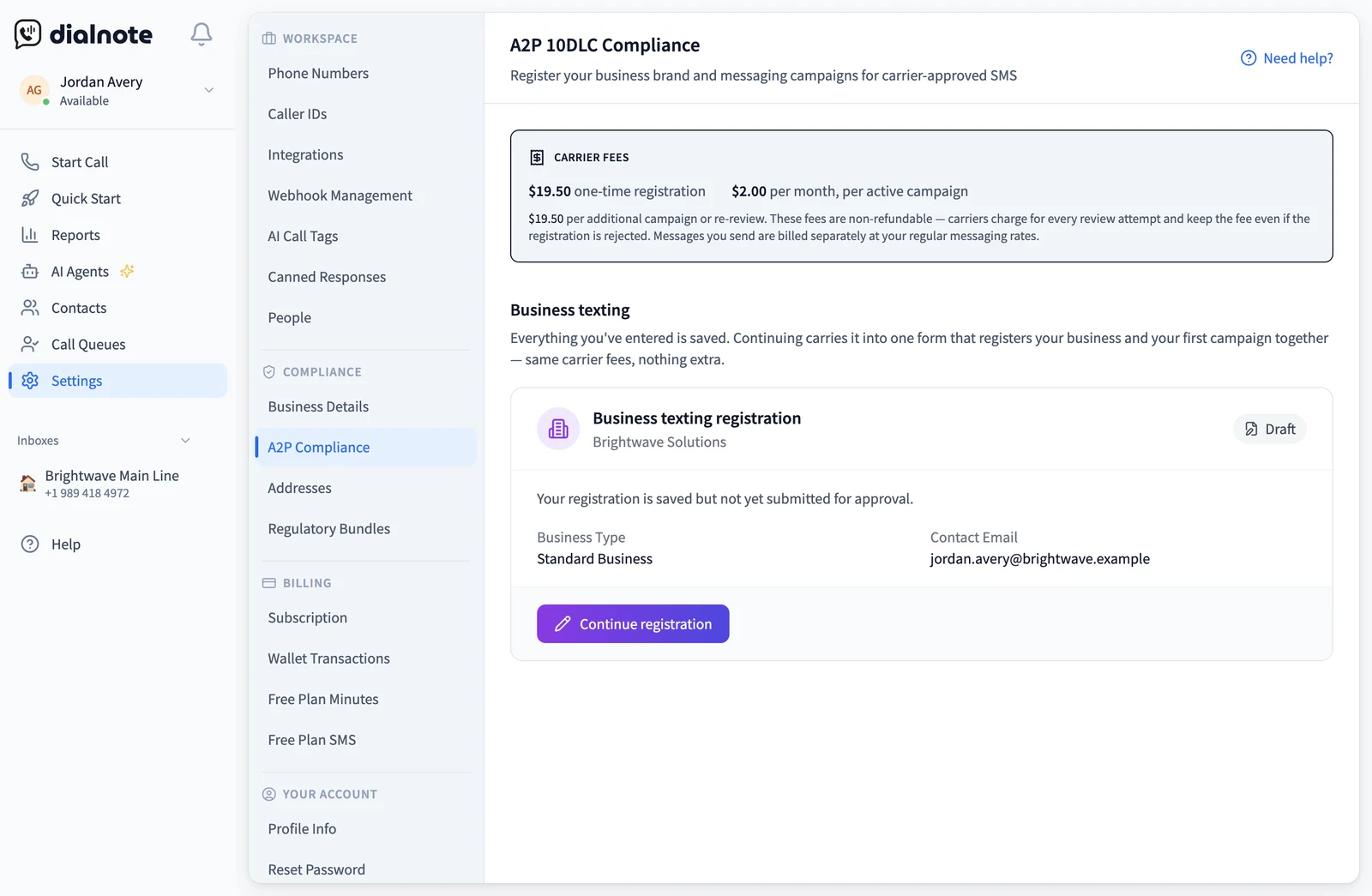
The fees themselves are carrier charges, so they read the same wherever you register. What changes is how much of the form you fill in by hand.
Numbers you buy later attach to the approved campaign automatically, which spares you a return trip after every purchase. The step-by-step version, including the eligibility questions and what each field wants, lives in the A2P quickstart guide, with fees and refunds broken down in what A2P registration costs.
One planning note before you start: texting isn't available on a free trial or on an entry-level single-user plan, because a $19.50 entry fee plus $2 a month on a $19 plan costs more than the plan. Sending starts on the Team plan at $49 a month flat, with unlimited seats. A single-user number still receives texts, it just can't send them.
A worked example
Say you run a six-van HVAC company in Ohio and you want reminder texts before the summer rush.
It's early spring. You pull the EIN letter, confirm the legal name is "Buckeye Climate Services LLC" rather than the "Buckeye Heating & Air" on your vans, and check that your site loads without a login. Your privacy policy is a template from three years ago that mentions sharing data with marketing partners, so you get that rewritten first. That's the afternoon's real work.
You register as a business rather than a sole proprietor, because you have the EIN and it buys you three campaigns and roughly 2,000 messages a day for the same $19.50. You pick account notifications as the use case, since every text you plan to send is about an appointment the customer already booked.
The brand clears in three days. The campaign takes another sixteen. Total elapsed: just under three weeks, which lands you comfortably before the first heat wave. Cost so far: $19.50 plus $2 a month.
Now run the alternative. You wait until the week the phones start ringing, register then, and spend the busiest month of your year without reminder texts, watching no-shows you'd normally have prevented. Same fee, dramatically different outcome. The registration isn't the expensive part. The timing is.
Is it worth it?
For a service business, yes, and it isn't close.
Think about what a reminder text actually prevents. One no-show on a $400 job pays for eleven years of the $2 monthly fee. The registration is a rounding error against a single recovered appointment, and that's before counting the quote follow-ups and the on-my-way notes that customers actually reply to.
The frustrating part isn't the cost. It's the 8-to-26-day wait sitting between you and a feature you already pay for, and the silence when unregistered messages disappear. So treat it the way you'd treat a licence renewal: unglamorous, non-optional, and much cheaper to do early than to do urgently.
Start it this week, not the week you need it. Then go write texts people actually want to receive, which is a harder problem than any carrier form.
Frequently asked questions
A2P 10DLC registration is how US carriers approve a business to text from a standard 10-digit local number. You register your business identity (the brand) and your reason for texting (the campaign). Until the campaign is approved, carriers filter your texts, so they can silently fail to arrive.
A2P 10DLC registration costs $19.50 per campaign registration, plus $2.00 a month for each active campaign. Carriers charge that vetting fee again on a campaign resubmission, so a rejected campaign costs another $19.50. The fee is in USD everywhere and applies to US local numbers only.
Brand verification usually takes 1 to 5 business days, and campaign vetting takes another 7 to 21 days after the brand clears. Plan on 8 to 26 days end to end. You can't send business texts from a US local number until the campaign itself reaches approved status.
No. Toll-free numbers use a separate toll-free verification process instead of A2P 10DLC, which applies to standard 10-digit local numbers. Canadian long codes have no registration regime at all, and the UK is outside the scheme entirely, so the $19.50 fee is a US local number cost.
Carriers filter unregistered business traffic. Your texts won't bounce with an error you can see; they just stop arriving, and the failure looks identical to a customer ignoring you. Teams often discover it weeks later, after chasing replies that were never delivered.

Written by
Upasana Sahu
Senior Digital Marketing Specialist, SmartReach.io
Upasana Sahu is a Senior Digital Marketing Specialist at SmartReach.io with over 10 years of experience in content marketing, SEO, and digital strategy. She manages end-to-end blog operations, from content creation and on-page/off-page SEO to traffic...
Upasana Sahu is a Senior Digital Marketing Specialist at SmartReach.io with over 10 years of experience in content marketing, SEO, and digital strategy. She manages end-to-end blog operations, from content creation and on-page/off-page SEO to traffic...
Related Articles
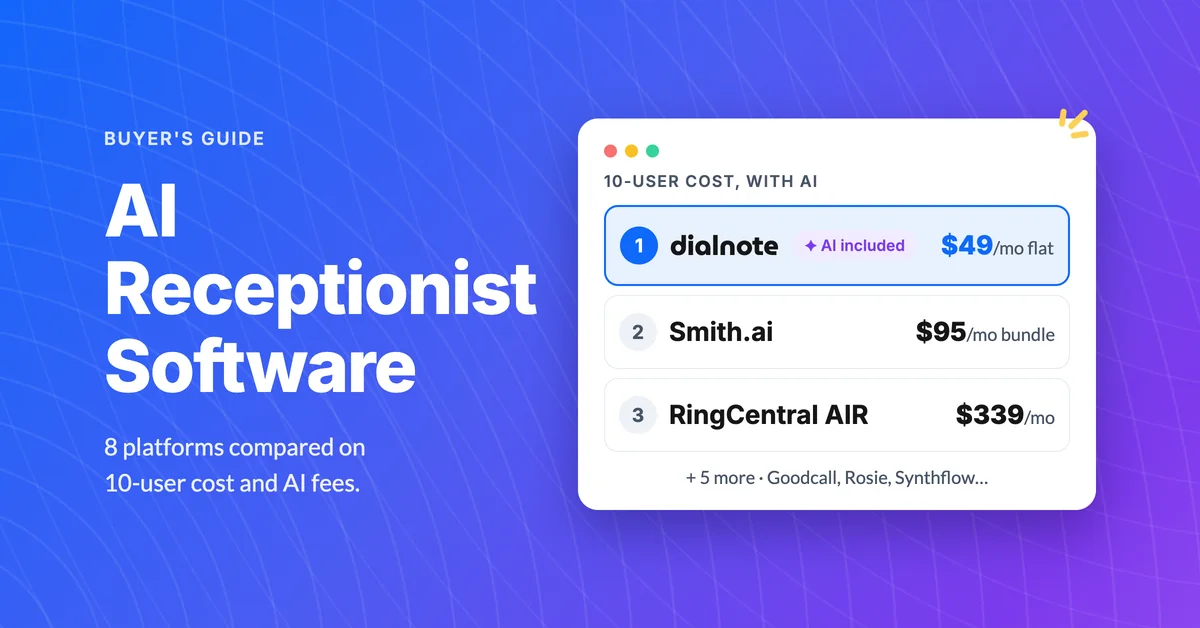
Best AI Receptionist Software For Businesses Ranked
Compare the best AI receptionist software for businesses by 10-user cost, per-minute AI fees, IVR, call queueing, and real reviews. Pick the right tool.
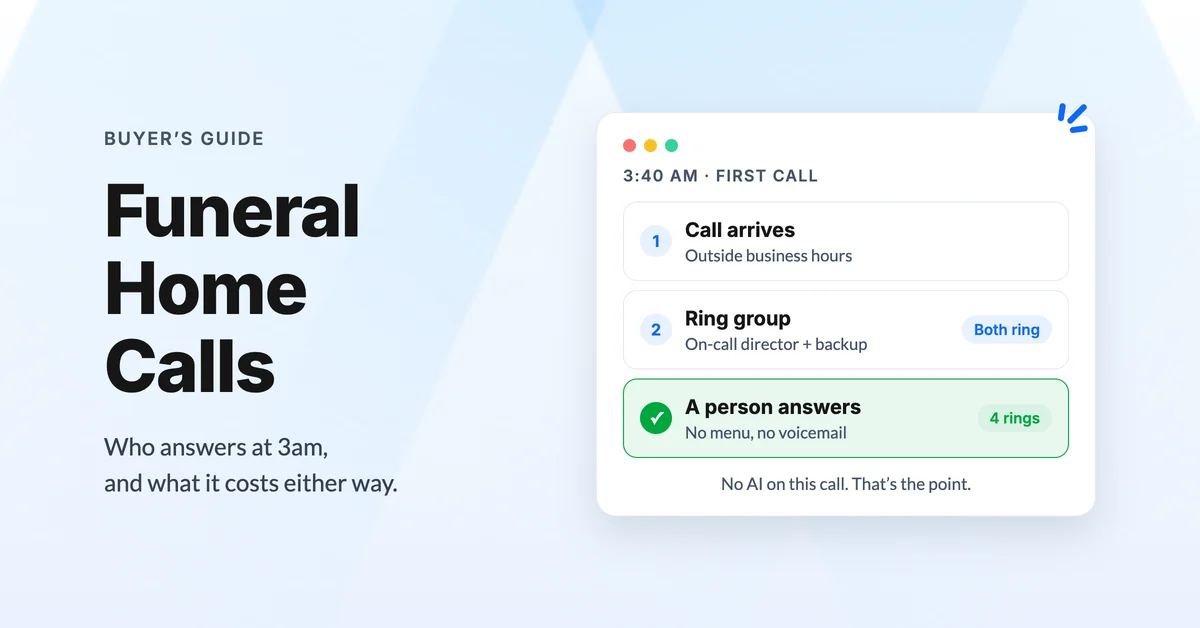
Funeral Home Answering Service: What Actually Works
Compare answering options for funeral homes, from live services to on-call ring groups, and see which setup gets a first call answered by a person.
Hotel Phone System: 6 Picks for Small Properties
Compare 6 hotel phone systems built for small inns, B&Bs and homestays, with the room-night math that shows which one earns back its monthly cost.