10 Best Aircall Alternatives With AI Included
Aircall's pitch is a phone system your support and sales teams run inside the CRM, and its 100+ native integrations genuinely deliver that. The bill is where the story turns. The $30 per user sticker is the entry fee: AI transcription is $9 more, advanced analytics $15 more, advanced messaging $20 more, and there's a 3-seat minimum before anyone's dialed a number.
That add-on stack is what sends people searching for Aircall alternatives. A 10-person team on Essentials with the AI add-on pays about $390 a month. On Professional with AI and analytics, $740. And none of that buys an AI that answers a call; Aircall's AI reviews calls after they happen.
Ray hit the stack from the operations side. He runs a four-location property-management company, 12 people on phones, and Aircall priced out fine at the demo: $360 a month on Essentials. Then the team wanted transcription ($108 more), the owner wanted the analytics pack ($180 more), and renewals landed the whole thing near $650 a month, a number that grows again with every hire. The product worked. The pricing model was the product.
Here's the whole field priced honestly: per-seat rivals that bundle what Aircall itemizes, budget swaps, and the flat-rate route that stops headcount from multiplying the bill.
TL;DR:
- Aircall starts at $30/user/month with a 3-seat minimum, and the features teams actually shortlist it for cost extra: AI $9/user, analytics $15/user, advanced messaging $20/user. A 10-person team with AI runs about $390/month, as of September 2026.
- The best Aircall alternative for most small teams is dialnote: a full phone system with unlimited users plus a 24/7 AI receptionist from $49/month flat, AI calls at a published $25/mo for 65 with the AI call pack (or $0.49/minute without one).
- Closest like-for-like swaps: CloudTalk for call-center depth, JustCall for sales texting, Quo (formerly OpenPhone) for app polish, Dialpad for included AI transcription.
- Budget rows: KrispCall from $12/user (pay-as-you-go usage) and Zoom Phone from $10/user metered.
- Your Aircall numbers port out in 1 to 3 weeks; don't cancel until the port completes.
Jump to: quick comparison · why people switch · the list · how to choose
Quick comparison: the 10 best Aircall alternatives
| Alternative | Starting price* | AI answering | 10-person cost with AI | Rating |
|---|---|---|---|---|
| dialnote | $49/mo flat, unlimited users | AI receptionist included; AI calls $25/mo for 65, or $0.49/min | $49/mo flat | 4.0★ G2 |
| Quo (formerly OpenPhone) | $15/user/mo | Sona included; 10 free AI calls/mo, packs from $25/mo | $230/mo (Business tier) | 4.7★ G2 |
| Dialpad | $15/user/mo | Transcription included; autonomous agents quote-only | $150/mo + quote | 4.4★ G2 |
| CloudTalk | $25/user/mo | AI tools on higher tiers | ~$250/mo+ | 4.3★ G2 |
| JustCall | $29/user/mo, 2-user min | AI voice agents on $89/user tier | $290/mo; $890 with AI tier | 4.3★ G2 |
| RingCentral | $20/user/mo | AIR add-on from $39/mo + per-minute | ~$239/mo | 4.2★ G2 |
| Nextiva | $15/user/mo | XBert add-on, reported ~$99/mo | ~$249/mo | 4.5★ G2 |
| KrispCall | $12/user/mo annual | No AI answering | $120/mo + usage, no AI | 4.5★ G2 (small base) |
| Phone.com | $15/user/mo | AI-Connect, $29.99/mo for 100 min | ~$180/mo | 4.3★ Trustpilot |
| Zoom Phone | $10/user/mo metered | No AI answering | $100–150/mo, no AI | 4.5★ G2 |
| Aircall (reference) | $30/user/mo, 3-seat min | Post-call AI, $9/user add-on | ~$390/mo | 4.3★ G2 |
*Annual billing where offered; published rates as of September 2026, and they shift often. "10-person cost with AI" uses each vendor's cheapest path to AI capability, which differs in kind: post-call transcription (Aircall, Dialpad) is not the same product as an AI receptionist that answers (dialnote, Quo's Sona, RingCentral's AIR).
Why are people looking for an Aircall alternative?
Nobody disputes what Aircall does well: the CRM integrations are deep and real, the desktop app is stable, and per-call logging into Salesforce, HubSpot, or Intercom mostly just works. The complaints cluster around what it costs to keep and what it still can't do.
The add-on stack. Aircall itemizes what rivals bundle. Base seat $30, AI $9, analytics $15, advanced messaging $20: a fully-equipped seat is $74 a month, and the 3-seat minimum sets the floor at $90 before add-ons. Per-seat pricing then multiplies all of it by every hire. Our strong opinion: pricing AI transcription as a separate SKU in 2026 is like charging extra for voicemail; it's a core expectation, and the itemization exists because renewal invoices, not feature lists, are where the model earns.
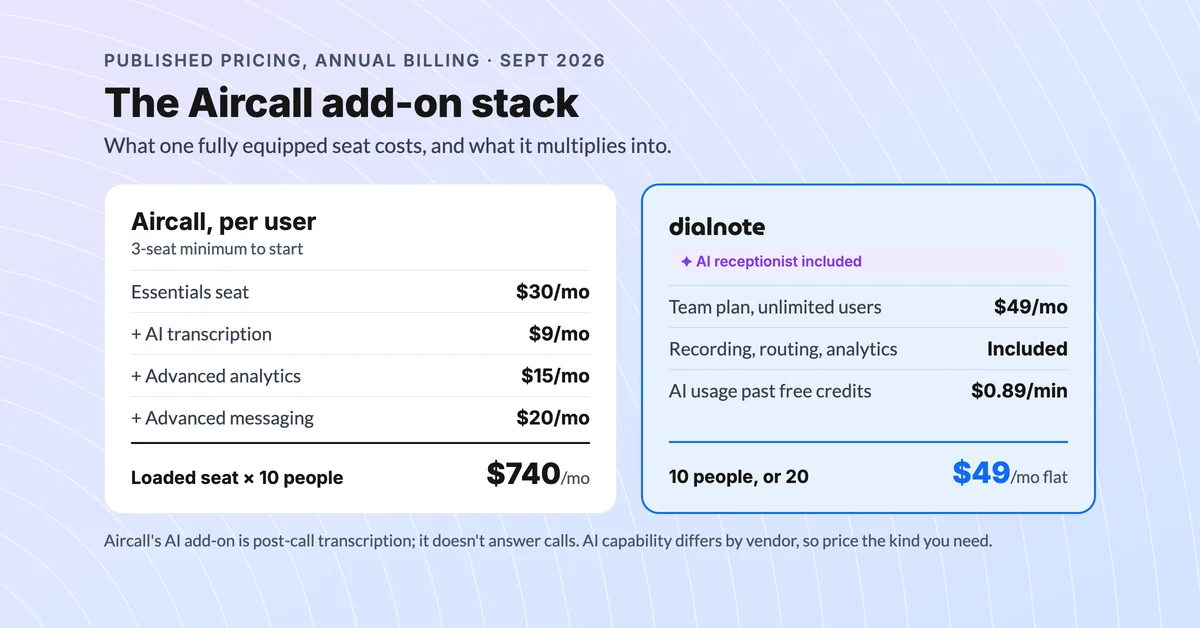
The AI watches; it doesn't answer. Aircall's AI is post-call: transcription, summaries, coaching review. Useful, but if 100 calls hit your line while everyone's busy, nothing picks up. There's no AI receptionist on any Aircall tier, and inbound-heavy teams increasingly treat that as the whole point of an upgrade.
Support and quality complaints at scale. Capterra analysis pegs slow or unhelpful support at around 38% of Aircall's critical reviews, and reviewers report audio quality degrading on weaker connections. The SMS cap (13,000 segments per user per month) also surprises teams running text campaigns alongside calls.
The minimums. Three seats minimum, annual pricing quoted by default, and analytics gated to add-ons. Solo operators and two-person shops aren't Aircall customers by design.
What to look for in an Aircall alternative
Decide what the AI is for. Post-call transcription (Dialpad does it best at the entry price) and AI answering (an agent that greets, captures, books, and transfers) are different products that get marketed under one label. Price the one your team actually needs; our AI receptionist software guide separates the categories.
Total the real seat, not the sticker. Ask each vendor what the seat costs with the features you'll turn on in month one. Aircall taught you why: $30 and $74 are both "the price," depending on the checklist.
Check the pricing model against your headcount plan. Per-seat tools punish growth; flat-rate tools don't care. A team planning to double should weight this above any feature.
Keep your integrations honest. If Salesforce or Intercom logging is why you bought Aircall, verify the replacement's integration does what you need before you port anything. This is the one axis where Aircall often genuinely wins, and we'd rather say so than have you find out mid-migration.
The 10 best Aircall alternatives in 2026
Flat-rate first, then the per-seat field from most to least Aircall-like.
1. dialnote: best overall Aircall alternative
dialnote is an AI business phone system with no per-user pricing. AI voice agents answer calls, capture leads, and book meetings 24/7. Plans from $19/mo. The structural difference from Aircall is the pricing unit: the $49 Team plan covers the whole team, unlimited users, with the AI receptionist and phone menu switched on. Nobody recalculates the phone budget when headcount changes.
The AI here answers rather than observes: it greets callers 24/7 in 14 languages, asks the qualifying questions you configure, books meetings through Calendly or Cal.com, sends SMS confirmations, and transfers to a teammate when someone's free, with call details synced to your CRM after the call. AI calls are $25/mo for 65 calls with the AI call pack, or $0.49/min from your wallet without one, and the phone menu routes calls first so the AI only handles what you choose. Calling reach covers 90+ countries.
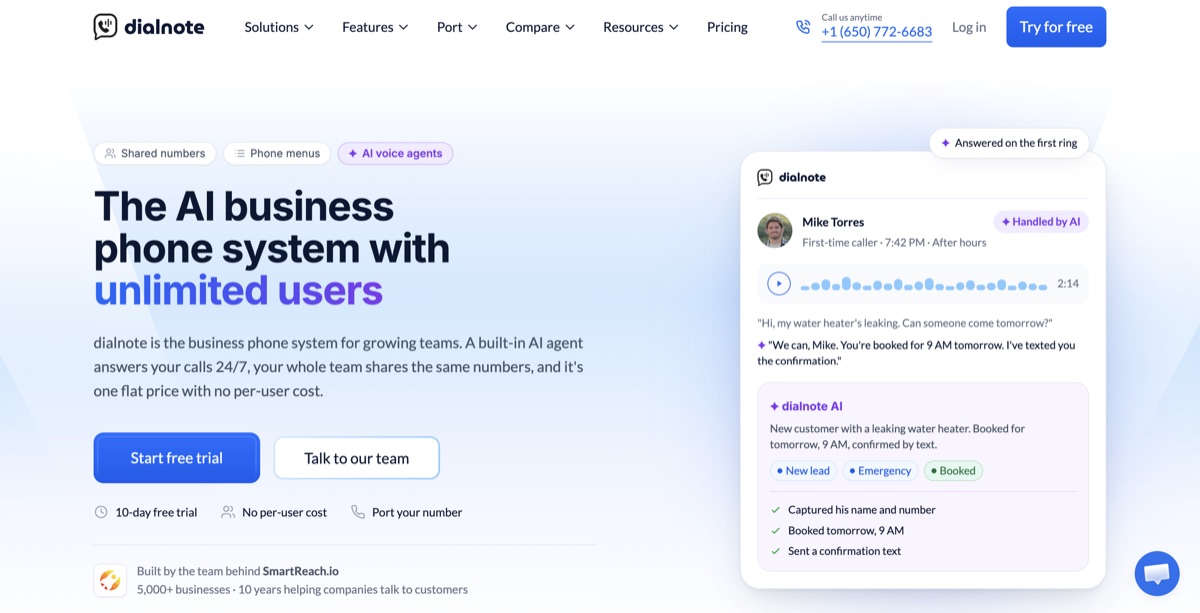
| SoloPhone system only, no AI | $19/mo |
| TeamUnlimited users; AI receptionist + phone menu, most popular | $49/mo |
| BusinessUnlimited users; advanced routing | $99/mo |
| AI call pack65 AI calls; stack up to 10 (Team and up) | $25/mo |
| AI voice usageWithout a pack or past it, from your wallet (free credits each month) | $0.49/min |
Flat pricing per account, not per user, with no seat minimums or per-seat add-ons. 10-day free trial, no credit card. As of September 2026.
Pros
- One flat bill replaces the seat price and the add-on stack: the AI agent, routing, recording, and analytics aren't per-seat SKUs
- The AI answers calls instead of just transcribing them: lead capture, booking, SMS follow-up, transfers
- No seat minimums; a 2-person shop and a 20-person team pay the same plan price
- Published pricing for everything, including the AI rate
Cons
- Built for inbound-first small teams, not outbound sales dialing; Aircall and JustCall serve power dialers better
- AI calls are paid usage (an AI call pack, or $0.49/min from the wallet), so all-day AI answering still shows up on the bill
- Fewer native CRM integrations than Aircall's 100+ catalog
Ready to stop paying by the call?
10-day free trial, no credit card needed.
What users say: dialnote holds a 4.0 on G2 as of September 2026 with a smaller review base than the per-seat incumbents; the recurring theme from switchers is the bill that stopped moving when the team grew.
Best for: small teams that bought Aircall for coverage rather than dialing, and want the answering problem and the phone bill solved in one flat plan.
2. Quo (formerly OpenPhone): best per-seat app polish
If you've seen OpenPhone recommended, this is the same product: OpenPhone rebranded to Quo in 2026. It's the best-liked app in the category (4.7 on G2 across 3,300+ reviews), built around shared numbers and a team text inbox, and its Sona AI agent answers missed calls on every plan, with 10 AI-handled calls included monthly and credit packs from $25/month past that.
| StarterAnnual billing; Sona starter credits included | $15/user/mo |
| BusinessAnnual; AI summaries, HubSpot + Salesforce | $23/user/mo |
| ScaleAnnual; AI call tags, priority support | $35/user/mo |
| Sona credit packsBeyond the 10 included AI calls/mo | $25–199/mo |
Per-user pricing; CRM integrations start on the Business tier. As of September 2026.
Pros
- Best-rated app experience in the category, with texting workflows teams genuinely like
- Sona AI answering included on every tier in starter doses
- Cheaper fully-loaded seat than Aircall ($23 with CRM vs $39 with AI)
Cons
- Still per-seat: a 10-person team on Business runs $230/month before AI packs
- Support is slow (email-first, days at times), a repeated review theme
- Call reliability dips on cellular data away from Wi-Fi
What users say: the interface and shared-inbox texting draw consistent praise; support response times and off-Wi-Fi reliability draw the complaints. Our Quo teardown runs the full pricing ladder.
Best for: texting-heavy customer teams that want Aircall's polish without Aircall's add-on stack.
3. Dialpad: best included AI transcription per dollar
Dialpad bundles what Aircall itemizes: real-time transcription and AI call summaries ship on the $15/user Standard plan, no add-on. That's the exact feature Aircall charges $9/user extra for, included at half Aircall's base price. Autonomous AI agents that answer calls end to end exist but are quote-only.
Pros
- AI transcription and summaries included at $15/user, the category's best included-AI value
- Natural-language auto-attendant routes callers by what they say
- Mature Google Workspace and Microsoft 365 integrations
Cons
- AI answering agents are quote-only, so the budget conversation ends at sales
- CRM integrations need the Pro tier and its 3-seat minimum
- Reviewers report dropped transfers and quote-vs-invoice drift
What users say: 4.4 on G2 across 4,100+ reviews, with transcription accuracy the standout and support responsiveness the gripe. Full field in our Dialpad alternatives guide.
Best for: teams whose "AI" requirement means notes and coaching on every call, at the lowest per-seat price.
4. CloudTalk: closest like-for-like call-center swap
CloudTalk is the nearest structural replacement for Aircall's calling engine: queues, IVR, skills-based routing, power dialers, and local numbers in 160+ countries, from $25/user/month annual with no 3-seat minimum. Its AI tooling (transcripts, sentiment, talk-listen ratios) arrives on higher tiers.
Pros
- Call-center depth that matches or beats Aircall's, including dialers Aircall gates higher
- Starts at one seat; no minimum
- Wide international number coverage
Cons
- AI features live on pricier tiers, so the comparison-shopping trap repeats
- Interface is more utilitarian than Quo or Aircall
- Per-seat pricing still scales with headcount
What users say: 4.3 on G2; praised for routing flexibility and coverage, dinged on occasional call-quality variance by region.
Best for: support and sales floors that want Aircall's call-center machinery at a lower entry with no seat minimum.
5. JustCall: best for sales teams that text
JustCall runs $29/user/month (annual) with a 2-user minimum, and it's built for outbound: dialers, SMS campaigns, and CRM logging. Its AI voice agents are genuinely capable and gated to the $89/user tier, which prices a 10-person AI team at roughly $890/month before overages.
Pros
- Strong outbound tooling: dialers, SMS sequences, workflows
- Deep CRM coverage similar to Aircall's core strength
- 2-seat minimum beats Aircall's 3
Cons
- AI answering costs $89/user/month, the priciest AI path on this list
- Per-seat plus per-minute AI overages stack meters
- Texting compliance setup (A2P) trips up new accounts
What users say: 4.3 on G2; sales teams like the sequences, and the recurring complaint is the gap between the $29 sticker and the tier that holds the features. Full teardown in our JustCall alternatives guide.
Best for: outbound-first sales teams comparing Aircall's dialer against a cheaper entry point.
6. RingCentral: best enterprise feature depth
RingCentral is the heavyweight: voice, video, fax, SMS, 300+ integrations, and a real AI receptionist (AIR) from $39/month as an add-on. Core starts at $20/user/month. You're buying the fullest feature set in the category and accepting enterprise complexity with it.
Pros
- Deepest overall feature set and integration catalog on this list
- AIR is a genuine AI receptionist with multilingual answering and booking
- Enterprise-grade reliability and support tiers
Cons
- Per-seat plus AIR plus per-minute usage stacks three meters
- Setup and admin complexity a 5-person team doesn't need
- Reviewers flag renewal pricing and contract friction
What users say: 4.2 on G2; the platform breadth earns it, the billing and complexity complaints persist. Our RingCentral alternatives guide covers the escape routes.
Best for: larger teams consolidating phone, video, and fax on one vendor with AI answering available.
7. Nextiva: best support reputation among the suites
Nextiva starts at $15/user/month with unlimited US/Canada calling and a reputation for actually answering its own support line. Its XBert AI assistant is an add-on reported around $99/month. The platform leans reliability-first rather than AI-first.
Pros
- Strong service reputation and 4.5 G2 rating at real volume
- Unlimited US/CA calling on the entry tier
- Solid reliability track record
Cons
- AI answering is an add-on without transparent public pricing
- Per-seat model with feature gates on higher tiers
- App polish trails Quo and Dialpad
Best for: teams that rank vendor support and reliability above AI depth. Our Nextiva alternatives guide has the full comparison.
8. KrispCall: cheapest per-seat entry
KrispCall starts at $12/user/month on annual billing, the lowest seat price here, with numbers in 100+ countries. The catch is the meter: the subscription covers the platform and number, while every call and text bills pay-as-you-go on top, and there's no AI answering.
Pros
- Lowest per-seat sticker on this list
- Wide international number availability
- No seat minimums
Cons
- Usage-based calling and texting on top of the subscription
- No AI answering at any tier
- Smaller review base and thinner integrations
Best for: budget-first teams with light, mostly international calling that don't need AI.
9. Phone.com: budget system with a published AI price
Phone.com starts at $15/user/month with mix-and-match user plans, and its AI-Connect answering add-on is $29.99/month for 100 minutes, a published price where most suite rivals send you to sales. Polish trails the leaders, but the math is honest.
Pros
- Published AI answering price, rare among per-seat suites
- Flexible per-user plan mixing keeps small bills small
- Cheap entry for basic needs
Cons
- AI-Connect's 100-minute bucket is small at real volume
- Dated interface next to Quo or Dialpad
- Feature nickel-and-diming across add-ons
Best for: cost-focused small teams that want light AI answering with a price tag they can read.
10. Zoom Phone: cheapest add-on to a Zoom shop
Zoom Phone starts at $10/user/month metered (or $15 unlimited US/CA), and if your team already lives in Zoom Meetings, it slots into the same client and admin console. There's no AI answering; you're buying dependable calling at commodity prices.

Pros
- Lowest usable entry price for light callers ($10 metered)
- One client for meetings and calls if you're already on Zoom
- Reliable core calling
Cons
- No AI answering on any tier
- Metered plan surprises heavy callers; unlimited is regional
- Phone features are a sidecar to the meetings product
Best for: Zoom-first offices with light call volume and no AI answering needs.
What does a 10-person team pay across the field?
Same team, September 2026 published rates, cheapest path that includes each vendor's AI capability where one exists. Aircall Essentials with the AI add-on: $390/month. JustCall Team without AI: $290, or $890 on the AI-agent tier. Quo Business: $230 before Sona packs. CloudTalk Starter: about $250. Dialpad Standard: $150 with transcription included and answering by quote. dialnote: $49 flat, AI receptionist included, plus AI calls from $25/mo for 65 with the AI call pack.
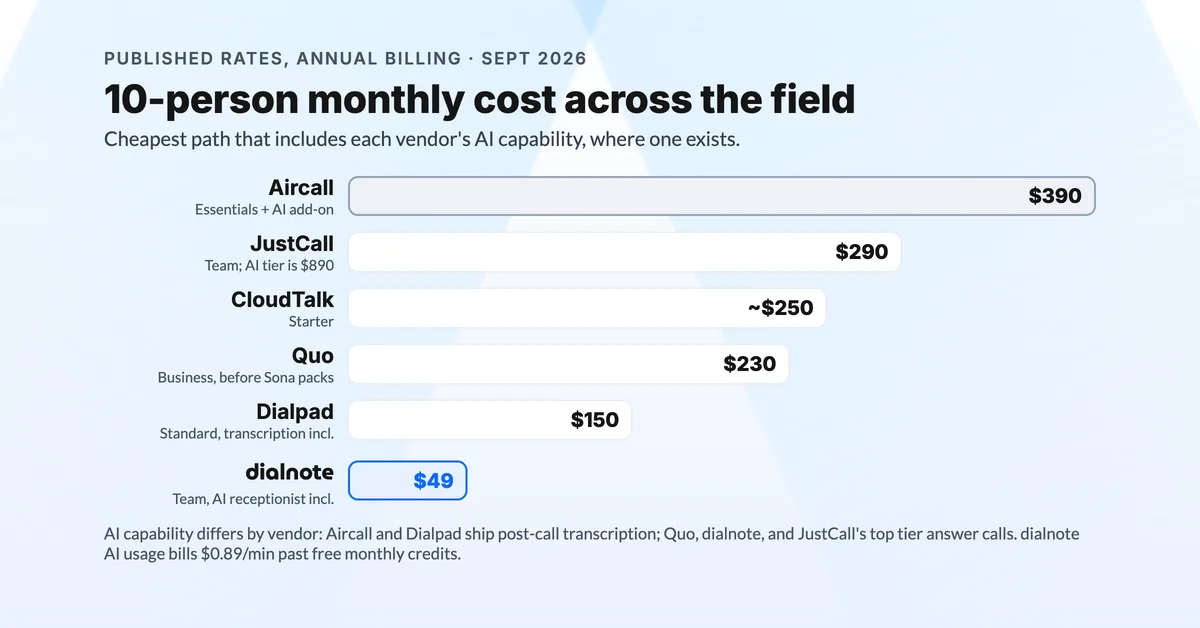
Two honest caveats on that chart. The AI capabilities differ in kind, so Dialpad's $150 buys transcription while dialnote's $49 buys answering, and you should price the one you need. And the flat rate isn't magic: dialnote's AI calls are paid usage (AI call packs, or the wallet past them), so a team that routes every call to the AI all day pays for those calls. The structural difference is that none of these numbers move when you hire, except the per-seat ones, which all do.
Where the flat rate wins, and where it loses
Flat pricing isn't automatically cheaper; it's cheaper past a crossover point, and the honest move is to compute it. dialnote's Team plan is $49 flat for the whole team; set that against each competitor's seat rate and the crossover headcount falls out:
| Against | Per-seat rate | Flat plan is cheaper from | Below that |
|---|---|---|---|
| Aircall Essentials | $30/user, 3-seat min | Any size ($90 floor beats $49 at 1 user) | Never cheaper to pick Aircall on price |
| Quo Business | $23/user | 3 users ($69 vs $49) | A 2-person team pays $46 on Quo and wins |
| Quo Starter / Dialpad Standard | $15/user | 4 users ($60 vs $49) | 1-3 people are cheaper per-seat |
| CloudTalk Starter | $25/user | 2 users ($50 vs $49) | Solo only |
| KrispCall Essential | $12/user | 5 users ($60 vs $49) | 1-4 people are cheaper per-seat, without AI |
Read that table both directions. A 2-person shop picking dialnote for price alone is making a mistake: Quo Starter costs them $30. The flat plan earns its keep from about 4 seats, and the gap then compounds with every hire, which is why the 10-person chart above looks the way it does.
The same honesty applies to the AI meter. A typical answered AI call runs 2 to 3 minutes, so on dialnote's AI call pack ($25/mo for 65 calls) each answered call costs about $0.38; without a pack, it's two to three minutes at $0.49/minute. Quo's Sona credit packs work out to about $0.45 to $1.00 per call. So per call the two are close, and what decides the total is the base: Quo charges per seat underneath its packs, dialnote doesn't. A small team with light AI volume favors Quo's economics; four or more seats, or heavier AI volume, favors flat. Neither vendor will run that arithmetic for you at the demo, so run it yourself before either pitch.
Three teams, priced end to end
Abstract crossovers are one thing; here's the math on three real team shapes, with a defended pick for each. Rates as of September 2026, annual billing.
The 2-person online store: Quo wins
Two founders, a support line, maybe 20 missed calls a month they'd love answered. Aircall can't even quote them: the 3-seat minimum makes the floor $90 before the AI add-on. dialnote runs $49 flat plus about $20 to $25 for those AI calls (2-minute calls run about $20 at $0.49/minute; one $25 AI call pack covers all 20 if they run longer), call it $70 to $75 a month all-in at that volume. Quo Starter: $30 for two seats with Sona's 10 free AI calls, plus a $25 credit pack for the rest, about $55 all-in.
The pick: Quo, and it's not close on price. Below the 4-seat crossover, per-seat pricing is the bargain, and Sona's message-taking covers light volume fine. Move to dialnote at this size only if in-call booking or intake questions are the whole point; keep Aircall off the shortlist entirely.
The 6-person service company: dialnote or Quo, on capability
Six people, phones ring all day, roughly 60 after-hours and overflow calls a month averaging 3 minutes that currently die in voicemail. Aircall Essentials with AI: 6 × $39 = $234 a month, and nothing answers those 60 calls, since Aircall's AI transcribes rather than picks up. Quo Business: 6 × $23 = $138, plus Sona packs for ~60 AI calls, roughly $165 to $200 all-in. dialnote: $49, plus one $25 AI call pack that covers all 60 three-minute calls = $74 (the same 180 minutes would be about $88 at the $0.49/min wallet rate), with the phone menu routing only after-hours calls to the AI.
The pick: not Aircall, and then it comes down to capability. Quo and dialnote land about $90 to $125 apart, with dialnote the cheaper of the two, so the decision is what happens during those 60 calls. Sona takes a message and texts a link back; dialnote's receptionist asks your intake questions, books into Calendly or Cal.com mid-call, and transfers if someone's on. If a missed call is a lost job, the booking is the feature; if a text-back is enough, Quo is fine too.
The 12-person HubSpot support floor: Aircall earns its keep, or CloudTalk
Twelve agents, 2,000 calls a month, queues, skills routing, per-call CRM logging, manager analytics. This is the shape Aircall was built for: Professional with AI and analytics runs 12 × $74 = $888 a month, and the 100+ native integrations genuinely reduce agent friction. CloudTalk delivers the same machinery at 12 × $25 = $300 base, with AI tooling on higher tiers, and no seat minimum drama.
The pick: CloudTalk if the budget leads, Aircall if the HubSpot depth is load-bearing. dialnote is the wrong tool here and we'd rather say so: no power dialer, no queue-depth analytics, and a floor this size lives in those features. The flat plan wins small-team math, not call-center operations.
How to choose the right Aircall alternative
Start from why you're leaving. If it's the add-on stack, shortlist the bundlers: Dialpad for transcription, dialnote for answering, Quo for the all-around app. If it's per-seat growth pain, the flat plan is the only structural fix. If Aircall's CRM depth is why you stay, test the replacement's integration on real records before you port; "syncs with Salesforce" covers a wide range of sync.
Price the seat you'll actually run, at the headcount you'll actually reach. Ask every vendor for the month-one invoice at today's team size and at plus-five hires. "The renewal is where per-seat pricing does its real work," says Akhilesh Betanamudi, dialnote's co-founder. "Buyers compare entry stickers; the model is designed for year two."
Then port on your schedule. Numbers move between providers in 1 to 3 weeks and the receiving provider does most of the paperwork; the Aircall porting guide walks the steps. Keep Aircall live until the port confirms, and run the two in parallel for a week if you can.
We're genuinely unsure how long the add-on-stack model holds across the category; Dialpad bundling transcription already forced the issue once, and AI answering feels next. What we can say now: run your own 10-person math on the pricing calculator before any demo call, because the demo never volunteers it.
The bottom line
Aircall is a good product wearing an itemized bill. If your team lives in the CRM, runs real call volume, and the finance team accepts $39 to $74 per seat, it earns its keep, and its integration catalog is still the deepest short of RingCentral.
Everyone else is paying the stack for depth they don't use. CloudTalk gives you the call-center machinery cheaper. Quo and Dialpad give you the polish and the transcription without the add-ons. And dialnote changes the unit entirely: $49 a month flat for the whole team, with an AI receptionist that answers, books, and follows up included, not itemized.
Start a free 10-day trial of dialnote, no credit card required, and run it next to your Aircall renewal quote.
Frequently asked questions
For most small teams, dialnote: $49/month flat covers the whole team's phone system with unlimited users plus a 24/7 AI receptionist, with AI calls from $25/mo for 65. For call-center depth, CloudTalk is the closest like-for-like swap; for texting-heavy teams, Quo (formerly OpenPhone).
The add-on stack, mostly. Aircall's $30/user sticker becomes $74/user once AI ($9), analytics ($15), and advanced messaging ($20) are added, with a 3-seat minimum underneath. Reviews also flag slow support and audio quality that dips on weaker connections.
Essentials is $30/user/month and Professional $50/user/month on annual billing, with a 3-seat minimum. AI adds $9/user, analytics $15/user, and advanced messaging $20/user. A 10-person team with AI pays about $390/month; Professional plus analytics, $740. As of September 2026.
Not in the base price. AI transcription and call summaries are a $9/user/month add-on, and Aircall's AI focus is post-call review rather than answering. There's no AI receptionist that handles a call end to end, which several alternatives now include.
Per seat, KrispCall starts at $12/user/month annual (calls and texts billed pay-as-you-go on top) and Zoom Phone at $10/user metered. For a whole team, dialnote's $49/month flat plan with unlimited users is usually the lowest total, since headcount stops multiplying the bill.
Yes. Business numbers port between providers in about 1 to 3 weeks, and your new provider handles most of the paperwork. Keep your Aircall account active until the port completes so calls keep landing during the switch.

Written by
Lancelot Dsouza
Chief Marketing Officer, SmartReach.io
Lancelot Dsouza is the Chief Marketing Officer at SmartReach.io, where he built the Marketing, Sales, and Customer Success verticals from the ground up. With over 25 years of experience spanning digital marketing, business development, and strategic...
Lancelot Dsouza is the Chief Marketing Officer at SmartReach.io, where he built the Marketing, Sales, and Customer Success verticals from the ground up. With over 25 years of experience spanning digital marketing, business development, and strategic...
Related Articles
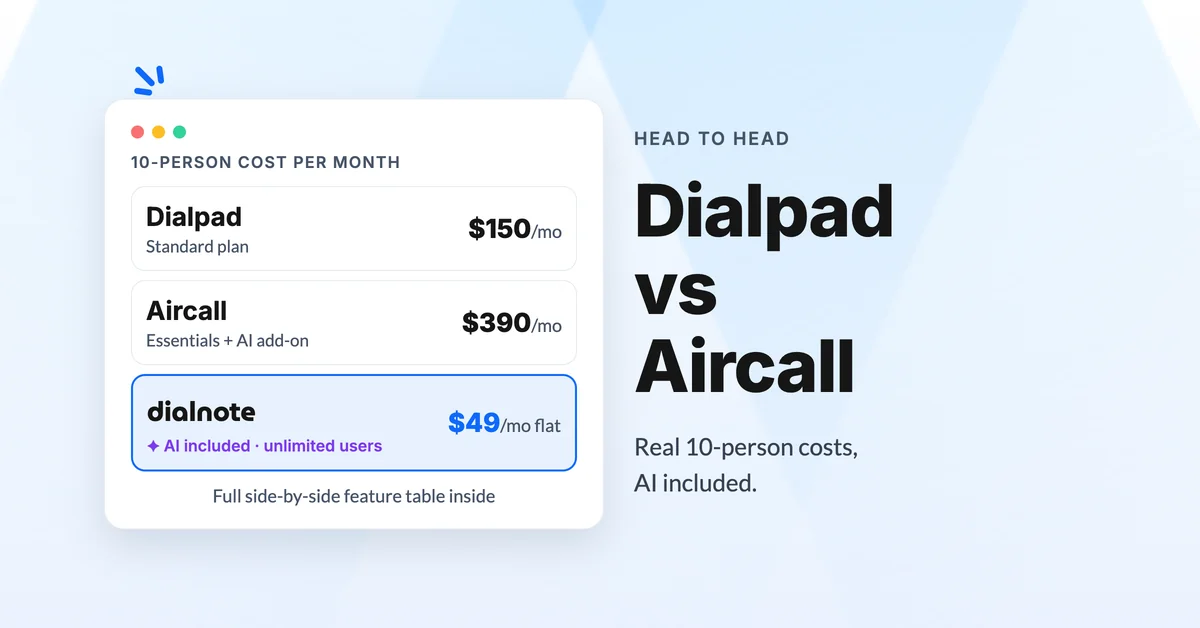
Dialpad vs Aircall: Which Phone System Wins?
Compare Dialpad vs Aircall on pricing, AI features, and real user reviews. Find out which business phone system best fits your growing team.
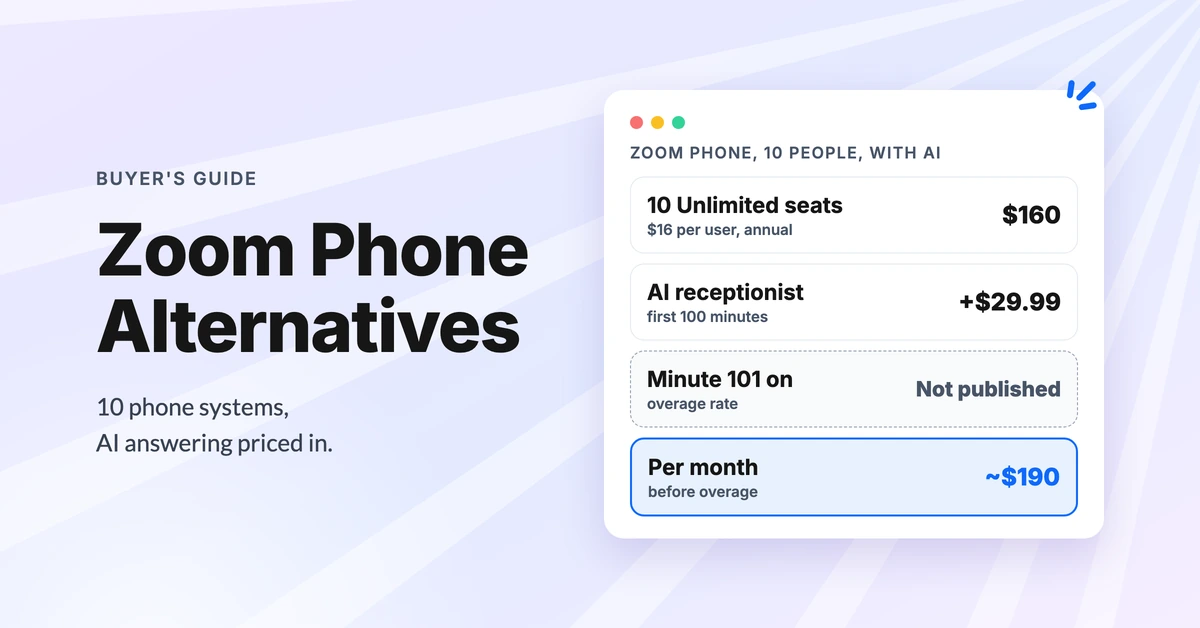
Best Zoom Phone Alternatives, Priced for a Real Team
Compare 10 Zoom Phone alternatives on what 3, 10, and 15 people pay once AI answering is added, using Zoom's live October 2026 prices. See the math.
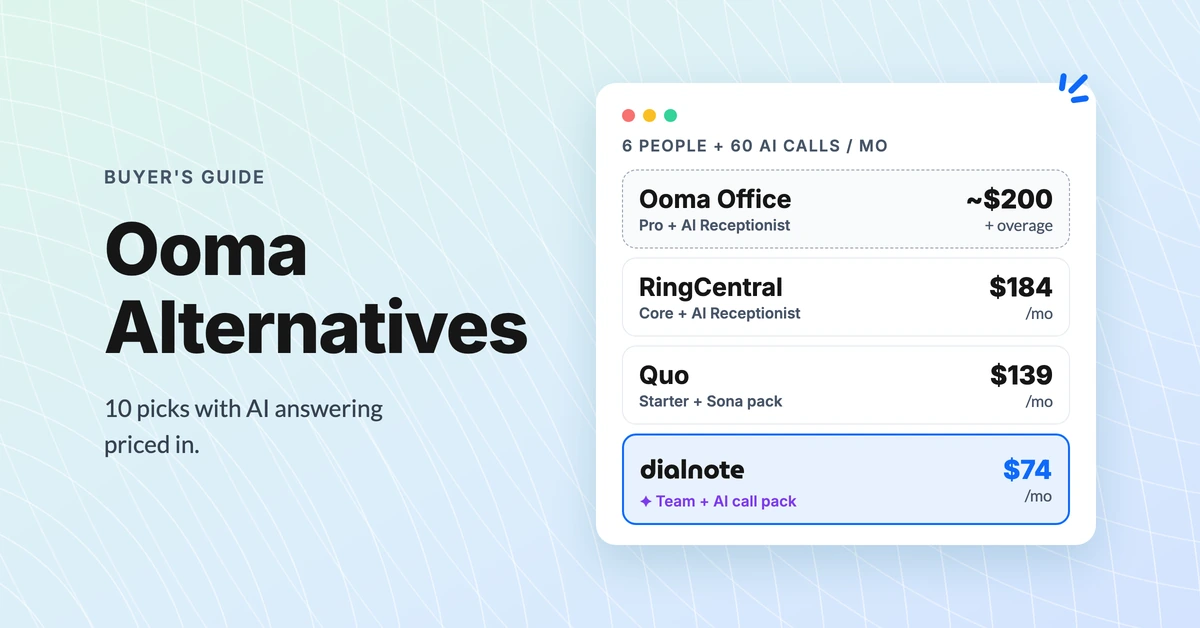
Ooma Alternatives: 10 Picks With AI Answering Priced In
Compare 10 Ooma alternatives by true team cost with AI answering, see which keep desk phones, and find out when staying on Ooma Office makes sense.