Answering Service vs Voicemail: Which Wins for Business?
A caller finds your number, taps it, and hears your voicemail greeting. Four seconds of "please leave a message after the tone" later, they've hung up and they're already dialing the next business on Google. That one moment is the whole answering service vs voicemail debate: voicemail didn't fail to record a message. It failed to keep the caller.
The honest version of this comparison isn't a two-way fight, either. It's a three-way one: voicemail (free, but most callers hang up on it), a human answering service (picks up live, but costs real money and mostly takes messages), and AI answering (picks up live, collects details, and books). Each wins on something. Only one loses on almost everything.
TL;DR:
- A Forbes piece from 2014 put it at 80% of callers sent to voicemail hanging up without leaving a message, so voicemail's real answer rate is near zero.
- A human answering service fixes the answer rate but runs $150 to $350+ a month at entry and usually just relays messages for you to call back.
- AI answering picks up 24/7, asks your intake questions, and books appointments during the call, at a fraction of live-service pricing.
- In our worked example, 20 after-hours clinic calls a month produce about $300 in booked revenue on voicemail vs $2,100 with AI answering. That's an $1,800 monthly gap.
Jump to: the head-to-head · do callers leave voicemails · what a human service costs · the lead math · the verdict
Answering service vs voicemail: the head-to-head
Strip away the marketing and five things decide this comparison: whether the call gets answered, how the caller feels, whether you get usable lead details, what it costs, and how much work setup takes.
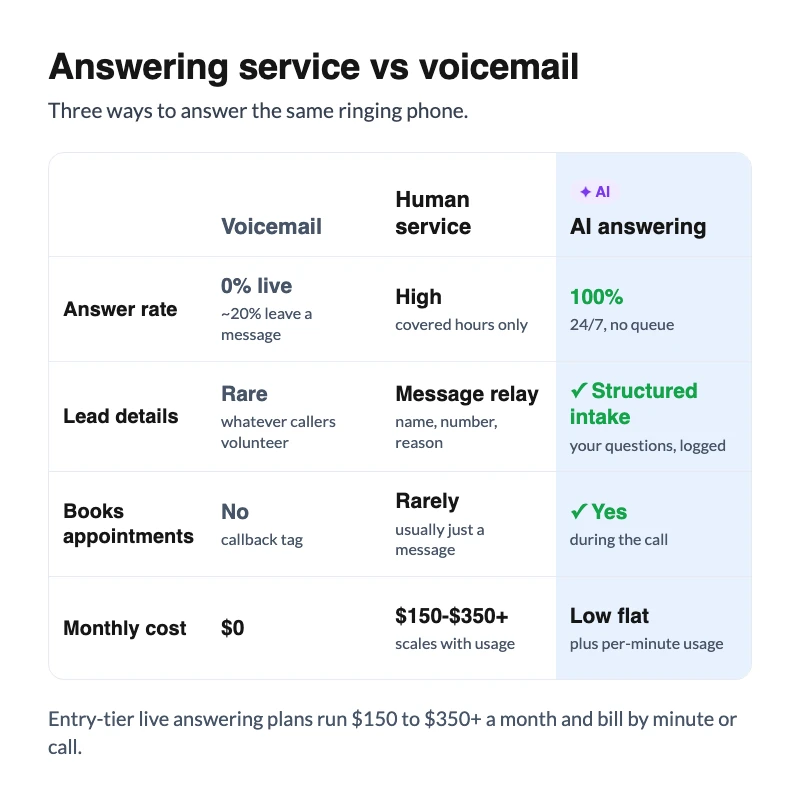
| What matters | Voicemail | Human answering service | AI answering |
|---|---|---|---|
| Answer rate | 0% answered live; ~20% leave a message | High during covered hours; queues at peak | Every call, 24/7, no queue |
| Caller experience | A greeting and a beep | A real person, warm but often script-bound | Natural conversation; a few callers still prefer humans |
| Lead capture | Whatever the caller volunteers | Name, number, reason (message relay) | Structured answers to the questions you set |
| Booking | No; you call back and hope | Rare at entry tiers; usually a message | Books into your calendar during the call |
| Cost per month | $0 | $150-$350+ at entry, scales with usage | Low flat plans plus per-minute usage |
| Setup effort | None | Onboarding call, scripts, per-change emails | An afternoon of self-serve setup |
Voicemail wins exactly one row: cost. But "free" only counts if it does the job, and the job here is keeping a caller who's ready to spend money. On that job, voicemail's numbers are grim enough to deserve their own section.
Do callers leave voicemails? Mostly, no
Here's the stat that should change how you think about your greeting: a Forbes piece from 2014 put it at 80% of callers sent to voicemail not leaving a message, largely because they don't believe it'll be heard. Four out of five potential customers hit your greeting and vanish without a trace.
And it's not just that they skip the message. A 411 Locals study of 85 small businesses found only 37.8% of calls got answered by a live person at all; the rest went to voicemail or rang out. Stack the two stats and the funnel looks brutal: most calls never reach a human, and most of those callers leave nothing behind. We break down the full picture in our missed call statistics roundup.

The generational trend makes it worse every year. A 2026 NumberBarn survey found only 12% of Gen Z leave a voicemail when a call goes unanswered; 53% send a text instead. SellCell's voicemail research shows the same pattern across age groups: younger callers treat voicemail as a dead channel, not a slow one.
Why do callers bail so fast? Because a voicemail greeting answers the question they were really asking: "is anyone there to help me right now?" The greeting says no. And the next business that might say yes is one tap away.
What a human answering service actually does (and costs)
A live answering service puts a trained human on your line: they greet callers in your business name, take down the caller's name, number, and reason, and relay the message to you by text or email. Entry plans generally run $150 to $350 a month and bill by the minute or per call, which means the bill climbs with your call volume. We tore down the real 2026 rates, hidden fees, and per-minute math in our answering service cost guide, so we won't rebuild those tables here.
Fair is fair: a good live service genuinely beats both alternatives in a few spots. A distressed caller, a grieving family calling a funeral home, an angry customer who needs to feel heard: a skilled human handles empathy-heavy calls better than any greeting or AI agent. Some callers simply relax when a person picks up.
But notice what most entry-tier live services don't do: they don't book the appointment, they don't answer detailed questions about your business, and they can't check your calendar. You get a message, faster and warmer than a voicemail, and then you're back to callback tag. The full AI receptionist vs live answering service comparison goes deeper on that gap.
So the real question isn't whether a human service beats voicemail. It does, easily. The question is whether "a nicer way to take a message" is worth $250 a month when software can take the message and finish the job.
The lead math: 20 after-hours calls, three ways
Time for actual numbers. Meet Dana, who runs the front desk at an 8-person dental clinic. Her team answers well during office hours, but between 6 PM and 8 AM the line is on its own. Twenty calls a month land in that window. What are those 20 calls worth? That depends entirely on what answers them.
Our assumptions, stated up front so you can swap in your own:
- 20 after-hours calls a month. 10 are new patients calling around town (a booked first visit averages $300); 10 are existing patients with reschedules and questions.
- Voicemail behavior follows the stats above: about 20% leave a message.
- The live service is a $250/month entry plan that takes messages; Dana's team calls back next morning. The AI plan costs about $74 a month all-in at this volume: the $49 Team plan plus one $25 AI call pack, which covers all 20 calls.
- New patients who don't get booked overnight often book elsewhere by morning, so callbacks convert worse than live answers.
| 20 after-hours calls/month | Voicemail | Human answering service | AI answering |
|---|---|---|---|
| Calls answered | 0 (0%) | 18 (90%) | 20 (100%) |
| Caller details captured | 4 messages (20%) | 18 (90%) | 19 (95%) |
| New patients booked (of 10) | 1, via callback tag | 5, via next-morning callbacks | 7, booked during the call |
| Booked revenue | $300 | $1,500 | $2,100 |
| Monthly cost | $0 | $250 | ~$74 |
| Net new revenue | $300 | $1,250 | ~$2,026 |

Read that bottom row again. The gap between voicemail and AI answering is roughly $1,800 a month, over $21,000 a year, from the same 20 calls Dana's clinic was already getting. The human service closes most of the answer-rate gap but gives back revenue in the callback race: a new patient with a toothache at 9 PM doesn't wait politely for a 9 AM return call.
Your numbers will differ. A plumber's after-hours calls skew emergency (higher value, faster to book elsewhere); a law office's skew intake (fewer calls, much bigger cases). Run your own version with your call log and your average job value; the after-hours answering service guide walks through how to pull those numbers.
The verdict: voicemail is where leads go to die
Here's our strong opinion, and we'll stand behind it: voicemail is not a budget answering option. It's a polite way to lose the call. When 4 out of 5 callers hang up on your greeting, "free" voicemail is quietly the most expensive option on the table, because it's the only one that converts almost nothing.
So the real decision in 2026 isn't answering service vs voicemail. It's which kind of answering: human or AI. Pick human if your calls are emotionally heavy and your volume is low enough that per-minute billing doesn't sting. Pick AI if your callers mostly want answers, appointments, and a fast response at 9 PM, which describes most service businesses we talk to.
Keep voicemail as the last-resort fallback behind whichever you choose. Just stop treating it as the plan.
Where dialnote fits
dialnote is the AI business phone system priced for your whole team: shared numbers, call routing, branded AI voice agents that answer, qualify, and book, and automatic CRM sync, all included, with no per-user cost. When a call comes in after hours (or any time you can't pick up), the AI agent answers in a natural voice, asks the intake questions you set under "Details to collect from callers," and logs every answer to the call record.
It can also act, not just listen: during the call it can check your calendar and book a meeting through your Calendly or Cal.com link, send the caller an SMS with details, or transfer to a teammate when a human needs to take over. After the call, the conversation syncs to your connected CRM automatically.
Two honest notes: the AI receptionist comes with the Team plan at $49/mo and up, and AI calls are $25/mo for 65 calls with the AI call pack, or $0.49 per minute from a prepaid wallet without one, so heavy call volume is a real line item. Even so, at Dana's 20 calls a month one pack covers everything and the all-in cost lands near $74, against $250+ for a live service that can't book.
The 10-day free trial, no credit card needed, is the cheapest way to settle this comparison for your own business: set up the agent in an afternoon, let it catch your after-hours calls for a week, then count the booked appointments that used to be hang-ups.
Replace your voicemail with an answer
10-day free trial, no credit card needed.
One recovered caller usually covers the month. Twenty of them, as Dana's math shows, covers a lot more than that.
Frequently asked questions
Mostly no. Around 80% of callers sent to voicemail hang up without leaving a message, and among Gen Z only about 12% leave one. For a business, a voicemail greeting works more like a hang-up prompt than a message-taking tool.
Yes, for lead capture. Voicemail is free but most callers hang up on it. An answering service (human or AI) picks up live, so the caller talks to someone instead of a greeting. The trade-off is cost: live services run $150-$350+ a month, AI plans much less.
Three common ones: a human answering service (live agents take messages), an AI answering service (answers 24/7, collects caller details, books appointments), and call forwarding to a team or on-call phone. Most small businesses combine forwarding with AI as the backstop.
Voicemail is free with any phone plan. Live answering services typically start around $150-$350 a month and scale with minutes or calls. AI answering runs far less; dialnote bundles it into a flat-rate phone system with plans from $49/mo, plus AI calls from $25/mo for 65 with the AI call pack.
Yes. dialnote's AI agent can check your calendar and book a meeting through Calendly or Cal.com during the call, send an SMS follow-up, or transfer to a teammate. It also asks the intake questions you set and logs every answer, so no lead leaves as a mystery.

Written by
Upasana Sahu
Senior Digital Marketing Specialist, SmartReach.io
Upasana Sahu is a Senior Digital Marketing Specialist at SmartReach.io with over 10 years of experience in content marketing, SEO, and digital strategy. She manages end-to-end blog operations, from content creation and on-page/off-page SEO to traffic...
Upasana Sahu is a Senior Digital Marketing Specialist at SmartReach.io with over 10 years of experience in content marketing, SEO, and digital strategy. She manages end-to-end blog operations, from content creation and on-page/off-page SEO to traffic...
Related Articles

How Much Does an Answering Service Cost in 2026?
See what an answering service costs in 2026: per-minute live rates, per-call plans, hidden fees, and the flat-rate AI math at real call volumes.
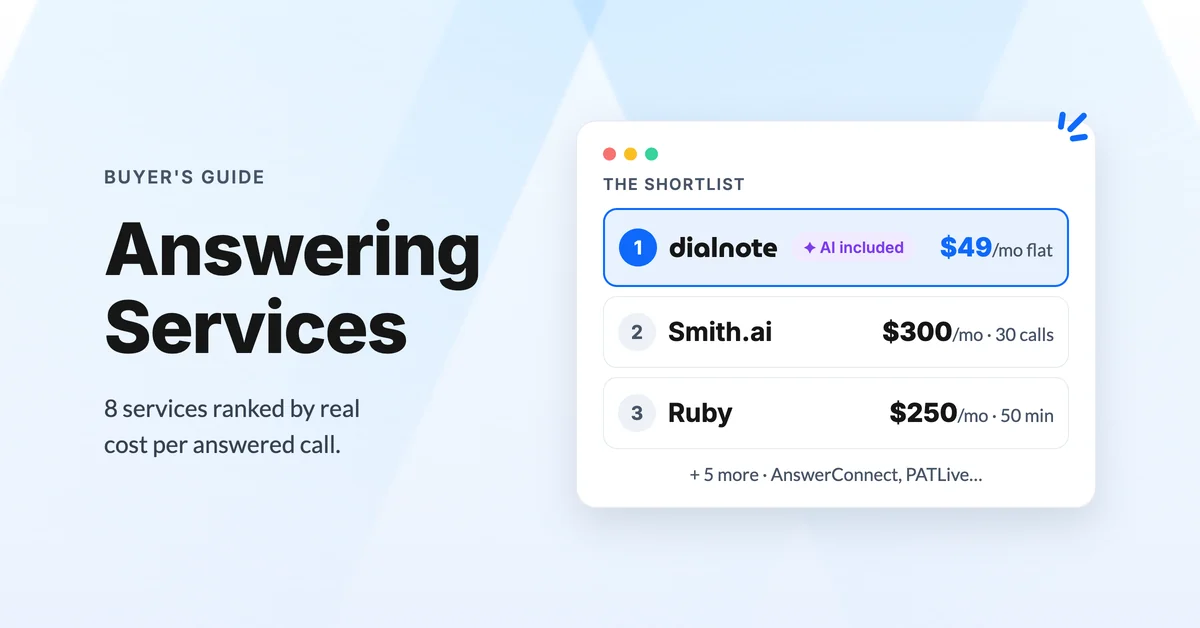
Best Answering Service for Small Business [2026]
Compare the best answering services for small business in 2026: live, AI, and hybrid options ranked by real cost per call and coverage.
Is an AI Receptionist Better Than a Live Answering Service?
Compare an AI receptionist vs live answering service on cost, quality, and 24/7 coverage. See which option fits your business better.