How to get a vanity phone number (and what it costs)
A number people can remember is a number people actually call. That's the whole pitch for a vanity number, and learning how to get a vanity phone number is easier than most sellers make it look: you pick a word, choose local or toll-free, and search for one that's free.
Below is the full process, what each route costs, and an honest take on when a word number is worth it.
TL;DR:
- A vanity phone number spells a word with the letters on a phone keypad, like 1-800-FLOWERS.
- Partial-word numbers, where only the last 3 or 4 digits spell something, are far easier to find than full words.
- To get one, pick a few short words, decide between local and toll-free, search, check that the number can text, then claim it.
- Your phone provider's own number search is usually the cheapest route. Marketplaces charge more for popular words.
- Under FCC rules, no private party can legally sell you a toll-free number for a fee. Sellers charge for setup and service instead.
What is a vanity phone number?
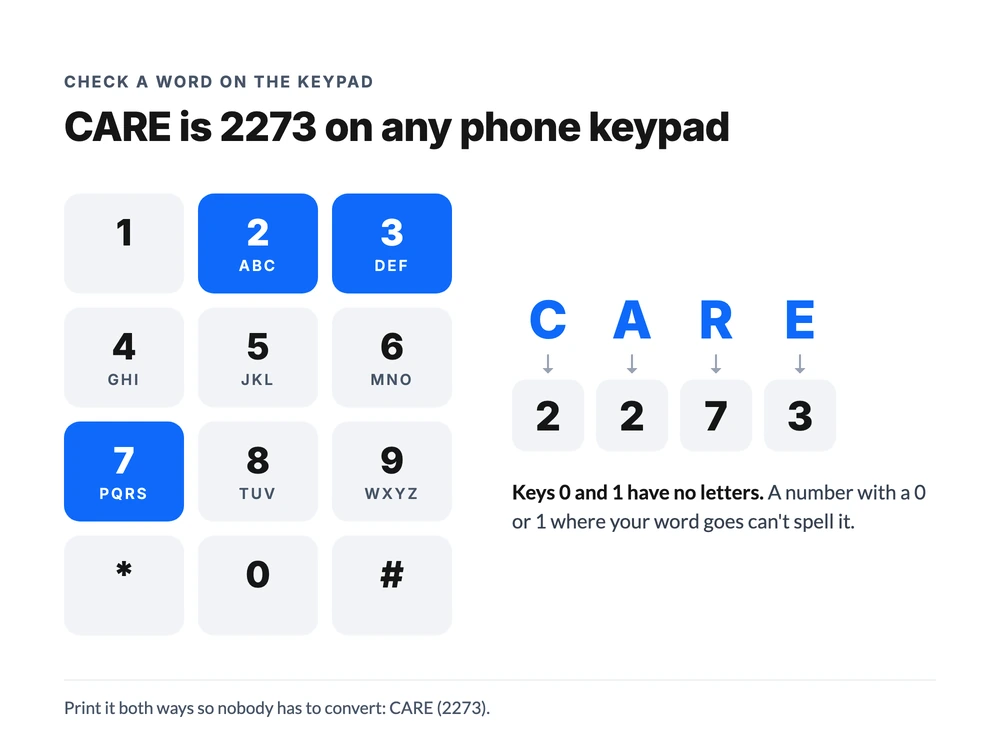
A vanity phone number is a regular phone number whose digits spell a word, name or phrase when you match them to the letters on a phone keypad. "CARE" is 2273. "PLUMBER" is 758-6237.
The number works exactly like any other one. The difference is that people can remember it.
Here's the keypad map you'll use to check any word:
| Key | Letters |
|---|---|
| 2 | A B C |
| 3 | D E F |
| 4 | G H I |
| 5 | J K L |
| 6 | M N O |
| 7 | P Q R S |
| 8 | T U V |
| 9 | W X Y Z |
Keys 0 and 1 have no letters. So any number with a 0 or 1 in the digits you want to spell can't be a word there. Every letter has to land on a 2 through 9.
Full-word vs partial vanity numbers
There are three kinds of vanity phone numbers for business, and which one you aim for decides how hard your search will be:
- Full-word numbers. All seven digits after the area code or the 800 prefix spell something, like 1-800-FLOWERS. These are rare, and the good ones were taken decades ago.
- Partial-word numbers. Only the last four digits spell a word, like a local number ending in CARE or HELP. These are much easier to find, and for most small businesses they do the same job.
- Pattern numbers. No word at all, just digits that are easy to remember: repeating numbers like 4000 or 7777, or the year you opened. Plenty of people forget this option.
Most famous vanity numbers are toll-free, because the prefix (800, 888, 877 and so on) is the same across the country. That's why a toll-free vanity number suits national ads. Local vanity numbers carry an area code, which tells callers you're nearby. If you're not sure which fits, our guide to local vs toll-free numbers walks through the tradeoff.
Here's the quick version for vanity numbers specifically:
| Local vanity number | Toll-free vanity number | |
|---|---|---|
| What callers see | Your area code, so you look nearby | An 8XX prefix, so you look national |
| How easy to find | Easier for short words, since each area code has its own pool | Harder, because every business in the country searches the same pool |
| Best for | Trades, clinics, salons and offices that serve one area | Businesses that sell across the country or run national ads |
| Texting | Needs A2P 10DLC registration in the US | Needs toll-free verification |
If you serve one town, start local. A number with your area code and a short word at the end is easier to get, and it tells callers you're down the road, not in a call center three states away.
How to pick a vanity word callers will remember
The word matters more than the number. A good one passes four tests:
- It's short. Three to five letters is the easiest to find and the easiest to remember. Every extra letter shrinks the pool of numbers that can spell it, and a seven-letter word has to fill every digit after the area code.
- It's spelled only one way. If a caller hears your word on the radio, will they type it the way you do? Skip words with common misspellings, and skip swaps like 4 for FOR. People hear "for" and dial F-O-R, which is 367, not 4.
- It survives being said out loud. Say your number the way a radio host would. If you have to spell the word to make it clear, pick another one.
- It says what you do or what callers get. Service words like PIPE, ROOF or TOW tell people what you do. Benefit words like CARE, HELP or FAST tell them how it'll feel. Your business name only works if people already know it.
Two more checks before you commit. First, read the digits on their own, then read every other word they spell. The same digits can spell more than one word, and you don't want the other one on the side of your van.
Second, if the word is another company's brand name, pick a different one. It confuses callers who meant to reach them, and it's an easy way to get a trademark complaint.
Here's where we're less sure: we haven't seen solid data on whether service words beat benefit words. Our hunch is that service words win on trucks and signs, where people have a second to read, and benefit words win on radio, where the feeling sticks better than the job.
Vanity number ideas by industry
Need a starting list? These are short words that fit the last three to five digits of a number. The digits are worked out for you, so you can type them straight into a search:
| Industry | Word ideas | Digits |
|---|---|---|
| Plumbing | PIPE, LEAK, DRAIN | 7473, 5325, 37246 |
| Heating and cooling | HEAT, COOL, HVAC | 4328, 2665, 4822 |
| Dental | SMILE, TEETH | 76453, 83384 |
| Law | LAW, LEGAL | 529, 53425 |
| Cleaning | CLEAN, MAID | 25326, 6243 |
| Roofing | ROOF | 7663 |
| Towing | TOW | 869 |
| Lawn and tree care | LAWN, TREE | 5296, 8733 |
| Pest control | PEST, BUGS | 7378, 2847 |
| Real estate | HOME, SOLD | 4663, 7653 |
| Salon | HAIR, NAILS | 4247, 62457 |
| Auto repair | AUTO, TIRE | 2886, 8473 |
| Pet care | PETS, PAWS, VET | 7387, 7297, 838 |
| Moving and junk removal | MOVE, JUNK | 6683, 5865 |
Four letters fit neatly into the last four digits of a number. A five-letter word like DRAIN or SMILE spills into the middle three digits, which makes it harder to find and harder to print cleanly. Three-letter words are the easiest of all: they can sit in the last four digits with one spare, or in the middle three.
How to get a vanity phone number in 6 steps
- List five to ten words. Your business name, your service (FIX, CLEAN, LAW, DENTAL) or a benefit (CARE, HELP, FAST). Three to seven letters is the sweet spot. Shorter words match more numbers.
- Check each word against the keypad. Write out the digits. If two of your words turn into the same digits, that's a bonus: either spelling works.
- Decide local or toll-free. Local if your customers are in one city or region. Toll-free if you sell across the country and want one number for everyone.
- Search for available numbers. Start with the number search in your phone provider. Most let you type letters as well as digits. If nothing comes up, try another prefix (888 or 877 instead of 800), a shorter word, or a nearby area code.
- Check what the number can do. Not every number supports texting. If you'll text customers, check the number's capabilities before you buy, and plan for registration: US local numbers need A2P 10DLC registration to send texts, and toll-free numbers need toll-free verification.
- Claim it and print it both ways. Once it's yours, list it as letters and digits, with the word followed by its digits: "CARE (2273)." Some callers dial from a keypad with tiny letters, and some just won't bother converting.
The step people skip is the last one. Why make every caller do the conversion work? A word number with no digits next to it does exactly that, and some callers won't bother.
How much does a vanity number cost?
There's no single price, because it depends on where the number comes from. Here's how the three routes compare:
| Route | What you pay | Good for |
|---|---|---|
| Your phone provider's number search | Usually the same as any number on your plan | Partial words and short words |
| A vanity number marketplace | A setup fee plus a monthly plan; popular words cost more | Specific full words |
| A broker reselling a toll-free number | Not allowed under FCC rules | Nothing. Skip it |
Marketplaces don't publish one flat vanity price, because each seller prices popular words one by one. NumberBarn's pricing page, for example, lists a one-time setup fee without a figure, then monthly plans from $2.99 to park a number up to $19.99 for unlimited call forwarding. Phone providers that offer vanity search usually charge their normal extra-number fee. Grasshopper, for one, charges $10 a month for each extra number ($9 on annual billing).
On toll-free numbers, one rule saves people money. Under the FCC's rule on hoarding and brokering, a private party can't sell a toll-free number for a fee. So when a site seems to be selling you an 800 word number outright, what you're really paying for is setup and service on it. That's not always a bad deal, but you should know which one you're buying.
Can you keep a vanity number if you switch providers?
Usually, yes. In the US, both local and toll-free numbers are portable, which means you can move a number to a new phone provider and keep every digit. That matters more for a vanity number than for any other, because the number itself is the part you paid for and printed everywhere.
To move one without losing it:
- Don't cancel your old service first. If the account closes before the move finishes, the number can be released, and someone else can claim it.
- Get your account details from the old provider. You'll usually need the account number, a transfer PIN, and the name and address on the account, exactly as the old provider has them.
- Start the move with the new provider. They send the request to the old one. Your number keeps working where it is until the move is done.
- Test it once it's live. Call it, text it, and check that it rings the right people before you switch anything else off.
One caveat for numbers from a marketplace. If you rent the number on a monthly plan, read the terms on moving it out, and whether there's a fee, before you print it on anything. It's a lot easier to check now than after the truck wrap is done.
Vanity number mistakes to avoid
Most of these are cheap to avoid and expensive to fix after the ad runs:
- Printing only the letters. It's the most common one. Always add the digits: "CARE (2273)."
- Words with O or I in a hard spot. O looks like zero and I looks like one, and neither 0 nor 1 has letters. Some callers will dial the digit they think they see. Printing the digits next to the word fixes it.
- Words longer than the number. An eight-letter word needs eight digits. Most phones ignore the extra key, but callers don't know that, and some will stop and wonder whether they've misdialed. Stay at seven letters or fewer.
- Paying for a full word you don't need. A number ending in a four-letter word does nearly the same job as a full seven-letter word for a local business, at a fraction of the effort.
- Forgetting about texting. If customers text you, check the number's capabilities before you buy, not after the cards are printed.
- Letting the plan lapse. A rented number you stop paying for can go back into circulation. Put renewals on autopay, and keep the account in the business's name rather than one employee's.
How to search for a vanity number by word
If you'd rather not pay a marketplace, start with your provider's search. In dialnote, an AI business phone system for small teams, the number search accepts a word as well as digits, so you can look for a partial vanity number in a few seconds. It's a search over numbers that are available right now, not a store of premium words.
You can try it before signing up. On the phone numbers page, pick a country, choose local or toll-free, and type a word like CARE into the search box. Matching numbers show the letters above the digits they map to. Pick one and it carries straight into signup (trials can claim US and Canadian local numbers).
Inside the app, it's the same search:
- Go to Settings, then Phone Numbers, and click Add New Number.
- Click See more numbers to search yourself instead of taking the suggested number.
- Pick a country and number type. For the US and Canada, you can narrow by state or province and area code.
- Type your word into the search box. Results refresh as you type.
- Check the Call, SMS and MMS badges, then click Confirm Purchase. Verify your email and mobile number if you're asked to.
Word search works for local and toll-free numbers in the US and Canada, and for numbers in the UK and France.
Every plan includes one to five numbers, and extra numbers are $5 a month in the US and Canada. Trial accounts can pick US and Canadian local numbers. Toll-free and other countries open up on a paid plan.
Already have a vanity number with another provider? You can port US and Canadian numbers in, and the number keeps working on your old carrier until the move is done. The getting numbers docs cover the rest.
How to tell if your vanity number is working
A vanity number is an ad expense, so judge it the way you'd judge an ad. Three habits make that easy:
- Give it one job. Put the vanity number only on the ad, truck or sign it was bought for, and keep your main number everywhere else. Then every call to it came from that one place.
- Count calls before and after. Compare a month of calls on that line against the month before the ad ran. A single good week tells you very little.
- Ask new callers how they found you. It takes five seconds at the end of a call, and it catches the people who saw the truck and then searched for you instead.
Marcus, who runs a six-person plumbing company, tried this with a local number ending in PIPE (7473). He put it on his four vans and nowhere else. Calls on that line were easy to spot, so after a couple of months he could see which jobs it had brought in and whether they covered what the number cost him.
There's a catch, though. If the line rings and nobody picks up, the number isn't the problem. A memorable number that goes to voicemail just helps people remember who didn't answer.
Is a vanity number worth it?
Honestly? For a lot of businesses, no. If most customers find you through search, a map listing or a referral, they tap your number. They never type it, so they never see the word.
A business vanity number earns its keep when people have to remember your number without a screen in front of them: radio ads, truck wraps, billboards, a sign on the building. That's where a number that ends in CARE beats seven random digits.
Elena, a solo family-law attorney, was about to pay a marketplace for a full-word number to put on a local radio spot. She tried her provider's search first, typed LAW into her own area code, and found a local number ending in 529. It cost her nothing beyond her plan, and it was easier to say in a 15-second ad than the 800 number she'd been quoted for. If you want the wider picture of what kind of number fits your business, our guide to business phone number types covers local, toll-free and virtual numbers side by side.
So before you pay for one, run through a quick check. A vanity number is probably worth it if:
- People see your number away from a screen: on vans, yard signs, billboards or radio.
- You're running an ad where the number has to stick after a few seconds.
- You can get a short word with your own area code, or a clean toll-free match.
It's probably not worth it if most customers find you through search, maps or referrals, if the only word left is long or awkward, or if it would cost much more than a normal number for a word nobody will see.
Start with your shortest word. It's the one most likely to be available.
Find a number your customers will remember
10-day free trial, no credit card needed. Trials include US and Canadian local numbers.
Frequently asked questions
Yes. Any business can get one, local or toll-free. Most phone providers let you search available numbers for a word, and vanity marketplaces sell numbers that spell popular words. Short words of three or four letters are the easiest to find.
There's rarely a truly free one, but you can avoid paying extra. If your phone plan includes numbers, a number you find with a word search costs the same as any other number on that plan. Premium words from marketplaces are where the extra fees come in.
It depends on where you get it. A number from your provider's own search usually costs the same as any number, often a few dollars a month. Marketplaces add a setup fee plus a monthly plan, and popular words cost more because each seller prices them one by one.
Yes. Beyond words, you can search for digit patterns that are easy to remember, like repeating numbers or your street address. A number search that accepts digits and letters, such as 415 or CARE, will show what's available right now in each area code.

Written by
Upasana Sahu
Senior Digital Marketing Specialist, SmartReach.io
Upasana Sahu is a Senior Digital Marketing Specialist at SmartReach.io with over 10 years of experience in content marketing, SEO, and digital strategy. She manages end-to-end blog operations, from content creation and on-page/off-page SEO to traffic...
Upasana Sahu is a Senior Digital Marketing Specialist at SmartReach.io with over 10 years of experience in content marketing, SEO, and digital strategy. She manages end-to-end blog operations, from content creation and on-page/off-page SEO to traffic...
Related Articles
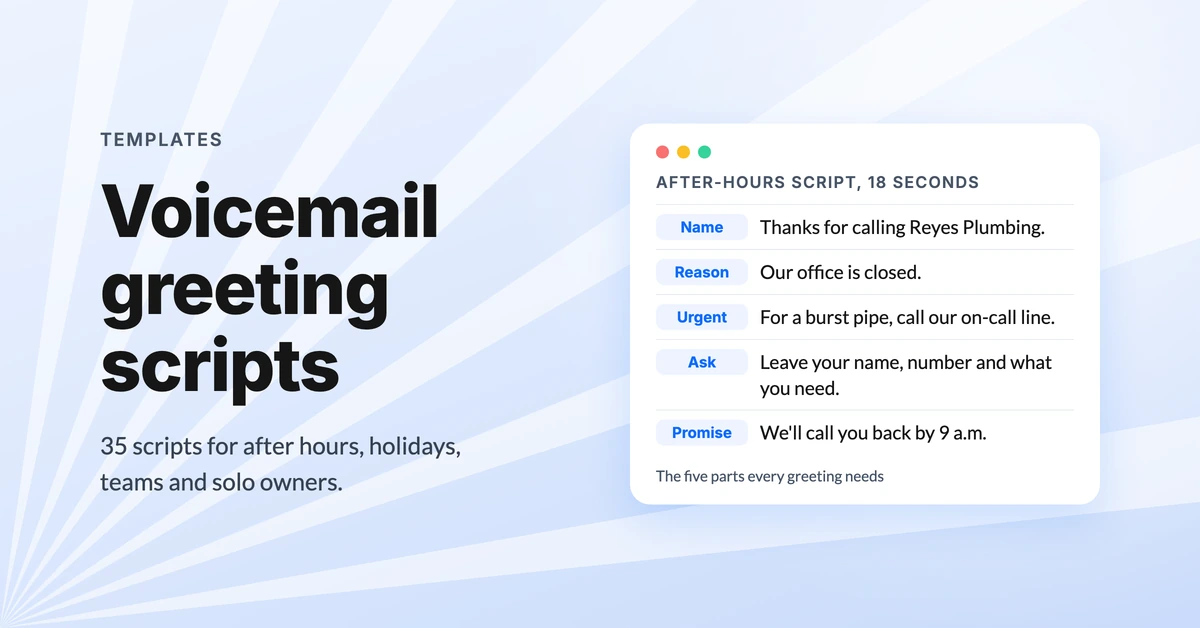
Business voicemail greeting examples (35 scripts)
Copy 35 business voicemail greeting examples for after hours, holidays, departments and small teams, plus what to say so callers leave a message.
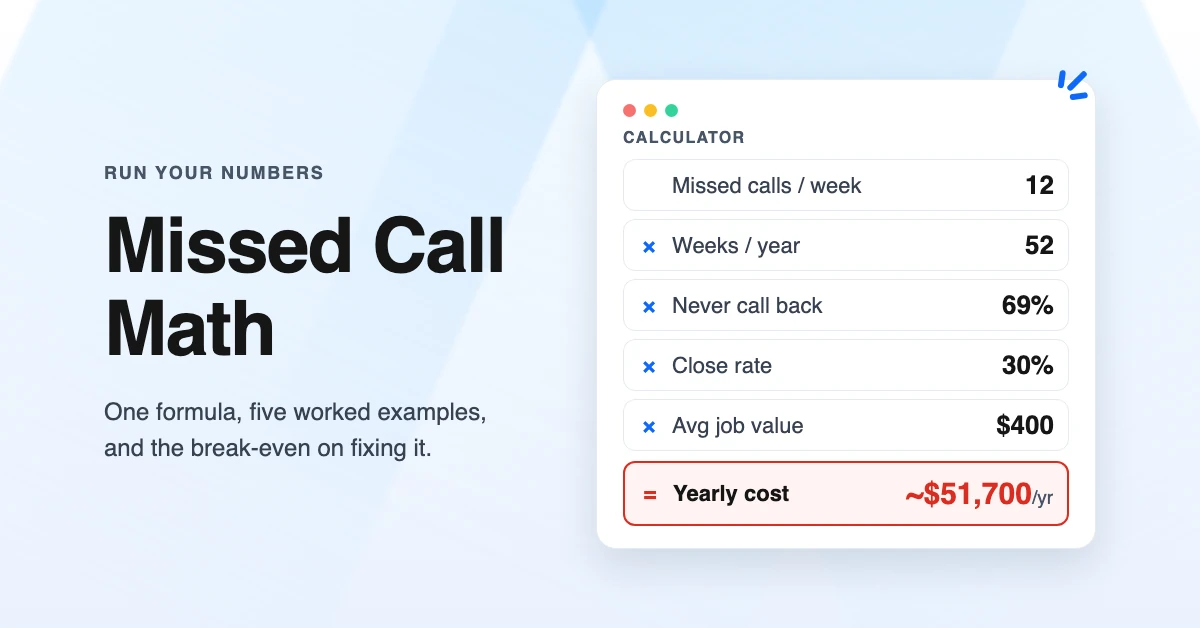
The Cost of Missed Calls: Calculator and Worked Examples
Calculate the cost of missed calls for your business with a simple formula, five worked examples by industry, and the break-even point for fixing it.
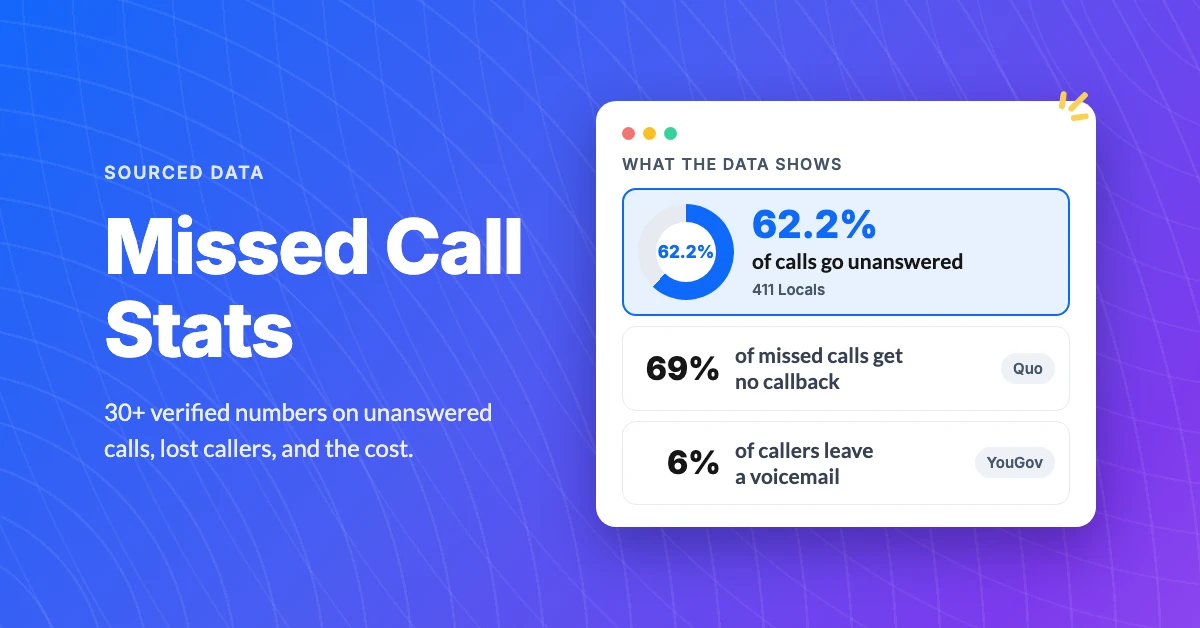
30+ Missed Call Statistics Small Businesses Need in 2026
See 30+ sourced missed call statistics for 2026: how many calls go unanswered, how few callers try again, and what that costs small businesses.