Local vs Toll-Free Numbers: Which Should Your Business Use?
Your phone number says more about your business than you might think.
When customers see a local area code, they assume you're nearby. A toll-free number? That signals a bigger, national operation. And here's the thing: both assumptions can work for you or against you, depending on who you're trying to reach.
So which should you pick? Local vs toll-free numbers isn't a one-size-fits-all decision. It depends on your customers, your sales process, and honestly, what kind of business you want to appear to be.
TL;DR:
- Local vs toll-free numbers comes down to your customers, not which one is "better": local numbers win for nearby audiences and outbound calls, while toll-free fits national reach and inbound support.
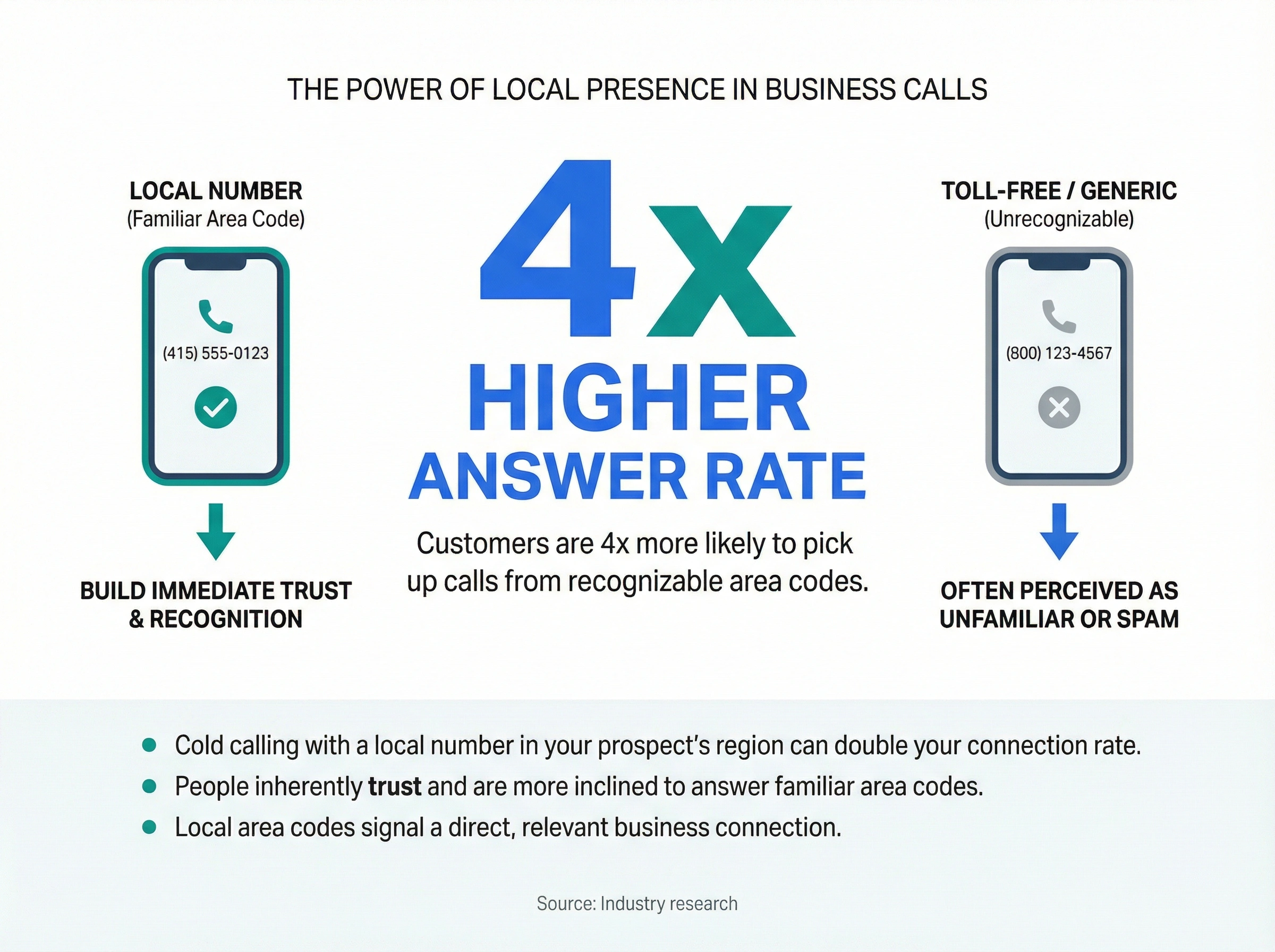
- Local numbers get up to 4x higher answer rates because people trust a recognizable area code, and they cost less to run.
- Toll-free numbers (800, 888, 877, and similar prefixes) project a national, professional image and let customers call for free, but you pay per inbound minute, sometimes $500 to $1000 a month at high volume.
- Toll-free numbers can hurt outbound calling because many people mistake them for spam, so use local numbers when you're the one dialing out.
- Both types support business texting after a one-time registration (A2P 10DLC for local, verification for toll-free), and both port to a new provider whenever you switch.
- Many businesses use both: toll-free for the website and national ads, local numbers for regional marketing and Google Business listings.
The real-world difference most people miss
An area code sets expectations before anyone picks up. A local code reads as "we're nearby." A toll-free prefix reads as "we're a company." Every other trade-off in this decision flows from that split-second judgment.
Amy runs a home cleaning service in Denver. She started with a toll-free number because it seemed more professional. But her answer rates were terrible. People kept ignoring her calls.
Then she switched to a 303 area code. Answer rates jumped by 4x overnight.
Why? Because her customers are local. They want someone nearby. A toll-free number made her look like a national call center, not the neighborhood business they were searching for.
Now flip the scenario. A SaaS company selling to businesses across the country would look odd with a single local number. Their customers expect a toll-free line that screams "we're big enough to handle your business."
Same phone system feature. Completely different results.
Local numbers: when they work best
Local numbers work best when your customers live in one region and your team makes outbound calls. They're cheaper to run, they support your local search presence, and people actually answer them.
A local number ties your business to a specific area code. Think 212 for New York, 415 for San Francisco, or 312 for Chicago.
What you get:
- Higher answer rates for outbound calls. Studies suggest customers are up to 4x more likely to pick up calls from recognizable area codes. Cold calling with a local number in your prospect's region can roughly double your connection rate.
-
Community trust. For businesses that serve a specific geographic area, a local number signals "I'm part of your neighborhood." That matters a lot for service businesses, restaurants, and local retail.
-
Lower cost. Local numbers are cheaper to maintain than toll-free options. You typically pay nothing for incoming calls, and outgoing rates are minimal.
-
Better local SEO. Google prioritizes businesses with local phone numbers in local search results. A Seattle plumber with a 206 number ranks higher in "Seattle plumber" searches than one with an 800 number.
Best for:
- Local service businesses (plumbers, cleaners, restaurants)
- Regional companies wanting presence in multiple markets
- Sales teams making outbound calls to specific regions
- Any business where a neighborhood feel matters
Toll-free numbers: when they make sense
Toll-free numbers make sense when you serve customers nationwide and want inbound calls to cost the caller nothing. You pick up the per-minute charge in exchange for an open door.
Toll-free numbers use prefixes like 800, 888, 877, 866, 855, 844, or 833. The FCC's toll-free guide explains how they're assigned, but the feature that matters is simple: callers don't pay for the call. You do.
What you get:
-
Professional image. A toll-free number makes even a small company look established. Most U.S. consumers associate toll-free numbers with credible, professional businesses.
-
No barrier to calling. When customers know the call won't cost them anything, more of them pick up the phone. This matters for customer support lines where you want to encourage people to call.
-
National reach. A toll-free number signals that you operate beyond a single city. For e-commerce companies or any business serving customers nationwide, this sets the right expectation.
-
Portability. Since toll-free numbers aren't tied to a physical location, you can move offices, change providers, or work remotely without ever changing your number.
One more flavor worth knowing: vanity numbers. These spell a word with the digits, like 1-800-FLOWERS. They're memorable in radio and podcast ads, and they cost more than a standard toll-free line. Worth it for national brands that advertise out loud. Overkill for everyone else.
Best for:
- Businesses serving customers nationwide
- Customer service and support lines
- E-commerce companies
- Any business where you want to encourage inbound calls
Do toll-free numbers hurt outbound calling?
Yes, toll-free numbers can hurt outbound calling. Many people mistake an 800-style number on caller ID for spam or telemarketing, so they let it ring. If your team dials customers for sales, reminders, or follow-ups, a local number gets answered far more often.
Here's something most guides won't tell you: this one factor quietly settles the debate for sales-heavy teams.
People have been burned by telemarketers and robocalls using 800 numbers. When a toll-free number shows up on caller ID, many won't answer. They assume it's spam. Carrier spam-likely labels pile onto the effect for numbers that dial out in high volume. We're not 100% sure how each carrier weighs its scoring (nobody outside the carriers is), but the pattern holds: unfamiliar toll-free numbers get ignored more than local ones.
Alex, a sales leader with a team of 12, learned this the expensive way. His reps dialed prospects across Texas from the company's 888 line, and connect rates sat in the single digits. He moved the team to Dallas and Houston numbers. Connects roughly doubled within a month. Same reps, same script, different caller ID.
So keep the toll-free line for inbound support, but use local numbers when you're the one dialing out.
How much do local and toll-free numbers cost?
Local numbers usually run $5 to $15 a month with free incoming calls. Toll-free numbers cost $10 to $25 a month plus a per-minute charge on every inbound call. The real gap shows up at high call volume, where toll-free minutes stack up fast.
Let's talk money, because that's often what drives the decision.
| Factor | Local Number | Toll-Free Number |
|---|---|---|
| Monthly fee | $5-15/month | $10-25/month |
| Incoming calls | Free | You pay per minute |
| Outgoing calls | Standard rates | Standard rates |
| Setup | Often free | Usually free |
| Premium options | Limited | Vanity numbers cost more |
The bigger cost difference comes from inbound call volume. If you receive hundreds of customer calls daily, those toll-free minutes add up. A business with high call volume might spend $500-1000/month just on inbound toll-free charges.
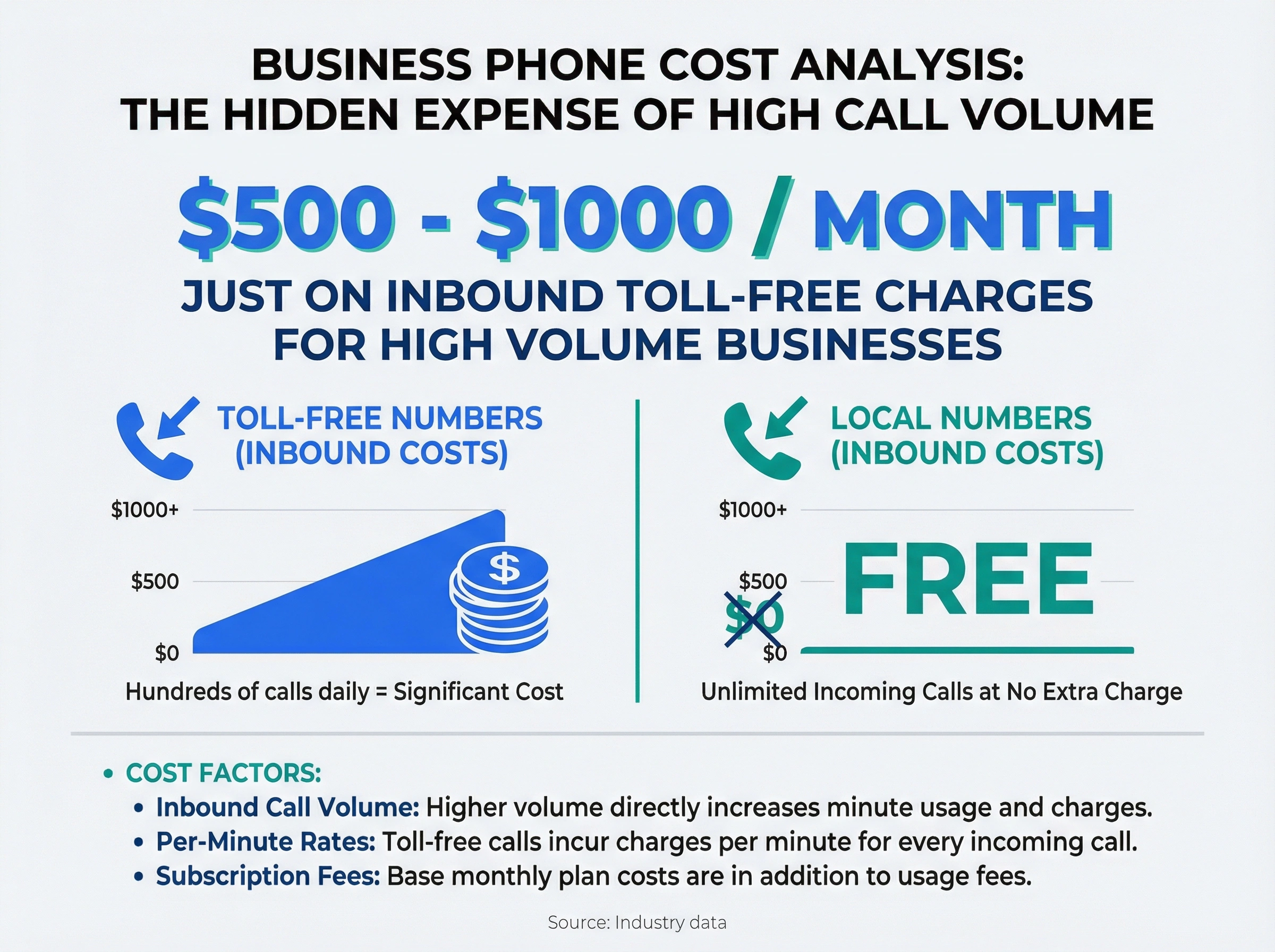
Run the math on your own volume before you commit. A support line taking 200 calls a day at four minutes each racks up roughly 24,000 inbound minutes a month, and on a toll-free line that lands you in that range fast. The same volume on a local number? Usually nothing extra.
For a business with mostly outbound calling, the cost difference is minimal. And flat-rate VoIP plans blur the line further, since many bundle generous calling minutes into one monthly price.
What about texting from your business number?
Both local and toll-free numbers can send business texts in the US after a one-time registration. Local numbers go through A2P 10DLC registration, while toll-free numbers go through toll-free verification.
Texting matters more than most number guides admit. Appointment reminders, quote follow-ups, "running 10 minutes late" notes: customers read texts quickly and reply to them more readily than to email or voicemail.
The registration step is where people trip. US carriers now filter business texts from unregistered numbers, so messages from an unverified line can silently vanish. Your provider handles the paperwork, but approval can take days. Sort it out the week you get the number, not the week you launch a campaign.
Which type texts "better"? Honestly, neither. Deliverability depends on registration and sending behavior, not the prefix. Pick your number for calling reasons, then register it for texting either way.
Can you use both a local and toll-free number?
Yes, and plenty of businesses do. A common setup pairs a toll-free number for the website and national ads with local numbers for regional marketing and Google Business listings. Both ring into the same phone system, so you get national credibility and neighborhood trust without picking a side.
Here's a secret from companies that have figured this out: you don't have to pick just one.
The hybrid approach:
- Display your toll-free number on your website, email signatures, and national advertising
- Use local numbers on Google Business listings and regional marketing
- Route inbound calls to the right team based on which number was dialed
This gives you the best of both worlds. Local trust for people searching "plumber near me." National credibility for your website visitors.
A real estate agency, for example, might have:
- A toll-free main line for general inquiries
- Local numbers in each market for community presence
- Virtual numbers for individual agents
All routing through the same phone system. Different numbers for different purposes.
Common mistakes when choosing a business number
The biggest mistake is picking a number for the image you want instead of the customers you have. The rest are operational slip-ups that are cheap to avoid and annoying to fix.
-
Inconsistent listings. Your Google Business profile, website, and directories should all show the same primary number. Mismatched listings confuse customers and weaken your local search presence.
-
Running the business on a personal cell. You can't set business hours, route calls to a teammate, or hand the number off when you hire. Separate the two early.
-
A vanity toll-free line for a one-location shop. You're paying a premium for national memorability your customers don't need.
-
Skipping texting registration. Unregistered business texts get filtered. Register the number the week you buy it.
Honestly? For most businesses under ten people, toll-free is overrated. Grab local numbers where your customers actually live, and add a toll-free line later if national demand shows up.
Local vs toll-free numbers: 3 questions to decide
Not sure which direction to go? Answer these:
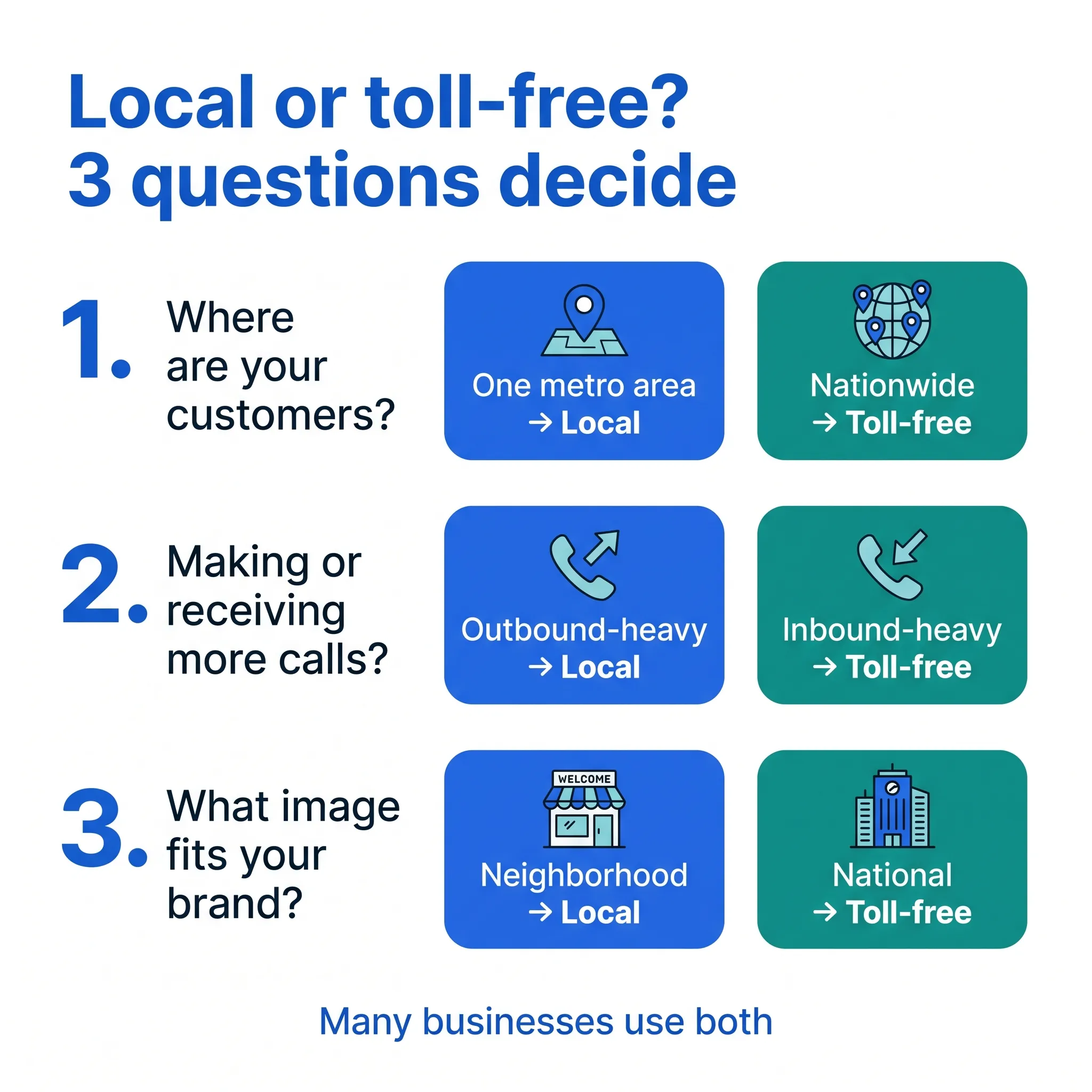
1. Where are your customers? If 80% of your business comes from one metro area, local numbers make sense. If you're serving a national audience, toll-free wins.
2. Are you making more calls or receiving them? Outbound-heavy? Local numbers get better answer rates. Inbound-heavy? Toll-free removes the cost barrier for customers.
3. What image are you projecting? A neighborhood bakery with an 800 number seems off. A nationwide software company with a single local number seems small. Match your number to your brand.
Setting up your business numbers
Once you've decided, getting numbers is straightforward with any modern VoIP phone system:
- Search available numbers in your chosen area code or toll-free prefix
- Select your number (or numbers, you can have multiple)
- Configure routing to determine where calls go
- Start receiving calls within minutes
The whole thing takes minutes, not weeks. No hardware, no site visit, no waiting on a phone company technician.
Can you keep your number if you switch providers?
Yes. In the US, providers are required to release your number when you move to a new carrier, and that applies to local and toll-free numbers alike. The process is called porting.
The FCC's porting rules protect you here, but a few practical habits save headaches:
- Don't cancel your old service first. A number has to be active to port. Cancel early and you can lose it for good.
- Gather your account details. The new provider needs your account number, the PIN on file, and your billing address exactly as the old carrier has them.
- Expect 1-2 weeks. Simple ports finish faster, but plan for up to two weeks. Your calls keep working the whole time.
- Port the number people know. If your local number sits on ten years of invoices and fridge magnets, that number is an asset. Take it with you.
This also removes the fear of picking wrong. Your numbers aren't married to a provider, so you can switch systems later without reprinting a single business card.
The bottom line
Local vs toll-free numbers isn't about which is "better." It's about which fits your business.
Local numbers build trust with nearby customers and get better answer rates for sales calls. Toll-free numbers project a professional, national image and encourage customers to call without hesitation.
Many smart businesses use both, matching the number type to the use case.
Ready to get your business numbers set up? dialnote offers local and toll-free business numbers in any area code and across all prefixes. Plans start at $19/mo flat, and every one comes with a 10-day free trial, no credit card needed. Start yours and see which combination works for your team.
Frequently asked questions
Local numbers have a geographic area code (like 212 for NYC). Toll-free numbers (800, 888, etc.) let customers call you for free. You pay for the incoming calls instead.
Local numbers work best for businesses serving a specific area. Customers are 4x more likely to answer calls from recognizable area codes, and local numbers cost less to maintain.
Yes. Toll-free numbers have higher monthly fees plus per-minute charges for incoming calls. High-volume businesses can spend $500-1000/month just on inbound toll-free charges.
Yes, many businesses use both. Display your toll-free number on your website for national reach, and local numbers on regional marketing and Google Business listings.
It depends on your audience. Most consumers see toll-free numbers as professional, but local customers often prefer calling a local number they recognize and trust.
Yes, once the number passes a one-time toll-free verification with US carriers. Local numbers need A2P 10DLC registration for business texting. Your provider handles both, so plan a few days for approval before your first campaign.

Written by
Lancelot Dsouza
Chief Marketing Officer, SmartReach.io
Lancelot Dsouza is the Chief Marketing Officer at SmartReach.io, where he built the Marketing, Sales, and Customer Success verticals from the ground up. With over 25 years of experience spanning digital marketing, business development, and strategic...
Lancelot Dsouza is the Chief Marketing Officer at SmartReach.io, where he built the Marketing, Sales, and Customer Success verticals from the ground up. With over 25 years of experience spanning digital marketing, business development, and strategic...
Related Articles
Business Phone Number Types: Local, Toll-Free & Virtual
Compare the four business phone number types (local, toll-free, vanity, and virtual), see what each costs, and pick the right one for your business.
How to Get a Business Phone Number Without a Landline
Learn how to get a business phone number without a landline in under 30 minutes. Compare VoIP, virtual, and mobile options for small businesses.
What Is a Virtual Phone Number? A Complete Guide
Learn what a virtual phone number is, how it works, what it costs, and how to get one in minutes. See why businesses save up to 75% on phone costs.