Business Phone Number Types: Local, Toll-Free & Virtual
Your business phone number is more than just a way for people to reach you. It's part of how customers judge your business before they ever speak to anyone.
Take Alex. He launched an HVAC company in Chicago, grabbed a free number from his carrier, and didn't think twice. The area code happened to be from Ohio. For months, he kept getting questions like "Are you actually local?" before customers would commit to a booking. One switch to a 312 Chicago number later, his conversion rate climbed and the skeptical questions stopped. The number was doing quiet damage he couldn't see.
Sound familiar? Picking a number based on what's available (rather than what's strategic) is a common early mistake. Knowing the four main business phone number types and when to use each helps you avoid it.
TL;DR:
- The four main business phone number types are local, toll-free, vanity, and virtual, and each one fits a different goal.
- Local numbers build neighborhood trust and can double outbound answer rates; toll-free numbers signal national reach and remove the call cost for the caller.
- Vanity numbers mostly pay off for businesses with heavy radio, TV, or billboard advertising; virtual numbers are the flexible default for remote and multi-market teams.
- Most businesses do best with a mix of number types, and you can port your existing number when you switch providers so callers never hit a dead end.
Local numbers
Local phone numbers are tied to a specific geographic area code. For example:
- 212-555-1234 (New York City)
- 310-555-5678 (Los Angeles)
- 312-555-9012 (Chicago)
What they are
A local number signals "I'm part of your neighborhood." For businesses serving specific regions, this builds immediate credibility before anyone picks up.
Benefits
Community trust
Customers are more likely to trust and call back a number they recognize as local. A Chicago-area business with a 312 number just feels more credible to Chicago customers than a generic toll-free line, even if both connect to the same team.
Higher answer rates
When making outbound calls, local numbers can double your answer rates. People are more likely to pick up a call from their own area code than an unknown toll-free number. Learn more in our local vs toll-free comparison guide.
Lower cost
Local numbers typically cost less to get and maintain than toll-free options.
Local presence for sales teams
Sales teams use local numbers strategically, not just one, but several. A rep based in Austin can show a Boston area code when calling Massachusetts prospects and a Denver area code when working Colorado leads. This is called local presence dialing, and it's one of the most practical reasons sales-driven companies maintain a collection of local numbers across regions.
The downside? If your brand is already well-known nationally, local numbers can sometimes feel out of place. A Fortune 500 company calling from a random 614 area code looks stranger than a 1-800 number. Local numbers work best when local recognition matters to the customer's decision to answer.
Best for
- Local businesses (restaurants, retailers, service providers)
- Regional companies wanting local presence in multiple markets
- Sales teams making outbound calls to specific regions
- Businesses that want a neighborhood feel
Toll-free numbers
Toll-free numbers use special prefixes that let callers reach you without being charged for the call:
- 800
- 888
- 877
- 866
- 855
- 844
- 833
What they are
The idea is simple: remove cost barriers and you get more inbound calls. For customer service lines, that math holds up well.
Benefits
No cost to callers
When calling is free, more people call. This matters especially for mobile users who watch their minutes, and for customers who'd otherwise hesitate before calling about a complaint or a return.
National presence
A toll-free number signals that your business operates nationally. Even a small company appears more established with an 800 number. Is that perception worth the extra monthly cost? For most national-facing businesses, yes.
Professionalism
Toll-free numbers are instantly recognized as a mark of a legitimate, customer-focused business.
Portability
Keep the same number regardless of where your business is located. Move offices without changing your main line.
How much do toll-free numbers cost?
Toll-free numbers usually cost about $5 to $15 a month per number, plus per-minute rates of roughly $0.02 to $0.06 for inbound calls. Most providers charge both a monthly fee and per-minute usage. For high-volume support lines, that cost adds up fast, so factor it in if you expect hundreds of inbound calls a day.
One misconception worth clearing up: toll-free numbers aren't old-fashioned. They're still the go-to for customer support, complaints lines, and any situation where you want zero friction for the caller.
Best for
- Businesses serving customers nationwide
- Customer service and support lines
- E-commerce companies
- Any business where you want to encourage inbound calls
Vanity numbers
Vanity numbers spell out a word, name, or memorable sequence using the letters on phone keypads:
- 1-800-FLOWERS
- 1-888-BEST-CAR
- 1-800-CONTACTS
- 1-877-CASH-NOW
Vanity numbers can be either toll-free or local.
What they are
Honestly? Vanity numbers are useful for a narrow set of businesses (ones with heavy ad spend on radio, TV, or billboards) and overkill for almost everyone else. If your customers mostly find you through search or referrals, a vanity number won't move the needle.
Benefits
Memorability
Vanity numbers are far easier to remember than a string of random digits. In a world of digital noise, being memorable still matters.
Marketing performance
Ads featuring vanity numbers tend to outperform ones with standard numbers. When people remember your number, they actually call. We're not 100% sure why the lift shows up so consistently across industries, but the pattern keeps repeating.
Brand reinforcement
A vanity number that includes your business name or value proposition reinforces your brand every time someone sees or dials it.
Best for
- Businesses with heavy advertising (radio, TV, billboards)
- Companies with a memorable brand name or tagline
- Service businesses where instant recall matters (emergency services, towing, plumbers and home service companies, construction contractors)
- Any business investing significantly in marketing
Finding available vanity numbers
Popular words are taken, but options exist:
- Use different toll-free prefixes (888 instead of 800)
- Try variations of your word
- Include numbers strategically (1-800-CAR-2DAY)
- Consider local vanity numbers for regional marketing
Virtual numbers
Virtual numbers aren't tied to a physical phone line. They route through the internet to any device you choose: computer, mobile phone, desk phone, or all of the above.
What they are
Virtual numbers are where most modern businesses land, and for good reason. The flexibility alone makes them the best default choice for any team that isn't working out of a single physical office.
Here's how they work: instead of a copper wire connecting your number to a physical handset, virtual numbers route calls through the internet using VoIP (Voice over Internet Protocol). The number itself is just a routing rule. You can point it at a laptop in New York, a mobile phone in London, or a whole team queue spread across three time zones, all at once if you want.
Benefits
Device flexibility
Receive calls on your laptop at home, your mobile on the road, and your desk phone in the office, all from the same number. No call gets missed just because you stepped away from your desk.
Location independence
Get a local number for any area code regardless of where you're physically located. Amy runs a consulting firm out of Austin, but most of her clients are in New York and San Francisco. She keeps a 212 and a 415 number that both ring her Austin phone. Her clients reach her on familiar-looking numbers without ever knowing she's in Texas.
Easy setup
No physical installation required. Provision new numbers in minutes through a web interface.
Separating personal and business
Use a virtual number for work without giving out your personal cell. Keep business and personal life distinct. For a step-by-step setup, see our guide on how to get a business phone number without a landline.
International reach
Virtual numbers can be set up in dozens of countries. If you're expanding into a new market, you can get a local number there before you have a single employee on the ground.
Types of virtual numbers
Virtual numbers can be:
- Local - Any area code you choose
- Toll-free - 800-series numbers
- Vanity - Memorable word-based numbers
- International - Numbers in other countries
Best for
- Remote workers needing professional phone presence
- Businesses serving multiple geographic markets
- Startups wanting to project a larger presence
- Anyone who wants calls on multiple devices
Side-by-side comparison
| Feature | Local | Toll-Free | Vanity | Virtual |
|---|---|---|---|---|
| Geographic association | Yes | No | Varies | Configurable |
| Free for callers | No | Yes | If toll-free | Varies |
| Memorability | Low | Medium | High | Varies |
| Monthly cost | $ | $$ | $$-$$$ | $ |
| Best for | Local businesses | National reach | Marketing | Flexibility |
Which business phone number type is best for a small business?
For most small businesses, a virtual local number is the best starting point. It gives you a recognizable local area code, works on any device, and costs less than a toll-free line. Add a toll-free number once you serve customers nationwide, and a vanity number only if you advertise heavily.
Combining number types
Most businesses benefit from multiple number types. Here are a few common setups:
Example: regional service company
- Local numbers in each market for community trust
- Toll-free main line for national inquiries
- Vanity number for advertising campaigns
Example: e-commerce startup
- Toll-free number for customer support
- Virtual local numbers for specific state compliance
- Vanity number for memorable marketing
Example: professional services firm
- Local number for primary business line
- Virtual numbers for individual staff members
- Toll-free option for out-of-state clients
For law firms specifically, phone system setup requires extra thought around compliance and client communication. See our guide on law firm phone systems for industry-specific advice.
Common mistakes businesses make with phone numbers
Most phone number mistakes are easy to avoid once you know what to watch for.
Using a personal cell as your main business line
This is the most common one. It feels fine early on, but it creates real problems: you can't hand it off to a team member, you can't track calls separately from personal ones, and customers have your personal number forever. Get a dedicated business number from day one. Even a free virtual number is better than your cell.
Picking a number that doesn't match your market
Like Alex in our intro, a mismatch between your area code and your actual service area quietly erodes trust. If you're local, look local. If you're national, go toll-free or use a virtual number with a neutral presence.
Not porting your number when you switch providers
Switching phone systems doesn't mean you have to lose your number. Most providers support number porting, transferring your existing number to the new system. Not doing this is a significant mistake. Customers who have your old number will hit a dead end, and rebuilding that brand recognition takes time.
Skipping local presence for sales teams
If your sales team makes outbound calls, a toll-free number hurts your answer rates. People screen unknown numbers aggressively, and toll-free numbers look like spam to a lot of recipients. Local numbers get picked up more. It's a small change with a measurable impact.
Getting only one number
One number means one point of failure. If it's misconfigured, goes down, or gets spam-flagged, your business is unreachable. Most modern VoIP systems make it easy to add multiple numbers cheaply. At minimum, have a backup line.
How do you choose the right business phone number type?
Choose based on three things: your audience, your use case, and your budget. Serving locals? Use a local number. Selling to the whole country? Go toll-free. Advertising heavily on radio, TV, or billboards? A vanity number pays off. Running a remote or multi-market team? Virtual numbers are the flexible default.
So which type actually makes sense for you? It comes down to those three factors, so let's break each one down.
Consider your audience
- Serving locals? Use local numbers.
- National customer base? Go toll-free. (Not sure which? See our local vs toll-free decision guide.)
- Heavy advertising? Consider vanity.
If you're unsure, think about your customers' first contact with you. Are they calling to check if you're local, to file a complaint, or because they saw your ad? The answer points directly to the right number type.
Think about your use case
- Customer support → Toll-free (removes barriers)
- Sales outreach → Local (higher answer rates)
- Brand building → Vanity (memorable)
- Remote team → Virtual (flexibility)
Budget accordingly
- Local: Lowest cost
- Toll-free: Moderate cost + per-minute charges for inbound
- Vanity: Premium for desirable words
- Virtual: Varies by provider
Don't over-optimize for cost here. The right number type pays for itself quickly if it improves answer rates or customer trust. The wrong one costs you in ways that don't show up on your phone bill.
Getting set up with business phone numbers
What you need
- VoIP phone system - Modern systems support all number types
- Compliance information - Business address and verification for toll-free
- Routing plan - Where should calls go?
Number porting
Already have numbers? You can port (transfer) existing numbers to a new provider while keeping them active. This process typically takes 1-2 weeks and makes sure there's no disruption to callers. During the port, your old number stays active until the transfer is complete, so there's no gap in service.
Provisioning new numbers
New numbers activate almost instantly on any modern VoIP platform. The provisioning itself is the easy part. The part that deserves thought is the decision you bring to it: which type, which area code, which market. That choice happens before you touch a signup form, and you can browse available business phone numbers before you create an account anywhere.
Alex's mistake from the intro wasn't picking a bad provider. It was signing up first and deciding later. Most platforms drop you into a dashboard, suggest whatever number is easiest to assign, and let you click accept. That's how an HVAC company in Chicago ends up answering calls from an Ohio area code for months.
dialnote is an AI business phone system with no per-user pricing. AI voice agents answer calls, capture leads, and book meetings 24/7 on the Team plan. After signup, the Quick Start page puts Get Phone Number first in your setup plan, so the number-type decision you just made in this guide is one search away from a working line:
- Sign up and open the Quick Start page
- Click Get Phone Number
- Search by area code, city, or specific digits
- Claim your number
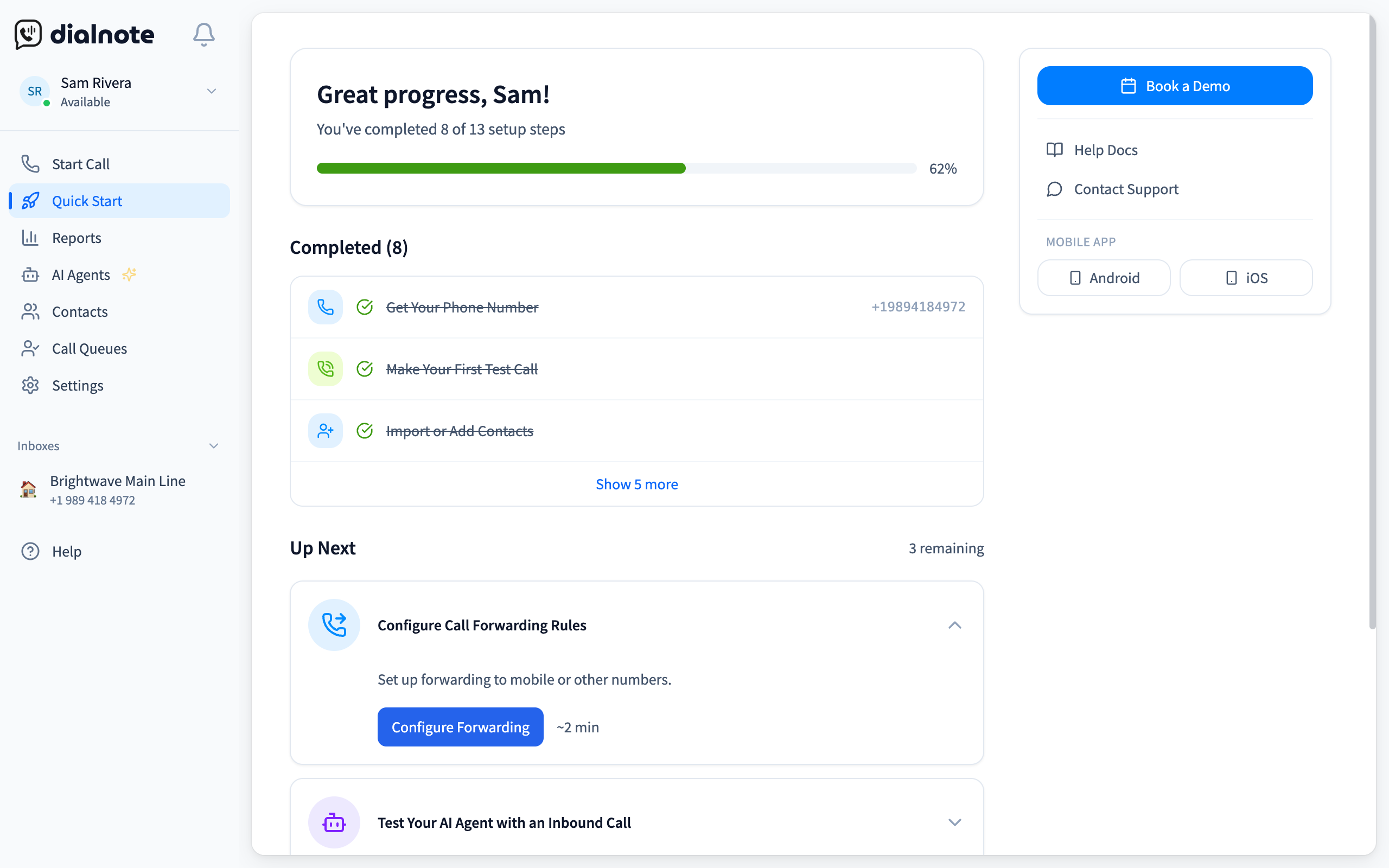
The page you land on tracks your whole setup, but the only card that matters right now is the first one. You already did the hard part by reading this far: if your customers are local, search your own area code and claim it. If you're building a national support line, claim the local number now and add toll-free once you're past the trial. Either way, make the type decision before you type a single digit into the search box.
Ready to claim your first business number?
10-day free trial, no credit card needed.
Frequently asked questions
Can I have multiple business phone numbers?
Yes. Most VoIP providers let you add as many numbers as you need (local, toll-free, or international) under a single account. You can assign different numbers to different departments, campaigns, or team members. There's no technical reason to stick with just one.
How long does it take to get a new business phone number?
New numbers are available almost immediately through most VoIP providers. You search, select, and configure in a few minutes. The only exception is toll-free numbers, which can take a day or two to fully activate across carrier networks.
Can I keep my existing number if I switch phone providers?
Yes. This is called number porting. As long as your current contract doesn't block it, you can transfer your existing number to a new provider. The process takes 1-2 weeks on average. Your number stays live throughout, so callers won't notice any interruption.
What's the difference between a virtual number and a VoIP number?
A VoIP number is any phone number that runs over the internet rather than a traditional phone line. A virtual number is a type of VoIP number that isn't tied to a specific device or location. All virtual numbers use VoIP, but not all VoIP numbers are "virtual" in the flexible sense: some are still assigned to a specific desk phone or location.
Do customers know when they're calling a virtual or toll-free number?
For virtual numbers with a local area code, callers have no way to tell it's virtual: it looks and behaves exactly like a local landline. For toll-free numbers, the 800 prefix makes it obvious, but most customers don't consider that a negative. They actually associate it with larger, more established businesses. The exception is vanity toll-free numbers, which some customers find easier to trust than a plain 1-800-XXX-XXXX because the word component signals intentionality.

Written by
Lancelot Dsouza
Chief Marketing Officer, SmartReach.io
Lancelot Dsouza is the Chief Marketing Officer at SmartReach.io, where he built the Marketing, Sales, and Customer Success verticals from the ground up. With over 25 years of experience spanning digital marketing, business development, and strategic...
Lancelot Dsouza is the Chief Marketing Officer at SmartReach.io, where he built the Marketing, Sales, and Customer Success verticals from the ground up. With over 25 years of experience spanning digital marketing, business development, and strategic...
Related Articles
Local vs Toll-Free Numbers: Which Should Your Business Use?
Learn how local vs toll-free numbers compare on cost, answer rates, and customer trust, so you pick the right business phone number the first time.
How to Get a Business Phone Number Without a Landline
Learn how to get a business phone number without a landline in under 30 minutes. Compare VoIP, virtual, and mobile options for small businesses.
What Is a Virtual Phone Number? A Complete Guide
Learn what a virtual phone number is, how it works, what it costs, and how to get one in minutes. See why businesses save up to 75% on phone costs.