Best VoIP providers compared & ranked
Picking the best VoIP providers for your team feels like a quick research project. Then the first invoice lands, and the math gets messy.
We've seen this pattern across hundreds of small businesses. The sticker price on a vendor's homepage rarely matches what shows up on the bill three months later. After 25+ years building marketing and growth teams, including the last few at SmartReach.io where we ship dialnote, I've watched too many founders pay double what they expected for a phone system. The problem isn't dishonest pricing. It's how VoIP providers package "unlimited" calling, AI add-ons, and per-seat fees so the real cost only shows up after you've signed up.
This guide ranks the 8 best VoIP providers with one rule: every cost estimate is based on a 10-person team and includes the platform fee, an AI agent, IVR setup, and at least one phone number. Calling minutes beyond fair use are extra on every provider, so we'll cover those separately.
TL;DR:
- The best VoIP providers for a 10-person team, ranked by true total cost, are dialnote ($49/mo flat, unlimited users, 1 AI agent included), then RingCentral, Nextiva, Dialpad, Zoom Phone, Vonage, Aircall, and OpenPhone (Quo).
- Per-seat plans for 10 users typically run $300 to $575/mo once you add an AI agent, extra numbers, and CRM integrations, versus dialnote's flat $49/mo Team plan.
- "Unlimited" VoIP calling isn't really unlimited: plans cap at 1,000 to 3,000 minutes per user per month and cover US and Canada only, with international calls billed per minute at $0.01 to $0.12.
- Compare providers on total 10-seat cost (platform + AI + IVR + a number), not the headline per-seat price, because add-ons are where the bill grows.
- You can keep your business number when you switch providers: porting takes about 1 to 2 weeks and your new provider handles most of the paperwork.
Read this before you compare: "unlimited" minutes are not unlimited
Almost every VoIP provider advertises unlimited calling. None of them mean it.
You see "unlimited" on the pricing page. You sign up. Two months in, your team makes a few calls to clients in the UK and Mexico, and the invoice shows per-minute charges you didn't expect. That's because every "unlimited" VoIP plan has two fine-print rules:
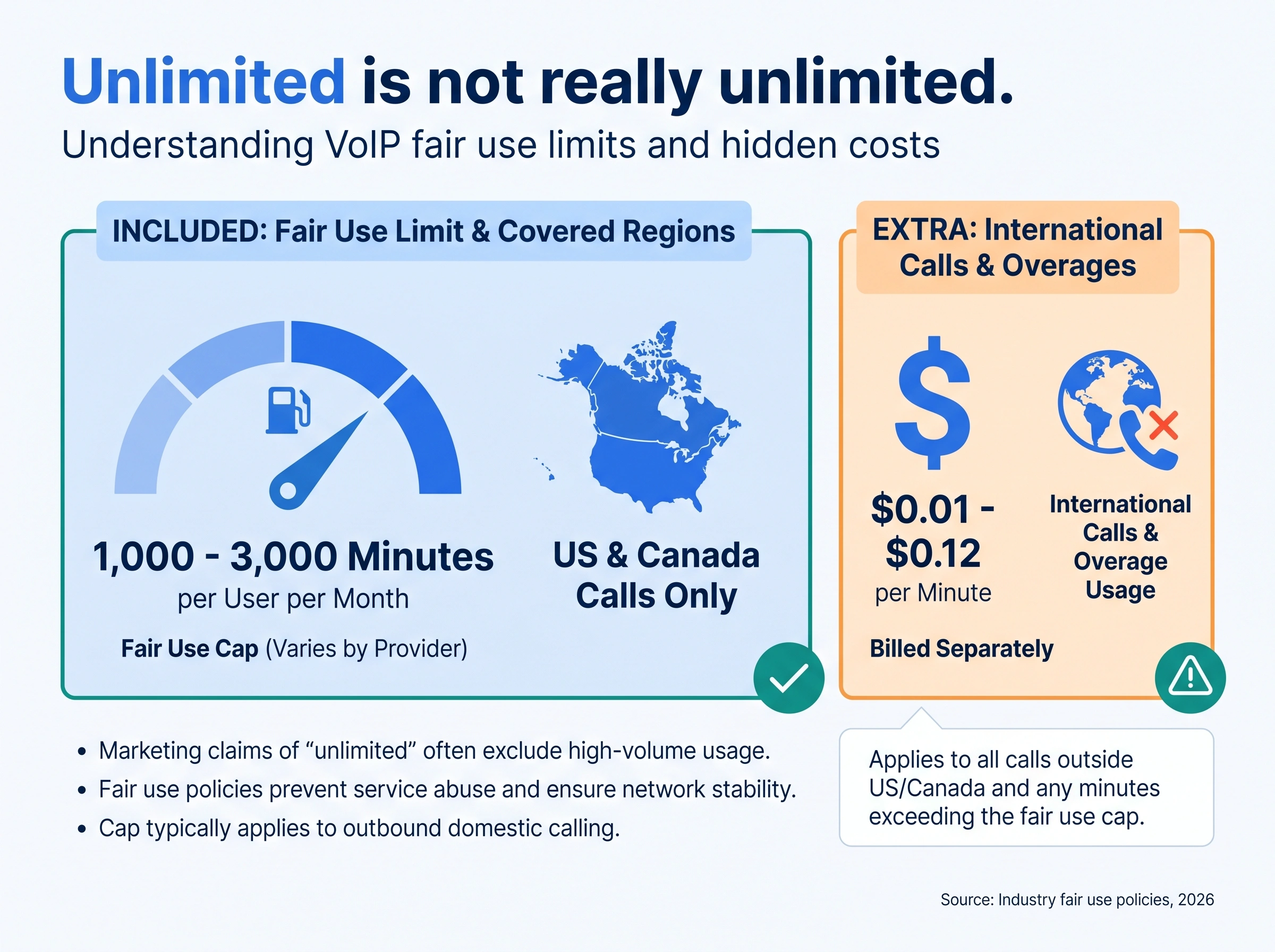
- Unlimited applies to the US and Canada only. Calls to any other country are billed per minute, usually between $0.01 and $0.12 depending on where you're calling. Some destinations like satellite numbers or premium-rate lines run $1+ per minute.
- There's a fair use cap on minutes too. Most providers cap "unlimited" at 1,000 to 3,000 minutes per user per month before throttling kicks in or overage charges apply. The terms usually say "reasonable business use," which isn't a definition.
According to GetVoIP's business phone systems buyer's guide, VoIP providers for small teams typically charge $25 to $40 per user monthly for the platform, and that's before any usage. The platform fee and the calling cost are two separate bills. Honestly? Most comparison articles bury this. We're putting it first because it changes the answer to "what's the cheapest VoIP provider" more than any other factor.
The other thing buried in fine print: phone numbers and AI features are usually add-ons. The $25/user plan you saw advertised? That's just a software license. You pay extra for each phone number, each AI minute, and each integration in many cases. So when we list a 10-seat estimate below, we include those.
How we ranked the best VoIP providers
Before getting into the list, here's what we weighted:
- True total cost for 10 users including platform, one AI agent, IVR setup, and a phone number
- AI capabilities: voice agent for after-hours coverage, call transcription, summaries
- Pricing model fit: per-seat math vs. flat-rate for growing teams
- Call routing depth: IVR, ring groups, business hours, overflow handling
- Integration breadth: CRM, helpdesk, calendar, communication tools
- Support quality: what comes with the plan, not what costs extra
We didn't rank by raw feature count. The most loaded platform isn't the best fit for an 8-person agency that needs an AI receptionist after 6pm. We're not 100% sure how much the rankings shift in the next 12 months as more providers add native AI, but for now this is what shipping today's tools actually looks like. For broader market context, TechRadar's 2025 review of business VoIP tracks similar criteria across a wider set of platforms.
See the best VoIP providers tested on video
Before you dig into the numbers, here's the short version on video. We tested the top VoIP providers with the same 10-user config and compared what each one really costs once AI and IVR routing are switched on. It's a quick way to get the lay of the land before the detailed rankings below.
Best VoIP providers at a glance: 10-user cost comparison
Below is a quick comparison of all 8 providers with estimated monthly cost for a team of 10, including AI agent capability, IVR routing, and at least one phone number. Calling minutes beyond fair use aren't included in any estimate. That's separate on every provider.
| # | Provider | Best for | Est. cost (10 users + AI + IVR + 1 number) |
|---|---|---|---|
| 1 | dialnote | Unlimited users with built-in AI | $49/mo (Team, unlimited users, flat) |
| 2 | RingCentral | Enterprise UCaaS with deep integrations | $350-$500/mo |
| 3 | Nextiva | Omnichannel customer service teams | $300-$450/mo |
| 4 | Dialpad | AI-first call coaching across plans | $300-$400/mo |
| 5 | Zoom Phone | Teams already running on Zoom | $250-$350/mo |
| 6 | Vonage | VoIP with API extensibility | $300-$400/mo |
| 7 | Aircall | Sales and support call centers | $400-$600/mo |
| 8 | OpenPhone (Quo) | Startups under 5 people scaling up | $230-$330/mo |
The range exists because most providers charge separately for AI minutes, extra numbers, and per-seat upgrades to access AI features at all. We'll explain each number below.
The best VoIP providers compared and ranked
1. dialnote: best overall for unlimited users with built-in AI
Best for: Growing teams (3-50 people) that want flat-rate pricing, an AI agent included, and no per-seat math.
dialnote was built around one idea: most small business phone bills get expensive because of per-seat fees, not because of usage. So we priced dialnote's pricing plans to scale with your business, not your headcount. The plans go from individual to enterprise, but the unlimited-user tiers (Team, Business, Pro) are where the math really tips against per-seat competitors.
Plans:
- Team ($49/mo, recommended): Unlimited users, 2 phone numbers, 700 included minutes, automatic call recording, AI transcription and summaries, 1 AI voice agent (30 min/mo), knowledge base, HubSpot/Salesforce/Pipedrive integration, Slack, Zapier, API access. This is the plan most teams start on.
- Business ($99/mo): Unlimited users, 3 phone numbers, 1,400 minutes, 5 AI agents, multilanguage AI, visual call flow builder, plus Zoho CRM, Zoom, Microsoft Teams, Make, n8n, Zendesk, Freshdesk, Intercom, WhatsApp.
- Pro ($199/mo): Unlimited users, 5 phone numbers, 2,800 minutes, 10 AI agents, AI call tags, AI call evaluation, call queueing, contact sharing permissions, Zoho Desk, Gong, dedicated CSM.
There's also a Solo plan ($19/mo, 1 user, 250 minutes, 1 phone number, no AI agents, no outbound texting) for true solopreneurs working under a $30 budget. We don't lead with it because it's not where most growing teams should land. It's a calling plan: the number still receives texts, but you can't send from it, so if texting customers matters, start at Team.
Wallet allowance: Every plan includes a monthly wallet credit ($8 on Team, $15 on Business, $30 on Pro). The wallet covers international calls, AI agent overage, and any minutes beyond the included pool. No surprise overage bills. Usage just draws down the wallet, which you can top up any time. Annual billing knocks 20% off everything.
What dialnote actually does on a call:
- AI voice agent: answers calls 24/7 so you never miss a lead, books meetings into your calendar via Calendly or Cal.com, transfers complex calls to the right team member, and sends SMS follow-ups with confirmations or links. Speaks naturally in 14 languages so customers feel like they're talking to a person. Try the AI receptionist demo without signing up.
- Visual call flow builder (Business+): drag-and-drop IVR menus up to 12 keys, ring groups, business hours routing, after-hours overflow to AI or voicemail. No code.
- Call recording, transcription, summaries: automatic on Team and up. Your team scans what happened on a call in 10 seconds instead of replaying voicemails.
- Phone numbers: local and toll-free numbers available in the US, Canada, UK, India, and France (more countries opened on request); extra numbers are $5/mo. International calling supported in 90+ countries via wallet.
- CRM and calendar integrations: HubSpot, Salesforce, Pipedrive, Calendly, and Cal.com, plus Zapier, Make, n8n, and webhooks reaching 5,000+ apps. Helpdesk connectors (Zendesk, Freshdesk, Intercom) are on the roadmap.
- Free 10-day trial with Pro features. No credit card required.
Why unlimited users matters:
Most VoIP providers charge $20-$40 per seat per month. A 10-person team on a typical per-seat plan: $300/month minimum, often $400+ when you add AI. As you grow to 15 or 20 people, the bill scales linearly. dialnote's Team plan stays at $49/month whether you have 3 users or 30. That's $5 per person at 10 seats, and $1.60 per person if you scale to 30.
Estimated cost for 10 users + AI agent + IVR + 1 phone number:
- Team plan: $49/mo flat (1 AI agent + IVR via Business or via call flow are included in plan tier where applicable)
- If your team needs the visual call flow builder, multilanguage AI, or 5 AI agents → Business at $99/mo flat
- Annual billing: $39/mo (Team) or $79/mo (Business)
- Overage and international calling: deducted from wallet (Team includes $8/mo, Business includes $15/mo)
Pros:
- Genuinely flat: 5 users or 50, the bill doesn't move
- AI voice agent included starting at $49/mo (most competitors charge $30-$100/mo extra)
- Wallet model means no shocking overage invoices: you see the meter draw down
- Free 10-day trial with Pro features, no credit card
Cons:
- Newer than RingCentral or Nextiva, so fewer Reddit threads if you're researching
- Visual call flow builder becomes available at Business ($99), not Team
- 700 minutes on Team is enough for most domestic teams but light for outbound-heavy sales
The honest take: if your team is mostly making domestic calls, needs an AI agent, and you don't want to do per-seat math every time you hire, dialnote is the cheapest option in this list by a meaningful margin. The trade-off: we're newer than RingCentral or Nextiva, so if you need 300+ niche integrations or a multi-year on-paper SLA, an enterprise vendor might fit better.
2. RingCentral: best for enterprise UCaaS with deep integrations
Best for: Mid-market and enterprise teams (100+ employees) needing a single platform for calling, video, messaging, fax, and contact center.
RingCentral is the most established all-in-one UCaaS platform, used by 500,000+ businesses. The platform handles voice, SMS, video meetings, team chat, and integrates with 300+ apps including Salesforce, HubSpot, Zendesk, and Microsoft Teams. AI features (RingSense) are sold as add-ons.
Pricing: Core $20/user/mo, Advanced $25/user/mo, Ultra $35/user/mo. AI features and contact center capabilities cost extra.
Estimated cost for 10 users + AI + IVR + 1 number: $350-$500/mo
- Advanced plan: $25 x 10 = $250/mo
- AI add-on: ~$50-100/mo
- Extra phone numbers: $5-10/mo each
- Total typically lands around $350-$500 depending on AI usage
Pros:
- Deepest integration catalog on this list (300+ apps, every major CRM and helpdesk)
- One platform replaces phone, video, fax, team chat, and contact center
- Strong global PSTN coverage with local numbers in 100+ countries
Cons:
- Per-seat pricing scales linearly (50 users on Advanced = $1,250/mo before AI)
- Bloated UI for teams that just want a phone system
- Onboarding takes weeks, not hours
What users say: RingCentral holds a 2.2/5 on Trustpilot, with the loudest complaints clustering around two themes. First, contracts: customers report aggressive auto-renewal that locks them into another year before they realize, with cancellation requiring escalation. Second, support: long response times, account managers who go silent, and "double-billing" issues that take weeks to resolve. On G2, ~22% of negative reviews mention pricing escalation across tiers, and ~17% flag CRM integrations being locked behind premium plans.
Trade-offs: Powerful but heavy. Worth it if you're replacing a contact center or need 200+ integrations; overkill (and costly) if you just need a phone system for a 10-person agency.
3. Nextiva: best for omnichannel customer service teams
Best for: Customer-facing teams that handle calls, chat, SMS, and email through one inbox.
Nextiva built its reputation on customer support quality. The platform bundles VoIP with team messaging, call analytics, sentiment analysis, and CRM integration. Its NextOS dashboard pulls customer history across channels, so an agent on a call can see prior chat and email context.
Pricing: Digital $20/user/mo (no voice), Core $30/user/mo, Engage $40/user/mo, Power Suite $60/user/mo. Voice starts at Core. The lowest sticker price typically requires a 36-month contract.
Estimated cost for 10 users + AI + IVR + 1 number: $300-$450/mo
- Core plan: $30 x 10 = $300/mo
- AI features (Engage tier): adds ~$10/user/mo
- Total: $400/mo typical
Pros:
- Genuinely omnichannel: calls, SMS, chat, and email in one inbox with shared customer history
- Sentiment analysis and call analytics are solid out of the box
- Strong support reputation historically (still rated highly on G2 for support response)
Cons:
- Multi-year contracts (often 36 months) for the lowest advertised price
- AI gated behind Engage/Power Suite, so the real price for AI parity is closer to $40-$60/user
- Reporting splits between contact center and business phone with no native bridge
What users say: Capterra and Trustpilot reviews consistently flag two issues. First, contract pain: users describe being locked into 3-year auto-renewals, with cancellation attempts resulting in demands for two more years of payment. Second, call quality: dropped calls and one-way audio are recurring themes, and support's default response is reportedly "the issue is on your end." Some users report the desktop app needs multiple sign-outs per day to keep receiving calls. Setup is distributed across sales, onboarding, and support with no single owner, a frequent source of frustration during the first 30 days.
Trade-offs: Strong on omnichannel and customer support workflows. AI features are gated behind higher tiers, so you'll likely need Engage or Power Suite to match what dialnote includes on Team. Read the contract terms carefully before signing.
4. Dialpad: best for AI-first call coaching
Best for: Sales and support teams that want real-time AI coaching, call summaries, and post-call action items across every plan.
Dialpad pioneered native AI in business VoIP. Every plan includes Ai Voice with real-time transcription, sentiment tracking, and post-call summaries. Their AI Agent product launched in 2024 for after-hours coverage and qualification.
Pricing: Standard $15/user/mo (annual), Pro $25/user/mo, Enterprise custom. AI Agent and contact center features cost extra.
Estimated cost for 10 users + AI + IVR + 1 number: $300-$400/mo
- Pro plan: $25 x 10 = $250/mo
- AI Agent add-on: $50-100/mo
- Extra phone numbers: $15-25/mo
- Total: ~$300-$400/mo
Pros:
- AI transcription and call summaries included on every plan, not gated to enterprise
- Real-time sentiment and coaching cues during calls (genuinely useful for sales/support managers)
- Clean modern interface with fast deployment
Cons:
- AI Agent (their AI receptionist equivalent) is a separate paid add-on
- Most powerful AI tools (advanced analytics, agent coaching dashboards) live on Enterprise
- 3-seat minimum prices out solo operators
What users say: Dialpad's AI is the most ambitious in this category, but reviews on G2 and Capterra repeatedly flag accuracy issues in real-world conditions. Transcription struggles with accents, cross-talk, and noisy rooms. Numbers and emails get mangled. Speakers get mislabeled during multi-agent calls. Industry-specific terminology (logistics, healthcare, legal jargon) often falls flat. Beyond AI, users cite "choppy" audio when switching between Wi-Fi and mobile data, and one-way audio glitches. Support is frequently described as slow or unresponsive on lower tiers, and final invoices can include unexpected taxes and carrier fees that weren't in the quote.
Trade-offs: Best AI experience among legacy VoIP providers when it works. The catch: AI Agent is a separate paid module, and accuracy varies by call conditions. For a 10-person team paying $25/user, you've already spent $250 before AI agents, and the AI parity with dialnote's $49 Team plan requires further upgrades.
5. Zoom Phone: best for teams already invested in Zoom
Best for: Companies running Zoom for meetings that want a unified communication hub.
Zoom Phone bolts a VoIP system onto Zoom Meetings, Zoom Team Chat, and Zoom Whiteboard. If your team already lives in Zoom for video, the integration is tight: a click in chat starts a phone call, voicemails appear in Zoom Mail, and meeting recordings live alongside call recordings.
Pricing: US & Canada Metered $10/user/mo (pay-per-minute), US & Canada Unlimited $15/user/mo, Pro Global Select $20/user/mo. AI Companion is included on most plans, but Zoom Virtual Agent (their AI phone bot) is sold separately to contact centers.
Estimated cost for 10 users + AI + IVR + 1 number: $250-$350/mo
- Unlimited plan: $15 x 10 = $150/mo
- AI Companion: included on most plans
- Phone numbers: included
- Power Pack or extra features: ~$100-200/mo
- Total: $250-$350/mo
Pros:
- Cheapest entry price among traditional UCaaS players
- Tight coupling with Zoom Meetings, Team Chat, and Mail if your team already lives there
- Clear call quality is a consistent positive theme in user reviews
Cons:
- Phone system tied to Zoom's product roadmap; integration story collapses if you switch away from Zoom for video
- AI receptionist functionality is a separate module (Zoom Virtual Agent), not included with Phone
- Advanced features (call recording, CRM integration, international calling) push the bill up quickly
What users say: Reviews on G2 and Capterra are mixed but trend negative for users who came in expecting feature parity with Zoom Meetings. Common complaints: calls going silent on both ends, calls appearing pre-answered when picking up, voicemail notifications arriving hours late, and call drops on lower-bandwidth connections. Support gets singled out as "rigid" and difficult to reach a human. Many users report bouncing through an AI assistant before getting routed to a person. Subscription pain comes up too: unexpected auto-renewals and charges for canceled services. International users report being sold UK numbers only to find out post-purchase they couldn't keep them without a UK-based business.
Trade-offs: Cheapest sticker price among traditional UCaaS players. But you're paying for two products, tightly coupling your phone system to Zoom's roadmap, and AI receptionist functionality requires a separate module. Best fit only if your team is fully committed to Zoom for video.
6. Vonage: best for VoIP with API extensibility
Best for: Tech-forward businesses that want to embed calling and SMS into their own product or workflow via APIs.
Vonage Business Communications is the standard VoIP product. Vonage also runs a separate API platform (Vonage Communications APIs) that powers companies like DocuSign and Snap. For a business that wants both an out-of-the-box phone system and the option to build custom calling workflows later, Vonage is a flexible bet.
Pricing: Mobile $20/user/mo, Premium $30/user/mo, Advanced $40/user/mo. AI features and CRM integrations require Premium or higher.
Estimated cost for 10 users + AI + IVR + 1 number: $300-$400/mo
- Premium plan: $30 x 10 = $300/mo
- AI Studio (their voice AI builder): metered usage, ~$50-100/mo
- Total: $300-$400/mo
Pros:
- Vonage Communications APIs are genuinely powerful for embedded telephony, used by major SaaS products
- Two-product strategy means you can start with the off-the-shelf VoIP and graduate to custom workflows
- Reliable call quality on stable connections, per most reviews
Cons:
- AI receptionist requires DIY assembly via AI Studio (no one-click setup)
- Packaged VoIP UI feels older than newer entrants like Dialpad or OpenPhone
- Billing surprises come up frequently in user reviews
What users say: Trustpilot and G2 reviews are mixed-to-negative on the business side. The most cited issues: bills that "balloon over time" due to surcharges, taxes, and fee escalations users don't recall agreeing to. In 2023, the FTC ordered Vonage to pay $100 million in refunds for making cancellation nearly impossible and charging junk fees, and that history still surfaces in current reviews. Other complaints: SMS functionality being unavailable for months at a time, mobile app sign-ins resetting, and slow support responsiveness on technical issues. Users who stay tend to be on the API platform; the packaged VoIP product gets the most heat.
Trade-offs: API platform is excellent if you have engineering resources to build custom workflows. The packaged VoIP product has fallen behind newer competitors on UX and AI. Read the contract and test cancellation flows before committing.
7. Aircall: best for sales and support call centers
Best for: Sales-driven teams that need a strong dialer, native CRM sync, and call coaching tools.
Aircall focuses tightly on sales and support workflows. Their dialer integrates with Salesforce, HubSpot, Pipedrive, and Outreach so reps can log calls without switching tabs. Power dialer, call whispering, and call monitoring are core features.
Pricing: Essentials $40/user/mo (3-user minimum), Professional $70/user/mo (3-user minimum), Custom from $50/user/mo. AI features (Aircall AI) cost an extra $9/user/mo.
Estimated cost for 10 users + AI + IVR + 1 number: $400-$600/mo
- Professional plan: $70 x 10 = $700/mo (often discounted to $500 with annual)
- AI add-on: $9 x 10 = $90/mo
- Phone numbers: included on most plans
Pros:
- Top CRM sync for HubSpot, Salesforce, and Pipedrive: calls log automatically with context
- Fast deployment: most teams go from signup to live calls in under 48 hours
- Power dialer, call whispering, and call monitoring are standard, not premium
Cons:
- 3-user minimum on every plan locks out solo operators and freelancers
- Among the most expensive options on this list per seat
- AI is an add-on, not included
What users say: Aircall's pros are real and consistent in reviews: fast setup, friendly support that resolves issues within a day, tight CRM sync. But three negative themes show up regularly. First, call quality: jitter and connection drops during high-traffic periods, with audio issues on the Android app specifically (some users report the mobile app failing to ring at all for incoming calls). Second, integration breakage: HubSpot integration "failing more than a few times" according to multiple users. Third, billing: Trustpilot reviews flag aggressive auto-renewal, charges after cancellation, and surprise invoices. Aircall does not refund unused time on annual contracts. SMS rollout has been slow for some users, with months of back-and-forth with support.
Trade-offs: Top pick for outbound sales teams using HubSpot or Salesforce. Among the most expensive options on this list. The 3-user minimum makes it a bad fit for solopreneurs or freelancers, and annual contracts have no early-exit refunds.
8. OpenPhone (Quo): best for startups under 5 people scaling up
Best for: Early-stage teams (1-10 people) that want a clean modern interface and per-seat simplicity.
OpenPhone (rebranded as Quo) is the design-forward newcomer. The mobile and desktop apps look great, setup takes 5 minutes, and basic features like shared inboxes and voicemail transcription work well out of the box.
Pricing: Starter $19/user/mo, Business $33/user/mo, Enterprise custom. AI agent and analytics live in the Business tier.
Estimated cost for 10 users + AI + IVR + 1 number: $230-$330/mo
- Business plan: $33 x 10 = $330/mo
- AI features included on Business tier
- Total: $330/mo
Pros:
- Cleanest UI on this list, with onboarding genuinely under 5 minutes
- Shared inboxes work well for small teams handling SMS and calls together
- Starter plan at $19/user is one of the lowest entry points
Cons:
- No live chat support on the Basic plan; email-only support is slow
- Scales poorly past 15-20 people on per-seat math
- API limited (webhook can't access messages, contact API is rough), AI responder priced per call with no custom-token API
What users say: OpenPhone gets praised for design but flagged on three recurring issues. First, support: no phone support, no live chat on the Basic plan, and email turnaround is slow enough that critical issues stay open for days. Multiple reviews report disabled accounts and unresolved issues. Second, call quality: "choppy or robotic sounding audio," one-way audio, and unexpected call drops, especially on weak Wi-Fi or cell signal. Third, app reliability: messages not loading, attachments missing, Android search broken (can't search SMS by phone number or keywords). International coverage is limited too. Local numbers and SMS work in fewer countries than competitors. Some users also report difficulty getting refunds.
Trade-offs: Beautiful product, fast setup, fits 1-5 person teams nicely. For an absolute solopreneur on a tight budget, dialnote's Solo plan at $19/mo is comparable in price and includes wallet credits, with the option to upgrade to unlimited users for $49. One real difference to weigh: Solo doesn't send texts, while texting is central to OpenPhone, so if you text customers daily, compare against dialnote's $49 Team plan instead. No migration when you hire your second person. Past 15-20 people, per-seat math on OpenPhone gets painful and you'll be looking at unlimited-user options anyway.
What does it really cost to run a VoIP system for 10 people?
If you've followed this far, you've noticed the same pattern: most providers advertise a low per-seat number, then sell AI, extra numbers, and CRM integrations as add-ons. By the time you've assembled the actual setup a 10-person team needs (platform + AI agent + IVR + a working phone number), the real bill is 1.5x to 3x the headline price.
A realistic 10-seat configuration typically costs:
- Per-seat VoIP providers ($20-$40/user): $200-$400/mo platform + $50-$150/mo AI add-on + $5-$25/mo phone numbers = $300-$575/mo
- dialnote Team (flat-rate): $49/mo, includes 1 AI agent, unlimited users, and 2 phone numbers = $49/mo (Business at $99/mo if you need 5 agents and the visual call flow builder)
- Calling minutes are extra on every provider once you exceed fair use (typically 1,000-3,000 mins/user/month)
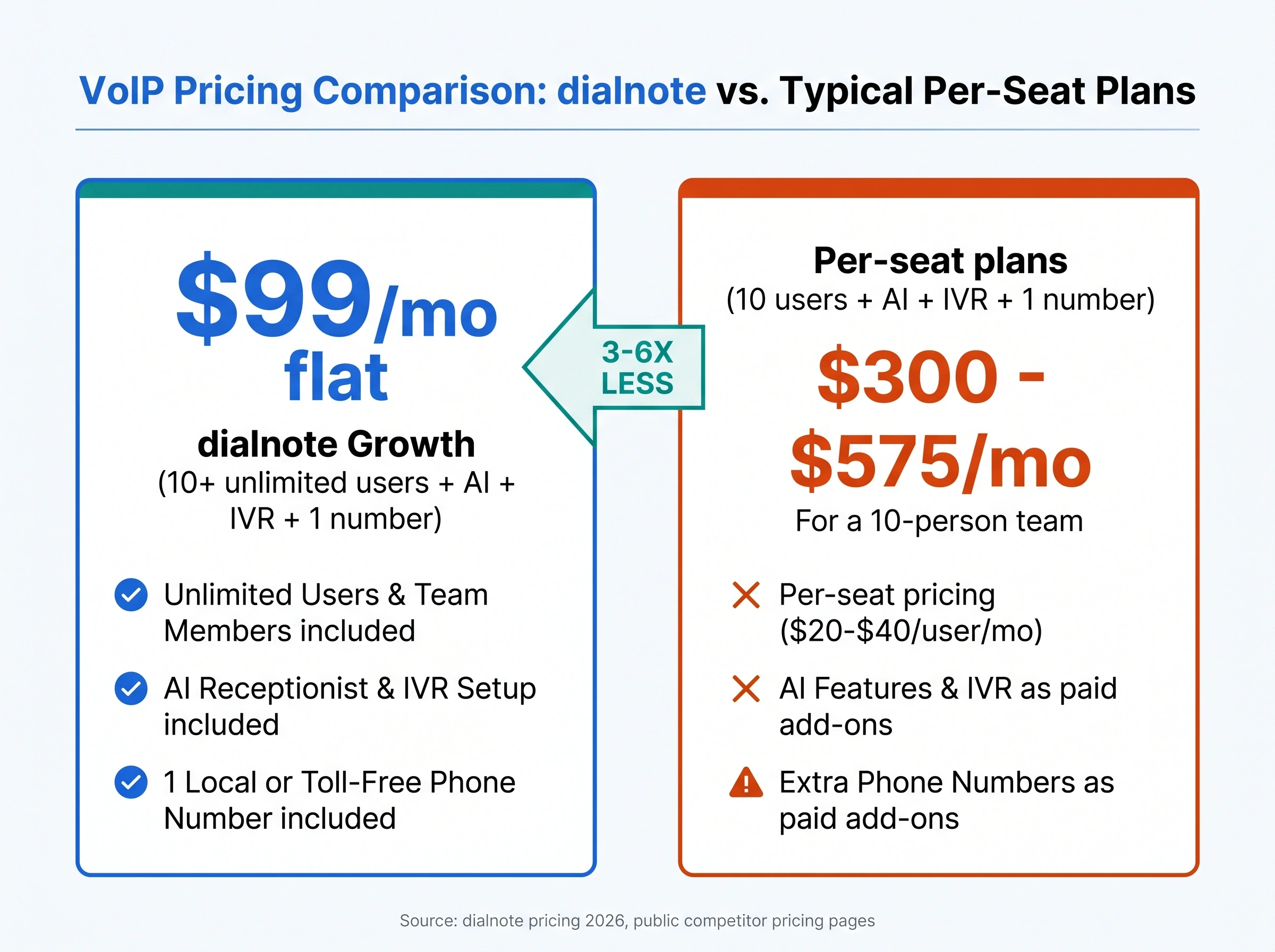
That difference compounds. At 20 seats, the per-seat math doubles. dialnote stays at $99/mo (or $199/mo if you've moved up to Pro for call queueing and AI evaluation).
How do you pick the best VoIP provider for your team?
Start with three honest questions:
How big will your team be in 12 months? If you're a true solopreneur on a tight budget, dialnote Solo at $19/mo or OpenPhone Starter at $19/user fit, though Solo is calling only, so pick Team at $49/mo if you need to text. If you're at 3+ and scaling, flat-rate unlimited (dialnote Team at $49/mo or Business at $99/mo) saves money every time you hire.
Do you need an AI receptionist? If yes, the question becomes: included on the base plan, or a paid add-on? dialnote includes 1 AI agent starting at $49/mo (Team) and scales to 5 agents on Business ($99/mo). Dialpad and RingCentral charge separately for AI Agent functionality. That's typically a $50-$200/mo difference for a 10-person team.
How many calls go to international numbers? If most of your calls stay in the US and Canada, fair-use unlimited plans cover you. If your team regularly calls Europe, Asia, or Latin America, look at 8x8 (broader country coverage) or budget for per-minute international rates separately.
The two questions to skip: "which provider has the most integrations" (you'll only use 3-5 of them) and "which has the highest uptime" (every major provider claims 99.99%, and the actual outages don't correlate with the marketing number).
The best VoIP provider depends on what you actually need
There isn't a single best VoIP provider. There's a best fit for your team size, industry, and growth trajectory. For most growing small businesses (3-50 people) that want predictable monthly costs and an AI agent included, dialnote's Team plan at $49/month is hard to beat on math alone (or Business at $99/mo if you need the visual call flow builder and 5 AI agents). For enterprise teams with deep Salesforce dependencies and a dedicated IT team, RingCentral or Nextiva makes sense, with the caveat that contracts and support quality have been recurring complaints in user reviews. For sales-driven teams using HubSpot or Salesforce, Aircall or Dialpad fits the workflow but at 4-6x the cost of dialnote Team for a 10-person team.
Run the actual cost calculation for your team size before committing to anything. Most providers will look very different at 5 seats vs. 25 seats. And read the fair-use policy on the "unlimited" plan before signing. That's where the surprises live.
If you want to see how the math works for your team, start a free 10-day dialnote trial (no credit card needed) or book a demo and we'll walk through your current call volume and what unlimited-user pricing would look like at your size.
Frequently asked questions
The top VoIP providers are dialnote (unlimited users with built-in AI from $49/mo), RingCentral (enterprise UCaaS), Nextiva (omnichannel), Dialpad (AI call coaching), and Zoom Phone (video-first teams). Pick based on team size, AI needs, and total calling cost.
Per-seat VoIP plans for 10 users run $200-$400/month for the platform alone, plus paid add-ons for AI and extra numbers. dialnote's Team plan is $49/month flat for unlimited users with 1 AI agent included. Calling beyond included minutes draws from your wallet, billed per minute.
No, not really. Every VoIP provider applies a fair use policy. Plans advertised as unlimited cap at 1,000-3,000 minutes per user per month and cover only US and Canada calls. International calls and overages are billed per minute at $0.01-$0.12 depending on the destination.
dialnote and Dialpad lead on AI. dialnote includes 1 AI voice agent, summaries, and transcription on its $49/mo Team plan with unlimited users, scaling to 5 agents on Business at $99/mo. Dialpad bundles AI transcription on all plans but charges per seat, and AI Agent is a separate add-on.
Yes. Federal rules require providers to release your number for porting. The transfer takes about 1-2 weeks, and your new VoIP provider handles most of the paperwork. Keep your old plan active until the port completes, then cancel.

Written by
Lancelot Dsouza
Chief Marketing Officer, SmartReach.io
Lancelot Dsouza is the Chief Marketing Officer at SmartReach.io, where he built the Marketing, Sales, and Customer Success verticals from the ground up. With over 25 years of experience spanning digital marketing, business development, and strategic...
Lancelot Dsouza is the Chief Marketing Officer at SmartReach.io, where he built the Marketing, Sales, and Customer Success verticals from the ground up. With over 25 years of experience spanning digital marketing, business development, and strategic...
Related Articles

Best Virtual Phone Systems for Business
8 best virtual phone systems for business compared on real 10-user cost, hidden AI per-minute fees, and Reddit reviews. See where dialnote ranks in 2026.

Best VoIP phone systems for small business
Compare 9 best VoIP phone systems for small business in 2026, with real pricing for 10 users including AI agents, IVR, and phone numbers.
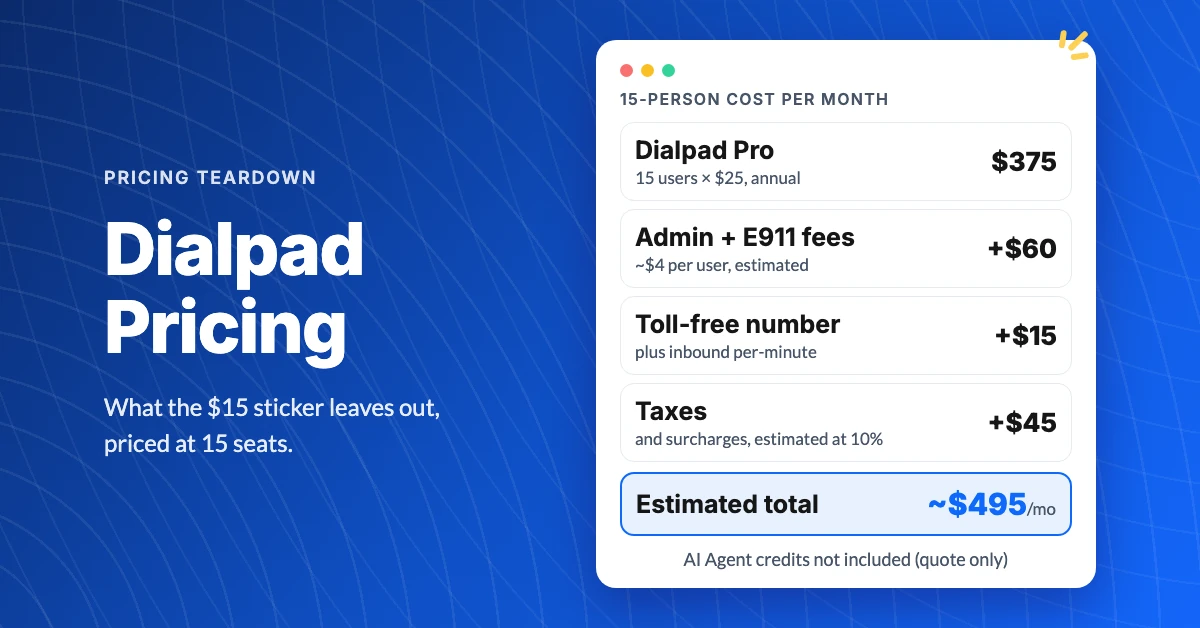
What Does Dialpad Pricing Really Cost a Small Team?
See what Dialpad pricing really costs: $15 to $35 per user, the 3-seat Pro minimum, per-text and admin fees, and real team math at 5, 15 and 30 people.