Best Virtual Phone Systems for Business
Pricing for the best virtual phone systems for business has gotten quietly dishonest. Open any vendor's page and the headline says $20 per user. Click into the FAQ and you'll find AI receptionist minutes billed on top, extra phone numbers at $5 to $10 each, and a "fair-use" clause that caps unlimited calling at 3,000 minutes a month.
Take Maya. Her 14-person agency runs on a $19/user virtual phone plan. The sticker price says $266 a month. After AI minutes, two extra phone numbers, and a Pipedrive integration tier, she's paying $480. By next year she'll be at 20 users and $700.
You're already past the "do I need a virtual phone system" question, so this list skips the sales pitch. It ranks the 8 best virtual phone systems for business by what they actually cost for a real 10-user setup, the AI fees most marketing pages hide, and the specific complaints users post on Reddit and G2. The ranking centers on per-agent cost, because that's the lever that bends most as you grow. For broader context, TechRadar's review of business VoIP tracks similar criteria across a wider list.
After 12+ years building SaaS for sales and customer service teams, including the AI voice agent work we ship at dialnote, I've watched per-seat pricing punish small teams more than any other line item. So that's the lens.
TL;DR:
- The real cost of a virtual phone system for business runs $260 to $680/month for a 10-user setup once AI receptionist minutes, extra phone numbers, and CRM tiers are added, not the ~$20/user sticker price.
- dialnote Business is $99/month flat for unlimited users, 3 phone numbers, 5 AI agents, and 1,400 shared calling minutes, which keeps per-agent cost the lowest in this list as you grow.
- "Unlimited calling" almost always hides a fair-use cap of 1,000 to 3,000 minutes per user per month and only counts US and Canada calls.
- Most competitors (RingCentral, Dialpad, Quo, Nextiva) bill AI receptionist minutes separately, usually $50 to $200/month for a 10-person team.
- Rank tools by per-agent cost and whether AI is bundled, not by integration count, since most "1,000+" claims rely on Zapier or Make connectors you build yourself.
Watch the top virtual phone systems in action
Want the fast version first? This video runs through the virtual phone systems most small teams shortlist, tested on the same setup, with a close look at where the per-seat math and AI fees bite. Watch it, then read on for the full ranking and the pricing traps to avoid.
Best virtual phone systems for business at a glance
Same config across all 8 platforms: 10 users, an AI receptionist that can answer overflow calls, an auto-attendant or IVR, and 3 phone numbers (one main, one sales, one support, which is what most growing teams end up needing). AI per-minute usage and international calling are extra everywhere, so the high end of each range reflects realistic moderate volume.
| # | Platform | Best for | True 10-user cost (per month) | AI agent included? | Unlimited seats? | Billing terms |
|---|---|---|---|---|---|---|
| 1 | dialnote | Unlimited users with AI baked in, wallet model for usage | $99/mo flat (Business) | Yes (5 agents on Business) | Yes (Team and above) | Monthly or annual (20% off annual) |
| 2 | RingCentral | Established UCaaS, deepest CRM connectors | $290-$510/mo | No, AI is paid add-on | No (per-seat) | Annual preferred, monthly costs more |
| 3 | Grasshopper | Solo and 2-3 person teams that want a 1-number setup | $180-$250/mo | No (no native AI) | Flat plans, capped extensions | Monthly or annual (10% off annual) |
| 4 | Quo (formerly OpenPhone) | Design-forward early-stage teams | $420-$510/mo | No (Sona priced separately) | No (per-seat) | Monthly or annual (~16% off annual) |
| 5 | Phone.com | Budget-focused micro-teams | $200-$320/mo | No native AI agent | Hybrid (unlimited extensions, per-seat plan) | Monthly or annual (~17% off annual) |
| 6 | Nextiva | Omnichannel customer support teams | $320-$470/mo | Only on top tier | No (per-seat) | Annual or multi-year required for best pricing |
| 7 | Dialpad | AI-first sales coaching teams | $340-$500/mo | AI Agent is a separate paid module | No (per-seat) | Monthly or annual (~16% off annual) |
| 8 | Vonage Business | Mid-market UCaaS with legacy CRM tie-ins | $310-$560/mo | AI gated to higher tiers | No (per-seat) | Annual contracts standard, monthly costs more |
The wide ranges aren't padding. They reflect what AI minutes, extra phone numbers, and CRM integration tiers actually do to the bill once you configure for a real 10-person team. Surprised by some of these numbers? Most teams are.
Stop. Read this before the listings.
Three things the marketing pages won't tell you up front. They change the math enough that it's worth pausing.
"Unlimited calling" is a marketing word, not a contract term. Every "unlimited" plan in this article hides a fair-use clause in the terms of service. The common caps: a per-user monthly minute ceiling (usually 1,000 to 3,000 minutes), after which the carrier can throttle, suspend, or push you to a higher tier.
Geographic restriction to US and Canada only, with international calls billed per minute. "Reasonable business use" language lets the carrier flag your account if call patterns look like a telemarketing operation. A 10-person sales team making 50 outbound calls a day at 3 minutes each will hit 30,000 minutes a month, which is over most carriers' per-user fair-use cap once you spread it across 10 seats.
"100+ integrations" usually means Make or Zapier. When a vendor advertises 200, 500, or "1,000+" integrations, most of those aren't native. They're third-party connectors via Make, Zapier, or n8n that you have to build and maintain yourself. Native integrations pass call data, contacts, and transcripts in real time without a webhook middleman. Before you pick on integration count alone, list the 3-5 tools your team uses daily, then check the vendor's native integration directory (not the Zapier marketplace) to confirm those specific apps are there.
AI receptionist minutes are billed on top of the plan. This is the single most ignored cost in virtual phone system comparisons. An AI receptionist doesn't just cost you a tier upgrade. It also costs per minute of AI usage.
Dialpad's Ai Agent, Quo's Sona (formerly OpenPhone), and RingCentral's Smart Concierge all bill per minute or per call on top of the seat fee. Typical rates run $0.10 to $0.30 per minute on lighter platforms, and $0.50 to $1.20+ on heavier enterprise modules.
A team taking 200 inbound calls a month with an average 3-minute AI conversation is looking at $60 to $180 a month in AI minutes alone, before the platform fee even starts.
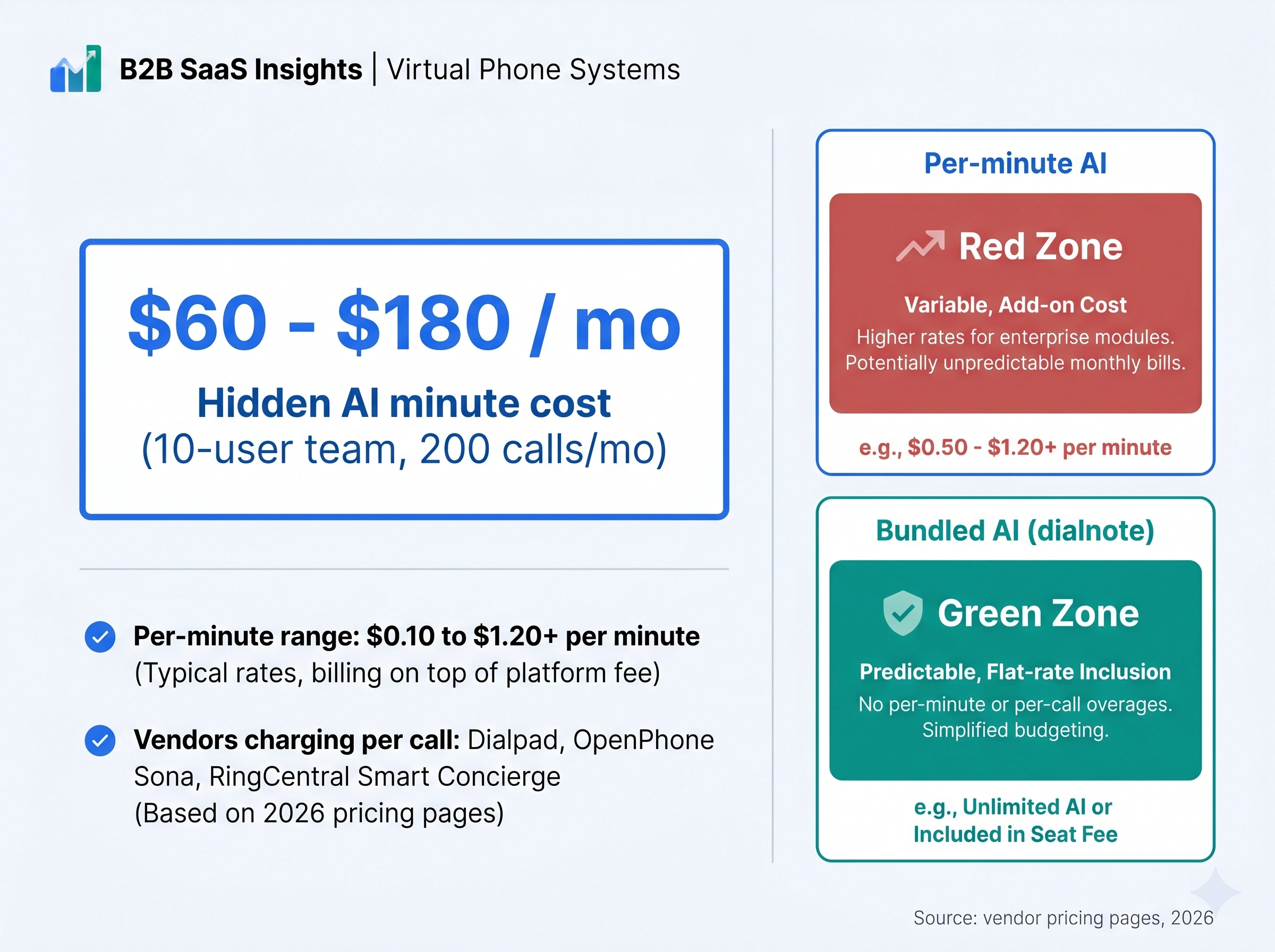
dialnote handles this differently. There's no separate AI tier and no metered AI receptionist module. Every paid plan ships with AI agents bundled in (1 on Team, 5 on Business, 10 on Pro) and a pool of calling minutes that covers both human and AI usage (700, 1,400, and 2,800 respectively). When you go past the pool, overage runs $0.89/min from a USD wallet, and each plan auto-credits the wallet every cycle ($8 on Team, $15 on Business, $30 on Pro) to keep it warm. You can set an auto top-up threshold so the wallet refills the moment it dips below your chosen floor. No mystery add-on, no shock invoice.
How we ranked the best virtual phone systems for business
Five criteria, weighted for teams of 5 to 30. Headline price doesn't crack the top three.
- True 10-user cost: platform + AI receptionist + IVR + 3 phone numbers, not the per-seat sticker
- AI per-minute cost: what AI usage adds on top of the plan
- Native CRM integrations: real bidirectional connectors, not Zapier wrappers
- Reddit and review-site signal: what users actually say on r/sales, r/smallbusiness, Trustpilot, G2
- Onboarding time: sign up to live calls without an IT ticket
We didn't rank by feature count. The widest spec sheet isn't the best fit for a 12-person agency that needs an AI receptionist after hours. Honestly? Most virtual phone feature lists are written to win RFPs, not to help a marketing manager pick a tool on a Friday afternoon. The most overrated metric in this category is "1,000+ integrations." Skip it. The most underrated is per-agent cost as you scale.
One thing we'll admit up front: we're not 100% sure where AI minute pricing lands in the next 12 months. Most vendors are repricing voice AI usage every few quarters. So treat the per-minute numbers below as a snapshot, not a contract.
1. dialnote
Flat-rate virtual phone system with unlimited users and an AI agent included from $49/month.
The pitch: Build a phone system once, hire as many people as you need, never see a per-seat increment again. Plans start at $19/mo for solo operators, $49/mo opens up unlimited users plus 1 AI agent and 700 calling minutes, and $99/mo covers 5 AI agents in 14 languages, 1,400 minutes, and the visual call flow builder.
The reality: Per-seat pricing for virtual phone systems is the most overrated way to grow a small business phone bill. Once you cross 5 users on a per-seat plan, the math turns sharply against you, and the moment you need AI, every competitor pushes you a tier up.
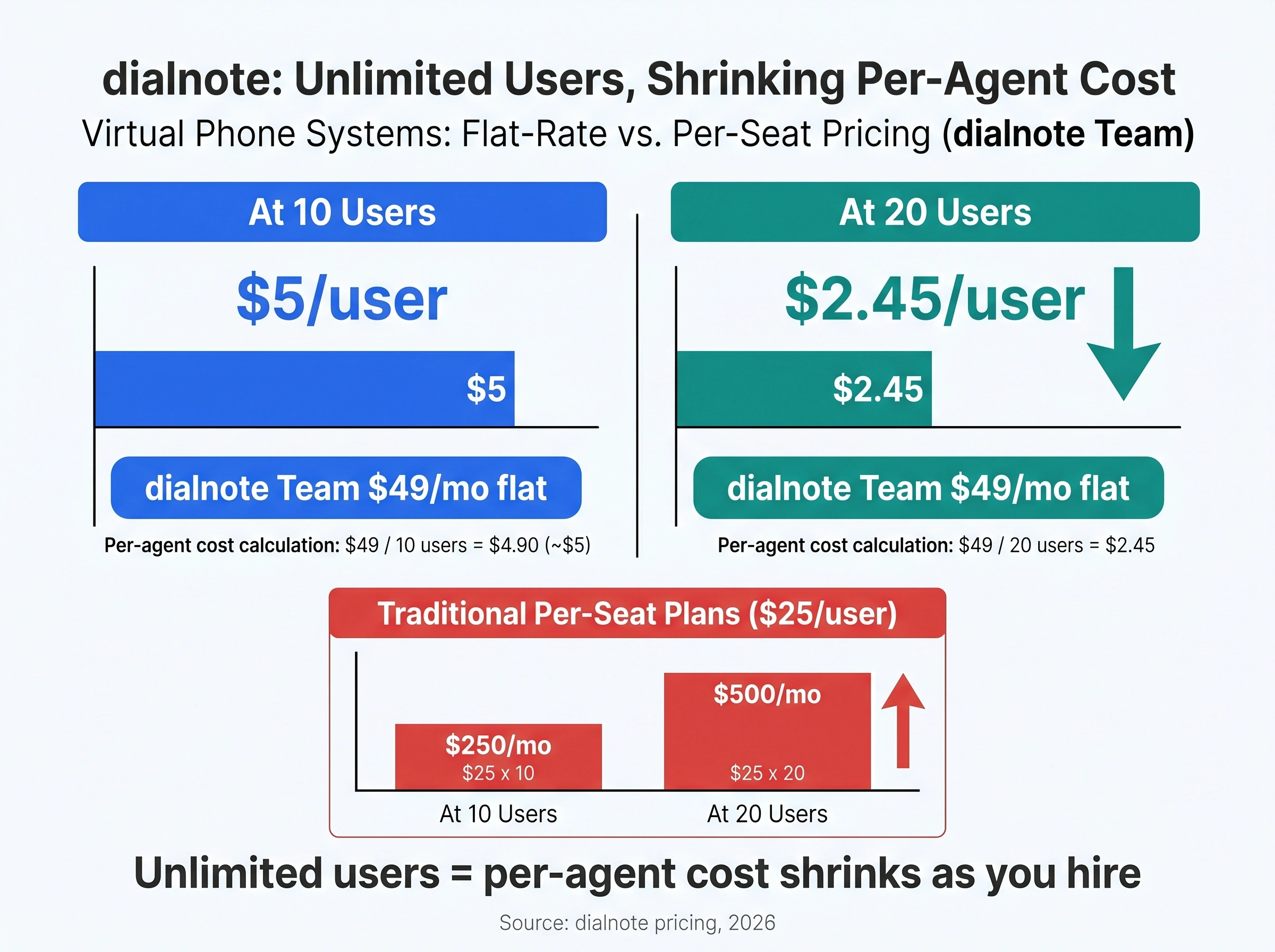
dialnote was designed around that observation. The Team, Business, and Pro plans all include unlimited users. Whether you hire your 5th rep, your 15th, or your 30th, the bill doesn't move. That makes the per-agent cost ($4.90/user at 10 seats on Team, dropping to $2.45/user at 20 seats) the lowest in this category.
Plans (monthly billing):
| Plan | $/mo | Users | Numbers | Minutes (shared by human + AI calls) | AI agents | Wallet credit |
|---|---|---|---|---|---|---|
| Solo | $19 | 1 | 1 | 250 | None | $3 |
| Team | $49 | Unlimited | 2 | 700 | 1 | $8 |
| Business ⭐ | $99 | Unlimited | 3 | 1,400 | 5 | $15 |
| Pro | $199 | Unlimited | 5 | 2,800 | 10 | $30 |
Team adds automatic call recording, AI transcription and summaries, knowledge base, API access, and native integrations with HubSpot, Salesforce, Pipedrive, and Zapier. Business adds 14-language AI and the visual call flow builder. Pro adds AI call tags, AI call evaluation, call queueing, disposition codes, and a dedicated CSM. Annual billing is 20% off everything.
What 10 users actually pay: $99/mo flat on Business. That covers 3 phone numbers, 5 AI agents, 1,400 minutes shared across human and AI calls, 14-language AI, and the visual call flow builder. Extra numbers (local or toll-free) are $5/mo per number on Business and above, available in the US, Canada, UK, India, and France (more countries opened on request). The wallet covers international calls and any minute overage at $0.89/min, with auto top-up so the wallet refills the moment it drops below your chosen floor.
What dialnote does on a call: the AI answering service is built for inbound. It greets the caller in any of 14 languages, asks qualifying questions, and then takes whichever next step the call needs:
- Captures the lead (name, number, reason for calling) and writes a structured message to the team inbox in real time
- Books, reschedules, or cancels meetings via Calendly or Cal.com
- Syncs the call, contact, and lead data into HubSpot, Salesforce, Pipedrive, Zoho, or Zendesk
- Auto-suggests leads from call transcripts so reps don't have to re-listen
- Sends follow-up SMS with booking links, confirmations, or callback notices
- Transfers the call to a human team member, or hands off to another AI agent (sales to support, English to Spanish) using the visual call flow builder
- Answers FAQs from a knowledge base (hours, pricing, location, insurance, returns)
- Auto-tags the call (inquiry, complaint, lead, support) and writes a summary with next steps to your CRM
The visual call flow builder (Business and up) wires IVR menus, ring groups, business hours, and after-hours overflow together. Automatic call recording, transcription, and summary ship from Team upward. Outbound calling works the same way (local numbers in the US, Canada, UK, India, and France; calling supported in 90+ countries via wallet) but the lift is in the inbound experience.
Free 10-day trial with Pro features, no credit card needed. You can also try the AI receptionist demo without signing up at all.
Reddit and review signal: dialnote is newer than RingCentral or Nextiva, so the Reddit thread count is shorter. Active reviewers consistently call out the flat-rate pricing and the AI voice agent included from $49 as the two standout features. The most common piece of feedback is that the wallet model makes overage feel manageable instead of mystery-billed. Several reviewers note they switched from per-seat platforms after running the 12-month math.
Verdict: If your team mostly takes inbound calls, you need an AI agent that can answer overflow and after-hours traffic, and you don't want to do per-seat math every time you hire, dialnote is the cheapest option in this list by a wide margin. Outbound calling is supported (90+ countries via wallet), but the bigger lift is on the inbound side. The trade-off: dialnote is newer than RingCentral, so the marketplace of niche integrations is smaller. For most growing 3 to 50-person teams, that gap doesn't matter.
2. RingCentral
Established UCaaS with the deepest CRM integration catalog and per-seat pricing that scales linearly.
The pitch: One platform for voice, video, SMS, team chat, and 300+ third-party app integrations including Salesforce, HubSpot, Microsoft Teams, and most major SaaS tools. RingSense is the in-house AI module, bundled on select tiers.
The reality: RingCentral is the most established UCaaS platform on this list, used by 500,000+ businesses. The integration catalog is genuinely deep, and the platform is one of the few that can plausibly replace your phone, video, and team chat tools at once. But the per-seat math punishes small teams. Core is $20/user/mo, Advanced $25, Ultra $35, and you'll need at least Advanced for usable CRM integration. Smart Concierge (the AI receptionist equivalent) is billed separately on top, usually adding $30-$60 per user per month for AI parity with what dialnote includes on Business.
What 10 users actually pay: $290 to $510 a month. Advanced at $25 x 10 = $250/mo. AI add-on $30 to $100/mo for 10 users. Two extra phone numbers $10 to $30/mo. Real-world bill typically lands in the upper range once AI usage is included.
Reddit and review signal: According to Trustpilot, RingCentral averages 2.2 out of 5 stars across customer reviews. The loudest complaints cluster around two themes. Aggressive auto-renewal locks customers in for another year before they realize, with cancellation requiring manager escalation. Long support response times, account managers going silent, and double-billing issues taking weeks to resolve. On Reddit's r/sysadmin, recurring gripes are billing surprises after the second year of the contract and a UI that "tries to be Slack, Zoom, and Salesforce at once." According to G2, roughly 22% of RingCentral's negative reviews flag pricing escalation across tiers.
Verdict: Powerful but heavy. Worth it if you're replacing a contact center or need 200+ native integrations. Overkill (and costly) if you just want a business phone system for a 10-person agency.
3. Grasshopper
The oldest virtual phone system on the market, designed for solo operators and very small teams.
The pitch: A virtual number, an auto-attendant, and a mobile app, all on flat-rate plans with no per-seat fees. Solo plan at $14/mo for one number with three extensions, Partner at $25 for three numbers and six extensions, Small Business at $80 for five numbers and unlimited extensions.
The reality: Grasshopper is the simplest option on this list, and that's both the appeal and the limitation. It's a 20-year-old product that hasn't kept up with the AI generation of phone tools. There's no native AI agent, no call coaching, no transcription, and the CRM integration list ends at HubSpot, Zapier, and a few legacy connectors. If you need an AI receptionist, you'll bolt on a third-party tool via Zapier and pay separately for the AI minutes.
What 10 users actually pay: $180 to $250 a month. Small Business plan at $80/mo covers 5 numbers and unlimited extensions. Add a third-party voice AI tool for the receptionist function, typically $100 to $170/mo for a basic setup. Total often lands around $220/mo with light AI usage.
Reddit and review signal: Long-time users on G2 and Capterra praise reliability and the no-per-seat pricing for very small teams. The most cited complaint on Reddit's r/smallbusiness is that the product hasn't kept up with newer entrants: no AI, no native CRM sync, no analytics worth using. Several users report the mobile app dropping calls or showing duplicate voicemails. The cancellation flow is described as friction-heavy, with refunds granted only in narrow conditions.
Verdict: A reasonable fit for a 1 to 3-person consultancy that wants a professional number and a basic auto-attendant. The moment AI, analytics, or real CRM integration matters, you'll outgrow Grasshopper inside 12 months and end up shopping again.
4. Quo (formerly OpenPhone)
Design-forward virtual phone system aimed at early-stage teams, with Sona AI sold as a paid add-on.
The pitch: A clean modern mobile and desktop app, shared inboxes that work for SMS and calls, and onboarding that genuinely takes under 5 minutes. Sona is the in-house AI agent module, gated to the Business tier. OpenPhone rebranded to Quo in September 2025 alongside a $105M growth round, so older Reddit threads still use the OpenPhone name.
The reality: Quo built the best-looking product in the small business virtual phone category. The shared inbox is genuinely useful for 2 to 5-person teams handling sales messages together. But the per-seat math scales poorly past 15 to 20 users, and Sona is priced per call or per minute with no included AI minutes on the standard plan. Email-only support on the Basic plan is slow enough that critical issues can stay open for days.
What 10 users actually pay: $420 to $510 a month. Business plan $33 x 10 = $330/mo. Each user gets one number; team-shared numbers are extra. Sona AI usage typically runs $80 to $150/mo for a team handling 200 inbound calls. Two extra shared numbers $10 to $30/mo.
Reddit and review signal: Quo (still referred to as OpenPhone in most older posts) gets praised for design but flagged on three themes. Support: no phone support, no live chat on Basic, email turnaround slow enough that disabled accounts stay disabled for days, per multiple Trustpilot reviews. Call quality: choppy or robotic audio, one-way calls, drops on weak Wi-Fi. App reliability: messages not loading, attachments missing, Android SMS search broken for some users. On Reddit's r/Entrepreneur, the most upvoted complaint is that the Business plan price jumped after the Sona AI launch, with users feeling pushed into the higher tier.
Verdict: Beautiful product, fast setup, fits 1 to 5-person teams nicely. Past 15 users, the per-seat math gets painful and the AI add-on math gets worse, and you'll be shopping for an unlimited-seats option within the year anyway.
5. Phone.com
Budget virtual phone system for micro-teams, with hybrid seat and extension pricing.
The pitch: A flat-rate virtual phone system from $14.99/user/mo with unlimited extensions on some tiers and a pay-as-you-go calling option for very light usage. Three plans: Basic, Plus, Pro.
The reality: Phone.com has one of the cheapest sticker prices in this category, and the feature set reflects it. There's no native AI agent or AI receptionist. Transcription is available on Plus and above, but it's basic. The UI feels dated, and the integration depth is limited to a handful of CRMs and Zapier. The pricing structure is opaque enough that the published per-seat number isn't what most teams actually pay once they add minutes, numbers, and transcription.
What 10 users actually pay: $200 to $320 a month. Plus plan around $24 x 10 = $240/mo. Two extra numbers $10/mo. If you need an AI receptionist, you're bolting on a third-party tool at $80 to $150/mo, and Phone.com goes from cheap to mid-pack in a hurry.
Reddit and review signal: G2 and Capterra reviews describe Phone.com as functional but uninspiring. The most cited positives are price and call quality for domestic calling. Negatives cluster around the mobile app crashing, support response times measured in days not hours, and a billing flow that several reviewers describe as "designed to make you stay." On Reddit's r/smallbusiness, the recurring critique is that newer entrants like dialnote and Quo (formerly OpenPhone) have shipped 5 years of features in 18 months while Phone.com's roadmap has felt frozen.
Verdict: Solid pick if your team is 2 to 6 people, you only make domestic calls, and AI is a hard no. For anything beyond that, the cheap sticker price gets eroded by add-ons fast.
6. Nextiva
Omnichannel virtual phone system that bundles calls, SMS, chat, and email behind multi-year contracts.
The pitch: Calls, SMS, chat, and email in a single inbox with shared customer history, plus sentiment analysis and call summaries on the higher tiers. Aimed at customer-facing teams that handle inquiries across channels.
The reality: Nextiva's omnichannel dashboard is genuinely useful for 5 to 25-person support teams. The NextOS view pulls customer history across channels, so an agent on a call sees prior chat and email context in the same screen. The catch is the contract. The lowest advertised prices typically require a 36-month commitment, and Reddit reports of being locked into 3-year auto-renewals show up often enough that you should treat every Nextiva quote as a contract negotiation. The voice AI agent is gated to Power Suite at $60/user/mo, with metered AI minutes on top.
What 10 users actually pay: $320 to $470 a month. Engage plan at $40 x 10 = $400/mo for AI parity with what dialnote includes on Business. Two extra numbers $10 to $30/mo. Power Suite at $60 x 10 = $600/mo if you want the voice AI agent module, which still has metered minute charges on top.
Reddit and review signal: Capterra and Trustpilot reviews flag two recurring issues. Contract pain: users describe being locked into 3-year auto-renewals, with cancellation attempts resulting in demands for two more years of payment. Call quality: dropped calls and one-way audio show up regularly, and support's default response is reportedly that the issue is on the customer's network. On Reddit's r/smallbusiness, the most upvoted complaint is the desktop app needing multiple sign-outs per day to keep receiving calls.
Verdict: Strong on omnichannel and customer support workflows. AI features are gated to Engage or Power Suite, which is where the real AI parity with dialnote starts. Read the contract terms carefully before signing, and request explicit cancellation language in writing.
7. Dialpad
AI-first virtual phone system that ships transcription with every plan and sells the AI Agent module separately.
The pitch: Native AI on every plan: real-time transcription, sentiment tracking, post-call summaries. Ai Agent (launched in 2024) handles after-hours coverage and basic qualification.
The reality: Dialpad pioneered native AI in business VoIP, and the transcription product is genuinely the most polished in the category when conditions are good. But conditions often aren't. Accents, cross-talk, noisy rooms, and industry jargon (legal, healthcare, logistics) consistently trip the transcription engine. The Ai Agent module is sold as a separate paid add-on, typically $50 to $100/mo for a small team's call volume. The most powerful AI tools (advanced analytics, coaching dashboards) live on Enterprise pricing.
What 10 users actually pay: $340 to $500 a month. Pro plan $25 x 10 = $250/mo. Ai Agent add-on $50 to $100/mo. Two extra numbers $30 to $50/mo. Final bill usually lands at $340 to $500.
Reddit and review signal: Reviews on G2 and Capterra repeatedly flag AI accuracy issues in real-world conditions. Numbers and emails get mangled in transcription, speakers mislabeled during multi-agent calls, and industry jargon falls flat. On Reddit's r/sales, users describe AI coaching cues being useful for new reps but ignored by senior reps after the first month. Beyond AI, users cite choppy audio when switching between Wi-Fi and mobile data, and final invoices sometimes include taxes and carrier fees that weren't in the original quote.
Verdict: Best AI experience among legacy VoIP providers when conditions are good. The catch is that the Ai Agent is a separate paid module, accuracy varies by call conditions, and reaching parity with what dialnote includes on Team requires further upgrades. Solid fit for sales teams that already pay for Gong-style coaching tools and want them bundled.
8. Vonage Business
Legacy UCaaS player with deep CRM integrations and per-seat pricing that scales like a 2015 playbook.
The pitch: Voice, SMS, and team chat in one platform with integrations into Salesforce, HubSpot, Microsoft Dynamics, and the long tail of legacy CRMs. Three tiers: Mobile, Premium, Advanced.
The reality: Vonage Business has been around long enough that it integrates with almost every CRM you've heard of. The Mobile plan starts at $14.99/user/mo, but it strips out video, chat, and analytics, so most teams end up on Premium ($24.99) or Advanced ($34.99) to get features that matter. AI features are gated to higher tiers, with the AI Virtual Agent module priced as a separate quote-based add-on. Onboarding is multi-step and usually includes a sales call before activation.
What 10 users actually pay: $310 to $560 a month. Premium $24.99 x 10 = $250/mo. AI Virtual Agent module $60 to $200/mo depending on call volume. Two extra numbers $10 to $30/mo. Final bill typically $310 to $560.
Reddit and review signal: Vonage Business reviews on G2 and Capterra trend mixed. Long-time customers cite reliable call quality and CRM integration depth. Negatives cluster around three themes. Onboarding: multiple sales calls before the account goes live. Support: tier-based response times that vary wildly, with lower-tier accounts waiting days. UI: feels dated next to OpenPhone or Dialpad. On Reddit's r/sysadmin, the recurring critique is that Vonage's product roadmap has felt slower than Cisco or RingCentral for the past 18 months.
Verdict: Solid pick for a 15 to 50-person team that needs to plug into a legacy CRM. For a smaller team that wants AI baked in and no per-seat math, the per-user pricing and standard annual contract make Vonage hard to recommend.
What does a virtual phone system actually cost for a 10-person team?
The pattern is clear by now. Most providers advertise a low per-seat number, then sell AI minutes, extra phone numbers, and CRM integrations as add-ons. By the time you've configured what a 10-person team actually needs (platform + AI receptionist + IVR + 3 working phone numbers), the real bill is 1.5x to 3x the headline price.
For a per-seat plan, the math typically runs:
- Platform: 10 users at $20 to $45 per seat per month = $200 to $450/mo
- AI receptionist module: $50 to $200/mo for moderate volume
- Two extra phone numbers: $10 to $30/mo
- Total: $260 to $680/mo
For dialnote Business: $99/mo flat. Unlimited users, 3 numbers, 5 AI agents, 1,400 minutes, 14-language AI, visual call flow builder. That's $9.90 per user at 10 seats, dropping to $4.95 per user at 20. The per-agent cost is the lever, and unlimited seats pulls it the most.
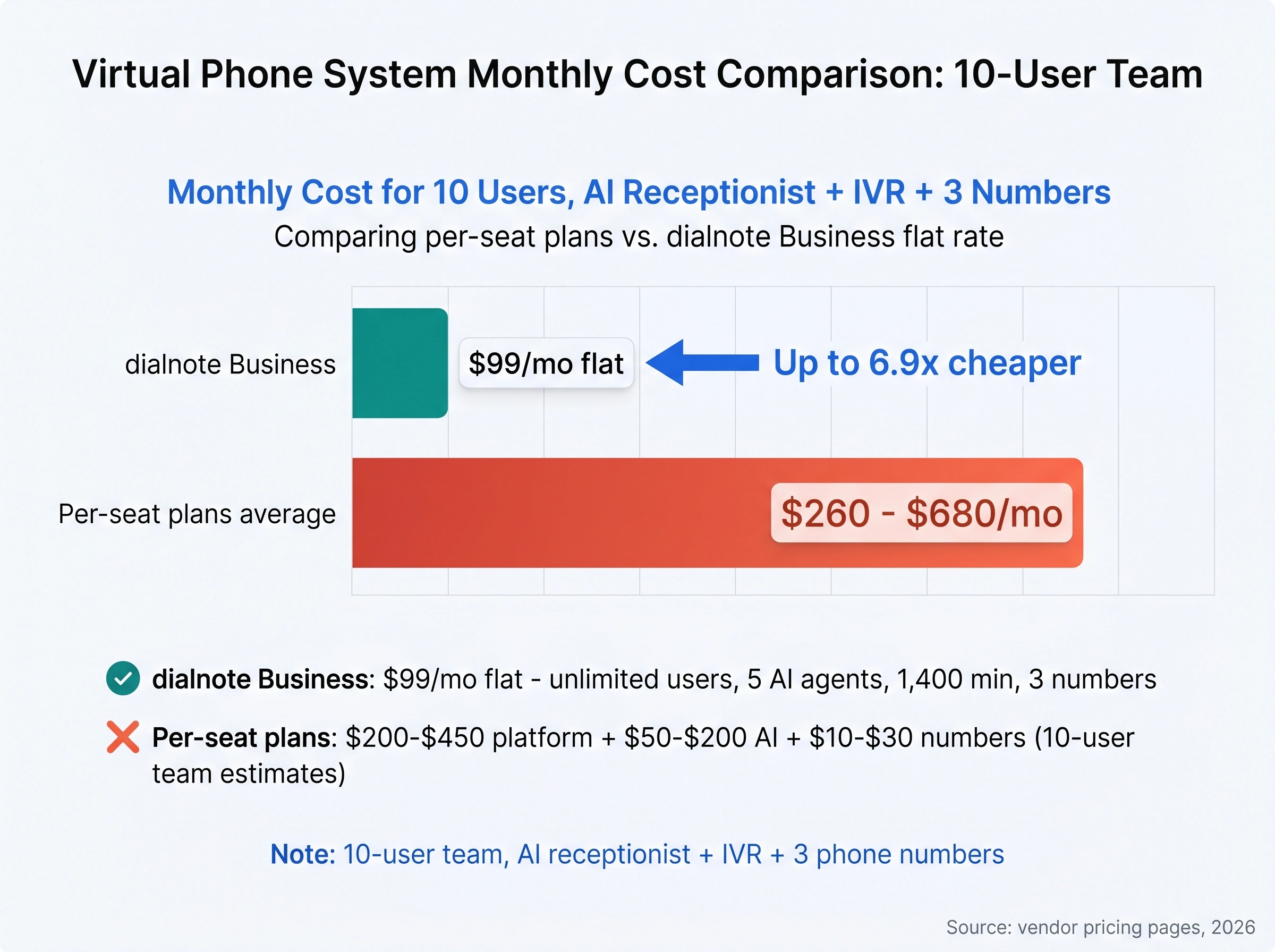
The gap compounds as you grow. At 20 users, the per-seat bill roughly doubles. dialnote stays at $99/mo. At 30 users, the annual saving for most teams is large enough to cover a junior hire. Worth running the math on your own team size before signing anything else?
How do you pick the right virtual phone system for your business?
Three honest questions cut through most of the noise.
How many people will use this in 12 months? If you're a true solopreneur on a $30 budget, Grasshopper Solo or dialnote Solo at $19/mo work. If you're at 3 people and growing, a flat-rate unlimited plan like dialnote's Team or Business pricing ($49/mo or $99/mo) saves money every time you hire. Per-agent cost is the metric that matters, not the per-seat sticker.
Do you need an AI receptionist? If yes, the real question is whether the AI is bundled or sold as a per-minute add-on. dialnote includes 1 AI agent at $49/mo and 5 agents at $99/mo. Dialpad, Quo (formerly OpenPhone), RingCentral, and Nextiva all charge separately, typically $50 to $200/mo for a 10-person team. If your AI receptionist isn't included in the base plan, you're paying twice for the same business hour.
What's your call volume profile? Most "unlimited" plans cap at 1,000 to 3,000 minutes per user per month under fair use, and only count US and Canada calls. If your team makes regular international calls, a wallet model like dialnote's handles it cleanly. If you stay domestic, fair-use unlimited covers most teams, but read the policy before signing.
Two questions to skip: "which provider has the most integrations" (you'll only use 3 to 5 of them, and most "1,000+" claims rely on Zapier or Make) and "which has the highest uptime" (every major provider claims 99.99% and the real outages don't track the marketing number).
The bottom line
There isn't one best virtual phone system for business. There's a best fit for your team size, your AI needs, and how fast you're growing. For most 3 to 50-person teams that want predictable monthly costs and an AI agent included, dialnote's Team plan at $49/mo or Business at $99/mo is hard to beat on math alone. For enterprise teams with deep Salesforce dependencies and a dedicated IT lead, RingCentral makes sense, with the caveat that contracts and support quality come up often in user reviews. For sales-driven teams using HubSpot or Salesforce, Dialpad fits the workflow but at 3 to 5x the cost of dialnote Team for a 10-person setup.
Run the actual cost calculation for your team size before committing. Most providers look very different at 5 seats versus 25 seats. And read the fair-use policy on the unlimited plan, because that's where the surprises live.
If you want to see how the math works for your team, start a free 10-day dialnote trial (no credit card needed). It plugs into HubSpot, Salesforce, or Pipedrive in under 10 minutes.
Prefer a guided walkthrough? Book a demo and we'll go through your call volume, AI usage, and what unlimited-user pricing looks like at your size.
Frequently asked questions
A virtual phone system is a cloud-hosted phone platform that runs over the internet instead of physical lines. It gives a business shared phone numbers, IVR menus, call recording, mobile and desktop apps, and (on platforms like dialnote) an AI receptionist, with no PBX hardware.
Per-seat virtual phone plans run $200-$680/month for a 10-user setup with AI receptionist, IVR, and 3 phone numbers once add-ons are included. Flat unlimited plans like dialnote Business are $99/month for unlimited users, 3 numbers, 5 AI agents, and 1,400 minutes.
Yes. Dialpad, Quo (formerly OpenPhone), RingCentral, and Nextiva bill AI minutes separately, usually $50 to $200/month for a small team. dialnote bundles 1 to 10 AI agents in paid plans, with AI usage drawing from the plan's calling minutes and $0.89/min overage from a USD wallet.
Not really. Almost every "unlimited" virtual phone plan hides a fair-use clause that caps usage at 1,000-3,000 minutes per user per month, only counts US and Canada calls, and lets the carrier throttle or push you to a higher tier if your call pattern looks like a call center.
Six features cover most growing teams: shared phone numbers, an auto-attendant or IVR, call recording with transcripts, CRM integration (HubSpot, Salesforce, Pipedrive), an AI receptionist for after-hours, and clean mobile and desktop apps. dialnote bundles all six from $49/month.

Written by
Prateek Bhatt
Co-Founder, SmartReach.io
Prateek Bhatt is a product leader, programmer, and serial entrepreneur with over 12 years of experience building SaaS and AI-powered tools for sales and customer service teams. As Co-Founder of SmartReach.io - a multichannel outreach platform used by...
Prateek Bhatt is a product leader, programmer, and serial entrepreneur with over 12 years of experience building SaaS and AI-powered tools for sales and customer service teams. As Co-Founder of SmartReach.io - a multichannel outreach platform used by...
Related Articles
Best VoIP providers compared & ranked
Compare the best VoIP providers ranked by total cost, with real 10-seat pricing including the platform fee, AI agent, IVR setup, and a phone number.

Best VoIP phone systems for small business
Compare 9 best VoIP phone systems for small business in 2026, with real pricing for 10 users including AI agents, IVR, and phone numbers.
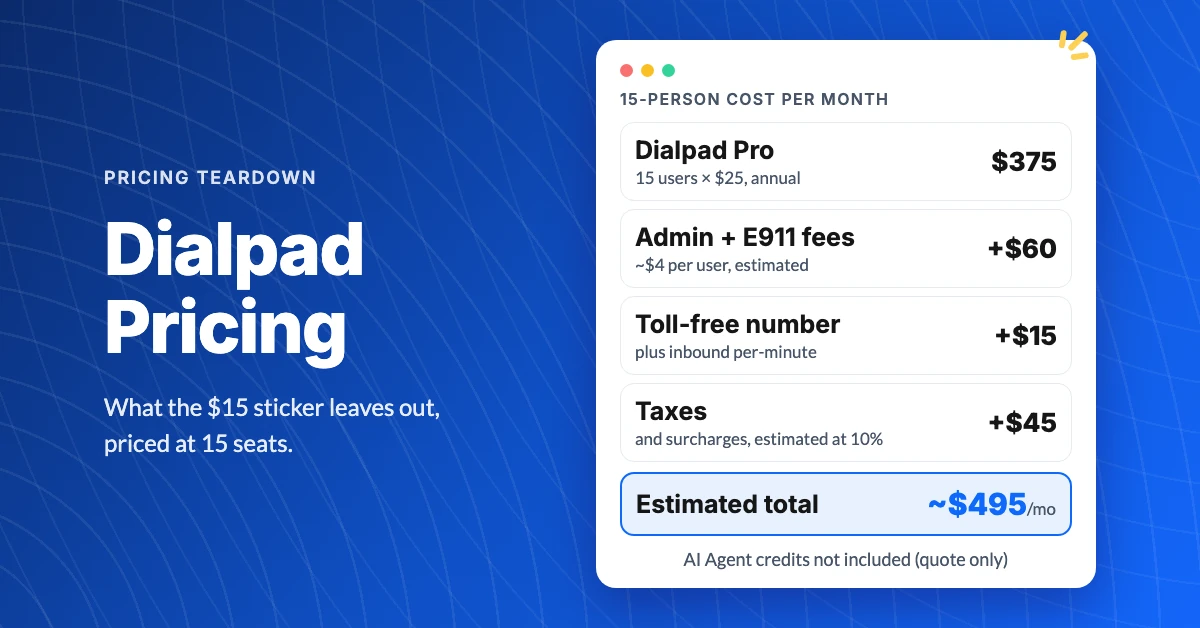
What Does Dialpad Pricing Really Cost a Small Team?
See what Dialpad pricing really costs: $15 to $35 per user, the 3-seat Pro minimum, per-text and admin fees, and real team math at 5, 15 and 30 people.