Phone vs Email in Sales: When to Pick Up the Phone
Your prospect opened your last three emails but didn't reply. Phone vs email sales decisions like this one can make or break your quarter. So what do you do next?
Amy, a senior SDR at a mid-size software company, faces this exact situation daily. She's good at her job. Consistently in the top 3 on her team. But she's noticed something strange. Some prospects who ignore her emails pick up the phone on the first ring. Others do the opposite. They'll reply to an email instantly but send every call to voicemail.
What gives? Is there a science to this?
Actually, yes. And once you understand it, picking the right channel becomes a lot less random.
TL;DR:
- Phone vs email sales isn't an either-or call. Match the channel to the moment, not a fixed rule.
- Prospects say they prefer email (80%, per HubSpot), yet calls convert far better than cold email at getting a real response.
- Pick up the phone for high-ticket deals, real-time objection handling, trust-building, and hot leads. Calling within 5 minutes of a form fill makes you 100x more likely to connect.
- Stick with email for at-scale outreach, documentation you'll reference later, time-zone gaps, and prospects who clearly prefer it.
- The hybrid play (email first, call second) books roughly 6% more meetings than email alone.
The phone vs email sales paradox (the numbers don't lie)
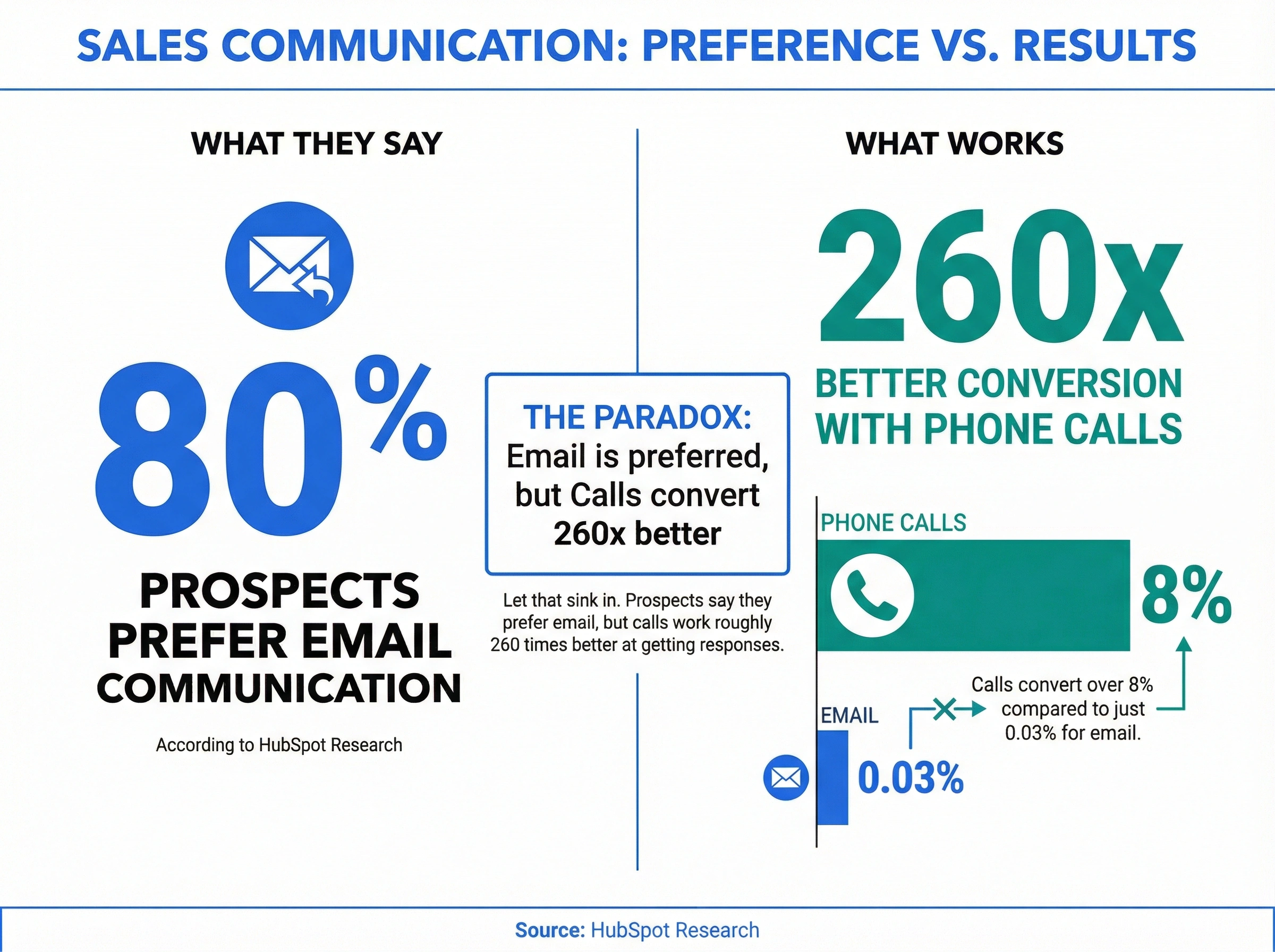
Here's a stat that might surprise you: according to HubSpot research, 80% of prospects say they prefer email communication with sales reps. But here's the catch. Phone calls convert at a far higher rate than cold email, by a wide margin.
Wait, what?
Let that sink in. Prospects say they prefer email, but calls work far better at getting responses. So which metric should you trust?
Both, actually. The preference stat tells you about interruption tolerance. The conversion stat tells you about engagement quality. They're measuring different things entirely.
Here's my take: people prefer email because it's non-intrusive. They can respond when they want, ignore what they want, and maintain control of their time. But that same convenience makes it easy to deprioritize. Your email sits in an inbox with 50 others.
A phone call? That's happening right now. There's no queue. You've got their full attention (even if only for 30 seconds).
When should you call a prospect instead of emailing?
Call a prospect when the deal is high-value, when you need to handle objections in real time, when trust matters early, or when a lead just showed interest. Phone calls convert better than cold email and resolve concerns in minutes instead of days, so speed and complexity both point to the phone.
Not every situation calls for a call. (Sorry, couldn't resist.) But some definitely do.
High-ticket deals
If you're selling something that costs $10,000 or more, pick up the phone. Period. The math is simple. Your time investment in a 15-minute call is tiny compared to the deal size. And for enterprise purchases, decision-makers often expect phone contact. It signals seriousness.
One study found that cold calling works best for B2B sales to founders, owners, and C-level executives. These folks are comfortable with phone conversations. They've been fielding sales calls their entire careers.
You need to handle objections in real time
Email is terrible for objection handling. Why? Because every objection creates a back-and-forth that takes days. The prospect says "it's too expensive." You respond with your value proposition. They counter with budget constraints. You offer a discount.
By the time you've exchanged four emails, a week has passed. On a phone call, that same conversation takes five minutes.
If you sense resistance or confusion, call. You'll resolve it faster and maintain momentum.
Trust building is critical
Can you build trust over email? Sure. But it takes longer. Much longer.
Calls create connection through tone, pacing, laughter, and shared moments. Your prospect can tell if you're genuinely trying to help or just reading from a script. They can hear your expertise in how you answer questions. (Need help making those calls count? Check out our guide on improving customer call experience.)
This is especially important early in the relationship. A quick intro call can establish more rapport than weeks of email exchanges.
The prospect has shown interest
If someone downloaded your whitepaper, attended your webinar, or requested a demo, they're warm. Don't let them cool off in your email sequence. Call them.
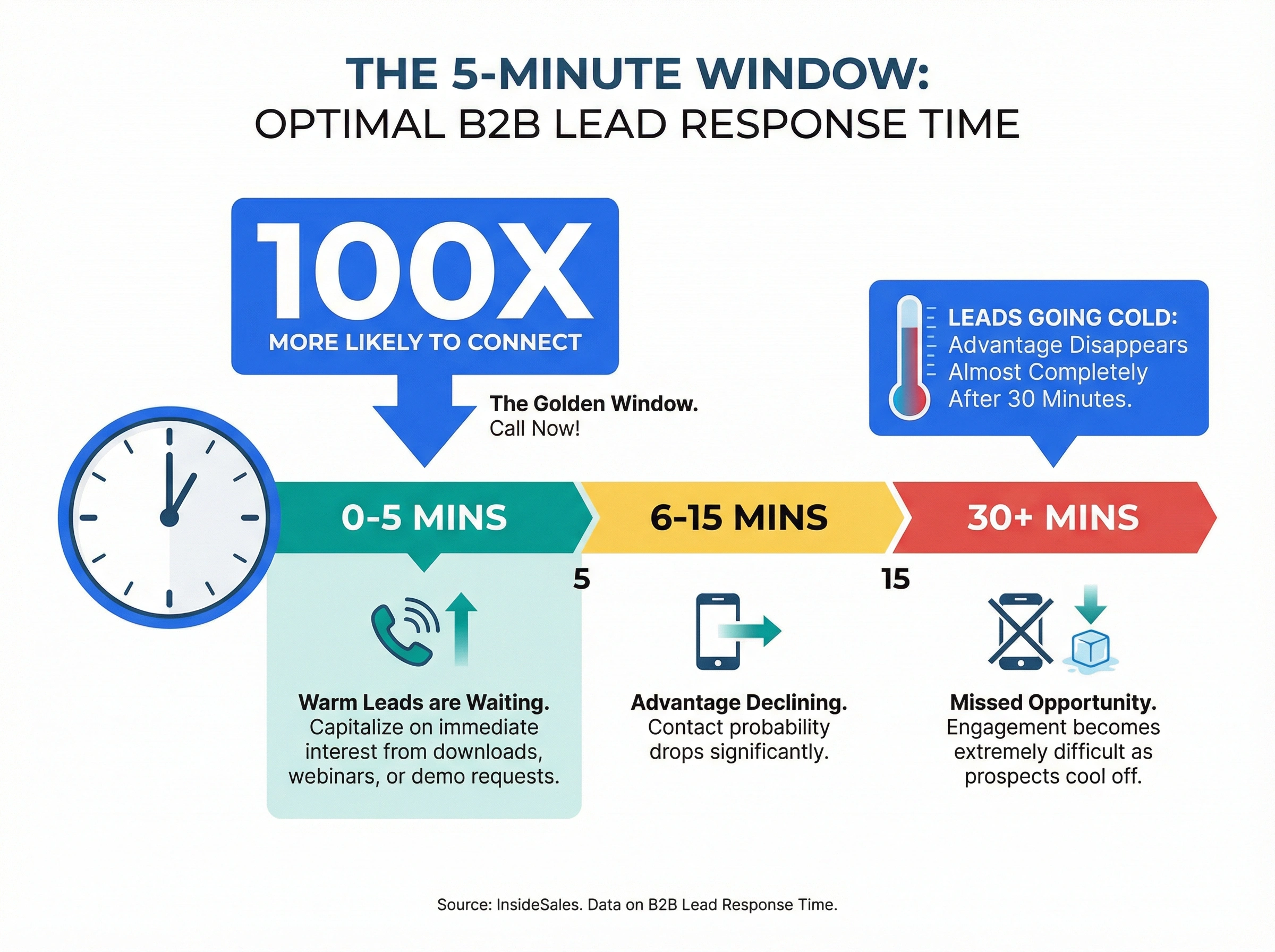
Timing matters here. A study from InsideSales found that calling within 5 minutes of a lead form submission makes you 100x more likely to connect. Yes, 100x. After 30 minutes, that advantage disappears almost completely.
When is email better than calling a prospect?
Email beats calling when you're doing outreach at scale, when a prospect clearly prefers it, when you need a written record of terms, or when time zones make a live call hard. It respects the prospect's schedule, scales to hundreds of contacts, and leaves a paper trail you can point back to later.
I'm not saying calls are always better. They're not. Here's when to stick with email.
Initial outreach at scale
You can't call 200 prospects in a day. Well, you could try, but you'd barely scratch the surface with meaningful conversations. Cold email scales in a way calls simply can't.
For top-of-funnel prospecting, email lets you cast a wider net. You can reach hundreds of potential customers while your competitors are dialing one number at a time.
Your prospect prefers it
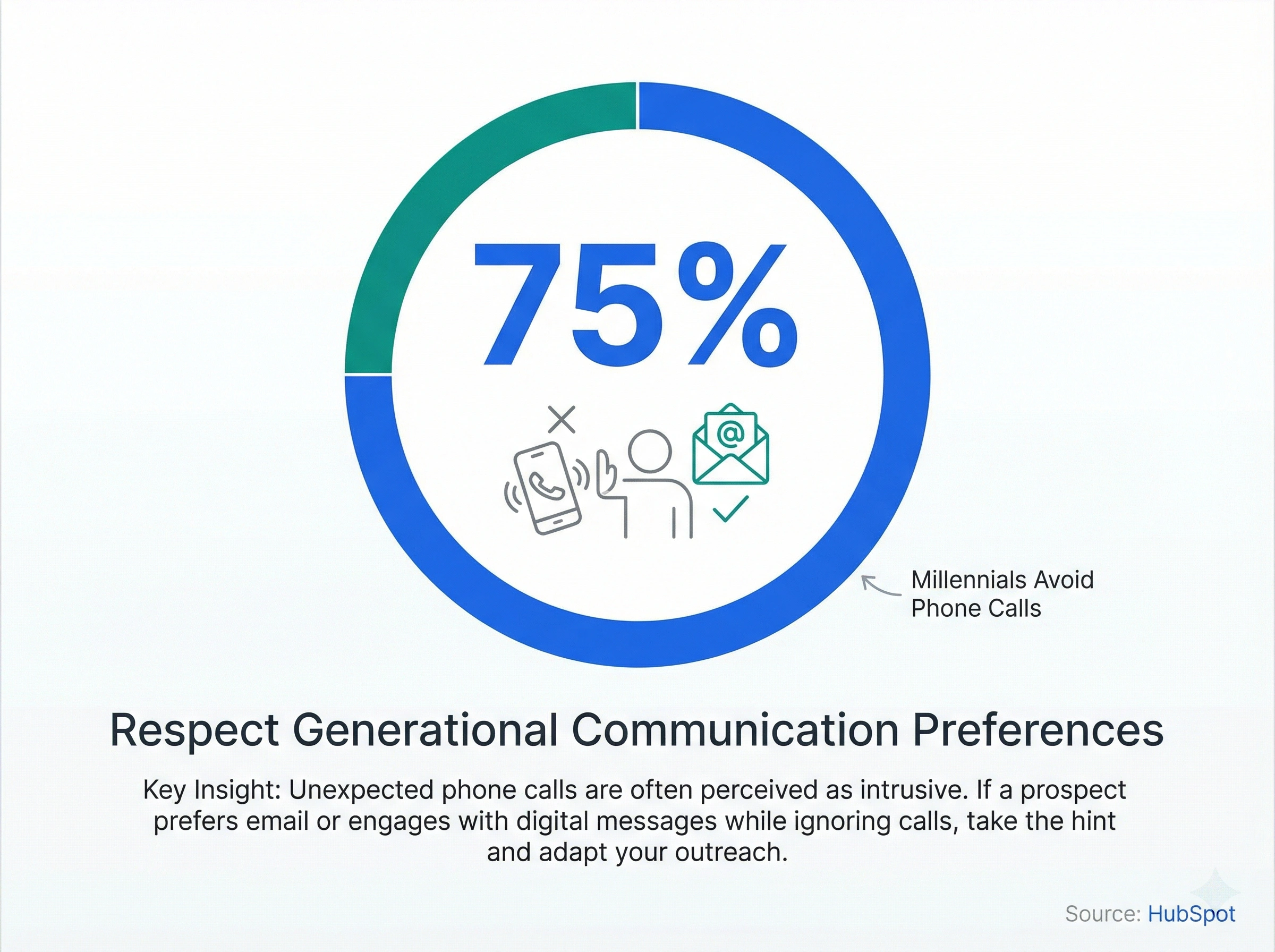
Millennials and younger professionals often have a genuine aversion to unexpected phone calls. According to some studies, 75% of millennials avoid phone calls because they're time-consuming.
Pay attention to signals. If someone's LinkedIn profile says "prefer email" or they've consistently ignored your calls while engaging with emails, take the hint. Meeting prospects where they are isn't weakness. It's good selling.
You need a paper trail
Some conversations need documentation. Pricing discussions, contract terms, feature specifications. These belong in email where both parties can reference them later.
I learned this one the hard way. A verbal agreement about pricing led to a heated disagreement two months later. "That's not what we discussed," my prospect said. He was wrong, but I had no proof.
Global prospects across time zones
Unless you want to call someone at 3 AM their time, email is your friend for international sales. It respects their schedule and doesn't require both parties to be available simultaneously. If you're managing a distributed team, our remote team communication guide covers how to mix channels effectively.
Should you email or call a prospect first?
Email first, then call. Send a short intro email that offers value, then follow up with a call that references it. Your name is already familiar, you've got a natural opener, and the prospect has context even if they only skimmed the email. This order books more meetings than email alone.
Here's the thing. The best salespeople don't pick sides. They use both channels strategically.
A pattern that works really well: email first, call second. Your initial email introduces you and provides value without demanding immediate attention. Then your follow-up call references that email: "Hey, I sent you something yesterday about [topic]. Did it resonate?"
This approach does three things:
- Your name is already familiar when they see caller ID
- You have a natural conversation starter
- The email provides context even if they didn't read it closely
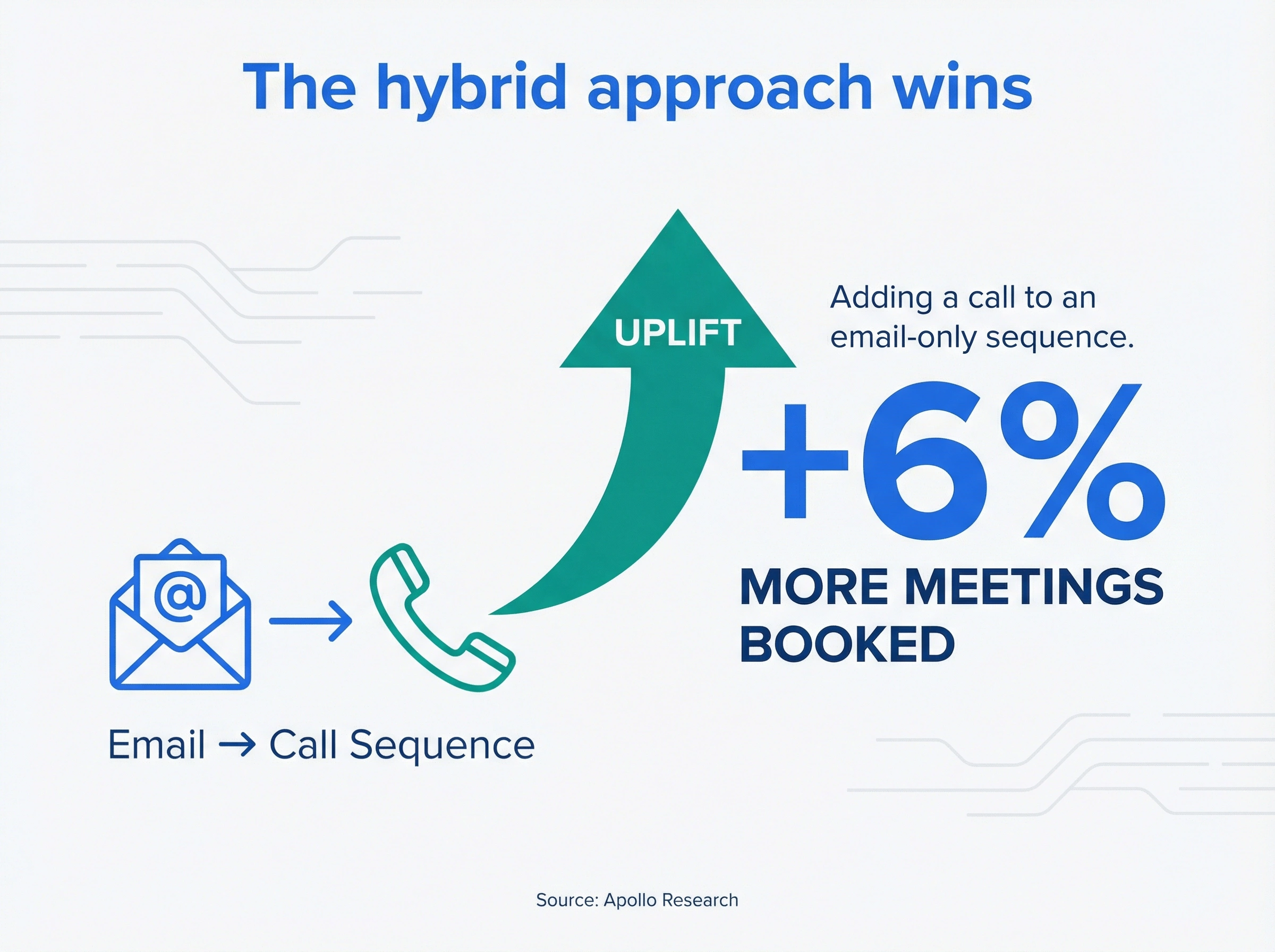
Data backs this up too. According to Apollo research, adding a call to an email-only sequence increases meetings booked by 6%. That might sound small, but over hundreds of prospects, it's significant.
Matching channels to buyer personas
One framework I find helpful: think about who you're calling and adjust accordingly.
Senior executives and founders: These decision-makers grew up making deals on the phone. They respect direct outreach. Call more, email less.
Individual contributors and junior staff: Often away from their desks, uncomfortable with cold calls, and gatekept by voicemail. Email lets you reach them without going through layers of screening.
Technical buyers: They want details before a conversation. Send comprehensive information via email first. Let them digest it. Then offer a call to discuss questions.
Time-crunched managers: They don't have time for lengthy emails OR lengthy calls. Short emails to qualify interest, followed by focused calls with clear agendas.
Practical tips for each channel
Making better sales calls
Best times to call? Wednesdays and Thursdays, either early morning (8-9:30 AM) or after lunch (2-3 PM). Mondays are chaotic. Fridays, people are mentally gone.
Keep early calls brief. Your goal isn't to close on the first call. It's to earn a longer conversation. If you can identify one problem you might solve, that's a win.
And leave good voicemails. Most go unreturned, but a concise, specific message can prime the pump for your next touchpoint. "Hi Sarah, this is Amy from Acme Software. I noticed your team is expanding into the midwest. We helped a similar company reduce their onboarding time by 40%. If that's interesting, I'd love a quick chat. I'll try you again Thursday, or feel free to reach out directly."
Writing emails that get responses
Subject lines matter more than body copy. Keep them short, specific, and curiosity-inducing. "Quick question about your midwest expansion" beats "Checking in" every time.
Get to the point fast. Your prospect decides within seconds whether to keep reading. Don't waste the first paragraph on pleasantries.
And personalize meaningfully. Mentioning their company name isn't personalization. Referencing something specific from their LinkedIn post, their recent funding round, or their company news is.
When dialnote can help
If you're spending hours logging calls, writing follow-up emails, and updating your CRM, you're wasting selling time. That's exactly where modern phone systems with smart call analytics become valuable. We've written more about how a VoIP phone system built for sales can catch calls your team would otherwise miss.
dialnote captures every conversation automatically with its AI-powered call features. AI transcribes calls, extracts key points, and syncs notes to your CRM without you lifting a finger. So instead of choosing between calling and documentation, you get both. Plans start at $19/mo flat, with a 10-day free trial and no credit card needed.
The result? More time for the conversations that actually close deals. Less time on admin work that doesn't.
The bottom line
Phone vs email isn't an either-or question. It's a "which one right now" question.
Call when you need speed, connection, or complexity handling. Email when you need scale, documentation, or to respect someone's preferences.
And don't overthink it. The best channel is often the one you'll actually use. A mediocre phone call beats a perfectly crafted email that sits in your drafts folder for three days.
Your prospects are waiting to hear from you. The only question is how.

Written by
Lancelot Dsouza
Chief Marketing Officer, SmartReach.io
Lancelot Dsouza is the Chief Marketing Officer at SmartReach.io, where he built the Marketing, Sales, and Customer Success verticals from the ground up. With over 25 years of experience spanning digital marketing, business development, and strategic...
Lancelot Dsouza is the Chief Marketing Officer at SmartReach.io, where he built the Marketing, Sales, and Customer Success verticals from the ground up. With over 25 years of experience spanning digital marketing, business development, and strategic...
Related Articles

Getting started with VoIP for your business
Learn how getting started with VoIP works, what you need to switch, and the steps to set up a business phone system that saves money and adds features.

How to improve customer call experience
Learn how to improve customer call experience with faster routing, shorter hold times, and simple steps that turn phone calls into loyal customers.

AI in business communication: a practical guide
Learn how AI in business communication transcribes calls, answers phones, and routes leads so your team catches more conversations and closes faster.