How to improve customer call experience
Your phone rings. A customer's already annoyed about a late order. Twenty seconds in, they get bounced to a second agent who asks them to repeat the whole story. That's the moment you lose them.
Here's the good news: you can improve customer call experience without hiring a bigger team or buying pricey gear. The call experience is the whole feeling someone gets, from the first ring to the second they hang up. Get it right and people stay. Get it wrong and they'll tell their friends. Most of the fixes below take a week, not a quarter.
TL;DR:
- To improve customer call experience, cut hold times, route each call to the right person fast, and hand agents caller context before they pick up.
- Shorter, smarter IVR menus (4 to 5 options max) get callers to a human sooner.
- Coaching and post-call feedback matter as much as the tech does.
- Give after-hours callers a next step, like a callback or an AI agent that takes their details, instead of a voicemail dead end.
- Track first-call resolution, average handle time, and CSAT to see if your changes actually stick.
- An AI business phone system like dialnote does most of the heavy lifting, with routing, call queues, and analytics on flat plans from $19/mo.
Why a good call experience still wins customers
Voice is still where hard problems get solved. When an issue feels urgent or emotional, people want a real person, not a chat widget that loops them in circles.
According to Zendesk's CX Trends research, more than half of customers will switch to a competitor after a single bad service experience. One rough call can cost you the whole relationship. That's a steep price for a menu that's too long or a transfer that drops.
Picture Priya. She runs support for a home-services company with six agents. Her team was drowning in repeat calls, cold transfers, and long holds. Customers kept saying the same six words: "I already explained this before." Sound familiar? Priya didn't need more staff. She needed her calls to flow better, and the fixes were smaller than she expected.
How to improve customer call experience in 5 steps
You improve customer call experience by shrinking wait times, adding caller context, simplifying menus, coaching agents, and acting on feedback. Here's how each step works in practice.
1. Cut hold times before they start
Long holds are the fastest way to make someone hang up. The goal is simple: get the caller to the right person on the first try.
- Offer a callback instead of forcing a wait, so people keep their spot in line without holding.
- Use smart routing to send each call to the agent best suited to answer it.
- Set up call queues so calls line up in a clear order during busy spells instead of ringing out.
Skills-based routing matters most here. When a billing question lands with a billing agent right away, you skip the transfer that customers hate.
How long is too long to keep a customer on hold?
Most callers start to feel ignored after about two minutes on hold, and drop-offs climb sharply past that. If your average hold stretches past a couple of minutes at busy times, that's your signal to add a callback option or open another queue. The fix isn't always more agents. Sometimes it's just sending calls to the people who are actually free.
2. Give agents caller context before they answer
When someone calls, they shouldn't have to retell their story from scratch. Modern phone systems can pull up who's calling before an agent even says hello.
Connect your phone system to your CRM (like HubSpot, Salesforce, or Pipedrive) and agents see the name, past orders, and open tickets on screen. That context lets them greet callers by name and skip the ten questions. A solid VoIP phone system for customer support makes this the default, not a manual lookup.
Think about how it feels on the other end. You call, and the person already knows your name and your last order. No hold music while they "pull up your account." No repeating your reference number three times. That small bit of prep turns a cold transaction into something that feels personal, and it costs you almost nothing to set up once the integration's in place.
3. Simplify your IVR menu
Your phone menu is often the first impression a caller gets. Keep it short and human.
Honestly? Most IVR menus are too long. If a caller needs a map and a pencil to reach a human, you've already lost them. Trim it down:
- Limit each level to 4 or 5 options, no more.
- Put the most common reasons for calling first.
- Always offer a clear path to a person for anything complex.
- Skip the corporate jargon and use plain words.
A tight menu respects people's time. And time, on a support call, is trust.
4. Coach your team, not just the tech
Tools speed things up, but people close the loop. The best call experience comes from agents who listen well and stay calm under pressure.
Three skills carry most of the weight. Active listening, so customers feel heard instead of rushed. Real empathy, not a canned script read at speed. And quick access to product knowledge, so agents solve the issue without a transfer. For the hard calls, a shared playbook helps: our guide on how to handle angry callers with a script gives your team the words when tempers run hot.
5. Collect feedback and actually use it
Feedback is only useful if it changes something. Ask small, then act on what you hear.
Keep post-call surveys to one or two questions. We're not 100% sure which exact length works for every audience, but a quick two-question ping beats a ten-question form nobody finishes. Review a sample of call recordings each week and score them for tone and resolution. Then look at the patterns in your call analytics dashboard to spot where calls stall. That's how Priya found her real problem: it wasn't her agents, it was a routing rule sending every call to the same overloaded line.
Putting the five fixes into practice
None of these fixes is a construction project. Your hours are a schedule, your menu is a list, and your after-hours plan is one routing decision. What usually kills them is scatter: on an older phone system each change means a support ticket or a hunt through an admin portal, so teams ship one fix, stall on the rest, and callers keep hearing the nine-option menu and the dead-end voicemail.
The faster way is the Quick Start page in dialnote, which turns this checklist into task cards on one screen (Business Hours, Call Flow / IVR, the AI agent) and runs inside the 10-day free trial, no credit card needed. Each card closes one gap your callers can hear.
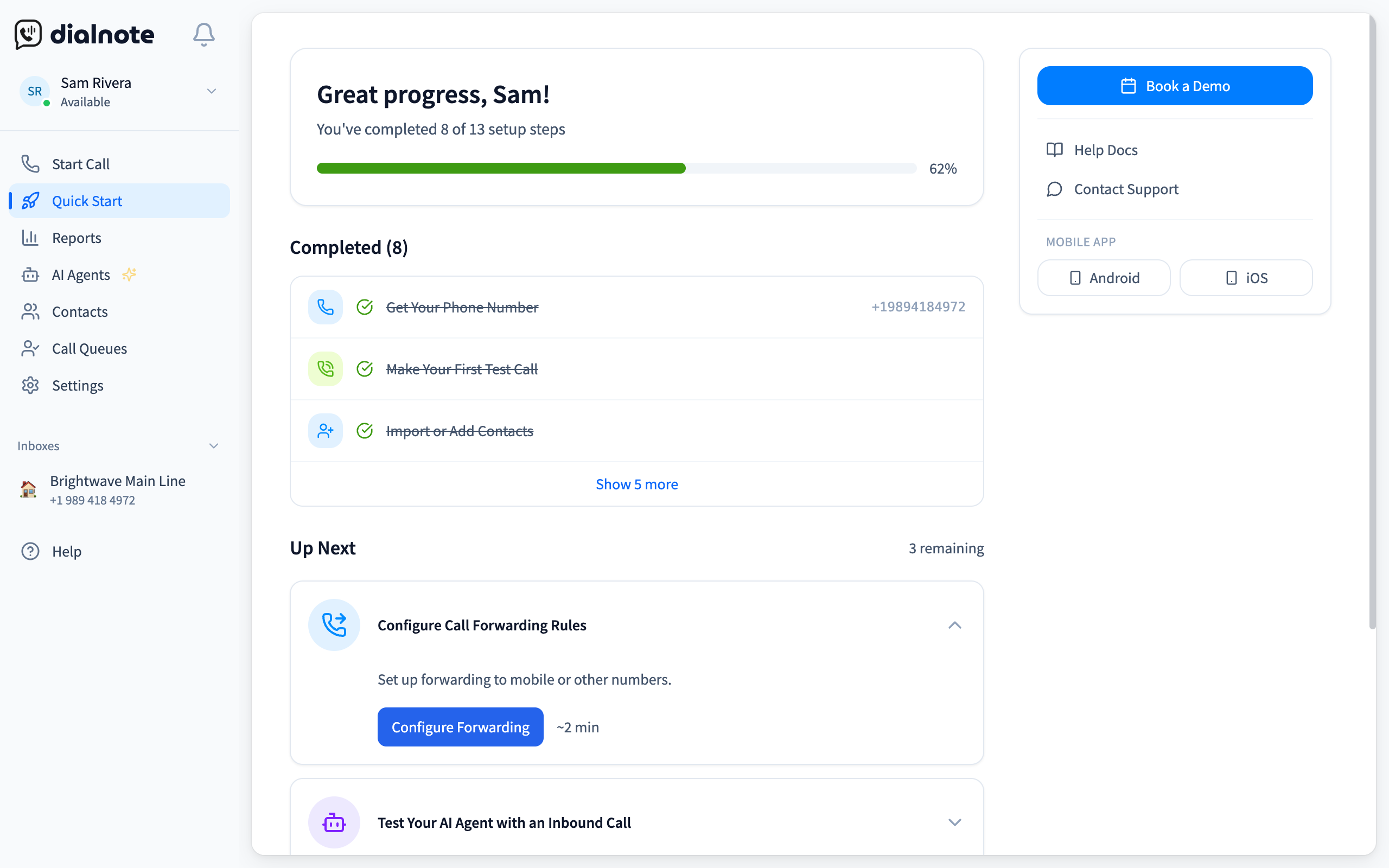
Work down the cards in the order a caller meets them:
- Click Get Phone Number and claim a local number
- Open Business Hours and set when your team answers live
- Point the after-hours branch to your AI agent instead of voicemail
- Open Call Flow / IVR and cap the menu at four or five options
- Go to AI Agents, click Configure AI Agent, and add the questions it should ask callers
- Call the number from your own cell and listen like a customer
That last call is the real deliverable. If the greeting sounds right, the menu is short, and an after-hours test gets answered with your questions instead of a beep, you've closed the three gaps callers complain about most. Anything that sounds off, reopen that card and fix it before a real customer hears it.
Set up the caller side of your phone system
10-day free trial, no credit card.
Which mistakes ruin the customer call experience?
Five mistakes do most of the damage: cold transfers, treating every caller the same, word-for-word scripts, chasing speed over resolution, and voicemail dead ends. Each one quietly pushes callers toward a competitor.
The cold transfer. An agent says "let me transfer you," and the caller starts from zero with the next person. Do warm transfers instead: the first agent stays on for ten seconds, introduces the caller, and hands over the context. Ten seconds of overlap saves five minutes of repetition.
Treating every caller the same. A first-time buyer, a longtime customer, and someone calling for the third time about the same issue shouldn't wait in the same line. Route repeat callers and open tickets to the front. They've already paid their waiting dues.
Word-for-word scripts. Callers can hear an agent reading. Give your team talking points and guardrails, not paragraphs to recite. Scripts have a place in regulated industries; everywhere else they flatten the empathy that makes a call feel human.
Chasing speed over resolution. If your team celebrates short calls, agents learn to hand off problems instead of solving them. The metric that matters is whether the caller has to ring back tomorrow.
The voicemail dead end. "Leave a message after the tone" is where leads go to die. More on that in a minute, because after-hours calls deserve their own plan.
Recognize any of these? Most teams run at least two of them without noticing.
How much does it cost to improve customer call experience?
Less than most owners expect. The highest-impact fixes are settings inside a cloud phone system, not new hires, and entry plans start around $19 a month.
Start with the free column. Trimming your IVR, reordering your queues, running a weekly coaching hour, and cutting your survey to two questions cost nothing but an afternoon. That afternoon usually beats a month of "we should really hire someone" meetings.
| Fix | Typical cost | Time to set up |
|---|---|---|
| Trim the IVR to 4 or 5 options | Free | An afternoon |
| Callback option in the queue | Included in most cloud phone plans | Under an hour |
| CRM screen pop for caller context | Included via integration | About an hour |
| Cloud phone system | From $19 a month | Same day |
| Extra support hire | Salary plus training time | Weeks |
Our honest take: skip the enterprise contact-center suites if you're under 20 people. You'll pay for workforce-management modules nobody on your team will ever open. A simple rule keeps budgets sane: fix the flow first, add software second, hire third. Most small teams never need step three.
What metrics show a better customer call experience?
The clearest signals are first-call resolution, average handle time, customer satisfaction, and abandonment rate. Watch them together, not in isolation, so you don't fix one number while breaking another.
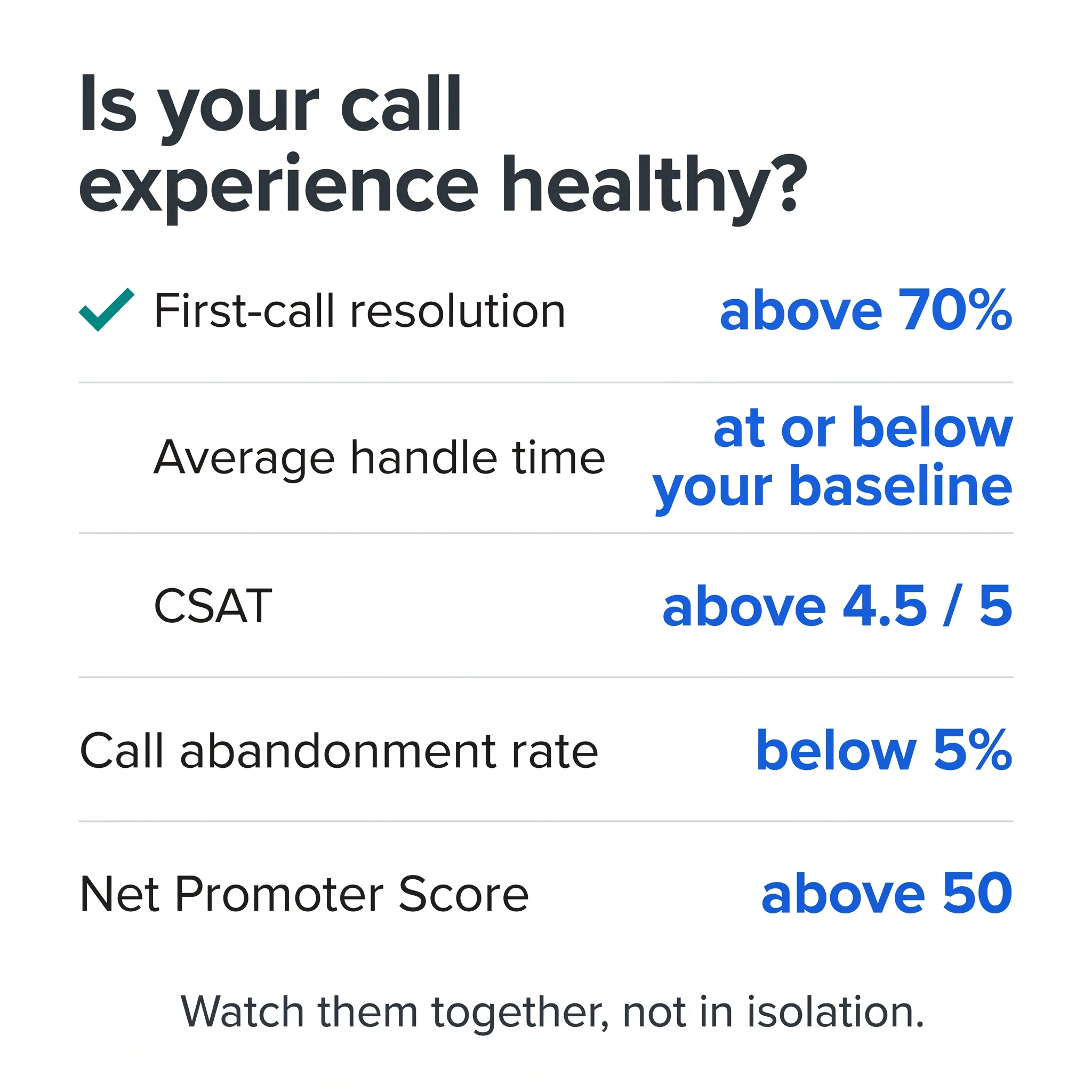
| Metric | Healthy target |
|---|---|
| First-call resolution | Above 70% |
| Average handle time | At or below your own baseline |
| Customer satisfaction (CSAT) | Above 4.5 / 5 |
| Call abandonment rate | Below 5% |
| Net Promoter Score | Above 50 |
One caution: don't chase a low average handle time so hard that agents rush callers off the phone. A fast call that doesn't solve the problem just becomes a second call tomorrow.
Better numbers show up in revenue, not just goodwill. According to research published in Harvard Business Review, customers who had the best past experiences spend 140% more than those who had the poorest ones.
How do you handle after-hours and overflow calls?
Give every unanswered call a next step: a callback, an AI agent that takes details, or at least a message with a real timeframe. Plain voicemail loses the caller.
After-hours callers are often your most valuable ones. Think about it. Somebody dialing a business at 9 pm usually has a problem with money attached.
Imagine a homeowner with a burst pipe on a Tuesday night. They call three plumbers. Two ring through to voicemail. The third answers, takes the address, and books a morning visit. Who gets the job? The winner didn't have better plumbing. They had a better phone setup.
That answer doesn't have to be a human losing sleep. dialnote sends any call that arrives outside the business hours you set to voicemail, a forward, or an AI voice agent that picks up 24/7 in 14 languages. The agent asks the exact questions you choose (name, callback number, what the job is), logs every answer, books a meeting through your Calendly or Cal.com link, sends an SMS confirmation, and transfers to an on-call teammate when something truly can't wait. Your crew walks in to a tidy list of captured leads instead of a screen full of missed-call icons.
Daytime overflow follows the same rule. When every agent is busy, offer a callback after a set wait instead of letting the queue stretch. Dead air is a decision, and callers hear it.
Does AI actually help the customer call experience?
Yes, when it removes busywork instead of adding a robot wall. AI can answer routine calls, write call summaries, and route smartly, so your agents spend their time on the conversations that truly need a human.
dialnote is an AI business phone system with no per-user pricing. AI voice agents answer calls, capture leads, and book meetings 24/7. Plans from $19/mo. It also works as a cloud VoIP phone system for small and mid-sized teams that want call-center features without the call-center price tag, the same tools you'd expect from full cloud call centre software.
Does the routing part really move the needle? In our own call logs, teams that turned on smart routing responded to callers about 30% faster. Faster first response means shorter holds, fewer transfers, and callers who feel like someone was actually ready for them.
AI call summaries help after the call too. Instead of scribbling notes, agents get a clean recap written for them, so the next person who picks up already knows what happened. Less repetition for the customer. Less guesswork for your team.
There's a limit worth naming, though. AI is great at the routine stuff: hours, order status, simple bookings, first-line triage. It's not a replacement for a skilled agent on a tense or unusual call. The best setups let AI clear the easy volume so humans have the time and headspace for the calls that really need care. Used that way, it lifts the whole customer call experience instead of hiding your team behind a bot.
Priya's team is proof this stuff compounds. After she fixed her routing rule, added a callback option, and trimmed her IVR from nine options down to four, repeat calls fell and her CSAT climbed within a month. None of it required a bigger headcount. It required calls that flow the way customers expect them to.
Turn better calls into loyal customers
Great call experiences aren't magic. They're the result of shorter waits, smarter routing, clear menus, and a team that's coached and listened to. Start with one fix, measure it, then move to the next.
dialnote brings smart routing, call queues, CRM integration, and call analytics together in one place, so every fix in this guide stays a setting instead of a project. Run the Quick Start checklist above, call your own number, and hear the difference better call handling makes for your customers.
Frequently asked questions
Under two minutes. Most callers start to feel ignored past that point, and hang-ups climb fast. If your average hold runs longer at peak times, add a callback option or another queue before you add headcount.
In a warm transfer, the first agent stays on the line, introduces the caller, and passes the context before dropping off. The customer never repeats their story, which is the complaint callers mention most.
Above 70% is a healthy target for most small support teams. Pair it with CSAT and abandonment rate so agents aren't tempted to close calls fast without actually solving the problem.
Yes. An AI phone agent can pick up 24/7, ask the questions you set, log the caller's details, book a meeting on your calendar, and send an SMS confirmation. Your team follows up in the morning with full context.
For urgent or emotional issues, yes. Chat and email work for simple questions, but when money or time is on the line, people want a real conversation. That's why one bad call does more damage than one slow email.

Written by
Lancelot Dsouza
Chief Marketing Officer, SmartReach.io
Lancelot Dsouza is the Chief Marketing Officer at SmartReach.io, where he built the Marketing, Sales, and Customer Success verticals from the ground up. With over 25 years of experience spanning digital marketing, business development, and strategic...
Lancelot Dsouza is the Chief Marketing Officer at SmartReach.io, where he built the Marketing, Sales, and Customer Success verticals from the ground up. With over 25 years of experience spanning digital marketing, business development, and strategic...
Related Articles

Phone vs Email Sales Strategy: When to Pick Up the Phone
Learn when to call and when to write with this phone vs email sales guide: real response data, a hybrid cadence, and the mistakes that cost you meetings.

Getting started with VoIP for your business
Learn how getting started with VoIP works, what you need to switch, and the steps to set up a business phone system that saves money and adds features.

How to reduce customer wait times on support calls
Learn how to reduce customer wait times with smart call routing, callbacks, and self-service that cut hold times and keep your callers happy.