How to Handle Angry Callers: A Script That Works
An angry caller can throw off your whole day, and one clumsy response can cost you a customer for good. The good news is that a few well-practiced phrases can turn a shouting match into a save.
This guide gives you tested scripts to handle angry callers, plus a simple framework so you always know what to say next.
TL;DR:
- The best way to handle angry callers is to listen first, validate how they feel, then move to a concrete fix, using a framework like the HEARD method (Hear, Empathize, Apologize, Resolve, Diagnose).
- Skip phrases like "calm down," "that's not my department," and "our policy is..." They sound like deflection and make anger worse.
- Your tone matters as much as your words: slow down, lower your pitch, and pause so the caller has room to settle.
- Set clear boundaries with abusive callers, and document those calls for your manager.
- Follow up within 24 hours to confirm the fix landed. The follow-up, not the apology, is what rebuilds trust.
- Complaints handled well build loyalty: customers whose issues get resolved quickly are far more likely to stay.
Most callers won't come back after a bad experience
Studies suggest most customers who get a bad phone experience just walk away and never call back. That reality should keep every business owner up at night. When an angry caller reaches your team, you have one chance to turn frustration into loyalty. Handle it wrong, and they're gone forever.
Amy has been an SDR for three years at a growing SaaS company. Last Tuesday, she picked up a call that started with shouting. The customer's order was late, their boss was furious, and Amy was the target for all that anger. Her heart raced. Her mind went blank. She stumbled through apologies that only made things worse.
Sound familiar? Every customer-facing team deals with angry callers. The difference between companies that keep customers and those that lose them comes down to one thing: having a script that actually works.
Why do customers get angry on the phone in the first place?
Most phone anger comes from four triggers: long waits, repeating the same story to different people, broken promises, and feeling powerless. The actual product issue is usually just the spark.
Think about the last time you called a support line. You waited on hold, explained the problem, got transferred, then explained it all again. By the third repeat, you weren't calm either.
That history walks in with every angry caller. They're not just reacting to a late order. They're reacting to every hold queue and dead-end phone menu they survived before yours.
Why does that matter for your script? Because it tells you what actually calms people down. It's rarely the refund. It's the feeling that one competent human finally owns the problem, and your script should make that ownership obvious in the first thirty seconds.
One more trigger worth naming: surprise. A price change nobody explained. A delivery window that quietly moved. If your company created the surprise, expect the anger, and plan the call before it happens.
Why do scripts matter for angry callers?
Scripts matter because they hand you words at the exact moment stress steals them. When a caller starts yelling, your brain flips into fight-or-flight and goes blank. A good script isn't about sounding robotic. It keeps you steady, helps you show real empathy, and points the call toward a fix instead of the complaint.
When someone yells at you over the phone, thinking clearly becomes nearly impossible. That's exactly when a script gives your brain a safe path forward.
Good scripts do three things:
- Keep you calm by giving you words when your mind goes blank
- Show empathy in ways that feel genuine, not corporate
- Guide toward resolution instead of getting stuck in the complaint
The goal isn't to read word-for-word. It's to have tested phrases ready so you can focus on listening instead of scrambling for what to say.
How do you handle angry callers with the HEARD method?
You handle angry callers by moving through five steps in order: Hear, Empathize, Apologize, Resolve, Diagnose. The order matters, because people can't process solutions until someone acknowledges the feeling first.
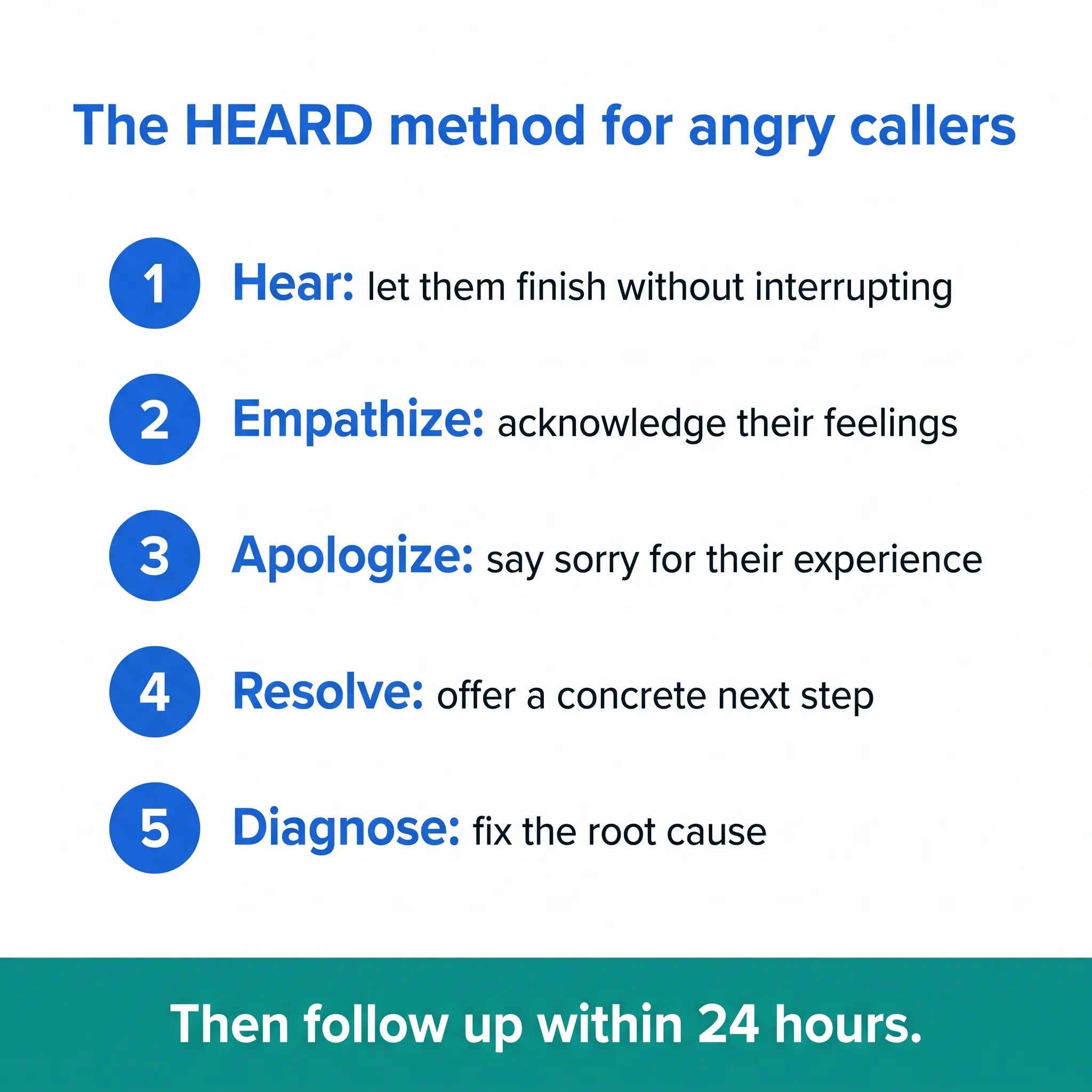
Before we get to specific scripts, you need a framework. The HEARD method gives you a structure that works on almost every call:
| Step | Action | Why It Works |
|---|---|---|
| Hear | Let them finish without interrupting | People need to vent before they can listen |
| Empathize | Acknowledge their feelings | Validation defuses anger faster than solutions |
| Apologize | Say sorry for their experience | Even if it wasn't your fault, their frustration is real |
| Resolve | Offer a concrete next step | Action shows you're taking ownership |
| Diagnose | Figure out the root cause | Prevent this from happening again |
Now let's put this into practice with actual scripts.
Script 1: the opening response
The best opening response validates the caller's frustration before you explain a single thing. When an angry caller starts venting, your first words set the tone. Here's what works:
Instead of: "I understand, but let me explain..."
Say this: "I hear you, and I'm sorry you're dealing with this. That sounds really frustrating. Let me make sure I understand exactly what happened so I can help fix this."
Why it works: You're not defending. You're not explaining. You're listening and validating. The phrase "let me make sure I understand" also signals that you're about to take action, not just apologize forever.
What should you never say to an angry caller?
Never tell an angry caller to "calm down," brush them off with "that's not my department," hide behind "our policy is...," or dead-end them with "I can't do anything about that." These phrases sound like deflection and push anger higher. Validate the feeling first, then move straight to what you can actually do.
Never say these phrases to angry callers:
- "Calm down": This always makes things worse
- "That's not my department": They don't care about your org chart
- "Our policy is...": Policy talk sounds like deflection
- "I can't do anything about that": Even if true, it's a dead end
Script 2: when they ask for a manager
When a caller demands a manager, ask for one chance to fix the problem yourself, and promise a hand-off if you can't. Customers usually demand a manager because they think you're powerless to help. Here's how to handle it without escalating:
Say this: "I'm confident I can help you with this, and I want to make sure we solve it right now. Would you give me a chance to fix this before we involve my manager? If I can't resolve it, I'll personally connect you with them."
This script works because:
- It shows confidence without being dismissive
- It offers a path forward while respecting their request
- It commits to escalation if needed, building trust
If they insist on a manager anyway, don't fight it. Say: "Absolutely, let me get them on the line. While I do that, can you share any details that might help them assist you faster?"
Script 3: the empathy bridge
The empathy bridge moves a caller from venting to problem-solving in one sentence: name what they expected, name what they got, then say what happens next.
Sometimes customers aren't even angry about the actual problem. They're angry about feeling ignored. Use this script to bridge from anger to problem-solving:
Say this: "If I were in your position, I'd be frustrated too. You expected [X] and got [Y] instead. That's not acceptable, and I want to make this right. Here's what I can do right now..."
The key phrases:
- "If I were in your position": Shows genuine empathy
- "You expected X and got Y": Proves you listened
- "Here's what I can do right now": Moves toward action
How do you keep your voice calm with an angry caller?
Slow down and drop your pitch. Speak about 20% slower than normal, lower your tone, and pause between sentences so the caller has room to settle. Match their volume at first, then gradually bring it down. Stay steady, and most callers fall into your calmer rhythm within a minute or two.
Scripts are only half the battle. How you say it matters just as much as what you say.
Tone tips
- Slow down: Speak 20% slower than normal. Speed signals stress.
- Lower your pitch: Higher voices sound defensive. Drop your tone slightly.
- Pause between sentences: Give them space to respond or calm down.
- Match their volume, then reduce: Start at their energy level, then gradually bring it down.
The goal is to be a calm anchor. When you stay steady, most callers will naturally match your energy within 60-90 seconds. We can't fully explain why that 60-to-90-second window shows up so consistently, but it does, call after call. Stay level for ninety seconds and you'll usually hear the shift.
Script 4: when you actually made a mistake
When your company caused the problem, admit it fast and completely. A specific apology paired with a specific fix beats any excuse.
Say this: "You're right, and I apologize. We dropped the ball on this. I can see exactly what happened, and I'm going to fix it. Here's what I'm doing right now: [specific action]. And here's what I'll do to make sure this doesn't happen again: [preventive step]."
This script works because:
- No excuses or deflection
- Specific actions, not vague promises
- Forward-looking prevention shows you care about the relationship
Script 5: when they're abusive
There's a difference between angry and abusive. Angry customers deserve patience. Abusive callers (those using personal attacks, profanity directed at you, or threats) deserve boundaries.
Say this: "I want to help you, and I'm committed to solving this problem. But I'm not able to do that if this continues. If we can have a respectful conversation, I'll do everything I can to make this right."
If it continues:
Say this: "I'm going to need to end this call. You can call back when you're ready to have a productive conversation, or I can have my manager call you in [timeframe]. Which would you prefer?"
Document abusive calls and involve your manager immediately. Your wellbeing matters too.
De-escalation mistakes that make things worse
The biggest de-escalation mistakes are apologizing on a loop without acting, reading empathy lines word for word, and parking callers on hold without asking. Each one tells the caller you're not really listening.
Honestly? Most de-escalation scripts fail because someone wrote them for legal cover, not for real conversations. If a phrase would sound strange said to a friend, it'll sound worse said to a stranger who's already upset.
Watch for these traps:
- The apology loop: Saying sorry five times without offering a fix reads as stalling. One sincere apology, then action.
- Robotic empathy: "I understand your frustration" repeated verbatim sounds like a machine. Rephrase it in your own words each time.
- The silent hold: Never park an angry caller without warning. Ask first, give a time estimate, and thank them when you're back.
- The blind transfer: Passing an angry caller to a teammate without context restarts the anger from zero. Brief your teammate first, even for ten seconds.
- Fact-checking feelings: Correcting details while the caller is still heated turns a complaint into a debate. Facts can wait ninety seconds. Feelings can't.
Putting it all together: a complete call flow
A well-handled angry call runs Hear, Empathize, Apologize, Resolve in under three minutes. Here's what that sounds like in real life:
Customer: "This is ridiculous! I've been waiting for my order for two weeks and no one can tell me where it is!"
You: "I hear you, and I'm sorry you're dealing with this. Two weeks is way too long, and I'd be frustrated too. Let me pull up your order right now and find out exactly what's going on."
[Pause to look up information]
You: "I found your order. It looks like it got stuck in our shipping system. That's our mistake, and I apologize. Here's what I'm going to do: I'm sending a replacement today with expedited shipping at no charge. You'll have tracking information within the hour. Does that work for you?"
Notice the flow: Hear → Empathize → Apologize → Resolve. The customer goes from furious to satisfied because they felt heard and saw immediate action.
How do you follow up after an angry call?
Follow up within 24 hours with a short recap of what you promised and proof it happened. That single message often does more for loyalty than the fix itself.
Most teams skip this step. That's a mistake, because the follow-up is where a saved call becomes a loyal customer.
Keep it simple:
- Recap in writing. A two-line text or email works: here's what we agreed, here's where it stands.
- Confirm the fix landed. Check the next day. If the replacement didn't ship, you want to know before they do.
- Log the root cause. This is the Diagnose step of HEARD. One angry call is a bad day; five about the same issue is a process problem.
- Share the pattern with your team. If billing surprises drive a third of your angry calls, fixing the invoice email kills those calls at the source.
Does a follow-up message feel like overkill for a small complaint? Maybe. Send it anyway. The customers who get one talk about it.
Train your team with real practice
Reading scripts isn't enough. Your team needs practice.
Tanya joined her team three months ago and froze on her first truly angry call. She knew the product cold, but she'd never heard a customer shout. One week of role-play later, she had a printed script at her desk and a much steadier voice. Here's how to build that skill without live customers:
Role-play scenarios
Run weekly 15-minute sessions where team members take turns being the angry caller. Use real complaints from your call logs (anonymized) for realistic practice.
Call recording reviews
With call analytics tools, you can review actual difficult calls together. Identify what worked, what didn't, and how to improve.
Create a de-escalation cheat sheet
Print the scripts from this article and keep them at every desk. In the moment, a quick glance at the right phrase can make all the difference.
Turn angry callers into loyal customers
Here's the surprising truth: customers who have a complaint handled well are often more loyal than customers who never had a problem. Research from the Harvard Business Review has long pointed to the same pattern: customers who get their issues resolved quickly are far more likely to stay.
Every angry call is an opportunity. When you handle angry callers with empathy, speed, and genuine care, you don't just save the relationship, you strengthen it.
The scripts in this article have been tested across thousands of customer service interactions. They work because they're built on psychology, not corporate speak. Use them as your foundation, then adapt them to your voice and your customers.
Better tools make better conversations
Having the right cloud call centre software helps your team handle difficult calls more effectively. Features like call routing connect customers to the right person faster, reducing frustration before it starts. AI call summaries help agents quickly understand customer history, so callers don't have to repeat themselves.
dialnote is an AI business phone system with no per-user pricing. AI voice agents answer calls, capture leads, and book meetings 24/7. Plans from $19/mo. For angry calls specifically, the useful part comes after you hang up: the call transcript and summary capture exactly what you promised the customer, so the 24-hour follow-up actually happens, and recordings give your team real conversations to review in role-play sessions.
When you pair good scripts with the right technology, your team can focus on what matters most: turning angry callers into loyal customers.
Give your team backup for the hard calls
10-day free trial, no credit card needed.
Frequently asked questions
HEARD stands for Hear, Empathize, Apologize, Resolve, Diagnose. You let the caller finish, validate how they feel, apologize for the experience, offer a concrete fix, then track down the root cause so the same problem doesn't come back.
Usually 30 to 90 seconds. Most callers run out of steam once they feel heard. Don't interrupt during that window. Take notes, reflect back what you heard, and then move the call toward a fix.
Yes, after one clear warning. Give the caller a chance to continue respectfully. If personal attacks or threats keep coming, end the call politely, document what happened, and tell your manager right away.
Validate the feeling first, then correct gently with evidence. Focus on what you can do instead of arguing about who's right. Winning the argument but losing the customer isn't a win.
Often, yes. Customers whose complaints get fixed quickly tend to become more loyal than customers who never had a problem, because the save proves you'll show up when something goes wrong.

Written by
Lancelot Dsouza
Chief Marketing Officer, SmartReach.io
Lancelot Dsouza is the Chief Marketing Officer at SmartReach.io, where he built the Marketing, Sales, and Customer Success verticals from the ground up. With over 25 years of experience spanning digital marketing, business development, and strategic...
Lancelot Dsouza is the Chief Marketing Officer at SmartReach.io, where he built the Marketing, Sales, and Customer Success verticals from the ground up. With over 25 years of experience spanning digital marketing, business development, and strategic...
Related Articles

Why do you need an AI receptionist for e-commerce?
Find out how an AI receptionist for e-commerce handles calls, tracks orders, and captures sales 24/7. See real ROI numbers and setup steps.

Voice AI vs Chatbots: When to Use Each for Your Business
Learn when voice AI beats chatbots and when chat wins. Compare voice AI vs chatbot costs, setup time, and use cases to pick the right fit for your team.

Call routing explained: a guide for small business
Learn how call routing sends every caller to the right person fast, with routing types, queues, IVR menus, and steps to build call flows that work.