Can an AI Receptionist Grow Your Construction Business?
Your superintendent's managing a concrete pour. The project manager's in a meeting with the architect. Your best estimator's doing a walkthrough at a new development. And back at the office? The phone's ringing. Nobody picks up.
That caller was a general contractor looking for a reliable sub to bid on a $200,000 commercial renovation. They called the next name on their list.
If you run a construction company, you've lived this scenario more than once. An AI receptionist for construction solves it by answering every call, collecting project details, and scheduling callbacks while your crew is out doing the actual work. And it costs less per month than a single day of a full-time receptionist's salary.
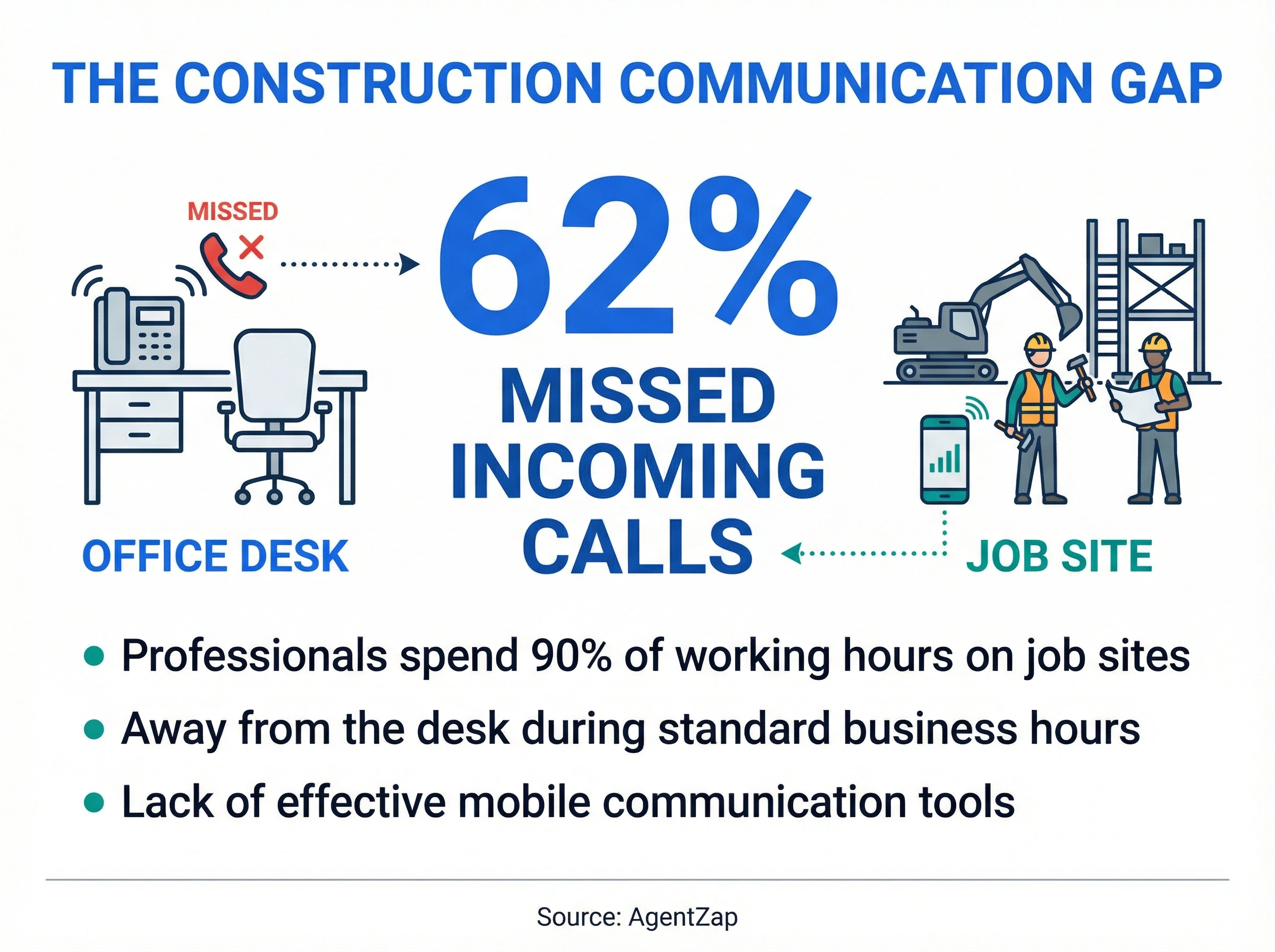
According to AgentZap research, the average construction company misses nearly two-thirds of all incoming calls during standard business hours. That's not just frustrating. It's expensive. With average construction leads worth $1,500 to $15,000 depending on your trade, even a handful of missed calls each week can mean tens of thousands in lost revenue every year.
TL;DR:
- An AI receptionist for construction answers every call around the clock, collects project details, and books estimates while your crew is on the job site.
- Construction companies miss close to two-thirds of business-hour calls, and each unanswered call can cost $100 to $1,200 in lost revenue depending on your trade.
- It runs about $50 to $300 per month versus $35,000 to $50,000 a year for a full-time receptionist, so you save 90% or more.
- Look for calendar and project-management integration, construction-specific training, smart emergency routing, and text or email call summaries.
- dialnote pairs an AI receptionist with a full phone system built for the field, so leads land in your CRM and calendar without anyone typing a thing.
Why do construction companies miss so many calls?
Construction professionals spend roughly 90% of their working hours on job sites, not behind a desk. That's the core problem.
Unlike a law firm or an accounting practice where someone's always near a phone, construction companies operate in the field. Your team's running equipment, managing subcontractors, doing inspections, or driving between job sites. The office phone rings and nobody's there to pick up.
Here's what a typical day looks like for Stan, who owns a mid-sized remodeling company with 15 employees. He gets to his first job site by 7:30 AM. Between then and 5 PM, he's handling material deliveries, code inspections, crew questions, and client walkthroughs. His phone buzzes constantly with texts, but picking up actual phone calls? That happens maybe three or four times on a good day.
The problem gets worse during peak season. Spring and summer bring a flood of renovation inquiries, insurance claims from storm damage, and commercial build-out requests. Your phone rings more than ever while you're busier than ever on active projects. It's the worst possible timing.
There's also an after-hours gap that costs you leads every single day. Many property owners and general contractors search for construction services in the evening. They're reviewing bids, checking Google reviews, and making calls at 7 or 8 PM. If your phone goes to voicemail, about 80% of callers won't leave a message. They just call someone else.
Smaller construction companies feel this the hardest. You can't justify a $40,000 salary for a full-time receptionist when you're doing $800,000 in annual revenue. But without someone answering calls, you're stuck in a cycle where you can't grow because you're missing the very leads that would fuel growth.
And it's not just new business at stake. Existing clients call to check on timelines, approve change orders, or report issues. When they can't reach you, trust erodes. One missed call probably won't lose a client. But three or four? They start wondering if you're reliable enough for their next project.
What does an AI receptionist do for a construction company?
An AI receptionist answers your business phone using natural-sounding conversation. It picks up every call, asks relevant questions, and takes action based on what the caller needs.
It's not a robotic phone tree or one of those "press 1 for billing, press 2 for scheduling" menus that everybody ignores. Modern AI receptionists use natural language processing to have actual conversations. They understand context, handle follow-up questions, and can even recognize returning callers by their phone number.
Think of it as a virtual front desk that never takes lunch, never calls in sick, and works evenings and weekends without overtime pay. When a homeowner calls about a kitchen remodel, the AI collects their contact info, project type, timeline, and budget range. Then it books an estimate on your calendar and sends you a text summary. When you check your phone between tasks, you've got a qualified lead with all the details, not a garbled voicemail you can barely hear over construction noise.
For construction businesses specifically, this matters because your calls are incredibly varied. In a single day, you might get:
- A homeowner wanting a bathroom remodel quote
- A general contractor needing a plumbing sub for a commercial project
- An existing client asking about their project timeline
- An insurance adjuster scheduling a damage inspection
- A supplier confirming a material delivery time
- A city inspector requesting access to the site
A well-configured AI receptionist handles each of these differently. It knows which calls need immediate attention (the emergency water intrusion) and which can wait (the "we're thinking about finishing our basement next year" inquiry).
The technology has come a long way in the past couple of years. If someone says "my basement flooded after the storm," the AI understands that's urgent and routes it differently than someone calling about a deck they want built next summer. It reads intent, not just keywords.
If you're curious about the basics, we've covered how AI voice assistants work for small businesses in a separate guide.
How does it handle construction-specific calls?
An AI receptionist trained for construction understands the difference between a routine quote request and an emergency water intrusion call. It routes urgent situations straight to your cell and handles routine inquiries on its own.
Here's what a typical interaction looks like:
Caller: "Hi, I've got water coming through my ceiling after last night's storm. I think there's roof damage. I need someone out here today."
AI receptionist: "I'm sorry to hear that. Let me get your information so we can get someone to you quickly. Can I get your name and address? And can you tell me roughly where the water is coming in?"
The AI captures the caller's name, address, phone number, urgency level, and a description of the problem. Then it follows rules you've set up. Emergency roof or water damage? It rings your cell immediately and sends a text with all the details. Standard quote for a fence installation? It books an appointment for your next available estimate slot.
Here's what a good AI receptionist handles for construction companies:
- Estimate scheduling. Books site visits and estimates directly into your calendar. No double-booking, no manual entry.
- Project intake. Asks about project type (remodel, new build, repair), scope, timeline, and budget range. Sends you a structured summary with everything you need to prepare.
- Emergency routing. Water damage, structural problems, gas leaks, or electrical hazards get flagged as urgent and forwarded to the right person immediately.
- Subcontractor inquiries. When a GC calls looking for a trade partner, the AI captures project details, location, timeline, and the specific trade needed.
- Returning caller recognition. Existing clients get recognized by phone number. "Hi, Mrs. Davis. Are you calling about the kitchen renovation at 42 Oak Street?"
- Supplier and vendor messages. Takes detailed messages about delivery schedules, material availability, and pricing updates so nothing falls through the cracks.
But can an AI really handle the odd calls construction companies get? The ones where someone asks if you also do HVAC work, or wants to know if you can start a project next week even though your schedule's booked for six weeks?
It handles about 85% of calls without any issues. For the other 15%, it takes a detailed message and flags it for your follow-up. That's still much better than a missed call or voicemail. The caller feels heard, their info is captured, and you can call back with a real answer instead of playing phone tag for three days.
What's the real cost of missed calls in construction?
Every unanswered call represents $100 to $1,200 in lost revenue depending on your trade, according to Entrepreneur. For construction companies, the numbers land on the higher end because project values are larger than most service industries.
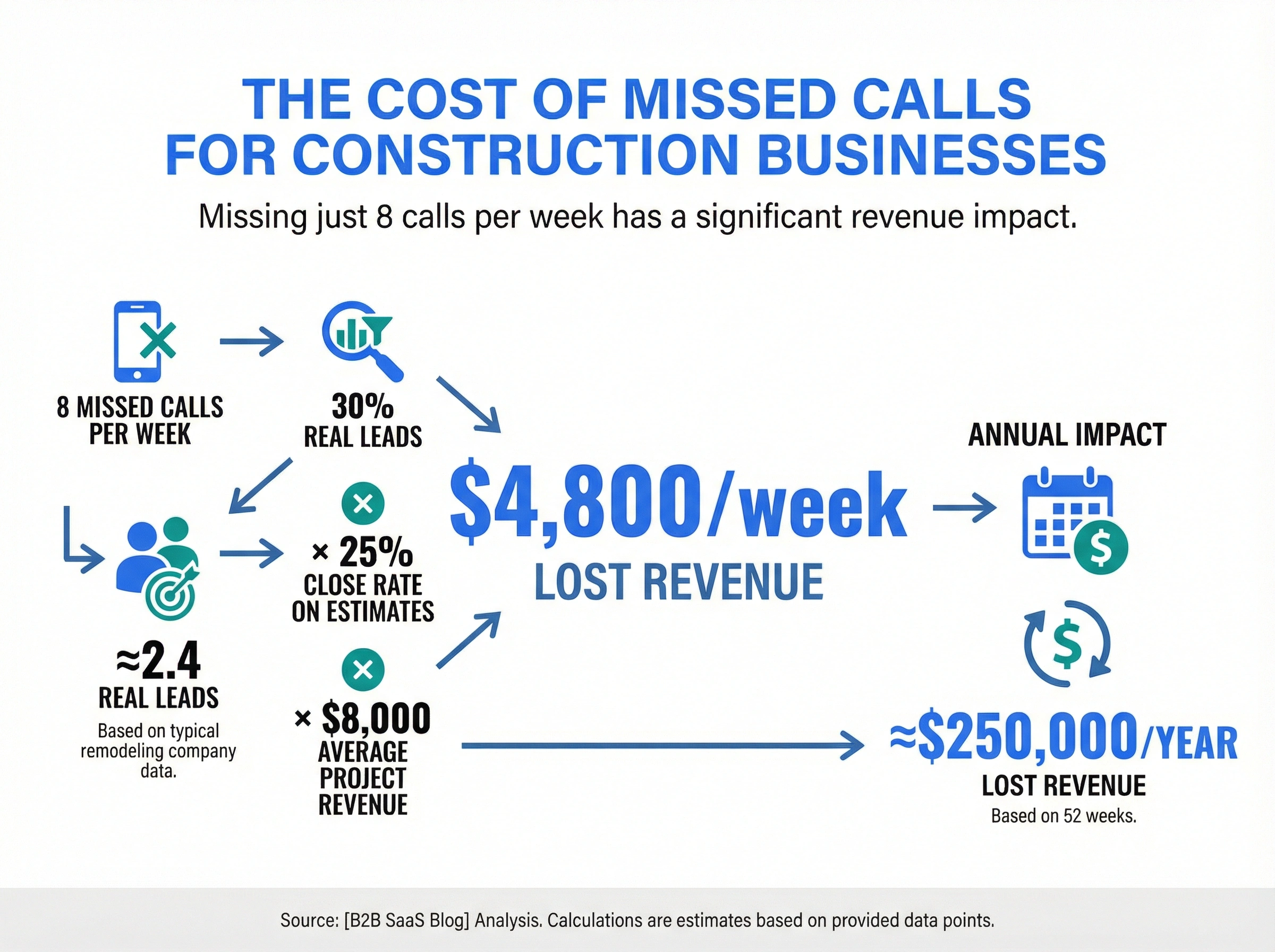
Let's walk through the math for a typical remodeling company. Say you miss 8 calls per week, which is conservative based on industry data. About 30% of those calls are real leads. Each lead, if closed, is worth an average of $8,000 in project revenue. With a 25% close rate on estimates, that's:
8 missed calls x 30% real leads x $8,000 project value x 25% close rate = $4,800 in lost revenue per week
Over a year? That's roughly $250,000. For a company doing $1.5 million in revenue, that's more than 16% of potential growth just disappearing into voicemail.
The data isn't entirely clear on exact percentages across every construction specialty, from HVAC to general contracting to concrete work. But the trend is consistent: companies that answer more calls close more projects.
According to AgentZap, construction companies offering round-the-clock phone availability generate 43% more annual revenue than those limited to standard business hours. And here's one that might surprise you: waiting just 30 minutes to return a missed call reduces your chances of winning that project by a factor of 21.
There's a reputation cost too. When a homeowner calls three contractors for a bathroom remodel quote, the first one to pick up and schedule an estimate almost always gets the job. Speed signals reliability. In construction, where trust is everything, that first impression matters more than your truck wrap or your website design.
Think about it from the homeowner's perspective. They've got a leaky roof or a kitchen they hate. They searched Google, found three contractors with decent reviews, and called all three. The one who answered, asked good questions, and booked an estimate on the spot? That's who they're going with. The two who sent them to voicemail just lost a $15,000 job.
We've done a full breakdown of AI answering service costs if you want the detailed comparison.
6 ways an AI receptionist helps construction companies grow
Growing a construction business is hard when every phone call has to go through you personally. You can't take on more projects, hire bigger crews, or expand into commercial work when you're the bottleneck for every new lead. Here's how an AI receptionist removes that constraint.
1. Capture every lead, day and night
Property owners and general contractors don't just call during business hours. They're reviewing proposals and making calls at 7 PM, 9 PM, even on weekends. According to Invoca research, home service businesses that miss after-hours calls lose a significant portion of their annual lead pipeline.
An AI receptionist picks up 24/7, 365 days a year. Whether it's a Sunday afternoon or a Tuesday at midnight, every caller gets a professional response. Those after-hours leads that used to vanish now show up as qualified appointments on your calendar the next morning.
Consider this: a roofing company that starts answering calls at 6 PM instead of letting them go to voicemail could capture 3-5 extra leads per week during storm season alone. At an average project value of $6,000, that's $18,000 to $30,000 per month in new pipeline that was previously invisible.
2. Free up 2-3 hours every day
Here's a quick breakdown of where your time actually goes. You spend 20 minutes returning missed calls. Another 30 minutes playing phone tag with people who called while you were on-site. 15 minutes scheduling estimates. 20 minutes answering basic questions about services, pricing, and availability. That's close to 2 hours every single day, gone.
An AI receptionist takes all of that off your plate. You get those hours back for billable work, client meetings, or crew management. For a company billing at $75 per hour, that's $150 in recovered productivity every day, roughly $39,000 a year.
And it's not just about the owner's time. If you've got a project manager or office coordinator who spends half their day fielding phone calls instead of managing schedules and coordinating subs, an AI receptionist frees them up too. That's a multiplier effect across your whole team.
3. Save $30,000+ compared to a full-time hire
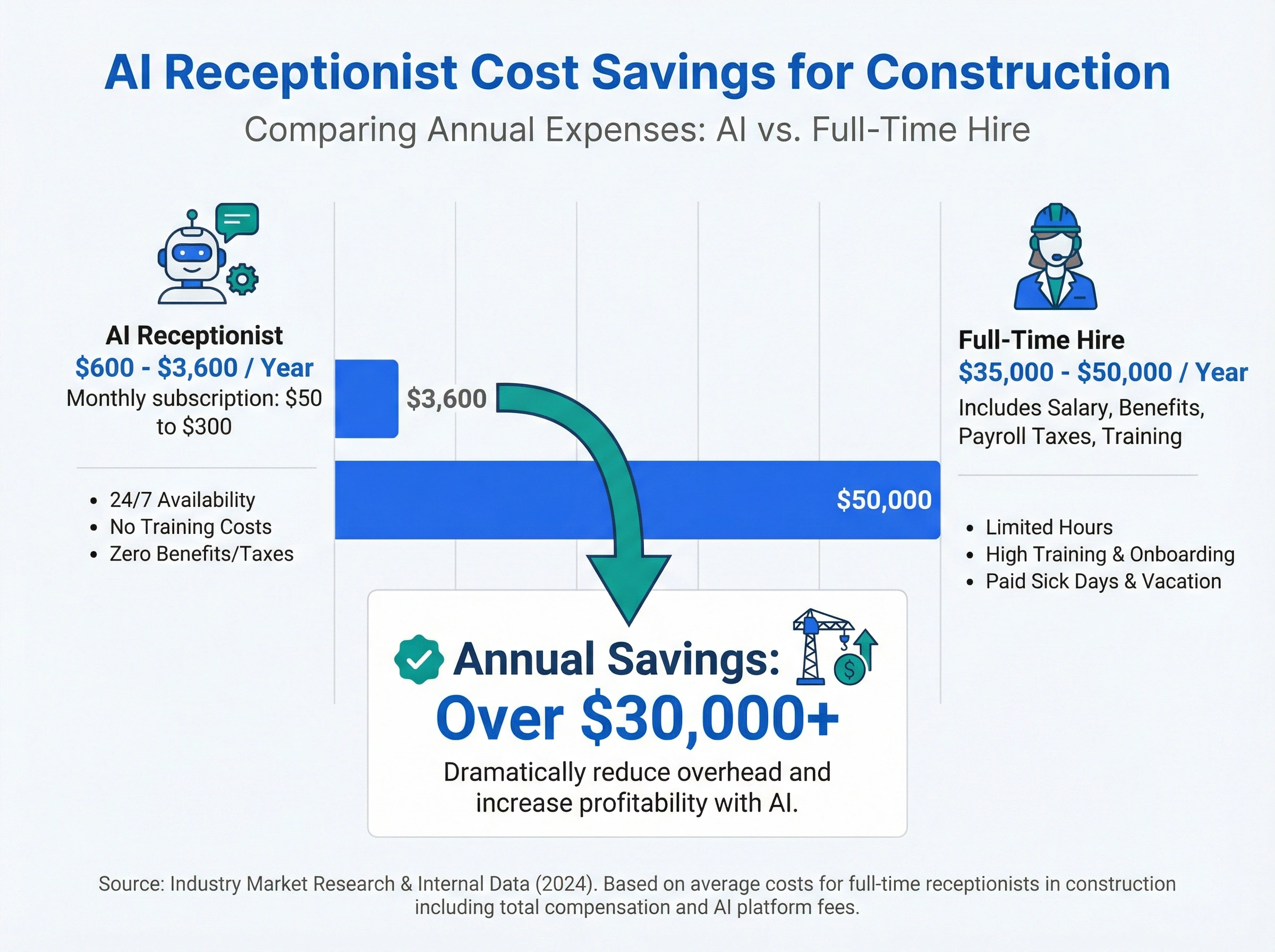
A full-time receptionist costs between $35,000 and $50,000 per year once you factor in salary, payroll taxes, benefits, training, and coverage for sick days and vacations. An AI receptionist? Typically $50 to $300 per month.
That's $600 to $3,600 per year versus $35,000+. The savings alone could pay for a new crew member, a piece of equipment, or a marketing campaign that brings in even more leads.
4. Look professional on every single call
When a general contractor calls looking for a sub on a $500,000 commercial project, first impressions matter. If they reach a voicemail recording you made from your truck cab, that's one impression. If they reach a professional-sounding receptionist who collects project details and books a callback within the hour, that's a completely different impression.
An AI receptionist makes a 5-person crew sound like a well-organized operation. For commercial contracts, where perception of professionalism can be the difference between getting invited to bid and getting passed over, this is a real competitive edge.
What if you never missed another bid request?
5. Handle seasonal surges without extra staff
Construction has extreme seasonality. Spring brings a rush of outdoor project inquiries. Storm season creates unpredictable demand spikes. Year-end sees commercial clients racing to use their capital improvement budgets before they expire.
An AI receptionist scales instantly. It handles 10 calls a day or 100 calls with the same quality and speed. No hiring temps, no overtime, no scrambling to cover phones during your busiest months. The AI handles the surge, and you show up to a full calendar every morning.
This is especially valuable for specialty contractors. If you do roofing, a single hailstorm can generate 50+ calls in two days. If you do plumbing, a cold snap with burst pipes can flood your phone lines (pun intended). An AI receptionist absorbs those spikes and makes sure every caller gets a response, even when your human team would be completely overwhelmed.
6. Qualify leads before you drive 45 minutes for an estimate
Not every call is worth a site visit. Honestly? About a third of the estimates most contractors go on never turn into projects. The caller's just shopping around, the budget's way too low, or the timeline doesn't work.
An AI receptionist can ask qualifying questions upfront: What type of project? What's the timeline? What's the budget range? Is this your property or a rental? By the time you see the lead summary, you know whether it's worth driving across town for an in-person estimate or if a quick phone call is all that's needed.
This alone saves hours every week and keeps your estimators focused on leads that are actually going to close.
What should you look for in an AI receptionist?
The right AI receptionist for your construction business needs to do more than answer phones. It should fit into how you actually run your operation day to day.
Calendar and scheduling integration. Your AI should book estimates and site visits directly into whatever calendar or scheduling tool you use. If it just takes a message and expects you to manually schedule later, you're losing the biggest time-saving benefit. That's basically a fancy voicemail.
Project management sync. If you use Buildertrend, CoConstruct, Procore, or another PM platform, your AI receptionist should push new leads directly into your pipeline. Skip any AI receptionist that can't connect with your project management tools. Without that integration, it's just a glorified answering machine.
Construction-specific training. A generic AI won't understand the difference between a load-bearing wall and a partition wall, or know that "demo" means demolition and not a software demonstration. Look for a system that's trained on construction terminology, project types, and the kinds of questions your callers actually ask. It should know what a change order is, understand that "rough-in" means plumbing or electrical work before the walls go up, and recognize that when someone says "my foundation is cracking," that's urgent.
Smart call routing. Emergency calls (water damage, structural concerns, gas leaks) need to reach someone right away. Routine estimate requests can wait for the next business day. Your AI should know the difference and act accordingly. You can learn more about how call routing works in our detailed guide.
Text and email summaries. After every call, you should get a summary with the caller's name, project type, urgency level, and any appointment booked. Quick follow-up wins jobs. The faster you respond, the more estimates you close.
Bilingual support. Depending on your market, a significant chunk of your calls might come in Spanish. An AI that handles both English and Spanish opens up more of your local market without any extra effort on your part.
Analytics and reporting. You should be able to see how many calls come in, what times are busiest, what types of projects people are asking about, and how many leads convert to estimates. This data helps you make smarter decisions about marketing, staffing, and which services to push. We've got a complete guide to using call analytics for your business if you want to dig deeper into this.
How dialnote helps construction companies stop missing calls
The phone problems construction companies face aren't just about missed calls. It's the entire communication system: scattered voicemails, personal cell phones doubling as business lines, no record of who called or what they said, and zero visibility into whether your team is actually following up on leads.
That's where dialnote comes in. dialnote gives construction businesses a complete VoIP phone system built for how you actually operate, from the job site, from your truck, and from the office when you're there.
A business number on the phone you already carry. You don't need a separate device or a landline at an office nobody sits in. dialnote's mobile app puts your business number on your personal phone. Customers see your business caller ID, not your personal cell number. And when the workday's done, flip on Do Not Disturb and calls go to voicemail without ringing your phone.
Shared numbers across your team. Got a main office line? With shared numbers, your project manager, estimator, and office coordinator can all pick up calls from the same number. If one person's busy or on-site, the call rolls to the next available team member. No more single points of failure where one person being unavailable means a lost lead.
Smart call routing that matches your workflow. Set simple rules: during business hours, ring the office first, then the PM's cell. After hours, let the AI receptionist handle it. Route emergency calls, water damage, structural issues, fire damage, straight to your on-call person. You control who gets what calls and when, without any complicated setup.
Call recording and AI-powered summaries. Every call is recorded and transcribed automatically. dialnote's AI pulls out the key details: project type, address, timeline, budget, and puts them in a clean summary you can read in 10 seconds. No more scribbling notes on a scrap of drywall and hoping you can read your own handwriting later.
CRM and project management integration. When a new lead calls, dialnote logs it directly in your CRM or PM tool. The lead's contact info, what they need, and when they called, all captured without anyone typing a thing. Your estimator opens the system the next morning and everything's already there.
Call analytics that actually help you grow. See exactly how many calls come in each day, what hours are busiest, and how many you're converting to estimates. If you're running Google Ads or yard signs to drive calls, you can finally track which sources are generating real leads versus which are just burning money.
The point isn't just answering more calls. It's building a phone system that supports how construction businesses actually work: in the field, on the move, across multiple job sites and team members. dialnote brings all of that together in one place.
AI receptionist for construction: build smarter, not just bigger
The construction industry is massive. According to McKinsey research, it's one of the largest economic sectors globally, yet productivity has barely improved in two decades. Most of that stagnation isn't about tools and equipment. It's about communication, coordination, and the business operations that happen between the physical work.
An AI receptionist won't fix every productivity challenge in construction. But it solves one of the most expensive and fixable problems: the phone calls you're missing every day while doing the work that actually pays the bills.
Construction companies that answer more calls, respond faster, and capture every lead are the ones that grow. The same is true for salons, clinics, and every other service business where the phone rings while your hands are full. It's not the flashiest strategy. It's not about buying bigger equipment or hiring more crews. It's about making sure the people who want to hire you can actually reach you.
If you're losing leads to voicemail every week, that's revenue sitting on the table. dialnote gives construction businesses the phone system and AI receptionist they need to capture every opportunity without adding headcount or office overhead.
The best construction companies aren't always the ones with the most crews or the biggest backhoes. They're the ones that pick up the phone. An AI receptionist makes sure you always do.
Give it a try and see what happens when every call gets answered.
Frequently asked questions
Most AI receptionist services run $50-$300 per month, compared to $35,000-$50,000 per year for a full-time receptionist. You save 90%+ while getting 24/7 call coverage.
Yes. A good AI receptionist books site visits and estimates directly into your calendar or project management tool like Buildertrend. No manual scheduling needed.
Modern AI receptionists sound natural and conversational. Most callers don't notice the difference, especially for routine questions about services and scheduling.
It identifies urgent situations like water damage or structural issues and routes them straight to your cell phone. Routine estimate requests get scheduled normally.
No. AI receptionists work with your existing business phone number. Setup typically takes under 30 minutes and doesn't require any new hardware.

Written by
Upasana Sahu
Senior Digital Marketing Specialist, SmartReach.io
Upasana Sahu is a Senior Digital Marketing Specialist at SmartReach.io with over 10 years of experience in content marketing, SEO, and digital strategy. She manages end-to-end blog operations, from content creation and on-page/off-page SEO to traffic...
Upasana Sahu is a Senior Digital Marketing Specialist at SmartReach.io with over 10 years of experience in content marketing, SEO, and digital strategy. She manages end-to-end blog operations, from content creation and on-page/off-page SEO to traffic...
Related Articles
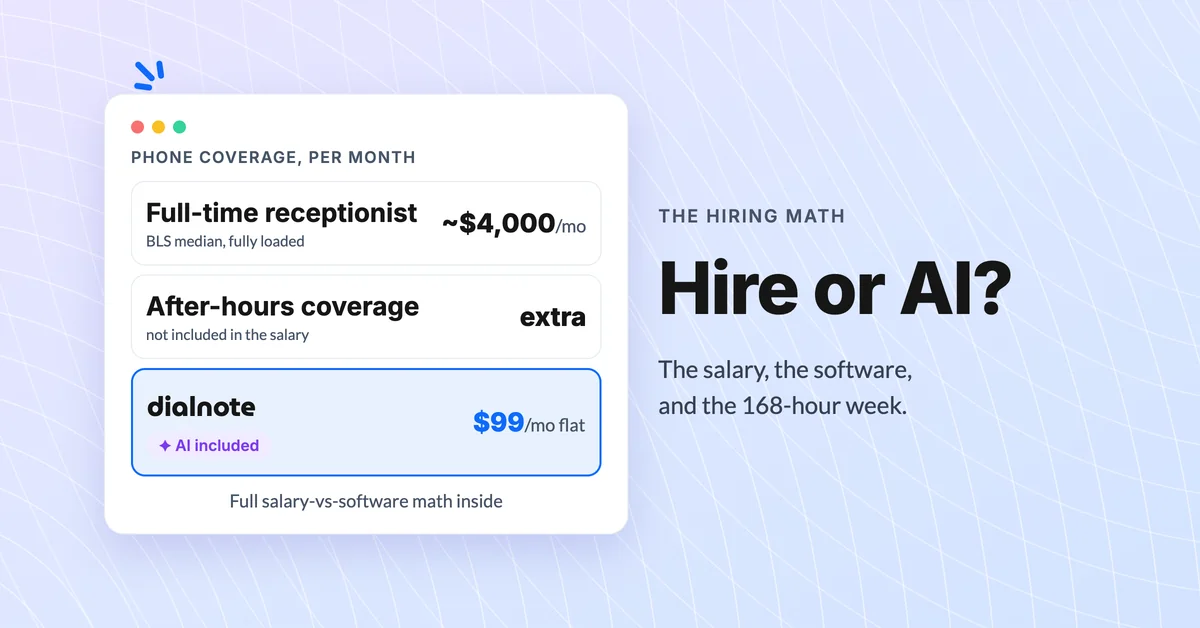
AI Receptionist vs Hiring: What Each Really Costs
Compare an AI receptionist vs hiring a receptionist: salary and benefits math, coverage hours, and what each option really costs over a year.
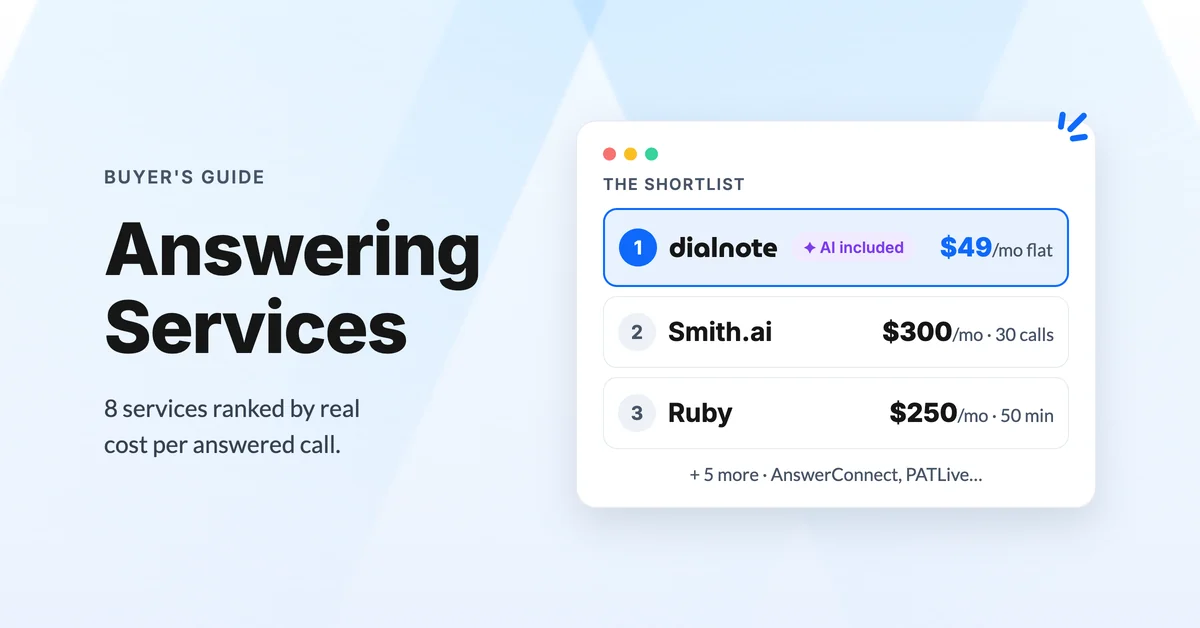
Best Answering Service for Small Business [2026]
Compare the best answering services for small business in 2026: live, AI, and hybrid options ranked by real cost per call and coverage.
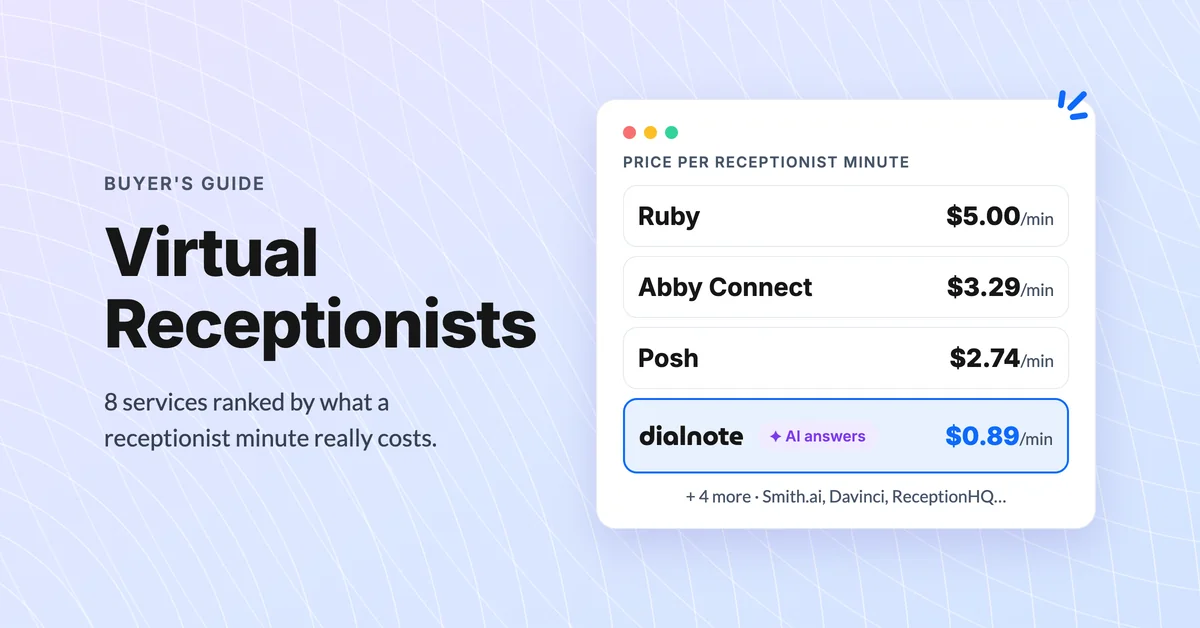
Best Virtual Receptionist Services Ranked [2026]
Compare the best virtual receptionist services of 2026 by price per receptionist minute, booking depth, and coverage, including the AI option.