Can an AI Receptionist Help Grow Your Salon?
Your salon's phone rings. Your colorist has foils in a client's hair. Your other stylist is mid-blowout. The front desk person is checking someone out, handing them a receipt, and trying to upsell a product at the same time.
Nobody picks up.
That call? It was a new client. She found your salon on Google, liked your reviews, and wanted to book a balayage appointment worth $250. But she didn't leave a voicemail. According to research from Salon Today, 68% of new salon clients won't call back if their first call goes unanswered. She called the salon down the street instead. They picked up on the second ring.
This happens more than most salon owners realize. And it's quietly costing them thousands every year. An AI receptionist for salons is one way to stop the bleeding, and it doesn't require hiring another person or chaining someone to the front desk.
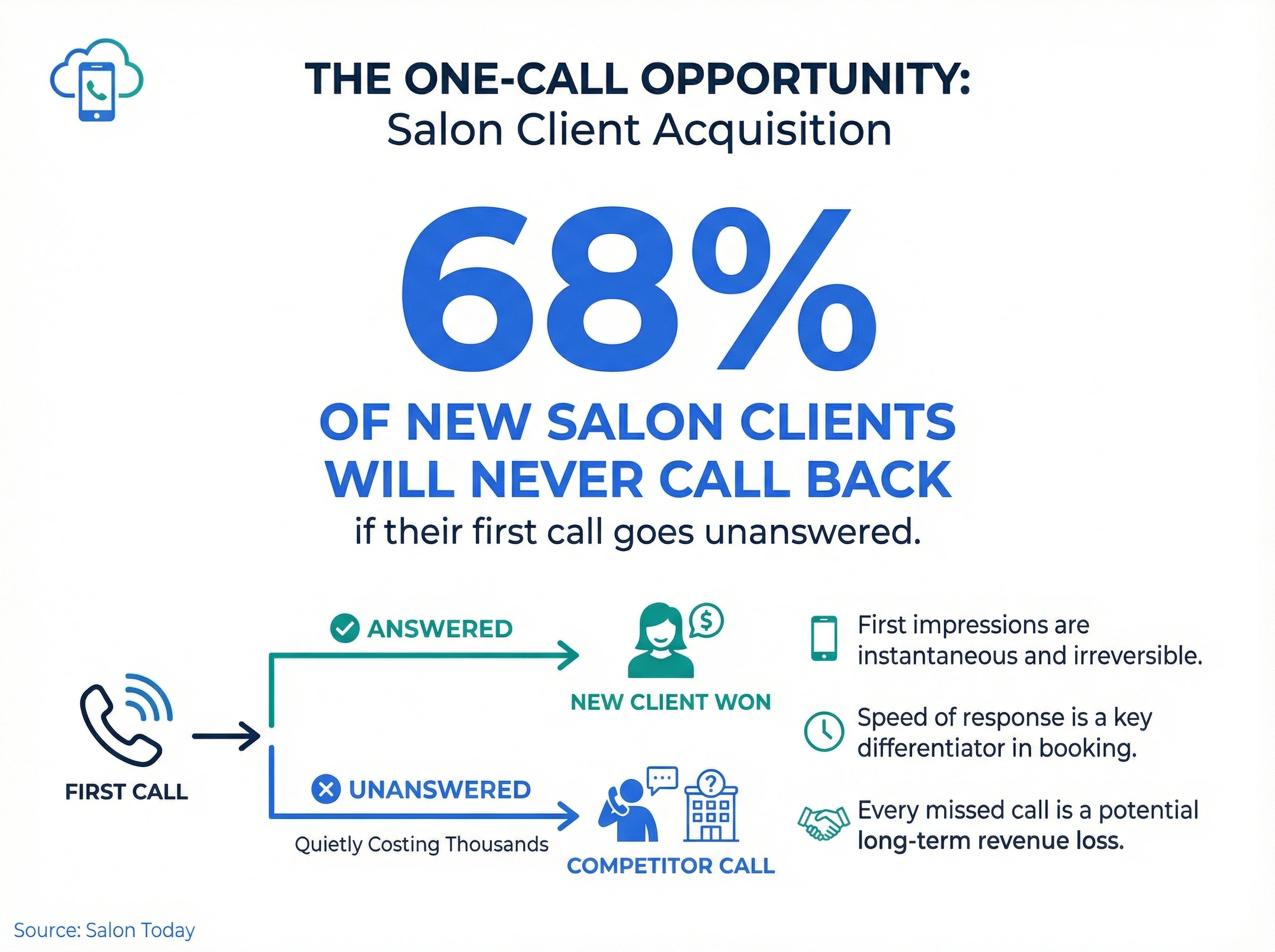
After spending over two decades in marketing and business growth, I've watched this pattern play out across industries. Salons are hit especially hard because the work is so physical and hands-on. You can't pause a haircut to grab the phone. But the client on the other end of that line doesn't care about your reasons. They just want someone to answer.
TL;DR:
- An AI receptionist for salons answers every call automatically, day or night, so booked-solid stylists never send a new client to voicemail.
- Salons miss an average of 300-500 calls a month, and 68% of new clients won't call back after one unanswered ring, which quietly costs thousands in lost bookings.
- The AI books, reschedules, and cancels appointments in real time by connecting to scheduling tools like Boulevard, Vagaro, Fresha, or Mindbody.
- It handles unlimited calls at once, sends no-show reminders, answers pricing and hours questions, and routes complex calls to a real person.
- dialnote is an AI-powered phone system built for small businesses that can't miss calls but can't afford a full-time receptionist either.
Why does your salon keep losing clients to the place down the street?
It's not your skills. It's not your pricing. It's your phone.
According to a 2024 Zenoti consumer survey, 67% of beauty clients choose the salon that responded first, not the cheapest one. Speed wins. And when 35-40% of your calls go unanswered during busy hours, you're handing clients to competitors on a silver platter.
Think about a typical Saturday at your salon. Every chair is full. Walk-ins are waiting. Your phone is ringing off the hook. Your front desk person (if you even have one) is juggling check-ins, retail sales, and appointment confirmations all at once. There's physically no way they can answer every call.
But what happens to that caller?
Most of them don't leave a voicemail. They don't send an email. They don't check your website's online booking system. They call the next salon on their list. And that salon gets the $200 color appointment, the $150 keratin treatment, the $80 cut-and-style. Multiply that by 15-20 missed calls a week, and you're looking at serious revenue walking out the door you never even opened.
The frustrating part is that it has nothing to do with how good you are at your job. It's a logistics problem. And it's fixable.
What salon owners actually deal with every day
Let's be honest about what running a salon really looks like. The Instagram version shows gorgeous transformations and happy clients. The reality involves a lot more chaos.
Here's a typical Tuesday for Priya, who owns a 6-chair salon in Austin. She built her client list over eight years. Her Google reviews sit at 4.8 stars. She's booked solid most weeks. By every visible measure, her business is doing great.
But her phone tells a different story.
8:45 AM. Priya arrives and checks her voicemail. Three missed calls from the night before. One voicemail that just says "Hi, I wanted to book an appointment, I'll try again." (They won't.)
10:30 AM. Her front desk person, Maria, is checking in two clients while the phone rings. Maria puts one client on hold to answer. The caller wants to reschedule. Maria digs through the appointment book while both clients wait. The caller on hold hangs up.
12:15 PM. Priya steps out from behind the chair to answer a call because Maria is at lunch. The client in Priya's chair watches her walk away mid-service. The caller just wants to know the price of a blowout, something an automated system could handle in 10 seconds.
2:00 PM. A no-show. That's a $175 slot gone. If Priya had an automated reminder go out that morning, the client might have canceled in time to fill the spot.
4:30 PM. Saturday's schedule has two empty slots. Priya posts an Instagram story trying to fill them. But the four people who called during lunch and didn't get through would've happily taken those spots.
6:00 PM. Priya closes up. She checks her call log. 23 incoming calls today. Maria answered 14 of them. Nine went to voicemail. Two people left messages.
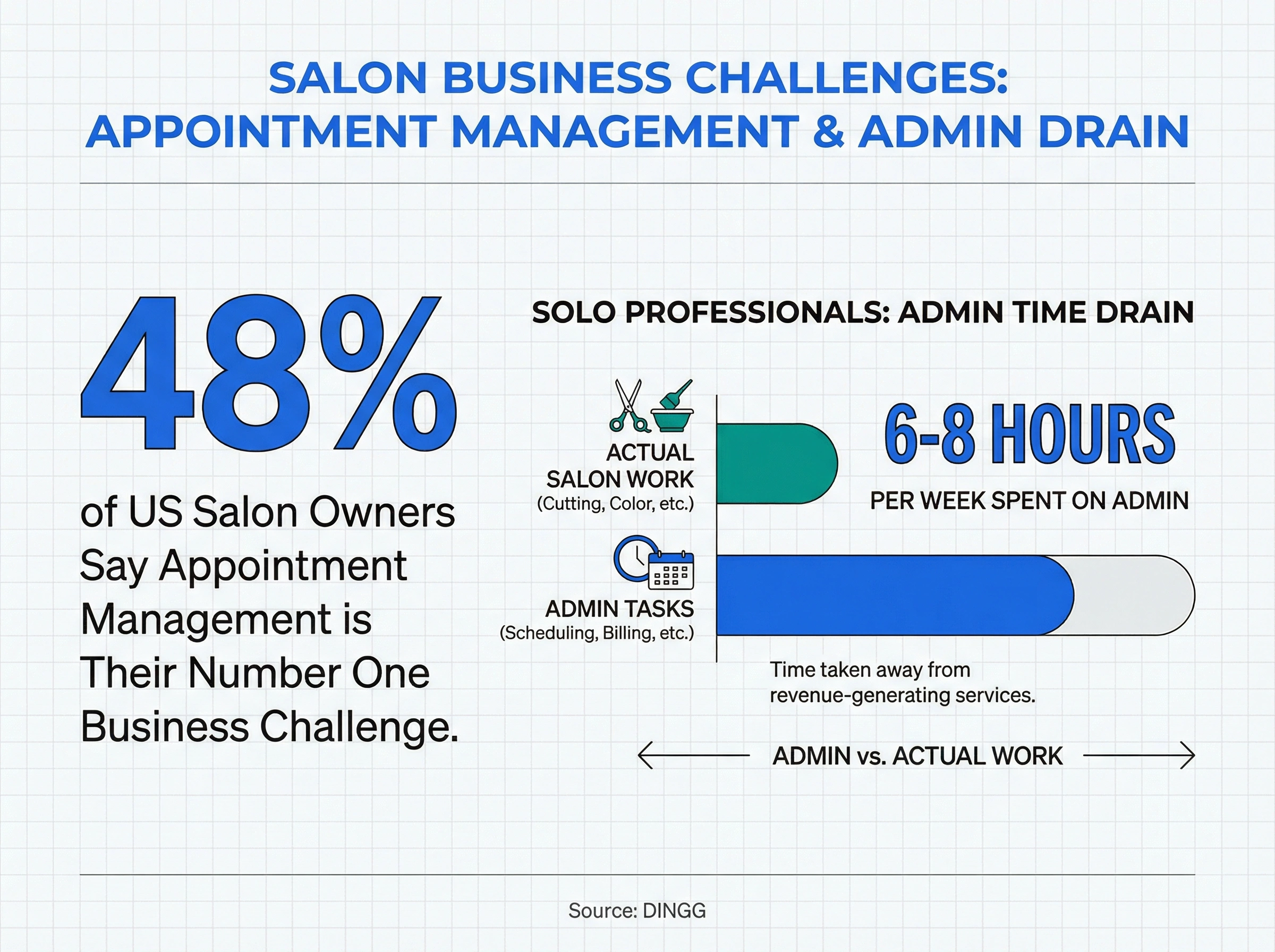
This isn't a bad day. This is a normal day. According to data from DINGG, 48% of US salon owners say appointment management is their number one business challenge. And solo professionals spend 6-8 hours every week just on admin tasks that have nothing to do with cutting hair or mixing color.
The problem isn't that Priya doesn't care. It's that she's one person trying to do everything, and her phone is one more thing she can't keep up with.
What can an AI receptionist do for your salon?
An AI receptionist answers your salon's phone calls automatically. It sounds like a real person, understands what the caller needs, and takes action without putting anyone on hold or sending them to voicemail.
So what does an AI receptionist actually do when someone calls your salon? Here's the short version: it picks up, figures out what the caller wants, and handles it.
The longer version depends on how you set it up, but most salon-focused AI receptionists can do all of this:
Answer every call, every time.
Whether it's 2 PM on a packed Saturday or 11 PM on a Tuesday, the AI picks up. No hold music. No voicemail tree. No "press 1 for appointments, press 2 for..." menus that make people hang up.
Book, reschedule, and cancel appointments.
The AI connects to your salon's scheduling software (most work with popular tools like Boulevard, Vagaro, Fresha, or Mindbody). A client calls and says "I need to move my Thursday appointment to Friday." The AI checks your availability, confirms the new time, and sends a text confirmation. Done.
Answer common questions.
Pricing. Hours. Location. Parking. Whether you take walk-ins. What products you carry. The AI knows all of this because you've given it the information upfront. These calls make up a huge chunk of your total call volume, and they don't need a human to handle them.
Send appointment reminders.
No-shows are one of the biggest profit killers for salons. A good AI receptionist sends automated text or call reminders 24-48 hours before an appointment. Clients who might have forgotten can confirm or reschedule, freeing up the slot if they can't make it.
Route calls that need a real person.
Not every call can be handled by AI. If a client has a complaint, wants a complex consultation, or needs to talk to their stylist directly, the AI transfers the call to the right person. It doesn't try to handle things it shouldn't.
Capture new client information.
When a brand-new caller reaches your salon, the AI collects their name, contact info, and what service they're looking for. That data goes straight into your system. No sticky notes. No forgotten details.
The key thing to understand is that an AI receptionist isn't replacing your front desk. It's handling the overflow that your front desk can't get to. It's the safety net that catches every call that would otherwise hit voicemail and disappear.
The numbers behind missed salon calls
Let's talk money. Because that's what this comes down to.
According to research compiled by Get Leads for Local, salons miss an average of 300-500 calls per month per location. Not all of those are new clients, but even a small percentage translates to real revenue.
Here's some rough math. Say your salon misses 400 calls a month. Industry data suggests about 20% of those are potential new clients. That's 80 new client calls. If even half of them would have booked (a conservative estimate since they called you first), that's 40 new appointments.
The data isn't entirely clear on exactly how much the average salon loses per missed call, but we can work backward from average service values. If your average ticket is $120, those 40 missed bookings represent $4,800 per month. That's $57,600 a year in revenue you never see.
And that's just first visits. A retained client comes back 4-6 times per year. So that $120 first visit from a single new client could turn into $600-720 in annual revenue. Multiply that across 40 missed new clients per month, and the lifetime value loss is staggering.
According to a case study published by Community Phone, one hair and nail salon tracked their missed calls after implementing an AI phone system. They recovered 21 missed calls per month that turned into $1,260 in new monthly revenue. That's a 1,500% ROI on their phone management cost.
Now, some salon owners might push back on these numbers. "We have online booking. People can just book on our website." And that's true. But here's the thing: according to a 2025 Zenoti survey, 57% of salon customers still prefer calling to book. Not texting. Not clicking through an app. Calling. Especially for first-time visits, when they have questions about services, pricing, or availability.
Online booking is great. But it doesn't replace the phone. It supplements it. And if your phone goes unanswered, you're ignoring the preferred booking method of more than half your potential clients.
How a salon AI receptionist handles your busiest hours
Saturday morning. Your salon's peak hour. Let's walk through what happens with and without an AI receptionist.
Without AI: The 10 AM rush
Your phone rings four times between 10:00 and 10:15. Maria answers the first call (a reschedule, takes 3 minutes). The second call goes to voicemail. The third caller hangs up after 5 rings. Maria picks up the fourth call while trying to check in a walk-in at the same time.
Total calls handled: 2 out of 4. Two potential clients lost.
With AI: The same 10 AM rush
All four calls get answered simultaneously. Yes, simultaneously. Unlike a human receptionist, an AI receptionist handles unlimited concurrent calls. There's no busy signal, no hold queue, no "all representatives are currently assisting other customers" recording.
Call 1: "I need to reschedule my 2 PM with Jessica to next week." The AI checks Jessica's availability, offers three time slots, the client picks one, and gets a text confirmation. Time: 45 seconds.
Call 2: "How much is a balayage?" The AI pulls your pricing: "Balayage at our salon starts at $180, depending on hair length and color goals. Want me to book a consultation?" The caller says yes. New appointment booked. Time: 60 seconds.
Call 3: "Do you take walk-ins today?" The AI checks today's schedule: "We have availability for a walk-in around 2:30 PM. What service are you looking for?" Time: 40 seconds.
Call 4: "I want to cancel my appointment tomorrow." The AI confirms the cancellation and immediately flags the open slot for potential fill-in bookings. Time: 30 seconds.
Total calls handled: 4 out of 4. One new client booked. One cancellation captured early enough to fill the slot. Zero revenue lost.
That 15-minute window on a Saturday could mean the difference between a $200 day and a $600 day. And it happens every single week.
What changes when every call gets answered?
When you go from missing 30-40% of calls to answering 100%, the effects ripple through your whole business.
More new clients walk through your door. This one's obvious. Every answered call is a chance to convert someone who's already interested. They searched for you. They picked up their phone. They dialed your number. They're ready to book. All you had to do was pick up.
Your no-show rate drops. Automated reminders catch the clients who forget. And when a client does need to cancel, the AI handles it instantly and opens the slot for someone else. Salon scheduling software company VocalyAI reports that automated reminders can reduce no-shows to 5% or less. For context, the industry average sits around 20-30%.
Your front desk does actual front-desk work. When Maria isn't glued to the phone, she can focus on the people standing right in front of her. Better check-in experiences. More retail conversations. Warmer goodbyes that get people to rebook before they leave.
What does that look like in practice? Imagine Maria spending her time greeting clients by name, recommending products, and making the in-person experience feel special instead of answering the same "what are your hours?" question for the tenth time today.
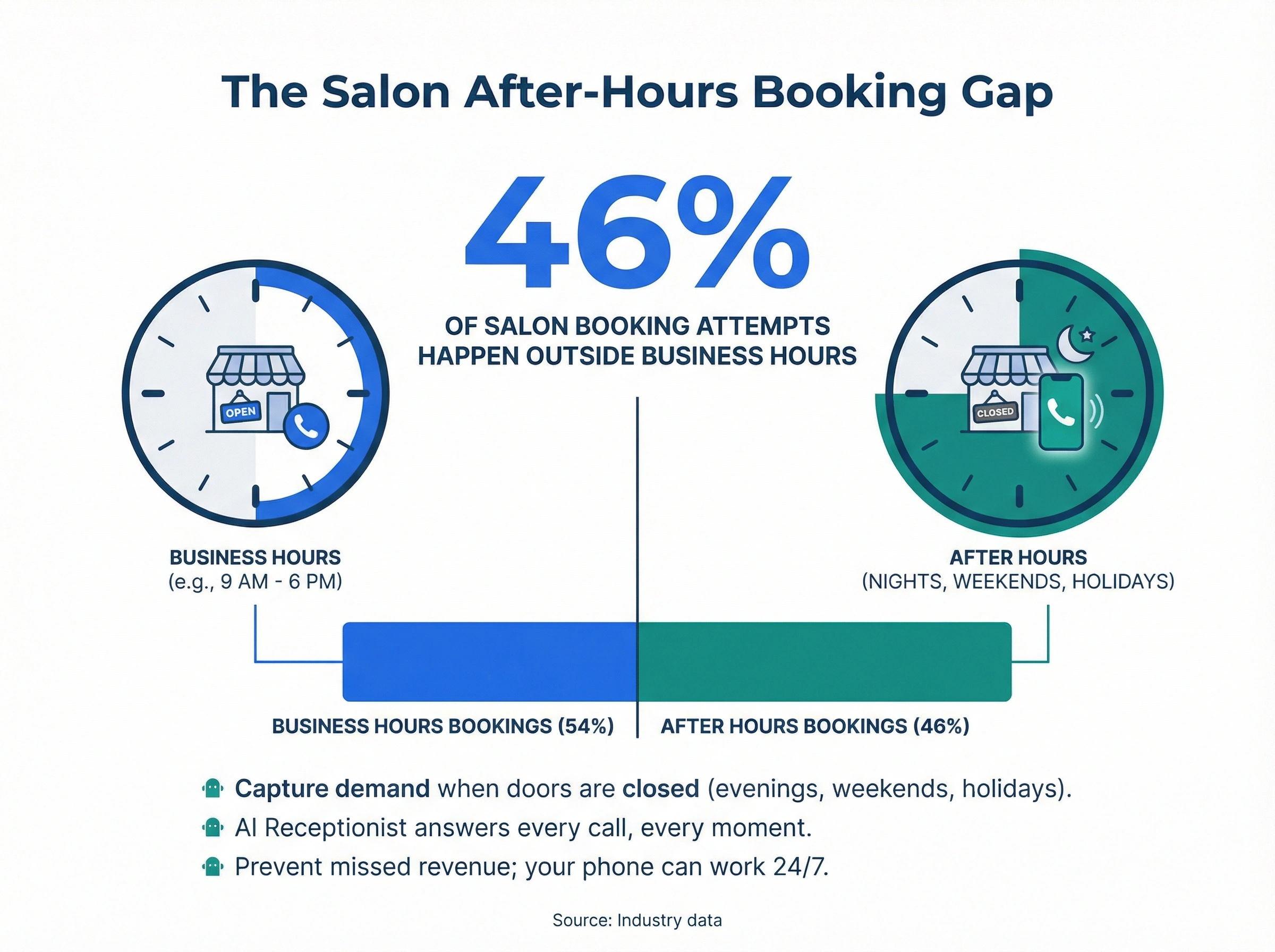
You capture after-hours demand. According to industry data, 46% of salon booking attempts happen outside business hours. That's nearly half your potential bookings coming in when nobody's there to answer. An AI receptionist covers nights, weekends, holidays, and every other moment your doors are closed but your phone could still be working for you.
You get real data about your calls. Most AI receptionist systems give you a dashboard showing call volume, peak times, common questions, and booking conversion rates. This data helps you make smarter decisions about staffing, hours, promotions, and services. Instead of guessing when your busy times are, you'll know exactly.
Your stylists stay focused. No more pulling a stylist away from a client to answer the phone. No more interrupting a color service because Maria is busy. Your team can focus on the craft they were hired for, and clients notice the difference.
Picking the right AI receptionist for your salon
Not every AI phone tool is built for salons. Some are designed for medical offices. Others target law firms. The features you need are specific to how salons actually operate.
Honestly? Most "AI receptionist" tools built for salons are just glorified voicemail with a chatbot bolted on. They answer the call, read a script, and tell the person to book online. That's not a receptionist. That's a recording with better marketing.
Here's what to look for when you're evaluating options:
Real-time scheduling integration.
The AI should connect directly to your booking software and see live availability. If it can't book an appointment during the call, it's not doing its job. Clients don't want to be told "someone will call you back." They want to book now.
Natural-sounding conversation.
Test it yourself. Call the demo line. If it sounds like a robot reading from a script, your clients will hang up. The best AI receptionists today sound remarkably human. They can handle small talk, follow-up questions, and even pauses in conversation without getting confused.
Multi-call handling.
Your Saturday rush means 5-10 calls in 15 minutes. If the AI can only handle one call at a time, it's no better than Maria. Make sure it can handle unlimited simultaneous calls.
Custom knowledge base.
You should be able to teach the AI about your specific services, pricing, stylists, specialties, and policies. A generic AI that doesn't know you offer olaplex treatments or that Jessica specializes in curly hair isn't going to impress your callers.
After-hours coverage.
This should be standard, but check anyway. Some tools only work during business hours, which defeats half the purpose.
Call analytics.
You want data. How many calls per day? What are people calling about? How many convert to appointments? This information is gold for running a smarter salon.
SMS follow-up.
After a call, the AI should be able to send a text confirmation, a link to online booking, or a reminder. Texting is how most people prefer to get confirmations now.
Bilingual support.
If your salon serves a diverse community, look for AI that handles multiple languages. A client who calls and hears their language feels immediately welcome.
How dialnote helps your salon never miss a call
So where does dialnote fit in all of this?
dialnote was built for exactly this problem. It's an AI-powered phone system designed for small businesses that can't afford to miss calls but also can't afford to hire a full-time receptionist.
Here's what makes it work for salons specifically:
The AI receptionist picks up every call. Day, night, Saturday rush hour, Tuesday slow period. It doesn't matter. Every call gets answered by an AI that sounds natural and knows your salon inside out. You can customize what it knows, what it says, and how it routes different types of calls.
It connects to your salon's scheduling tools. dialnote integrates with popular scheduling platforms, so the AI can check real-time availability and book appointments without human involvement. No back-and-forth. No "let me check and call you back."
Call routing sends the right calls to the right people. Sometimes a client needs to speak with their specific stylist. Sometimes it's a vendor call. Sometimes it's an emergency. dialnote's smart call routing sends each call where it needs to go based on rules you set.
You get a local or toll-free business number. If you've been using your personal cell for the salon, dialnote lets you set up a dedicated business number. It looks more professional, keeps your personal life separate, and gives you a single number that all your marketing and signage can point to.
Text messaging built in. Send appointment confirmations, reminders, promotions, or follow-ups via text. Clients who prefer texting over calling get served too. And the AI can send automatic texts after calls with booking links or confirmations.
Call analytics show you exactly what's happening. See how many calls you're getting, when they come in, what callers are asking about, and how many convert to bookings. Use that data to adjust your hours, staffing, promotions, and service menu.
No long-term contracts. You can try dialnote and see results before committing. For a salon that's losing $4,000-5,000 a month to missed calls, even recovering a fraction of that makes the investment obvious.
We've seen salons go from missing 30-40% of their calls to answering virtually all of them within the first week of setup. The revenue impact usually shows up within the first month.
Growing your salon without growing your overhead
Building a salon is hard work. You've spent years perfecting your craft, building a reputation, and earning clients who trust you. Losing those clients (or never getting them in the first place) because of a missed phone call is a problem that shouldn't exist anymore.
An AI receptionist for salons won't make your stylists better at their jobs. It won't redesign your space or improve your product line. What it will do is make sure that every person who calls your salon gets an answer, gets help, and gets the chance to become a client.
The numbers back it up. Fewer missed calls. More bookings. Lower no-show rates. Better data. Happier front-desk staff who can focus on the people right in front of them instead of being pulled in five directions at once.
The salon industry is going through a big shift right now. According to Allied Market Research, the hair salon services market is worth $57.4 billion in the US and growing at nearly 5% per year. Competition is fiercer than it's been in years. The salons that grow through this period won't just be the ones with the best stylists. They'll be the ones that answer the phone.
Frequently asked questions
Most AI receptionist services for salons cost between $50-300 per month, depending on call volume and features. That's a fraction of hiring a full-time receptionist at $2,500+ monthly.
Yes. A good AI receptionist connects to your scheduling software and books, reschedules, or cancels appointments in real time. Clients don't need to wait for a callback.
Modern AI receptionists sound natural and conversational. Some clients won't notice. But being transparent about it actually builds trust, and most clients don't mind as long as they get help fast.
Yes, that's one of the biggest benefits. An AI receptionist answers calls 24/7, so you don't lose the 46% of potential bookings that come in outside business hours.
Absolutely. Unlike a human receptionist who can only take one call at a time, an AI receptionist handles unlimited simultaneous calls. No more busy signals during your Saturday rush.

Written by
Lancelot Dsouza
Chief Marketing Officer, SmartReach.io
Lancelot Dsouza is the Chief Marketing Officer at SmartReach.io, where he built the Marketing, Sales, and Customer Success verticals from the ground up. With over 25 years of experience spanning digital marketing, business development, and strategic...
Lancelot Dsouza is the Chief Marketing Officer at SmartReach.io, where he built the Marketing, Sales, and Customer Success verticals from the ground up. With over 25 years of experience spanning digital marketing, business development, and strategic...
Related Articles
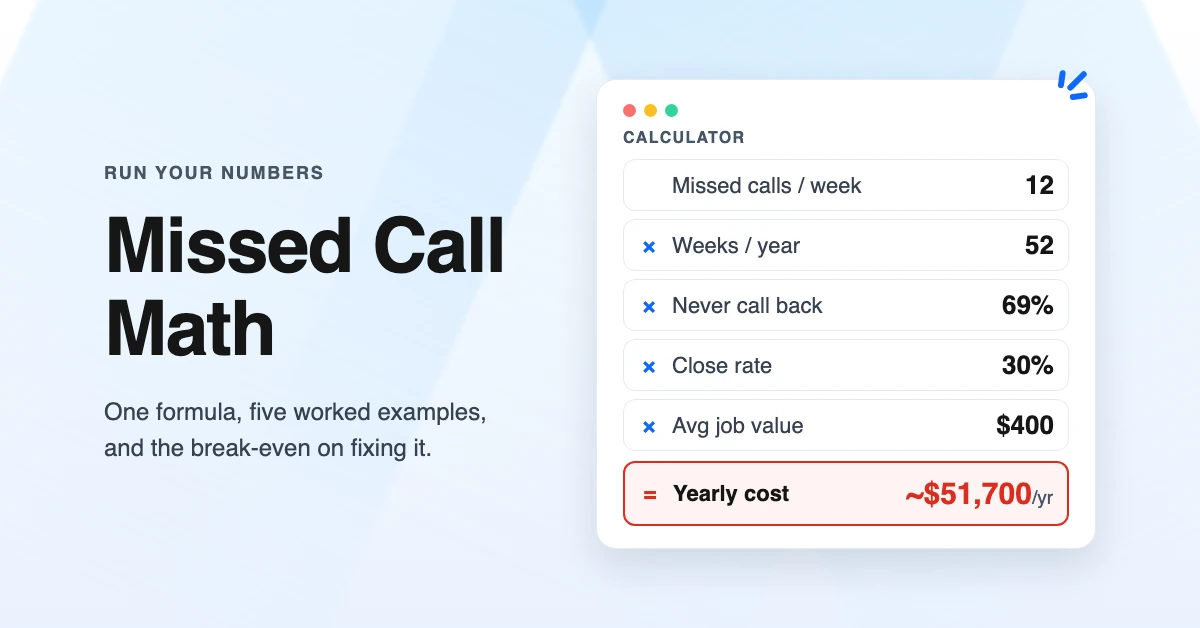
The Cost of Missed Calls: Calculator and Worked Examples
Calculate the cost of missed calls for your business with a simple formula, five worked examples by industry, and the break-even point for fixing it.
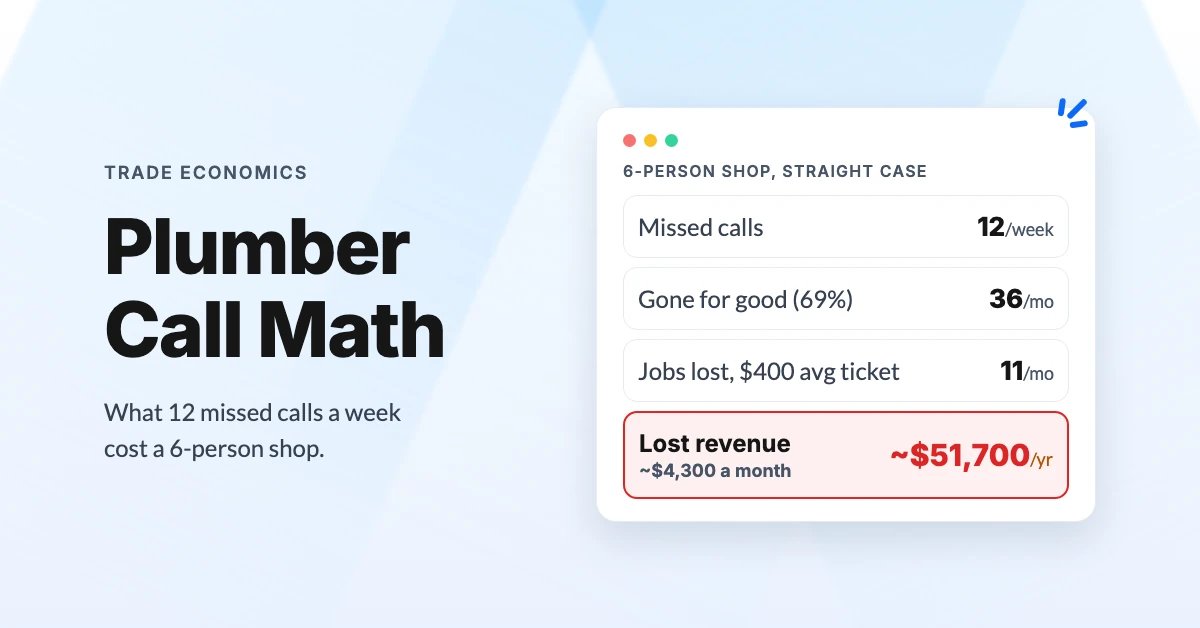
The Real Cost of Missed Calls for Plumbers (2026 Math)
Work out what missed calls cost your plumbing business: per-job values, after-hours miss rates, and a worked example that shows the yearly leak.
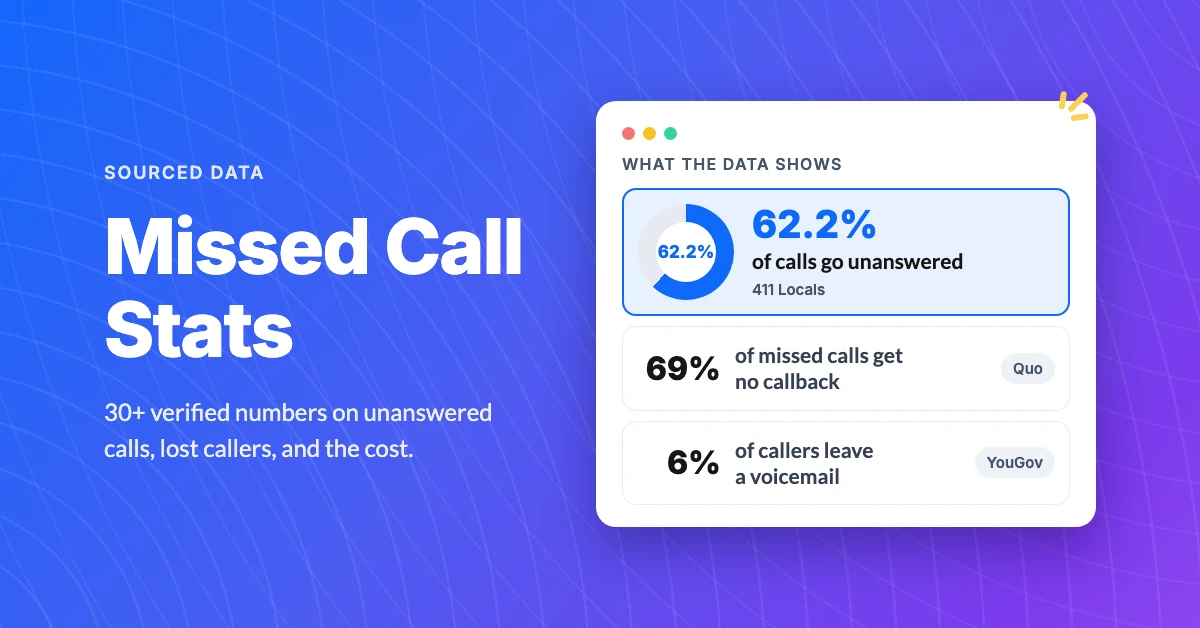
30+ Missed Call Statistics Small Businesses Need in 2026
See 30+ sourced missed call statistics for 2026: how many calls go unanswered, how few callers try again, and what that costs small businesses.