Funeral Home Answering Service: What Actually Works
A family calls at 3:40 in the morning. Someone has died, they've been given your name by a hospice nurse, and they have no idea what happens next. The phone rings four times and goes to voicemail.
That family won't leave a message and wait. They'll go back to the nurse, or search again, and call whoever picks up. This is the only part of funeral service where the whole relationship is decided in about twelve seconds, and it's why a funeral home answering service is less a convenience than a condition of staying in business.
What follows is a comparison of the ways funeral homes actually cover that call, including the one most vendor content skips: routing it to a human on your own staff instead of paying someone else to take a message.
TL;DR:
- A first call should reach a person. This is the one vertical where automating the primary call is the wrong answer, and we'd tell you so even though we sell phone systems.
- Live answering services exist for exactly this, and for many funeral homes they're the right buy.
- The alternative isn't AI. It's a ring group plus after-hours routing, which sends the call to the on-call director's mobile and a backup at the same time, with no third party involved.
- The real choice is whether somebody on your staff is willing to carry the phone overnight. If yes, routing is cheaper and more personal. If no, pay for a live service.
- dialnote is the AI business phone system priced for your whole team: shared numbers, call routing, branded AI voice agents that answer, qualify, and book, and automatic CRM sync, all included, with no per-user cost. For a funeral home it's the routing layer, not the voice on a first call.
What should a funeral home answering service do?
It should get a first call to a human being who can speak to a family, within a few rings, at any hour. Everything else about it is secondary: message formats, scripts, portals and reporting all matter less than whether the phone gets answered by someone who sounds like they expected the call.
That sounds obvious. It's worth stating because the category has drifted toward feature lists that have very little to do with it.
A funeral home's call mix also isn't uniform, and the difference matters when you're choosing. First calls arrive at any hour, carry the whole relationship, and need a person. Pre-need enquiries, vendor calls, clergy coordination and price questions arrive in daytime, are far more numerous, and need accuracy rather than empathy. Buying one solution for both is how funeral homes end up overpaying for the easy calls and underserving the hard one.
Why AI is the wrong answer for a first call
We build AI voice agents, and we'd tell you not to put one on a first call.
A family in the first hour after a death isn't completing a transaction. They often don't know what to ask. They need someone to say the right thing slowly, take a name and an address, and confirm that somebody is coming. An AI agent can capture those details accurately, and it will still be the wrong experience, because the thing being bought in that moment is reassurance from a person.
This is the uncomfortable part of the category, and most content about it is written by people selling the thing they're recommending. There's a version of this post that sells you an AI receptionist for 3am calls. It would convert about as well, and it would be wrong.
Where AI genuinely helps a funeral home is everything else. Pre-need enquiries that come in during the day while the whole staff is at a service. Vendor and clergy calls that need routing. The fourth person this week asking about cremation pricing. Those calls are repetitive, nobody on them is in distress, and leaving them to voicemail costs real pre-need revenue.
Where AI does belong at a funeral home
Everything that isn't a first call, which is most of the phone volume.
Pre-need enquiries are the clearest case. Somebody rings on a Tuesday afternoon to ask what a cremation costs or whether you do pre-payment plans. Nobody's in distress, the questions repeat, and the whole staff is frequently at a service when those calls arrive. Those are the calls quietly going to voicemail, and pre-need is the revenue line most homes say they want to grow.
Vendor and clergy coordination is the same shape. So are the price questions that come in before a family has decided anything.
Routing by call type is what makes this work. An after-hours call goes to the on-call ring group and a person answers. A daytime call that nobody picks up within a few rings can go to an AI agent that answers the pricing question, captures a name and a number, and logs it. Same number, two very different paths, and the one that matters most has no automation in it at all.
That split is the honest version of what a phone system does for a funeral home. The routing is the product. The AI is one destination among several, and for this vertical it's deliberately not the destination for the call that counts.
The options compared
Four ways funeral homes cover the after-hours call, and they're genuinely different products.
| What it is | Best for | Weakness | |
|---|---|---|---|
| Live answering service | Trained operators take the first call and reach your director | Homes where nobody will carry a phone overnight | Per minute or per call, and an operator who doesn't know your families |
| Funeral-specific answering service | Same, with staff trained on first-call protocol | Homes wanting scripted first-call handling | Highest cost of the four |
| Ring group plus after-hours routing | Your phone system rings the on-call director and a backup together | Homes with a director already willing to be on call | Somebody has to actually answer |
| Voicemail | Nothing | Nobody | Loses the family |
Most of the buying conversation in this category is about the first two. The third is the one worth understanding, because a lot of funeral homes are paying for an answering service to do something their phone system can already do.
How on-call routing actually works
If a director is willing to carry the phone, the setup is straightforward and the family reaches your own staff rather than a stranger.
A ring group rings several phones at once. The on-call director's mobile and a backup both ring, the first to pick up gets connected, and the other stops. No one is relying on a single phone being charged and in the right room.
A business-hours rule decides when that happens. During the day, calls go to the office. Outside your schedule, the same number routes straight to tonight's on-call group. The family dials the number on your sign and reaches a person, with nothing in between.
That's the whole mechanism, and none of it involves AI. It's ordinary phone-system routing that has existed for years, and it's the reason a funeral home shouldn't assume a monthly answering-service bill is the only way to cover nights.
The honest condition attached: it only works if somebody genuinely answers. A rota that exists on paper and gets ignored at 3am is worse than an answering service, because at least the service picks up. If your directors are already stretched, don't talk yourself into this to save money.
What this costs either way
Worth putting numbers against, because the two models price completely differently.
Live answering services bill per minute or per call. A first call isn't short, and the ones at 3am are the longest. A home taking 20 after-hours calls a month at a typical per-call rate is looking at a few hundred dollars monthly, and the bill rises in exactly the months you're busiest.
A phone system with on-call routing is flat. dialnote runs $49/mo on Team with no per-user cost, so adding a second director to the on-call group doesn't change the bill.
| Live answering service | On-call routing | |
|---|---|---|
| Pricing | Per minute or per call | Flat monthly |
| Busy month | Costs more | Costs the same |
| Who answers | A trained stranger | Your own director |
| Needs a rota | No | Yes |
But read the row that matters. If nobody on staff will carry the phone, the flat price is irrelevant and the answering service is the correct purchase. A cheaper system that nobody answers isn't cheaper. That's the honest version, and it's the row most vendor comparisons leave out.
What does after-hours coverage actually cost?
Worth running properly, because the two models diverge fast and the variable that drives it is call length, not call count.
Live answering services bill per minute or per call. General-purpose ones publish rates: PATLive runs $99/mo for 50 minutes, Ruby $250/mo for 50 minutes, Smith.ai $300/mo for 30 calls, AnswerConnect $350/mo for about 50 calls. Funeral-specific services with first-call training cost more than these, and most don't publish, so treat the numbers below as the floor rather than the quote you'll get.
Now apply a funeral home's call shape. Say 20 after-hours calls a month, and first calls running 8 to 12 minutes because nobody rushes a family at 3am.
| Model | Rate | 20 calls at 10 min | What moves the bill |
|---|---|---|---|
| Per minute | $5/min equivalent | about $1,000/mo | Call length, which you can't shorten |
| Per call | $10/call equivalent | about $200/mo | Call count |
| On-call routing | Flat | $49/mo on Team | Nothing |
The per-minute row is the one funeral homes get caught by. A 50-minute bundle sounds generous until you notice it's four first calls. Per-call pricing suits this vertical far better, and it's worth asking for explicitly.
And the row that outranks all of them: if nobody on staff will answer at 3am, the $49 is a false economy and the $200 is the correct spend. Routing only beats a service when somebody picks up.
Where dialnote fits, and where it doesn't
dialnote is the phone system underneath, not the voice on a first call.
What it does: ring groups so the on-call director and a backup ring together, business-hours rules so evenings and weekends route automatically, shared numbers so the team isn't scattered across personal mobiles, and a log of every call so nothing is reconstructed from memory. The AI agent is available and we'd suggest pointing it at daytime overflow and pre-need enquiries rather than first calls.
What it isn't: a staffed answering service. There's no operator on our side. If your answer to "who picks up at 3am" is "somebody you employ", dialnote routes that call well. If your answer is "nobody, that's why we're buying this", you want a live service and we'd rather say so than sell you a routing layer that leaves the phone ringing.
There's also no integration with funeral management software like SRS or Passare today. Call details are captured and logged; moving them into a case file is still a person's job.
What a good first-call handoff looks like
Whichever route you pick, the handoff is where most setups quietly fail.
With a live service, the failure is latency. The operator takes the details, then pages or emails the director, who rings the family back twenty minutes later. For a family standing in a hospital corridor, twenty minutes is long enough to call somebody else. The question to ask a service isn't whether they answer, it's how fast the director is actually on the phone with the family, and what happens when the first page goes unacknowledged.
With on-call routing, the failure is simpler and more avoidable: one phone, one person, no fallback. A director who's driving, asleep or already on a call becomes a missed first call, and there is nobody behind them. This is exactly what a ring group is for, and it's the step most homes skip when they set this up themselves. Two phones ringing at once costs nothing extra on a flat plan and removes the single point of failure entirely.
Either way, write down what happens on the second failure. If the on-call director doesn't pick up, who rings next, and after how many seconds? If you can't answer that, you don't have a coverage plan, you have a hope.
The homes that handle this best tend to have the least sophisticated setup and the clearest rota. We've seen that pattern hold across a lot of small service businesses: the system matters less than whether somebody has decided, in advance and in writing, who is responsible at 3am on a Sunday.
What to check before you buy
Four questions, in the order they decide it.
- Will a director genuinely answer overnight? Answer this before comparing any products. It determines which half of this page applies to you.
- Test the first call yourself. Ring your own after-hours number at 11pm from a phone nobody recognises and listen to what a family would hear. Most owners have never done this.
- Ask a live service who answers at 3am and how many accounts that person covers simultaneously. The quality gap between services is almost entirely here.
- Separate the daytime calls. Whatever you choose for nights, pre-need and vendor calls are a different problem and usually a cheaper one.
We worked through the broader human-versus-AI tradeoff in AI receptionist vs live answering service, and the general after-hours case in does your business need an after hours answering service.
Where none of this helps
Two honest limits.
Coverage doesn't fix capacity. If your director is already conducting three services this week, routing the call to them faster adds pressure rather than removing it. Some homes need another person, not a better phone system, and no vendor on either side of this comparison will tell you that.
It also doesn't fix how the call is handled. A family reaching a tired director who answers badly is worse than reaching a trained operator who answers well. The phone system controls where the call goes, not what gets said when it arrives, and the second one decides whether that family stays.
One thing we don't know: whether families can tell the difference between a well-run answering service and a director answering directly, once the call is actually answered. We suspect the gap is smaller than funeral directors assume and larger than answering services claim, and we haven't seen credible data either way. If you've measured it, we'd genuinely like to know.
You can see the flat pricing on pricing, or how the routing pieces fit together on call routing and IVR.
Frequently asked questions
It's a service that answers a funeral home's calls when staff can't, usually overnight and at weekends. Most are staffed by trained human operators who take first-call details and reach the on-call director, because those calls can't wait until morning.
No. A first call from a bereaved family should reach a person. AI belongs on the other calls a funeral home takes, like pre-need enquiries, vendor questions and daytime overflow, where nobody is in distress.
Sometimes. If a director is genuinely willing to answer overnight, a ring group plus after-hours routing sends the call straight to their mobile and a backup, with no third party. If nobody wants that pager duty, a live service is the better answer.
It's the phone system underneath, not the person answering. Ring groups ring the on-call director and a backup together, business-hours rules route evenings and weekends, and calls are logged. Flat from $49/mo with no per-user cost.
Fast. Most first calls are made from a hospital or a home within hours of a death, and families rarely wait for a callback. An unanswered first call is usually a family served by somebody else.

Written by
Prateek Bhatt
Co-Founder, SmartReach.io
Prateek Bhatt is a product leader, programmer, and serial entrepreneur with over 12 years of experience building SaaS and AI-powered tools for sales and customer service teams. As Co-Founder of SmartReach.io - a multichannel outreach platform used by...
Prateek Bhatt is a product leader, programmer, and serial entrepreneur with over 12 years of experience building SaaS and AI-powered tools for sales and customer service teams. As Co-Founder of SmartReach.io - a multichannel outreach platform used by...
Related Articles
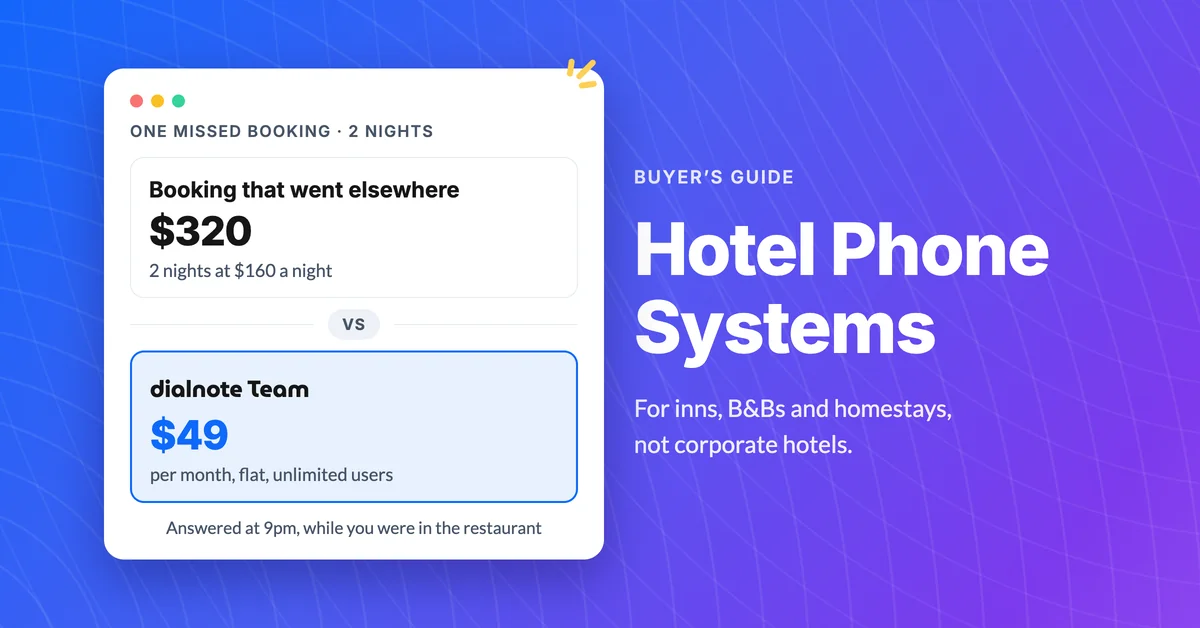
Hotel Phone System: 6 Picks for Small Properties
Compare 6 hotel phone systems built for small inns, B&Bs and homestays, with the room-night math that shows which one earns back its monthly cost.
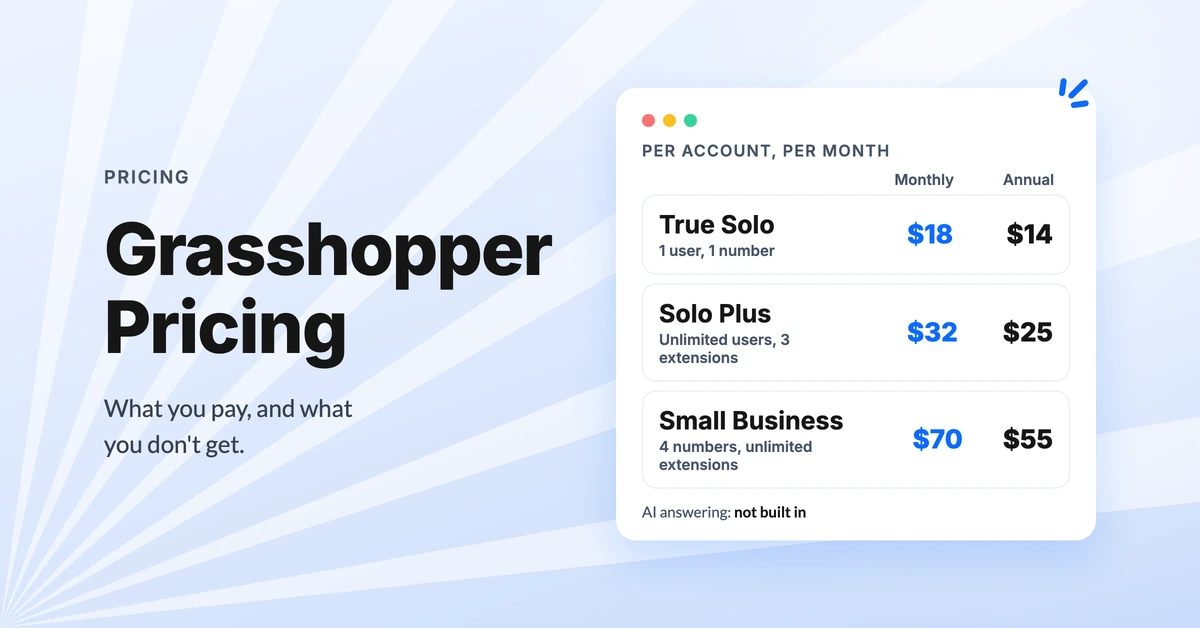
Grasshopper Pricing: What You Pay and What You Don't Get
See Grasshopper pricing plan by plan: $18 to $70 a month, less on annual billing, the hidden texting and number fees, and the real cost with AI answering.
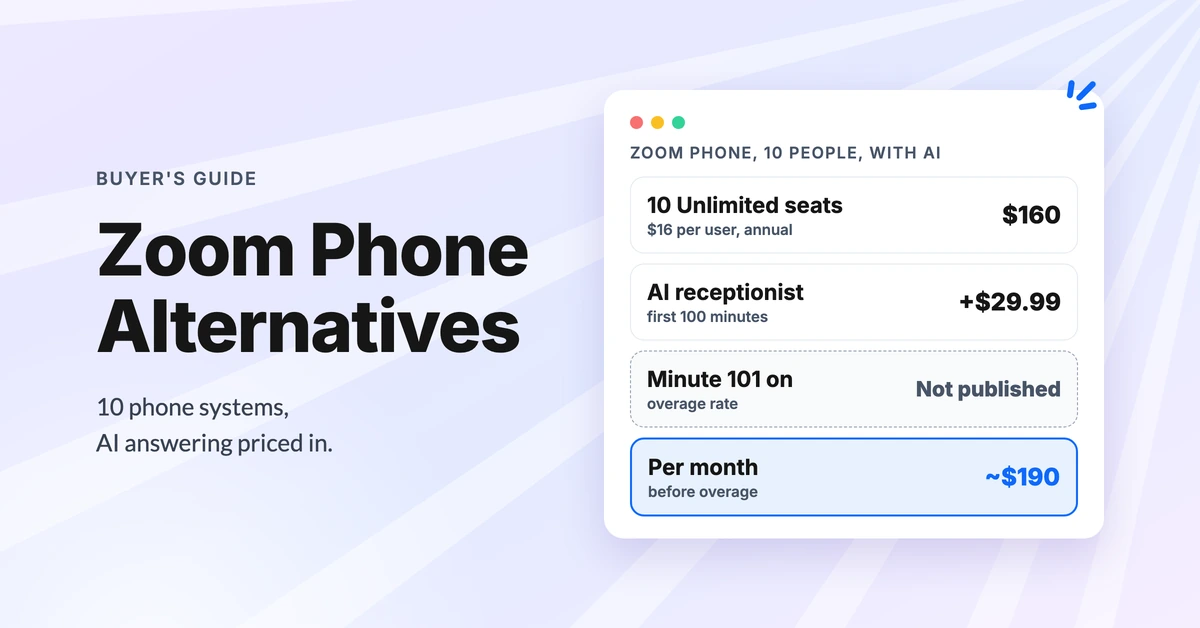
Best Zoom Phone Alternatives, Priced for a Real Team
Compare 10 Zoom Phone alternatives on what 3, 10, and 15 people pay once AI answering is added, using Zoom's live October 2026 prices. See the math.