VoIP vs traditional phone lines: honest comparison
Your business phone rings at 8 a.m. with a new customer who wants a quote. The line crackles, the call cuts out, and they hang up before you catch a name. That's the kind of moment that makes the VoIP vs traditional phone lines question suddenly feel urgent.
One system runs on copper wire that's been in the ground for decades. The other runs over the same internet connection you already pay for, and it does a lot more than ring. So which one actually earns its place in a small business today? Let's compare them the honest way, cost by cost and feature by feature, so you can pick with your eyes open.
TL;DR:
- The VoIP vs traditional phone lines choice usually comes down to cost, features, and how much you value flexibility over old-school power-outage reliability.
- VoIP runs voice over your internet and bundles calling, voicemail, call routing, and analytics into one monthly price. Traditional landlines charge for most of that as add-ons.
- VoIP typically costs far less to set up and run, since it skips desk hardware, PBX boxes, and per-line long-distance fees.
- Landlines still win in one narrow case: places with unreliable internet and frequent long power outages.
- For most small and mid-sized teams, a cloud phone system is the practical pick, especially if you want remote work, easy scaling, and AI call features.
What's the difference between VoIP and traditional phone lines?
Traditional phone lines send your voice as an analog signal over copper wire. VoIP sends it as digital data over the internet. That single shift, from wire to web, is what changes almost everything else about cost, features, and setup.
Traditional landlines (PSTN)
The Public Switched Telephone Network, or PSTN, is the copper-wire system that's carried phone calls for more than a century. It's reliable in a plain way: your desk phone plugs into a jack, the jack connects to a local exchange, and a call goes through even when the power's out. But it's also frozen in time. Features like caller ID or voicemail get billed as extras, and adding a new line means a technician and a wait.
VoIP (voice over internet)
Voice over Internet Protocol turns your voice into small data packets and ships them across the internet. It works on desk IP phones, laptops, and the smartphone already in your pocket. Because it's software at heart, a VoIP line can do things a copper line never could: transcribe a call, route it by menu, or ring three people at once. This is where a cloud phone system starts to pull ahead.
Here's a quick way to keep the two straight if you're new to the topic. Copper is hardware you rent. VoIP is a service you subscribe to. Everything below flows from that difference.
VoIP vs traditional phone lines: cost comparison
VoIP almost always costs less than a traditional landline, both to install and to run each month. You skip the PBX hardware, the per-line long-distance charges, and most add-on fees, since features come bundled into the plan price.
Let's look at the numbers. These are typical market ranges, not a promise for any one provider, so treat them as a planning guide.
Setup costs
| Cost type | Traditional | VoIP |
|---|---|---|
| Desk hardware | $200-500 per phone | $0-150 per phone |
| Installation | $100-500 | Usually free |
| Wiring | New cabling often required | Uses existing internet |
| PBX system | $5,000-50,000 | Included in the service |
The gap here is brutal for a growing team. A traditional setup wants physical gear and a wired PBX before you make a single call. A VoIP setup often needs nothing more than an app login and a headset.
Monthly costs
| Service | Traditional | VoIP |
|---|---|---|
| Local calls | $30-50 per line | Included |
| Long distance | $0.05-0.10 per min | Included |
| International | $0.50-2.00 per min | $0.01-0.05 per min |
| Extra features | $10-30 add-on | Included |
Add it up across a small team and the monthly difference gets real fast. A five-line landline setup with voicemail, caller ID, and some long distance can run several hundred dollars a month. Many VoIP plans land under $50 per user with those same features baked in. For context, take dialnote. It's a cloud-based VoIP phone system built for small and mid-sized businesses, and it runs calls, texts, and AI call notes from one app instead of a wall of hardware. Its plans start at $19/mo, with the popular Team plan at $49/mo for unlimited users, so the whole team shares one predictable bill.
Want the honest bottom line? For most businesses, the VoIP vs traditional phone lines cost math isn't close. VoIP wins, and it usually isn't a squeaker.
Which system has more features?
VoIP has far more built-in features than a traditional landline, and most of them cost nothing extra. Landlines can match a few basics, but each one tends to be a paid add-on rather than a standard tool.
Think about what a modern small business actually needs from a phone. It's rarely just dial tone. It's routing, records, and a way to work from anywhere.
Traditional landline features (mostly add-ons):
- Basic call waiting
- Caller ID (usually extra)
- Voicemail (usually extra)
- Call forwarding (limited)
- Conference calling (needs a separate service)
VoIP features (usually included):
- Unlimited domestic calling
- Auto-attendant and call menus
- Voicemail transcription and voicemail-to-email
- Call recording and analytics
- Mobile and desktop apps
- CRM integration
- Multi-location support on one system
- AI features like call summaries
That last line matters more than it used to. With a cloud phone system, AI can write up what a call covered so your team doesn't scribble notes mid-conversation. dialnote turns each call into a searchable summary on its own, which spares reps a real chunk of after-call admin every day. You can read more about how that works in our guide to AI call summaries.
Is VoIP reliable enough for business?
Yes, for most businesses VoIP is now as reliable as a landline, as long as your internet is stable. Modern providers run multiple data centers with automatic failover, so a call can reroute to a mobile if one path drops.
Reliability used to be the landline's trump card, and it's worth being fair about where copper still holds an edge.
Where traditional lines stay strong
- They work during a power outage, since the line itself carries a small charge.
- Call quality stays consistent without depending on your bandwidth.
- Decades of proven stability mean fewer surprises.
The catch? That infrastructure is aging out. According to the FCC, U.S. carriers have been approved to retire copper landline networks across many areas as they shift to fiber and IP-based service. So the "old reliable" option is quietly being phased out from underneath its own users. We're not 100% sure how long copper will linger in rural pockets, but the direction is clear.
Where VoIP now competes
- Multiple data centers give real redundancy, not a single point of failure.
- Calls can fail over to a cell phone or another location automatically.
- Your number isn't tied to one desk, so a storm or move doesn't cut you off.
The one honest weakness: VoIP needs internet and power at your location. A battery backup, or UPS, plus mobile failover handles most of that. But if your internet drops for a day, so does your VoIP line unless calls forward to a phone somewhere else.
What about call quality?
VoIP call quality is at least as good as a landline when it's set up right, and HD voice codecs often make it sound clearer. Quality depends on a few things you can actually control.
- Bandwidth: budget roughly 100 Kbps per active call, which most business connections clear easily.
- Network health: low latency and low jitter keep voice smooth.
- Router settings: turning on QoS gives voice traffic priority over downloads.
- Provider quality: infrastructure varies, so pick one with a real track record.
Get those four right and most people can't tell VoIP from a landline. Plenty of listeners think the VoIP call actually sounds better. When it does go wrong, it's almost always a network issue on your side, not the technology itself.
Scaling up: which system grows with you?
VoIP scales in minutes with no technician visit, while traditional lines need physical work for every change. If your headcount moves up and down, this difference alone can settle the debate.
Picture Marcus, who runs a three-location auto repair shop. Every time he opened a new bay and hired two more service writers, his old phone provider quoted him a week's wait and a wiring fee per line. When he moved to a cloud phone system, adding a user became a two-minute task he did himself before lunch. Same numbers, same day, no truck roll.
That's the pattern in a nutshell:
- Traditional scaling: technician visits, separate systems per location, long lead times, physical limits.
- VoIP scaling: add or remove users online, unlimited virtual extensions, one system across every location.
Sound familiar if you've ever waited on a phone company? For a growing business, VoIP's flexibility isn't a nice-to-have. It's the whole point.
Are the two systems equally secure?
Both can be secure, but they protect against different threats. A copper line is hard to tap without physical access, while VoIP defends against remote attacks with encryption and authentication that a landline simply can't offer.
Traditional lines have a quiet security perk: eavesdropping usually needs a physical tap on the wire. That's a high bar for a casual attacker. But copper offers little in the way of encryption or modern access control.
VoIP flips that. It supports call encryption, strong authentication, and regular security updates pushed by the provider. The trade-off is that it needs proper setup and a reputable vendor, since a badly configured internet phone system is a bigger target than a wire in the ground. Choose a provider that takes security seriously and this becomes a strength, not a worry.
When do traditional phone lines still make sense?
Traditional lines still make sense in a few specific cases: unreliable internet, heavy existing investment, strict regulations, or frequent long power outages. Outside those, the reasons to stay on copper get thin fast.
Keep a landline, or at least keep one as backup, if any of these describe you:
- Your internet is genuinely unreliable, common in some rural areas.
- You've sunk serious money into gear that still has years of life.
- A regulation or contract specifically requires a PSTN line, such as certain alarm or elevator lines.
- Power outages at your location are frequent and last for hours.
Notice these are edge cases, not the norm. Most small businesses in a city or suburb don't hit any of them.
When is VoIP the clear winner?
VoIP is the clear winner when you want lower costs, remote work, built-in features, and easy scaling, which describes most modern small and mid-sized businesses. If two or more of those matter to you, the choice basically makes itself.
Go with a cloud phone system if you want:
- Real cost savings versus per-line landline billing
- Modern features like auto-attendant and call recording included
- The ability to answer business calls from home or the road
- Simple scaling as you hire or open new locations
- Integration with your CRM and other business tools
- AI features like automatic call summaries and voicemail transcription
Honestly? For most teams under 50 people, clinging to copper is a mistake that quietly costs money every month. The features you're paying extra for on a landline are already sitting inside a VoIP plan. If you're weighing options, our roundup of the best VoIP phone systems for small business breaks down how the top choices stack up.
How to switch from a landline to VoIP
Switching from a traditional line to VoIP takes five clear steps, and you can keep your existing business number through porting. Plan for a short overlap so you're never without a working phone.
- Audit your current usage. Pull a few months of bills and note your call volume, number of lines, and busiest hours. This tells you what plan size you actually need.
- Check your internet. Run a speed and reliability test at each location. If your connection is steady, VoIP will run fine. If it's shaky, fix that first.
- Port your numbers. Ask your new provider to port your existing business numbers so customers reach you at the same digits. Number porting is a standard part of most VoIP setups.
- Plan the transition. Keep both systems live for a short overlap window. Test calls, routing, and voicemail before you cut the old service.
- Train your team. Spend an hour walking through the app, call routing, and new features so nobody's fumbling on a live customer call.
If you're deciding between a cloud service and running your own hardware, our comparison of a cloud-based phone system vs on-premise goes deeper on the trade-offs before you commit to either path.
Does VoIP still work if the power or internet goes out?
This is the one place a traditional line has the edge, so it's worth an honest answer. A landline draws power from the phone company, so it often keeps working in a blackout. VoIP needs both electricity and internet, so a local outage can take your calls down with it.
The good news is that the gap is smaller than it sounds. Most cloud systems let you set failover rules, so calls forward to a mobile number the moment your office drops offline. Pair that with a cheap battery backup for your router, and you cover the rare outage without paying for a landline all year.
So is this a dealbreaker? For most businesses, no. A few minutes of failover planning closes the one real weakness in the VoIP column.
VoIP vs traditional phone lines: a quick verdict
Here's the summary in one table, so you can settle the VoIP vs traditional phone lines debate at a glance.
| Factor | Traditional landline | VoIP |
|---|---|---|
| Setup cost | High (hardware, wiring, PBX) | Low (app and headset) |
| Monthly cost | Higher, add-ons extra | Lower, features bundled |
| Features | Basic, mostly paid add-ons | Rich, mostly included |
| Reliability | Works in power outage | Needs internet and power |
| Scaling | Slow, technician required | Instant, self-service |
| Remote work | Tied to the desk | Any device, anywhere |
| Best for | Rural or backup-only use | Most small businesses |
The pattern is hard to miss. Traditional lines win one row on reliability during outages. VoIP wins nearly everything else, and it does it for less money.
So where does that leave you? If you're in a spot with steady internet, VoIP gives you more phone for less cost, plus features a landline can't touch. If you're truly rural with spotty service, a landline backup still has a job to do. Most businesses sit firmly in the first camp.
Ready to see what a modern phone setup feels like? dialnote gives you HD calling to 90+ countries, AI call summaries, and apps for every device, all on a 10-day free trial with no credit card required. You can port your existing numbers and be taking calls the same day. Start your free trial and hear the difference for yourself.

Written by
Lancelot Dsouza
Chief Marketing Officer, SmartReach.io
Lancelot Dsouza is the Chief Marketing Officer at SmartReach.io, where he built the Marketing, Sales, and Customer Success verticals from the ground up. With over 25 years of experience spanning digital marketing, business development, and strategic...
Lancelot Dsouza is the Chief Marketing Officer at SmartReach.io, where he built the Marketing, Sales, and Customer Success verticals from the ground up. With over 25 years of experience spanning digital marketing, business development, and strategic...
Related Articles
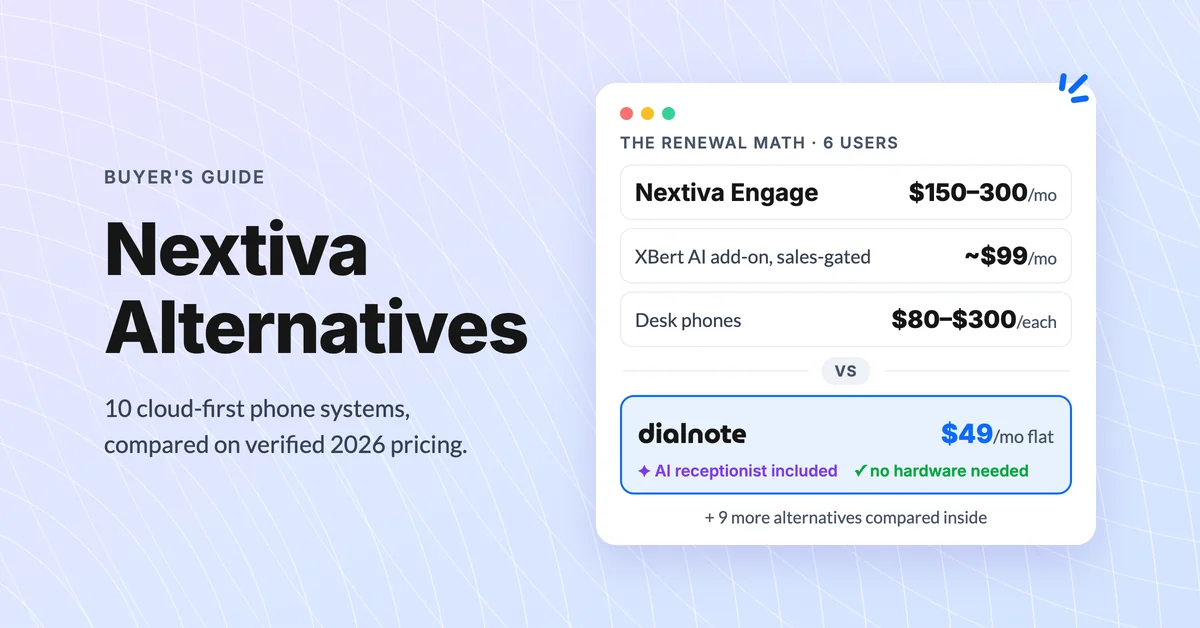
10 Best Nextiva Alternatives for 2026 (Cloud-First)
Compare the 10 best Nextiva alternatives with verified August 2026 pricing, AI answering costs, and desk phone support before you renew.
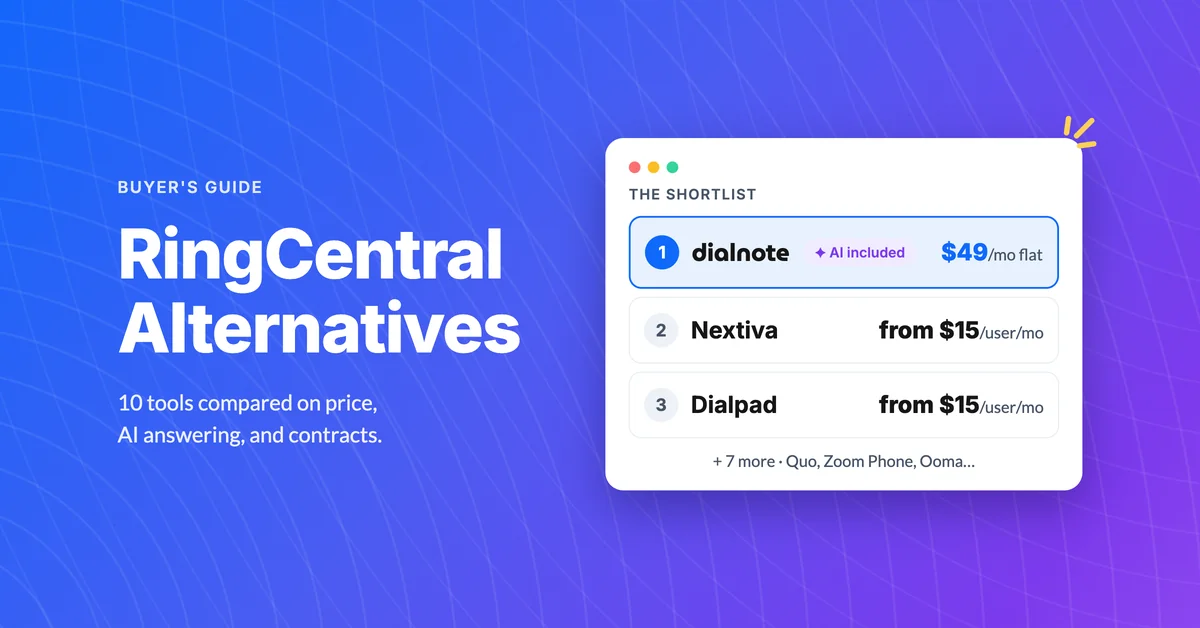
10 Best RingCentral Alternatives for Small Business
Compare 10 RingCentral alternatives for small business by real per-user cost, AI receptionists, and contract traps before you renew.

10 Best Grasshopper Alternatives with AI Answering
Compare the 10 best Grasshopper alternatives with AI answering. See verified August 2026 pricing, screenshots, and real reviews before you switch.