Medical Office Answering Service: What It Really Costs
It's 2:47 PM on a Tuesday. Your waiting room is packed. Two patients are checking in at the front desk. The phone is ringing for the fourth time in ten minutes.
Your receptionist is trying to verify insurance on the computer while a patient across the counter asks about their copay.
The phone keeps ringing. Nobody picks up. That gap is what a medical office answering service exists to close.
That caller? A new patient who found your medical clinic on Google and wanted to book a first visit. They hung up after six rings and called the practice down the street instead.
If you run a clinic, this isn't a rare bad day. It's a daily reality. An AI receptionist for clinics fixes this by answering every patient call, scheduling appointments, and routing urgent needs to your team, all while your front desk staff focuses on the patients standing right in front of them.
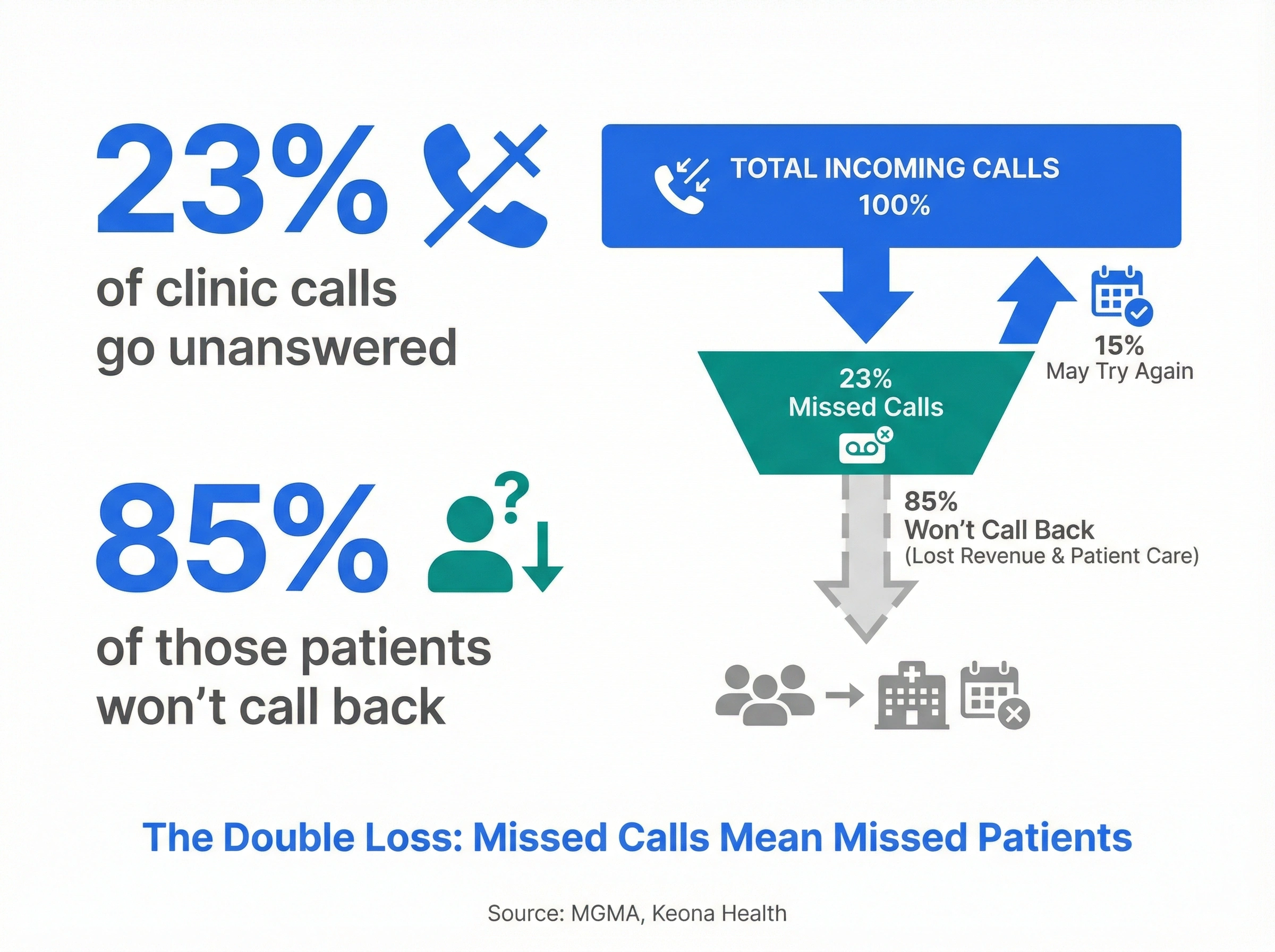
According to MGMA research, phone access is one of the top patient access priorities for medical practices heading into 2026. And for good reason: the average medical practice misses 23% of incoming calls, sending patients straight to voicemail or to your competitor.
TL;DR:
- An AI receptionist for clinics answers every patient call around the clock, books appointments, and routes urgent needs to your team, so no new patient lands in voicemail.
- The average medical practice misses 23% of incoming calls, and about 85% of patients who can't get through won't call back.
- Clinics using an AI receptionist for scheduling report a 15-25% drop in no-show rates, driven by easier rescheduling and automated reminders.
- At $50-300 per month versus $33,000-$40,000 a year for a front desk hire, it adds 24/7 coverage without adding staff.
- For healthcare, insist on a signed Business Associate Agreement (BAA), encrypted calls, and direct EHR or practice-management integration before you buy.
Why are clinic phones always ringing off the hook?
Clinics miss calls because the front desk is doing ten jobs at once. It's that simple.
Your receptionist is checking in patients, verifying insurance, processing copays, scanning documents, and answering questions from the waiting room. Oh, and they're also supposed to answer the phone. Something has to give. Usually, it's the phone.
Primary care practices receive roughly 53 inbound calls per physician per day, according to healthcare phone research. For a three-provider clinic, that's nearly 160 calls hitting your front desk daily. Appointment requests, prescription refills, billing questions, referral follow-ups, test result inquiries. They all compete for the same overworked person's attention.
Here's the part that hurts most. According to a Tebra patient survey, 67% of patients still prefer calling when they need to reach their healthcare provider. Patient portals are growing, sure, but the phone is still king.
And when patients call and can't get through? About 85% of them won't call back. They'll either try another provider or just put off their care entirely.
The staffing crisis makes all of this worse. According to the American Hospital Association, healthcare facilities are heading into 2026 with persistent vacancies and burnout across all roles, including administrative staff. Nearly 60% of medical practices cite staffing as their biggest operational concern.
When your front desk is already running short-handed, adding more phone volume isn't the answer. Burning out your existing team is how you lose them entirely.
And it's not just new patients you're losing. Existing patients call to reschedule follow-ups, ask about lab results, or check if their referral went through. When they can't reach you, frustration builds.
One missed call won't lose a patient. But three or four over a couple of months? They start looking at other options. Retention is just as vulnerable as acquisition when your phones go unanswered.
Sound familiar?
What can a medical office answering service do?
An AI receptionist for clinics answers your phone with natural-sounding conversation, not a robotic menu tree. It handles common patient requests on its own and routes everything else to the right person on your team.
Think of it as a virtual receptionist for your medical practice that never takes lunch, never calls in sick, and never gets overwhelmed when three calls come in at once. When a patient calls asking to schedule an annual physical, the AI checks your provider's availability, books the appointment, and sends a confirmation. Your human staff doesn't even know the call happened.
It's not a voicemail system. It's not one of those "press 1 for appointments, press 2 for billing" trees that drive patients crazy. Modern AI receptionists use natural language processing to have actual conversations.
A patient can say "I need to see Dr. Patel sometime next week" and the AI understands what they mean.
For clinics specifically, a good AI receptionist handles:
- Appointment scheduling. Books, reschedules, and cancels directly in your practice management system. No double-booking.
- Prescription refill routing. Takes the patient's name, medication, and pharmacy, then sends it to your clinical team for approval.
- Insurance and billing questions. Answers common ones like "Do you accept Blue Cross?" based on your payer list.
- New patient intake. Collects demographics, insurance info, and reason for visit before the first appointment.
- Urgent call triage. If a patient describes chest pain or trouble breathing, the AI immediately routes to your clinical staff or instructs them to call 911.
- After-call text summaries. You get a clean summary of every call with the patient name, what they needed, and what was booked.
Can it handle every call perfectly? Honestly, no. Based on industry averages, about 85% of calls get resolved without any human involvement.
For the other 15%, like complex insurance disputes, sensitive clinical questions, or patients who just want to talk to a person, the AI takes a detailed message and flags it for follow-up. That's still way better than a missed call.
If you're curious about how AI voice assistants work for small businesses, we've covered the technology in a separate guide.
How does it help with patient scheduling and no-shows?
Patient no-shows cost clinics real money, and an AI receptionist for clinics can help. According to research published in PMC, the average no-show rate across medical practices is 23%, and each missed appointment represents $150-$200 in lost revenue. For a busy clinic, that adds up to $150,000 or more per year in empty slots that could have gone to someone else.
An AI receptionist tackles no-shows from two angles.
First, it makes booking and rescheduling so easy that patients actually do it. When a patient needs to move their Thursday appointment, they don't have to wait on hold for 15 minutes. They call, the AI pulls up their appointment in seconds, and offers the next available slot.
Done in under two minutes. The easier it is to reschedule, the fewer people just skip the appointment entirely.
Second, the AI sends automated reminders. A text 48 hours before, a call the morning of. When patients confirm, it updates your schedule.
When they cancel, it opens the slot and can even reach out to your waitlist to fill it. That kind of proactive scheduling is almost impossible for a human receptionist who's juggling everything else at the front desk.
We're not 100% sure how much of the no-show reduction comes from easier rescheduling versus reminders versus just better patient engagement overall. The data isn't clean on that. But clinics using an AI receptionist for scheduling consistently report a 15-25% drop in no-show rates. So what's actually moving the needle? Probably all three working together. Whatever the breakdown, it's working.
5 ways an AI receptionist helps clinics grow
Growing a clinic is hard when your phones are the bottleneck. You can't take on more patients, add providers, or expand hours when every new patient call has to squeeze through an already-overwhelmed front desk. Here's how an AI receptionist for clinics removes that constraint.
1. Answer every patient call, 24/7
Most patients search for healthcare providers after work hours. They're looking up clinics at 7 PM, reading reviews at 8 PM, and ready to call at 9 PM. If your phones shut off at 5, those potential patients disappear.
An AI receptionist picks up every call, day or night. A new patient calling at 9 PM on a Wednesday gets the same professional response as someone calling at 10 AM. They can book their first appointment right then. When your staff arrives the next morning, there's a new patient on the schedule they didn't have to lift a finger for.
2. Free your front desk for in-person care
This is the one that clinic managers get most excited about. When the AI handles phone calls, your front desk staff can actually focus on the patients in the room. Better check-in experiences. Shorter wait times. More eye contact and less "hold on, I need to answer this."
Isn't that what your front desk was hired for in the first place? Patient satisfaction doesn't come from the phone call. It comes from the in-person experience.
3. Cut admin costs without cutting corners
Industry data shows that healthcare practices save between 18% and 30% on administrative costs after implementing AI tools. Medical clinic AI answering solutions typically cost $50-300 per month versus $33,000-$40,000 per year for a full-time front desk hire.
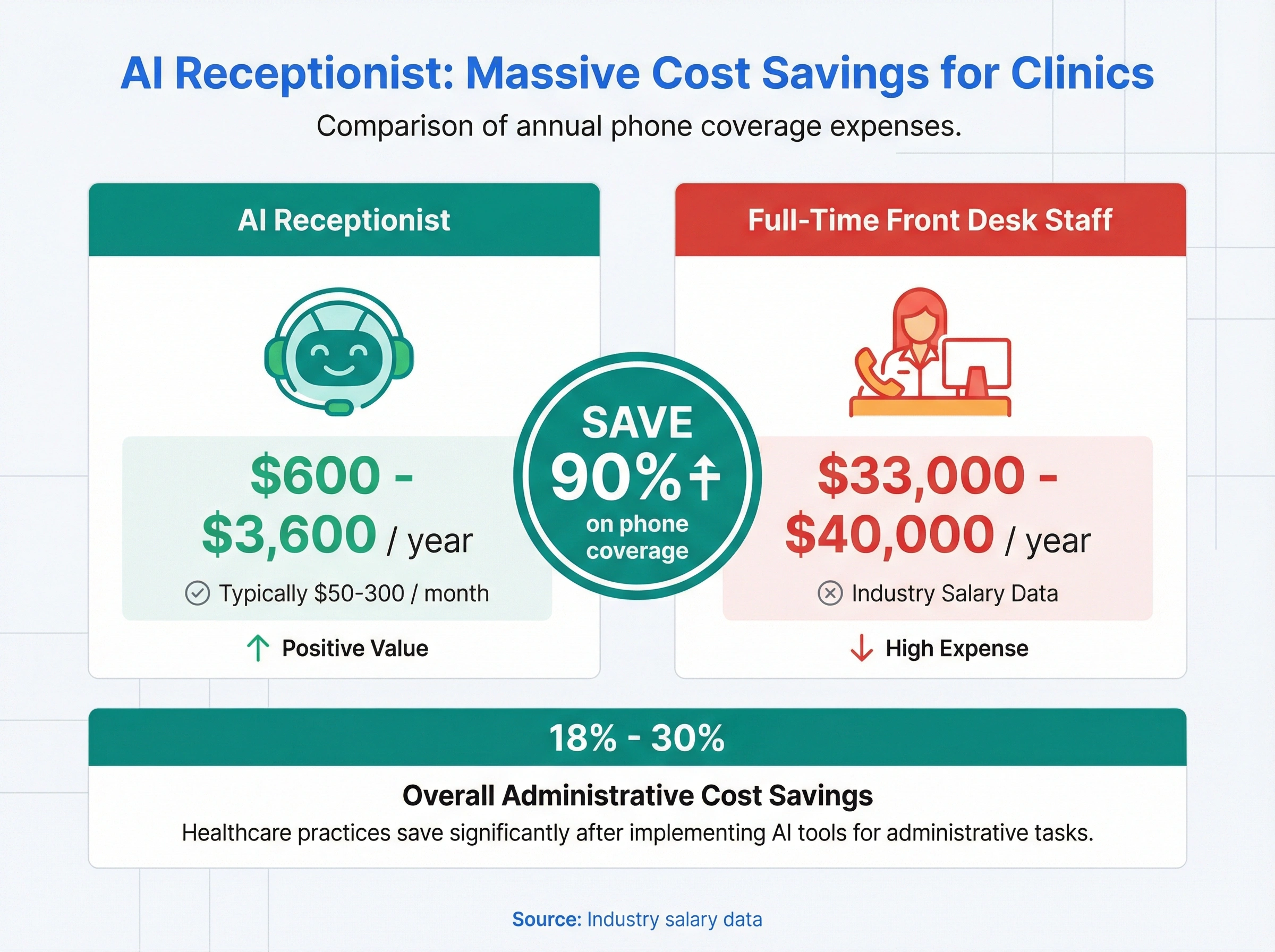
That doesn't mean you fire your receptionist. It means you don't need to hire a second one when you add a provider or extend your hours. The AI handles the overflow, and your existing staff handles the work that requires a human touch.
We've broken down the full cost comparison of AI answering services if you want the detailed math.
4. Handle seasonal surges without scrambling
Flu season. Open enrollment. Allergy season. Back-to-school physicals. Clinic call volume doesn't stay flat.
It spikes hard at predictable times throughout the year. Without extra help, your staff drowns in calls right when patients need you most.
An AI receptionist scales instantly. Whether you get 50 calls a day or 200, every single one gets answered. No temps, no overtime, no stress about who's covering the phones while the front desk is slammed.
5. Look professional from the first call
First impressions matter in healthcare. When a new patient calls and immediately gets a knowledgeable, professional response (no hold music, no "we're experiencing higher than normal call volume"), they feel like they picked the right clinic.
That's especially important if you're competing with larger health systems. An AI front desk gives a three-provider healthcare clinic the same phone experience as a hospital network. Patients don't know (or care) how many people work at your practice. They care that someone picked up.
What about HIPAA and patient privacy?
Any AI front desk technology in healthcare must meet HIPAA requirements. This is non-negotiable, and it's the first question you should ask any AI receptionist provider.
Here's what HIPAA compliance looks like for an AI receptionist:
- Business Associate Agreement (BAA). The provider must sign one. If they won't, walk away. Period.
- Encrypted calls and data. All voice data and patient information should be encrypted in transit and at rest.
- No unauthorized PHI storage. The AI shouldn't store protected health information beyond what's needed for the call summary.
- Access controls. Only authorized staff should see call summaries containing patient details.
- Audit logs. Every interaction should be logged for compliance review.
Honestly? Not every AI receptionist on the market is built for healthcare. Some are designed for retail or home services and bolt on "HIPAA compliance" as an afterthought. For a clinic, you need a provider that was built with healthcare workflows in mind from the start.
We wrote a deep dive on HIPAA-compliant phone systems for medical offices if you want the full checklist.
Should a clinic use a human answering service or an AI one?
Use a human medical answering service when you need a signed BAA and HIPAA-covered call handling. Use an AI one for scheduling volume, after-hours routing and reminders. For most clinics the deciding factor isn't call quality, it's compliance paperwork.
This is the one place in this guide where the honest answer points away from us. Medical answering services like MAP Communications and AnswerFirst sign Business Associate Agreements and run HIPAA-covered workflows. dialnote doesn't offer a BAA. If your calls carry protected health information and your compliance officer needs that paperwork, a medical answering service is the right call, and no amount of price difference changes it.
| A medical answering service | An AI answering service | |
|---|---|---|
| Best at | HIPAA-covered call handling, a signed BAA, nurse triage protocols | Appointment volume, after-hours routing, reminders |
| Pricing model | Per minute or per call: PATLive $99/mo for 50 minutes, AnswerConnect $350/mo for about 50 calls | Flat monthly, whatever the call count |
| Breaks down when | Volume makes per-minute billing impossible to forecast | You need a BAA, or the call needs clinical judgment |
Where an AI service does fit a clinic is the half of the phone day that never touches clinical detail. Are you taking new patients. What are your hours. I need to move Thursday. That's most of what the front desk fields, and it's the part that makes them miss the call that mattered.
More on the tradeoff in AI receptionist vs live answering service.
What to look for in a medical office answering service
Not all AI receptionists are created equal, especially for healthcare. Here's what actually matters when you're choosing an AI receptionist for clinics like yours.
EHR and practice management integration. Your AI should book appointments directly in your system, whether that's Epic, Athena, eClinicalWorks, or something else. If it just takes a message and expects your staff to manually schedule later, it's barely better than voicemail.
HIPAA compliance (with a real BAA). Already covered this above, but it bears repeating. No BAA, no deal.
Smart call routing. A patient describing severe symptoms needs to reach your triage nurse immediately. A billing question can wait. Your AI should route based on urgency, not just send everything to the same queue.
Bilingual support. Depending on your patient population, Spanish-language support can be critical. An AI receptionist that handles both English and Spanish widens your access without hiring bilingual staff.
Customizable knowledge base. Your AI should know your providers, your specialties, your accepted insurance plans, and your hours. And you should be able to update this information in minutes, not through a week-long support ticket.
Analytics and call reporting. You should see how many calls come in, peak call times, no-show rates, and booking conversion. This data helps you staff smarter and identify patterns you'd never catch otherwise.
How a clinic runs on dialnote with AI receptionist
The AI receptionist isn't a standalone tool you bolt onto your existing phone chaos. It works best as part of a complete business phone system built for how clinics actually operate. Here's what a typical day looks like when a clinic uses dialnote with the AI receptionist turned on.
7:00 AM - Before your staff arrives. A patient calls to cancel their 9 AM appointment. The AI receptionist picks up, confirms the cancellation, updates your calendar, and immediately texts the next person on your waitlist to offer the open slot. By the time your front desk arrives at 8, the slot is already filled. No lost revenue, no manual phone tag.
9:30 AM - Your front desk is slammed. Three patients are checking in. The phone rings. Your receptionist doesn't have to choose between the patient in front of them and the caller. The AI handles the incoming call, books a new patient appointment, and sends a summary to your shared inbox. Meanwhile, dialnote's shared numbers mean if a second call comes in simultaneously, it can roll to your office manager's phone as backup.
12:15 PM - Lunch break. Your front desk takes lunch. Calls don't stop. The AI receptionist handles four calls during the break: two appointment requests, one prescription refill routing, and one insurance verification question. All documented, all summarized, all handled without a single person at the desk.
6:45 PM - After hours. A worried parent calls about their child's fever. The AI recognizes urgency keywords, takes their information, and immediately routes a notification to your on-call provider's cell. Non-urgent calls after hours get a professional response with next-day callback scheduling.
Beyond the AI receptionist, dialnote gives your clinic the phone infrastructure to run everything smoothly:
A real business number on your personal phone. dialnote's mobile app puts your clinic's number on the phone you already carry. Patients see your clinic's caller ID, not your personal cell. When you're off the clock, Do Not Disturb sends calls to voicemail silently.
Call recording and transcription. Need to review what a patient said about their symptoms? Go back and listen. AI-powered call summaries give you the key points without replaying the whole recording. This is also valuable for compliance documentation.
Analytics that help you staff smarter. See exactly how many calls come in, what times are busiest, and how many you're missing. This helps you staff your front desk during peak hours and spot trends in patient demand before they become problems.
The AI receptionist is powerful on its own. But when it's part of a complete phone system with shared numbers, smart routing, call recording, and analytics, your clinic's entire communication stack gets sharper.
Picking a medical office answering service: your next step
The healthcare staffing crunch isn't going away. According to AHA data, over 6.5 million healthcare professionals may exit the workforce by 2026, and administrative staff are some of the hardest positions to fill.
You can't solve a staffing problem by piling more work onto the people you already have. But you can solve the phone problem, the one that's burning out your front desk, losing new patients, and costing you revenue every single day.
An AI receptionist for clinics won't replace your team. It'll give them room to breathe. dialnote offers an AI receptionist built for service businesses like yours, whether you're running a clinic, a salon, an accounting firm, or a law firm. It answers calls, books appointments, and sends you summaries so your front desk can focus on what matters: the patients in the room.
Try it for yourself and see what happens when patients stop hearing voicemail.
Frequently asked questions
Most AI receptionist services for clinics run $50-300 per month. That's a fraction of the $33,000-$40,000 you'd spend on a full-time front desk hire, and you get 24/7 coverage.
Yes. The AI takes refill details from patients and routes them to your pharmacy or provider for approval. It won't make clinical decisions, but it captures everything your staff needs.
It depends on the provider. Look for one that signs a Business Associate Agreement (BAA), encrypts all calls, and doesn't store protected health information without proper safeguards.
Most patients don't notice. Modern AI receptionists sound natural and handle common clinic questions smoothly. For complex issues, the AI takes a message and flags it for your team.
Typically 30-60 minutes. You'll configure your services, hours, and routing rules. Most providers offer templates for medical practices, so you're not starting from scratch.

Written by
Lancelot Dsouza
Chief Marketing Officer, SmartReach.io
Lancelot Dsouza is the Chief Marketing Officer at SmartReach.io, where he built the Marketing, Sales, and Customer Success verticals from the ground up. With over 25 years of experience spanning digital marketing, business development, and strategic...
Lancelot Dsouza is the Chief Marketing Officer at SmartReach.io, where he built the Marketing, Sales, and Customer Success verticals from the ground up. With over 25 years of experience spanning digital marketing, business development, and strategic...
Related Articles
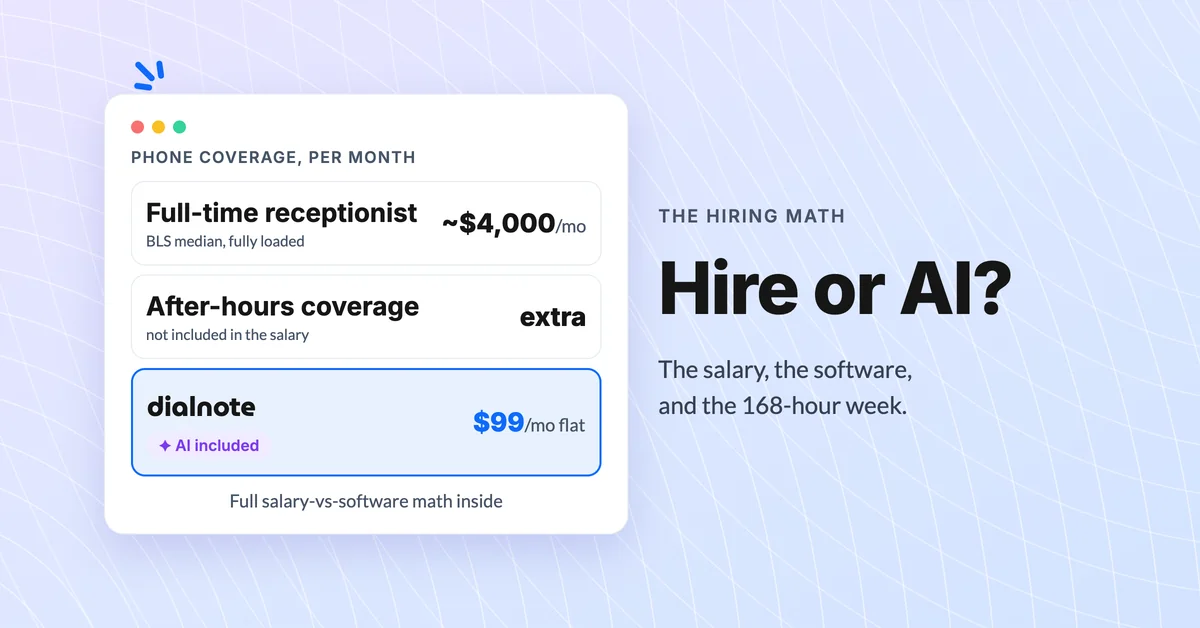
AI Receptionist vs Hiring: What Each Really Costs
Compare an AI receptionist vs hiring a receptionist: salary and benefits math, coverage hours, and what each option really costs over a year.
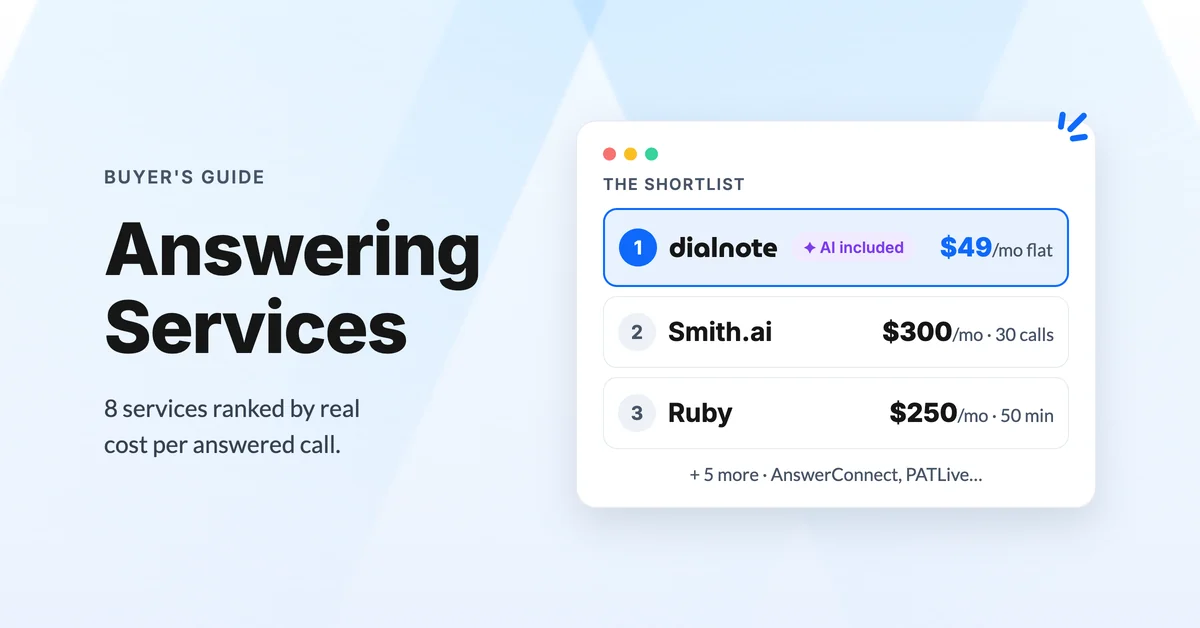
Best Answering Service for Small Business [2026]
Compare the best answering services for small business in 2026: live, AI, and hybrid options ranked by real cost per call and coverage.
Best Virtual Receptionist Services Ranked [2026]
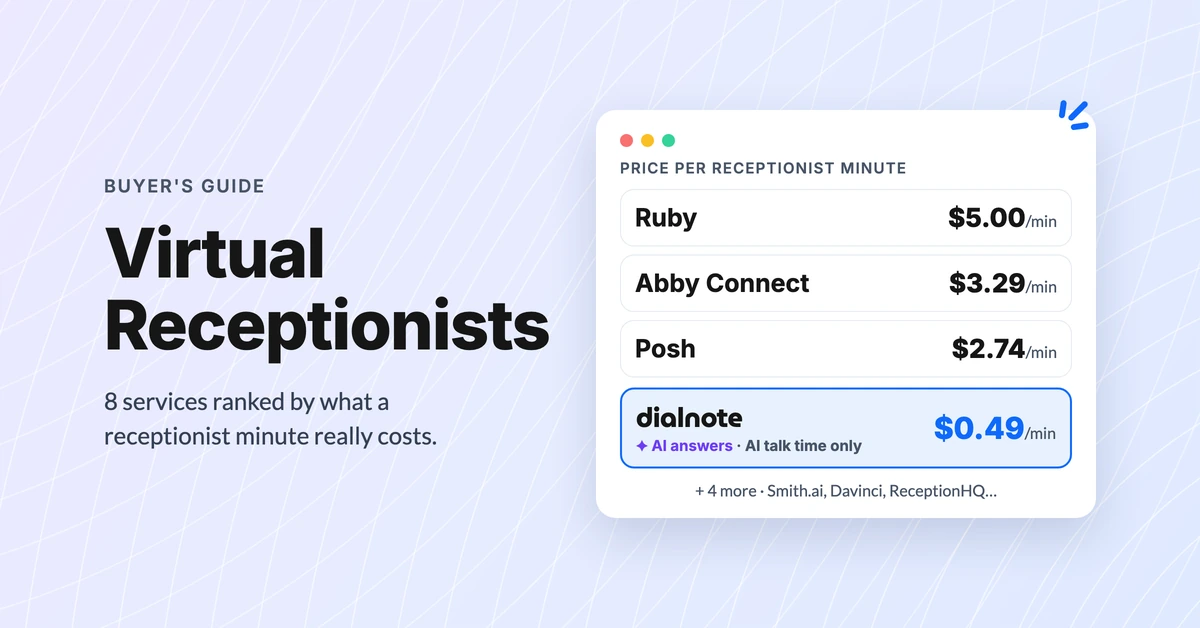
Compare the best virtual receptionist services of 2026 by price per receptionist minute, booking depth, and coverage, including the AI option.