Best Call Center Software: 10 Top Picks Ranked
You're picking the best call center software for inbound calls, which means you've already nailed the problem: missed calls during peaks, slow routing across queues, and per-agent costs that climb every time you add a support rep. Some of you are switching from a clunky CCaaS that priced you out at 15 seats. Others are setting up a real call center for the first time, after running support manually on a shared inbox, Slack, and personal numbers. Either way, this guide skips the "why your business needs a call center" filler and goes straight to comparing platforms on the metrics that actually drive your invoice.
I run digital marketing at SmartReach.io, and I've spent a decade watching IT heads, operations leads, and support managers pick call center tools for 10 to 50-seat teams. Most comparison articles skip the parts that hurt: per-agent pricing math, AI minutes billed on top, "unlimited" calling that turns out to have fair-use caps, and "100+ integrations" that turn out to be Zapier connectors in disguise. So we pulled the lowest-rated G2 and Capterra reviews for each platform, scanned Reddit threads on r/sysadmin, r/contactcenter, r/sales, and r/CRM, and re-ran trials on the ones we hadn't touched recently.
This list ranks 10 call center software platforms built for inbound-first businesses, not developer voice APIs. You can run outbound on most of them too, but the focus here is the queue, the IVR, the AI agent picking up after-hours, the auto-tagging, and the call evaluation. We compare on real 10-agent cost, AI voice agent (the native kind, not the bolted-on kind), AI SMS agent, IVR depth, call queueing, AI call evaluation and auto-tagging, AI actions, and integration honesty. Every number reflects 2026 pricing.
TL;DR:
- The best call center software for SMB and mid-market inbound teams is dialnote, from $49/mo flat for unlimited users, with a native AI voice agent and IVR included, and call queueing on Pro ($199).
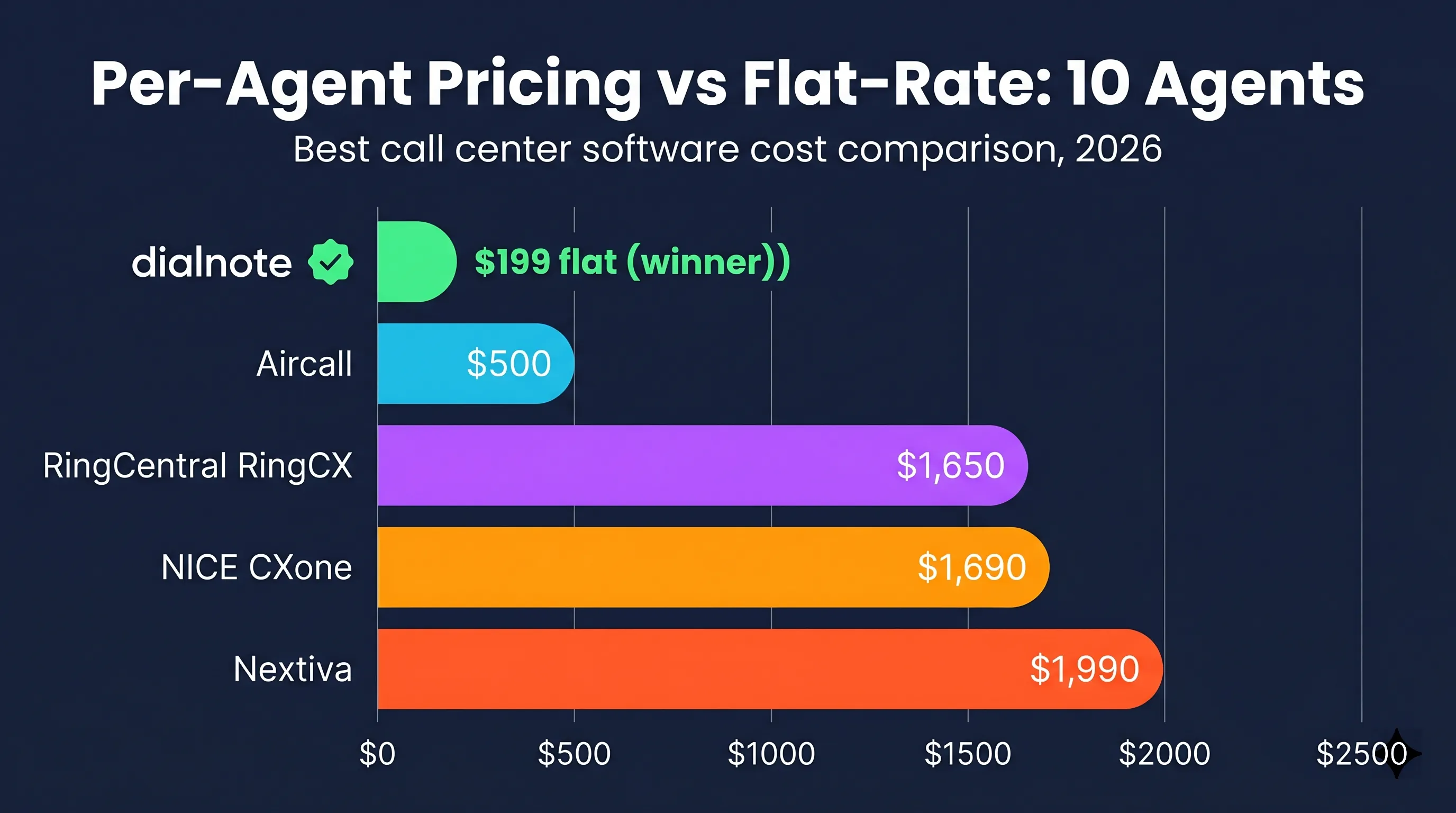
- For 10 agents, enterprise CCaaS costs $750-$2,490/mo before AI fees (Five9, Talkdesk, NICE CXone, Genesys, Nextiva), while per-seat SMB tools like Aircall and CloudTalk run $250-$500/mo. Five9 also sets a 50-seat minimum, so it isn't a real 10-agent option.
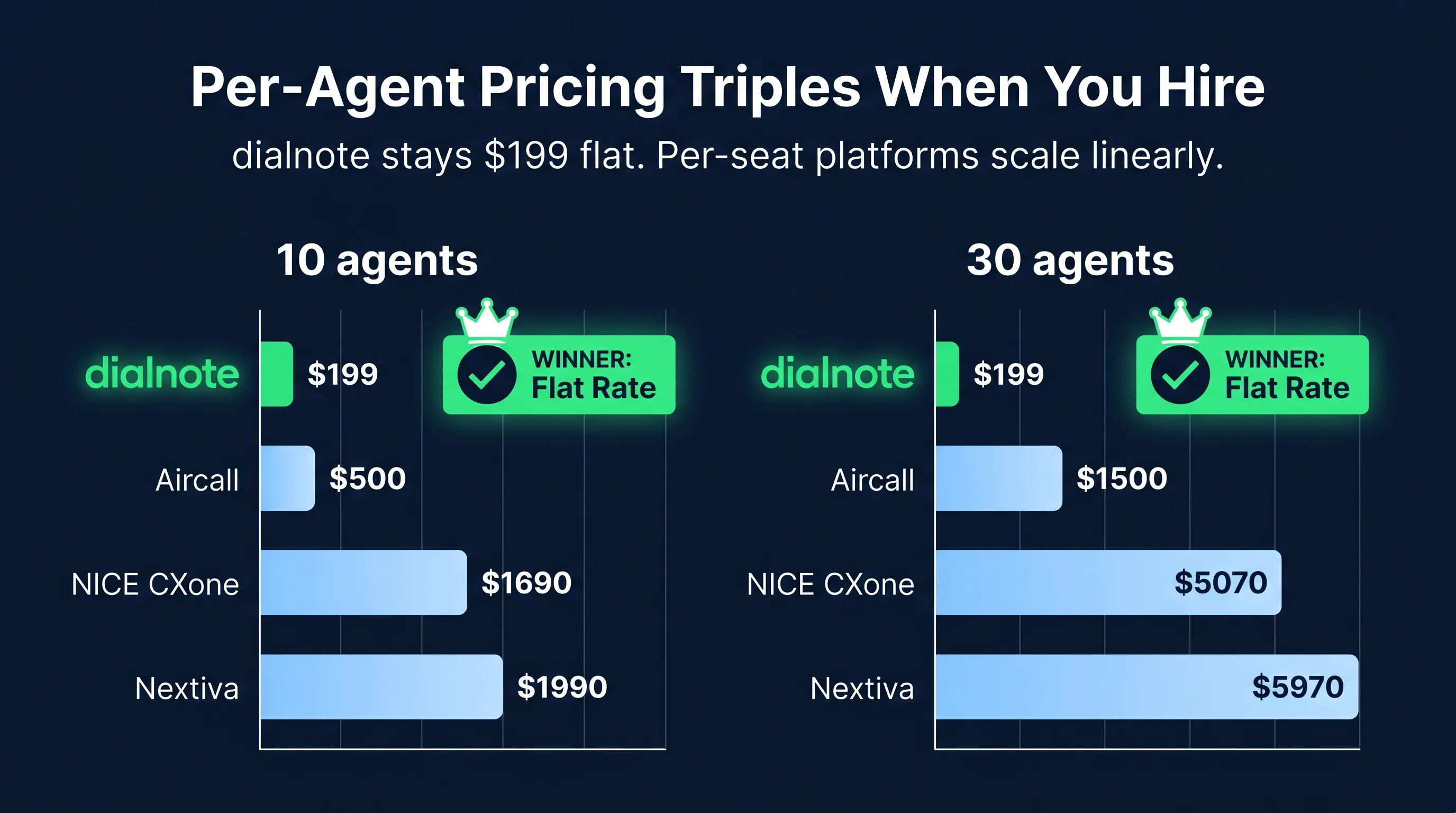
- Per-agent pricing compounds fast: a team growing from 8 to 30 seats sees the bill triple on most platforms, but stays flat on dialnote.
- Watch two claims on every pricing page: "100+ integrations" usually counts Zapier or Make connectors, and "unlimited" calling almost always has a fair-use cap or per-minute fee.
- Native AI (built into the plan) beats add-on AI on cost and latency, since a separate AI module is a separate invoice and another vendor to debug.
What we evaluated (and what real users complain about)
Marketing pages all look the same. The lowest-rated reviews don't. Here's what we weighted across all 10 platforms, with the inbound IT or ops buyer at a 10 to 50-seat call center in mind:
- Real 10-agent monthly cost including AI minutes, voice add-ons, recording, and per-agent math, not just the headline number
- Per-minute AI usage fee on top of the platform plan, the line item most ads bury
- AI voice agent quality and where it's bundled: native to the plan, paid module, or third-party add-on
- AI SMS agent support, since most inbound queues now handle text and voice together (your AI should answer both)
- IVR or call flow builder depth: visual drag-and-drop versus admin-console JSON
- Call queueing for teams that need overflow handling, skill-based routing, and queue analytics
- AI call evaluation and auto-tagging so QA isn't a manual sampling exercise on Monday morning, and disposition codes get filled even when an agent forgets
- Transcript and summary accuracy, since the whole point of recording every call is that nothing gets misremembered or miscaptured in a CRM note. An agent juggling six chats can't accurately type up a 12-minute call from memory
- AI actions and webhooks to call your own API for booking, payments, ticket creation, lookups
- Integration honesty: most "100+ integrations" or "150+ integrations" claims just mean Make, Zapier, or n8n connectors, so we noted what's native versus middleware (always check the integrations you actually need)
- "Unlimited" calling fine print: nearly every CCaaS plan with the word "unlimited" on the page has a fair-use ceiling, country restriction, or per-minute fee buried two clicks deep, so we flagged what's truly unmetered and what's marketing
- Worst reviews from G2, Capterra, and Reddit, since common complaints predict your second month of usage better than five-star reviews do
We didn't rank by raw feature count. The platform with 7,000 integrations isn't the right pick for a 12-person support team that needs queueing, an AI agent for after-hours, and HubSpot sync.
A note on the "100+ integrations" claim. We saw it on at least seven of the 10 platforms below. Almost every time, the count includes Zapier, Make, or n8n connectors, which means another monthly subscription, another vendor to debug, and another point of latency between a call and your CRM. Sound familiar? It's the most-quoted bullet on a CCaaS landing page and the most-broken promise in the buyer's first month. So before you sign, list the four or five integrations you actually need and verify each one is native. The G2 contact center category is a useful sanity check for this.
Same goes for "unlimited calling." Most plans cap inbound at 1,000 to 3,000 minutes per agent per month before the fair-use clause kicks in, restrict the unlimited promise to specific countries (US and Canada only is the most common), or quietly meter international minutes at $0.05 to $0.25 per minute. Read the footnotes on the pricing page before you assume a 10-agent team can handle 50,000 monthly inbound minutes for free. Plus, "unlimited" almost never covers AI voice agent minutes, which are billed separately on every platform here, including dialnote.
Best call center software compared: 10-agent cost, AI features, and core differences
Here's the side-by-side. Detailed reviews follow below.
| # | Tool | 10-agent cost | AI voice agent | AI SMS agent | IVR / Call flow | Call queueing | AI actions |
|---|---|---|---|---|---|---|---|
| 1 | dialnote | $49-$199/mo flat (unlimited users) | Included (Team+) | Coming soon | Visual Call Flow (Team+) | Yes (Pro) | Yes (Team+; webhooks Business+) |
| 2 | Five9 | $1,190-$1,590/mo list (10 × $119-$159), but sold with a 50-seat minimum | Add-on (Agent Assist, IVA) | Limited | Yes | Yes | Yes |
| 3 | Talkdesk | $1,050-$1,650/mo (10 × $105-$165, voice) | Bundled higher tiers (Copilot) | Yes | Yes (Studio) | Yes | Yes (AppConnect) |
| 4 | NICE CXone | $1,100-$2,490/mo (10 × $110-$249) | Native (Enlighten) higher tiers | Yes | Yes | Yes | Yes |
| 5 | Genesys Cloud CX | $750-$2,400/mo (10 × $75-$240, annual) | Bundled higher tiers | Yes | Yes | Yes | Yes |
| 6 | RingCentral RingCX | $650-$1,450/mo (10 × $65-$145, annual) | Add-on (AIR) | Yes | Yes | Limited | Limited |
| 7 | Aircall | $300-$500/mo (10 × $30-$50, annual) | Included (50 min/mo), then usage | No | Limited | Limited | Limited |
| 8 | Dialpad Ai Contact Center | $800-$1,500/mo (10 × $80-$150, annual) | Native (Dialpad Ai) | Limited | Yes | Yes | Yes |
| 9 | CloudTalk | $250-$490/mo (10 × $25-$49, annual) | Add-on (AI Voice Agents, from $99/mo) | Limited | Yes | Yes (Essential+) | Limited |
| 10 | Nextiva Contact Center | From $750/mo (10 × $75; higher tiers by quote) | Add-on (XBert, $99/mo) | Yes (XBert) | Yes | Yes | Yes |
Two patterns jump out. First, per-agent platforms compound fast. A 10-agent team on Five9, Talkdesk, NICE CXone, or Genesys lands between $750 and $2,490/month before AI minute fees (and Five9 won't sell fewer than 50 seats). The same team on dialnote pays $49 to $199/month flat. Second, the AI label hides three very different things across vendors: native AI built into the plan, a paid AI module on top, or a third-party AI bolted onto the platform. We're not 100% sure which model wins long-term, since AI pricing across CCaaS is still moving, but the version that doesn't show up as a separate invoice is the one your CFO won't argue about.
The 10-agent number is the most-hidden math in this market. Vendors quote per-agent prices in big type and skip the multiplication. Multiply it. The number is the actual gap between flat-rate platforms with unlimited users and per-agent legacy tools.
The 10 best call center platforms reviewed
1. dialnote: best for unlimited agents and built-in AI
Best for: Inbound-heavy call centers with 10 to 50 agents, run by an IT or operations lead who wants a VoIP phone system with unlimited users, an AI voice agent included from day one, IVR, queueing, AI evaluation, auto-tagging, and a flat monthly bill that doesn't change when the team grows.
dialnote is the AI phone system we build at SmartReach.io, part of the SmartReach.io group that also runs the multichannel sales outreach platform. We priced it flat after watching SMBs pay $1,000 to $2,000 per month on per-agent call center tools, just to grow a support team from 8 agents to 14. The whole point of unlimited users is that you stop dreading new hires. We've also seen this work as a first call center for businesses that ran support manually on personal numbers and a shared inbox: the visual Call Flow builder is forgiving enough that an ops manager can map out the IVR in an afternoon, no implementation consultant required.
Why dialnote wins on 10-agent inbound cost (using $199 Pro as the anchor):
A 10-agent inbound team on Five9, Talkdesk, NICE CXone, Genesys, or Nextiva spends $750 to $2,490 per month before any AI minute fees, and that's still missing native AI call evaluation, AI auto-tagging, and bundled AI voice agents in the base price. dialnote Pro stays at $199 per month flat for 10 agents, with all of those included. The same Pro plan covers 30 agents. So that's $19.90 per agent at 10 agents and $6.63 at 30. The bill doesn't move when you scale, and you don't get a separate invoice for the AI module, the QA module, or the seat license. One bill for the whole inbound stack.
dialnote plans (monthly billing):
-
Team ($49/mo, recommended starter): Unlimited agents, 2 phone numbers, 700 included minutes, automatic call recording, AI transcription and summaries, 1 AI voice agent, knowledge base, phone menus (IVR), business-hours routing, transfers, hold, group calling, and native HubSpot, Zapier, and Calendly integrations.
-
Business ($99/mo, most popular): Everything in Team, plus 5 AI voice agents, AI multi-language across 14 languages, advanced call forwarding and ring order, API access and webhooks, Salesforce and Pipedrive, Make and n8n via webhooks, and live chat support.
-
Pro ($199/mo): Everything in Business, plus 10 AI voice agents, AI branding (custom voice), AI Call Tags, AI Call Evaluation, disposition codes, call queueing, contact sharing permissions, priority support, and a dedicated CSM.
AI usage cost: $0.49/min from a monthly wallet allowance. Every plan includes a monthly wallet credit ($5 on Team, $12 on Business, $25 on Pro). The wallet covers AI agent minutes, international calls, and any minutes beyond the included pool. So the AI agent itself costs nothing extra: you pay only for the minutes it's on a call, from the same wallet that funds your calling. No surprise overage invoices.
Annual billing: Save 20%. Team drops to $39/mo, Business to $79/mo, Pro to $159/mo.
What dialnote does as a call center platform:
- Unlimited agents on Team, Business, and Pro plans (most competitors charge $25-$249 per seat)
- Native AI voice agent answers 24/7 (in 14 languages on Business and up), with voices from ElevenLabs, OpenAI, Deepgram, and PlayHT
- Visual Call Flow builder (full IVR) on Team and up, no JSON, no admin console gymnastics
- Call queueing with overflow on Pro, plus AI Call Tags and AI Call Evaluation for QA
- AI actions via custom webhooks on Business and up (booking lookups, ticket creation, payment links, real-time CRM lookup)
- Native CRM integrations: HubSpot (Team and up), Salesforce and Pipedrive (Business and up); help desks connect through Zapier or webhooks today
- 90+ countries supported for international calling, with per-country rates published transparently
- Free 10-day trial with Pro features, no credit card required
You can try the dialnote AI receptionist demo without signing up. Two minutes, no credit card.
Pros:
- Genuinely flat: 10 agents or 30, the bill doesn't move
- AI voice agent built into the plan, not a separate $99-$349/mo module
- Wallet model means no shocking overage invoices, you watch the meter daily
- Visual Call Flow IVR on Team ($49), call queueing on Pro ($199), no quote-based contact-sales pricing
- 90+ countries supported for international calling
- API, webhooks, Make, and n8n on Business and up for real AI actions
- Free 10-day trial with full Pro features and no credit card
Cons:
- Newer than the legacy giants like Five9 or Genesys, so fewer Reddit threads if that's how you research
- Advanced forwarding, ring order, and Salesforce/Pipedrive start at Business ($99), not Team ($49)
- Call queueing, AI Call Tags, and AI Call Evaluation are on Pro ($199), not on lower tiers
- 700 included minutes on Team is plenty for most domestic teams but light for outbound-heavy sales floors (Business or Pro fits those)
The honest take: if you're an IT or operations lead picking the best call center software for a 10 to 50-seat inbound team, dialnote Pro is the cheapest fully-featured option in this list. The trade-off: we don't yet ship SAML SSO or 2FA, and we're newer than the legacy CCaaS giants. So if your InfoSec team has mandated SAML or you need a 10-year enterprise SLA on paper, a bigger vendor fits better. Most call centers under 100 agents don't need either.
2. Five9: best for pure-play enterprise voice contact centers
Best for: Enterprise teams (50-1,000+ agents) running a high-volume voice contact center with deep WFM, QM, and analytics needs.
Five9 is one of the original CCaaS pure-plays. Founded in 2001, it's a voice-first contact center platform with mature workforce management, quality management, and analytics layers. Five9 added Inference Studio (AI IVA) and Agent Assist over the past few years, but voice is still the core.
Pricing (2026):
- Digital ($119/agent/mo): Digital channels only, no voice
- Core ($159/agent/mo): All channels, including voice, with essential AI
- Plus (quote only): All channels with advanced AI
- Pro (quote only): Essential AI plus workforce engagement management (WEM)
- Enterprise (quote only): Advanced AI plus WEM
- Minimum: Prices are per concurrent seat, with a 50-seat minimum and usage-based charges on top
- Per-minute AI cost: Inference Studio (Intelligent Virtual Agent) is priced per session and per AI minute, quoted via sales
Features:
- Mature voice routing, IVR, and skills-based queueing
- Native workforce management and quality management on Pro and Enterprise
- Inference Studio for AI virtual agents (separate spend)
- Agent Assist with real-time AI suggestions during calls
- Native CRM integrations: Salesforce, ServiceNow, Microsoft Dynamics, Zendesk, Oracle
- Reporting and analytics with custom dashboards
10-agent cost: Core at $159 × 10 = $1,590/mo for voice; Digital at $119 × 10 = $1,190/mo for non-voice. That's list math only: Five9's pricing page sets a 50-seat minimum, so the real floor on Core is about $7,950/mo. Advanced AI tiers are quoted by sales on top.
Pros:
- Voice quality and routing reliability are top-tier in the category
- Mature workforce management and quality management
- Strong native CRM integrations (Salesforce, Dynamics, ServiceNow, Zendesk)
- Compliance-ready for regulated industries (HIPAA, PCI-DSS, SOC 2)
Cons:
- Per-agent pricing punishes growing teams: 50 agents on Core = $7,950/mo before AI, and 50 seats is also the minimum
- AI features sit behind separate sales conversations and are not bundled in the core plan
- Implementation typically runs 60-120 days with paid professional services
- Admin console feels dated compared to newer Talkdesk or Genesys UIs
- Annual contracts are the norm; month-to-month is rare
- Reporting customization often needs a vendor PSO engagement
What reviewers say: G2 worst reviews flag the steep learning curve, the dated supervisor desktop, and contract terms that lock teams into multi-year commits. Capterra reviewers consistently note that pricing is opaque before signing and that AI features add another negotiation. Reddit threads on r/sysadmin and r/contactcenter call out long implementation timelines (3-4 months is common) and a heavy reliance on Five9 PS for any custom routing logic.
The honest take: Five9 is the best call center software for enterprise voice teams that need a battle-tested platform with deep WFM and QM. For SMBs and mid-market under 30 agents, the per-agent math is brutal and the AI is a separate line item. Skip it if you don't already have a contact center director on staff.
3. Talkdesk: best AI-driven contact center for mid-market
Best for: Mid-market and enterprise teams (30-500 agents) that want native AI built into the agent desktop rather than bolted on.
Talkdesk is one of the strongest AI-native CCaaS platforms in the market. Talkdesk Copilot, Autopilot, and AI Trainer are real native AI features, and the agent desktop ships with AI prompts built in. AppConnect is their integration marketplace with 80+ pre-built apps.
Pricing (2026):
- Digital Essentials ($85/user/mo): Email, chat, SMS, and social channels; no voice
- Voice Essentials ($105/user/mo): Voice, speech recognition, Studio routing, reporting
- Elite ($165/user/mo): Adds workforce management, performance management, screen recording, and custom reporting
- Industry Experience Clouds ($225/user/mo): Elite plus healthcare, retail, financial services, and other vertical packages (government is custom-priced)
- Per-minute AI cost: AI minutes are bundled into Elite tiers; Copilot and Autopilot are separately licensed
Features:
- Talkdesk Studio: visual IVR and routing flow builder
- Talkdesk Copilot: real-time AI agent assist
- Talkdesk Autopilot: AI virtual agents for self-service
- Talkdesk AI Trainer: lets non-engineers train the AI
- Native AppConnect integrations: Salesforce, Zendesk, ServiceNow, HubSpot, Slack
- Workforce management and performance management on Elite
10-agent cost: Voice Essentials × 10 = $1,050/mo; Elite × 10 = $1,650/mo. AI features bundled in higher tiers, but Copilot and Autopilot can add quote-based fees.
Pros:
- AI features are native, not third-party bolt-ons
- Talkdesk Studio is one of the cleanest visual IVR builders in CCaaS
- Strong native CRM integrations beyond just Zapier middleware
- Vertical clouds (healthcare, retail, FS) come with industry templates
- Strong reporting and dashboarding
Cons:
- Per-agent pricing scales linearly: 50 agents on Elite = $8,250/mo
- Workforce management and screen recording gated to Elite
- AI features compete on tiers: some Copilot capabilities require Elite plus a separate license
- Vertical bundles jump to $225/user, and add-ons are quoted by sales
- Annual contracts standard
What reviewers say: G2 reviewers praise the agent desktop and AI features but flag pricing complexity, with multiple add-ons that aren't visible at signup. Capterra reviewers call out the support response gap once you're past onboarding. Reddit threads on r/contactcenter mention that Talkdesk's AI is good but changes pricing tiers more often than a buyer would like, with vertical packages re-priced multiple times in 2024.
The honest take: Talkdesk is the best call center software for mid-market teams that want AI built into the agent experience. The pricing math gets steep above 30 agents, but the platform's AI is genuinely native, which is rare. If you can stomach the per-agent fee and want a clean AI-first contact center, Talkdesk is on the shortlist.
4. NICE CXone: best for large enterprise omnichannel CX
Best for: Enterprise teams (100-10,000+ agents) running a full omnichannel customer experience platform with integrated WFM, QM, and analytics.
NICE CXone is the largest pure-play CCaaS by revenue. The platform combines voice, digital channels, workforce engagement management, and Enlighten AI for analytics and self-service. CXone Mpower is the 2024-2026 rebranded version with deeper AI integration across the agent and supervisor experience.
Pricing (2026):
- Omnichannel Suite ($110/agent/mo): Voice and digital channels, omnichannel routing, recording
- Essential, Core, and Complete Suites ($135, $169, and $209/agent/mo): Each step adds more AI and workforce engagement modules
- Ultimate Suite ($249/agent/mo + $0.25/session): Top tier, with usage-based session fees on top
- Billing: Monthly in arrears, per NICE's pricing page
- Per-minute AI cost: Enlighten AI minutes are bundled within higher tiers; complex AI workflows are quote-based
Features:
- Mature voice and omnichannel routing
- Native Enlighten AI for sentiment, intent, and quality scoring
- Native workforce management (forecasting, scheduling, intraday)
- Quality management with screen recording and AI scoring
- 700+ pre-built integrations claimed (verify which are native versus iPaaS bridge)
- Industry-specific compliance (HIPAA, PCI-DSS, FedRAMP)
- Strong WFO ecosystem with NICE-owned tools
10-agent cost: Omnichannel Suite × 10 = $1,100/mo; Core Suite × 10 = $1,690/mo; Ultimate Suite × 10 = $2,490/mo plus per-session AI fees.
Pros:
- Largest CCaaS catalog of features and integrations
- Enlighten AI is native and trained on years of real call data
- Workforce engagement management is among the strongest in the category
- Strong compliance posture for regulated industries
- Most analytical depth of any platform in this list
Cons:
- Per-agent pricing scales like enterprise software (because it is): 100 agents on Omnichannel Suite = $11,000/mo
- Implementation is heavy; 90-180 days with paid PS is typical
- Admin UX has improved but the legacy supervisor console is still around
- Pricing is opaque before signing and add-on heavy
- Multi-year contracts standard
- Overkill for most teams under 50 agents
What reviewers say: G2 worst reviews mention pricing surprises after the first renewal and admin console complexity, with new admins often needing certifications to manage the platform fluently. Capterra reviewers note long implementation timelines and the need for a dedicated CCaaS administrator on the customer side. Reddit r/contactcenter threads call out the platform as powerful but heavyweight, with AI features ramping up but still uneven across tiers.
The honest take: NICE CXone is the best call center software for large enterprises with hundreds or thousands of agents and an internal CX administrator. The platform is enormous and powerful. For SMBs and mid-market, you're paying for capabilities you'll never use, and the per-agent math compounds painfully.
5. Genesys Cloud CX: best for enterprise CX platform with strong WEM
Best for: Enterprise teams (50-5,000+ agents) that want an integrated CX platform spanning voice, digital, AI, and workforce engagement under one license.
Genesys Cloud CX is the cloud-native version of Genesys's long-running contact center business. The CX1 to CX4 tiers run from a voice contact center up to full omnichannel with WEM and the largest AI allowance. Genesys is a leader in WEM and has invested heavily in conversational AI through Genesys AI Experience.
Pricing (2026):
- CX1 ($75/user/mo, billed annually): Voice contact center
- CX2 ($115/user/mo): Omnichannel plus quality assurance and compliance
- CX3 ($155/user/mo): CX2 plus full workforce engagement management
- CX4 ($240/user/mo): Adds the biggest AI allowance (30 AI Experience tokens per named agent)
- Per-minute AI cost: Some AI features consume AI Experience tokens; a monthly allotment is included per org, and extra tokens are quoted by sales
Features:
- Genesys Architect: visual flow builder for IVR and routing
- Native voice and digital channels (web chat, SMS, email, social)
- Native workforce engagement on CX3 (forecasting, scheduling, QM)
- AI Experience tokens power bots, Agent Assist, and predictive routing
- 350+ AppFoundry integrations claimed (verify which are native)
- Native PCI-DSS, HIPAA, SOC 2 compliance
- Strong native voice with G.711, Opus, regional carriers
10-agent cost: CX1 × 10 = $750/mo; CX3 × 10 = $1,550/mo; CX4 × 10 = $2,400/mo, all billed annually. Extra AI Experience tokens are quoted on top.
Pros:
- Strong WEM (workforce engagement management) on CX3
- Cloud-native architecture with regional data centers
- Native AI Experience with bots, Agent Assist, predictive routing
- Architect IVR builder is mature
- Strong compliance posture
- Steady release cadence
Cons:
- Per-agent pricing compounds like all enterprise CCaaS
- Heavy AI use means buying extra AI Experience tokens beyond the included allotment
- Implementation is heavy (60-120 days typical)
- Custom reporting often needs Architect or Genesys PSO support
- Pricing opacity around add-ons (predictive routing, advanced WEM)
- Annual contracts standard
What reviewers say: G2 worst reviews mention an admin console that requires training to use confidently and a steep curve for non-Genesys-veteran admins. Capterra reviewers cite reporting limitations without custom development. Reddit r/contactcenter threads praise the platform's depth but flag the WEM upsell pressure and inconsistent customer success engagement after the first year.
The honest take: Genesys Cloud CX is the best call center software for enterprise teams that prioritize workforce engagement, mature AI Experience, and strong cloud architecture. For mid-market and SMB, the per-agent math doesn't compete with flat-rate or lighter contact center tools.
6. RingCentral RingCX: best for existing RingCentral phone system users
Best for: Mid-market teams (20-500 agents) that already run RingCentral RingEX as their phone system and want a contact center on top without integrating two vendors.
RingCentral RingCX is RingCentral's native contact center, built to fit alongside RingEX (the UCaaS phone system). It includes voice, digital, and basic AI through RingCX Bot. RingSense and the AIR module add deeper AI for receptionist, summarization, and Agent Assist.
Pricing (2026):
- RingCX Standard ($65/agent/mo annual, $75 monthly): Voice plus 20+ digital channels, IVR, skills-based routing
- RingCX Professional ($95/agent/mo annual, $110 monthly): Adds AI quality management and AI agent assist
- RingCX Elite ($145/agent/mo annual, $165 monthly): Adds AI supervisor assist, interaction analytics, workforce management
- AI Receptionist standalone ($49/mo): AI receptionist with 100 minutes
- AIR as a RingEX add-on ($39/mo + $30/seat RingEX Core monthly): AI receptionist on top of phone system
- Per-minute AI cost: $0.50/min after the 100 included minutes, billed in 30-second increments
Features:
- Native fit with RingCentral phone, video, team chat (no separate vendor)
- RingCX Bot for self-service (basic, not as deep as Talkdesk Autopilot)
- AIR for AI receptionist with real-time IVA capabilities
- RingSense for conversation intelligence
- Native CRM integrations: Salesforce, HubSpot, Microsoft Dynamics, Zendesk
- STIR/SHAKEN spam call blocking
- Voice and video conferencing through RingEX
10-agent cost: RingCX Standard × 10 = $650/mo; Elite × 10 = $1,450/mo (annual billing; $750 and $1,650 month to month). AIR adds another $49-$339/mo depending on whether you bundle with RingEX.
Pros:
- Native fit if you're already on RingCentral RingEX (no API stitching)
- STIR/SHAKEN spam blocking included
- Strong fit for mid-market teams that want phone, video, chat, and contact center from one vendor
- Multilingual without extra config
Cons:
- Per-agent pricing scales linearly
- AI is a separate add-on (AIR) with its own metering
- 100 included AI minutes runs out fast for service businesses (about 30-40 calls)
- RingCentral's $0.50/min AI overage stacks on top of per-agent seats, while dialnote bills AI at $0.49/min on one flat plan
- Onboarding takes weeks across the RingCentral suite
- RingCX UI is newer than RingEX so feels uneven across the same vendor
What reviewers say: G2 worst reviews mention onboarding delays (4-8 weeks is common across the RingCentral stack) and the maze of paid add-ons that aren't clear at signup. Reddit r/sysadmin threads complain about contract lock-ins and difficulty downgrading mid-contract. Capterra reviewers note that RingCX works well technically but the supervisor and admin consoles feel unfinished compared to Talkdesk and NICE.
The honest take: RingCX is the best call center software for businesses already paying for RingCentral RingEX. The native fit with the phone system is the main reason to pick it. For everyone else, the per-agent math plus AIR add-on costs don't compete with dialnote or Aircall on price, or with Talkdesk and Genesys on AI depth.
7. Aircall: best for SMB call centers under 30 agents
Best for: Small business sales and support teams (3-30 agents) that want a clean call center UX without enterprise contact center complexity.
Aircall is one of the most popular SMB-focused call center platforms. It's voice-first with a simple agent desktop, native CRM integrations, and a cleaner onboarding experience than enterprise CCaaS. AI Voice Agents now come built into every plan (50 minutes a month on Essentials), with usage billed beyond that.
Pricing (2026):
- Essentials ($30/user/mo annual, $40 monthly): 3-user minimum, basic call routing, 250+ integrations, 50 AI Voice Agent minutes/month
- Professional ($50/user/mo annual, $70 monthly): 3-user minimum, adds Salesforce, advanced analytics, AI call summaries
- Custom (quote): Custom contracts for teams of 25+ licenses
- AI Voice Agents: Included on every plan; standalone from $100/mo
- Per-minute AI cost: Usage-tiered; Aircall's calculator shows $0.49/min pay-as-you-go
Features:
- Clean web and desktop agent app
- Native CRM integrations: HubSpot, Salesforce, Pipedrive, Zendesk, Intercom
- Power dialer and click-to-call on Professional
- Basic IVR and call routing
- Call recording, transcription, sentiment analysis
- 100+ integrations claimed (most are native, some via Zapier; verify what you need)
- Aircall AI Voice Agent answers, routes, and books appointments
10-agent cost: Essentials × 10 = $300/mo; Professional × 10 = $500/mo (annual billing; $400 and $700 month to month). AI Voice Agent minutes past the included 50 are billed on top.
Pros:
- Clean UX for SMB teams that don't need enterprise contact center features
- Strong native CRM integrations beyond Zapier
- Simple onboarding (often live within a week)
- Power dialer and analytics included on Professional
- 3-user minimum is reasonable for small teams
Cons:
- Per-user pricing compounds: 30 agents on Professional = $1,500/mo
- 3-user minimum even on the cheapest plan
- IVR is basic compared to Talkdesk Studio or dialnote Call Flow
- Call queueing is limited (basic queue, no skill-based routing on Essentials)
- AI Voice Agent includes only 50 minutes a month on Essentials; usage past that is billed
- No two-way AI SMS agent
What reviewers say: G2 reviewers praise the simple UX and CRM integrations but flag pricing increases at renewal and limitations in advanced reporting. Capterra reviewers mention support response time outside US business hours. Reddit r/sales threads consistently mention Aircall as a clean choice for SMB sales teams under 20 agents but warn against scaling past that without re-evaluating cost.
The honest take: Aircall is the best call center software for small sales and support teams that want clean UX and don't need queueing analytics or AI built in. Once you cross 20-30 agents, the per-user math starts looking expensive next to flat-rate alternatives like dialnote.
8. Dialpad Ai Contact Center: best for native AI in mid-market
Best for: Mid-market teams (20-300 agents) that want Dialpad Ai (real-time transcription, sentiment, coaching) baked into every call.
Dialpad's contact center pivoted hard into AI. Dialpad Ai is the proprietary AI layer that runs across phone, contact center, and meetings. Real-time transcription, sentiment, AI coaching, and AI scorecards are native to the platform.
Pricing (2026):
- Essentials ($80/user/mo annual, $95 monthly): Basic contact center, AI transcription, IVR
- Advanced ($115/user/mo annual, $135 monthly): Adds sentiment, AI scorecards, advanced reporting
- Premium ($150/user/mo annual, $170 monthly): Adds workforce management, advanced AI coaching
- Per-minute AI cost: AI features are included in tier pricing; some advanced AI is quote-based
Features:
- Native Dialpad Ai across calls, meetings, and contact center
- Real-time transcription, sentiment, summarization
- AI scorecards for QA on Advanced and up
- Visual flow builder for IVR
- Native CRM integrations: Salesforce, HubSpot, Zendesk, ServiceNow
- Native workforce management on Premium
- 70+ integrations claimed (mix of native and Zapier; check what you need)
10-agent cost: Essentials × 10 = $800/mo; Premium × 10 = $1,500/mo (annual billing; $950 and $1,700 month to month).
Pros:
- Dialpad Ai is genuinely native, not a third-party AI layer
- Real-time transcription quality is among the best in the category
- AI sentiment and scorecards on Advanced and up
- Cleaner UX than legacy CCaaS
- Native WEM on Premium
Cons:
- Per-user pricing scales: 50 agents on Advanced = $5,750/mo (annual)
- Premium tier is needed for full WEM, doubling the per-user cost
- AI SMS agent capability is limited compared to Nextiva XBert
- Reporting customization is gated to higher tiers
- Some integrations require API/webhook plumbing
What reviewers say: G2 reviewers praise Dialpad Ai's real-time transcription and sentiment but flag pricing hikes at renewal. Capterra reviewers note that the contact center side feels less mature than the UCaaS side, and that workforce management on Premium is functional but lighter than NICE or Genesys. Reddit r/contactcenter threads mention Dialpad as a strong pick for AI-curious mid-market teams but caution that the WEM depth doesn't match enterprise-grade tools.
The honest take: Dialpad Ai Contact Center is the best call center software for mid-market teams that prioritize real-time AI transcription and coaching. The per-user math compounds, but Dialpad Ai is genuinely useful, not a marketing label. For SMBs under 20 agents or for teams that want unlimited seats, it's still per-user pricing in the end.
9. CloudTalk: best for international SMB and mid-market call centers
Best for: Sales and support teams (10-100 agents) running multilingual outbound and inbound across multiple countries.
CloudTalk is a call center platform with strong international coverage and an AI Voice Agent (CeTe) layered on top. It supports 60+ languages and 160+ countries for outbound dialing, with HIPAA and GDPR compliance.
Pricing (2026):
- Starter ($25/user/mo): Basic call center, 1 number, basic IVR
- Essential ($29/user/mo): Adds skill-based routing, real-time analytics
- Expert ($49/user/mo): Adds Power Dialer, advanced analytics, Salesforce (3-license minimum)
- Custom (quote): Larger teams with custom routing
- Billing: Prices above are billed annually; monthly billing runs $34-$69/user
- AI Voice Agents: AI Receptionist from $99/mo for 200 minutes, AI Specialist at $349/mo for 1,000 minutes
- Per-minute AI cost: Roughly $0.30-$0.50/min depending on the bundle, on top of the per-user platform fee
Features:
- 60+ languages and 160+ countries supported
- Power Dialer and Predictive Dialer on Expert
- Skill-based routing on Essential and up
- Native CRM integrations: HubSpot, Salesforce, Pipedrive, Zoho, Intercom, Zendesk
- Smart dialer, call recording, sentiment analysis
- HIPAA and GDPR compliant
- AI Voice Agent (CeTe) for inbound and outbound
10-agent cost: Starter × 10 = $250/mo; Expert × 10 = $490/mo (annual billing). AI Voice Agents add $99-$349/mo on top.
Pros:
- Strongest international coverage in this list (60+ languages, 160+ countries)
- Power Dialer and Predictive Dialer on Expert
- HIPAA and GDPR compliance baked in
- Native CRM integrations beyond Zapier
- Skill-based routing on Essential ($29/user)
Cons:
- The AI Specialist at $349/mo is one of the priciest AI tiers in this list for low-volume teams
- Per-user platform fees scale linearly: 50 users on Expert = $2,450/mo before AI
- Built for call centers, so the UX is heavier than Aircall for a 5-person team
- Lowest advertised platform price often requires annual commit
- AI SMS support is limited compared to Nextiva XBert
What reviewers say: G2 reviewers praise the international call quality but flag the AI add-on cost as the most common reason teams skip CeTe and stay on the base platform. Capterra reviewers mention complex pricing across multiple add-ons. Reddit r/sales threads complain about support response times outside European hours and difficulty getting price clarity before signing.
The honest take: CloudTalk is the best call center software for businesses already operating as a multilingual call center, particularly cross-border ones. For a 5-agent support team that wants AI to pick up after-hours, the $99-$349/mo AI add-on plus per-user platform fee is overkill versus dialnote, where the AI agent comes with the plan and you pay only for its talk time at $0.49/min.
10. Nextiva Contact Center: best for SMB-to-mid omnichannel with AI
Best for: Small-to-mid teams (10-200 agents) that want voice, SMS, chat, and email through one platform with AI on top.
Nextiva Contact Center grew out of Nextiva's UCaaS roots and now operates as a separate Contact Center product line, with the XBert AI module added in 2024. The platform handles voice, SMS, chat, and email through one agent inbox.
Pricing (2026):
- Essential (from $75/agent/mo): Voice and web chat contact center with basic features
- Professional (quote): Adds self-service, real-time supervisor support, progressive and predictive dialing, more channels
- Premium (quote): Adds workforce management, unlimited skills-based routing, advanced analytics
- XBert AI Receptionist ($99/mo flat add-on): 100 resolutions/mo, then per-resolution
- Nextiva platform (UCaaS, separate): Core $15/user, Engage $25/user, Scale $75/user on a 12-month term (Core $23 and Engage $50 month to month)
- Per-minute AI cost: Capped at 100 resolutions/month (a "resolution" is a completed call, text, or chat). Overages priced per resolution
Features:
- Genuine omnichannel: voice, SMS, chat, email through one agent UI
- XBert AI for AI receptionist with two-way SMS
- Workforce management on higher tiers
- Native CRM integrations: HubSpot, Salesforce, Zoho, Microsoft Dynamics
- Knowledge base learning for AI
- Sentiment analysis and call analytics
- Real-time call transfer with conversation context
10-agent cost: Essential × 10 = from $750/mo; Professional and Premium are quote-only. XBert adds $99/mo flat. Bundled with Nextiva Core UCaaS for 10 seats: $750 + ($15 × 10) = $900/mo on annual terms.
Pros:
- Genuine omnichannel: voice, SMS, chat in one inbox
- XBert AI SMS agent runs real two-way conversations, not just confirmations
- 100 resolutions/mo is plenty for most small businesses
- Tight fit with Nextiva's UCaaS suite if you already use it
- Assisted onboarding included
Cons:
- Per-user math compounds fast: 50 agents on Essential = $3,750/mo before AI, and the higher tiers are quote-only
- Advertised UCaaS prices need a 12-month minimum term (month to month costs up to double)
- AI is gated behind a separate $99/mo XBert add-on
- Reporting splits between Contact Center and UCaaS without a clean bridge
- Pricing opacity around recording and analytics add-ons
What reviewers say: G2 reviewers praise the omnichannel handoff but flag contract length as the biggest deal-breaker for SMBs. Capterra reviewers mention support response gaps on the contact center side. Reddit r/CRM threads complain about hidden add-on costs (recording, analytics) that don't appear in the headline price.
The honest take: Nextiva Contact Center is the best call center software for SMB-to-mid teams that want one system handling voice, text, and chat. The catch: the per-user pricing plus $99/mo XBert add-on plus a 12-month minimum term land you well above flat-rate alternatives. If you're already on Nextiva UCaaS, it's a reasonable upgrade. If you're starting fresh, do the math at 10 and 30 agents before signing.
How do you choose the best call center software for your business?
Four questions decide it for an IT or operations lead at a 10 to 50-seat inbound team.
1. How many agents are you adding in the next year? Per-agent pricing punishes growth. If you're moving from 8 agents to 20, run the math at both numbers. dialnote is the only truly flat option in this list (10 agents or 30, the bill is the same). Aircall, CloudTalk, Five9, Talkdesk, NICE, Genesys, RingCentral, Dialpad, and Nextiva all scale linearly with agent count, even when their plans say "unlimited" elsewhere on the page.
2. Is your AI agent native, an add-on, or third-party? Native AI sits in the agent desktop and the call flow without separate licenses (Talkdesk, NICE Enlighten, Dialpad Ai, dialnote). Add-on AI is a separate module with its own metering (Five9, RingCentral AIR, CloudTalk CeTe, Nextiva XBert, Aircall AI). Third-party AI is anything you wire in via webhooks. Each model has different bills, different latency profiles, and different vendors to debug at 2 a.m.
3. Do you need SAML SSO, SCIM, or 2FA on day one? If your InfoSec team has mandated SAML or SCIM, you're shopping in the enterprise tier (NICE CXone, Genesys Cloud CX, Five9, Talkdesk). dialnote doesn't support SAML or SCIM because we built the platform for 10 to 50-seat call centers where workspace-based admin and role permissions are enough. 2FA is still in development, so for now sign in with Google, Microsoft, or Apple to get multi-factor protection. Know which side of that line you're on before the demo, not after.
4. Do you actually need contact center software, or a business phone system with calling features? A 10-agent inbound support team with steady volume often does fine on a VoIP phone system with queueing, IVR, AI receptionist, AI evaluation, and auto-tagging. Full CCaaS (Five9, Genesys, NICE, Talkdesk) makes sense at 30+ agents with WFM, QM, and complex omnichannel.
dialnote sits between the two. It's a full AI phone system with the inbound call center features (queueing, IVR, AI agents, AI Call Tags, AI Call Evaluation) bundled into a flat monthly bill. One vendor, one bill, unlimited users.
Which call center software would we actually pick?
Honestly? Most teams overthink this. We've watched ops leaders run 12-vendor evals when the answer was clear by week one. Here's the rule of thumb that's worked across hundreds of conversations:
- Under 30 agents, want unlimited users with bundled AI eval, queueing, IVR, auto-tagging: dialnote Pro ($199 flat). One bill for the inbound stack. If you want a per-seat alternative with a longer track record, Aircall Professional at $500/mo for 10 is the cleanest brand pick, just budget for AI Voice Agent minutes past the included allowance.
- Under 30 agents, very tight budget, basic IVR and routing only: dialnote Team ($49 flat) for the visual Call Flow IVR and an AI agent; step up to Business ($99) for 5 AI agents and 14 languages. CloudTalk Starter ($250/mo for 10) is the per-seat alternative if you want native multilingual dialing and don't need bundled AI evaluation.
- Under 30 agents, first call center ever (running it manually until now): dialnote Business ($99 flat) or Pro ($199 flat). The lift from a shared inbox to a real platform is steep enough that fighting a per-seat invoice in month two is the last thing an ops manager needs. Aircall Essentials ($300/mo for 10) is the per-seat alternative if you've already standardized on a per-seat SaaS budgeting model.
- Multilingual outbound at 20 to 100 agents: CloudTalk Expert plus CeTe. 60+ languages, deep dialer. dialnote Pro is the cheaper inbound-side companion if outbound stays on CloudTalk.
- 30 to 100 agents, want native AI in the agent desktop: Talkdesk Elite or an Industry Experience Cloud, or Dialpad Advanced or Premium. dialnote Pro at $199 flat is still the per-seat-cost outlier here, but if your team has standardized on Salesforce service cloud workflows, Talkdesk's native fit is worth the per-agent fee.
- 100 to 1,000 agents, voice-first contact center: Five9 Core (or quoted Plus and Pro tiers) for voice, NICE CXone Omnichannel Suite for omnichannel.
- 100 to 5,000+ agents, full WEM plus AI: Genesys Cloud CX3 or NICE CXone Complete Suite.
- Already on RingCentral RingEX: RingCX Standard or Professional for native fit.
- Omnichannel SMB-to-mid with AI SMS: Nextiva Contact Center plus XBert if a 12-month minimum term works for you.
- InfoSec mandates SAML SSO or SCIM: skip dialnote, look at NICE CXone, Genesys Cloud CX, or Five9.
For everyone else under 50 seats, start with the cheapest flat-rate option. Try the dialnote AI receptionist demo for two minutes. If it doesn't sound like the agent you'd want answering a $2,000-job call, walk away. We'll be honest about that.
Next steps for picking the best call center software
The best call center software for your business is the one that picks up inbound calls when your agents can't, routes intelligently, captures the conversation accurately, and stops scaling its bill faster than your team. Most of the 10 platforms above can do that. The differences come down to per-agent math, AI bundling, IVR depth, AI evaluation and auto-tagging, and which integrations are native versus middleware.
dialnote is the one we built because we kept seeing 10 to 50-seat call centers pay $1,000 to $2,000 per month on per-agent CCaaS just to add a third or fourth support rep. We rolled the AI receptionist, IVR (visual Call Flow), call queueing, AI Call Tags, AI Call Evaluation, and native CRM sync into one $199 per month Pro plan with unlimited agents. One bill. Predictable. We're transparent about the trade-offs too: no SAML SSO, because we built it for SMB and mid-market call centers, not regulated enterprises, and 2FA is still in development.
Try the AI answering service demo before signing up. Then start a free 10-day trial with Pro features and no credit card. The whole point of unlimited users is that the bill stops being a reason not to hire.
Frequently asked questions
dialnote leads for SMB and mid-market teams at $49/mo flat for unlimited users, with a native AI voice agent and full IVR (queueing on Pro). For enterprise voice, Five9, Talkdesk, NICE CXone, and Genesys Cloud CX lead but cost $750-$2,490/mo for 10 agents before AI fees.
In 2026, 10 agents costs $49-$199/mo flat on dialnote, $250-$490 on CloudTalk, $300-$500 on Aircall, $650-$1,450 on RingCentral RingCX, $750-$2,400 on Genesys, $1,050-$1,650 on Talkdesk, $1,100-$2,490 on NICE CXone, and from $750 on Nextiva.
Call center software handles inbound and outbound voice calls with routing, IVR, queueing, and recording. Contact center adds omnichannel: SMS, email, web chat, social, and WhatsApp through one agent desktop. Most platforms today call themselves contact centers.
For small business call centers under 30 agents, dialnote wins on price: $49/mo flat for unlimited users on Team, or $99/mo on Business for 5 AI agents and advanced routing. Aircall and CloudTalk are strong picks at $250-$500/mo for 10 agents but charge per seat. Avoid enterprise CCaaS for SMBs.
Most don't bundle AI in the base plan. dialnote includes 1 AI voice agent on Team ($49), 5 on Business ($99), and 10 on Pro ($199). RingCentral, Five9, Genesys charge extra; Aircall includes a small AI Voice Agent allowance, then bills usage. NICE, Talkdesk, Dialpad bundle AI in higher tiers.

Written by
Upasana Sahu
Senior Digital Marketing Specialist, SmartReach.io
Upasana Sahu is a Senior Digital Marketing Specialist at SmartReach.io with over 10 years of experience in content marketing, SEO, and digital strategy. She manages end-to-end blog operations, from content creation and on-page/off-page SEO to traffic...
Upasana Sahu is a Senior Digital Marketing Specialist at SmartReach.io with over 10 years of experience in content marketing, SEO, and digital strategy. She manages end-to-end blog operations, from content creation and on-page/off-page SEO to traffic...
Related Articles
Best AI Receptionist Software For Businesses Ranked
Compare the best AI receptionist software for businesses by 10-user cost, per-minute AI fees, IVR, call queueing, and real reviews. Pick the right tool.
Best Dialpad Alternatives with AI Voice Agents
Compare the 10 best Dialpad alternatives with AI voice agents. See real user reviews, pricing, and find the right fit for your team.
Why Does an AI Voice Agent Pause Before Answering?
Find out why an AI voice agent pauses before answering, what each millisecond is spent on, and how to tell a well-built agent from a sluggish one.