Can An AI Receptionist Help Contractors Win More Jobs?
Your phone rang six times yesterday while you were on a roof. You didn't hear any of them.
Two were homeowners looking for kitchen remodel quotes. One was a property manager who needed drywall repair across three units. Another was a referral from a past client, the kind of warm lead that practically closes itself. All four called someone else within 90 seconds of hitting your voicemail.
An AI receptionist for contractors is built to stop exactly this kind of bleeding. It picks up every call, asks the right questions, books estimates, and sends you a summary before you've even climbed down the ladder. And it costs less per month than one day of a full-time receptionist's salary.
Dave runs a general contracting company in Dallas with eight employees. Remodels, additions, commercial tenant buildouts. Solid reputation, steady referrals.
But last quarter, he tracked his missed calls for two weeks and found something that made his stomach drop: 38 missed calls in 14 days. His average job brings in $2,400. Even if just a third of those callers would've hired him, that's over $30,000 walking out the door every two weeks.
Dave isn't a bad contractor. He's just a busy one. But what can you actually do about it when your hands are full of drywall mud and your crew needs direction?
Why do contractors keep missing the calls that matter most?
Contractors spend roughly 85-90% of their workday away from a desk. That's the root of the problem, and it's not something you can fix by trying harder.
Unlike an accounting firm or a dental office, a contracting business operates in the field. You're measuring spaces, meeting with inspectors, managing material deliveries, and bouncing between job sites.
Picking up the phone during a client walkthrough feels unprofessional. Picking it up while you're on scaffolding feels dangerous. And having your phone buzz in your pocket while you're running a table saw? You're not going to answer that.
According to Invoca research, home service businesses miss around 27% of all inbound calls. For solo contractors and small crews without office staff, that number climbs much higher. Some estimates put it at 62% during active work hours. That's almost two out of every three calls going to voicemail.
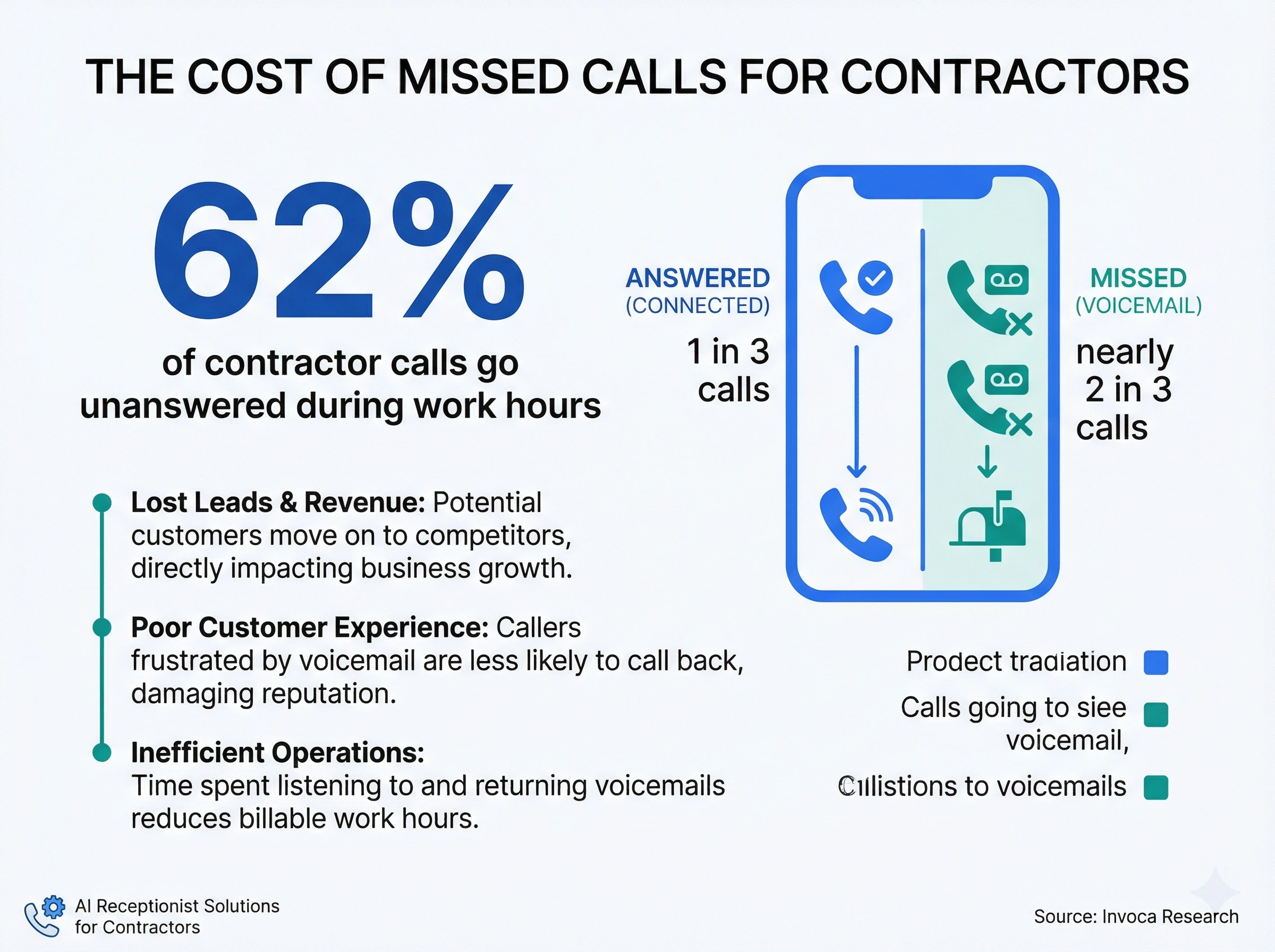
Then there's the after-hours gap. A lot of homeowners research contractors in the evening after they get home from work. They're browsing Google, reading reviews, and making calls between 6 and 9 PM.
If your phone flips to voicemail, roughly 80% of those callers won't leave a message. They'll just tap the next search result. By morning, that lead has already scheduled an estimate with your competitor.
There's also the reality of multi-line chaos. You've got your personal cell, maybe a business line, texts from your crew, and notifications from material suppliers. Now a client is trying to call while your sub is asking about the tile layout.
Your brain is already split five ways. Even when you could technically answer, you don't because you're in the middle of something that needs your full attention.
And here's the seasonal squeeze. Spring and summer bring a surge of renovation requests, storm damage claims, and commercial buildout inquiries. Your phone rings more than ever during the months when you're busiest on active projects.
It's the worst timing imaginable. You're turning down overtime pay to keep up with existing work, and your phone keeps buzzing with new opportunities you can't grab.
Smaller contracting companies feel this the hardest. Hiring a full-time receptionist at $35,000-$45,000 a year is tough to justify when your annual revenue is under a million. But without someone answering calls, you're stuck in a loop where you can't grow because you're missing the leads that would fuel growth. It's a chicken-and-egg problem that an AI phone answering service breaks wide open.
What happens to your business when a lead can't reach you?
The short answer: they hire someone else. Fast.
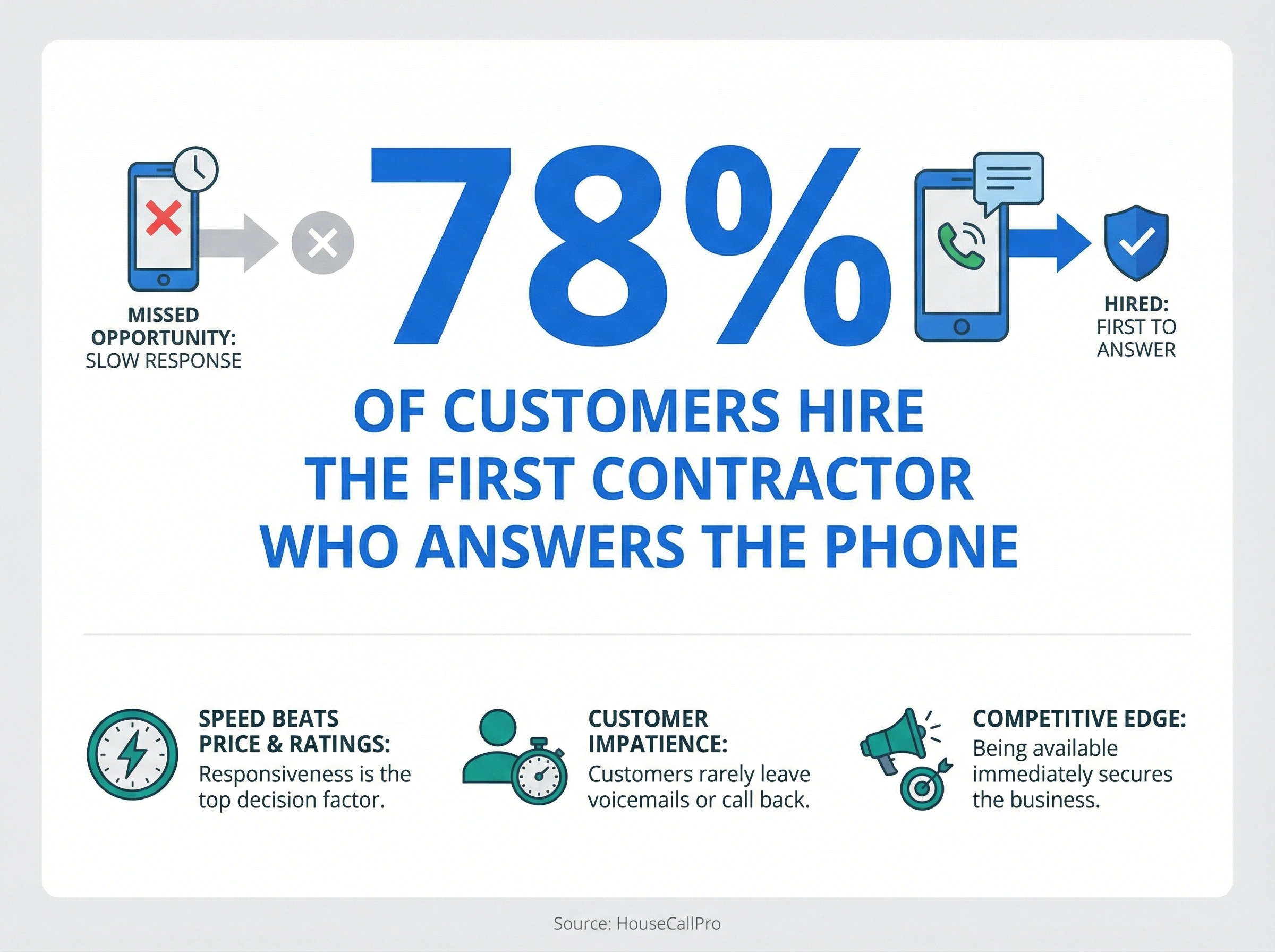
According to HouseCallPro, 78% of customers hire the first contractor who answers the phone. Not the cheapest. Not the highest rated. The first one who picks up. That stat alone should reshape how you think about answering calls.
Let's break down what a single missed call actually costs. Say your average job is worth $2,000. You miss five calls a week, and a conservative 30% of those would've converted.
That's three jobs per week, or $6,000. Over a year? That's $312,000 in lost revenue. And that doesn't factor in repeat business or referrals from those customers.
Here's a quick look at what missed calls cost by contractor type:
| Contractor type | Avg. job value | Missed calls/week | Est. annual loss |
|---|---|---|---|
| General contractor | $3,000-$15,000 | 5-10 | $45,000-$300,000 |
| Kitchen/bath remodeler | $8,000-$25,000 | 3-7 | $36,000-$150,000 |
| Handyman service | $300-$800 | 10-20 | $15,000-$60,000 |
| Roofing contractor | $5,000-$12,000 | 5-12 | $50,000-$200,000 |
| Painting contractor | $1,500-$5,000 | 5-10 | $22,000-$100,000 |
The numbers vary, but the pattern doesn't. Every missed call is money left on the table.
There's a compound effect too. When a homeowner calls and you don't answer, they don't just move on from that one job. They form an opinion. "This contractor doesn't pick up. They must be disorganized. Or too busy for me." You've lost their future projects, their neighbor's projects, and the Google review they might've left.
Think about the referral chain. One happy customer tells three friends. One frustrated caller who couldn't get through tells five. And in the age of online reviews, that frustration might end up on Google for everyone in your service area to read.
Commercial clients are even less forgiving. A property manager calling about a $50,000 tenant buildout isn't going to chase you. They've got three other bids coming in. If you don't answer on the first try, you're off the list.
Property management companies in particular tend to build a short list of reliable contractors. If you're hard to reach, you don't make that list. And once you're off it, you don't get back on.
It's not just new leads either. Existing clients call to approve change orders, ask about timelines, or report an issue. When they can't get through, trust erodes slowly.
One missed call is forgivable. Three in a week? They start wondering if you'll be reliable during the actual build. And a client who loses confidence mid-project is the fastest way to end up with a bad review, regardless of how good your craftsmanship is.
How does an AI receptionist for contractors actually work?
An AI receptionist answers your business phone 24 hours a day, 7 days a week. It handles real conversations, not just recorded menus, and it can manage most of the calls your office would typically field.
So what does it actually do when someone calls your business number?
First, it picks up immediately. No hold music, no "press 1 for estimates." The caller talks to an AI that sounds natural and conversational.
It greets them with your company name, asks what kind of project they need help with, and captures the key details: type of work, location, timeline, and budget range.
For estimate requests, it checks your calendar and books a site visit. If you use scheduling software, it syncs directly. The caller gets a text confirmation and you get a notification with all the project details before you've even finished your current task. No back-and-forth phone tag required.
For existing client calls, it pulls up project context. "Hi Mrs. Chen, I see you've got a bathroom remodel scheduled for next week. How can I help?" That kind of personalization builds trust, even when the caller knows it's an AI.
Emergency calls get flagged and routed right away. Roof leak during a storm? Water damage from a burst pipe? The AI identifies urgency, collects the critical info, and patches the call through to your cell phone or your on-call person. You get the details before you even say hello.
Here's a breakdown of how different call types get handled:
| Call type | What the AI does | Response time |
|---|---|---|
| New estimate request | Qualifies lead, books site visit | Instant |
| Emergency/urgent | Routes to your cell with details | Instant |
| Existing client check-in | Provides project update or books callback | Instant |
| Supplier/vendor call | Confirms details, logs message | Instant |
| Spam/solicitation | Politely declines, doesn't bother you | Instant |
| After-hours inquiry | Full service, books for next available | Instant |
The data isn't entirely clear on whether AI or human receptionists perform better on complex construction bids. But for the 90% of calls that are routine, like booking an estimate, asking about availability, or confirming a time, it's not even close. The AI handles them faster and more consistently than most office staff.
What you get at the end of every call is a summary: caller name, contact info, project type, urgency level, and any notes. It's organized and searchable, so you're not digging through voicemails or trying to read scribbled notes from a Post-it.
At the end of the day, you open your phone and see exactly what came in, what's been booked, and what needs your personal attention.
3 myths contractors believe about answering services
There's a lot of skepticism in the trades about anything that doesn't involve showing up and doing the work yourself. Fair enough. But some of that skepticism is based on outdated assumptions.
Myth 1: "My customers want to talk to a real person"
They want to talk to someone who picks up. That's the key distinction. Research from Invoca shows that the top frustration for callers isn't who answers, it's whether anyone answers at all. A well-trained AI receptionist that picks up on the first ring and gathers the right details outperforms a voicemail box every single time.
Modern AI doesn't sound like a phone tree. It asks follow-up questions, understands context ("I need someone to fix the drywall in my garage, there's water damage from the roof"), and responds naturally. Most callers don't even realize they're talking to an AI.
Myth 2: "It's too expensive for a small operation"
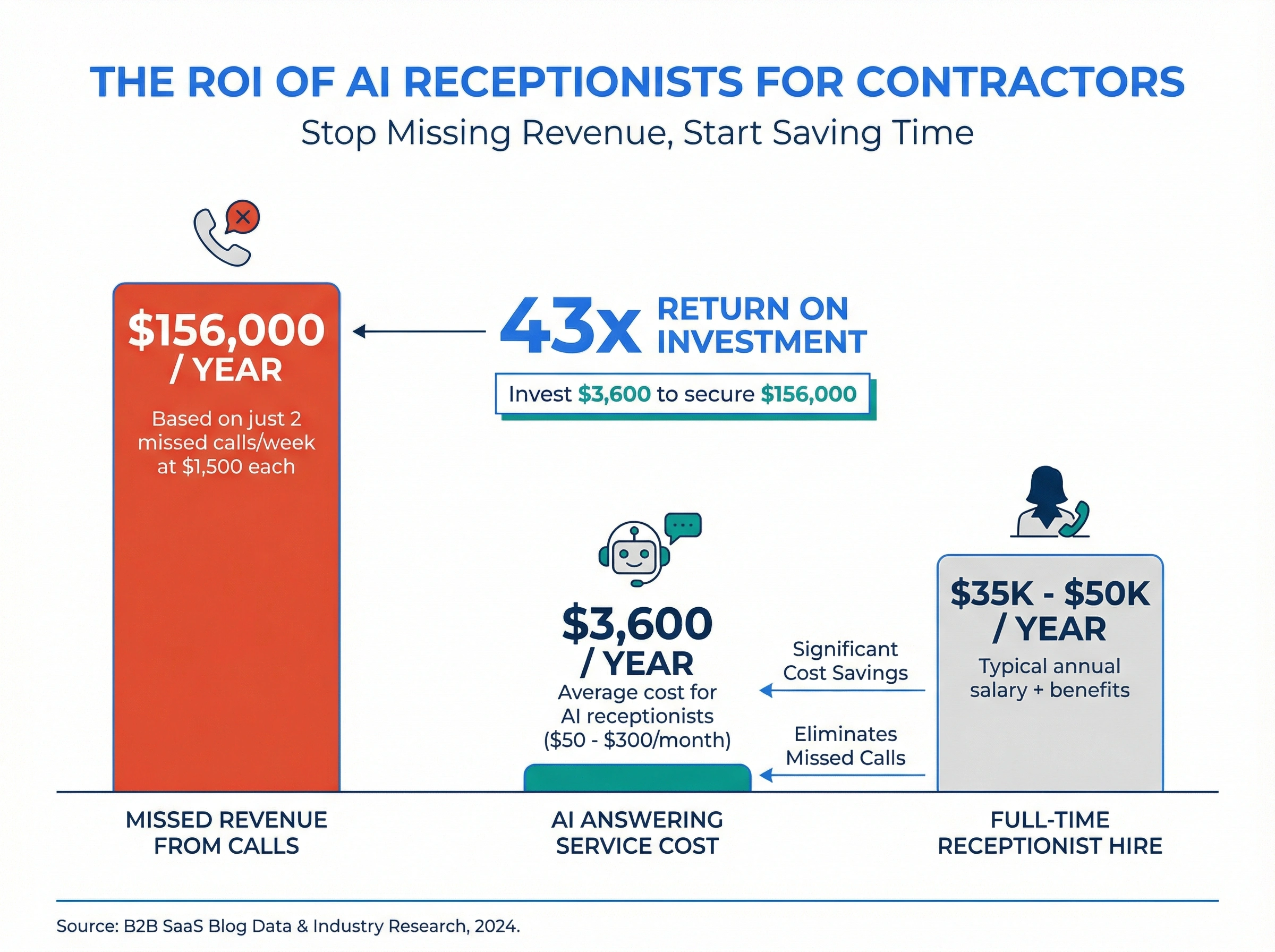
Most AI receptionist services cost between $50 and $300 a month. Compare that to a full-time receptionist at $35,000 to $50,000 a year, or even a part-time office helper at $15-$20 an hour. The math isn't subtle.
Honestly? Most contractors who resist AI answering are losing more money every month than the service costs for an entire year. If you're missing just two calls a week worth $1,500 each, that's $156,000 a year in lost revenue versus $3,600 for an AI answering service for contractors.
Myth 3: "An AI can't understand construction terminology"
This was true five years ago. It's not true now. Today's AI can handle conversations about load-bearing walls, concrete pours, permit requirements, HVAC ductwork, subflooring, and just about any trade-specific term you'd expect on a job site. Similar to how AI receptionists work for construction companies, you train it once on your services and terminology, and it remembers.
It won't replace your estimator's expertise during a walkthrough. But it doesn't need to. Its job is to capture the lead, ask the right qualifying questions, and book the appointment. Your team handles the rest.
A day in the life: your business with an AI receptionist
What would it look like if every single call got answered? Here's how a typical Tuesday plays out for a contractor using an AI phone answering service.
6:45 AMA property manager calls about water damage in a commercial unit. The AI picks up, identifies it as urgent, collects the address and unit number, and texts you immediately. You call back within 10 minutes and lock in a $4,500 emergency remediation job before your first cup of coffee.
8:30 AMYou're loading tools into the truck. Two calls come in back-to-back. One homeowner wants a deck estimate. Another asks about a basement finishing project. The AI books both for site visits later this week and sends you the details. You glance at the summaries while waiting at a red light, and your schedule is already filling up.
10:15 AMA Spanish-speaking homeowner calls asking about a fence installation. The AI switches to Spanish, gathers the project details, and books the site visit. You get the summary in English. Lead captured, no language barrier, no awkward moment where you ask them to call back later.
11:00 AMYou're mid-demo on a kitchen remodel. Three more calls. One is a supplier confirming a material delivery. One is a past client asking about adding a mudroom. One is a cold call from an insurance company. The AI handles all three: confirms the delivery, books a callback for the past client, and politely declines the cold call. You don't even know they happened until you check your phone at lunch.
1:30 PMA homeowner who got your name from a neighbor calls. She wants to know if you handle bathroom remodels and what the process looks like. The AI walks her through your typical project flow, answers her questions about timelines, and books a consultation for next Monday. She hangs up thinking she already talked to someone on your team.
2:00 PMYour project manager gets a call from a homeowner checking on their renovation timeline. The AI pulls up the project status and provides an update. No interruption to your PM's afternoon.
4:45 PMYou're wrapping up at the job site. You pull out your phone and scroll through the day's call log. Clean summaries, everything sorted by priority. Two new estimates booked, one emergency handled, three existing client check-ins managed. You didn't miss a single one.
7:30 PMYou're at dinner with your family. A homeowner browsing Yelp calls about a bathroom remodel. The AI answers, qualifies the lead (budget range, timeline, location), and books a site visit for Thursday morning. You get a text summary. Your wife doesn't even notice the buzz.
Total calls handled: 12. Calls you personally took: 1 (the emergency callback). Jobs booked: 4. Revenue captured: roughly $18,000.
Without the AI, maybe you'd have caught two or three of those twelve calls. That's not just a difference in call volume. That's the difference between a business that's struggling to grow and one that's booked out three weeks ahead.
What to look for in an AI phone answering service for contractors
Not all answering services are built for contracting work. Some are designed for medical offices or law firms and won't know the difference between a soffit and a fascia. Here's what actually matters when you're picking one.
Industry training matters. The AI should understand construction and home improvement terminology out of the box. If you have to spend weeks teaching it what a change order is, that's a red flag. Ask about their onboarding process and whether they have pre-built knowledge for home improvement trades.
Calendar integration is non-negotiable. If the AI can't book site visits directly into your schedule, it's just a fancy voicemail. Look for integrations with Google Calendar, Jobber, or whatever scheduling tool you already use. The best systems also factor in travel time between job sites.
Call routing needs to be smart. Emergency calls should go straight to your phone. Routine estimate requests should get booked and logged. Existing client calls should get context-aware responses. A good contractor phone system handles all three differently. If everything goes to the same queue, it's not worth your time.
You need call summaries, not recordings. Listening to call recordings takes forever. What you want is a clean text summary of every call: who called, what they need, when they're available, and how urgent it is. Bonus points if the system categorizes calls automatically (new lead, existing client, vendor, spam).
Multilingual support is a plus. Depending on your market, you might get calls in Spanish, Mandarin, or other languages. An AI receptionist that handles multiple languages means you don't lose leads just because of a language barrier. In markets like Texas, California, or Florida, this is less of a nice-to-have and more of a requirement.
Scalability without contracts. Your call volume spikes in spring and drops in winter. The answering service for contractors you choose should scale with you, not lock you into a fixed plan. Look for month-to-month pricing that lets you adjust as your business cycles shift.
Setup should take minutes, not weeks. You're busy. If the onboarding process requires multiple training sessions, weeks of customization, and a dedicated account manager, it's probably more complex than it needs to be. The best AI receptionists let you port your number, set your preferences, and go live the same day.
How dialnote gives contractors a phone system that works on the job site
dialnote was built for businesses where the team is never sitting behind a desk. That's exactly the problem contractors deal with every day.
Here's what makes it different from a generic answering service:
AI receptionist that speaks your trade. dialnote's AI receptionist understands contracting language from day one. Demolition, framing, rough-in, finish work, punch list, it gets the context. Callers describe their project and the AI captures the right details without awkward pauses or misunderstandings.
Smart call routing built for field teams. Using dialnote's IVR and call routing, emergency calls go straight to your cell. Estimate requests get booked and logged. Existing client check-ins get routed to the right project manager. Your shared number means your whole team stays connected through one business line without giving out personal numbers.
Real-time AI call summaries. Every call gets an automatic summary through dialnote's AI call tags and analytics. You see who called, what they need, and how urgent it is. No more listening to voicemails during your lunch break.
Full business phone system, not just an answering service. dialnote gives you a professional business calling system with a real business number. Add text messaging to follow up with leads, send estimates, and confirm appointments. It's everything you need to run your phone operations from your truck.
Works where you work. Your phone, your tablet, or any device with an internet connection. No desk phone required. No landline. Just a VoIP system that travels with you to every job site. If you want a deeper look at what a full phone system for home service businesses looks like, we've written about that too. Running a pest control business? Same principles apply.
A lot of contractors try to solve the phone problem by hiring someone part-time or asking their spouse to answer calls. That works until it doesn't. dialnote replaces all of that with a system that's on 24/7, costs a fraction of a hire, and actually gets smarter over time as it handles more of your calls.
The real ROI: what contractors are actually seeing
Let's stop talking in theory and look at numbers that real contracting businesses see after adding an AI receptionist.
The average contractor misses 5-10 calls per week. At an average job value of $2,000-$5,000, and a conservative 25% conversion rate, that's $2,500 to $12,500 per week in lost revenue.
Over a year, that's $130,000 to $650,000. Even at the low end, the ROI on a $200/month AI answering service is massive.
But it's not just about revenue from new leads. Here's what changes across your entire operation:
You stop playing phone tag. When every call gets answered live and summarized in text, there's no back-and-forth. You read the summary, call back when you're ready, and you already know what the client needs. That saves 30-45 minutes a day of chasing messages.
Your online reviews improve. Responsiveness is one of the top factors in contractor reviews. When every caller gets a friendly, immediate response, your 5-star reviews climb. And those reviews drive more inbound calls, creating a positive loop.
Your crew stays focused. When you're not pulling your project manager off a job site to answer the phone, projects run smoother. Fewer interruptions mean fewer mistakes, faster timelines, and happier clients.
Your marketing finally pays off. You've spent money on Google Ads, SEO, a website, and yard signs. All of that investment funnels into one thing: a phone call. If nobody answers that call, every marketing dollar is wasted. An AI receptionist makes sure the leads your marketing generates actually convert.
We're still figuring out exactly how much AI receptionists will change the contracting industry over the next few years. But the contractors who've adopted them early aren't waiting around for the data. They're booking more jobs, growing faster, and spending their evenings with their families instead of returning missed calls.
Your next job is calling, so will someone pick up?
Every contractor who's been in the business long enough has a story about the job that got away. The one where the client said, "I called three times and nobody answered, so I went with someone else." It stings because you know the work would've been great. You just never got the chance.
The contracting industry has always been about showing up and doing good work. That hasn't changed. But the way clients find and choose contractors has shifted. They search, they call, and they go with whoever answers. Your reputation on the job site doesn't matter if nobody's there to pick up the phone before the job starts.
An AI receptionist for contractors isn't about replacing your team. It's about making sure every call your marketing generates actually turns into a conversation. Every lead gets captured. Every client gets an answer. Every emergency gets handled.
If you're curious, try tracking your missed calls for one week. Count them. Multiply by your average job value. That number is what an AI receptionist is worth to your business.
Get started with dialnote and stop letting your next job ring through to voicemail.
Frequently asked questions
It answers your business phone 24/7, asks callers about their project, captures details like job type, location, and timeline, then books estimates directly into your calendar. You get a text summary of every call.
Most AI receptionist services run $50-$300 per month. Compare that to $35,000-$50,000 a year for a full-time receptionist. Most contractors see ROI within the first week from captured leads alone.
Modern AI receptionists sound natural and conversational. They understand construction terms like change orders, punch lists, and permit timelines. Most callers don't realize they're talking to AI.
Yes. It identifies urgent situations like water damage or structural issues, collects the critical details, and routes the call straight to your cell phone or on-call person immediately.
No. AI receptionists work with your existing business phone number. Setup typically takes under 30 minutes and doesn't need any new hardware. It works on your phone, tablet, or any internet-connected device.

Written by
Lancelot Dsouza
Chief Marketing Officer, SmartReach.io
Lancelot Dsouza is the Chief Marketing Officer at SmartReach.io, where he built the Marketing, Sales, and Customer Success verticals from the ground up. With over 25 years of experience spanning digital marketing, business development, and strategic...
Lancelot Dsouza is the Chief Marketing Officer at SmartReach.io, where he built the Marketing, Sales, and Customer Success verticals from the ground up. With over 25 years of experience spanning digital marketing, business development, and strategic...
Related Articles
Best AI Receptionist Software For Businesses Ranked
Compare the best AI receptionist software for businesses by 10-user cost, per-minute AI fees, IVR, call queueing, and real reviews. Pick the right tool.
Does Your Business Need an After Hours Answering Service?
Learn how an after hours answering service captures missed calls, compare pricing for live vs AI options, and set up 24/7 coverage for your business.
AI Phone Answering Service vs Virtual Receptionist?
Compare AI phone answering services and virtual receptionists side by side. Find which option fits your business, budget, and call volume.